
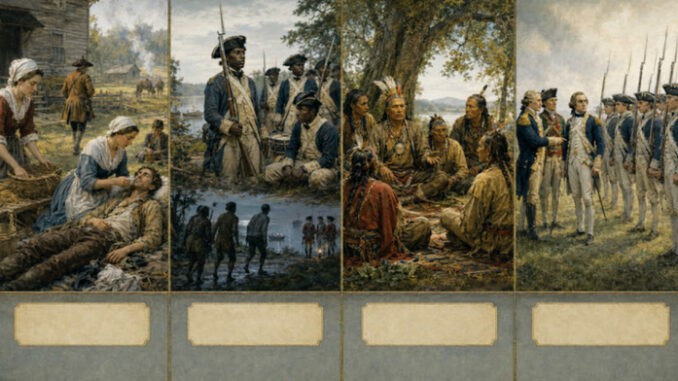

WOMEN
Women managed farms and businesses, produced military supplies, raised funds, carried messages and cared for the sick. Camp followers performed essential labor. Deborah Sampson served disguised as a man; Margaret Corbin was wounded while assisting artillery. Others suffered displacement, occupation, violence and loss. Abigail Adams’s appeal to “remember the ladies” expressed the widening contradiction between revolutionary language and women’s legal dependence.
BLACK AMERICANS
Thousands of Black men served in Patriot forces, including integrated New England units and the First Rhode Island Regiment. Yet Britain’s Lord Dunmore had earlier offered freedom to enslaved men belonging to rebels who joined the Crown, and later proclamations broadened the promise. Many enslaved people therefore sought liberty through British lines. Others used wartime disruption to escape independently. The war opened paths to freedom for some while leaving slavery deeply entrenched.
INDIGENOUS NATIONS
Most Native nations judged the rapidly expanding colonists a greater territorial threat than Britain, though alliances varied and communities divided. The Haudenosaunee Confederacy fractured as member nations chose different sides. Patriot campaigns devastated Haudenosaunee towns and food supplies. The Treaty of Paris would transfer British claims without Indigenous consent, demonstrating that American liberty could accompany Native dispossession.
LOYALISTS AND IMMIGRANTS
Loyalists included royal officials, merchants, farmers, recent immigrants, enslaved people seeking British protection and others who feared rebellion or remained attached to the Crown. Tens of thousands eventually left the United States. Immigrants and foreign volunteers also strengthened the Patriot cause: Lafayette, von Steuben, Pulaski and Kosciuszko became prominent, while countless less-famous soldiers brought labor and skill.



Be the first to comment