Tag: Mark Zuckerberg

  • Meta donates $1 million to Trump’s inaugural fund

    Meta donates $1 million to Trump’s inaugural fund

    WASHINGTON, D.C. (TIP): Meta, the parent company of Facebook and Instagram, has donated $1 million to President-elect Donald Trump’s inaugural fund, a spokesperson for the social media giant confirmed Wednesday, December 11 night. The news was first reported by the Wall Street Journal.

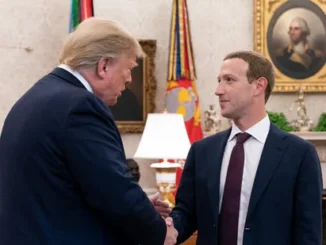
    The move comes two weeks after Meta CEO Mark Zuckerberg traveled to Florida and dined with Trump at his Mar-a-Lago estate.

    At the time, Trump adviser Stephen Miller told Fox News that Zuckerberg had “made clear that he wants to support the national renewal of America under Trump’s leadership.”

    Trump was removed from Facebook following the Jan. 6, 2021, attack on the U.S. Capitol when it determined that his posts had potentially encouraged the violence that occurred that day.

    The company restored his account in early 2023, but with certain “guardrails.” In July, those restrictions were lifted by Meta. Trump has a combined 65 million followers on Facebook and Instagram.

    In August, Zuckerberg submitted a letter to Congress claiming that the Biden administration in 2021 “repeatedly pressured our teams for months to censor certain COVID-19 content, including humor and satire.” He called “the government pressure wrong” and said he would push back against any similar efforts in the future.

    Silicon Valley has been uneasy about the kind of the treatment it may get from a second Trump administration, and the donation may signal an attempt by Zuckerberg to thaw those tensions. Trump’s choice of Brendan Carr, a prominent critic of big tech, to lead the Federal Communications Commission has potentially heightened those concerns.

  • Mark Zuckerberg is now world’s second-richest person, surpassing Jeff Bezos

    Mark Zuckerberg is now world’s second-richest person, surpassing Jeff Bezos

    California (TIP)- Meta CEO Mark Zuckerberg surpassed Jeff Bezos to become world’s second richest person as his net worth reached $206.2 billion, according to the Bloomberg Billionaires Index. With this, Mark Zuckerberg topped the $205.1 billion net worth of former Amazon CEO and president Jeff Bezos. At present, the Facebook co-founder trails Tesla CEO Elon Musk by almost $50 billion, the index showed.Mark Zuckerberg, who owns a 13% stake in the Menlo Park, California-based company, has seen his fortune grow $78 billion so far this year and has gained four spots this year on the wealth index. In 2024, Mark Zuckerberg’s net-worth has risen by $78 billion- more than any member of the of the 500 richest people who are tracked by the Bloomberg Index. Meta shares have jumped almost 70% since the start of this year owing to increase in Mark Zuckerberg’s personal wealth alongside investor enthusiasm. Meta has repeatedly boasted of its artificial intelligence (AI) investments as a reason for its sales growth. This is a huge turnaround for the company which laid of 21,000 employees in late 2022 as Mark Zuckerberg instituted a major cost-cutting plan that investors feel helped the company rebound. At present, Meta is spending billions of dollars on the virtual and augmented reality technologies, but investors continue to support the company whose core ad business remains healthy. Last week, Meta debuted its Orion AR glasses, which garnered positive reviews.

  • Mark Zuckerberg launches WhatsApp Channels, Indian celebs join

    Mark Zuckerberg launches WhatsApp Channels, Indian celebs join

    Meta chief executive officer Mark Zuckerberg on September 13 launched WhatsApp Channels in India and 150 other countries. Taking to Facebook, Mark Zuckerberg shared a post and captioned it, “Today we’re starting to roll out WhatsApp Channels globally and adding thousands of new channels that people can follow in WhatsApp. You can find Channels in the new ‘Updates’ tab.”
    WhatsApp Channels are a one-way broadcast tool and deliver a private way to receive updates from people and organizations that matter to you, right within WhatsApp.
    Mark Zuckerberg, announced the news on his WhatsApp Channel, “Excited to introduce you all to WhatsApp Channels, a new private way for you to get updates from people and organizations you follow. I’m starting this channel to share Meta news and updates. Looking forward to connecting with you all around the world.” Launching the official Indian Cricket Team WhatsApp Channel, BCCI, said, “The Indian Cricket team is thrilled to partner with WhatsApp on the launch of Channels. We kick-off our partnership with WhatsApp with the ICC Men’s Cricket World Cup 2023 which is set to begin in October. We will leverage Channels to generate excitement and support as India gets ready to host the marquee event after a decade-long wait.”

  • As Big Tech is firing employees by thousands, what is driving layoffs and how worried should we be

    As Big Tech is firing employees by thousands, what is driving layoffs and how worried should we be

    Durham (TIP)- Tech companies are always in the news, usually touting the next big thing. However, the tech news cycle recently hasn’t been dominated by the latest gadget or innovation. Instead, layoffs are in the headlines. In the last year, more than 70,000 people globally have been laid off by Big Tech companies – and that doesn’t count the downstream effect of contractors (and other organisations) losing business as budgets tighten.

    What exactly led to this massive shakeout? And what does it mean for the industry, and you?

    What’s the damage?

    Since the end of the pandemic hiring spree, large numbers of employees have been fired from major tech companies, including Alphabet (12,000 employees), Amazon (18,000), Meta (11,000), Twitter (4,000), Microsoft (10,000) and Salesforce (8,000). Other household names share the spotlight, including Tesla, Netflix, Robin Hood, Snap, Coinbase and Spotify – but their layoffs are significantly less than those mentioned above.

    Importantly, these figures don’t include the downstream layoffs, such as advertising agencies laying off staff as ad spend reduces, or manufacturers downsizing as tech product orders shrink – or even potential layoffs yet to come.

    And let’s not forget the folks leaving voluntarily because they don’t want to come into the office, hate their managers, or aren’t keen on Elon Musk’s “hardcore work” philosophy.

    The knock-on effects of all of the above will be felt in the consulting, marketing, advertising and manufacturing spaces as companies reduce spending, and redirect it towards innovating in AI.

    So what’s driving the layoffs?

    The canary in the coal mine was reduced advertising spend and revenue. Many tech companies are funded through advertising. So, for as long as that income stream was healthy (which was especially the case in the years leading up to COVID), so was expenditure on staffing. As advertising revenue decreased last year – in part due to fears over a global recession triggered by the pandemic – it was inevitable layoffs would follow.

    Apple is one exception. It strongly resisted increasing its head count in recent years and as a result doesn’t have to shrink staff numbers (although it hasn’t been immune to staff losses due to work-from-home policy changes).

    What does it mean for consumers?

    Although the headlines can be startling, the layoffs won’t actually mean a whole lot for consumers. Overall, work on tech products and services is still expanding.

    Even Twitter, which many predicted to be dead by now, is looking to diversify its streams of revenue.

    That said, some pet projects such as Mark Zuckerberg’s Metaverse likely won’t be further developed the way their leaders had initially hoped. The evidence for this is in the layoffs, which are concentrated (at least at Amazon, Microsoft and Meta) in these big innovation gambles taken by senior leaders.

    Over the past few years, low interest rates coupled with high COVID-related consumption gave leaders the confidence to invest in innovative products. Other than in AI, that investment is now slowing, or is dead.

    And what about the people who lost their jobs? Layoffs can be devastating for the individuals affected. But who is affected in this case?

    For the most part, the people losing their jobs are educated and highly employable professionals. They are being given severance packages and support which often exceed the minimum legal requirements. Amazon, for example, specifically indicated its losses would be in tech staff and those who support them; not in warehouses.

  • Laid off Indian employees on H1B visa in the United States still struggling to find a job

    Laid off Indian employees on H1B visa in the United States still struggling to find a job

    WASHINGTON, D.C. (TIP): It has been a few months now and a new year but laid off Twitter and Meta employees are still struggling to find a new jobs given the macroeconomic conditions globally. Meta and Twitter laid off thousands globally. Many among them were Indians holding H1B visa. In 2022, employees working for tech companies were majorly impacted by layoffs. Some of the biggest layoffs that took place were at Twitter and Meta. Together, the two biggest tech companies laid off thousands of employees, many of which were Indians living in the United States with H1B visa. At the time of announcing layoffs, Meta head Mark Zuckerberg extended immigration support to foreign employees, but no such support was offered by Elon Musk-headed Twitter.

    (Source:  India Today Tech)

  • Making diaspora invest in India a challenge

    Making diaspora invest in India a challenge

    “The unresolved issue with the NRIs is that the Indian government just does not know what it can do with them. The government wants their money, no doubt, and they are indeed sending money home, which accounts for 3 per cent of India’s GDP, according to the World Bank. The BJP’s foreign policy notion that the NRIs are its soldiers abroad to spread national glory is at best a delusion. And it could become a dangerous one if Indians abroad are seen as ‘fifth columnists’. Most NRIs have no interest in Indian politics nor are they motivated to push India’s case across the world. A time has to come when Indians need not migrate to other countries for better opportunities.”

    The NRIs remittances are higher than the foreign direct investment (FDI) that India is able to attract. The NRI remittances to India were $89.4 billion in 2021 and $100 billion in 2022.

    By Parsa Venkateshwar Rao Jr.

    The Bharatiya Janata Party (BJP), in its pursuit of overzealous nationalism, has looked upon the Indian diaspora across the world as an extension of India, politically as well as culturally. During the tenure of the then Prime Minister Atal Bihari Vajpayee, an attempt was made to woo overseas Indians, with the PM making it a point to interact with the Indians abroad rather than with other citizens of the host country. It was in 2002 that the first Pravasi Bharatiya Divas event was held in New Delhi.

    Prime Minister Narendra Modi intensified the outreach to the NRIs by addressing rallies in Madison Square Garden (New York) and then in Sydney after his party’s historic win in the 2014 Lok Sabha elections. But despite the enthusiasm to cultivate the NRI constituency in the past two decades, there is uncertainty and confusion over how to tap the potential of the NRIs to strengthen India at the global level or even at home.

    The 17th Pravasi Bharatiya Divas event, held in Indore from January 8 to 10, reflected the confusion. The Indian government does not seem to be keen that the Indians living abroad should come back and help in the development of the country with the knowledge and expertise they have acquired abroad. It only wants that the NRIs invest in India. But it is in many ways a non sequitur.

    Indians settled abroad, whether in the Gulf countries, the UK, the US, Canada, Australia or Singapore, have been sending money home to their families. But they have not thought that it is profitable to do business in India or invest in India. Even today, the NRIs remittances are higher than the foreign direct investment (FDI) that India is able to attract. The NRI remittances to India were $89.4 billion in 2021 and $100 billion in 2022, higher than what the Chinese and Filipino emigrants send to their home countries.

    So, at successive conventions of the Pravasi Bharatiya Divas, the country’s leaders of the day give rhetorical messages to the few thousand delegates who attend the event. And this year seems to have been no different. PM Modi, Finance Minister Nirmala Sitharaman and Education and Entrepreneurship Minister Dharmendra Pradhan delivered homilies and the unintended ironies were there for all to see. PM Modi, in his inaugural speech on January 8, said, “In Pravasi Bhartiyas, we see myriad images of Vasudhaiva Kutumbakam and Ek Bharat Shreshtha Bharat,” and “Pravasi Bhartiyas echo the voice of a powerful and capable India.”

    Pradhan said, “We all agree that once upon a time India was a ‘Vishwaguru’, not in terms of military power but in terms of intellect.” And then he turned to the government’s programme of creating a skilled network in the country. He told the NRIs that India has a skilled workforce of 500 million. Sitharaman, echoing PM Modi’s statement of how cheap India’s Mars mission was, said, “The cost of the Chandrayaan, which goes to the moon, is far less than that of a Hollywood film.” And citing a NASSCOM (National Association of Software and Service Companies) report, she said Indian IT companies hired 2 lakh Americans at an average salary of $1,06,360 in 2021.

    These statements can only confuse NRIs. The government wants to woo them by telling them how good India has become since they left the country and what an attractive investment destination it is now. Surely, the NRIs would want to test the government’s claims on the ground and it will be reflected in the investment decisions they will make in the future.

    But there is also the fact that though Indians in the US are sending home more money than those in the Gulf countries, as was the case earlier, the Indian-Americans are less likely to return home and even start businesses in India. The Indians in Gulf countries will come back at some point of time because as yet there is no possibility of becoming citizens in those countries. In contrast, more Indians are getting the coveted Green Card in the US and they are more likely to become citizens there. Secondly, there are more billionaires in India than among the NRIs. Steel magnate Laxmi Narayan Mittal and metal magnate Anil Agarwal are among the exceptions. The NRIs in the US are prosperous but they are not super-rich yet. They do not have surplus capital to pump into India like Meta’s Mark Zuckerberg or Amazon’s Jeff Bezos.

    It is, however, true that more and more Indians in western countries are becoming part of the political mainstream of their adopted countries, and they are reaching positions of influence and power. Whether it is Indian-origin leaders such as US Vice-President Kamala Harris, British Prime Minister Rishi Sunak, President of Guyana Mohamed Irfaan Ali or President of Suriname Chandrikapersad Santokhi (the last two were special guests at the Pravasi Bharatiya Divas event in Indore), they owe nothing to India, and there is nothing that India can do to support or strengthen them. India is not the imperial power that the Modi government would imagine itself to be.

    The unresolved issue with the NRIs is that the Indian government just does not know what it can do with them. The government wants their money, no doubt, and they are indeed sending money home, which accounts for 3 per cent of India’s GDP, according to the World Bank. The BJP’s foreign policy notion that the NRIs are its soldiers abroad to spread national glory is at best a delusion. And it could become a dangerous one if Indians abroad are seen as ‘fifth columnists’. Most NRIs have no interest in Indian politics nor are they motivated to push India’s case across the world. A time has to come when Indians need not migrate to other countries for better opportunities.

    (The author is a senior journalist)

  • Mark Zuckerberg announces 32-person video call on WhatsApp

    Mark Zuckerberg announces 32-person video call on WhatsApp

    Meta Founder and CEO, Mark Zuckerberg on Thursday, November 3,  announced the global roll out of a 32-person video calling feature called ‘Communities’ on WhatsApp. Zuckerberg posted a video on Facebook to announce the new feature, calling it a “major evolution for WhatsApp”. “We’re launching Communities on WhatsApp. It makes groups better by enabling sub-groups, multiple threads, announcement channels, and more. All secured by end to end encryption so your messages stay private,” he said.

    The new feature will allow admins to better organise the conversations “under one umbrella”, Zuckerberg added. Besides Communities, WhatsApp also released more features to “improve the group chat experience”, including in-chat polls, larger file sharing, reactions, groups with up to 1,024 users and shareable call links. Meanwhile, as Meta doubled down on its monetisation drive across its family of apps, Zuckerberg had said that JioMart on WhatsApp in India was going to be a big opportunity for the paid messaging market. During the company’s Q3 earnings call, the CEO said that paid messaging was another opportunity that we were starting to tap into.

    “We launched JioMart on WhatsApp in India, and it was our first end-to-end shopping experience that showed the potential for chat-based commerce through messaging,” Zuckerberg told analysts.

                    Source: IANS

  • Former President Donald Trump announced he is suing Facebook, Twitter and Google

    Former President Donald Trump announced he is suing Facebook, Twitter and Google

    WASHINGTON (TIP): Former President Donald Trump took his fight with three massive tech companies to court, filing lawsuits that legal experts say are all but guaranteed to fail – even as they rally Republican voters, fundraisers and donors. Trump revealed Wednesday, July 7,  that he is suing Facebook, Twitter and Google, as well as their respective CEOs Mark Zuckerberg, Jack Dorsey and Sundar Pichai, in class-action lawsuits.

    Trump, who has a history of threatening legal action but not always following through, made the announcement at his golf club in Bedminster, New Jersey, alongside two leaders from the America First Policy Institute, the pro-Trump nonprofit group that is supporting the lawsuits.

    Shortly after the news conference wrapped, Trump’s political entities started sending out fundraising messages that touted the lawsuits in their appeals for money. One such text message, written as if it were coming from Trump himself, includes a link to his joint fundraising committee Save America, which also raises money for other Republican political initiatives. The lawsuits were unveiled just over a month after Facebook decided to uphold Trump’s ban from using the platform until at least January 2023. Twitter, Trump’s preferred social media outlet throughout his one term in office, permanently banned him on the heels of the Jan. 6 invasion of the Capitol by a mob of his supporters. The lawsuit against Pichai also names as a defendant YouTube, the video-sharing website bought by Google in 2006. YouTube indefinitely banned Trump in January. “We’re not looking to settle,” Trump told reporters at Bedminster when asked about the lawsuits. “We don’t know what’s going to happen but we’re not looking to settle,” he said. The three related lawsuits, filed in federal court in Florida, allege the tech giants have violated plaintiffs’ First Amendments rights. The suits want the court to order the media companies to let Trump back on their platforms. They also want the court to declare that Section 230 of the Communications Decency Act, a piece of legislation that stops tech companies from being held liable for what users post on their platforms, is unconstitutional. As president, Trump railed against Section 230 and repeatedly called for its repeal. He even tied the issue to a crucial round of stimulus checks at the height of the coronavirus pandemic, as well as the passage of an annual defense spending bill. Legal experts doubt whether Trump’s latest attack on big tech companies will succeed.

  • Instagram working on new tools for influencers

    Facebook-owned Instagram is working on a suite of new tools to help influencers make money off its platform, including creator shops, affiliate commerce and a “branded content marketplace.” Facebook CEO Mark Zuckerberg announced the upcoming features during a live stream with Instagram chief Adam Mosseri.

    Creator Shops would be an extension of the company’s existing shopping features, which allows businesses to sell products, reports Engadget.

    “We see a lot of creators setting up shops too, and one part of being a content creator business model is you create great content, and then you can sell stuff, and so having creator shops is awesome,” Zuckerberg said.

    Zuckerberg also said the company is working on tools that would enable Instagram stars to get paid for promoting products.

    “Creators should be able to get a cut of the sales of things that they’re recommending and we should build up an affiliate recommendation marketplace to enable that to all happen,” he said.

  • Facebook blocks Australians from accessing news on platform

    Facebook blocks Australians from accessing news on platform

    Canberra (TIP): Facebook announced on Thursday, February 17,  that it has blocked Australians from viewing and sharing news on the platform because of proposed laws in the country to make digital giants pay for journalism.

    Australian publishers can continue to publish news content on Facebook, but links and posts can’t be viewed or shared by Australian audiences, the US-based company said in a statement.

    Australian users cannot share Australian or international news.

    International users outside Australia also cannot share Australian news.

    “The proposed law fundamentally misunderstands the relationship between our platform and publishers who use it to share news content,” Facebook regional managing director William Easton said.

    “It has left us facing a stark choice: attempt to comply with a law that ignores the realities of this relationship, or stop allowing news content on our services in Australia. With a heavy heart, we are choosing the latter,” Easton added.

    The announcement comes a day after Treasurer Josh Frydenberg described as “very promising” negotiations between Facebook and Google with Australian media companies.

    Frydenberg said after weekend talks with Facebook CEO Mark Zuckerberg and Sundar Pichai, chief executive of Alphabet Inc and its subsidiary Google, he was convinced that the platforms “do want to enter into these commercial arrangements”.

    Frydenberg said he had had a “a constructive discussion” with Zuckerberg after Facebook blocked Australian news.

    “He raised a few remaining issues with the Government’s news media bargaining code and we agreed to continue our conversation to try to find a pathway forward,” Frydenberg tweeted.

    But communications Minister Paul Fletcher said the government would not back down on its legislative agenda.

    “This announcement from Facebook, if they were to maintain this position, of course would call into question the credibility of the platform in terms of the news on it,” Fletcher told Australian Broadcasting Corp.