Tag: Martin Luther King

  • Martin Luther King Jr.: When History Became a Life, and a Life Became History

    Martin Luther King Jr.: When History Became a Life, and a Life Became History

    By Prof. Indrajit S Saluja
    By Prof. Indrajit S Saluja

    In three days, America will once again commemorate Martin Luther King Jr.,a man whose life became inseparable from the moral history of the United States. King is remembered not merely as a charismatic speaker or a skillful organizer, but as one of the true leaders of the masses who emerged from among ordinary people and led them with extraordinary moral courage.His greatness lay not in the power he wielded, but in the conscience he awakened;not in authority imposed,but in dignity restored.In his case,history did not merely record a life-it flowed through it. King stepped onto the national stage at a moment when America was struggling to reconcile its founding ideals with its lived realities. The Constitution proclaimed equality, liberty, and justice, yet millions of citizens-particularly African Americans-were systematically denied these promises. Segregation was law in many states; discrimination was normalized; exploitation was an everyday condition. For Black Americans,the legacy of slavery had not ended with emancipation; it had taken new and insidious forms through Jim Crow laws, voter suppression, economic deprivation,and social exclusion. This was the America King confronted-not with bitterness or vengeance, but with moral clarity and disciplined hope. What distinguishes King from many other leaders is the path he consciously chose. Deeply influenced by Christian ethics and inspired by Mahatma Gandhi’s philosophy of nonviolence, King believed that injustice could not be defeated by hatred and that violence could never cleanse a society of oppression. His movement was a Gandhian experiment on American soil-one that sought to rid the nation of inequality through moral force rather than brute strength. King understood that violence might secure temporary concessions, but only nonviolence could achieve lasting transformation by changing hearts as well as laws. King did not invent the civil rights movement, but he gave it focus, coherence, and a unifying moral language. Through the Montgomery Bus Boycott, the Birmingham Campaign, the Selma marches, and the historic March on Washington, he helped turn localized protests into a national moral awakening. He compelled America to look unflinchingly into the mirror-and to confront the gulf between its professed ideals and its daily practices. He made the suffering of the marginalized visible, and he did so in a way that appealed to the nation’s highest values rather than its lowest instincts.
    Perhaps King’s most enduring contribution was his insistence on the universality of justice.Though he emerged as a leader of the Black community, he never confined his message to one race or one grievance. His dream was not of one group’s ascendancy over another, but of a shared humanity bound by equal dignity. When he spoke of a nation where people would be judged not by the color of their skin but by the content of their character, he articulated a moral ideal that transcended race while directly confronting racial injustice.In doing so,he transformed the civil rights struggle from a sectional demand into a national moral imperative.
    It must be acknowledged-honestly and without evasion-that America still suffers from many of the ailments King sought to remove.Inequality persists;discrimination has not vanished but often changed form; economic disparities remain stark;and the wounds of racial injustice continue to reopen with troubling regularity. The realities of unequal policing, voter disenfranchisement, unequal educational opportunities, and disproportionate incarceration serve as reminders that the journey King began remains unfinished.
    Yet these truths do not diminish King’s achievement;they magnify it.Before King, segregation was defended openly as tradition and law. After King, discrimination became morally indefensible-even when it persisted in practice. Before King, vast sections of America accepted inequality as inevitable. After King, equality became a shared national aspiration, however imperfectly realized. He shifted the moral center of gravity of the nation.
    King’s leadership lifted a large section of the American population-particularly the Black community-from the quagmire of invisibility and institutionalized exploitation. His efforts helped secure landmark legislative victories such as the Civil Rights Act of 1964 and the Voting Rights Act of 1965, reshaping the legal architecture of American democracy. These were not mere statutes; they were declarations that the nation would no longer legitimize exclusion as policy.
    Crucially, King’s moral vision widened toward the end of his life.He spoke not only against racial injustice, but also against economic exploitation and militarism. He recognized that poverty was a form of violence and that endless war abroad eroded justice at home. His opposition to the Vietnam War-controversial and costly to his popularity-flowed from a consistent belief that a society cannot value human life selectively. Justice, for King, was indivisible.
    King paid dearly for his convictions. He was surveilled, harassed, and maligned. Ultimately,he was assassinated.Yet even in death, his voice did not fade. It gained permanence. His legacy took root not only in laws and institutions, but in the American conscience itself-where it continues to question, challenge, and inspire. As America prepares to honor Martin Luther King Jr., it must resist the temptation to reduce him to a ceremonial figure adorned with safe quotations. To honor King authentically is to engage his life as a challenge, not a comfort. It is to reckon honestly with progress achieved and failures endured, and to accept responsibility for the work that remains. The Unfinished Trust: A Charge to Today’s Leaders This is where the present generation of leaders must be addressed-plainly and directly. The responsibility of carrying King’s mission forward now rests squarely on their shoulders. King did his part. He showed the path,bore the burden,and paid the price. What remains unfinished is not due to a lack of vision,but to an erosion of moral courage among those entrusted with power. King’s dream was never meant to be preserved as an artifact of history. It was meant to be practiced and advanced. Today’s leaders-elected officials, policymakers, judges, educators, and civic voices-must rise above partisan advantage and ideological trench warfare.Leadership worthy of the name unites people; it does not profit from their division. America today stands dangerously polarized along racial, economic, ideological,and cultural lines.Much of this division is cultivated, amplified, and weaponized. King warned against such temptations. He believed power was legitimate only when it served justice; authority authentic only when it uplifted the vulnerable;governance honorable only when it respected human dignity. The question for leaders today is stark: are they builders of bridges or architects of walls? Are they healers or amplifiers of grievance? King understood that America’s diversity was not a liability to be managed but a strength to be honored. Unity, as he envisioned it, did not require uniformity, fairness, empathy, and a shared commitment to justice. To carry forward King’s mission is not to recite his words but to embody his values.It is to reject politics of fear and embrace politics of hope; to ensure that the law protects the powerless as faithfully as it serves the powerful; and to guarantee that no American feels excluded from the nation’s promise because of race, faith, or economic circumstance. Above all, it is to practice leadership that elevates the moral tone of public life. King believed that the arc of the moral universe bends toward justice-but only if people are willing to bend it.His life proves that progress is neither automatic nor inevitable; it is earned through sacrifice, restraint, and moral resolve. If today’s leaders can summon that spirit-if they can rise to King’s standard rather than merely praise it-then his dream can live on not as memory,but as reality. A nation united by justice is a nation nothing can divide. That was Martin Luther King Jr.’s faith.It must now become America’s resolve.

  • India Day celebrated at Gates Foundation on the occasion of Gandhi Jayanti

    India Day celebrated at Gates Foundation on the occasion of Gandhi Jayanti

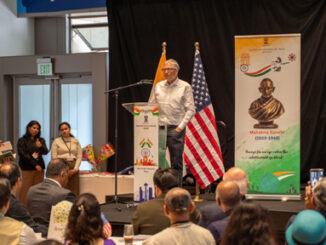
    SEATTLE, WA (TIP): In partnership with Gates Foundation, Consulate General of India in Seattle hosted a special celebration showcasing Indian culture, arts and cuisine at the Gates Foundation today (October 2). The event was graced by Mr. Bill Gates, Chair and Board Member of Gates Foundation, along with senior leadership of Washington State and Seattle City government.

    Mr. Bill Gates, Chair and Board Member of Gates Foundation, being presented a special publication on Gandhi ji by Mr. Prakash Gupta, Consul General of India in Seattle, at Gandhi Jayanti celebrations , October 2, 2025.

    Addressing the gathering, Mr. Bill Gates said “It’s fitting that we’re coming together on the birthday of Mahatma Gandhi. The ideals he championed, the equality and dignity of every person, are foundational to the work we do. Today, India stands as a global leader in innovation and is pioneering solutions with the potential to save and improve millions of lives across the Global South. We look forward to continuing to partner with India on its journey toward Viksit Bharat 2047.”

    “Natyam – A Dance Mosaic of Bharat” – a specially curated dance performance on various states of India being performed at Gandhi Jayanti celebrations

    The event also coincided with the Gandhi Jayanti and International Day of Non-Violence celebrations in the Greater Seattle area and also featured a special address on the ‘Relevance of Gandhian Values in Contemporary World Order’ by Mr. Jonathan Granoff, President of the Global Security Institute.

    Dignitaries at Gandhi Jayanti celebrations

    Earlier in the day, a commemorative event was also held at the Statue of Mahatma Gandhi near the Bellevue Public Library, where Bellevue City Council leadership joined in honoring the legacy of the Mahatma. In addition, another commemorative function was hosted in the afternoon at the Seattle Center (near the base of Space Needle) and floral tributes were offered at the bust of Mahatma Gandhi by Washington State Senator Vandana Slatter in the presence of Eddie Rye, Chairman and Founder of the Martin Luther King (MLK) – Gandhi Foundation. A large cross-section of Indian-American leadership attended these events in Seattle and Bellevue respectively, which also featured a special rendition of Gandhi Ji’s favorite hymns by young school children.

    Commemoration of Gandhi Jayanti at Seattle Center next to Space Needle on October 2,2025.
  • Legislator Davis Commemorates Martin Luther King Day at Hempstead Village March

    Legislator Davis Commemorates Martin Luther King Day at Hempstead Village March

    Photos: Office of Legislator Scott M. Davis

    HEMPSTEAD VILLAGE, NY (TIP): Nassau County Legislator Scott M. Davis (D – Rockville Centre) joined with community leaders and government colleagues on Monday, Jan. 15 for the Village of Hempstead’s annual Martin Luther King, Jr. Day of Reflection march through Hempstead Village and ceremony at Hofstra University.

    Legislator Davis was joined at the event by New York State Senator Kevin Thomas; Hempstead Village Mayor Waylyn Hobbs, Jr.; Deputy Mayor Jeffrey Daniels; and Village Trustees Clariona Griffith, Kevin D. Boone, and Noah Burroughs. The ceremony featured keynote speaker Pastor-elect Curtis Brown of the Rising Star Baptist Church and a panel discussion focused on Dr. King’s legacy in the Mack Student Center. The event also honored the family of New York City surgeon Dr. Emil Naclerio, who saved Dr. King’s life in 1958 after he was stabbed in the chest while signing copies of his first book.

    “Through his fearless efforts to eradicate injustice and racism from our society, Dr. King established a model for the pursuit of a more equal and inclusive society that is followed to this day,” Legislator Davis said. “It was truly a pleasure to be a part of this great tradition in Hempstead Village that celebrates the life and legacy of a singular civil rights pioneer in the history of our nation.”

  • Spread the Warmth- Blankets  Donation

    Spread the Warmth- Blankets Donation

    LONG ISLAND, NY (TIP): The Indo American Lions Club’s motto, “WE SERVE” is best represented through charities like these that involve giving and serving the community. The club has carried out many projects for underprivileged under the leadership of President Shyam Gajwani. During the frigid winter weather, the Club Organized “Spread the Warmth’ Project –and distributed Plush Blankets on Wednesday January 10th 2023 at the Royale Restaurant during the monthly meeting.

    This project was organized by Project Chair Sanju Sharma and co-Chair: Anchit Aery. The President Shyam Gajwani welcomed all the recipients. Secretary & Project Chair-Sanju Sharma invited the Representatives of various organizations to introduce themselves. The blankets were handed over to the Disabled American Veterans, All War Veterans homeless veterans, Social Services department of Nassau County, Homeless shelters, Roosevelt Bible Church distribution center, Martin Luther King Center of Long Island.

    This was a very humbling experience for all the members present. It is really hard to imagine someone surviving the bitter frigid cold weather without a warm wrap or blanket.

    The project chair showed gratitude to the members for their contribution and help to make this project successful. She thanked President Shyam Gajwani, Founder President –Indu Gajwani, Sr. Vice President- Kanak Golia, Vice President Anju Sharma, Treasurer Vijay Shah, Co-chair Anchit Aery, Yogini Oza, BOD-Saurabh Sheth & Nimesh Shah, Shila Shah, Shyam Agarwal for their help in setting up the blankets. She also thanked Vijay Kumar ‘Banjara’ (a nonmember) for his help in loading the blankets..

    In the second phase of this project more blankets will be distributed next week to Pamanock Queens community Center, United Methodist Church, Town of Oyster Bay. Three hundred fifty blankets will be distributed to spread warmth in our community.

    Our Club members find it an extremely humbling experience, while spreading the warmth during this challenging Season.

  • Martin Luther King Jr: American civil rights activist

    Martin Luther King Jr: American civil rights activist

    The national holiday, which takes place on the third Monday of January each year, serves as a day of remembrance for Martin Luther King, who was killed in Memphis in 1968. This year, it will be celebrated on Monday, January 17

    Martin Luther King, Jr., original name Michael King, Jr., (born January 15, 1929, Atlanta, Georgia, U.S.—died April 4, 1968, Memphis, Tennessee), Baptist minister and social activist who led the civil rights movement in the United States from the mid-1950s until his death by assassination in 1968. His leadership was fundamental to that movement’s success in ending the legal segregation of African Americans in the South and other parts of the United States. King rose to national prominence as head of the Southern Christian Leadership Conference, which promoted nonviolent tactics, such as the massive March on Washington (1963), to achieve civil rights. He was awarded the Nobel Peace Prize in 1964.

    Early years

    King came from a comfortable middle-class family steeped in the tradition of the Southern Black ministry: both his father and maternal grandfather were Baptist preachers. His parents were college-educated, and King’s father had succeeded his father-in-law as pastor of the prestigious Ebenezer Baptist Church in Atlanta. The family lived on Auburn Avenue, otherwise known as “Sweet Auburn,” the bustling “Black Wall Street,” home to some of the country’s largest and most prosperous Black businesses and Black churches in the years before the civil rights movement. Young Martin received a solid education and grew up in a loving extended family.

    This secure upbringing, however, did not prevent King from experiencing the prejudices then common in the South. He never forgot the time when, at about age six, one of his white playmates announced that his parents would no longer allow him to play with King, because the children were now attending segregated schools. Dearest to King in these early years was his maternal grandmother, whose death in 1941 left him shaken and unstable. Upset because he had learned of her fatal heart attack while attending a parade without his parents’ permission, the 12-year-old King attempted suicide by jumping from a second-story window.

    In 1944, at age 15, King entered Morehouse College in Atlanta under a special wartime program intended to boost enrollment by admitting promising high-school students like King. Before beginning college, however, King spent the summer on a tobacco farm in Connecticut; it was his first extended stay away from home and his first substantial experience of race relations outside the segregated South. He was shocked by how peacefully the races mixed in the North. “Negroes and whites go [to] the same church,” he noted in a letter to his parents. “I never [thought] that a person of my race could eat anywhere.” This summer experience in the North only deepened King’s growing hatred of racial segregation. At Morehouse, King favoured studies in medicine and law, but these were eclipsed in his senior year by a decision to enter the ministry, as his father had urged. King’s mentor at Morehouse was the college president, Benjamin Mays, a social gospel activist whose rich oratory and progressive ideas had left an indelible imprint on King’s father. Committed to fighting racial inequality, Mays accused the African American community of complacency in the face of oppression, and he prodded the Black church into social action by criticizing its emphasis on the hereafter instead of the here and now; it was a call to service that was not lost on the teenage King. He graduated from Morehouse in 1948.

    King spent the next three years at Crozer Theological Seminary in Chester, Pennsylvania, where he became acquainted with Mohandas Gandhi’s philosophy of nonviolence as well as with the thought of contemporary Protestant theologians. He earned a bachelor of divinity degree in 1951. Renowned for his oratorical skills, King was elected president of Crozer’s student body, which was composed almost exclusively of white students. As a professor at Crozer wrote in a letter of recommendation for King, “The fact that with our student body largely Southern in constitution a colored man should be elected to and be popular [in] such a position is in itself no mean recommendation.” From Crozer, King went to Boston University, where, in seeking a firm foundation for his own theological and ethical inclinations, he studied man’s relationship to God and received a doctorate (1955) for a dissertation titled “A Comparison of the Conceptions of God in the Thinking of Paul Tillich and Henry Nelson Wieman.”

    The Montgomery bus boycott of Martin Luther King, Jr.

    While in Boston, King met Coretta Scott, a native Alabamian who was studying at the New England Conservatory of Music. They were married in 1953 and had four children. King had been pastor of the Dexter Avenue Baptist Church in Montgomery, Alabama, slightly more than a year when the city’s small group of civil rights advocates decided to contest racial segregation on that city’s public bus system following the incident on December 1, 1955, in which Rosa Parks, an African American woman, had refused to surrender her bus seat to a white passenger and as a consequence was arrested for violating the city’s segregation law. Activists formed the Montgomery Improvement Association to boycott the transit system and chose King as their leader. He had the advantage of being a young, well-trained man who was too new in town to have made enemies; he was generally respected, and it was thought that his family connections and professional standing would enable him to find another pastorate should the boycott fail.

    In his first speech to the group as its president, King declared:

    We have no alternative but to protest. For many years we have shown an amazing patience. We have sometimes given our white brothers the feeling that we liked the way we were being treated. But we come here tonight to be saved from that patience that makes us patient with anything less than freedom and justice.

    These words introduced to the country a fresh voice, a skillful rhetoric, an inspiring personality, and in time a dynamic new doctrine of civil struggle. Although King’s home was dynamited and his family’s safety threatened, he continued to lead the boycott until, one year and a few weeks later, the city’s buses were desegregated.

    The Southern Christian Leadership Conference

    Recognizing the need for a mass movement to capitalize on the successful Montgomery action, King set about organizing the Southern Christian Leadership Conference (SCLC), which gave him a base of operation throughout the South, as well as a national platform from which to speak. King lectured in all parts of the country and discussed race-related issues with religious and civil rights leaders at home and abroad. In February 1959 he and his party were warmly received by India’s Prime Minister Jawaharlal Nehru and others; as the result of a brief discussion with followers of Gandhi about the Gandhian concepts of peaceful noncompliance (satyagraha), King became increasingly convinced that nonviolent resistance was the most potent weapon available to oppressed people in their struggle for freedom. King also looked to Africa for inspiration. “The liberation struggle in Africa has been the greatest single international influence on American Negro students,” he wrote. “Frequently I hear them say that if their African brothers can break the bonds of colonialism, surely the American Negro can break Jim Crow.”

    In 1960 King and his family moved to his native city of Atlanta, where he became co-pastor with his father of the Ebenezer Baptist Church. At this post he devoted most of his time to the SCLC and the civil rights movement, declaring that the “psychological moment has come when a concentrated drive against injustice can bring great, tangible gains.” His thesis was soon tested as he agreed to support the sit-in demonstrations undertaken by local Black college students. In late October he was arrested with 33 young people protesting segregation at the lunch counter in an Atlanta department store. Charges were dropped, but King was sentenced to Reidsville State Prison Farm on the pretext that he had violated his probation on a minor traffic offense committed several months earlier. The case assumed national proportions, with widespread concern over his safety, outrage at Georgia’s flouting of legal forms, and the failure of Pres. Dwight D. Eisenhower to intervene. King was released only upon the intercession of Democratic presidential candidate John F. Kennedy-an action so widely publicized that it was felt to have contributed substantially to Kennedy’s slender election victory eight days later.

    In the years from 1960 to 1965, King’s influence reached its zenith. Handsome, eloquent, and doggedly determined, King quickly caught the attention of the news media, particularly of the producers of that budding medium of social change—television. He understood the power of television to nationalize and internationalize the struggle for civil rights, and his well-publicized tactics of active nonviolence (sit-ins, protest marches) aroused the devoted allegiance of many African Americans and liberal whites in all parts of the country, as well as support from the administrations of Presidents Kennedy and Lyndon B. Johnson. But there were also notable failures, as in Albany, Georgia (1961–62), when King and his colleagues failed to achieve their desegregation goals for public parks and other facilities.

    The letter from the Birmingham jail of Martin Luther King, Jr.

    In Birmingham, Alabama, in the spring of 1963, King’s campaign to end segregation at lunch counters and in hiring practices drew nationwide attention when police turned dogs and fire hoses on the demonstrators. King was jailed along with large numbers of his supporters, including hundreds of schoolchildren. His supporters did not, however, include all the Black clergy of Birmingham, and he was strongly opposed by some of the white clergy who had issued a statement urging African Americans not to support the demonstrations. From the Birmingham jail, King wrote a letter of great eloquence in which he spelled out his philosophy of nonviolence:

    You may well ask: “Why direct action? Why sit-ins, marches and so forth? Isn’t negotiation a better path?” You are quite right in calling for negotiation. Indeed, this is the very purpose of direct action. Nonviolent direct action seeks to create such a crisis and foster such a tension that a community which has constantly refused to negotiate is forced to confront the issue.

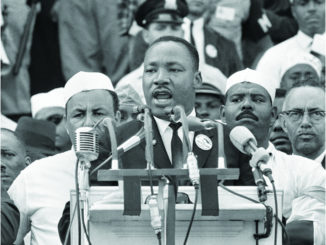
    Near the end of the Birmingham campaign, in an effort to draw together the multiple forces for peaceful change and to dramatize to the country and to the world the importance of solving the U.S. racial problem, King joined other civil rights leaders in organizing the historic March on Washington. On August 28, 1963, an interracial assembly of more than 200,000 gathered peaceably in the shadow of the Lincoln Memorial to demand equal justice for all citizens under the law. Here the crowds were uplifted by the emotional strength and prophetic quality of King’s famous “I Have a Dream” speech, in which he emphasized his faith that all men, someday, would be brothers.

    The rising tide of civil rights agitation produced, as King had hoped, a strong effect on national opinion and resulted in the passage of the Civil Rights Act of 1964, authorizing the federal government to enforce desegregation of public accommodations and outlawing discrimination in publicly owned facilities, as well as in employment. That eventful year was climaxed by the award to King of the Nobel Peace Prize in Oslo in December. “I accept this award today with an abiding faith in America and an audacious faith in the future of mankind,” said King in his acceptance speech. “I refuse to accept the idea that the ‘isness’ of man’s present nature makes him morally incapable of reaching up for the eternal ‘oughtness’ that forever confronts him.”

    Challenges of the final years of Martin Luther King, Jr.

    The first signs of opposition to King’s tactics from within the civil rights movement surfaced during the March 1965 demonstrations in Selma, Alabama, which were aimed at dramatizing the need for a federal voting-rights law that would provide legal support for the enfranchisement of African Americans in the South. King organized an initial march from Selma to the state capitol building in Montgomery but did not lead it himself. The marchers were turned back by state troopers with nightsticks and tear gas. He was determined to lead a second march, despite an injunction by a federal court and efforts from Washington to persuade him to cancel it. Heading a procession of 1,500 marchers, Black and white, he set out across Pettus Bridge outside Selma until the group came to a barricade of state troopers. But, instead of going on and forcing a confrontation, he led his followers to kneel in prayer and then unexpectedly turned back. This decision cost King the support of many young radicals who were already faulting him for being too cautious. The suspicion of an “arrangement” with federal and local authorities—vigorously but not entirely convincingly denied—clung to the Selma affair. The country was nevertheless aroused, resulting in the passage of the Voting Rights Act of 1965.

    Throughout the nation, impatience with the lack of greater substantive progress encouraged the growth of Black militancy. Especially in the slums of the large Northern cities, King’s religious philosophy of nonviolence was increasingly questioned. The rioting in the Watts district of Los Angeles in August 1965 demonstrated the depth of unrest among urban African Americans. In an effort to meet the challenge of the ghetto, King and his forces initiated a drive against racial discrimination in Chicago at the beginning of the following year. The chief target was to be segregation in housing. After a spring and summer of rallies, marches, and demonstrations, an agreement was signed between the city and a coalition of African Americans, liberals, and labour organizations, calling for various measures to enforce the existing laws and regulations with respect to housing. But this agreement was to have little effect; the impression remained that King’s Chicago campaign was nullified partly because of the opposition of that city’s powerful mayor, Richard J. Daley, and partly because of the unexpected complexities of Northern racism.

    In Illinois and Mississippi alike, King was now being challenged and even publicly derided by young Black-power enthusiasts. Whereas King stood for patience, middle-class respectability, and a measured approach to social change, the sharp-tongued, blue jean-clad young urban radicals stood for confrontation and immediate change. In the latter’s eyes, the suit-wearing, calm-spoken civil rights leader was irresponsibly passive and old beyond his years (King was in his 30s)—more a member of the other side of the generation gap than their revolutionary leader. Malcolm X went so far as to call King’s tactics “criminal”: “Concerning nonviolence, it is criminal to teach a man not to defend himself when he is the constant victim of brutal attacks.”

    In the face of mounting criticism, King broadened his approach to include concerns other than racism. On April 4, 1967, at Riverside Church in New York City and again on the 15th at a mammoth peace rally in that city, he committed himself irrevocably to opposing U.S. involvement in the Vietnam War. Once before, in early January 1966, he had condemned the war, but official outrage from Washington and strenuous opposition within the Black community itself had caused him to relent. He next sought to widen his base by forming a coalition of the poor of all races that would address itself to economic problems such as poverty and unemployment. It was a version of populism—seeking to enroll janitors, hospital workers, seasonal labourers, and the destitute of Appalachia, along with the student militants and pacifist intellectuals. His endeavours along these lines, however, did not engender much support in any segment of the population.

    Meanwhile, the strain and changing dynamics of the civil rights movement had taken a toll on King, especially in the final months of his life. “I’m frankly tired of marching. I’m tired of going to jail,” he admitted in 1968. “Living every day under the threat of death, I feel discouraged every now and then and feel my work’s in vain, but then the Holy Spirit revives my soul again.”

    King’s plans for a Poor People’s March to Washington were interrupted in the spring of 1968 by a trip to Memphis, Tennessee, in support of a strike by that city’s sanitation workers. In the opinion of many of his followers and biographers, King seemed to sense his end was near. As King prophetically told a crowd at the Mason Temple Church in Memphis on April 3, the night before he died, “I’ve seen the promised land. I may not get there with you. But I want you to know tonight that we, as a people, will get to the promised land.” The next day, while standing on the second-story balcony of the Lorraine Motel, where he and his associates were staying, King was killed by a sniper’s bullet. The killing sparked riots and disturbances in over 100 cities across the country. On March 10, 1969, the accused assassin, a white man, James Earl Ray, pleaded guilty to the murder and was sentenced to 99 years in prison.

              Source: Britannica.com

  • History This Week

    “We are not makers of history. We are made by history.”

    Martin Luther King, Jr.

    September 24

    September 24, 1957 – President Dwight Eisenhower ordered the National Guard to enforce racial integration of schools in Little Rock, Arkansas.

    September 24, 1980 – War erupted between Iran and Iraq as Iraqi troops crossed the border and encircled Abadan, then set fire to the world’s largest oil refinery.

    Birthday – John Marshall (1755-1835) was born in Germantown, Virginia. He was appointed by President John Adams to the position of Chief Justice of the U.S. Supreme Court in January 1801. He became known as “The Great Chief Justice,” largely responsible for expanding the role of the Supreme Court through such cases as Marbury vs. Madison and McCulloch vs. Maryland.

    Birthday – American writer F. Scott Fitzgerald (1896-1940) was born in St. Paul, Minnesota (as Francis Scott Key Fitzgerald). Best known for This Side of Paradise, The Great Gatsby and Tender is the Night.

    Birthday – Puppeteer Jim Henson (1936-1990) was born in Greenville, Mississippi. He created the Muppets, including Kermit the Frog, and Bert and Ernie, entertaining and educating generations of children via the daily TV show Sesame Street.

    September 25

    September 25, 1513 – Spanish explorer Vasco Nunez de Balboa first sighted the Pacific Ocean after crossing the Isthmus of Panama.

    September 25, 1690 – The first American newspaper was published. A single edition of Publick Occurrences Both Foreign and Domestick appeared in Boston, Massachusetts. However, British authorities considered the newspaper offensive and ordered its immediate suppression.

    September 25, 1789 – The first U.S. Congress proposed 12 Amendments to the Constitution, ten of which, comprising the Bill of Rights, were ratified.

     Birthday – American writer William Faulkner (1897-1962) was born in New Albany, Mississippi. Best known for The Sound and the Fury and The Reivers.

    Birthday – Russian composer Dmitri Shostakovich (1906-1975) was born in St. Petersburg, Russia. He witnessed the Russian Revolution and went on to become one of the greatest Soviet composers.

    September 26

    September 26, 1687 – The Acropolis in Athens was attacked by the Venetian army attempting to oust the Turks, resulting in heavy damage to the Parthenon.

    September 26, 1918 – The last major battle of World War I, the Battle of the Argonne, began as a combined force of French and Americans attacked the Germans along a 40-mile front.

    September 26, 1960 – The first-ever televised presidential debate occurred between presidential candidates John F. Kennedy and Richard M. Nixon. Many who watched were inclined to say Kennedy ‘won’ the debate, while those who listened only to the radio thought Nixon did better. Nixon, who declined to use makeup, appeared somewhat haggard looking on TV in contrast to Kennedy.

    September 26, 1984 – Britain agreed to allow Hong Kong to revert to Chinese sovereignty in 1997.

    Birthday – American folk legend Johnny Appleseed (1774-1845) was born in Leominster, Massachusetts (as John Chapman). For 40 years, he traveled through Ohio, Indiana and into Illinois, planting orchards. He was a friend to wild animals and was regarded as a “great medicine man” by Native Americans.

    Birthday – Writer T.S. (Thomas Stearns) Eliot (1888-1965) was born in St. Louis, Missouri. He rejected conventional verse and language in favor of free expression.

    Birthday – Composer George Gershwin (1898-1937) was born in Brooklyn, New York. Along with his brother Ira, he created enduring songs including The Man I Love, Strike Up the Band, I Got Rhythm and the opera Porgy and Bess.

    September 27

    September 27, 1964 – After a 10-month investigation, the Warren Commission Report was issued stating a lone gunman had been responsible for the assassination of President John F. Kennedy in Dallas on November 22, 1963.

    September 27, 1995 – The Israeli cabinet agreed to give Palestinians control of much of the West Bank which had been occupied by Israel for 28 years.

    Birthday – American revolutionary leader Samuel Adams (1722-1803) was born in Boston, Massachusetts. He was a passionate, vocal man who helped ignite the revolution and served as a delegate to the First and Second Continental Congresses. He was a signer of the Declaration of Independence and the Articles of Confederation.

    Birthday – American political cartoonist Thomas Nast (1840-1902) was born in Landau, Germany. He originated the symbols for the two main U.S. political parties, the Democratic donkey and the Republican elephant. Nast was also instrumental in destroying the Tweed Ring, a group of corrupt politicians plundering the New York City treasury.

    September 28

    September 28, 1066 – The Norman conquest of England began as Duke William of Normandy landed at Pevensey, Sussex.

    September 28, 1542 – California was discovered by Portuguese navigator Juan Rodriguez Cabrillo upon his arrival at San Diego Bay.

    September 28, 1978 – Pope John Paul I died after only 33 days in office. He was succeeded by John Paul II.

    September 28, 1995 – Israeli Prime Minister Yitzhak Rabin and Palestine Liberation Organization leader Yasser Arafat signed an accord at the White House establishing Palestinian self-rule in the West Bank.

    September 29

    September 29, 1789 – Congress created the United States Army, consisting of 1,000 enlisted men and officers.

    September 29, 1829 – Britain’s “bobbies” made their first public appearance. Greater London’s Metropolitan Police force was established by an act of Parliament at the request of Home Secretary, Sir Robert Peel, after whom they were nicknamed. The force later became known as Scotland Yard, the site of their first headquarters.

    September 29-30, 1941 – Nazis killed 33,771 Jews during the Babi Yar massacre near Kiev.

    Birthday – Nuclear physicist Enrico Fermi (1901-1954) was born in Rome. While teaching at the University of Chicago, he developed a method of causing nuclear fission, producing a chain reaction releasing explosive nuclear energy which led to the development of the Atomic bombs.

    September 30

    September 30, 1938 – British Prime Minister Neville Chamberlain returned to England declaring there would be “peace in our time,” after signing the Munich Pact with Adolf Hitler. The Pact ceded the Czechoslovakian Sudetenland to the Nazis. Chamberlain claimed the agreement meant peace, however, Hitler seized all of Czechoslovakia in March of 1939.

    September 30, 1949 – The Berlin Airlift concluded after 277,264 flights carrying over 2 million tons of supplies to the people of West Berlin, who were blockaded by the Soviets.

    September 30, 1955 – Actor James Dean was killed in a car crash in California at age 24. Although he made just three major films, Rebel Without a Cause, East of Eden and Giant, he remains one of the most influential actors.

    September 30, 1966 – Nazi war criminals Albert Speer and Baldur von Schirach were released from Spandau prison after serving 20 years. The prison, originally built for 600 inmates, was left with only one prisoner, former Deputy Führer Rudolf Hess.

    Birthday – American writer Truman Capote (1924-1984) was born in New Orleans, Louisiana (as Truman Streckfus Persons). He took the last name of his stepfather, becoming Truman Capote. Best known for Breakfast at Tiffany’s and In Cold Blood.

  • Today We Are All Asian

    By Wallace Ford

     Yesterday (March 16), another member of the Tribe of Armed and Angry White Men decided that it would be a good thing to kill as many Asians as he could find in massage spas in and around Atlanta. He managed to kill eight people, six of whom were Asian. The other two just happened to discover that their Sell By date was yesterday. In other words, the other two were just collateral damage in the continued hate war being waged by the Tribe of Armed and Angry White Men. And in that war, anyone and everyone stands the risk of being collateral damage. In that sense, we are all Asian. Just as we are all Black. We are all Latino. We are all Muslims. We are all Indigenous people. We are all LGBTQI members. We are all Jews. Because in hating and targeting all of the above, the Tribe of Armed and Angry White Men doesn’t care who gets in the way. And they certainly don’t care who dies. Yesterday it was six Asian women who committed the capital crime of Being Asian and Working. About a year ago it was Armaud Arberry who committed the capital crime of Jogging While Black in an Atlanta suburb. In August 2019 it was 23 Latinos in El Paso who committed the capital crime of Being Latino in A Public Place. And in 2017 it was Heather Heyer who committed the capital crime of Demonstrating for Justice with Black People in Charlottesville. And in 2018 it was 11 Jews worshiping in a synagogue who committed the capital crime of Being Jews.

    Of course, the behavior which cost these men and women their lives are only capital crimes in the twisted universe of white supremacist domestic terrorists. These men (and women) have been letting us know who they are for years and the response of the public and law enforcement has been tepid at best. All of the referenced atrocities are considered isolated events and not part of the obvious pattern of white extremist violence which is committed to maintaining white minority rule in this nation, no matter the human or institutional cost.

    We saw the savage combination of white supremacy and white privilege on January 6, 2020 when a mob that would have warmed the heart of the Ku Klux Klan in days gone past, stormed the capital – ostensibly to keep 45 as president – but…there were Confederate flags and Nazi paraphernalia present — clear signs that white supremacy was coursing through the veins of these so-called “good people”.

    History shows quite clearly how this country responds when it perceives a domestic threat. Look at what happened to Julius and Ethel Rosenberg and Paul Robeson among thousands of others accused of being part of some Russian conspiracy to overthrow the government.

    Look at what happened to the Black Panther Party when its members asserted the constitutional right of Black people to exercise their Second Amendment rights (the irony is apparent). And look what happened to Martin Luther King, Jr. when the Federal Bureau of Investigation considered him to be “the greatest domestic threat” in the country.

    A Black man preaching nonviolence in the quest for justice is a domestic threat. A tribe of white supremacist domestic terrorists are considered to be either misunderstood or misguided, but certainly not a national threat.

    Attorney General Merrick Garland has stated that he considers domestic terrorism to be a national threat. But he needs to be more specific – it is white supremacist domestic terrorism that is a true national threat. And unless and until this nation confronts this danger from within, every American citizen is in danger of being in the cross hairs of this renegade tribe.


    And that is why today we are all Asian.

  • Two children, 8-month-old and 11-year-old, killed in Jersey City fire:officials

    JERSEY CITY, NJ (TIP): Two children were killed in a blaze that burned through a New Jersey home late Wednesday, February 10, officials said. An 8-month-old and 11-year-old were killed when flames broke out shortly before midnight at a home on Martin Luther King Drive near Union St. in Jersey City, the Hudson County Prosecutor’s Office said Thursday, February 11. When emergency responders arrived at the scene, the mother desperately told them her two children were still inside, ABC 7 News reported.

    The bodies of the two kids were found on the second floor after the flames were put out, the news outlet reported. Three police officers suffered smoke inhalation due to the fire. “It was crazy. I came outside with no clothes on, I had to get dressed outside… I’m just shocked,” resident Randy Williams told CBS 2 News. He said he saw the flames were on the roof and the first floor. “The whole house was on fire, the whole house was burning,” he added. The Hudson County Regional Arson Task Force is investigating the blaze, authorities said.

  • Remembering Martin Luther King Jr. on his 92nd birthday

    Remembering Martin Luther King Jr. on his 92nd birthday

    Minister, civil rights activist, and public opinion leader who changed the face of America

    January 15, 1929, Atlanta, Georgia

    Died

    April 4, 1968, Memphis, Tennessee

    Spouse

    Coretta Scott King

    Accomplishments

    Leader of African American Civil Rights Leader

    Nobel Peace Prize (1964)

    Presidential Medal of Freedom (1977)

    Congressional Gold Medal (2004)

    Famous letters and speeches

    “I have a dream” Speech

    Letter from Birmingham jail

    Letter to Coretta

    Our God is Marching On (How Long? Not Long)

    Martin Luther King Jr. became the predominant leader in the civil rights movement to end racial segregation and discrimination in America during the 1950s and 1960s, and was a leading spokesperson for nonviolent methods of achieving social change. His eloquence as a speaker and his personal charism—combined with a deeply rooted determination to establish equality among all races despite personal risk—won him a worldwide following. He was awarded the Nobel Peace Prize in 1964 and was selected by Time magazine as its Man of the Year. His “I Have a Dream “speech, which is now considered to be among the great speeches of American history, is frequently quoted. His success in galvanizing the drive for civil rights, however, made him the target of conservative segregationists who believed firmly in the superiority of the white race and feared social change. He was arrested over 20 times and had his home was bombed. Ultimately, he was assassinated on April 4, 1968, on the balcony of a motel where he was staying in Memphis. A monument to Dr. King was unveiled in the national capital in 2012.

    Early Life of Martin Luther King Jr.

    Martin Luther King Jr. was born Michael Luther King Jr., in Atlanta, Georgia, on January 15, 1929. His father, in a 1957 interview, said that both he and his son were supposed to be named for the leader of the Protestant Reformation but misunderstandings led to Michael being the name on birth records. The boy became the third member of his family to serve as pastor of the Ebenezer Baptist Church in Atlanta, following in the footsteps of his grandfather and father. His training and experience as a minister undoubtedly contributed to his renowned oratorical style and cadence.

    He also followed the educational path taken by his father and grandfather: he got his education in Georgia’s segregated public schools (from which he graduated at age 15). And he received a B.A. degree from Atlanta’s Morehouse College, a traditionally black college. He then went on to study theology at Crozer Theological Seminary in Pennsylvania, an integrated school where he was elected president of his senior class although it was comprised primarily of white students. In 1955, he received an advanced degree from Boston College in Massachusetts; he had completed the residence for his doctorate two years earlier. (In 1991, a Boston University investigatory committee determined he had plagiarized portions of his doctoral dissertation; plagiarism was also discovered in his word at Crozer. However, the committee did not recommend his degree be revoked. Evidence of plagiarism had been discovered by Boston University archivists in the 1980s.)

    While in Boston, he met and married Coretta Scott, who would be his lifetime partner in both marriage and his campaign for civil rights. In 1954, the couple moved to Montgomery, Alabama, where King had been hired as the pastor of the Dexter Avenue Baptist Church.

    He was already active in the National Association for the Advancement of Colored People, America’s leading African-American organization. At the time of his move to Montgomery, he was a member of its executive committee, and in December 1955, he led a 382-day boycott of Montgomery’s segregated public bus system. Negroes, the term then used for those of African descent, were relegated to the back of the bus and forced to give up their seats if a white person wanted to sit. Since many blacks lived in poverty or near-poverty, few could afford automobiles, and public busses were essential to them for traveling to and from work and elsewhere. During the boycott, King became a target for segregationists. Personal abuse, arrest, and the bombing of his home made clear the risks he would be taking if he continued to work with the movement for civil rights.

    In 1957, that movement spawned a new organization, the Southern Christian Leadership Conference, to focus on achieving civil rights. King was elected president. By dropping reference to Negroes or colored people in its title and instead using the term “Christian Leadership” the organization was declaring its goals were not just those of one race but should be those of all Christian people. King strongly influenced the ideals of the organization.

    During the next 11 years, he would speak over 2,500 times at public events, traveling over six million miles. He also wrote articles and five books to spread the message farther. In 1963, he was a leader in the massive civil rights protests at Birmingham, Alabama, that drew the attention of all America—indeed, of the entire world—to the discrimination African Americans faced and their demands for change. Arrested during the protests, he penned “Letter from a Birmingham Jail,” which became a manifesto for the civil rights revolution and placed King among America’s renowned essayists such as Henry David Thoreau and Ralph Waldo Emerson.

    Civil rights leader Martin Luther King Jr. during the March on Washington for Jobs and Freedom on Aug. 28, 1963, in Washington.

    Influence of Mohandas Karamchand Gandhi

    His tactics for achieving social change were drawn from those of Mohandas Karamchand Gandhi (known as Mahatma, “great soul”), who had used nonviolent civil disobedience to bring about change in his native India (as he had done with some success previously to win concessions for Indian immigrants living in South Africa’s apartheid system). Gandhi’s methods included boycotts of British goods and institutions. (Like Martin Luther King, Jr., Gandhi was repeatedly arrested and ultimately was assassinated by a fanatic.)

    Although King stressed nonviolence, even when confronted by violence, those who opposed change did not observe such niceties. Protestors were beaten, sprayed with high-pressure water hoses, tear-gassed, and attacked by police dogs; bombings at black churches, homes, and other locations took a number of lives; some—both black and white—who agitated for civil rights such as the right to vote were murdered, but the movement pressed on.

    King was the most prominent leader in the drive to register black voters in Atlanta and the march on Washington, D.C., that drew a quarter-million participants. His message had moved beyond African Americans and was drawing supporters from all segments of society, many of them appalled by the violence they saw being conducted against peaceful protestors night after night on television news.

    Martin Luther King’s Nobel Peace Prize

    His oratory and impassioned drive, not just for equality under the law, but for true understanding and acceptance of all races and creeds by all races and creeds, led Time magazine to select Martin Luther King, Jr., as its Man of the Year for 1963. The following year, the Nobel Prize Committee in Stockholm, Sweden, awarded him the Nobel Peace Prize. Then 35, he is the youngest man ever to have received it. The prize included an award of over $54,000, which he promised to donate to the furtherance of the civil rights movement.

    As the Vietnam War escalated, King spoke out against America’s involvement in the conflict. His antiwar position was an outgrowth of his belief in nonviolence, but to those who opposed King it intensified their belief he was pro-Communist and anti-American.

    Martin Luther King, Jr. Assassinated

    In the spring of 1968, King traveled to Memphis, Tennessee, where the majority of the city’s black sanitation workers had been striking since February 12 for increased job safety measures, better wages and benefits, and union recognition. The mayor, Henry Loeb, staunchly opposed all these measures. King was solicited to come to Memphis to lead a planned march and work stoppage on March 28.

    Funeral procession for Martin Luther King, Jr., April 9, 1968, Atlanta. 

    That protest march turned violent when sign-carrying students at the end of the parade began breaking windows of businesses, which led to looting. One looter was killed and about 60 people were injured. The city of Memphis lodged a formal complaint in the U.S. District Court against King and several other leaders of the Southern Christian Leadership Conference. He and those leaders negotiated with the factions among the workers and their supporters who had initiated the march.

    Assured that they would observe the creed of nonviolent civil disobedience, King agreed to return to Memphis for the rescheduled march on April 5. The district court had issued a restraining order, however, representatives of the SCLC met with the judge on April 4 and worked out a broad agreement that would permit the protest march to be held on April 8. Details were to be worked out on April 5.

    On the evening of April 4, one of the SCLC representatives, Andrew Young (who would later serve as President Jimmy Carter’s ambassador to the United Nations and would be elected mayor of Atlanta), came to King’s room at the Lorraine Motel and informed him of what had been worked out with the judge. They prepared to go out to dinner, along with their colleagues. When King stepped onto the balcony in front of his room, he was shot and killed. He was just 39 years old. In direct contrast to the nonviolence he had preached, riots broke out following Martin Luther King, Jr.’s death. In Chicago alone, nearly a dozen people died, 350 were arrested for looting, and 162 buildings were destroyed by arson.

    Martin Luther King Jr’s Legacy

    By the time of Martin Luther King Jr.’s death, the civil rights movement was evolving; in some ways, it seemed to be leaving him behind. New black power activists did not accept his philosophy of nonviolence as a way to achieve their goals. The FBI was breaking the power of the Ku Klux Klan, which had stood squarely in the way of racial equality. After successfully campaigning for Carl Stokes, the first black mayor of Cleveland, King was not invited to the victory celebration. The next civil rights challenges, such as fighting poverty, were more abstract compared with the clarity of issues like discrimination in hiring and the use of public amenities. These new concerns would likely have proven more difficult for him to achieve the same levels of success as he had in his previous campaigns for equality and justice. On the last Saturday of his life, he mused about quitting his full-time role in the movement, though he seemed to talk himself out of that, according to one of his fellow activists, Jesse Jackson.

    Yet, the lasting legacy of Martin Luther King Jr. as a vibrant catalyst for social change cannot be denied. Among the prominent legacies of his ability to organize and energize the movement for equality are the Civil Rights Act of 1964 and the Voting Rights Act of 1965. His birthday has become a national holiday, when government offices and many private businesses close to honor his memory. A portion of the Lorraine Motel, including two persevered rooms and the balcony on which he was assassinated, are part of the National Civil Rights Museum. King’sbirthplace is now part of the National Park System.

    His eloquent words live on, inspiring others who see injustices and seek to change them. He had a dream, and though it is still a long way from being fully realized, the America of his racially segregated youth and that of today’s integrated society—in which a black man was elected president of the United States having served two full terms from 2008-2016—are as far apart and different from each other as the planet Mars is from Neptune. It is impossible to imagine such sweeping change would occur as quickly as it did without a leader like Martin Luther King Jr. driving it forward.

    But 60 years after the March on Washington, there is no gainsaying that Martin Luther King Jr.’s “I Have a Dream” has entered American public culture as “the oratorical equivalent of the Declaration of Independence,” as Hansen puts it. If its fame threatens to swamp the balance of King’s legacy, and if its stature directs historical memory only toward the brightest and not the bleakest days of the 1960s black freedom movement, it nonetheless remains the most notable oratorical achievement of the 20th century—a “sort of a Gettysburg Address” indeed.

    (This article was written by David J. Garrow and originally published in August 2003 issue of American History Magazine. Courtesy / HistoryNet)