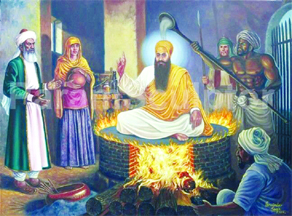
Each year, millions of Sikhs around the world solemnly commemorate the Martyrdom Day of Guru Arjan Dev Ji, the fifth Guru of Sikhism and the first Sikh martyr, whose death in 1606 CE became a defining moment in the history of the Sikh faith. Observed during the summer month of Jeth (May–June), this day honors Guru Ji’s unwavering commitment to truth, religious freedom, and justice in the face of brutal persecution under the Mughal regime.
Guru Arjan (15 April 1563 – 30 May 1606) compiled the first official edition of the Sikh scripture called the Adi Granth, which later expanded into the Guru Granth Sahib.
Guru Arjan was born in Goindwal, in the Punjab, the youngest son of Bhai Jetha, who later became Guru Ram Das, and Mata Bhani, the daughter of Guru Amar Das. He completed the construction of the Darbar Sahib at Amritsar, after the fourth Sikh Guru founded the town and built a sarovar.Guru Arjan compiled the hymns of previous Gurus and of other saints into Adi Granth, the first edition of the Sikh scripture, and installed it in the Harimandir Sahib.
Guru Arjan reorganized the masand system initiated by Guru Ram Das, by suggesting that the Sikhs donate, if possible, one-tenth of their income, goods or service to the Sikh organization (dasvandh). The Masand not only collected these funds but also taught tenets of Sikhism and settled civil disputes in their region. The dasvand financed the building of gurdwaras and langars (shared communal kitchens).
Guru Arjan was arrested under the orders of the Mughal Emperor Jahangir accusing him of supporting a rebellion under Khusrau Mirza. He was asked to convert himself to Islam. He refused and, as a result, was tortured and executed in 1606 CE. Historical records and the Sikh tradition are unclear as to whether Arjan was executed by drowning or died during torture. The Sikh tradition states the Guru’s execution was a part of the ongoing persecution of the Sikhs under the Mughal Empire. His martyrdom is considered a watershed event in the history of Sikhism.
Early life
Guru Arjan was born in Goindwal to Bibi Bhani and Jetha Sodhi. Bibi Bhani was the daughter of Guru Amar Das, and her husband Jetha Sodhi later came to be known as Guru Ram Das. Arjan’s birthplace site is now memorialized as the Gurdwara Chaubara Sahib. He had two brothers: Prithi Chand and Mahadev. Various Sikh chroniclers give his birth year as 1553 or 1563, the latter is accepted by scholarly consensus as the actual year of birth with 15 April as the accepted birth date.
Guru Arjan spent the first 11 years of his life in Goindwal and the next seven years with his father in Ramdaspur. Per Sikh tradition, he had stayed for two years in Lahore during his youth after being sent by his father to attend the wedding of his first cousin Sahari Mal’s son as well as to establish a Sikh congregation. He was appointed as the Sikh Guru in 1581 after the death of his father. Guru Ram Das was a Khatri of the Sodhi sub-caste. With Arjan’s succession, the Guruship remained in the Sodhi family of Guru Ram Das.
Succession and time as Guru
Guru Ram Das chose Arjan, the youngest, to succeed him as the fifth Sikh Guru. Mahadev, the middle brother chose the life of an ascetic. His choice of Guru Arjan as successor, as throughout most of the history of Sikh Guru successions, led to disputes and internal divisions among the Sikhs.
The succession dispute regarding Guru Arjan created a schism that yielded different narratives for the two factions. In the orthodox Sikh tradition, Prithi Chand is remembered as vehemently opposing Guru Arjan, creating a factional sect of the Sikh community. The Sikhs following Arjan referred to the breakaway faction as Minas (literally, “scoundrels”). Prithi Chand and his followers attempted to assassinate the young Hargobind thrice. Prithi Chand also befriended Mughal agents. Subsequent written competing texts written by the Minas, on the other hand, offered a different explanation for the attempt on Hargobind’s life, and present him as devoted to his younger brother Arjan. The eldest son of Prithi Chand, Miharvan, is mentioned in both traditions as having received tutelage from both Prithi Chand and Arjan as a child.
The competing texts acknowledge the disagreements. They state Prithi Chand left Amritsar, became the Sahib Guru after the martyrdom of Guru Arjan and one who disputed the succession of Hargobind as the next Guru. The followers of Prithi Chand considered themselves the true followers of Guru Nanak as they rejected the increasing emphasis on militarization of the panth under Hargobind to resist Mughal persecution in the wake of Arjan’s martyrdom, in favor of non-violent interiorization. In addition to Prithi Chand, a son of Guru Amar Das named Baba Mohan had also challenged the authority of Arjan. These challenging claims were asserted by the early Sikh sects in part by their manuscripts of Sikh hymns. Baba Mohan possessed the Goindval pothi containing the hymns of Nanak and other early Gurus, while Prithi Chand possessed the Guru Harsahai pothi then believed to have been the oldest scripture from the time of Nanak. This, state scholars, may have triggered Guru Arjan to create a much enlarged, official version of the Adi Granth.
Upon the first parkash of the Adi Granth according to Gurbilas, Guru Arjan said, “Listen you all to my directive. And believe it as ever true. Accept the Granth as equal with the Guru. And think no distinctions between the two.”
The mainstream Sikh tradition recognized Guru Arjan as the fifth Guru, and Hargobind as the sixth Guru. Arjan, at age 18, became the fifth Guru in 1581 inheriting the title from his father. After his execution by the Muslim officials of the Mughal Empire, his son Hargobind became the sixth Guru in 1606 CE.
Execution
Guru Arjan died in Mughal custody; this has been one of the defining, though controversial, issues in Sikh history.
Most Mughal historians considered Guru Arjan’s execution as a political event, stating that the Sikhs had become formidable as a social group, and Sikh Gurus became actively involved in the Punjabi political conflicts. A similar theory floated in the early 20th-century, asserts that this was just a politically-motivated single execution. According to this theory, there was an ongoing Mughal dynasty dispute between Jahangir and his son Khusrau suspected of rebellion by Jahangir, wherein Arjan blessed Khusrau and thus the losing side. Jahangir was jealous and outraged, and therefore he ordered the Guru’s execution. But according to Jahangir’s own autobiography, most probably he didn’t understand the importance of Sikh gurus. He referred to Arjan as a Hindu, who had “captured many of the simple-hearted of the Hindus and even of the ignorant and foolish followers of Islam, by his ways and manners…for the three or four generations (of spiritual successors) they had kept this shop warm.” The execution of Arjan marks a sharp contrast to Jahangir’s tolerant attitude towards other religions such as Hinduism and Christianity.
The Sikh tradition has a competing view. It states that the Guru’s execution was a part of the ongoing persecution of the Sikhs by Islamic authorities in the Mughal Empire, and that the Mughal rulers of Punjab were alarmed at the growth of the Panth. According to Jahangir’s autobiography Tuzk-e-Jahangiri (Jahangirnama) which discussed Arjan’s support for his rebellious son Khusrau, too many people were becoming persuaded by Arjan’s teachings and if Arjan did not become a Muslim, the Sikh Panth had to be extinguished.
In 1606 CE, the Guru was imprisoned in Lahore Fort, where by some accounts he was tortured and executed, and by other accounts, the method of his death remains unresolved. The traditional Sikh account states that the Mughal emperor Jahangir demanded a fine of 200,000 rupees and demanded that Arjan erase some of the hymns in the text that he found offensive. The Guru refused to remove the lines and pay the fine which, the Sikh accounts state, led to his execution. Some Muslim traditional accounts such as of Latif in 19th-century states that Arjan was dictatorial, someone who lived in splendour with “costly attire”, who had left aside the rosary and the clothes of a saint (fakir). Shaikh Ahmad Sirhindi cheered the punishment and execution of Arjun, calling the Sikh Guru an infidel. In contrast, Mian Mir – the Sufi friend of Guru Arjan, lobbied when Jehangir ordered the execution and the confiscation of Arjan’s property, then got the confiscation order deferred, according to Rishi Singh.
Some scholars state that the evidence is unclear whether his death was due to execution, torture or forced drowning in the Ravi river. J.S. Grewal notes that Sikh sources from the seventeenth and eighteenth-century contain contradictory reports of Arjan’s death.J. F. Richard states that Jahangir was persistently hostile to popularly venerated saints, not just Sikhism. Bhai Gurdas was a contemporary of Arjan and is a noted 17th-century Sikh chronicler. His eyewitness account recorded Arjan’s life, and the order by Emperor Jahangir to torture the Guru to death.
A contemporary Jesuit account, written by Spanish Jesuit missionary Jerome Xavier (1549-1617), who was in Lahore at the time, records that the Sikhs tried to get Jahangir to commute the torture and death sentence to a heavy fine, but this attempt failed. Dabistan-i Mazahib Mobad states Jahangir tortured Arjan in the hopes of extracting the money and public repudiation of his spiritual convictions, but the Guru refused and was executed. Jerome Xavier, in appreciation of the courage of Guru Arjun, wrote back to Lisbon, that Arjan suffered and was tormented.
According to the Sikh tradition, before his execution, Arjan instructed his son and successor Hargobind to take up arms, and resist tyranny. His execution led the Sikh Panth to become armed and pursue resistance to persecution under the Mughal rule. Michael Barnes states that the resolve and death of Arjun strengthened the conviction among Sikhs that, “personal piety must have a core of moral strength. A virtuous soul must be a courageous soul. Willingness to suffer trial for one’s convictions was a religious imperative”.
There are several stories and versions about how, where and why Arjan died. Recent scholarship have offered alternative analyses, wary of “exaggerating fragmentary traces of documentary evidence in historical analysis”. The alternate versions include stories about the role of Arjan in a conflict between the Mughal Emperor Jahangir and his son who Jahangir suspected of trying to organize a patricidal coup. An alternate version highlights the role of a Hindu minister of Jahangir named Chandu Shah. He, in one version, takes revenge on Arjan for not marrying his son Hargobind to Chandu Shah’s daughter. In another Lahore version, Chandu Shah actually prevents Arjan from suffering torture and death by Muslims by paying 200,000 rupees (100,000 crusados) to Jahangir, but then keeps him and emotionally torments him to death in his house. Several alternative versions of the story try to absolve Jahangir and the Mughal empire of any responsibility, but have no trace or support in the documentary evidence from early 17th century, such as the records of Jesuit priest Jerome Xavier and the memoirs of Jahangir.
Guru Arjan’s father Guru Ram Das founded the town named after him “Ramdaspur”, around a large man-made water pool called “Ramdas Sarovar”. Guru Arjan continued the infrastructure-building effort of his father. The town expanded during the time of guru Arjan, financed by donations and constructed by voluntary work. The pool area grew into a temple complex with the Gurdwara Harmandir Sahib near the pool. Guru Arjan installed the scripture of Sikhism inside the new temple in 1604. The city that emerged is now known as Amritsar, and is the holiest pilgrimage site in Sikhism.
Continuing the efforts of Ram Das, Guru Arjan established Amritsar as a primary Sikh pilgrimage destination. He wrote a voluminous amount of Sikh scripture including the popular Sukhmani Sahib. Guru Arjan is credited with completing many other infrastructure projects, such as water reservoirs called Santokhsar (Pond of Contentment) and Gongsar (Pond of Bells), founding the towns of Tarn Taran, Kartarpur and Hargobindpur.
Community expansion
While having completing the Harmandir Sahib with dasvand donations during the first decade of his guruship between 1581 and 1589, creating a rallying point for the community and a center for Sikh activity, and a place for the instalment of the Adi Granth, guru Arjan had also gone on a tour of Majha and Doaba in Punjab, where he would found the towns. Due to their central location in the Punjab heartland, the ranks of Sikhs would swell, especially among the Jat peasantry, and create a level of prosperity for them; Arjan would serve not only as a spiritual mentor but as a true emperor (sacch? p?dsh?h) for his followers in his own right.
Adi Granth
According to the Sikh tradition, Guru Arjan compiled the Adi Granth by collecting hymns of past Gurus from many places, then rejecting those that he considered as fakes or to be diverging from the teachings of the Gurus. His approved collection included hymns from the first four Gurus of Sikhism, those he composed, as well as 17 Hindu bards and 2 Muslim bards (Bhagats). The compilation was completed on 30 August 1604, according to the Sikh tradition and installed in the Harmandir Sahib temple on 1 September 1604.
Guru Arjan was a prolific poet who composed 2,218 hymns. More than half of the volume of Guru Granth Sahib and the largest collection of hymns has been composed by Arjan. According to Christopher Shackle and Arvind-Pal Singh Mandair, Guru Arjan’s compositions combined spiritual message in an “encyclopedic linguistic sophistication” with “Braj Bhasha forms and learned Sanskrit vocabulary”.
After Guru Arjan completed and installed the Adi Granth in the Harimandir Sahib, Mughal emperor Akbar was informed of the development with the allegation that it contained teachings hostile to Islam. He ordered a copy be brought to him. Arjan sent him a copy on a thali (plate), with the following message that was later added to the expanded text:
In this thali (dish) you will find three things – truth, peace and contemplation:
in this too the nectar Name which is the support of all humanity.
AG 1429, Translated by William Owen Cole and Piara Singh Sambh
The Akbarnama by Abu’l-Fazl Allami mentions that Arjan met the Mughal emperor Akbar and his cortege in 1598. According to Louis Fenech, this meeting likely influenced the development of Sikh manuscriptology and the later martial tradition.
One of the Sikh community disputes following Guru Ram Das was the emergence of new hymns claiming to have been composed by Nanak. According to the faction led by Arjan, these hymns were distorted and fake, with some blaming Prithi Chand and his Sikh faction for having composed and circulated them. The concern and the possibility of wrong propaganda, immoral teachings and inauthentic Gurbani led Arjan to initiate a major effort to collect, study, approve and compile a written official scripture, and this he called Adi Granth, the first edition of the Sikh scripture by 1604.
The composition of both Prithi Chand and his followers have been preserved in the Mina texts of Sikhism, while the mainstream and larger Sikh tradition adopted the Guru Granth Sahib scripture that ultimately emerged from the initiative of Arjan.
Category: Martyrs
-

Martyrdom day of Guru Arjan Dev ji
-

Lesser known heroes who sacrificed their lives for country’s freedom
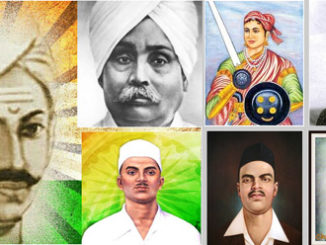
Bhagat Singh, Azad, Rajguru, Sukhdev, Ram Prasad Bismil, Gandhi, and Bose are few names that are synonymous with our struggle for freedom from the British. We owe our freedom to them. But apart from these hallowed names, there were thousands of others who too sacrificed their lives on the path of freedom. But unlike these big names, history didn’t do justice with them. Many of them have been forsaken by history and most of us don’t even know about them. This is an attempt to give those souls a tribute because their contribution to our freedom is by no means lesser than those who got their due.
Kartar Singh Sarabha
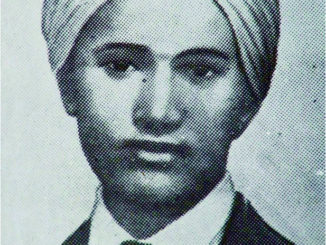
We all love Bhagat Singh, but only a handful know Kartar Singh Sarabha who Bhagat Singh himself considered his guru. Kartar Singh Sarabha was the main architect of the Ghadar revolution which aimed to incite a mutiny in British Indian Army during the thick of World War-I. Sarabha sought to take advantage of the war to uproot the British from India. Born in Ludhiana, Punjab in 1896, Sarabha went to the US for studies and established Ghadar Party in 1913.
In 1913, the party came out with a paper called ‘Ghadar’ which came out in languages like Pushto, Hindi, Punjabi, Bengali, Urdu, and Gujarati. Sarabha aimed to start a mutiny within British Indian Army and over 20 thousand Ghadar activists travelled to India from different countries of the world put plans in the motion. But the betrayal of an insider resulted in the arrested Sarabha and a few more. After the trial, the 19-year-old, Kartar Singh Sarabha was hanged on November 16, 1915, in Lahore central jail, the same jail where Bhagat Singh, Rajguru and Sukhdev were hanged.
Raja Mahendra Pratap
A royalty of Hathras, Aligarh, Raja Mahendra Pratap was one of the first Marxist revolutionaries in the country. In fact, Pratap was the president of first President of the Provisional Government of India formed in Afghanistan. In 1906, despite against the wishes of the family, he went to Calcutta to attend the Congress session and met several leaders of the Swadeshi movement.
But soon he realised that Congress won’t be able to help his cause of freedom. Therefore, he moved out of India in 1915 and via Switzerland, entered Germany. With help of Indian members of the Berlin Committee, he met Kaiser Wilhelm-II, the German emperor who promised him assistance to invade India via Afghan border. Pratap who had family relations with Jat Sikh states of Jind, Nabha and Patiala wanted to invade India through Afghanistan and later to use these states to crush the British in India.
But with Germany’s defeat in WW-I, his dream of invading India didn’t materialise. Pratap also tried to connect with Russians after Germans forsake him and his peers. He met Lenin as well. In 1932, Pratap was also nominated Nobel Prize in 1932. N.A. Nilsson, his nominator, said about him- “Pratap gave up his property for educational purposes, and he established a technical college at Brindaban. In 1913 he took part in Gandhi’s campaign in South Africa. He travelled around the world to create awareness about the situation in Afghanistan and India. In 1925 he went on a mission to Tibet and met the Dalai Lama. He was primarily on an unofficial economic mission on behalf of Afghanistan, but he also wanted to expose the British brutalities in India. He called himself the servant of the powerless and weak.” Today majority of land acquired by Aligarh Muslim University is donated by Pratap and his family.
Alluri Sitarama Raju
Born in a prosperous Kshatriya family in Andhra Pradesh in 1887, Raju left everything for the freedom struggle. In 1922-24, he led a failed yet important ‘Rampa Rebellion’ with the help of tribals. Raju was referred, “Manyam Veerudu” (Hero of the Jungles) by the local people. He took up the cause of the tribal people in the Agency areas, who were being harassed by British officials under the Forest Act, and led an armed rebellion against the British forces. Raju was trapped and killed by the British in the jungle in 1924.
Tirot Singh
Tirot Singh was one of the chiefts of Khasi people in the early 18th century who fought against the Britsh who tried to take control over the Khasi hills. Though the year of his birth is unknown, Tirot Singh fought the British in 1835 when British tried to acquire Khasi hills to extend their possession on Lower Assam areas.
Actually, the British wanted to construct a road through this area to connect Guwahati with Sylhet to save weeks of travel and malarious country. But Singh and his tribe objected the British occupation of the area and thus British tried to crushed their opposition which resulted in a bloody war between Khasi tribes and the British in which Singh sacrificed his life defending his tribe and land.
Pingali Venkayya
Venkaya was the man who designed the Indian national flag. Before independence, many flags were designed and used by different groups and in this process, Venkaya designed one version of flag for Indian National Congress which later became Indian flag after minor alterations post-Independence
According to The Hindu, “Pingali Venkayya was an authority in geology, agriculture and also an educationist who set up an educational institution in Machilipatnam. He, however, died in poverty in 1963 and was largely forgotten by the society and by his own party, the Congress.” A postage stamp was issued to commemorate him in 2009 and in 2011 it was proposed that he be posthumously awarded the Bharat Ratna. The outcome of that proposal is, however, not known.
Tanguturi Prakasam
Not many people know about this Andhra Kesari (Lion of Andhra). Prakasam was first the chief minister of Madras presidency and then chief minister in Andhra state. He started as a lawyer but gave up practice in 1921 to participate in the freedom movement. He rose to fame in 1928 during the protest against Simon Commission in Madras. The police had issued orders of shooting people in some areas. But Prakasam didn’t fear the orders and faced police by tearing open his shirt and daring police to shoot at him. This lone act of defiance won him the title of Andhra Kesari.
Veerapandiya Kattabomman
Almost 60 years before the rebellion of 1857, Kattabomman rebelled against the British and refused to pay taxes to them.As a chieftain of Palyekar community in the 18th century, Kattabomman waged a war against the British to protect his lands. He too died in the war against the British.
The Trio of Badal, Dinesh and Benoy
Bengal had given many freedom fighters and these three were also from there. They are known for their attack on the Dalhousie Square in Kolkata. Much like Bhagat Singh and his friends killed Saunders, the trio killed Col NS Simpson Inspector General of Prisons who was known for his atrocities on the prisoners. The trio of Badal Gupta, Dinesh Gupta and Benoy Basu decided not only to kill him, but also to strike fear in the hearts of the British by attacking the secretariat building- the Writers’Building in Dalhousie Square, Kolkata. On 8 December 1930, trio dressed as Europeans went to Writers’ building and killed Simpson. None of the three revolutionaries wanted to be nabbed; therefore Badal consumed poison whereas Benoy and Dinesh shot themselves. Badal was taken to hospital where he died on 13 December.
Surya Sen
Surya Sen popularly known as master Da because he was school teacher was a Bengali Indian independence activist. Sen is known for 1930s Chittagong armoury raid. Sen drew his inspiration from nationalist ideals during his college days on 1916 in Behrampore. In 1918, he was selected as the president of INC’s Chittagong branch. Later after college, Sen started recruiting young men to fight the British. In the late 1920s, Sen decided to free Chittagong from the British and thus formed a group of revolutionaries who carried out the infamous Chittagong armoury raid. On 18 April, Sen led a group which looted the armoury of the police. Their plan was to seize the arms and destroy the communication system of the city, thereby isolating Chittagong from rest of the British India. The group managed to loot the armoury, but failed to get the ammunition. The group hoisted the Indian National Flag on the premises of the armoury before escaping. But the British captured most of the revolutionaries but Sen in Jalalabad hills. Many died there while fighting the British.
Sen managed to escape and remained absconding for three years before being captured in 1933. Before he was hanged by the British, he was tortured beyond the limit.
Source: Indiatimes
-

The character of a nation is known by its martyrs
A nation is known by its people. The strength of a nation is known by its heroes. The character of a nation is known by its martyrs. With the Martyrs Day (March 23), commemorating the martyrdom of the three patriots- Bhagat Singh, Rajguru and Sukhdev-four days away, the editorial board of The Indian Panorama decided to recall their sacrifices, as also of many others who sacrificed their lives to bring freedom to India.
The brief description of the martyrs is meant to remind Indians that the freedom they enjoy today is the result of their sacrifices, and whatever tributes they may pay the patriots on this day, are not enough to repay them for their nobility.
Let us know some of the martyrs of India.
India’s freedom movement against the British was witness to an overwhelming participation of people throughout the country. From Kashmir to Kanyakumari, Assam to Gujarat, thousands of men and women fought together against atrocities of the British Raj. While many selflessly gave their lives to protect the dignity of their motherland, others got injured and embraced imprisonment. Let us know about a few brave freedom fighters from various parts of colonial India who gave their lives to achieve freedom for their beloved motherland:Mangal Pandey
Mangal Pandey, (born July 19, 1827, Akbarpur, India—died April 8, 1857, Barrackpore), Indian soldier whose attack on British officers on March 29, 1857, was the first major incident of what came to be known as the Indian, or Sepoy, Mutiny (in India the uprising is often called the First War of Independence or other similar names).
Pandey was born in a town near Faizabad in what is now eastern Uttar Pradesh state in northern India, although some give his birth place as a small village near Lalitpur (in present-day southwestern Uttar Pradesh). He was from a high-caste Brahman landowning family that professed strong Hindu beliefs. Pandey joined the army of the British East India Company in 1849, some accounts suggesting that he was recruited by a brigade that marched past him. He was made a soldier (sepoy) in the 6th Company of the 34th Bengal Native Infantry, which included a large number of Brahmans. Pandey was ambitious and viewed his profession as a sepoy as a stepping-stone to future success.
Pandey’s career ambitions, however, came into conflict with his religious beliefs. While he was posted at the garrison in Barrackpore in the mid-1850s, a new Enfield rifle was introduced into India that required a soldier to bite off the ends of greased cartridges in order to load the weapon. A rumour spread that the lubricant used was either cow or pig lard, which was repugnant to Hindus or Muslims, respectively. The belief arose among the sepoys that the British had deliberately used the lard on the cartridges.
There have been various accounts of the events of March 29, 1857. However, the general agreement is that Pandey attempted to incite his fellow sepoys to rise up against their British officers, attacked two of those officers, attempted to shoot himself after having been restrained, and eventually was overpowered and arrested. Some contemporary reports suggested that he was under the influence of drugs—possibly cannabis or opium—and was not fully aware of his actions. Pandey was soon tried and sentenced to death. His execution (by hanging) was set for April 18, but British authorities, fearing the outbreak of a large-scale revolt if they waited until then, moved the date up to April 8. Resistance to the use of Enfield cartridges later that month in Meerut led to the outbreak of a revolt there in May and the start of the larger insurrection.
In India, Pandey has been remembered as a freedom fighter against British rule. A commemorative postage stamp with his image on it was issued by the Indian government in 1984. In addition, a movie and stage play that depicted his life both appeared in 2005.Rani Lakshmi Bai
Lakshmi Bai, also spelled Laxmi Bai, (born c. November 19, 1835, Kashi, India—died June 17, 1858, Kotah-ki-Serai, near Gwalior), rani (queen) of Jhansi and a leader of the Indian Mutiny of 1857–58.
Brought up in the household of the peshwa (ruler) Baji Rao II, Lakshmi Bai had an unusual upbringing for a Brahman girl. Growing up with the boys in the peshwa’s court, she was trained in martial arts and became proficient in sword fighting and riding. She married the maharaja of Jhansi, Gangadhar Rao, but was widowed without bearing a surviving heir to the throne. Following established Hindu tradition, just before his death the maharaja adopted a boy as his heir. Lord Dalhousie, the British governor-general of India, refused to recognize the adopted heir and annexed Jhansi in accordance with the doctrine of lapse. An agent of the East India Company was posted in the small kingdom to look after administrative matters.
The 22-year-old queen refused to cede Jhansi to the British. Shortly after the beginning of the mutiny in 1857, which broke out in Meerut, Lakshmi Bai was proclaimed the regent of Jhansi, and she ruled on behalf of the minor heir. Joining the uprising against the British, she rapidly organized her troops and assumed charge of the rebels in the Bundelkhand region. Mutineers in the neighbouring areas headed toward Jhansi to offer her support.
Under Gen. Hugh Rose, the East India Company’s forces had begun their counteroffensive in Bundelkhand by January 1858. Advancing from Mhow, Rose captured Saugor (now Sagar) in February and then turned toward Jhansi in March. The company’s forces surrounded the fort of Jhansi, and a fierce battle raged. Offering stiff resistance to the invading forces, Lakshmi Bai did not surrender even after her troops were overwhelmed and the rescuing army of Tantia Tope, another rebel leader, was defeated at the Battle of Betwa. Lakshmi Bai managed to escape from the fort with a small force of palace guards and headed eastward, where other rebels joined her.
Tantia Tope and Lakshmi Bai then mounted a successful assault on the city-fortress of Gwalior. The treasury and the arsenal were seized, and Nana Sahib, a prominent leader, was proclaimed as the peshwa (ruler). After taking Gwalior, Lakshmi Bai marched east to Morar to confront a British counterattack led by Rose. Dressed as a man, she fought a fierce battle and was killed in combat.
Subhas Chandra BoseSubhas Chandra Bose, byname Netaji (Hindi: “Respected Leader”), (born c. January 23, 1897, Cuttack, Orissa [now Odisha], India—died August 18, 1945, Taipei, Taiwan?), Indian revolutionary prominent in the independence movement against British rule of India. He also led an Indian national force from abroad against the Western powers during World War II. He was a contemporary of Mohandas K. Gandhi, at times an ally and at other times an adversary. Bose was known in particular for his militant approach to independence and for his push for socialist policies.
The son of a wealthy and prominent Bengali lawyer, Bose studied at Presidency College, Calcutta (Kolkata), from which he was expelled in 1916 for nationalist activities, and the Scottish Churches College (graduating in 1919). He then was sent by his parents to the University of Cambridge in England to prepare for the Indian Civil Service. In 1920 he passed the civil service examination, but in April 1921, after hearing of the nationalist turmoils in India, he resigned his candidacy and hurried back to India. Throughout his career, especially in its early stages, he was supported financially and emotionally by an elder brother, Sarat Chandra Bose (1889–1950), a wealthy Calcutta lawyer and Indian National Congress (also known as the Congress Party) politician.
Bose joined the noncooperation movement started by Mohandas K. Gandhi, who had made the Indian National Congress a powerful nonviolent organization. Bose was advised by Gandhi to work under Chitta Ranjan Das, a politician in Bengal. There Bose became a youth educator, journalist, and commandant of the Bengal Congress volunteers. His activities led to his imprisonment in December 1921. In 1924 he was appointed chief executive officer of the Calcutta Municipal Corporation, with Das as mayor. Bose was soon after deported to Burma (Myanmar) because he was suspected of connections with secret revolutionary movements. Released in 1927, he returned to find Bengal Congress affairs in disarray after the death of Das, and Bose was elected president of the Bengal Congress. Shortly thereafter he and Jawaharlal Nehru became the two general secretaries of the Indian National Congress. Together they represented the more militant, left-wing faction of the party against the more compromising, right-wing Gandhian faction.
Vocal support for Gandhi increased within the Indian National Congress, meanwhile, and, in light of this, Gandhi resumed a more commanding role in the party. When the civil disobedience movement was started in 1930, Bose was already in detention for his associations with an underground revolutionary group, the Bengal Volunteers. Nevertheless, he was elected mayor of Calcutta while in prison. Released and then rearrested several times for his suspected role in violent acts, Bose was finally allowed to proceed to Europe after he contracted tuberculosis and was released for ill health. In enforced exile and still ill, he wrote The Indian Struggle, 1920–1934 and pleaded India’s cause with European leaders. He returned from Europe in 1936, was again taken into custody, and was released after a year.
Meanwhile, Bose became increasingly critical of Gandhi’s more conservative economics as well as his less confrontational approach toward independence. In 1938 he was elected president of the Indian National Congress and formed a national planning committee, which formulated a policy of broad industrialization. However, this did not harmonize with Gandhian economic thought, which clung to the notion of cottage industries and benefiting from the use of the country’s own resources. Bose’s vindication came in 1939, when he defeated a Gandhian rival for reelection. Nonetheless, the “rebel president” felt bound to resign because of the lack of Gandhi’s support. He founded the Forward Bloc, hoping to rally radical elements, but was again incarcerated in July 1940. His refusal to remain in prison at this critical period of India’s history was expressed in a determination to fast to death, which frightened the British government into releasing him. On January 26, 1941, though closely watched, he escaped from his Calcutta residence in disguise and, traveling via Kabul and Moscow, eventually reached Germany in April.
In Nazi Germany Bose came under the tutelage of a newly created Special Bureau for India, guided by Adam von Trott zu Solz. He and other Indians who had gathered in Berlin made regular broadcasts from the German-sponsored Azad Hind Radio beginning in January 1942, speaking in English, Hindi, Bengali, Tamil, Telugu, Gujarati, and Pashto.
A little more than a year after the Japanese invasion of Southeast Asia, Bose left Germany, traveling by German and Japanese submarines and by plane, and arrived in May 1943 in Tokyo. On July 4 he assumed leadership of the Indian Independence Movement in East Asia and proceeded, with Japanese aid and influence, to form a trained army of about 40,000 troops in Japanese-occupied Southeast Asia. On October 21, 1943, Bose proclaimed the establishment of a provisional independent Indian government, and his so-called Indian National Army (Azad Hind Fauj), alongside Japanese troops, advanced to Rangoon (Yangon) and thence overland into India, reaching Indian soil on March 18, 1944, and moving into Kohima and the plains of Imphal. In a stubborn battle, the mixed Indian and Japanese forces, lacking Japanese air support, were defeated and forced to retreat; the Indian National Army nevertheless for some time succeeded in maintaining its identity as a liberation army, based in Burma and then Indochina. With the defeat of Japan, however, Bose’s fortunes ended.
A few days after Japan’s announced surrender in August 1945, Bose, fleeing Southeast Asia, reportedly died in a Japanese hospital in Taiwan as a result of burn injuries from a plane crash.
Lala Lajpat RaiLala Lajpat Rai, (born 1865, Dhudike, India—died November 17, 1928, Lahore [now in Pakistan]), Indian writer and politician, outspoken in his advocacy of a militant anti-British nationalism in the Indian National Congress (Congress Party) and as a leader of the Hindu supremacy movement.
After studying law at the Government College in Lahore, Lajpat Rai practiced at Hissar and Lahore, where he helped to establish the nationalistic Dayananda Anglo-Vedic School and became a follower of Dayananda Sarasvati, the founder of the conservative Hindu society Arya Samaj (“Society of Aryans”). After joining the Congress Party and taking part in political agitation in the Punjab, Lajpat Rai was deported to Mandalay, Burma (now Myanmar), without trial, in May 1907. In November, however, he was allowed to return when the viceroy, Lord Minto, decided that there was insufficient evidence to hold him for subversion. Lajpat Rai’s supporters attempted to secure his election to the presidency of the party session at Surat in December 1907, but elements favouring cooperation with the British refused to accept him, and the party split over the issues.
During World War I, Lajpat Rai lived in the United States, where he founded the Indian Home Rule League of America (1917) in New York City. He returned to India in early 1920, and later that year he led a special session of the Congress Party that launched Mohandas (Mahatma) Gandhi’s noncooperation movement. Imprisoned from 1921 to 1923, he was elected to the legislative assembly on his release. In 1928 he introduced the legislative assembly resolution for the boycott of the British Simon Commission on constitutional reform. Shortly thereafter he died, after being attacked by police during a demonstration in Lahore.
Bhagat SinghBhagat Singh, (born September 27, 1907, Lyallpur, western Punjab, India [now in Pakistan]—died March 23, 1931, Lahore [now in Pakistan]), revolutionary hero of the Indian independence movement.
Bhagat Singh attended Dayanand Anglo Vedic High School, which was operated by Arya Samaj (a reform sect of modern Hinduism), and then National College, both located in Lahore. He began to protest British rule in India while still a youth and soon fought for national independence. He also worked as a writer and editor in Amritsar for Punjabi- and Urdu-language newspapers espousing Marxist theories. He is credited with popularizing the catchphrase “Inquilab zindabad” (“Long live the revolution”).
In 1928 Bhagat Singh plotted with others to kill the police chief responsible for the death of Indian writer and politician Lala Lajpat Rai, one of the founders of National College, during a silent march opposing the Simon Commission. Instead, in a case of mistaken identity, junior officer J.P. Saunders was killed, and Bhagat Singh had to flee Lahore to escape the death penalty. In 1929 he and an associate lobbed a bomb at the Central Legislative Assembly in Delhi to protest the implementation of the Defence of India Act and then surrendered. He was hanged at the age of 23 for the murder of Saunders.
SukhdevSukhdev Thapar was a senior member of the Hindustan Socialist Republican Association. He participated in several actions alongside Bhagat Singh and Shivaram Rajguru, and was hanged by the British authorities on 23 March 1931 at the age of 23. Sukhdev participated in numerous revolutionary activities such as a prison hunger strike in 1929. He is best known for his assaults in the Lahore Conspiracy Case (1929–30). He is best remembered for his involvement in the assassination of Deputy Superintendent of Police, J. P. Saunders, on 17 December 1928, by Bhagat Singh and Shivaram Rajguru, undertaken in response to the violent death of the veteran leader Lala Lajpat Rai.
RajguruShivaram Hari Rajguru was an Indian revolutionary from Maharashtra, known mainly for his involvement in the assassination of a British Raj police officer. He also fought for the independence of India and On 23 March 1931 he was hanged by the British government along with Bhagat Singh and Sukhdev Thapar.
Chandra Shekhar AzadChandra Shekhar Azad a close associate of Bhagath Singh in the freedom struggle was born in the year 1906. He is the most challenging and fearless Independence Fighters against the British Rulers. He was a part of the Hindustan Republican Association. After a fierce battle with British Soldiers and killing so many enemies he shot himself with a pistol.
Ram Prasad BismilRam Prasad Bismil was a young revolutionary Independence Fighters from India who martyred for his country like Bhagat Singh. He was born in the year 1857 and was a respectable member of the Hindustan Republican Association along with Sukhdev. British government sentenced him to death for involving in the notorious Kakori train robbery.
Bipin Chandra PalBipin Chandra Pal an unforgettable revolutionary was born in the year 1858. Pal was a substantial part of the Indian National Congress and he is the one who encouraged the abandonment of foreign goods. He formed an association with Bal Gangadhar Tilak, Lala Lajpat Rai, and Lal-Pal-Bal trio. All of them together executed many revolutionary activities for the country.
Chittaranjan DasDas the founder of the Swaraj Party and a Lawyer by Profession was born in the year 1870. He was popular as Deshbandhu and took an active part in the Indian National Movement. Being a Law Practitioner he successfully defended Aurobindo Ghosh who was charged in a crime by the British. Chittaranjan used to Mentor Subash Chandra Bose.
Abdul Hafiz BarakatullahAbdul Hafiz Mohamed Barakatullah fought in a unique style for the nation’s freedom. He was born in the year 1854 and is also the co-founder of Ghadar Operated overseas from San Francisco. He took Pen as a weapon and published blazing articles in England’s leading daily to arose the fire of Independence.
Ashfaqulla KhanAshfaqulla Khan the founder of young revolutionary fire sacrificed his life for Mother India like many other leaders in the list. Similar to Bismil and Chandrashekhar he became a prominent member of the Hindustan Republic Association. He carried out the popular train robbery Kakori Khan with the help of his associates. That’s the reason British Executed him.
Khudiram BoseBorn on December 3, 1889 in Habibpur of Midnapore district of the then Bengal Presidency, Khudiram Bose lost both his parents, Trailokyanath Bose and Lakshmipriya Devi, when he was just six. Never too fond of studies, he would rather spend his time helping people affected by flood and other calamities. A student of Midnapore Collegiate School, he gave up studies to dedicate his life to revolutionary activities. After dropping out, he became a member of the Revolutionary Party.
In 1905, when Bengal was divided, ‘Banga-Bhanga’ saw the strongest protests in Midnapore where Khudiram Bose actively participated in burning British products. The British attitude towards peasants, revolutionaries, farmers and other Indians further fuelled his anger.
As a member of the Revolutionary Party, he started distributing pamphlets with Vande Matram written on them. At one of the places where Bose was distributing pamphlets, he apparently slapped a police officer, breaking his nose when he was just 14 years old.
At the age of 16, he had learnt how to make bombs and went about planting bombs near police stations and targeted government officials.
In 1908, he and Prafulla Chaki were assigned to assassinate Muzzaffarpur district magistrate Kingsford. Kingsford, before being transferred to Muzaffarpur, was a magistrate in Bengal and his method of torturous punishments against revolutionaries had angered the youngsters of Bengal. It was decided that the two appointed men, Bose and Chaki, would hurl bombs at him in the court but after 10 days of monitoring Kingsford’s movements, they realised that hurling bombs in courtroom would injure a large number of innocent civilians. The plan was thereafter changed to assassinate him outside a club which he attended.
On April 30, 1908, Khudiram Bose instructed Chaki to run away and threw the bomb himself on the carriage, in which Kingsford was supposed to be travelling. However, as he had on previous occasions, Kingsford escaped death as the carriage was, instead, carrying the wife and daughter of a barrister named Pringle Kennedy. Bose was arrested from a railway station in Samastipur district, where he had reached walking barefoot for 25 kilometres (16 miles) after bombing the carriage. Later, the station where he was captured was renamed to Khudiram Bose Pusa railway station.
Unlike other parts of India, where revolutionaries could rarely afford a lawyer, educated Bengali lawyers’ teams used to represent the revolutionaries of Bengal for free. Khudiram’s statement was recorded in English, instead of the language used by Bose, and lawyer Narendra Kumar Basu used this, along with Bose’s tender age, to defend him. Bose was too young to know the art of making a bomb, he had argued.
However, the judge received a letter, where it was written that there would be revolutions not only in Bengal but also in Bihar if Bose was not sentenced, or sentenced lightly.
On 13 July 1908, Bose was finally sentenced to death. On being asked by the shocked English judge, as Bose was still smiling after hearing the judgment, whether he understood the judgment, the young freedom fighter said with a smile on his face, “Yes, I do and my lawyer said that I was too young to make bombs. If you allow me some time before I’m taken away from here, I can teach you the skills of making bombs too.”
He was, finally, executed at 4:30 in the morning of August 11, 1908.
Jatindra Nath DasHe was born in Calcutta and when he was in B.A he was arrested for revolutionary activities. Later, he was contacted by other revolutionaries and he agreed to prepare the bomb. He was arrested when police discovered the Saharanpur bomb factory of H.S.R.A and were put in Lahore Jail with Bhagat Singh and Batukeshwar Dutta. He started hunger strike along with Bhagat Singh and other revolutionaries and died on the 63rd day of his hunger strike.
Bhagwati Charan VohraHe was born in Lahore and he joined H.S.R.A when he met other freedom fighters of India at National College in Lahore. He was a great orator and a campaigner and he prepared the HSRA manifesto that was used to educate people about HSRA and its activity. He rented out a small room in Lahore and used it as his bomb preparation laboratory. The bomb prepared by him was used to blast the train of Viceroy Lord Irwin. He died in Lahore on 28th May 1930 while testing a bomb. It is said that bomb was necessary for the rescue of Bhagat Singh and other revolutionaries. His last words were: “Had this death been late by two days I would have attained more success before dying. Now that desire of mine remained unfulfilled.”
Madan Lal DhingraMadan Lal was one of the first Indian revolutionaries of the 20th century. He was studying in England when he carried out the Assassination of William Hutt Curzon Wyllie. While studying in England he joined Abhinav Bharat Mandal and became an active member of India House an organization started by Indian in England. On 1st July 1909, during the gathering of the Indian National Association, Dhingra fired five shots at Curzon Wyllie and then he didn’t try to escape and surrendered. After a trial of 25 days, he was sentenced to death and subsequently hanged on 17th August 1909.
Pratap Singh BaharatPratap Singh Baharat was an Indian revolutionary who hailed from Udaipur district of the Indian State of Rajasthan. He was born in the family of freedom fighters and with his uncle, he carried out bombing at viceroy procession (Lord Hardinge) on 3rd December 1912. Later he was caught and trailed under Banaras Conspiracy Case. He was sentenced to 5 years rigorous imprisonment. Inside the jail, he was tortured to reveal the name of his fellow revolutionaries and he refused. He died in Bareilly Central Jail on 7th May 1918.
Bhai Balmukund
Bhai Balmukund was born in Jhelum district, now in Pakistan. He was one of the founding members of the Ghadar Party. He was involved in throwing a bomb at Viceroy Procession in Delhi and killing Europeans by a bomb at Lawrence Garden in Lahore. He was arrested in Jodhpur and after a trial in court, he was sentenced to death. He was hanged in Ambala Central Jail on 11th May 1915.
Rajendra Lahiri
Rajendra was born in Pabna District, now in Bangladesh and while studying in college he joined H.R.A to overthrow British from India by aggressive means. He participated in Dakshineswar Bombing and afterward escaped from the site. He remained underground in Benaras as a student and after joining H.R.A executed famous Kakori Train Conspiracy. After a long trial he was found guilty in both the cases and he was hanged in Gonda district Jail on 17th December 1927.
Udham SinghUdham Singh was born in Sangrur district of Punjab and he is commonly referred to as Shaheed-i-Azam Sardar Udham Singh. His father and mother died at an early age of 8 and he studied in an orphanage. He was inspired by Bhagat Singh and joined the Gadar Party. He helped Indian Revolutionaries by providing Arms and ammunition for which he was later arrested. He is famous for Assassinating Michael O’Dwyer in England who approved Reginald Dyer’s Jallianwala Bagh massacre. He concealed his revolver in a book and entered the hall. When the meeting was over he shot O’Dwyer twice killing him immediately. After assassinating O’Dwyer he didn’t try to escape and was arrested.
-

The saga of Komagata Maru
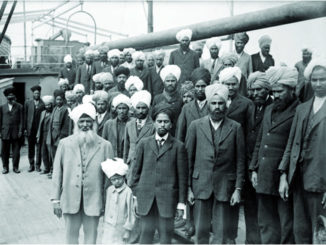
The Komagata Maru incident involved the Japanese steamship Komagata Maru, on which a group of people from British India attempted to immigrate to Canada in April 1914, but most were denied entry and forced to return to Calcutta, where at least 19 people were killed in a clash with British soldiers. IN 2017, the Akal Takht, the highest temporal seat of the Sikhs, accorded the status of martyrs upon those killed in Komagata Maru tragedy.
On May 20, 2016, Canadian Prime Minister Justin Trudeau rendered an apology in Parliament, saying ‘More than a century ago, a great injustice took place.’ This was one of the rare occasions when a sitting public ofcial apologised publicly for a controversial historic event. What he wasapologising for was the SS Komagata Maru incident of 1914, when aship laden with Indian immigrants was refused entry at the Canadian ports.
It was a time when Canada’s immigration policies were an actively racialised endeavour. The objective of the Canadian government was to attract more British and American immigrants, as well as immigrants from the ‘preferred countries’ of central and northern Europe. This strict hierarchy continued till the Second World War, with a more inclusive policy only being adopted in the 1960s.
Suffice it to say, Indians and other ‘Asians’ were on the bottom deck, actively kept out due to Western paranoia about them coming and taking up local jobs and introducing their ‘ways of life.’
As per the Canadian government’s 1908 Continuous Passage Act, all potential immigrants had to make a continuous journey to Canada, with no stops. A later amendment stated that no immigrant of ‘Asiatic’ origin would be permitted unless they were in possession of $200, a signicant sum even today.
Canada at the time was actually seeing a period of increased migration from Europe, with its more direct routes. A journey from law. This was, therefore, just another case of ‘smart discrimination,’ part of a concerted Asian-exclusion policy by the Canadian Government, to keep the ‘unwanted’ out.
Matters came to a head with the Komagata Maru incident.
The story begins in 1913. Gurdit Singh was a well-to-do Sikh contractor from Amritsar, who had also lived variously in south-east Asia. During a visit to Hong Kong in 1913, he came across a large contingent of Sikhs who were looking to immigrate to the United States or Canada.
The ship set sail from Hong Kong on April 4, 1914, with 165 passengers, and more joining in Shanghai and Yokohama. It left Yokohama on May 3 with 376 passengers and sailed into Burrard Inlet, near Vancouver, on May 23. The Canadian authorities, however, citing the policy, refused permission to dock and the passengers were detained on board. A two-month stalemate followed, with negotiations, political manoeuvring and talks taking place. Conditions aboard were abysmal for the passengers, with a shortage of food and water.
‘Shore’ committees were formed to help the passengers with provisions, both food and legal, by Indians in Vancouver. Protest meetings were also held in the city. But on July 23, the ship was forced to turn back, with only 20 people satisfying the authorities to
stay back and the rest having their dreams shattered.
The ship’s departure, however, was just the beginning of the saga though—the passengers faced the iron st of the British authorities, to much more violent ends, on the return voyage.
It was the time when the revolutionary Ghadar movement was sweeping across the Indian diaspora in the USA and Canada. Theleaders planned to return to India and foment a revolution. Clarion calls were sounded across Indian student societies across the Pacic Coast, including California and Oregon, urging Indians to ‘go home’.
The British were not in the dark about what was brewing. They were ell-prepared for it, and the passengers of the Komagata Maru had to bear the brunt of the response. They even passed an ordinance restricting the liberties of any Indian returning to the country after September 5, 1914, and the ship’s passengers were one of the first to be charged. The SS Komagata Maru arrived at the Budge Budge dock in Calcutta on September 27, only to be welcomed by British gunboats at the entry into the port. The passengers were charged as political agitators who had acted illegally. A riot ensued, as the police stepped in to capture Gurdit Singh and other leaders. In the ruckus, 19 passengers were shot and killed, the rest were incarcerated or kept under house arrest until WWI ended. Gurdit Singh escaped, but eventually gave himself up and served a ve-year term.
Komagata Maru was an incident that not only shaped Indian immigration but galvanised Indian nationalism, particularly with the Ghadar movement. The confrontation became a rallying point in a diasporic movement for social justice and a springboard for an international, anti-colonial sentiment.
In 1952, the Indian government erected a monument to the martyrs of Komagata Maru at Budge Budge. September 29 is marked as memorial day when Sikhs visit Budge Budge to pay homage.
While remembered as a dark phase in Canadian history, the story still remains largely forgotten in India.
Source: Live History India
-

Ghadar Movement: The rebels who wrote history
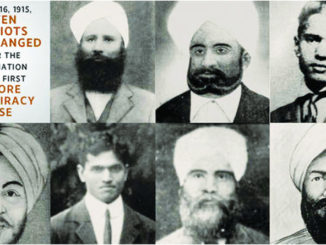
On November 16, 1915, seven patriots were hanged after the culmination of the first Lahore Conspiracy Case. These hangings, however, did not deter the Ghadarites from waging a war against the British. These included Bakshish Singh, Jagat Singh, Vishnu Ganesh Pingle, Surain Singh s/o Boor Singh, Surain Singh s/o Ishar Singh, Harnam Singh and Kartar Singh Sarabha. These trials were to have an enduring impact on the psyche of Punjab and reverberations on India’s history. These hangings by the colonial government were one of the many in order to curb the war declared by the Ghadarites on the colonial government in India in February of 1915.
Events that led to Ghadar
A week after Britain declared war on Germany on August 4, 1914, a clarion call had appeared in Ghadar, a weekly revolutionary newspaper published from San Francisco, summoning its overseas Indian readers to return to their homeland and fight. It said the opportunity to free their country from slavery had arrived.
This was so because Britain was quite vulnerable due to depletion of troops and resources. Also, its arch-enemy Germany was offering support to various revolutionary movements which had the potential of undermining the strength of the Empire. These included the Indian and Irish national revolutionists and the pro-Ottoman pan-Islamists. This was how the Ghadar Movement was launched among the Punjabi migrant workers in North America in 1913. It was characterised by a predominant Punjabi male participation and was a ringing explosion in the ears of the imperial government of the time.
The Ghadar Party was established by the Punjabi Sikhs of the USA and Canada in June 1913 also known as the Hindi Association of the Pacific Coast. The word ‘Ghadar’ means “mutiny” or “rebellion” or “revolt”. On November 1, 1913, the Ghadar Party issued their first newspaper from University of California in Berkeley. This party was originally built around the weekly paper Ghadar. For the first time, a true picture of the British rule was shown in the journal, simultaneously enunciating a vision for the future of India. In fact, the founders envisioned that the Ghadar would do the work of preparing the Indians for revolt until the actual war.
Today, it is important to remember the martyrs and the specific conditions that led the erstwhile loyal ‘Sikhs’ to turn against their imperial benefactors. At the heart of the movement was the Punjabi farmer-soldier-turned-labourer abroad, driven out by the accretion of economic problems at home.
In the decade before the seeds of this large-scale unrest were sown by the imperial government in Punjab, the agrarian legislation, the colonisation Bill, issues of water rates and enhancement of land revenue had largely contributed to Punjabi men being forced to migrate in search of economic opportunities. At the same time the Indian National Association, the Indian National Congress, the Swadeshi Movement and the activities of Zamindara League (Unionist Party) had contributed to the political awakening of the Punjabis.
The Sikh connection
It is a curious question of history as to how the Sikh community in Punjab which was given the distinction of being a ‘martial race’ by the British, turned around to demand complete independence and plan a violent stratagem against their benefactors. The spectacular display of material prosperity, the spring of freedom in the steps of white people and the opportunities of economic mobility in the USA and Canada led the pioneer migrants to understand their own depravity induced by slavery to an imperial power. The white Canadians and Americans believed that they belonged to a superior and civilised race whereas Indians and other Asians were considered uncivilised.
During the first decade of the 20th century, 5,000 Indians reached Canada. Out of these more than 90 per cent were Sikhs. The harsh racial differentiation, violent attacks by white labourers and hoodlums led to a feeling of humiliation and shame among these Indian migrants. They believed they were subjected to this treatment because they were citizens of a slave nation. The British at that time did not want Indians associating or interacting with white people. This led to measures being taken by the Canadian government, then a colony of Britain, discouraging immigration from India. The freedom offered by these countries to the migrants propelled the transition to a demand for a more just social order.
These socio-political conditions led to the birth of the Ghadar Party, a party that gave expression to the evolved understanding of the repercussions of colonial rule in India. Although strict interpretation of its character is difficult without being unfair to its secular participants, numerically the Ghadar was largely a Sikh movement. The Komagata Maru incident was the final spark that ignited an already inflamed Sikh pride. The aftermath of this incident was a burst of revolutionary activity in the migrant Sikhs to redeem themselves from both the shame of allegiance to the British government in 1857 and their own cursed status as a slave nation.
Literary legacy
The Ghadar was no ordinary movement neither in its scope of influence nor its tactics. Maia Ramnath has observed in her book, Haj to Utopia that the Ghadar’s printed material served as connective tissue or switching circuit, capable of linking various elements among the Indian radicals abroad. It also linked Indian radicals to other networks, and also connected pre to post-war revolutionary movements inside the country. This movement in its overall assessment has been termed as a “heroic failure” by Ghadar historian Harish K Puri. Although it largely failed to impact the colonial government in ways its members had originally anticipated, its cultural reach extends to this day.
The literature of Ghadarites was strikingly separate from any talk of fatalism. Instead it spoke to the higher ideal in men while looking at the ultimate fate in its eye. It remains a shiny reminder of the refusal of a population which formed the spine of the military prowess of the colonisers to yield to exploitation, a doomed attempt of unthinkable courage and splendid patriotism. It is a story of our forefathers which merits remembrance and retelling.
The Ghadar Movement was the first Indian movement with truly global linkages that effectively kick-started the movement of immigrants for equal rights and consolidated the integration of migrants into their new nations. It needs to be remembered that the participants being largely Sikh, the ideas of egalitarianism, sacrifice, service and martyrdom formed the bedrock of the political thinking of this and the later resistance movements in the region.
A struggle like Ghadar which failed in its overall objective and did not gain the large-scale support of the citizenry has a tendency to be relegated into historical insignificance. However, this is the exact reason why it must be remembered that not every battle is about victory.
Parallels can be drawn with the widespread desire of today’s Punjabi youth for migration abroad. The fact that it speaks volumes about the socio-economic conditions here is not lost to anyone. The demand for fair migratory opportunities is a prominent legacy of the Ghadar.
The rejection of sectarianism, calling out for social justice and demand for a just society, are vestiges of its cultural impact. In line with Kartar Singh Sarabha’s daring conviction ‘the blood of martyrs never goes waste’, the failure of the Ghadar Movement proved to be a landmark in the struggle for freedom. It inspired the likes of Bhagat Singh who considered Kartar Singh Sarabha his role model towards a revolutionary change. It will be right to conclude that the dreams of these primal modern revolutionaries must be remembered on the day of their martyrdom to serve as a light post for the future we aspire to as a society and a country and to forever be grateful.
Source: The Tribune