Tag: Medicare

  • Kamala Harris accepts historic presidential nomination, pledging to be the President for all Americans

    Kamala Harris accepts historic presidential nomination, pledging to be the President for all Americans

    Says election offers “fleeting opportunity” to move past “bitterness, cynicism”

    Indrajit Saluja

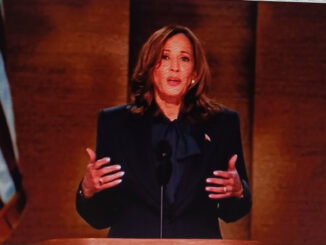
    CHICAGO, August 23,  (TIP): Vice President Kamala Harris officially accepted the Democratic presidential nomination Thursday, August 23, promising to be “the president for all Americans”. “I will be a president who unites us around our highest aspirations”, she pledged.

    Framing the upcoming election as an opportunity for the nation to “chart a new way forward” , she encouraged voters to write the “next great chapter in the most extraordinary story ever told.”

    “As a prosecutor, when I had a case, I charged it not in the name of the victim, but in the name of the people. For a simple reason, in our system of justice, a harm against any one of us is a harm against all of us. And I would often explain this to console survivors of crime, to remind them, no one should be made to fight alone. We are all in this together, and every day in the courtroom, I stood proudly before a judge, and I said five words, “Kamala Harris, for the people”. And to be clear, my entire career, I’ve only had one client, the people, and so on behalf of the People, on behalf of every American, regardless of party, race, gender or the language your grandmother speaks, on behalf of my mother and everyone who has ever set out on their own unlikely journey, on behalf of Americans like the people I grew up with, people who work hard, chase their dreams and look out for one another, on behalf of everyone whose story could only be written in the greatest nation on Earth, I accept your nomination, President of the United States of America.”

    Harris makes history as the first Black woman to lead a major party’s presidential ticket, and her remarks closed out the final day of the Democratic National Convention in Chicago.

    Promising to be the President for all Americans, Harris said “ and with this election, our nation has a precious, fleeting opportunity to move past the bitterness, cynicism and divisive battles of the past, a chance to chart a new way forward, not as members of any one party or faction, but as Americans, and let me say, I know there are people of various political views watching tonight, and I want you to know I promise to be a president for all Americans, you can always trust me to put country above party and self, to hold sacred America’s fundamental principles, from the rule of law to free and fair elections to the peaceful transfer of power.

    Democratic Convention in Chicago, August 22, 2024.

    Harris kicked off her speech by offering her thanks to President Biden, calling his character “inspiring,” and she predicted history would look favorably upon his record in office.

    “Let us show each other and the world who we are and what we stand for: freedom, opportunity, compassion, dignity, fairness and endless possibilities,” she said. “We are the heirs to the greatest democracy in the history of the world and on behalf of our children and our grandchildren and all of those who sacrificed so dearly for our freedom and liberty, we must be worthy of this moment.”

    “We are charting, and we are charting a new way forward, forward to a future with a strong and growing middle class, because we know a strong middle class has always been critical to America’s success, and building that middle class will be a defining goal of my presidency”, Harris said.

    “As President, I will bring together labor and workers and small business owners and entrepreneurs and American companies to create jobs, to grow our economy and to lower the cost of everyday needs like health care and housing and groceries. We will provide access to capital for small business owners and entrepreneurs and founders, and we will end America’s housing shortage and protect Social Security”.

    “As a young courtroom prosecutor in Oakland, California, I stood up for women and children against predators who abused them. As Attorney General of California, I took on the big banks, delivered $20 million for middle class families who faced foreclosure and helped pass a homeowner bill of rights, one of the first of its kind in the nation.”

    “I stood up for veterans and students being scammed by big for-profit colleges who are workers who are being cheated out of their wages, the wages they were due for seniors facing elder abuse. I fought against the cartels who traffic in guns and drugs and human beings who threaten the supply security of our border and the safety of our communities. And I will tell you, these fights were not easy, and neither were the elections that put me in those offices. We were underestimated at practically every term, but we never gave up, because the future is always worth fighting for, and that’s the fight we are in right now, a fight for America’s future. Fellow Americans, this election is not only the most important of our lives, it is one of the most important in the life of our nation, in many ways”.

    Lambasting her opponent Donald Trump, Harris said, “ Donald Trump is an unserious man. But the consequences of putting Donald Trump back in the White House are extremely serious. Consider not only the chaos and calamity when he was in office, but also the gravity of what has happened since he lost the last election. Donald Trump tried to throw away your votes. When he failed, he sent an armed mob to the United States Capitol, where they assaulted law enforcement officers when politicians in his own party begged him to call off the mob and send help. He did the opposite. He fanned the flames and now for an entirely different set of crimes, he was found guilty of fraud by a jury of everyday Americans, and separately found Bible through committing sexual abuse and consider what he intends to do if we give him power again, consider his explicit intent to set free violent extremists who assaulted those law enforcement officers at the Capitol, his explicit intent to jail journalists, political opponents and anyone he sees as the enemy, his explicit intent to deploy our active duty military against our own citizens. Consider the power he will have, especially after the United States Supreme Court just ruled that he would be immune from criminal prosecution. Just imagine Donald Trump with no guard rails and how he would use the immense powers of the presidency of the United States, not to improve your life, not to strengthen our national security, but to serve the only client he has ever had- himself. And we know what a second Trump term would look like. It’s all laid out in Project 2025, written by his closest advisors, and its sum total is to pull our country back to the past, but America, we are not going back. We are not going back. We are not going back. We are not going back to when Donald Trump tried to cut Social Security and Medicare. We are not going back to when he tried to get rid of the Affordable Care Act, when insurance companies could deny people with preexisting conditions. We are not going to let him eliminate the Department of Education that funds our public schools, and we are not going to let him end programs like Head Start that provide preschool and childcare for our children. America, we are not going back.”

    “Now compare that to Donald Trump. I think everyone here knows he doesn’t actually fight for the middle class, no, he doesn’t actually fight for the middle class. Instead, he fights for himself and his billionaire friends, and he will give them another round of tax breaks that will add up to $5 trillion to the national debt. And all the while, he intends to enact what in effect is a national sales tax, call it a Trump tax, that would raise prices on middle class families by almost $4,000 a year. Well, instead of a Trump tax hike, we will pass a middle-class tax cut that will benefit more than 100 million Americans friends, I believe America cannot truly be prosperous unless Americans are fully able to make their own decisions about their own lives, especially on matters of hearth and home.”

    Harris criticized Trump’s nationwide abortion ban, taking away the rights of women to have control over their bodies. She said it needed to be reversed. “And when Congress passes a bill to restore reproductive freedom, as President of the United States, I will proudly sign it into law.”

    “In this election, many other fundamental freedoms are at stake, the freedom to live safe from gun violence in our schools, communities and places of worship, the freedom to love who you love openly and with pride, the freedom to breathe clean air and drink clean water and live free from The pollution that fuels the climate crisis and the freedom that unlocks all the others, the freedom to vote. With this election, we finally have the opportunity to pass the John Lewis Voting Rights Act and the freedom to vote.”

    “And let me be clear, after decades in law enforcement, I know the importance of safety and security, especially at our border last year, Joe and I brought together Democrats and conservative Republicans to write the strongest border bill in decades. The Border Patrol endorsed it, but Donald Trump believes a border deal would hurt his campaign, so he ordered his allies in Congress to kill the deal….. And here is my pledge to you as President, I will bring back the bipartisan border security bill that he killed, and I will sign it into law. I know we can live up to our proud heritage as a nation of immigrants and reform our broken immigration system. We can create an earned pathway to citizenship and secure our border and America.

    We must also be steadfast in advancing our security and values abroad. As Vice President, I have confronted threats to our security, negotiated with foreign leaders, strengthened our alliances, and engaged with our brave troops overseas. As Commander in Chief, I will ensure America always has the strongest, most lethal fighting force in the world, and I will fulfill our sacred obligation to care for our troops and their families, and I will always honor and never disparage their service and their sacrifice, I will make sure that We lead the world into the future on space and artificial intelligence, that America, not China, wins the competition for the 21st century, and that we strengthen, not abdicate our global leadership. Trump, on the other hand, threatened to abandon NATO. He encouraged Putin to invade. Our allies said Russia could do whatever the hell they want. Five days before Russia attacked Ukraine, I met with President Zelensky to warn him about Russia’s plan to invade, I helped mobilize a global response over 50 countries to defend against Putin’s aggression. And as President, I will stand strong with Ukraine and our NATO allies”.

    “With respect to the war in Gaza, President Biden and I are working around the clock, because now is the time to get a hostage deal and a cease fire deal done.

    And let me be clear. And let me be clear, I will always stand up for Israel’s right to defend itself, and I will always ensure Israel has the ability to defend itself, because the people of Israel must never again face the loss that a terrorist organization called Hamas caused on October 7. At the same time, what has happened in Gaza over the past 10 months is devastating. So many innocent lives lost, desperate, hungry people fleeing for safety. Over and over again, the scale of suffering is heartbreaking. President Biden and I are working to end this war so that Israel is secure, the hostages are released, the suffering in Gaza ends, and the Palestinian people can realize their right to dignity, security, freedom and self-discrimination, And know this, I will never hesitate to take whatever action is necessary to defend our forces and our interests against Iran and Iran backed terrorists. I will not cozy up to tyrants and dictators like Kim Jong Un who are rooting for Trump. Because, you know, they know, he is easy to manipulate with flattery and favors. They know Trump won’t hold autocrats accountable because he wants to be an autocrat himself.
    And as President, I will never waver in defense of America’s security and ideals, because in the enduring struggle between democracy and tyranny, I know where I stand and I know where the United States belongs”.

    “We are the heirs to the greatest democracy in the history of the world, and on behalf of our children and our grandchildren and all those who sacrificed so dearly for our freedom and liberty, we must be worthy of this moment. It is now our turn to do what generations before us have done, guided by optimism and faith, to fight for this country we love, to fight for the ideals we cherish and to uphold the awesome responsibility that comes with the greatest privilege on Earth, the privilege and pride of being an American.”

    “So, let’s get out there. Let’s fight for it. Let’s get out there. Let’s vote for it, and together, let us write the next great chapter in the most extraordinary story ever told”, concluding her speech, she said.


  • Why Has Obamacare Worked?

    Why Has Obamacare Worked?

    “In its early years, Obamacare was the subject of fierce criticism from both the left and the right. Actually, as I pointed out in my most recent column, politicians on the right are still saying the same things they said a decade ago, pretending that their predictions of doom haven’t been falsified by events. But Obamacare has survived, greatly expanding health insurance coverage without busting the budget. Critics on the left complain that it hasn’t produced truly universal health care, which indeed it hasn’t. But it has done a lot and has become quite popular.”

    By Paul Krugman

    We’ve just passed the 14th anniversary of the enactment of the Patient Protection and Affordable Care Act, a.k.a. the Affordable Care Act, a.k.a. Obamacare — although many of the law’s provisions didn’t take effect until 2014.

    In its early years, Obamacare was the subject of fierce criticism from both the left and the right. Actually, as I pointed out in my most recent column, politicians on the right are still saying the same things they said a decade ago, pretending that their predictions of doom haven’t been falsified by events. But Obamacare has survived, greatly expanding health insurance coverage without busting the budget. Critics on the left complain that it hasn’t produced truly universal health care, which indeed it hasn’t. But it has done a lot and has become quite popular:

    So why has Obamacare worked as well as it has?

    The thing is, critics of Obamacare from the left have a point. If your goal is to give people access to health care, why not just give them access by instituting a single-payer system in which the government pays the bills? This was, in fact, what we did for seniors when Medicare was created in the 1960s.

    The A.C.A., however, created a complicated system in which people have to buy their own insurance, although in many cases the government picks up much of the tab. And the complexity of the system, combined with the fact that important parts of it are run by state governments, some of which are controlled by conservatives who want Obamacare to fail, means that a lot of people fall through the cracks: 8 percent of the U.S. population is still uninsured, although that’s a lot better than the pre-A.C.A. situation:

    Why, then, didn’t we go for single-payer? Politics. It wasn’t just a matter of buying off the insurance industry by keeping it at the center of American health care, although that was part of it. More important, I believe, was the perceived need to avoid disturbing Americans happy with their existing health coverage, mostly those getting insurance via their employers. Rather than reforming our whole health insurance system, Obamacare sought to fill the holes in our system by adding stuff. In particular, it tried to create a working marketplace in which individuals not covered by their employers could find affordable health insurance.

    Many people, especially but not only on the right, expected this effort to fail. I don’t want to get too deep into the weeds here, but the A.C.A. prohibited insurers from denying coverage or charging higher premiums to people with existing medical conditions. This kind of regulation can cause a death spiral: Too few healthy people buy insurance, so the risk pool gets worse, which drives up premiums, which drives out still more relatively healthy people and so on.

    Initially, the A.C.A. included a mandate — a penalty on Americans who didn’t have insurance — but it’s not clear how effective the insurance mandate ever was, and Republicans eliminated the penalty in 2017.

    Yet Obamacare didn’t collapse. Why not?

    Here’s how I’d put it: In practice, Obamacare has ended up functioning a lot like a single-payer system after all — and such systems aren’t subject to death spirals.

    First, a large part of the rise in health coverage came from an expansion of Medicaid, the government health insurance for lower-income Americans — single-payer, although less generous than Medicare:

    Second, individual purchase of insurance on the A.C.A.-created marketplaces is subsidized. In fact, last year 91 percent of marketplace enrollees were receiving so-called premium tax credits. In many cases these credits cover a large part of individuals’ premiums. Also, crucially, the subsidies don’t take the form of lump-sum credits. Instead, the law specifies a maximum percentage of income that enrollees can pay for insurance (that percentage depends on your income) and makes up the difference if premiums exceed that maximum.

    This isn’t single-payer, exactly, but it does mean that the government is the marginal payer, in the sense that even if premiums rise, most people don’t pay more; the government picks up the extra bills. This, in turn, means that a death spiral basically can’t happen, because even if healthy people drop their insurance, costs for most enrollees don’t rise.

    This is smart policy design; among other things, it protects the A.C.A. from hostile politicians. Soon after taking office in 2017, Donald Trump declared that “the best thing politically is to let Obamacare explode.” And while his attempt to repeal the law failed, his administration engaged in acts of sabotage, in effect trying to induce a death spiral. But the subsidies frustrated this plan. In 2019 I asked Nancy Pelosi about how politicians like her had interacted with the clever policy wonks who devised such a robust system. “I am a wonk,” she replied.

    Obamacare, then, has defied the doomsayers. But what about warnings that it would prove unsustainably costly? As I noted in the column, federal spending on health care is currently considerably lower than the Congressional Budget Office projected before the A.C.A. went into effect, despite the expansion of coverage. How was this possible?

    Part of the answer is that before Obamacare went into effect, the uninsured in America consisted disproportionately of relatively young adults — and the health costs of younger people are, on average, much lower than those of seniors (who were already covered by Medicare). So, covering many of the uninsured was never going to cost all that much, unless the policy design was fatally flawed, which it wasn’t.
    We don’t know exactly why this happened. The A.C.A. contained a number of measures intended to control costs, which may partly explain the bending of the curve. It’s worth noting, however, that health costs have leveled off across the advanced world. It’s possible that the direction of technological progress in medicine has shifted, generating fewer ways to treat the previously untreatable and more ways to deliver care more cheaply. And to some extent, we may be seeing the effects of Stein’s Law: If something cannot go on forever, it will stop. Health spending couldn’t absorb an ever-growing share of national income, so at a certain point insurers and providers began to take cost control seriously.

    In any case, Obamacare has worked. It didn’t provide universal coverage, but it did provide health insurance to millions of Americans, some of whom desperately needed that safety net, and it did so without breaking the bank. Predictions that the A.C.A. would be unworkable have been proved wrong. At this point, the only serious threat the program faces — and it is a serious threat — is political: People who kept insisting, wrongly, that health care reform would die of its own accord may simply step in to kill it.
    ( Source: New York Times. Paul Krugman is an Opinion Columnist with New York Times. He is also a distinguished professor at the City University of New York Graduate Center. He won the 2008 Nobel Memorial Prize in Economic Sciences for his work on international trade and economic geography. @PaulKrugman)

  • Joe Biden to urge 25% billionaire tax, levies on rich investors

    Joe Biden to urge 25% billionaire tax, levies on rich investors

    President Joe Biden is proposing a series of new tax increases on billionaires, rich investors and corporations in his latest proposal for how Congress should prioritize taxes and spending.
    Biden’s budget request to Congress, which is slated to be released Thursday, calls for a 25% minimum tax on billionaires, according to a White House official familiar with the proposal who declined to be named because the plan is not yet public. The plan would also nearly double the capital gains tax rate for investment to 39.6% from 20% and raise income levies on corporations and wealthy Americans.
    The proposal, which is largely a reprise of Biden’s multi-trillion dollar Build Back Better economic package, has little chance of passing Congress, particularly now that Republicans control the House of Representatives. Biden was unable to pass similar tax increases when Democrats enjoyed control of both chambers of Congress, instead settling for slimmed down legislation focusing on energy and health policy known as the Inflation Redution Act.
    But the White House’s proposal foreshadows both Democrats’ strategy ahead of high-stakes negotiations over the debt ceiling and government spending later this year, as well as the economic platform underpinning an expected Biden reelection campaign. Administration officials argue that the proposals show a commitment to cutting the deficit — projecting that Biden’s budget would slash $3 trillion largely through increased revenues over the next decade — and represent a politically popular return to tax levels in place before former President Donald Trump’s tax reform legislation. Taxes on the wealthy and large corporations have been a rallying cry for progressives for years and polls repeatedly show they are favored by a majority of Americans.
    House Speaker Kevin McCarthy immediately dismissed Biden’s plans to increase levies, telling reporters Wednesday “I do not believe raising taxes is the answer.”
    The Biden proposal would require that the richest 0.01% of Americans pay at least a 25% tax rate. It would also increase the top tax rate for Americans making $400,000 to 39.6% from 37%, reversing one of Trump’s tax cuts — though tax rates for those making below that amount would remain untouched. It additionally calls for investors making at least $1 million to pay that 39.6% on their long-term investments, which are currently taxed at a 20% rate. The proposal would increase the corporate tax rate to 28% from 21%, undoing another signature Trump tax change. It would also eliminate a loophole that business owners and higher-earners can exploit to avoid paying levies for the Medicare Hospital Insurance Trust Fund on more of their income. White House officials so far have not indicated that Biden’s budget includes new Social Security payroll taxes on wages above $400,000, which some Democrats have proposed to shore up the program.
    Biden is also calling for an end to valuable industry-specific tax breaks for private equity fund managers, oil companies, as well as investors in crypto and real estate, in his upcoming budget proposal, according to a summary of the plan. Eliminating these would upend the economics of many real estate and investment-fund deals — forcing Wall Street to reinvent the way that many transactions have been done for decades — if they were to become law. Source: Bloomberg

  • Indian American doctor Aarti D. Pandya pays $1,850,000 for violating  the False Claims Act

    Indian American doctor Aarti D. Pandya pays $1,850,000 for violating the False Claims Act

    ATLANTA (TIP): An Indian American doctor has agreed to pay approximately $1,850,000 for allegedly billing the government for cataract surgeries and diagnostic tests that were not medically required.

    Aarti D. Pandya and her Pandya Practice Group violated the False Claims Act by also performing and billing for tests that were incomplete or of worthless value, and office visits that did not provide the level of service claimed.

    “Physicians who perform procedures and tests without a legitimate medical need place profits ahead of patients and subject those patients to unnecessary risk,” told US Attorney Ryan K Buchanan in a statement released on Monday. “This settlement represents our office’s commitment to ensuring accountability for physicians who subject patients to unwarranted medical care and waste taxpayer funds,” Buchanan said.

    From January 1, 2011, to December 31, 2016, Pandya knowingly submitted false claims to federal healthcare programs for medically unnecessary cataract extraction surgeries and YAG laser capsulotomies, according to a Justice Department release.

    The prosecution alleged that Pandya performed these procedures on patients that did not qualify for the procedure under accepted standards of medical practice and, in some cases, caused injury to her patients.

    Additionally, it accused Pandya of falsely diagnosing patients with glaucoma to justify unnecessary diagnostic testing and treatment that was billed to Medicare.

    The prosecution also said that many of the diagnostic tests that Pandya ordered were not properly performed, were performed on a broken machine, or were not interpreted in the medical record, as required by Medicare.

    The Department of Health and Human Services (HHS) imposed in 2019 a payment suspension on the Pandya Practice Group that precluded it from receiving any reimbursement from Medicare for Part B claims.

    As part of the settlement of the government’s claims in this case, the Pandya Practice Group agreed to forfeit the suspension amount to the government. The payment suspension will also be lifted as part of the settlement.

    To protect federal healthcare programs and beneficiaries going forward, Pandya and the Pandya Practice Group have entered into a detailed, multi-year Integrity Agreement and Conditional Exclusion Release (IA) with the Office of Inspector General. “We must assure patients and taxpayers that healthcare is dictated by clinical needs, not fiscal greed,” said Keri Farley, Special Agent in Charge of FBI Atlanta. “This settlement should serve as a reminder that the FBI will not tolerate healthcare providers who engage in schemes that defraud the industry and put innocent patients at risk.”

  • Indian-American Helps with Life Saving Medication during Hurricane Harvey

    Indian-American Helps with Life Saving Medication during Hurricane Harvey

    HOUSTON, TX (TIP):   When a Texas hospital called to request a rare disease medication, an Indian-American CEO of a pharmacy firm got it shipped by to Houston from Orlando by sending his employee to pick it up as all logistics company were unable to deliver overnight due to Hurricane Harvey.

    Harish Katharani, founder and CEO of Southside Group of Companies, explained Impavido – only oral treatment drug used for critically ill patients with Leishmaniasis – costs about USD 49,000 and hence is not readily stocked by pharmacies.

    Mr. Kathrani sent one of his employee to get the drug shipped to Texas Children’s Hospital in the midst of Harvey, the most powerful hurricane to hit the US mainland in 13 years. Harvey has left a trail of destruction across Texas, pummeling the region with heavy rains. Around 13 million people have been battling “catastrophic” flooding in Texas.

    In another incident, Medicare Advantage provider TexanPlus contacted Southside’s Texas Medical Centre to inquire if the firm could provide services to their patients during the hurricane weekend.

    Despite not being contracted by this health maintenance organization, Southside readily volunteered to provide healthcare services to their patients during this crisis.

    TexanPlus circulated an internal memo letting their case workers know about Southside’s availability during Hurricane Harvey.

    The Indo-American Chamber of Commerce of Greater Houston’s Executive Director Jagdip Ahluwalia stated that he was proud that one of their Chamber members was going above and beyond the call of duty to serve the community in this hour of need.

    Southside is a pharmacist owned and operated company established in 1992. They ship specialty medication to over 35 states. Their pharmacies will remain open during the weekend’s regular hours but their pharmacist and nurses are on call 24/7 to help Texans tide over the troubles case by the hurricane.

    Mr. Katharani, who came to the US in 1972, is a generous donor to various charitable organizations such as MS Society, Hep-C Clinic, Liver Foundations as well as to Cancer and HIV research institutions.

  • Indian-American Doctor, Wife to Pay $1.2 Million to Settle Fraud Charges

    Indian-American Doctor, Wife to Pay $1.2 Million to Settle Fraud Charges

    JOHNSON CITY (TIP): A prominent Indian-American doctor and his wife have agreed to pay USD 1.2 million to settle allegations of prescribing unapproved drugs in the US.

    Anindya Sen, 68, owns two cancer centers in Greeneville and Johnson City in Tennessee. His wife Patricia Posey Sen, 69, managed his medical practice from 2009 through 2012.

    The couple allegedly profited by administering cheaper unapproved drugs, Department of Justice said.

    They will pay USD 1.2 million to resolve state and federal False Claims Act allegations that their medical practice billed Medicare and Tennessee Medicaid for anti-cancer and infusion drugs that were produced for sale in foreign countries and not approved by the Food and Drug Administration (FDA) for marketing in the US, it said.

    “Billing for foreign drugs that are not approved by the FDA undermines federal healthcare programs and could potentially risk patient safety,” said Acting Assistant Attorney General Chad Readler of the Justice Department’s Civil Division.

    The government alleged that the unapproved drugs that the Sens provided to patients and billed to Medicare were not reimbursable under those programs.

    It is further alleged that the Sens purchased unapproved drugs because they were less expensive than the drugs approved by FDA for marketing in the US.

    Claims settled by this agreement are allegations only and there has been no determination of liability, the Justice Department added.

    (Source: PTI)

  • Indian American Seema Verma sworn in as Healthcare Chief

    Indian American Seema Verma sworn in as Healthcare Chief

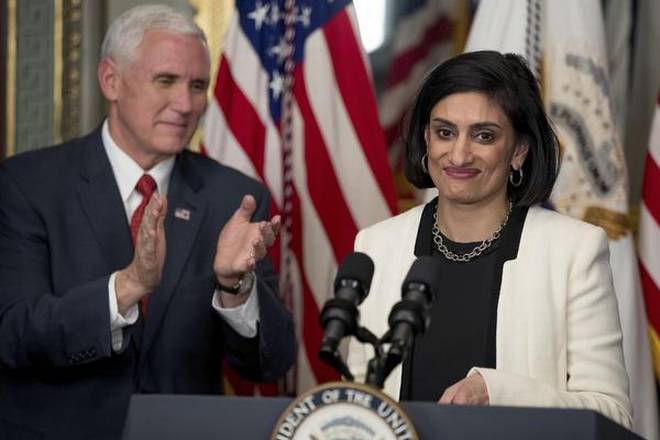
    WASHINGTON (TIP): Indian-American healthcare consultant Seema Verma, on March 14, was sworn-in as the head of a key healthcare agency in the Donald Trump administration. The Senate on March 13 confirmed Verma as administrator of the Centers for Medicare & Medicaid Services (CMS) in a 55-to-43 vote. She was sworn in by U.S. Vice President Mike Pence as administrator of CMMS, which is part of the Department of Health and Human Services and oversees the Obamacare insurance markets, Medicare, and Medicaid.

    “President Donald Trump has chosen one of the leading experts in America on state-based healthcare solutions to lead this important agency,” Vice President Pence said at the swearing-in ceremony at the White House. On November 29, 2016, President-elect Donald Trump nominated Verma to serve as administrator of the CMMS.

    Verma is the founder and CEO of SVC Inc., a health policy consulting firm. She is president and CEO of the company, which has worked with the states of Indiana, Iowa, Kentucky, Maine, Michigan, Ohio, and Tennessee. In preparation for the implementation of Obamacare, Verma and SVC Inc. have worked with state insurance agencies and public health agencies to redesign their Medicaid programs. She developed Medicaid reform programs, including waivers, for Ohio, Kentucky, and Iowa. Her firm provided technical assistance to the state of Michigan in the implementation of their Section 1115 Medicaid waiver. SVC also assisted Tennessee in their coverage expansion proposal and supported Iowa’s Medicaid transition to managed care.

    Following the passage of Obamacare, Verma worked with Indiana Governor Mitch Daniels on health care policy. She was the architect of the Healthy Indiana Plan. The health insurance program, designed for people with low income, requires participants to pay into a health savings account and has high deductibles.[3] According to Verma, “you have to make your contribution every month, with a 60-day grace period. If you don’t make the contribution, you’re out of the program for 12 months. It’s a strong personal responsibility mechanism.” The Healthy Indiana Plan received support from the Indiana legislature and passed into law in January 2008. She later created the related “HIP 2.0” under Governor Mike Pence.

    Prior to consulting, Ms. Verma served as Vice President of Planning for the Health & Hospital Corporation of Marion County and as a Director with the Association of State and Territorial Health Officials (ASTHO) in Washington D.C.

  • Indian Americans Dipal Doshi, Sachin Jain, Rupal Patel named Aspen Institute Health Innovators Fellows

    Indian Americans Dipal Doshi, Sachin Jain, Rupal Patel named Aspen Institute Health Innovators Fellows

    WASHINGTON (TIP): Indian Americans Dipal Doshi, Sachin Jain and Rupal Patel were among 21 healthcare leaders named to the second annual Aspen Institute Health Innovators Fellowship.The institute announced the Fellows in a July 12 statement.

    The Fellows will participate in a two-year Fellowship designed to strengthen the leadership of innovators across the U.S. healthcare ecosystem and challenge them to create new approaches that will improve the health and well-being of all Americans, Aspen Institute said in a news release.

    The Fellows come from various industries and sectors throughout the country, including medicine, pharmaceuticals, public health, biotechnology, insurance, mental health, government, venture capital and genomics, among others.

    “I am delighted to welcome this talented and inspiring group of healthcare leaders with a track record of accomplishments and the potential for even greater contributions in the future,” said fellowship managing director Rima Cohen in a statement. “The Fellows bring a diverse set of life experiences and skills to their work; we’re thrilled to be able to give them a platform from which they can harness their energy and expertise to tackle our nation’s most pressing health care challenges.”

    Dipal Doshi, Rupal Patel and Sachin Jain have been named to the second annual Aspen Institute Health Innovators Fellowship
    Dipal Doshi

    Doshi is the chief business officer at Princeton, N.J.-based Amicus Therapeutics Inc. He also serves as the general manager of Scioderm, Inc., a rare disease company Amicus acquired in 2015.

    Prior to joining Amicus, Doshi founded RStreet Advisors, a healthcare consulting firm through which he advised pharmaceutical, biotech and diagnostics companies on business development, corporate strategy and market and commercial planning.

    From 2008 to 2013, Dipal was the senior vice president and member of the management team  Auvenat Therapeutics, a global private equity and bio-pharmaceutical development company. He received a B.A. from Rutgers University and an M.B.A. from The Wharton School of Business at the University of Pennsylvania.

    Jain is the chief executive officer of Los Angeles-based CareMore Health System, an innovative health plan and care delivery system with $1.2 billion in revenue and over 100,000 members in eight states.

    He is also a consulting professor of medicine at the Stanford University School of Medicine and a contributor at Forbes.

    Jain was previously CareMore’s chief medical officer and chief operating officer. Prior to joining CareMore, Jain was chief medical information and innovation officer at Merck & Co. He also served as an attending physician at the Boston VA-Boston Medical Center and was on faculty at Harvard Medical School and Harvard Business School.

    Additionally, from 2009 to 2011, Jain worked in the Obama administration, where he was senior adviser to Donald Berwick when he led the Centers for Medicare and Medicaid Services.

    He was the first deputy director for policy and programs at the Center for Medicare and Medicaid Innovation, and he was special assistant to David Blumenthal when he was the National Coordinator for Health Information Technology.

    Sachin Jain
    Sachin Jain

    Jain graduated from Harvard College with a bachelor’s degree in government and earned his M.D. from Harvard Medical School and M.B.A. from Harvard Business School.

    Patel is the founder and president of Boston, Mass.-based VocaliD Inc., a speech technology company that creates custom voices for text-to-speech applications, leveraging its crowdsourced Human Voicebank (See India-West’s profile here: http://bit.ly/2agVQhR.) VocaliD’s award-winning technology has been featured on TED and NPR and in leading news and technology outlets such as The Wall Street Journal, Wired, Bloomberg and BuzzFeed.

    She is currently on leave from Northeastern University where she is a tenured professor in the College of Computer and Information Science and the Department of Communication Sciences and Disorders. Her research focuses on speech motor control in healthy talkers and those with neuromotor speech impairment.

    Patel also holds appointments in the Harvard/MIT Speech and Hearing Biosciences and Technology program, the Department of Psychiatry at University of Massachusetts, and Haskins Laboratory at Yale University.

    She earned her bachelor’s degree from the University of Calgary, her master’s and doctorate degrees from the University of Toronto and she completed her post-doctoral training at MIT.

    The Health Innovator Fellows will spend four weeks over the course of two years exploring their leadership, core values, desired legacies and their vision for the healthcare system.

    Each Fellow commits to launching a leadership venture that will stretch and challenge them and have a positive impact on health care in the U.S. The Health Innovator Fellows join more than 2,200 other entrepreneurial leaders from 49 countries to become members of the Aspen Global Leadership Network.

  • Indian American-Led “Democrats for Truth” Attacks Ami Bera

    Indian American-Led “Democrats for Truth” Attacks Ami Bera

    Congressman Ami Bera, running for reelection in the state of California has come under attacks by his own party men, this time, surprisingly by a group led by an Indian American, “Sacramento Democrats For Truth.” Led by Amar Shergill, a former Bera supporter an Indian-American, the new group has launched an attack on Rep. Ami Bera, D-California, on grounds he has “refused” to provide documentation about his overseas trips and that donors to his campaign had overseas interests.

    Bera’s support among local Democrats in his district suffered a blow when local unions refused to endorse him for his vote in favor of President Obama’s Trans Pacific Partnership trade pact. Bera is now relying on getting enough support at the state party convention Feb. 26-28, to get re-nominated for his third term race. He is unopposed.

    California’s District 7 is almost equally divided along party lines and has a significant uncommitted voter base, has proved a tough seat and Bera has won with small margins. Republicans have targeted the district for takeover.

    Ami Bera won reelection over a year ago with a razor thin margin. Now with strong opposition from both Democrats, Labor Unions and Republicans, his reelection bid in the November 2016 election has come to be recognized as even harder. The National Republican Congressional Committee’s (NRCC) ad has tried to distort Bera’s record of finding bipartisan solutions and protecting and strengthening Medicare and defending against efforts to privatize Social Security.

    “Congressman Ose’s DC Republican backers are just repeating the same tired old lies,” said Bera spokesperson Allison Teixeira. “They are resorting to more misleading attacks to try to distract voters from Ose’s partisan record of voting with his political party nearly 95 percent of the time while helping enrich himself and his Wall Street friends, and voting to privatize Social Security.”

    According to Rep. Bera’s website, Bera has a clear record of finding bipartisan solutions to our nation’s challenges as a leader of the Problem Solvers’ No Labels coalition, and is one of the most moderate members of Congress. He is also an ardent defender of Social Security and Medicare, recently announcing the support of the National Committee to Preserve Social Security and Medicare (NCPSSM) and the Alliance for Retired Americans (ARA) because he has been “a leader in the fight to preserve and protect Social Security and Medicare,” and has “a proven record of fighting plans that would end the Medicare guarantee for our seniors.”

    In a press release, the Sacramento Democrats For Truth said that despite requests from some party delegates, Bera “has refused to provide documents describing payments for his overseas trips, with whom he meets and his political contributors with more than $1 million in assets overseas.” The group said they had gone through Bera’s campaign finance filings, and remain “troubled by contributions from those that appear to be closely connected to foreign investment funds and foreign nations.”

    Bera calls the accusations unfounded and that all regulations relating to foreign trips had been complied with and quarterly filings with the Federal Elections Commission were public. Even Shergill conceded that Bera would get the state party endorsement this coming weekend. “At the state convention, it’s very likely the party establishment will rescue his endorsement and he will get it even though he is rejected by his local Democrats,” Shergill said.

    Shergill’s list of 9 contributors to Bera, virtually all of them venture capitalists, showed none of them had given money to SuperPACs with overseas interests. Rather, they had contributed the maximum allowed, $2,700 to Bera and given large amounts to Democratic Party or Democratic candidate SuperPACs.

    “All of the Congressman’s contributions are publicly available and disclosed on a quarterly basis, and as a member of the Foreign Affairs Committee he complies with all travel disclosure rules,” Congressman Bera’s campaign manager Jerid Kurtz said. “It’s unfortunate that the same detractors that worked against the Congressman since 2014 are continuing to lob baseless accusations,” Kurtz added.

  • Indian American Doctors subpoenaed over Performing Needless Procedures

    Indian American Doctors subpoenaed over Performing Needless Procedures

    As many as 293 patients of an Indian-American cardiologist around a small town in Indiana have filed lawsuits against him and two other doctors in his practice claiming that they performed needless procedures.

    The Indiana state Medicaid programme has started an investigation against Munster, Indiana based Dr Arvind Gandhi and his partners, Dr Wail Asfour and Dr Satyaprakash Makam, according to the New York Times.

    The three doctors received nearly $5 million in combined Medicare payments in 2012, making them the three most reimbursed cardiologists in Indiana, it said.

    The Times quoted one doctor not named in the litigation as saying he had received a subpoena from the US attorney’s office and provided the medical charts of several former patients of Dr Gandhi and his colleagues that he has since treated.

    Lawyers for Dr Gandhi and his practice, Cardiology Associates of Northwest Indiana, said they had not received any subpoenas, and the doctors denied any wrongdoing.

    The partners invested in real estate, including luxury apartments in Chicago, and a local restaurant, the Times said.

    Besides the doctors, the malpractice lawsuits also name Community Hospital, where “Dr Gandhi was a star”, through the foundation that oversees its operations, as a defendant, the daily said.

    Dr Gandhi was a high-ranking member of the medical staff at the hospital, and the lawsuits charge that the superfluous procedures were done “with the authority and consent” of Community Hospital, it said. Lawyers for the hospital deny any wrongdoing.

    Lawyers for Dr Gandhi, his practice and the hospital, say the lawsuits are without merit. The legal actions, they say, are being driven by envious physicians eager to take patients from Dr. Gandhi and by greedy lawyers seeking a big settlement.

    A whistle-blower lawsuit brought by a physician and a hospital employee against the hospital, Dr Gandhi and his practice in 2008 raised similar accusations that the hospital had billed for unnecessary defibrillator and pacemaker implantations that were performed by doctors without the proper credentials to implant the devices.

    But the suit, eventually joined by the US attorney’s office in Hammond, Indiana, just north of Munster, was settled without anyone admitting wrongdoing. The hospital paid a $48,942 settlement.

    The hospital and the doctors say that the settlement shows that the issues have been investigated and that they have been absolved of many of the same allegations contained in the current malpractice suits, the Times said.

  • Dark Money in Politics

    Dark Money in Politics

    [quote_box_center] “I’ve covered corrupt regimes all over the world, and I find it ineffably sad to come home and behold institutionalized sleaze in the United States”, says the author.[/quote_box_center]

    I’ve admired the Clintons’ foundation for years for its fine work on AIDS and global poverty, and I’ve moderated many panels at the annual Clinton Global Initiative. Yet with each revelation of failed disclosures or the appearance of a conflict of interest from speaking fees of $500,000 for the former president, I have wondered: What were they thinking?


    But the problem is not precisely the Clintons. It’s our entire disgraceful money-based political system. Look around:


    • Gov. Chris Christie of New Jersey accepted flights and playoff tickets from the Dallas Cowboys owner, Jerry Jones, who has business interests Christie can affect.


    • Senator Marco Rubio of Florida has received financial assistance from a billionaire, Norman Braman, and has channeled public money to Braman’s causes.


    • Jeb Bush likely has delayed his formal candidacy because then he would have to stop coordinating with his “super PAC” and raising money for it. He is breaching at least the spirit of the law.


    “For meaningful change to arrive, ‘voters need to reach a point of revulsion.’ Hey, folks, that time has come.”


    When problems are this widespread, the problem is not crooked individuals but perverse incentives from a rotten structure.


    “There is a systemic corruption here,” says Sheila Krumholz of the Center for Responsive Politics, which tracks campaign money. “It’s kind of baked in.”


    Most politicians are good people. Then they discover that money is the only fuel that makes the system work and sometimes step into the bog themselves.


    Money isn’t a new problem, of course. John F. Kennedy was accused of using his father’s wealth to buy elections. In response, he joked that he had received the following telegram from his dad: “Don’t buy another vote. I won’t pay for a landslide!”


    Yet Robert Reich, Bill Clinton’s labor secretary and now chairman of the national governing board of Common Cause, a nonpartisan watchdog group, notes that inequality has hugely exacerbated the problem. Billionaires adopt presidential candidates as if they were prize racehorses. Yet for them, it’s only a hobby expense.


    For example, Sheldon and Miriam Adelson donated $92 million to super PACs in the 2012 election cycle; as a share of their net worth, that was equivalent to $300 from the median American family. So a multibillionaire can influence a national election for the same sacrifice an average family bears in, say, a weekend driving getaway.


    Money doesn’t always succeed, of course, and billionaires often end up wasting money on campaigns. According to The San Jose Mercury News, Meg Whitman spent $43 per vote in her failed campaign for governor of California in 2010, mostly from her own pocket. But Michael Bloomberg won his 2009 re-election campaign for mayor of New York City after, according to the New York Daily News, spending $185 of his own money per vote.


    The real bargain is lobbying — and that’s why corporations spend 13 times as much lobbying as they do contributing to campaigns, by the calculations of Lee Drutman, author of a recent book on lobbying.


    The health care industry hires about five times as many lobbyists as there are members of Congress. That’s a shrewd investment. Drug company lobbyists have prevented Medicare from getting bulk discounts, amounting to perhaps $50 billion a year in extra profits for the sector.


    Likewise, lobbying has carved out the egregious carried interest tax loophole, allowing many financiers to pay vastly reduced tax rates. In that respect, money in politics both reflects inequality and amplifies it.


    Lobbyists exert influence because they bring a potent combination of expertise and money to the game. They gain access, offer a well-informed take on obscure issues — and, for a member of Congress, you think twice before biting the hand that feeds you.


    The Supreme Court is partly to blame for the present money game, for its misguided rulings that struck down limits in campaign spending by corporations and unions and the overall political donation cap for individuals.


    Still, President Obama could take one step that would help: an executive order requiring federal contractors to disclose all political contributions.


    “President Obama could bring the dark money into the sunlight in time for the 2016 election,” notes Michael Waldman of the Brennan Center for Justice at the New York University School of Law. “It’s the single most tangible thing anyone could do to expose the dark money that is now polluting politics.”


    I’ve covered corrupt regimes all over the world, and I find it ineffably sad to come home and behold institutionalized sleaze in the United States.


    Reich told me that for meaningful change to arrive, “voters need to reach a point of revulsion.” Hey, folks, that time has come.

    (NY Times May 28, 2015)

  • Indian-American Physicians’ Role Praised by US Lawmakers

    Indian-American Physicians’ Role Praised by US Lawmakers

    WASHINGTON:  US lawmakers have lauded Indian-origin American physicians for their role in passage of a bill by the Congress that reformulates the way physicians are reimbursed for a government health insurance for seniors.

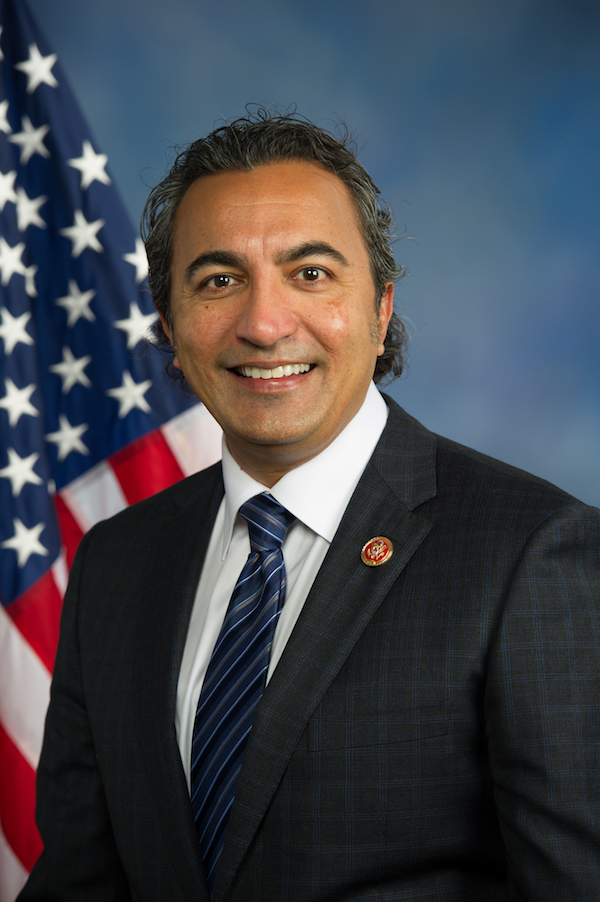
    Several US lawmakers – including Nisha Desai Biswal,Assistant Secretary of State for South and Central Asia, and Ami Bera, the lone Indian-American physician in the US Congress –  praised them for their hard work and their constant efforts to make healthcare affordable.

    “We are extremely delighted and grateful to the US Congress for passing this historic measure,” said Ravi Jahagirdar, President of the Association of American Physicians of Indian Origin (AAPI) urging the US Senate to take up the bill and pass it without delay.

    The legislation requires the Senate approval to repeal medicare sustainable growth rate (SGR) currently in use and would reformulate how physicians are reimbursed for Medicare, a government health insurance for seniors over 65.

    The passage of SGR bill came on March 26. The SGR formula places a cap on spending for physicians services, according to an AAPI statement.

    “AAPI has been a tremendous organisation for what you do here in the United States and for what you do in India and for what you do to improve and extend the US-India relationship,” Biswal said in her keynote address.

    Bera shared his own personal experience of growing up to be a physician and how he got elected in a district that has only 1 per cent Indian-Americans.

    “My story is your story and our story is that of the entire nation,” he said, adding: “I want my legacy to be how the generation is going to take us all to the next level and have many more Indian Americans get elected to the Congress.”

    AAPI is the largest ethnic organisation of physicians, representing over 100,000 physicians, fellows and students of Indian-origin in the US, who have been lobbying for the repeal of SGR formula for years.

  • Indian-American doctor arrested on charges of taking kickback

    Indian-American doctor arrested on charges of taking kickback

    WASHINGTON (TIP): An Indian-American doctor in the US has been arrested on charges of receiving kickbacks for referring patients for medical treatment, a March 14 PTI report says.

    Neil Sharma, who was arrested on Friday, March 13, faces a maximum potential penalty of up to five years in prison, a fine of up to $25,000, and full restitution, prosecutors said.

    According to federal charges, Sharma, 34, of Lemont, Illinois, a licensed Illinois physician and the medical director of an Illinois healthcare company, received a kickback of $2,500 in cash, from an individual in return for his referring Medicaid and Medicare patients to the individual’s company for medical treatment.

    In February 2015, Sharma offered an individual who owns Company B an additional 500 patients at an increased rate. He also offered to refer to Company B Medicaid and Medicare patients in two new programs Company A planned to implement.

    In exchange, Sharma wanted a cash payment immediately and additional cash payments every month after for an unidentified length of time.

    He planned to conceal the payments received from the individual by being named the medical director for the individual’s other health care companies not contracted with Company A,

    That individual went to the FBI before meeting with Sharma in Rockford on Feb. 27 and giving him $2,500 in cash, according to court documents. The meeting was monitored by federal agents, who witnessed Sharma leaving with the money.

  • Former illegal immigrants eligible for ‘amnesty bonuses’ – to get tax refunds

    Former illegal immigrants eligible for ‘amnesty bonuses’ – to get tax refunds

    Millions of immigrants benefiting from President Obama’s executive actions could get a windfall from the Internal Revenue Service, a reversal of fortune after years of paying taxes to help fund government programs they were banned from using.

    Armed with new Social Security numbers, many immigrants who were living in the United States illegally will be able to claim up to four years’ worth of tax credits designed to benefit the working poor. For big families, that’s a maximum of nearly $24,000, as long as they can document their earnings during those years.

    Advocates argue that many immigrants pay taxes, so they should be able to claim the same tax credits as anyone else. During the past decade, illegal immigrants have paid an estimated $100 billion in Social Security payroll taxes, even though few will be able to collect benefits, said Stephen Goss, Social Security’s chief actuary.

    Obama has issued executive orders shielding about 4 million immigrants from deportation. Some were brought here as children; others are parents of children who are American citizens or legal residents.

    Republicans in Congress oppose Obama’s actions and are trying to use a funding bill for the Department of Homeland Security to overturn them. Democrats are resisting, resulting in a stalemate that threatens to shut down the department.

    Funding for the department, which oversees immigration enforcement, will run out on Feb. 27.

    The dispute over tax credits illustrates the complicated relationship that many immigrants have with the tax system. Social Security estimates that illegal immigrants work at about the same rate as the rest of the population, even though federal law bars them from employment.

    For those who work and pay federal income taxes, the IRS provides them with an Individual Taxpayer Identification Number. Since 1996, the IRS has issued 21 million such numbers. About a quarter of them are in use, the agency says.

    The IRS accepts these tax returns without reporting the taxpayers to immigration authorities, IRS Commissioner John Koskinen said. That encourages the workers to pay taxes.

    “We don’t enforce the Social Security laws. We don’t enforce the immigration laws,” Koskinen said of his agency. “In fact, the reason illegal immigrants file taxes with us is they know we aren’t sharing that data with anybody. We treat it as taxpayer-protected information.”

    Even if immigrants pay taxes, they are ineligible for most federal programs. They cannot legally get food stamps, unemployment benefits, Pell grants or federal student loans. They cannot get Medicaid, except for emergency medical services, and are ineligible for subsidies under Obama’s health law. They can claim some federal tax breaks if they file tax returns, but until now, they were not eligible for Social Security, Medicare or the Earned Income Tax Credit, one of the government’s largest anti-poverty programs.

    Obama’s executive actions will offer Social Security numbers to these immigrants, something that eventually could make them eligible for Social Security and Medicare.

    More immediately, they could take advantage of the EITC. Last year, the credit provided low-income workers with about $70 billion.

    The credit is popular among conservatives because it rewards work — the more you work, the bigger your credit, as long as your income does not exceed certain limits. It is popular among liberals because it provides cash payments to low-wage workers, even if they do not make enough money to pay federal income taxes.

    Once the immigrants receive Social Security numbers, they can file tax returns claiming the EITC, as long as they meet the income requirements and can document their earnings.

    There’s more.

    They can file amended tax returns for up to three years after they were due, which means these immigrants can claim tax credits going back as far as 2011.

    The maximum credit for families with three or more children is about $6,000, so some could get as much as $24,000 in credits.

    Some members of Congress are outraged.

    “The administration may have blown open the doors for fraud with amnesty bonuses of more than $24,000 to those who receive deferred action,” said Sen. Ben Sasse, R-Neb. “This program severely undermines the White House’s lip service to enforcing the law, and would increase the burden on law-abiding taxpayers.”

    Advocates for immigrants say that if these workers are paying taxes, they should get the same benefits as other taxpayers.

    “Let’s not forget that these workers receive the lowest wages for what they contribute to their communities and local economies,” said Ellen Sittenfeld Battistelli, policy analyst at the National Immigration Law Center. “What do we as a nation gain by further impoverishing them?”

  • GOPIO Cosponsors First Successful Health Fair

    GOPIO Cosponsors First Successful Health Fair

    WASHINGTON (TIP): Healthcare is a big issue for new immigrants, especially elderly people. While Medicare is available to virtually all citizens, starting at age 65, immigrants legally present in the U.S. for less than five years are not eligible and private insurance companies generally do not offer health insurance plans for those over 65. Although there are health insurance options, but these are usually catastrophic traveler’s insurance.


    48
    Organizers. From L to R: Sam Mukherjee, Mayur Modi, Zafar Iqbal, Dr. Surinder Singh Gill


    They usually have a very high deductible and they are very expensive. In view of these harsh realities facing elderly community members from the Subcontinent, the Masjid Gulzar E Madina of Islamic Center Millford Mill Road, Pikesville, Maryland took a bold initiative to organize a first health fair on Sunday 23rd November2014. A number of area community organizations, such as the Global Organization of People of Indian Origin (GOPIO) – Metropolitan Washington, Philippines Nurses Association, Chinese Culture and Community Center, Muslim Community Clinic Inc., Silver Spring, Capital Region Telugu Society, Kerala Cultural Organization and Hindu Seva, co-sponsored this event.

    A large number of physicians, nurses, and healthcare workers volunteered their resources and worked tirelessly to provide their services for a large number of attendees covering a wide range of ages. An easy access to physicians of diverse specialties under one roof provided convenient consultation for wide range of medical issues. In addition to primary care, the medical specialties available for free consultations in a privacy setting included primary care, endocrinology, gastroenterology, hematology-oncology, otolaryngology, orthopedics, rheumatology, and medical ID cards for the community.

    Colgate-sponsored dental van provided dental consultation for children ages 1 to 12. Maryland Physicians Care Van made nutritional healthy food, Amerigroup sponsored Moon Bounce for children, and Columbia Lite House Van did eye sight screenings. The health fair also provided massage therapy and yoga enthusiasts displayed their skills and love for healthy living. Besides yoga sessions on site, there were diabetes and cancer prevention education vendors, healthy living demos and advice booths.

    Mental and behavioral health information, often a taboo topic, was sensitively offered by Counselors Helping South Asians/Indians (Chai). The Samar Group obtained bone marrow sign ups and the Washington Regional Transplant enrolled organ donor. Volunteers from a local Farm Market gave a wide range of fresh vegetables to all attendees. “The outstanding accomplishments of the day were made possible by the cohesive and dedicated collaboration of the Health Fair planning team, physicians, allied medical personnel, county and state health agencies, voluntary charitable organizations countless volunteers, Masjid management, and the Health Fair Advertising team as well as the support of the local organizations,” said Dr. Zafar Iqbal, President GOPIO DC Chapter.

    This successful event was coordinated by Mayur Mody and the management of Islamic Center thanked him for providing excellent leadership with efficient and indefatigable energy. The logistics for medical team was coordinated by Dr. Surinder Singh Gill and Dr. Alif Manijwala, and Dr. Sukhpal headed the team of volunteers. The health fair was open to people of all different ethnic, religious and socioeconomic backgrounds and over 400 people were able to get medical consultation.

  • From Slavery to Freedom The Journey of American Nation

    From Slavery to Freedom The Journey of American Nation

    Story of American Journey from British Occupation to slaving and racially discriminating its own citizens to vibrant Democracy to Crony Capitalism

    The journey of America from a little known land mass inhabited by primitives to what it is today is an interesting piece of history of man and evolution of a nation. Today, America is known to the world as a country built by immigrants and governed by immigrants. Whether some one’s ancestors arrived last year or last century, every American with the exception of Native Americans the Red Indians; has a family tree with roots somewhere else. People have come in to America from all continents- Europe, Africa, Latin America, Asia, and Australia. What a wonderful mosaic of nationalities here! America is currently the most religiously diverse nation in the world. It is the quintessential melting pot for world’s major religions, Americans honor the divine in mosques, churches, synagogues, temples, Monasteries, Gurudwaras and they are a multi-cultural, multi-religious nation. At the same time America belongs to the nonbelievers, too.

    The many nationalities and religions brought with them their culture, their value systems which we find have beautified and enriched the composite culture, yes, the composite culture, of America. But the making of America of today is a long story of a protracted and grim struggle, trials and travails. The Story of American Journey from British Occupation to slaving and racially discriminating its own citizens to evolving in to a vibrant and functional Democracy is worth studying. It is a long history, from the initial battles in the Revolutionary War which broke out in April 1775 for complete independence from Great Britain to the first commemoration by Philadelphia of independence on July 4, 1777.

    I will not go in to details of the history of the freedom struggle. I believe most of us have read about it either at school or at some other point. Nor will I dwell on the Flag of America, the national song of America, the manner of celebration of July 4th. These are commonplace knowledge. But I will certainly touch upon the human aspect of America’s evolution in to a great functional democracy. 1777 brought freedom from colonial rule. But it did not bring freedom to all human beings in America. Unfortunately some Americans especially the African Americans were excluded from the Independence and freedom.

    Enslaved men women and children labored to make millions for their masters. The seeds of this slavery were planted with the birth of a nation built upon the labor derived from slave-wages and the contradiction-in-terms produced by claiming freedom and democracy while owning and profiting from slavery at the same time. Millions of enslaved people were bought and sold; practically one third of all Southerners lived in bondage. Even in Washington D C, slave auctions were a daily occurrence with chained human beings marched routinely in front of the Capital of the nation dedicated to the proposition of human freedom.

    The de-humanization of black-people being treated as animals, traded as commodity, tortured beyond human tolerance, murdered and lynched in cold blood and their separation from the common run of humanity gave birth to confrontation between North and South on the issue of slavery that tormented the nation for almost a century. I hope, you have seen the wonderful movie “12 Years a Slave” which deals precisely with this subject It took America more than a century to end discrimination. We remember that on August 28, 1963, 186 years after independence, a March to Washington was held with the active support of President Kennedy, in a collaborative effort of all of the major civil rights organizations.

    The march had six official goals:
    (1) meaningful civil rights laws
    (2) a massive federal works program
    (3) full and fair employment
    (4) decent housing
    (5) the right to vote
    (6) adequate integrated education. The major focus was on passage of the civil rights law that the Kennedy administration had proposed after the upheavals in 100 cities including Birmingham earlier in the summer. The march was a success, an estimated 200,000 to 300,000 demonstrators gathered in front of the Lincoln Memorial, where Dr King delivered his famous “I Have a Dream” speech. Dr King said even after one hundred years after signing of Emancipation Proclamation, (which Lincoln had signed on January 1, 1863) the Negro is still not free, the life of the Negro is still sadly crippled by the manacles of segregation and the chains of discrimination.

    One hundred years later, the Negro lives on a lonely island of poverty in the midst of a vast ocean of material prosperity and is still languished in the corners of American society and finds himself an exile in his own land. And so we’ve come here today to dramatize a shameful condition. He said, “And so let freedom ring from the prodigious hilltops of New Hampshire. Let freedom ring from the mighty mountains of New York. Let freedom ring from the heightening Alleghenies of Pennsylvania. Let freedom ring from the snow-capped Rockies of Colorado. Let freedom ring from the curvaceous slopes of California.

    But not only that: Let freedom ring from Stone Mountain of Georgia. Let freedom ring from Lookout Mountain of Tennessee. Let freedom ring from every hill and molehill of Mississippi. From every mountainside, let freedom ring. And when this happens, when we allow freedom ring, when we let it ring from every village and every hamlet, from every state and every city, we will be able to speed up that day when all of God’s children, black men and white me, Jews and Gentiles, Protestants and Catholics, will be able to join hands and sing in the words of the old Negro spiritual: Free at last! Free at last! Thank God Almighty, we are free at last!” July 2, 1964, Johnson signed the Civil Rights Act of 1964, that banned discrimination based on “race, color, religion, sex or national origin” in employment practices and public accommodations.

    The bill authorized the Attorney General to file lawsuits to enforce the new law. The law also nullified state and local laws that required such discrimination. President Lyndon Johnson’s call for “Great Society” further expanded and guaranteed access to opportunity by minorities in America while Congress helped support new federal spending in the form of programs such as Medicare and Food Stamps. A year later, on August 6, 1965 Johnson signed the Voting Rights Act suspending poll taxes, literacy tests, and other subjective voter registration tests. It authorized Federal.

  • Indian-origin doctor pleads guilty to taking bribes in US

    Indian-origin doctor pleads guilty to taking bribes in US

    NEW YORK (TIP): An Indian-origin pediatrician in the US has pleaded guilty to accepting bribes in exchange for test referrals as part of a long-running scheme operated by a diagnostic firm. Surender Gorukanti, 46, of Brooklyn, New York, admitted before US District Judge Stanley Chesler in Newark federal court to an information charging him with one count of accepting bribes, attorney Paul Fishman said.

    Besides Gorukanti, 24 people — including 14 physicians — have pleaded guilty in connection with the bribery scheme, which its organizers have admitted involved millions of dollars in bribes and resulted in more than $100 million in payments to the diagnostic firm from Medicare and various private insurance companies.

    Gorukanti admitted he accepted cheques of $1,000 per month as bribes from the firm in return for referring patient blood specimens to it. The bribery count to which Gorukanti pleaded guilty carries a maximum potential penalty of five years in prison and a $250,000 fine. Sentencing is scheduled for June 16.

  • Physician Shortage Estimated to be over 130,000 by 2015

    Physician Shortage Estimated to be over 130,000 by 2015

    AAPI to advocate for more Residency slots during Legislative Day on Capitol Hill

    CHICAGO (TIP):With the beginning of the implementation of the Affordable Care Act (ACA), health insurance coverage is expected to expand to an additional 34 million people in the United States. The Association of American Medical Colleges (AAMC) projects that universal coverage will increase the use of physicians by 4%,while the Bureau of Health Professions projects a 5.2% increase.

    According to Census projections, the overall population will increase by 15.2% from 2010 to 2025, and the population aged older than 65 years will grow by 60%,while those aged younger than 18 years will increase by 13%. Accordingly, it’s been estimated that the total number of office visits to primary care physicians alone for the United States will increase from a base of 462 million in 2008 to 565 million in 2025.

    Because of aging, the average number of visits to primary care physicians will increase from 1.60 in 2008 to 1.66 in 2025. By age 65, about two-thirds of senior citizens have at least one chronic disease, and 20 percent of Americans older than 65 see 14 or more physicians and average 40 physician visits each year. In addition to these changes, is the age factor of the currently practicing physicians themselves. Every 1 in 3 practicing physicians in the U.S. is over the age of 55 and is close to retirement.

    The irony, however, is that the number of Medicare-sponsored residency slots has been capped since 1997, and the Medical school graduates may exceed the number of residency positions by 2015. Struggling to meet these higher demands and reduced supply of physicians, the nation is projected to be short by more than 90,000 physicians by 2020 and 130,000 physicians by 2025, according to projections by the Association of American Medical Colleges. Indian-Americans constitute less than one percent of the country’s population, but they account for nine percent of the American doctors and physicians. As Forbes magazine aptly summed up, “The overrepresentation of Indians in these fields (engineering, IT and medicine) is striking – in practical terms, one out of seven doctors is likely to be of Indian Heritage.”

    They provide medical care to over 40 million of US population. The annual Legislative Day & Congressional Reception organized by Association of American Physicians of Indian Origin (AAPI) on Capitol Hill on Wednesday, March 26th and Thursday, March 27th, 2014, with participation from dozens of key US Congressmen and Senators will be a perfect forum to advocate for more Residency Slots. “As you are aware, how important it is for us to be involved in the decision making on Bills that affect not only our patients but also us,” says Dr. Jayesh Shah, President of AAPI. “We’re pleased that bipartisan Members of Congress are joining us on Capitol Hill this month. Some of the important bills including SGR Repeal and increase in Residency Slots will be discussed during this session. Your presence on the Capitol Hill is more needed now than ever before.”


    20
    Dr. Ami Bera addressing AAPI delegates on Capitol Hill

    According to Dr. Shah, AAPI strongly supports the “Resident Physician Shortage Reduction Act of 2013,” introduced by U.S. Congressman Joe Crowley (D-NY) (H.R. 1180) and U.S. Senator Bill Nelson (D-FL) (S. 577),which would provide an additional 15,000 residency positions in Fiscal Years 2015-2019. “Increasing the size of medical school classes is not enough. There must be a simultaneous increase in the size of residency positions to train these future doctors,” he says. Dr. Ravi Jahagirdar, President-Elect of AAPI, says, “AAPI urges members of Congress to include physicians graduating from U.S. residency programs for Green Cards in the comprehensive immigration reform bill.

    “Physicians graduating from accredited U.S. residency programs should also receive similar treatment. Such a proposal would enable more physicians to be eligible for Green Cards and address the ongoing physician shortage,” he adds. As part of comprehensive immigration reform, a proposal may include international students graduating with degrees in science, technology, engineering and mathematics (STEM) being fast-tracked for Green Cards. This proposal enables highly-skilled workers to remain in the United States after receiving their higher education in America. “We are pleased to inform you that a bipartisan legislation was recently introduced in Congress to permanently repeal the Medicare Sustainable Growth Rate (SGR) Formula,” Dr. Harbhajan Ajrawat, Chair of AAPI Legislative Affairs Committee,while referring to “SGR Repeal and Medicare Provider Payment Modernization Act of 2014,” H.R. 4015, says. “AAPI will continue monitoring this vital legislation and will be asking members of Congress tough questions about the SGR during our Legislative Day on Capitol Hill.”

    AAPI supports Congress providing a permanent fix to the Medicare sustainable growth rate (SGR) formula. In January 2013, Congress passed a temporary patch to avert a 26.5 percent cut,which expires in 2014. AAPI urges members of the House to cosponsor H.R. 574 to bring certainty to the Medicare reimbursement system, Dr. Ajrawat adds. Dr. Sampat Shivangi, Co-Chair of AAPI Legislative Affairs Committee, says, “In our continued goals to reach out to US Congress, our annual Legislative Conference will focus on burning issues like Medicare SGR, Immigration reform, Combating Obesity, Implementation Affordable Care and of course on growing USIndia relations in spite of few recent setbacks.” He has urged “the AAPI community to be part of this exciting event and share their enthusiasm and experience on various issues which promises to be very exciting event.”

    In the 112th Congress, AAPI helped secure the introduction of the “Doctors for Underserved Areas in America Act,” (H.R. 2805), by U.S. Rep. Zoe Lofgren (D-CA),which would make the J-1 Visa Waiver Program permanent. The J-1 visa gives international medical graduates the opportunity to perform their medical training and residency in the United States. AAPI wants members of Congress to cosponsor legislation making the J-1 Visa Waiver Program permanent when it is reintroduced in the House and to cosponsor S. 616.In its efforts to maintain a healthy doctor-patient environment by curbing aggressive litigation targeting physicians, AAPI has been advocating for federal and state legislation that places effective caps on noneconomic damages, limits the use of joint-andseveral liability, provides physicians with flexibility to negotiate settlements with medical insurers and limits the statute of limitations for filing medical malpractice claims.

    “AAPI fully supports the nomination of Dr. Vivek H. Murthy as Surgeon General of the United States,” says Dr. Jayesh Shah,who along with his colleagues met with several key US Senators last month, seeking support for his confirmation. “Dr. Murthy has impeccable academic credentials and has been a longtime supporter of advancing health care across the United States. He has also worked tirelessly to support health care initiatives in rural India through his volunteerism and entrepreneurship.” AAPI’s Legislative Day Reception is scheduled on Wednesday, March 26, 2014 from 5 pm to 7 pm at B-340 Rayburn House Office Building. “Our legislative committee met more than six months ago and discussed in detail what type of reception we should host this year,” recalls Dr. Shah.

    “It came to light that in the late 1990’s, AAPI also hosted a well-attended dinner with congressional staff. Based on the feedback from committee members,we decided it would be best to go back to the feature of serving Indian food, as this past model was always well-received by Members of Congress and their staff.” The Indian Buffet Reception on Capitol Hill on March 26th will be addressed by: Rep. Alan Nunnelee (RMS); Rep. Zoe Lofgren (D-CA); Rep. Tom Price, MD (R-GA); Rep. Frank Pallone (D-NJ); Rep. Steny Hoyer (D-MD); Rep. Phil Gingrey, MD (RGA); Rep. Ed Royce (R-CA); Rep. Joe Heck, DO (RNV); Rep. Tammy Duckworth (D-IL); Rep. Gregg Harper (R-MS); and Rep. Mike Honda (D-CA). Ambassador Dr. S. Jaishankar will provide the keynote address during the Congressional reception.

    Among the many US lawmakers who have confirmed their participation addressing the AAPI delegates during the Legislative Conference on March 27th are: U.S. Congressmen Ed Royce (R-CA), Chairman – House Foreign Affairs Committee; Rep. Frank Pallone (D-NJ), Ranking member – Health Subcommittee, House Energy and Commerce Committee; Rep. Joe Crowley (D-NY), Co-chairman – Congressional Caucus on India and Indian Americans; Rep. Peter Roskam (R-IL), Co-chairman – Congressional Caucus on India and Indian Americans; and Rep. Zoe Lofgren (D-CA), Ranking member, Immigration Subcommittee and House Judiciary Committee.

  • Indian-American Physicians to bring Issues before Lawmakers

    Indian-American Physicians to bring Issues before Lawmakers

    WASHINGTON (TIP): An influential body of Indian- American physicians is holding its annual legislative day on Capitol Hill March 26-27 to bring issues facing the community before U.S. lawmakers.

    Association of American Physicians of Indian Origin (AAPI), the largest ethnic organization of physicians, representing over 100,000 physicians of Indian origin, wants to make their voices heard on Capitol Hill and around the nation, it said.

    AAPI’s Annual Legislative Day conference will discuss medicare sustainable growth rate, immigration reform, combating obesity, implementation of affordable care and growing U.S.-India relations, according to a media release.

    Indian-Americans constitute less than one percent of the country’s population, but they account for nine percent of the American doctors and physicians. One out of every seven doctors serving in the U.S. is of Indian heritage, providing medical care to over 40 million of U.S. population.

    Several key lawmakers including Ed Royce Republican chairman of House Foreign Affairs Committee and Joe Crowley and Peter Roskam, Democratic and Republican co-chairman of Congressional Caucus on India and Indian Americans respectively have confirmed their attendance.

    “AAPI has been seeking to collectively shape the best health care for the people of U.S. with the physician at the helm, caring for the medically underserved as we have done for several decades when physicians of Indian origin came to the U.S. in larger numbers,” said Jayesh Shah, president of AAPI. “AAPI is once again in the forefront in bringing many burning health care issues facing the community at large and bringing this to the Capitol and to the U.S. Congress,” said Sampat Shivangi, Co-chair of AAPI Legislative Affairs Committee.

    As part of comprehensive immigration reform, AAPI has urged the Congress to include international medical graduates also along with international students graduating with degrees in science, technology, engineering and mathematics (STEM) for being fasttracked for Green Cards. This proposal would enable highly-skilled workers to remain in the U.S. after receiving their higher education in Am.

  • Pre-K dominates the first budget of Mayor de Blasio

    Pre-K dominates the first budget of Mayor de Blasio

    NEW YORK (TIP): The 109th Mayor of New York City, Bill de Blasio, unveiled his administration’s first city budget on Wednesday, February 12th.

    The $73.7B budget includes no broad base spending cuts, yet more money for closed hospitals and a $530M in new revenue from the proposed tax hike plan to fund universal pre-k. The mayor also projected a $1.1B deficit in FY 2016, while the city still enjoys a surplus.

    The primary focus of the mayor’s plan includes universal, full-day pre-kindergarten, which includes $530 million from taxing the rich. De Blasio also outlined a series of stark fiscal challenges presented by impending contract negotiations with all 150 municipal unions. The city employees have all been working on expired contracts. Labor leaders have asked for retroactive raises which could cost more than $7 billion.

    The mayor has noted that the city has never had all its labor contracts open at once. “I think the previous administration was given an artificially high level of credit for management,” the mayor said. “The way they budgeted was not appropriate. You cannot ignore open labor contracts for years on end.

    In the final years of the mayor’s term there was a particular interest in burnishing the mayor’s legacy,” de Blasio said. The mayor’s budget also calls for inspector general for the NYPD, and enforcement of the paid sick leave act. He has also set goals for investing more money in public housing repairs and maintenance and intends to expand services for homeless youths and cap rent contributions for HIV and AIDS clients.

    The de Blasio administration’s FY 2015 preliminary budget is being seen as a fiscally-responsible document that begins to put New York City’s financial house back in order. Here are some important features of the budget. The Structural Deficit: The budget for the current year, FY 2014, remains balanced by relying on $1 billion from the prior year. The FY 2015 plan right now relies on $1.8 billion of resources from the prior year for balance.

    The city is already facing a deficit of $1.1 billion for FY 2016. Maintaining the Retiree Health Benefits Trust Fund: The Retiree Health Benefits Trust Fund pays for the cost of retiree health benefits for city workers, including health insurance, welfare funds, and Medicare Part B reimbursements.

    The previous plan drained $1 billion from the Trust; the de Blasio preliminary budget restores that funding to the Trust for this long-term obligation. Ensuring DSNY has the Resources it Needs: An unusually heavy snow season this year means reorganizing the budget so the sanitation department has all the resources it needs to ensure the city’s streets remain clear and safe throughout the winter.

    The previous plan budgeted $57 million for the sanitation department to respond to snow and winter storms, and the de Blasio administration has increased that allocation by $35 million – covering costs to date, as well as expected costs for the rest of the season. Increasing School Aid from the State: New York State has not kept up with its obligations to fund New York City schools.

    In FY 2015, there will be a $2.7 billion gap between the current level of state aid and the funding levels agreed-upon following the Campaign for Fiscal Equity lawsuit. In this preliminary budget, the de Blasio administration is asking the state for an additional $500 million to fund improvements to New York City public schools. The resources will help reduce class size and provide additional teacher supports in early grades; strengthen elementary Common Core academic intervention; and increase funding equity across schools, so students are treated more fairly.

  • Indian-American physiotherapist sentenced to 10 years in jail

    Indian-American physiotherapist sentenced to 10 years in jail

    MICHIGAN (TIP): An Indian- American physiotherapist has been sentenced to 10 years in prison and ordered to pay over $10 million in restitution for his role in a multi-million dollar healthcare fraud and money laundering scheme.

    Chiradeep Gupta, 39, of Michigan was sentenced by US district judge Denise Page Hood in the eastern district of Michigan. In addition to the 120 months prison term, Gupta was sentenced to serve three years of supervised release and was ordered to pay more than $10 million in restitution, jointly and severally with his co-defendants, acting assistant attorney general Mythili Raman of the justice department’s criminal division said in a statement on Friday.

    Gupta, a physiotherapist and partowner of a home healthcare company, was found guilty at trial in October 2012 of one count of conspiracy to commit health care fraud, one count of conspiracy to commit money laundering, and three substantive counts of money laundering. The fraud scheme totaled almost $11 million.

    According to evidence presented at trial, Gupta and his co-conspirators submitted false and fraudulent claims to federal social insurance program Medicare through a home healthcare company, which purported to provide skilled nursing and physical therapy services to Medicare beneficiaries in the greater Detroit area.

  • Obamacare-how caring?

    Obamacare-how caring?

    Some 106,185 people signed up for Obamacare in its first month of operation, a period marred by major technological problems with both the federal and state enrollment websites.

    Troubled HealthCare.gov is unlikely to work fully by end of November, says an official with knowledge of the project. According to this source of information, software problems with the federal online health insurance marketplace, especially in handling high volumes, are proving so stubborn that the system is unlikely to work fully by the end of the month as the White House has promised. The insurance exchange is balking when more than 20,000 to 30,000 people attempt to use it at the same time – about half its intended capacity, said the official, who spoke on the condition of anonymity to disclose internal information. And CGI Federal, the main contractor that built the site, has succeeded in repairing only about six of every 10 of the defects it has addressed so far. Government workers and technical contractors racing to repair the Web site have concluded, the official said, that the only way for large numbers of Americans to enroll in the health-care plans soon is by using other means so that the online system isn’t overburdened.

    This inside view of the halting nature of HealthCare.gov repairs is emerging as the insurance industry is working behind the scenes on contingency plans, in case the site continues to have problems. And it calls into question the repeated assurances by the White House and other top officials that the insurance exchange will work smoothly for the vast majority of Americans by Nov. 30. Speaking in Dallas a week ago, President Obama said that the “Web site is already better than it was at the beginning of October, and by the end of this month, we anticipate that it is going to be working the way it is supposed to, all right?” Julie Bataille, director of communications at the Centers for Medicare and Medicaid Services (CMS), which is part of the Department of Health and Human Services, said: “We are working 24/7 to make improvements so that by the end of the month the site is working smoothly for the vast majority of users.We are making progress, including fixes to reduce error rates and get the site moving faster. “The challenges we are addressing today,” she added, “are a snapshot of November 12th, not November 30th.” Meanwhile, pressure intensified Tuesday on the Obama administration to address the growing complaints of Americans whose individual insurance policies are being canceled because they do not comply with new government rules for coverage. The online magazine Ozy published a video interview with former president Bill Clinton saying that Obama must “honor the commitment” he made to Americans that they could keep their insurance – even if it requires a change in the law. Fewer than 27,000 Americans selected an insurance plan through the federal healthcare.gov site, which is handling enrollment for 36 states, according to figures released Wednesday by the Obama administration.

    The site is still far from fully operational, leaving tech experts racing to get it working by month’s end, as the administration promised. The states running their own exchanges are responsible for the bulk of the sign-ups. Nearly 79,400 people have selected a plan through state-based exchanges, with California leading the way with nearly 35,400 selecting a plan. States have also been battling system errors, with Oregon having yet to accept online applications. Only 11 states reported sign-up figures Wednesday. These figures reflect people who have selected insurance plans through the exchanges, but not necessarily paid for them. Americans have until Dec. 15 to pay if they want coverage to begin on Jan. 1. Open enrollment lasts through March 31. Kansas Insurance Commissioner Sandy Praeger said she and her counterparts in other states have offered suggestions to the White House on how best to address the problem of canceled policies. The most obvious solution, she said, would be to allow customers to renew policies early to let them stay in effect until November 2014. But that would come with a trade-off, she said: Those people would not receive federal subsidies for which they might be eligible if they bought a plan on the exchange. She said that she and other insurance commissioners are trying to address consumers’ desire to use the federal exchange. “Honestly,” she said, “it’s just a big mess right now. .?.?. I don’t know what to tell people.” Debate over how to respond to Americans who are irate about losing their insurance is intensifying on Capitol Hill.

    The House plans to vote this week on a bill introduced by Energy and Commerce Committee Chairman Fred Upton (R-Mich.) that would extend this year’s insurance plans for a year. On Tuesday, Sen. Dianne Feinstein (D-Calif.) said she is co-sponsoring a bill with Sen. Mary Landrieu (D-La.) that would require insurers to offer 2013 plans on the individual market indefinitely. The software defects that ware making the Web site unstable with too much volume mean that some people face frozen computer screens when they try to enter information – and then get timeout errors, said the official with knowledge of the project. Call centers have had problems, too. Within the network of 17 federally sponsored call locations staffed by more than 10,000 people, consumers are discovering that telephone representatives lack the authority to correct errors in online applications. And sometimes, consumers with more than routine questions are promised that specialists will call them back, but the calls never come. Insurance companies, which have been pressing the White House for greater ability to sign up customers directly, are stuck at the moment, unable to complete enrollments. That is because they must connect with the federal online system to determine whether customers’ incomes qualify them for tax credits to help pay for their insurance – a part of the system that does not work. According to the official, workers are trying to streamline the computer system so that it can handle outside queries from insurers and the call centers about whether people are eligible for subsidies. Technical workers are striving to have this part of the system working reliably within two to three weeks.In a telephone call with reporters earlier Tuesday, Bataille said that HHS is emailing about 275,000 consumers who have gotten stuck while trying to shop for and buy health plans. The e-mails encourage them to try again. Asked whether the Web site could handle all those consumers if they logged on at once, Bataille replied, “That’s why we are sending this series of e-mails in waves.” The CMS has said it has cut the waiting time for pages on the federal Web site from an average of eight seconds to one second and has reduced errors that have blocked consumers from 6 percent to 2 percent.

  • Only 248 signed up for Obamacare in first two days

    Only 248 signed up for Obamacare in first two days

    WASHINGTON (TIP: Enrollment in health insurance plans on the troubled Obamacare website was very small in the first couple of days of operation, with just 248 Americans signing up, according to documents released on October 31 by a US House of Representatives committee. The Obama administration has said it cannot provide enrollment figures from HealthCare.gov because it doesn’t have the numbers. The federal website, where residents of 36 states can buy new healthcare plans under President Barack Obama’s law, was launched on October 1. “We do not have any reliable data around enrollment, which is why we haven’t given it to date,” Health and Human Services Secretary Kathleen Sebelius told lawmakers on Wednesday. But the documents, which are labeled “war room” notes and appear to be summaries of issues with the problematic website beginning on October 2, indicate a mere six enrollments had occurred by that morning – the day after the website was launched and almost immediately crashed. “High capacity on the website, direct enrollment not working,” the October 2 notes said. By later that day, “approximately 100” enrollments had taken place. “As of yesterday, there were 248 enrollments,” said the notes from the morning of October 3.

    The documents were released by the House Oversight and Government Reform Committee, which has been demanding information from the administration about the website’s problems. The committee is chaired by Representative Darrell Issa, a Republican opponent of Obamacare. The notes were from meetings at the Centers for Medicare and Medicaid Services, the arm of the Health and Human Services Department that has been overseeing the website, an Issa spokeswoman said. The documents were first reported by CBS News. Health and Human Services spokeswoman Joanne Peters said the department will release Obamacare enrollment statistics on a monthly basis after coordinating information from different sources. This will including call centers, paper applications for insurance, and data from insurers and states. The first release of enrollment data will likely be mid-November, she said. “These appear to be notes, they do not include official enrollment statistics,” Peters said of the documents Issa’s panel released. “As the secretary (Sebelius) said before Congress, we are focused on providing reliable and accurate information and we do not have that at this time … We have always anticipated that the pace of enrollment will increase throughout the enrollment period.” HealthCare.gov has been plagued with technology problems since its rollout. It was back up on Thursday after not being fully functional for much of Wednesday. Both the federal exchange and the exchanges built by 14 other states and Washington D.C. were set up to let residents enroll in new plans created under the Affordable Care Act, Obama’s 2010 healthcare reform law commonly known as Obamacare. The government has said it expects about 7 million people to enroll for individual insurance in 2014, many of whom are expected to receive government subsidies.

  • THE POLITICS OF THE GOVERNMENT SHUTDOWN

    THE POLITICS OF THE GOVERNMENT SHUTDOWN

    With the government having lurched into its first shutdown since the 1990s, many commentators are focusing on the potential ill effects that it might have for Republicans. Almost all of these analyses use the shutdowns of 1995- 1996 as their starting point. While I don’t think this development will be great for Republicans, many of the concerns are likely overwrought. Here are four points to ponder:
    1. While the GOP’s tactics are similar to those employed in the mid-’90s, the goals are different.
    The earlier budget debates were broad in nature and dealt with the scope of government. The 104th Congress, led by Newt Gingrich, believed that they were the culmination of the realignment supposedly begun by Ronald Reagan, that Bill Clinton’s election was a fluke caused by Ross Perot’s candidacy, and that they had been elected with a mandate to shrink the size and scope of government dramatically. They entered the shutdown believing that the public would rally to their side, that Clinton’s job approval would fall in the wake of the shutdown, and that he would ultimately cave on their demands. Despite the lore that has since sprung up, this wasn’t a completely harebrained view of the underlying politics: An earlier shutdown, in 1990, did play an important role in persuading George H.W. Bush to abandon his famous “no new taxes” pledge a few weeks later. Of course, that isn’t how it played out at all in 1995 and 1996; Bill Clinton was widely viewed as having held the line against the Republican onslaught, although he actually did give substantial ground on taxes and a number of other issues.

    The budget fight became the focal point of Democrats’ attempt to take back the House and Senate in the 1996 elections. But the Democrats didn’t actually use the shutdown itself as their main line of attack on Republicans. It was part of it, but the real attacks came over the Republicans’ motivation for the shutdown. Because of the expansive nature of the GOP’s cuts, the Democrats were able to focus on several unpopular portions of the GOP budget: the so-called M2E2 strategy. They commenced a mantra-like repetition of their opposition to Republican attempts to gut “Medicare, Medicaid, Education and the Environment” in favor of a “risky tax scheme” that benefited the rich. In other words, in evaluating 1996 as an illustration of what will happen to the GOP today, we probably have to separate the tactic of a shutdown from the substance of what motivates it. And today, the GOP is focused on defunding Obamacare, a law that isn’t particularly popular. For the analogy to 1995-96 to really stick, the GOP will probably have had to try something along the lines of shutting down government to implement the Paul Ryan balance-budget plan. While public opinion might be against the shutdown tactic, there probably won’t be the same level of outrage against the underlying policy motivation, which is what 1995-96 was mostly about. If Obamacare turns out to be the train wreck some conservatives predict (I have no clue whether it will or won’t), the tactic itself might be viewed as less of a negative.

    2. John Boehner is not Newt Gingrich, and Barack Obama is not Bill Clinton.
    This is a fairly minor point, but Gingrich’s public persona did play a part in bringing the shutdown to an unhappy end for the GOP. He was polarizing from the start, and the media didn’t bend over backwards to help him out. Case in point: The Daily News cover depicting him as a crybaby who shut down the government because he had to sit in the back of Air Force One. Boehner, on the other hand, has kept a much lower profile, and while he isn’t all that popular, he isn’t a lightening rod either (although Ted Cruz seems to be inching toward filling Gingrich’s shoes in that regard). At the same time, Obama is not really Clinton. The current president’s ability to present himself as a cautious centrist in political face-offs with Republicans to date have been mixed at best; his strength has always been energizing the liberal base for elections rather than tacking to the center. Clinton might be the most successful president of my lifetime when it comes to publicly framing a debate in a way favorable to his side (see, for example, the M2E2 strategy above). There are actually few examples, if any, of Obama rallying the public to his side in the various battles he’s fought; there are plenty of failures, with the fight over sequestration being the most recent case in point.

    3. The net effect of the shutdown was small in the 1990s.
    For all the talk of the sustained damage the Republicans suffered, the actual evidence for this is pretty weak. In 1994, Republicans won 230 seats in Congress. Five party switches and a special election victory later, they entered the 1996 elections with 236 seats. They emerged from those elections with 228 seats, for a loss of eight total (including the open seat of one of the Democratic Party switchers). So while Republicans lost seats, it ended up being something of an empty victory for Democrats: Americans elected a Republican Congress back-to-back for the first time since the 1920s. Republican candidates won the popular vote for the House, albeit very narrowly (Democrats won the vote only if you split up votes cast for candidates running on multiple party lines, e.g., a Republican also running on the Conservative Party line in New York). Republicans even gained a seat in a special election held in a Democraticleaning district in between government shutdowns, and only narrowly lost a Senate seat in Democratic-leaning Oregon immediately after the shutdown (Republicans proceeded to win another open Senate seat in the same state by four points in November). Those Republican House losses weren’t terribly surprising.

    Republicans were overexposed as a result of the 1994 “wave election” that swept a number of weak members into swing-to-Democratic-leaning districts. Losing representatives like Andrea Seastrand, Michael Flanagan and Fred Heineman was more a part of regression-to-the-mean than any wholesale rejection of Republicans. Of the 21 House seats that Democrats claimed from Republicans in 1996 (it was actually 22, but I don’t have presidential data for Louisiana’s 7th District), Clinton had carried 18 in 1992. The other four seats were all something of special cases: Bob Dornan in California, Gary Franks in Connecticut, David Funderburk in North Carolina, and Toby Roth’s open House seat in Wisconsin. This presents a problem for Democrats hoping to capitalize on the 2013 shutdown: The seats are much better sorted these days. Going into the 1996 elections, 79 Republicans occupied seats that had voted for Clinton in 1992. In other words, they lost 23 percent of their caucus from “Clinton seats.” Today, only 17 Republicans come from “Obama seats” to begin with. If Republicans suffered losses in unfriendly territory at the same rate as they did in 1996, they’d lose only four seats, before we start looking at the effect on Democrats from “Romney seats.” Perhaps Republicans would have fared better had they not attempted to shut down the government in the first place.

    Republicans picked up 10 open House seats and defeated three Democratic incumbents in 1996; absent the shutdown, perhaps they might have gained seats. In the Senate, Republicans narrowly lost open Democratic seats in Louisiana and Georgia, while missing good opportunities to defeat Tom Harkin in Iowa and Max Baucus in Montana. But as Harry Enten has ably demonstrated, Republicans did about as well in the House and in presidential elections as we would have expected given the performance of the economy, especially when you consider that exit polls showed Ross Perot pulling votes disproportionately from Republicans (unlike 1992, when he pulled evenly from both parties). Clinton’s comeback was likely due more to the flurry of good economic news in the run-up to the election than to anything else. Indeed, while Clinton’s job approval improved over the course of the shutdown, it had also improved in the months leading up to the shutdown at a similar rate. Senate losses in Louisiana and Georgia look bad today, but in 1996 both states were more Democratic; Clinton had carried both states in 1992 and only narrowly lost Georgia in 1996 while winning Louisiana by 12 points. Republicans had only won two narrow Senate elections in Georgia before 1996 (and hadn’t won the governorship since Reconstruction), while Republicans had never won a Senate election in Louisiana and were burdened by a controversial candidate in Woody Jenkins. Republicans were unable to defeat Harkin, Baucus or Mary Landrieu in the good GOP year of 2002.

    4. What happens to red state Senate Democrats?
    Of course, the real action for 2014 is not the House, where the GOP will continue to control the agenda except in the unlikely event that it loses 17 seats. The real fight is for control of the Senate, which in turn revolves around races in eight states: West Virginia, Arkansas, Kentucky, South Dakota, Louisiana, Alaska, Montana and North Carolina. Obama lost those states by, respectively, 27, 24, 23, 18, 17, 14, 14 and two points, respectively. The politics of a shutdown in these states are very different than in the nation as a whole. We can try to estimate the popularity of a shutdown by taking as a national baseline CNN’s recent finding that 46 percent of voters would blame Republicans for a shutdown vs. the 36 percent that would blame Obama. If we adjust these numbers according to the results of the presidential election in 2012, we would estimate that the president would shoulder the blame for a shutdown in each of those states save for North Carolina, and that outright majorities would blame the president in West Virginia, Arkansas and Kentucky. The last thing Democratic candidates in these states want is a public spat over a piece of legislation that is highly controversial, that might have a problematic rollout in the coming weeks and months, and that places them on the side of an unpopular president.

    If there’s an upside for the GOP, this is probably it. Even after the 1995-96 shutdowns, the GOP managed to gain Senate seats, largely by making gains in reddish states. Of course, none of this should be read as advocating the shutdown, or predicting that it could not possibly have any negative consequences for the GOP. For starters, a government shutdown is essentially lighting a fuse without knowing exactly where it will go. This is something that could easily get out of control if the shutdown stretches out for weeks and bleeds into the debt ceiling battle, which could be potentially catastrophic for the county. Moreover, it could give Democrats an issue to rally around. Unlike 1996, the economy is weak; the president’s job approval has suffered in recent months as a result of his perceived failure to move the Democratic agenda forward, and the aborted intervention in Syria. Many of these losses have come as a result of Democrats becoming dissatisfied with the president. If the election were held with the president’s job approval at its present level, Democrats would probably lose another 10 House seats or so, giving Republicans their largest House majority since 1946 (and possibly 1928). A dustup with congressional Republicans would probably help bring these Democrats back into the fold, especially if the president emerges victorious from the fight, helping to limit Democratic losses. Finally, we should also remember that the current weak recovery has been ongoing now for 52 months.

    It’s already longer than six of the 11 recoveries in the post-War era. By this time next year, it will be longer than seven of them. By 2016, only the booms of the mid-’60s, mid-’80s, and mid-’90s will have lasted longer. And, well, this recovery doesn’t much resemble those recoveries so far. In other words, there’s a decent chance that we’ll encounter a downturn in the economy in the next year, and a very good chance that we’ll encounter one in the next three years. Obama is probably reaching the end of the time period where his predecessor can be blamed for the state of the economy. But a lengthy shutdown could conceivably give Democrats ammunition to place the blame back on Republicans. The bottom line is this: The shutdown will probably not be a good thing for the GOP, and there’s a good chance Republicans won’t achieve their intended goal of limiting Obamacare’s reach. But at the same time, a lot of the prophecies of doom for Republicans are heavily overwrought. Unless things get too far out of control, the predictions of heavy GOP losses from a shutdown are likely overstated.

  • U.S. failure to pay bills hurts everyone

    U.S. failure to pay bills hurts everyone

    If Congress does not raise the debt limit soon, seniors, veterans, kids, among others, are at risk.

    In an op-ed published in the October 4, 2013 edition of USA TODAY, Treasury Secretary Jacob J. Lew discusses the importance of Congress raising the debt limit immediately to avoid self-inflicted wounds that could impede economic growth and create uncertainty for families and businesses.
    It might be hard to believe, but there is a dangerous debate underway in Congress right now over whether the United States, the world’s strongest economy, should pay all of its bills. This is not a debate about reducing future spending or cutting the deficit. This is about making sure the United States can meet its existing obligations to our citizens, businesses and investors – and the stakes could not be higher. If the United States cannot pay its bills in full and on time, each and every American will be affected, including seniors who rely on Social Security, veterans who depend on disability payments, children in need of food assistance, and doctors and hospitals who treat Medicare patients, among others.

    The stock market, including investments in retirement accounts, could tumble, and it could become more expensive for Americans to buy a car, own a home and open a small business. We cannot put our nation in the position of not paying its bills because Congress has refused to raise the country’s debt limit. It is important to note that increasing the debt limit does not give the government the ability to spend more money. An increase in the debt limit simply allows us to pay our bills. Without a debt limit increase, our government will – in a matter of days – not have the resources it needs to make good on its commitments. Only Congress has the power to lift the debt limit. That means only Congress can clear the way for our government to meet all of its financial obligations. The United States has met all its financial obligations for more than 200 years. We are a nation that keeps our word. We are a nation that stands behind our full faith and credit. Some claim that the United States does not need to meet every one of its commitments. They argue that the government could pay certain bills and let others go unpaid without consequences.

    The United States cannot be put in a position of having to choose which commitments it should meet. How could we possibly decide among supporting our veterans, maintaining food assistance for children in need, or sending Medicare payments to hospitals? President Obama has made clear that he stands ready to find a sensible solution to curb spending and bring down our deficits. He has already worked with Congress to shrink our deficits by more than half by the end of this year. And he has put forward a budget plan that contains spending cuts favored by Republicans because he is committed to making compromises to strengthen our economic future. He has also made clear, however, that we will not negotiate over whether the United States pays its bills for past commitments. It is a solemn responsibility with which Congress has been entrusted. Congress has met that responsibility consistently throughout our history. It must do it again now.