Tag: Melissa Mark-Viverito

  • New York City Council Works With Microsoft To Test First Paperless Stated Meeting

    New York City Council Works With Microsoft To Test First Paperless Stated Meeting

    Goals are to reduce paper use, create efficiency and modernize work

    NEW YORK CITY (TIP): Speaker Melissa Mark-Viverito and the New York City Council announced, October 27, the integration of Microsoft Surface tablets into the Council’s Stated meeting as a means of testing how technology can help Members view or easily search documents, reduce the use of volumes of paper and the preparation time involved with copying and distribution, and modernize the way the Council conducts its business. The use of tablets, along with QR codes for looking up documents, was first tested during a hearing of the Council’s technology committee in June. Today is the first trial run at a Stated meeting. This latest digital effort reflects the Speaker and Council’s commitment to building a Council that is technologically agile and that can engage the public both online and offline. In 2015, the Speaker announced Council 2.0, a roadmap for digital inclusion and open government that called for testing new ways of making the Council more accessible to diverse New Yorkers. Results from this plan include the introduction of a plain-language, mobile-friendly website, labs.council.nyc, the integration of texting in Participatory Budgeting and the release of a constituency services dataset.

    “The Council must be present and engaged online, across all the platforms we find diverse New Yorkers on, and this requires us to upgrade the way we work and interact,” said Speaker Mark-Viverito.

    “I am thrilled with this historic effort to embed digital and environmentally-friendly practices that will allow us to be more effective policy makers and public servants, and I thank Microsoft for being such an enthusiastic technology partner.”Microsoft loaned the Council more than 60 tablets and other equipment to perform today’s first-ever paperless Stated meeting.

    This Friday, tablets will also be integrated into the Council’s Sanitation committee hearing.

    Following the test at Stated and the hearing, the Council will study feedback from Members and work to advance the public’s digital experience with Council meetings.

  • A Push for Ethnic Media- MOME Awards CUNY J-School$1 Million to Train Community and Ethnic Journalists

    A Push for Ethnic Media- MOME Awards CUNY J-School$1 Million to Train Community and Ethnic Journalists

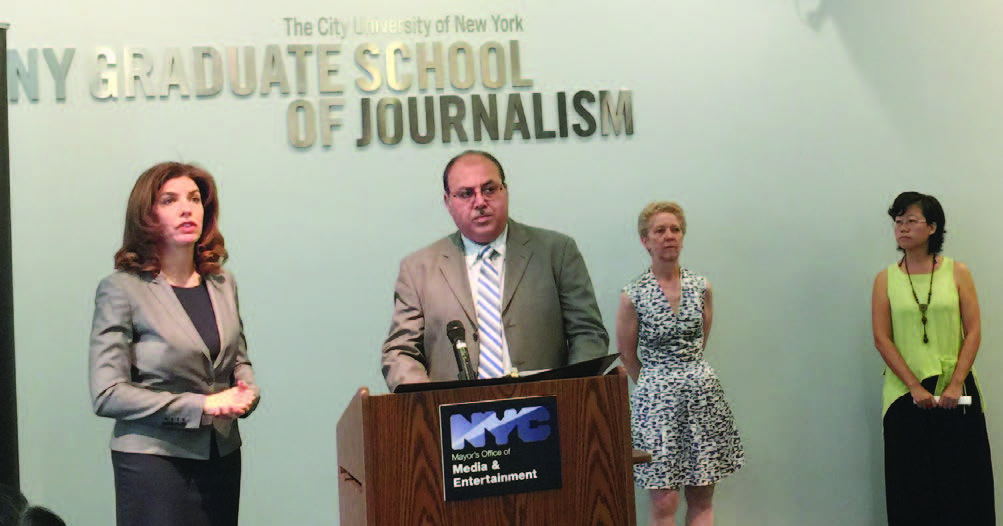
    NEW YORK CITY (TIP): The Mayor’s Office of Media and Entertainment (MOME) has granted $1 million to the CUNY Graduate School of Journalism to help New York City’s community and ethnic media outlets stay competitive in the current media landscape and bring them further into the digital age. The announcement of the grant was made, Monday, June 27 by MOME Commissioner Julie Menin at a well-attended press conference at CUNY School of Journalism in Midtown Manhattan.

    The funding will allow a major expansion of training opportunities for journalists working at these publications, which have an enormous readership and are of vital importance to communities around the city.

    In addition, the J-School’s broadcast facilities will be officially renamed the “Made in NY Broadcast Center” in recognition of MOME’s commitment to this important element of New York’s media sector. “The diversity and breadth of New York City’s community and ethnic media reflects the diversity of our city as a whole, and it is crucially important to keep these outlets thriving,” said MOME Commissioner Julie Menin. “These publications add key perspective to our local news landscape, and they keep New Yorkers in the know – whether their native language is English or Bengali. We look forward to collaborating with the J-School on this important initiative, which builds on their history of providing excellent training for journalists at ethnic and community publications.”

    “Since 2006, the CUNY Graduate School of Journalism has been dedicated to opening doors for a diversity of reporters and ensuring that everyone in the media industry has access to the new tools of the trade,” said CUNY J-School Dean Sarah Bartlett. “This partnership with the Mayor’s Office of Media and Entertainment, which ensures that the community and ethnic press throughout New York City will have many opportunities to benefit from professional training sessions, recognizes and builds on the CUNY J-School’s track record.”

    New York City is the ethnic media capital of the world, with more than 350 community and ethnic outlets that produce news in dozens of languages for print, radio, television and the web.

    A significant portion of New Yorkers – one-third of whom are foreign-born – rely on these outlets as a key source of news and information. Combined circulation of daily and weekly community and ethnic publications reaches 4.5 million people -more than half of New York City’s population.

    The CUNY J-School launched the Center for Community and Ethnic Media (CCEM) in 2012 to address the need to support these news outlets in particular, and help them tackle the unique challenges they face.

    Mayor de Blasio and Speaker Melissa Mark-Viverito announced an expansion of New York City’s outreach and engagement with community and ethnic media in January of this year. The initiative includes the launch of an online directory of ethnic and community media for city employees to use in outreach and informational and paid campaign efforts.

    While New York’s community and ethnic outlets are a key element of the city’s media landscape, many of them are struggling to keep up with the quickly evolving world of tech-driven journalism. In addition, many of the news outlets that CCEM serves are under financial pressure.

    Their employees often wear multiple hats: reporter, publisher, editor, publisher, photographer, ad salesman, and social media director. These publications are stretched thin: they often cannot afford to devote resources to professional development, and few have been able to fully migrate to a digital environment.

    Through this grant, MOME will provide CCEM with the means to create new, affordable courses building on the J-School’s current offerings in subjects such as social media, video storytelling, podcasting, and broadcasting techniques. It is estimated that MOME’s grant will allow the J-School to train 200 to 300 journalists per year over five years.

    Potential courses supported by this grant, which will be developed by CCEM in collaboration with the J-School’s CUNY J+ professional development division include: Multimedia and data visualization: Journalists will receive training with tools for multimedia presentation, training on Microsoft Excel, and sessions on how to effectively use data visualization. Video: Courses will focus on video storytelling for the web, the fastest-rising application in the news industry and one that is increasingly drawing the attention of advertisers.

    Social media: Participating journalists will learn to use platforms such as Twitter, Facebook, and YouTube effectively. They will also learn strategy around different social media platforms, and how to use analytic tools to inform content.

    Podcasting: Using the “Made in NY Broadcast Center” facility, participating journalists will learn about the components of a podcast and have the opportunity to make their own.

    Broadcast skills: Courses will provide journalists with training for on-camera appearances, as well as practice with public speaking and presentation skills.

    The “Made in NY Broadcast Center” is composed of a high-definition TV studio and radio recording facility, all with cutting-edge equipment including DSLR cameras, video cameras and audio recorders. Training for community and ethnic media reporters will include use of camera, audio, video, and lighting.

    “I join my colleague and co-director Karen Pennar in thanking Commissioner Julie Menin and the Mayor’s Office of Media and Entertainment for their very generous grant to support a new training initiative at the CUNY J-School’s Center for Community and Ethnic Media,” said J-School CCEM co-director Jehangir Khattak. “By helping this sector to adopt new technologies effectively, the Center’s training initiative will help community and ethnic media outlets improve the quality of their journalistic content, and support them in the important role they play in increasing the civic engagement of the diverse communities they serve.”


  • Good, honest exchanges needed, says Mayor de Blasio

    Good, honest exchanges needed, says Mayor de Blasio

    NEW YORK CITY (TIP): Mayor Bill de Blasio on Feb. 17 pledged that the city would spend more than $9 million in “language access” programs including translation and interpretation services in 2016, and that the city’s ad buys in community and ethnic media, which tripled in 2015 from 2013, were on track to outpace last year’s level of $1.3 million.

    He also said that members of the community and ethnic press would gain more ready access to city officials, noting that three seats would be reserved for community and ethnic media representatives at the City Hall press room. [The City Hall press office clarified that “three available desks will be rotated to accommodate different outlets, based on request volume.]

    While saying that he wanted to be careful about making a “blanket pledge” about meeting any and all requests from the ethnic media, Mayor de Blasio said that the city was dedicated to “deepening” its relationship with these diverse media outlets. “My goal is to consistently do more,” he said.

    “We are the ultimate city of immigrants. We honor that fact and know that it’s essential to our greatness and that means we need to communicate with people” in a way that they trust, said the mayor. In the past, he said, “New York City government too often attempted to basically communicate with the people of New York City only through traditional mainstream media and didn’t understand the power of community and ethnic media.”

    Now, he said, “we’re going to start changing that reality and we’re going to deepen these changes over the next few years. We aim to reach all of the people with everything we do.” On matters from pre-K seats to IDNYC to taking advantage of the earned income tax credit, de Blasio said, the city wants people in diverse communities to be well-informed, and the way to ensure that is through “pushing out more information to all of you than we have in the past.”

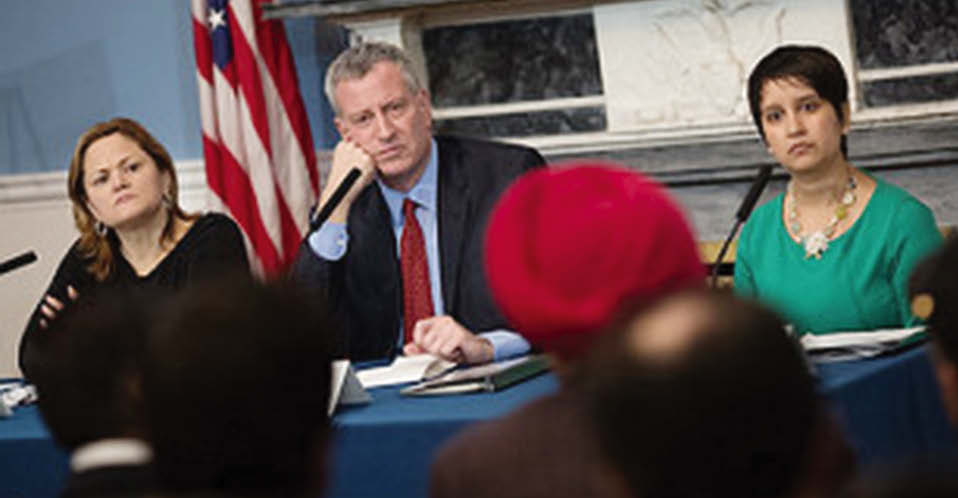
    With City Council Speaker Melissa Mark-Viverito on his right and the Commissioner for Immigrant Affairs Nisha Agarwal to his left, the mayor addressed and took questions from more than 50 members of the community and ethnic press in a standing room-only briefing held in the Blue Room at City Hall. Mark-Viverito and Agarwal also addressed the group.

    Mark-Viverito said she understood the role that community and ethnic media play in the city, and was “very passionate” about developing a strong partnership with that media, since she is bilingual and bicultural, gets her information from many media, and herself was once a journalist at WBAI. She noted that she had named the first-ever director of media diversity relations for the City Council, Juana Ponce de Leon. The Council speaker said she was “very excited” about the city’s efforts, that this is “just a beginning” and conceded that “it’s overdue – let’s be clear about that.” During questioning from the community and ethnic press, the mayor took notes and told some individual reporters that he would be sure to have their particular questions or complaints about prior inattention addressed. Agarwal, who described some of the city’s new initiatives to improve language access, such as inviting residents to dial 311 with complaints if interpretation services were found wanting, said that “we want to be held accountable in how we are bridging the language barrier.”

    Prof. Indrajit S Saluja, Editor of The Indian Panorama underscored the need to provide press releases to ethnic newspapers in their languages. He said many South Asian language newspapers fail to carry important City information only because they have no in house translators to translate press releases which are in English or Spanish.

    Following the end of the briefing, which lasted nearly an hour, press officers from numerous city agencies circulated among the ethnic and community media, inviting them to make contact.

    (With Voices of New York)

  • Mayor Bill de Blasio and Speaker Melissa Mark-Viverito Announce Expansion of New York City’s Outreach Engagement with Community Media

    Mayor Bill de Blasio and Speaker Melissa Mark-Viverito Announce Expansion of New York City’s Outreach Engagement with Community Media

    NEW YORK CITY (TIP): Mayor Bill de Blasio and Speaker Melissa Mark-Viverito announced, January 27, an expansion of New York City’s outreach and engagement with community and ethnic media outlets across the five boroughs. Today’s announcement includes the launch of an online directory of ethnic and community media for City employees to use in outreach and informational and paid campaign efforts, and a system to ensure accountability with the aim of having equitable communications across diverse ethnic, racial and geographic communities. The Mayor and Speaker will convene community-based journalists in the coming weeks to discuss these efforts.

    Melissa Mark-Viverito
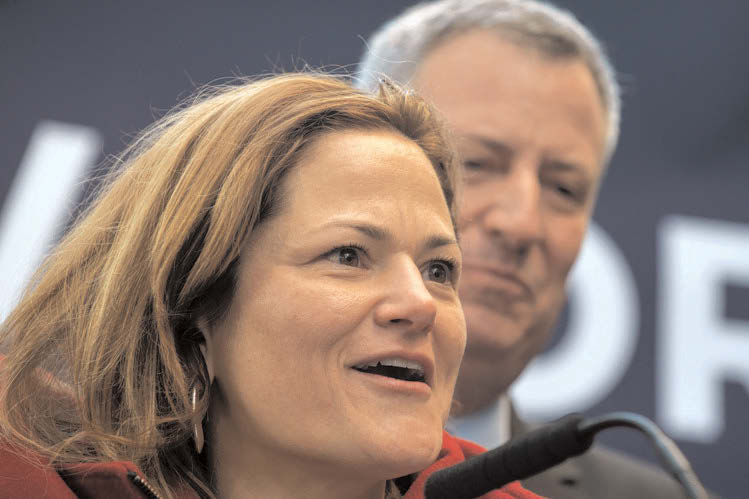
    “Today we are ensuring that the City speaks the language of our people,” said Mayor Bill de Blasio. Speaker Melissa Mark-Viverito is seen in the front.

    Many New Yorkers turn to neighborhood, youth and ethnic media to get their news, frequently in languages other than English, and the de Blasio Administration is committed to providing equal access to information. Speaker Melissa Mark-Viverito has advocated for proactive and consistent engagement of community media, and has dedicated resources and expertise in working with the Administration to ensure inclusion of diverse outlets.

    “In the city of immigrants, no person should be denied access to vital services or information due to their language. Half of all New Yorkers speak a language other than English at home. Almost one-sixth of all NYC households – 1.8 million people – are proficient in languages that are not English. Today we are ensuring that the City speaks the language of our people,” said Mayor Bill de Blasio.

    “Government has a responsibility to engage diverse media equitably so that we can communicate with a wide range of constituents,” said Council Speaker Melissa Mark-Viverito. “I am pleased that we are raising the bar for the way agencies plan and execute their outreach, public service announcements and paid campaigns. By doing so, we move towards being a more inclusive city at all levels.”

    “The de Blasio Administration is committed to speaking the language of multilingual New Yorkers, and as part of this outreach we must also reach them in the media outlets that are an integral part of their day-to-day lives,” said Nisha Agarwal, Commissioner of the Mayor’s Office of Immigrant Affairs. “The Administration has also deepened its commitment to language access to ensure that information is made available to all New Yorkers by hiring an Executive Director at MOIA who works to implement citywide tools, training, and reporting mechanisms. 311 now also accepts complaints from New Yorkers who have experienced language barriers at City Agencies.”

    “The Ethnic and Community Media Directory will strengthen the effectiveness of communications efforts throughout the city,” said Mindy Tarlow, Director of the Mayor’s Office of Operations. “Now communications teams have a guide that will further ensure their message is heard across the five boroughs.”

    “The responsibility of ensuring that our communities have access to relevant news is shared by press and by government. This Council is interested in engaging community press sources in a real way and this commitment is memorialized in part by today’s announcement. Without a doubt, we need to remain engaged about how we strengthen our relationships with community press and by extension, with the communities that they serve. I am proud to be witness to this important first step,” said Council Member Carlos Menchaca, Chair of the Committee on Immigration.

    “The ethnic and community press plays a crucial role in our city’s diverse neighborhoods –  especially to public school families who collectively speak more than 200 languages,” said Maite Junco, NYC Department of Education Senior Advisor for External Communications. “These media outlets spread out across our city are vital vehicles to reach our families and I thank the Administration for providing communication professionals in city government with an online tool to help us reach every New Yorker regardless of their zip code or language they speak.”

    Historically, City Agencies’ media outreach has focused primarily on English-language outlets, in spite of the fact that New York City is the ethnic media capital of the country -with hundreds of community and ethnic media outlets speaking dozens of languages. This trend has shifted under the de Blasio Administration, with the development of campaigns to inform all New Yorkers about IDNYC, Paid Sick Leave, and Pre-K For All, among other initiatives. Ethnic and community media were central to the outreach strategy, and the engagement and enrollment results clearly demonstrated the effectiveness of multilingual media outreach.

    To ensure that engagement of community and ethnic media becomes standard citywide practice, MOIA has worked with the Mayor’s Office of Operations, the City Hall Press Office, the City Council Speaker’s Office and the CUNY School of Journalism to create an online directory of ethnic and community media. The directory is a database of more than 200 TV, radio, print and digital news outlets covering more than 30 languages. This directory will help City Agency communications staff identify the most effective ways of reaching their intended audiences through media outreach as well as public service announcements and paid media campaigns. For City Agencies, this resource will strengthen the Administration’s communications reach to all corners of the five boroughs. In addition, City Agencies will report on an annual basis their advertising budgets alongside the budget spent on ethnic media outreach. This process will ensure that agencies are accountable and will measure communications efforts against metrics that gauge if outreach is equitable amongst different ethnic/racial and/or limited English proficient (LEP) communities.

    “A significant portion of New Yorkers depend on ethnic and community media as a source of news and information. By providing City Agencies with this media resource, the City will better connect with immigrant communities across the five boroughs,” said Jehangir Khattak, Co-Director of the Center for Community and Ethnic Media at the CUNY Graduate School of Journalism.

    “Ethnic and community media play a critical role in reaching dozens of immigrant communities. As an organization, we work closely with a broad range of ethnic media, recognizing that they are lifelines for immigrants who learn about programs and policies that impact them in their own languages first,” said Steve Choi, Executive Director of the New York Immigration Coalition, composed of over 200 community-based and immigrant direct service organizations, representing constituencies across New York State. “The Ethnic and Community Media Directory released by the Mayor’s Office of Immigrant Affairs and the City Council Speaker will be a vital tool for city government, agencies, and community organizations to strengthen their connections to the reporters and journalists who are at the frontlines of immigrant issues and who will ensure that our communities are fully informed.”

  • Gratitude to Martin Luther King, Jr

    Gratitude to Martin Luther King, Jr

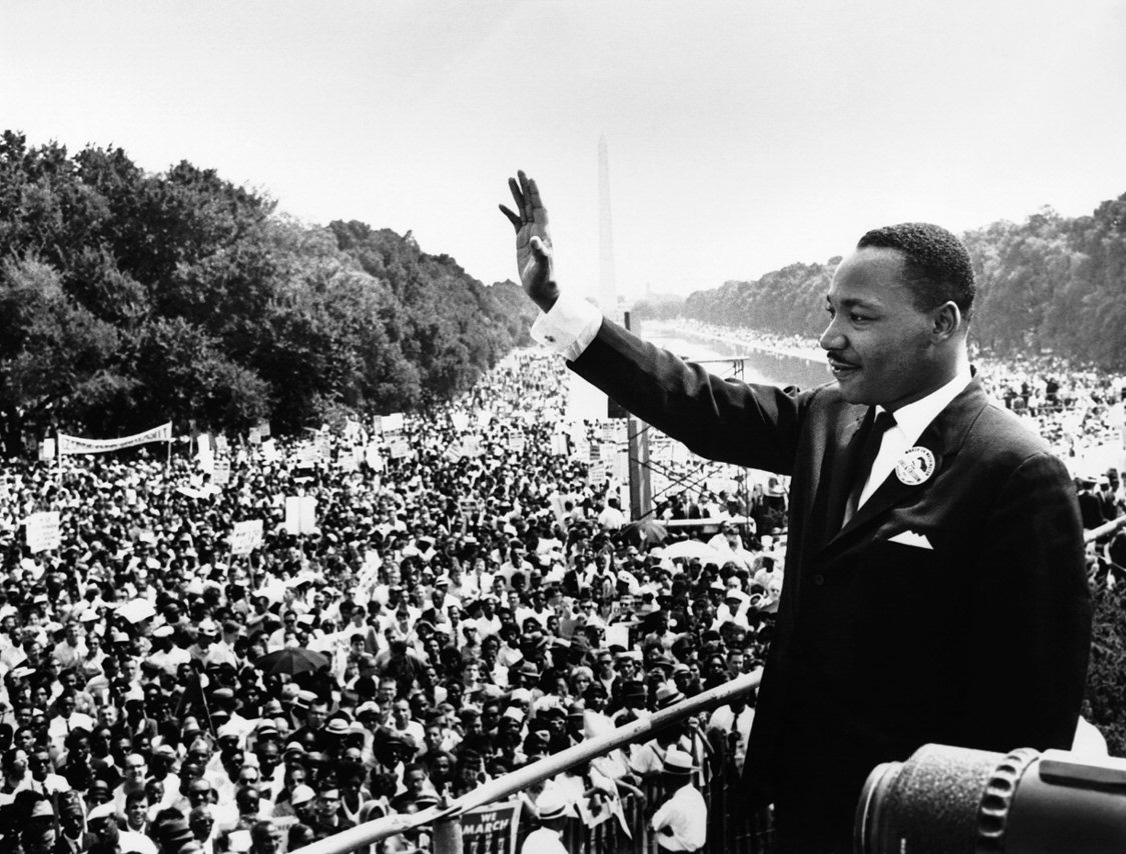
    Firstly, we the people owe a great deal to Rev. Martin Luther King Jr.  A majority of us Americans were living with a sense of guilt, a sense of being rotten the way we treated our fellow men and women.    His struggle has liberated us from such pain, and has brought freedom to the oppressed Black Men and women, we still have ways to go, but go we will.

    Secondly, we the people appreciate the white majority to have stood up for what was right – and join MLK on the steps of Lincoln Memorial to let the administration know what was morally right needs to become the law of the land.

    Thirdly, we appreciate the African American community for enduring the humility and non-violently appealing to the morality of the nation and bring about the change that was needed.

    Fourthly, we the immigrant Americans, particularly the non-whites would not have made it to America, had it not been for the Civil rights acts that MLK caused to happen. All of us non-white Americans owe our success to MLK and we need to pray for his soul today.

    Fifthly, as Indian Americans, we appreciate MLK, who saw the value in Mahatma Gandhi’s’ non-violent methods to turn the oppressors around to see the futility in their approach. In MLK’s own voice – https://www.facebook.com/cspanhistory/videos/880821915364690/

    Sixthly, as Muslim Americans, we are deeply committed to building a cohesive America, where no American has to feel alienated, apprehensive or fearful of the fellow Americans. We are committed to the safety and security of America.

    Seventhly, I invite my fellow Americans to take time to reflect on the bottom line work of all the great spiritual masters and civic leaders in creating such societies, and share your favorite quote of MLK.

    God bless Martin Luther King Jr., and God bless America!

    Mike GhouseMike Ghouse : The author is a community consultant, social scientist, thinker, writer, news maker, and a speaker on Pluralism, Interfaith, Islam, politics, terrorism, human rights, India, Israel-Palestine and foreign policy.


    “Today, as we honor an inspirational and exemplary leader in the fight for equality, we must continue in Dr. Martin Luther King Jr.’s legacy making sure that every person in this country is treated equally. From opening our doors to recent immigrants looking for a better opportunity, to ensuring that workers are getting paid a fair wage and putting forward policies to uplift all New Yorkers, we must renew our commitment to creating the kind of world Dr. King envisioned. The City Council stands with our city’s labor unions in the fight to provide a living wage for all New Yorkers and will continue to dedicate our work in making Dr. King’s dream a reality.”

    Melissa Mark-Viverito

    Speaker, New York City Council


  • Gun Control | President Obama’s Executive Action on Federal Gun Control

    Gun Control | President Obama’s Executive Action on Federal Gun Control

    POTUS unveiled new restrictions on gun purchases at the White House, saying the “constant excuses for inaction” have to stop. He was introduced by Mark Barden, whose son Daniel was killed in the 2012 massacre at Sandy Hook Elementary School in Connecticut. (Obama circled back to that shooting in the final moments of his speech)

    The White House has outlined his plans for executive action, which focus on background checks.

    Most of the actions can be carried out without Congressional approval.

    “That’s why we’re here, not to do something about the last mass shooting, but to prevent the next one,” he said.

    “The gun lobby may be holding Congress hostage right now, but they can’t hold America hostage,” Mr Obama said.

    He gave his remarks surrounded by survivors and relatives of victims of shootings, recalling mass shootings in the US in the past few years and everyday gun violence in cities like Chicago.

    The White House is seeking to expand background checks for buyers. The measure clarifies that individuals “in the business of selling firearms” register as licensed gun dealers, effectively narrowing the so-called “gun show loophole,” which exempts most small sellers from keeping formal sales records.

    The executive actions include:

    • Background checks for all gun sellers, overturning current exemptions to some online and gun show sellers
    • States providing information on people disqualified from buying guns due to mental illness or domestic violence
    • Increased workforce for the FBI to process background checks, hiring more than 230 new examiners
    • Congress being asked to invest $500m (£339m) to improve access to mental healthcare in the US
    • The departments of defence, justice and homeland security exploring “smart gun technology” to improve gun safety

    The announcement is already shaping up to be an issue in the 2016 presidential election.

    Leading Democratic candidate Hillary Clinton tweeted: “@POTUS is right: We can protect the second Amendment while protecting our families and communities from gun violence. And we have to.”

    Republican candidate Senator Ted Cruz tweeted that the executive actions are unconstitutional, with a link to sign up for his campaign correspondence on a webpage that says “Obama wants your guns” with a photo of the president in an army jacket and hat.

    Former Florida governor Jeb Bush tweeted that he would repeal the actions and protect the Second Amendment.

    Speaker Melissa Mark-Viverito “Tragedy after terrible tragedy has proven beyond doubt that the time for stringent federal gun control is long overdue. While Republicans in Congress stalled and squalled, thousands of men, women, and young children in our country have suffered and died because of lax regulations that allow these deadly weapons into the wrong hands. Consistently backward and shameful efforts to block sensible gun reform make Washington Republicans complicit in these tragedies – but we as a nation cannot and should not allow the lives of those we lost to be in vain. The executive action signed by President Obama will close dangerous loopholes in our current gun laws and tighten reporting requirements so that fewer guns end up on our streets and in our communities. This is a critical step on the path to ending the fatal epidemic of gun violence in our nation. I thank President Obama for taking action.”

    President Barack Obama grew emotional Tuesday, January 5, as he made a passionate call for a national “sense of urgency” to limit gun violence.

    Slide1 copy


    Gun violence is significantly higher in the US than in other advanced countries, killing about 30,000 people each year.

    Congress has been reluctant to pass any laws restricting gun ownership, facing pressure from gun owners and the powerful National Rifle Association.

    Mr Obama tried to pass expanded background check legislation in 2012 after the shooting in Newtown, Connecticut, that left 20 children and six adults dead but it failed in Congress.

  • SCHOOLS CHANCELLOR FARINA NAMES 15 SCHOOLS MODEL DUAL LANGUAGE PROGRAMS

    SCHOOLS CHANCELLOR FARINA NAMES 15 SCHOOLS MODEL DUAL LANGUAGE PROGRAMS

    NEW YORK  (TIP): Schools Chancellor Carmen Fariña announced that 15 schools with existing Dual Language programs will become Model Dual Language Programs for the 2015-16 school year. The schools will receive $10,000 for multilingual instructional materials and staff will have ongoing professional development. This initiative will foster collaborative practices among Dual Language educators, elevate the quality of programs across the City and provide support and guidance to school staff interested in opening programs.

    Each school designated as a Model Dual Language Program will host visits from other school leaders and staff to share best practices and strengthen other schools’ existing or prospective Dual Language programs. The 15 Model Dual Language Programs include elementary, middle and high schools in all five boroughs – four in the Bronx, three in Brooklyn, three in Queens, four in Manhattan, and one on Staten Island. They include Chinese, French, Russian, Hebrew, and Spanish Dual Language programs.

    “When principals and teachers share effective strategies, it’s the students who benefit,” saidSchools Chancellor Carmen Fariña. “Dual Language programs offer academic rigor for students and the opportunity to maintain their native language while learning a new one and learning about diverse cultures. These 15 schools are leaders in Dual Language education and, through collaborative practices, we can ensure a supportive, high-quality multilingual experience for even more students.”

    The Division of English Language Learners and Student Support, a standalone office dedicated to supporting English Language Learners, selected the 15 Model Dual Language Programsbased on their Dual Language education and schoolwide commitment to it, as well as classroom rigor and strong family engagement practices.

    “Our division is committed to expanding Dual Language programs in all five boroughs of New York City public schools,” said Milady Báez, Deputy Chancellor for the Division for English Language Learners and Student Support. “The first cohort selected will serve as models in creating uniformity across the City on the essential components of Dual Language programs. Next year, we will be selecting the second cohort of Model Dual Language Programs. This initiative allows leaders from premier Dual Language programs to share their successful practices and work collaboratively with educators.”

    “As the world becomes more and more global, being able to speak a second language is an asset,” said Tirza Shreiber-Prieto, a parent at PS 166 in Queens. “Dual Language teachers are passionate and committed to the program and my children are receiving top-tier instruction and a multilingual foundation that will last them a lifetime.”

    “Dual Language programs provide educators with innovative ways to strengthen school diversity and meet and expand horizons for both English Language Learners and English-proficient students,” said Council Speaker Melissa Mark-Viverito. “I’m pleased that MS 223 and PS 73 have been selected to host Model Dual Language Programs and look forward to continuing to work with Chancellor Fariña and the Department of Education as we work together to expand this promising new initiative.”

    “The citywide Model Dual Language Program is one more step forward towards better education in The Bronx, and is an important part of the continued push to promoting cultural integration into our society as well as professional development,” said Bronx Borough President Ruben Diaz Jr. “I want to congratulate the leadership of the four schools in The Bronx that were selected as part of the citywide Model Dual Language Program, the principals who helped make this happen, the parents, the students and the New York City Department of Education for their dedication to helping our youth reach their maximum potential.”

    “In a global economy, and in a borough where 47 percent of households speak a language other than English at home, second languages are increasingly becoming a necessity rather than an amenity,” said Brooklyn Borough President Eric L. Adams.
    “Congratulations to the students and staff of Brooklyn’s PS 200, PS 133 and IS 228, as well as all of our schools listed today, for their recognition as being a Model Dual Language Program, and I thank Mayor de Blasio for recognizing these outstanding schools and for working toward a day when this recognition becomes the norm, rather than the exception, in all of our schools.”

    “Robust incorporation of languages in the schools can literally open up new worlds of opportunity to our kids,” said Manhattan Borough President Gale A. Brewer. “I strongly support further expansion of language education in our schools.”

    “We are excited whenever a Staten Island school is recognized for the high caliber and commitment of their leadership, their level of parental involvement, and their student achievement,” said Staten Island Borough President James Oddo. “We are also excited when our schools receive additional funding to implement new programs that will help better educate their students. Congratulations to Principal Petrone and the PS 19 family.”

    “This recognition of the High School for Dual Language and Asian Studies and PS 133 William A. Butler is a testament to how these schools are dedicated to ensuring all students’ educational needs are met,” said Congresswoman Nydia M. Velázquez. “I’m proud that both schools are in my district and commend them for their continued excellence.”

    “As the representative of one of the most ethnically diverse districts in the country, I’m thrilled to see PS 16 and IS 145 selected as part of the City’s Model Dual Language Program,” said Congressman Joe Crowley. “I congratulate the principals, faculty, and parents at these schools for their role in a successful program that not only enriches our students’ education but sets them up for success. I also commend the NYC Department of Education for their commitment in the effort to strengthen these programs throughout the rest of our public schools.”

    “New York City is one of the most culturally diverse places on the planet,” said Council Education Committee Chair Daniel Dromm. “It is important that we equip our students with the language skills they need in order to succeed in school and after graduation. I applaud Chancellor Fariña’s financial support of these exemplary duel language programs. These funds will help develop already existing models and will help establish new programs in other schools interested in opening one. I look forward to continuing to support this worthy initiative as chairperson of the Council’s Education Committee.”

    “It is always great to hear that schools in the district are being distinguished for their work, leadership and innovative teaching,” said State Senator Jose Peralta. “In the 21st century, knowing just one language is not enough and that is why I am pleased that PS 16, The Nancy DeBenedittis School, is leading the way and making our kids bilingual, as well as IS 145, Joseph Pulitzer. Having the ability to fully speak another language is vital to compete in the marketplace, and that is why the Dual Language Programs are crucial for our students’ future. I want to congratulate both schools for their selection as citywide Model Dual Language Programs.”

    “I want to congratulate IS 145 for this outstanding achievement,” said Assemblyman Michael G. DenDekker. “An effort put forth by parents, staff, and most importantly students is exemplified here and their excellence has been rewarded.”

    “As our immigrant population grows, it is critical for our education system to keep pace with the reality of a growing ELL student population,” said Assemblyman Francisco Moya. “Dual Language programs are a critical part of engaging underserved student populations and making sure that all of our students are enriched by our education system. As the Assemblyman who represents the most diverse district in the country, I know how important Dual Language programs are for immigrants and first-generation Americans. I am proud to represent PS 16, The Nancy DeBenedittis School, and commend the principal, educators, parents, and students for setting the standard in high-quality Dual Language public education.”

    “In a City as linguistically diverse as ours, the expansion of foreign language education must be a priority so that students can understand other cultures and compete in a global economy,” saidCity Council Member Margaret Chin. “I am delighted that the High School for Dual Language and Asian Studies in my district has been selected for this important program. I thank Chancellor Fariña for her dedication to dual language instruction and for her selection of this exemplary school as a model for others throughout our City.”

    “New York City is arguably the most culturally diverse city in the United States. This diversity is reflected in the student body of our school system,” said City Council Member Vincent Gentile.

    “The Model Dual Language Program enables ELLs and English-proficient students to become bilingual and bicultural. At an exemplary elementary school in my district, PS 200 The Benson School, students are learning how to read, write, and speak Russian in addition to English. The bilingual and bicultural skills that our students develop as a result of this program undoubtedly strengthen their understanding of different cultures and also plants the seed for future success in the ever-increasingly diverse and competitive professional world.”

    “I am proud to congratulate Principal Sergio Caceres and the students, parents, educators, and staff of PS/IS 218 The Rafael Hernandez Dual Language Magnet School as they receive the Chancellor’s Model Dual Language Program award,” said City Council Member Vanessa Gibson. “Biliteracy is an increasingly important skill and I thank the schools being recognized today for their commitment to the highest caliber of Dual Language education and for ensuring their students develop an invaluable skillset that will serve them in their futures. I commend Schools Chancellor Carmen Fariña and the Department of Education for prioritizing dual language education and am proud a District 16 school is being recognized for their leadership in this field. I thank the DOE for their commitment to creative and innovative educational methods and thank them for taking the time to recognize the excellence of the hard-working educators honored today.”

    “I’m very happy to see Chancellor Fariña recognizing the truly excellent program at PS 133 in today’s celebration of the top Dual Language programs across NYC,” said City Council Member Brad Lander. “We have so many different strengths throughout our school system, and programs that allow our schools to learn from one another and further build out their top programs will help keep all our schools strong citywide. Congratulations to all 15 Model Dual Language Programs recognized today, and especially to the fantastic teachers, staff, parents and students of PS 133.

    “In a City as diverse as New York, it is imperative that our educational system not only provide high-quality Dual Language instruction but that we also support the schools who are doing this work so well. From Washington Heights to Corona Queens, the citywide Model Dual Language Program will come a long way in providing the support schools need to expand upon the quality of their Dual Language programing,” said City Council Member Ydanis Rodriguez. “I congratulate the schools and principals selected for this new initiative and am especially proud of MS 319 Maria Teresa and Principal Ysidro Abreu in my district.”

    “We are in one of the most diverse cities in the world, and our diversity is a social, political, and economic strength,” said City Council Member Mark Treyger. “There is no better place to cultivate and celebrate that diversity than in our public schools. The more we expose our children to multi-lingual diverse languages and cultures, the stronger our City and our future will become. This is a win-win for the children of New York City and for the social, political, and economic future of New York City. I thank the administration, the teachers, and the entire family at Boody Junior High School for their commitment to this wonderful program and the support they have received.”

    List of Model Dual Language Program Schools

    Bronx
    PS/IS 218 Rafael Hernandez Dual Language Magnet School -Spanish
    PS 73 – Spanish
    MS 223 the Laboratory School of Finance and Technology -Spanish
    High School of World Cultures – Spanish

    Brooklyn 

    PS 200 Benson School – Spanish
    PS 133 William A. Butler – Spanish and French
    IS 228 David A. Boody – Russian, Chinese, Hebrew and Spanish

    Manhattan

    PS 161 Pedro Albizu Campos – Spanish
    MS 319 Maria Teresa – Spanish
    Manhattan Bridges High School – Spanish
    High School for Dual Language and Asian Studies – Chinese

    Queens

    PS 16 The Nancy DeBenedittis School – Spanish
    PS 166 Henry Gradstein – Spanish
    IS 145 Joseph Pulitzer – Spanish

    Staten Island

    PS 19 The Curtis School – Spanish

  • Mayor’s Office Enters in to Partnership with City Libraries to develop ‘NYCITIZENSHIP’

    Mayor’s Office Enters in to Partnership with City Libraries to develop ‘NYCITIZENSHIP’

    NEW YORK CITY (TIP): Mayor de Blasio announced, September 17, a new initiative with the City’s library system to develop NYCitizenship, a public-private partnership that will install comprehensive citizenship assistance services at library branches citywide to increase naturalization rates. The NYCitizenship announcement comes alongside a nationwide campaign in support of immigration integration initiatives and naturalization efforts, led by the nearly 100 members of Cities United for Immigration (CUIA) in partnership with the White House, Cities for Citizenship and a number of other national organizations.

    “Citizenship is a vital piece of our citywide strategy to promote economic opportunity and equity – and cities are central to protecting and promoting the inclusion and diversity that make our country so great,” said Mayor Bill de Blasio. “Citizenship is linked to increased wages, higher rates of homeownership, and other important factors in helping people unlock vital civic and economic opportunity. We’re proud to stand with cities and other leaders nationwide in expanding opportunity to citizenship for those who have long been hardworking, productive members of our country.”

    “Barriers such as lack of information or access to quality, affordable legal services prevent immigrants from taking the final step to become a citizen – we can change that,” said Commissioner of the Mayor’s Office of Immigrant Affairs Nisha Agarwal. “By providing New Yorkers access to citizenship information and legal support at places they already frequent, such as our City’s public libraries, we can work to ensure more city residents are able to access the benefits and privileges they’re entitled to as citizens.”

    “The NYCitizenship Initiative will help forge a clear path to citizenship – a journey that can be daunting and complex for so many New Yorkers. By providing thorough information, legal assistance and help with application procedures, we can ensure that more individuals navigate this process successfully and enjoy the stability and opportunities that come with U.S. citizenship. I thank the Mayor’s Office of Immigrant Affairs and our City’s libraries for partnering together in this effort to increase meaningful civic participation,” said New York City Council Speaker Melissa Mark-Viverito.

    Through NYCitizenship, the Mayor’s Office of Immigrant Affairs will work with the City’s libraries to provide free, comprehensive information on applying for citizenship as well as legal assistance in completing applications. The program also integrates financial education to help new citizens on their path to financial sustainability. Mayor de Blasio made the announcement as part of a naturalization ceremony for 100 New Yorkers hosted by City Hall in celebration of Citizenship Day.

    Mayor Bill de Blasio also kicked off the City’s first-ever Citizenship Week of Action to encourage more New Yorkers to become U.S. citizens through citywide outreach, information sessions and legal clinics. The events will be held in collaboration with faith, labor, and community organizations starting today through September 22, culminating on National Voter Registration Day. Over 150 volunteers will engage with immigrant community members where they live, work and worship to assist over 500 applicants. The list of events can be found at nyc.gov/nycitizenship

    Expanding on the recently-created New American Corners in City libraries, a partnership with United States Citizenship and Immigration Services (US-CIS) to provide recent immigrants with access to information and resources about citizenship and entrepreneurship, the City is working to further its assistance to permanent legal residents in order to encourage them to apply for citizenship by providing legal services.

    Approximately 700,000 immigrant New Yorkers are one step away from citizenship. Half of them are low-income, and increasing access to citizenship services is a powerful tool for promoting economic stability. Achieving citizenship can improve earning potential, increase social and economic mobility, open access to voting, and protect against deportation. As individuals achieve economic security and build more stable families, our city and our communities benefit. Positive outcomes include increased tax revenue, less reliance on emergency assistance programs, and an increase in civic participation.

  • Mayor De Blasio  for  eliminating Times Square pedestrian plazas to kick out topless women, costumed characters

    Mayor De Blasio for eliminating Times Square pedestrian plazas to kick out topless women, costumed characters

    NEW YORK (TIP): Mayor de Blasio on Thursday, August 20, floated the idea of tearing up the popular pedestrian plaza to rid the area of the topless painted ladies and the costumed characters who harass tourists for tips, say media reports.

    Acr3332699153876-19371“You could argue that those plazas have had some very positive impact,” de Blasio said. “You could also argue that they’ve come with a lot of problems. And a lot of the surrounding business community has certainly cited those problems. So we’ll give that a fresh look.”

    De Blasio said he’s already discussed the idea with Police Commissioner Bill Bratton, the co-chair of the city’s special task force charged with ousting the jiggly panhandlers from the Crossroads of the World.

    “Now that’s a very big endeavor and like every other option comes pros and cons,” the mayor said. “So we’re going to look at what those pros and cons would be.”

    Bratton sounded like he was ready to start tearing the plaza up right away.

    Acr333269915387624144“My own personal preference, as I’ve looked at all the different options, is to return it to what it once was,” the top cop said. “Part of the attraction for the characters and the topless ladies is that is a very wide plaza where they can congregate. If it was just sidewalks they would not be able to congregate to the degree that they’ve been able to do in that public space.”

    The pushback started literally within minutes.

    City Council Speaker Melissa Mark-Viverito immediately turned thumbs down on that scheme.

    “The City Council is considering its legislative options, but the Speaker believes in and supports keeping pedestrian plazas,” her spokesman, Eric Koch, said.

    Mark-Viverito also suggested City Hall was over-reacting to the painted ladies.

    “There are many, many more serious issues facing New York City which deserve our immediate attention and this is not one of them,” her spokeswoman, Robin Levine, said.

    City Controller Scott Stringer called the proposal to tear up the pedestrian plaza “a serious overreaction to what is essentially a quality of life enforcement issue.”

    And City Councilman Dan Garodnick, who represents Times Square, said “let’s not throw the baby out with the bathwater here.”

    “The Times Square plazas have provided a safe haven for pedestrians who previously had to navigate very narrow and overcrowded sidewalks right next to fast traffic,” he said.

  • City and Ethnic and Community Media need to come closer

    City and Ethnic and Community Media need to come closer

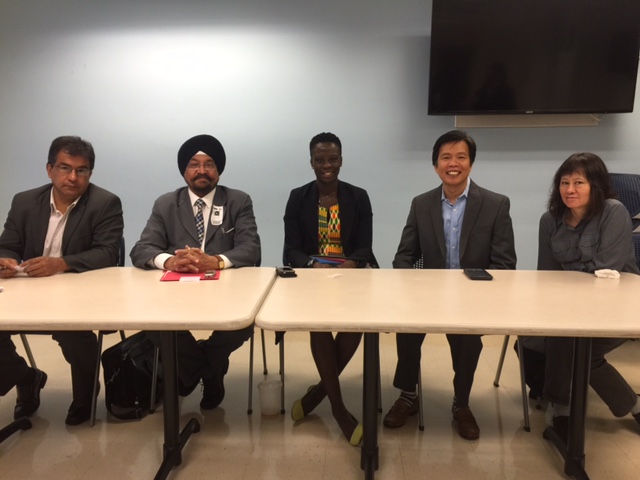
    NEW YORK CITY (TIP): A 5 member panel of representatives of ethnic and community media  interacted  with communications directors of City Council members at a  panel  discussion organized by Juana Ponce de Leon, Director of Media Diversity Relations, Office of Speaker Melissa Mark-Viverito on June 1.

    A view of the Communications Directors present at the conference
    A view of the Communications Directors present at the conference

    The panel included  Javier Castano , Director, Queens Laino,  Prof. Indrajit S Saluja , Editor, The Indian Panorama, Isseu Diouf Campbell, Communications & Media Consultant and Founder of  Afrikanpot.com, Anthony Advincula  from  New American Media, and Lotus Chan from Sing Tao Daily. Around 25 of the 51 Communications Director participated.

    Speaking of the objective of the panel discussion, Juana who moderated said there was a need   for newspaper editors and communications directors to understand each other’s needs and get to know what each expected of the other.  It was necessary, she said, to build a closer relationship between the City through the  communications directors and the newspapers.

    While  each of the panelists presented his/ her  perspective, the panelists also took questions  from the communications directors. The broader consensus was that the City and the ethnic and community media needed to work in closer cooperation.

    Directors of communication were requested to send in information on a regular basis, preferably in the  language of the newspaper to which the information was being sent

    Speaking about the contribution of these papers, a panelist, Prof. Saluja  said: “There are around 350 ethnic and community newspapers in scores of languages which reach out to millions of immigrants living in New York City. The City school system claims that 182 languages are spoken in the City schools. The ethnic and community media reaches out to 37% population of New York which has an immigrant population of 1.4 to 1.8 million. They have little or no English. The only source of information for them is their language newspaper. They depend on ethnic and community newspapers to get to know of what is happening here and “back home”. It is these newspapers which carry to these millions the policies and programs of New York City and the multiple administration agencies and keep them informed on various political, social, economic and cultural issues. Exercising great influence over the minds of their readers, they help them form healthy opinions. And, yet there was a  disconnect between the City and the ethnic media.  The City spent in 2013, $18 million on advertisements and 82% of it went to mainstream media, numbering just a few. Imagine, 350 small ethnic and community publications got a meager 18%. Here is the disconnect. It must end.”

  • City Council Passes Bill Banning Credit Checks in Hiring

    City Council Passes Bill Banning Credit Checks in Hiring

    NEW YORK CITY (TIP): The City Council passed a bill, April 16 that will ban most employers from using credit histories to screen job candidates.

    The bill passed the Council by a vote of 47 in favor to three opposed.

    Left-leaning council members, labor unions and activist organizations argued that credit checks are discriminatory, unfairly targeting minorities and low-income New Yorkers with poor credit histories. The bill, known as the “Stop Credit Discrimination in Employment Act,” was hailed by supporters as one of the “strongest” measures in the country against employment credit checks.

    “Credit checks for employment unfairly lock New Yorkers out of jobs for a whole set of unfair reasons. Divorce, healthcare debt, student loans, identity theft, simple errors,” said Councilman Brad Lander, a Brooklyn Democrat and lead sponsor of the legislation, at a City Hall press conference. “There is no demonstrated correlation between people’s credit history and their likelihood to commit fraud or theft, between their job performance-this is smart legislation.”

    Council Speaker Melissa Mark-Viverito said the use of credit checks had a disparate impact on certain groups, ranging from people of color to domestic violence victims. “It is very much a discriminatory practice,” she said during a City Hall press conference.

    “All New Yorkers deserve the chance to compete for a job based on their skills and qualifications, not three digits on their financial report,” she said.

    During negotiations on the bill, some business groups called for broad carve-outs found in other municipalities, which often exempt the entire financial services industry from the law. Advocates, meanwhile, called for there to be almost no exceptions to the ban. Today’s legislation includes exemptions for a smaller category of jobs, council members said.

    “This is going to be the strongest law on this issue in the country,” Ms. Mark-Viverito said.

    Among those exempt-people whose credit history can still be checked-are police officers, peace officers, law enforcement personnel at the Department of Investigation, any position subject to DOI background checks, those bonded by city or state law, national security professions, and those with access to trade secrets or with the signatory authority to assets above $10,000.

    Mr. Lander said in eight of the other 11 jurisdictions with similar laws, the entire financial sector is exempt-“down to bank tellers and custodians”-with many locales allowing credit checks of anyone in any kind of managerial position or with access to a company credit card.

    “None of those are in this bill,” Mr. Lander said.

    Some business leaders, like Partnership for New York President Kathryn Wylde, were also pleased with the final language of the legislation.

    “The Partnership represents companies that employ almost a million New Yorkers. In this age of technology, where many employees have access to private customer and company information and funds, employers have a greater responsibility than ever to carefully vet their workforce,” Ms. Wylde said in a statement. “We worked with the Mayor’s office and the City Council to ensure that the final legislation allows employers some discretion in use of credit checks, which we hope proves sufficient to protect the interests of businesses and consumers.”

    But the bill didn’t find favor with everyone in the Council. Councilman Mark Weprin, a Queens Democrat, said he didn’t feel comfortable telling employers who they must hire, as long as they follow state and federal law.

    “I just feel this is a little bit too much of the nanny state,” Mr. Weprin, who voted against the bill, said.

    A coalition of 79 community, labor and student organizations, including the Working Families Party and the New York Public Interest Research Group, led a push for the credit check ban. Stuart Appelbaum, the president of the Retail, Wholesale and Department Store Union, said the bill “puts an end to a practice that puts job applicants behind an economic eight ball.”

    “Using a person’s credit worthiness to judge their workability is really just another form of discrimination,” he said. “In New York City, workers will never again have to face that kind of discrimination.”Ramon Lebron, a student at Bronx Community College, said student loan and personal debt had kept him from landing jobs in the finance industry.

    “We’re in school right now because we’re trying to get jobs, we’re trying to improve ourselves,” Mr. Lebron said. “How are we supposed to get jobs to improve or establish our credit if we can’t get jobs because that lack of credit history or not having good credit in general? Mayor Bill de Blasio is expected to sign the bill into law.

  • America’s  most ambitious municipal identification program  launched

    America’s most ambitious municipal identification program launched

    IDNYC acceptance by more than 10 financial institutions and the complete package of card benefits, including entertainment and BigAppleRx prescription discounts

    NEW YORK (TIP): Mayor Bill de Blasio and Council Speaker Melissa Mark-Viverito launched, January 12, the IDNYC municipal identification program for residents of all five New York City boroughs. The Mayor also announced that the IDNYC card will be accepted as valid primary identification for opening a bank or credit union account at more than 10 financial institutions, and revealed the card’s full suite of benefits.

    “IDNYC is not only a card for all New Yorkers, it is the gateway to City services, the key to opening a bank account or getting a library card, and the ticket to many of our city’s finest cultural institutions. More than that, this card represents who we are: New Yorkers who value equality, opportunity and diversity,” said Mayor Bill de Blasio. “I want to thank Speaker Mark-Viverito and our partners in the Council for their tremendous work and collaboration on this program. Today, we are launching the most ambitious, dynamic and useful municipal ID program in the country, which will have a real and tangible impact on the lives of all New Yorkers.”

    “Time and again, New York City has shown that we are not afraid to lead,” said Council Speaker Melissa Mark-Viverito. “In launching the IDNYC program, we are living up to our highest ideals about who we are as a city. I’m proud of my colleagues and bill sponsors Immigration Committee Chair Carlos Menchaca and Council Member Daniel Dromm for their support in this process and thank the de Blasio administration for its partnership in making IDNYC a reality for all New Yorkers.”

  • NYC Council Speaker Melissa Mark-Viverito speaks with Ethnic and Community Media

    NYC Council Speaker Melissa Mark-Viverito speaks with Ethnic and Community Media

    NEW YORK CITY (TIP): At a Dec. 11 roundtable with ethnic, community and independent journalists, Speaker Melissa Mark-Viverito announced the launch of an initiative to strengthen the Council’s outreach efforts to diverse media across New York City.

    “My vision is for a New York City that is more equitable and inclusive -and this includes of all media,” said Mark-Viverito to a meeting attended by more than 60 representatives that covered dozens of ethnic publications, communities of color and a cross-section of neighborhoods. “We also know that editors and reporters like you are leaders in your communities and that you wear several hats – as guides to navigating a broader society, as providers of news and information that is relevant to your communities, and as advocates for their rights.”

    As part of this vision, the Speaker has brought on Juana Ponce de León as Director of Media Diversity Relations, a position created specifically to provide ethnic, community and independent media with equal access to information. Ponce de León is the former Founding and Executive Director of the New York Community Media Alliance, a nonprofit organization that worked with and advocated for more than 350 publications in New York City serving the city’s immigrant and communities of color.

    At the roundtable, the Speaker heard the concerns of some of the attendees, who expressed interest in more responsiveness from city agencies and fairness in the distribution of ad dollars, among other issues. The Speaker also outlined some of the Council’s achievements during the first year of her leadership, including passage of legislation to create a Municipal ID, funding for legal services for unaccompanied minors, and a stabilization fund for community-based organizations.

    This is the first time that such an effort is undertaken by a New York City Council Speaker to promote a culture of media diversity and ensure that the Council’s outreach is inclusive and consistent. The roundtable was convened with the help of the Center for Community and Ethnic Media at the CUNY Graduate School of Journalism and is the first in a series to be held during the Speaker’s tenure.

  • NEW YORK CITY COUNCIL ANNOUNCES FORMATION OF COMMITTEE ON COURTS AND LEGAL SERVICES

    NEW YORK CITY COUNCIL ANNOUNCES FORMATION OF COMMITTEE ON COURTS AND LEGAL SERVICES

    NEW YORK CITY (TIP): The New York City Council announced, September 11, formation of the Committee on Courts and Legal Services. Chaired by Council Member Rory Lancman, the Committee on Courts and Legal Services will allow the City Council greater oversight of the New York City’s legal system in its mission to provide due justice and fair representation for all New Yorkers.

    “Every New Yorker is entitled to equal justice under the law, and the Committee on Courts and Legal Services and the City Council will work with community partners and city agencies to identify ways to meet that fundamental goal,” said Speaker Melissa Mark-Viverito. “Under the leadership of Chair Rory Lancman, the Committee will examine the demand for legal services and the resources and support needed for the courts to serve our city with integrity.

    Now more than ever, this is an important step forward and I look forward to commencing hearings in the weeks ahead.” “A sound justice system — fair and efficient courts, access to quality legal representation – – is essential to progressive government, and I’m grateful for the Speaker’s confidence in my ability to help move these issues forward,” said Council Member Rory Lancman. “We applaud the New York City Council for its insight in creating the new Committee on Courts and Legal Services which will focus on access to justice issues, expansion of much needed legal services, and the need to provide additional services to communities of color,” said Seymour W. James, Jr., Attorney-in-Chief of The Legal Aid Society.

    “The Committee should review the availability of legal services and make recommendations for much needed increases in funding for legal services. We at The Legal Aid Society look forward to working with this new Committee in the future.” “Civil legal services are essential in the fight against poverty and for equal justice for all New Yorkers,” said Raun Rasmussen, Executive Director of Legal Services NYC. “Unfortunately, fewer than one in five lowincome New Yorkers who need legal help can get it due to insufficient funding. We are thrilled that the City Council is taking this important step toward expanding access to justice for all New Yorkers.”

    “Every year the New York Legal Assistance Group turns away tens of thousands of vulnerable New Yorkers seeking our services, who are forced to navigate the civil justice system without benefit of counsel,” said Yisroel Schulman, President and Attorney-in-Charge of the New York Legal Assistance Group. “We support the City Council’s efforts to increase access to justice for those least able to fight back – seniors, immigrants, ailing veterans, children, families facing foreclosure, renters facing eviction, low-income consumers, people with disabilities, and other vulnerable populations.” “Civil society depends on well-functioning and properly maintained courts, and on access to quality legal representation for all parties,” said Joseph Carola III, Esq., President of the Queens County Bar Association.

    “That’s why the Queens County Bar Association commits so much time and resources to advocating for our justice system and supporting the professional development of our members. I commend Speaker Melissa Mark-Viverito for establishing this important committee and Council Member Rory Lancman for his willingness to undertake this important responsibility.” “As a chapter of the Women’s Bar Association of the State of New York, the New York Women’s Bar Association and the Women’s Bar Association of the State of New York support access to justice for all.

    Access to justice addresses the core of WBASNY’s mission purpose: the advancement of the law to assist women and all in society,” said Yacine Barry-Wun, Esq., President of the NYWBA. “Every day, thousands of New Yorkers — many of them self-represented or without adequate legal representation — rely on our courts to render impartial justice on matters large and small,” said Mitchell B. Nisonoff, Co-Chair, Civil Court Practice Section, New York County Lawyers’ Association. “The City Council has an important role to play in ensuring that our justice system is fair and efficient. I strongly commend this increased focus on our courts and the provision of legal services.”

  • Mayor Bill de Blasio signs legislation to create MUNICIPAL ID CARD

    Mayor Bill de Blasio signs legislation to create MUNICIPAL ID CARD

    ID card to provide thousands of New Yorkers access to core City service
    City to waive application fee for first-year applicants

    NEW YORK CITY (TIP): Mayor Bill de Blasio signed , Thursday, July 10, legislation to create a municipal ID card for all New York City residents. The legislation paves the way for the creation of a municipal ID for all residents of the five boroughs who meet the program’s proof of identity and city residency requirements. The City will immediately initiate implementation of the program, with the goal of launching the new identification card in January 2015. The Mayor also announced today that the card will be issued at no cost for applicants during the program’s first year.

    “We cannot accept a city where some of our residents are forced to live fearfully in the shadows, unable to visit their child’s school or sign a lease. Today, this legislation will begin to provide New Yorkers with the dignity and peace of mind they deserve,” said Mayor Bill de Blasio. “This bill has become reality because community activists and organizers worked tirelessly to make this day happen. I want to thank the City Council, including Speaker Melissa Mark-Viverito, and City Council Members Danny Dromm and Carlos Menchaca for their incredible leadership in helping all our city’s residents attain the identification they deserve.”

    “From our earliest days, New York City has been a beacon of hope and optimism, and today we are continuing to build that legacy,” said City Council Speaker Melissa Mark-Viverito. “This new ID card is more than a means of identification-it is upholding the promise of acceptance and opportunity we make to one another as New Yorkers. I thank Council Member Dromm, Council Member Menchaca, my Council colleagues, and Mayor de Blasio for their strong support, and I am proud to be here today as we sign this landmark legislation to create a more fair and just city that is inclusive of all New Yorkers.”

    “Today’s bill signing is a transformative moment in the history of this city.With this law, New Yorkers will have access to the largest municipal identification program in the country, and will have increased access to the rights and privileges afforded to them as members of our city. This identification program is real celebration of the diversity of this city, and a commitment to the protectionand inclusion-of all. I am proud today to be a member of this Council, and a resident of this great city,” said Council Member Carlos Menchaca, Chair of the Committee on Immigration.

    “Today is a historic day,” said Council Member Daniel Dromm. “I thank Mayor de Blasio, Speaker Mark-Viverito, Council Member Menchaca, my fellow Council colleagues, and the many advocates and supporters who helped make the municipal ID a reality. This new form of identification will make our city even more inclusive. It is certain to become the must-have accessory for all New Yorkers.” “Today is a great day for all New Yorkers,” said Council Member Julissa Ferreras, Chair of the Committee on Finance.

    “Our great city has long celebrated its heritage as a gateway to the American dream for so many people who leave their homeland in search of a better way of life. Mayor de Blasio’s signing of the municipal ID bill marks a great stride toward helping all undocumented residents achieve this dream. As the daughter of immigrants, I am proud to see a day where thousands of our undocumented residents will no longer have to live in the shadows, fearing to come forward to receive the many public benefits our great City has to offer.

    I applaud Mayor de Blasio and my colleagues in the City Council for championing this piece of legislation. Our collective efforts have, at long last, paved the way to equal access of safe and secure identification amongst all New Yorkers, regardless of their immigration status.” Municipal ID will be an accessible and safe document that will ensure access to City services and grant admission to all municipal buildings. The City is also working toward having the ID be recognized by banks, as well as connecting the ID with stores, restaurants, cultural institutions, discounts and other incentive programs.

    The City will continue to expand and improve upon the municipal ID card program and benefits after the launch date. To ensure broad and easy accessibility, the City will establish walk-in enrollment centers in trusted community institutions around the boroughs, and will post the application online for applicants to complete it prior to visiting a walk-in center. In addition, the City will create mobile enrollment units that can travel to neighborhoods that do not have walk-in centers.

    The City will also ensure that the outreach and application processes are accessible to people with limited English proficiency and people with disabilities. The City will protect the confidentiality of all municipal ID card applications, and will not ask applicants about their immigration status.

  • MUNICIPAL IDENTIFICATION CARDS FOR NEW YORKERS MOOTED

    MUNICIPAL IDENTIFICATION CARDS FOR NEW YORKERS MOOTED

    Speaker Mark-Viverito and Council Members Menchaca & Dromm announce legislation

    CITY HALL, NY (TIP): City Council Speaker Melissa Mark-Viverito, Immigration Committee Chair Carlos Menchaca and Council Member Daniel Dromm , April 10, announced the introduction of legislation to provide New Yorkers with municipal identification cards – the New York City Identity Card- that will facilitate New Yorkers access to City services.

    The legislation would require the City to create the New York City Identity Card Program. Through this program, the City would offer a secure municipal identification card to anyone who lives within the five boroughs. Under the law, City agencies would be required to accept the card, making it easier for New Yorkers to use to access City services where identification is required. Much like a license, applicants would have to provide proof of residency and identity to obtain the card.

    To increase the popularity of the card, the City would be required to expand the benefits once implemented including working with banks and other public and private institutions to promote broad acceptance of the municipal identification program. The bill requires that the card be designed in a way that deters fraud much like a driver’s license or passport. “New York City Identity Cards will provide New Yorkers with broader access to City services, foster better community relations and help bring stability to all City residentsthis is a smart, humane policy that will help New Yorkers,” said Speaker Melissa Mark- Viverito. “I’m proud to work with Immigration Chair Menchaca and Council Member Dromm on this critical legislation, and look forward to hearing from my Council colleagues, the de Blasio Administration and the public on this bill.”

    “The New York City Identity Card will provide residents with government issued identification,” Council Member Daniel Dromm (D-Jackson Heights, Elmhurst) said. “Everybody needs identification everywhere you go in New York City. Without ID, individuals are not allowed to enter schools to pick up their children. This legislation makes New York City a safer, more inclusive city.” Immigration Committee Chair Carlos Menchaca said: “As Chair of the Immigration Committee, I am proud to join Council Member Daniel Dromm to introduce legislation that would create New York City’s first municipal identification card program. I commend Speaker Melissa Mark-Viverito’s leadership in spearheading this legislation.

    I represent the 38th Council District, which is made up of many diverse and vibrant neighborhoods. I know firsthand that far too many of our neighbors struggle to prove their identity, finding it difficult to access the most basic of services. Identification cards are gateways to critical services. A number of other cities, including New Haven, Los Angeles, and San Francisco, have established municipal ID card programs. With this bill, the City Council is committed to creating a municipal ID card program that benefits our entire City. This introduction is just the first step, and we look forward to working hand-in-hand with the administration to ensure that proof of identity is no longer a privilege for New Yorkers.”

  • Mayor Bill de Blasio signs paid sick leave expansion set to take effect April 1

    Mayor Bill de Blasio signs paid sick leave expansion set to take effect April 1

    BROOKLYN, N.Y. — Mayor Bill de Blasio signed legislation Thursday, March 20 expanding paid sick leave to companies with at least five employees starting next month.

    “This will be the first city law that I will have the privilege to sign as mayor, and I could not be more honored that that law is the expanded paid sick leave law — so important to the people of this city,” de Blasio said.

    The bill removes many of the compromises reached in a paid sick bill passed under former City Council Speaker Christine Quinn — that legislation applied only to larger businesses, and was phased in over the course of several years, depending on the size of the company.

    This legislation will take effect April 1. The bill signed Thursday will apply to any business with five or more employees — but there will be a grace period for those smaller businesses that wouldn’t have been covered by the previous law, which would have applied first to businesses with 20 or more employees and later to those with 15 or more employees.

    “We have prevailed at last — we have achieved our full goal — half a million more people about to be covered under a law that will protect their rights,” de Blasio said. City Council Speaker Melissa Mark- Viverito offered the example of a lowwage worker whose wife was killed and son injured in the East Harlem gas explosion in her district. The man has been at his son’s bedside since the explosion, she said. “Those individuals now have protection to be able to stand by the beside, at a hospital, of a child,” Ms. Mark-Viverito said. “This is very real to many families many times over in this city.”

    The mayor — who ran on the promise of representing the outer boroughs — opted to sign his first bill at a Brooklyn ice cream manufacturer, rather than the City Hall Blue Room, where bills are often signed. Staten Island’s two Republican Council members, Minority Leader Vincent Ignizio (South Shore) and Councilman Steven Matteo (Mid- Island/Brooklyn), were among those voting against the legislation in the Council — where many members expressed concerns about how the bill might affect small businesses but voted for it anyway.

    While a six-month grace period applies to businesses with fewer than 19 employees, it won’t apply to those with more — the businesses that would have been covered by the original law. But with the law going into effect in under two weeks, Staten Island Chamber of Commerce President Linda Baran said businesses haven’t even been educated about the original law, let alone this one. But de Blasio said there has been plenty of information out over the “the last four years” as the bill has been discussed. “There’s been a lot of information out since the original bill was passed last year,” he added.

    “So I don’t think there’s too many businesses that haven’t heard the basics, but we’re going to continue that education effort.” Consumer Affairs Department Deputy Commissioners Alba Pico said the department would launch a “big campaign” in the subways and buses at the end of the month. “We have the paperwork that is required for them to enforce the law, and also a notice that they have to give out to the employees,” she said.

    “So, we’re ready, and many businesses are ready now.” The mayor said education and making aggrieved workers whole — rather than fining businesses — would be his focus for the law. “I care deeply about fairness for small business. I think the way this law is structured, with the emphasis on education, the emphasis on working with small business, it’s going to turn out to be a great result for everyone,” de Blasio said.

  • Council Member Daniel Dromm elected Education Committee Chair

    Council Member Daniel Dromm elected Education Committee Chair

    Award-winning Educator Brings Classroom Experience to City Hall
    NEW YORK, NY (TIP): Council Member Daniel Dromm was elected as the NYC Council’s Education Committee chairperson at a meeting in City Hall on January 22. Daniel has a long career as a former New York City public school teacher and child day care center director prior to being elected to the Council. “I want to thank Speaker Melissa Mark-Viverito and my colleagues in the Council for this honor’, said Daniel.

    He said he had identified several areas of focus for this legislative session:

    • Providing universal prekindergarten to all New York City children
    • Improving teacher morale and ensuring teachers and parents have a role in the decision making process
    • Reducing class size in all grades
    • Child-centered curriculum, with reduced emphasis on testing, and expand whole-child efforts (including art, physical education, music, foreign language)
    • Establishing a safe and supportive environment for all students but especially for lesbian, gay, bisexual, transgender and questioning (LGBTQ) students

    Daniel graduated from Marist College in Poughkeepsie in 1977 with a degree in Spanish Language Studies and Communications. He originally wanted to be a Spanish teacher but was convinced by his mother, Audrey Gallagher, a long time elementary school teacher, to apply for a position at the Grant Day Care Center in Harlem. While there, he earned his master’s degree in education from City College and in 1984 accepted a position with the old NYC Board of Education as a fourth grade teacher at PS199Q in Sunnyside, Queens where he stayed for 25 years.

    In 1992, he came out as an openly gay teacher in response to my local school board’s (District 24) opposition to the inclusive “Children of the Rainbow” curriculum that sought to teach tolerance of all of New York’s diverse communities including lesbian and gay families. The curriculum, which contained three pages of optional material regarding the teaching of tolerance of LGBT families, was opposed by the religious right. The curriculum was written as part of an overall approach to ending hate crimes against African Americans, Latinos, gays and other minorities. Having known of the connection between politics and education, he resolved to change the devastatingly homophobic environment for lesbian, gay, bisexual and transgender (LGBT) students and teachers in the New York City public schools.

    At first, it required organizing the Queens LGBT communities by founding the first Queens LGBT Pride Parade and Festival. He went on to help found most of the existing LGBT organizations, such as Generation Q and SAGE Queens, in the borough. To develop political power within the community he also spearheaded the creation of the Lesbian and Gay Democratic Club of Queens. In 2009, he was elected as the NYC Council Member for the 25th District. He was appointed to the Education Committee and has been an active member ever since. In 2013, he ran unopposed for re-election. Daniel Dromm says, “I am proud to have been elected by my peers to this position and look forward to working with schools in my district and citywide to improve education”.