Tag: Memorial Day

  • Memorial Day

    Memorial Day

    Memorial Day is an American holiday, observed on the last Monday of May, honoring the men and women who died while serving in the U.S. military. Memorial Day 2023 falls on May 29 this year.

    Originally known as Decoration Day, the Memorial Day originated in the years following the Civil War and became an official federal holiday in 1971. Many Americans observe Memorial Day by visiting cemeteries or memorials, holding family gatherings and participating in parades. Unofficially, it marks the beginning of the summer season.
    More than a half dozen places have claimed to be the birthplace of the holiday. In October 1864, for instance, three women in Boalsburg, Pennsylvania, are said to have decorated the graves of loved ones who died during the Civil War; they then returned in July 1865 accompanied by many of their fellow citizens for a more general commemoration. A large observance, primarily involving African Americans, took place in May 1865 in Charleston, South Carolina. Columbus, Mississippi, held a formal observance for both Union and Confederate dead in 1866. By congressional proclamation in 1966, Waterloo, New York, was cited as the birthplace, also in 1866, of the observance. In 1868 John A. Logan, the commander in chief of the Grand Army of the Republic, an organization of Union veterans, promoted a national holiday on May 30 “for the purpose of strewing with flowers or otherwise decorating the graves of comrades who died in defense of their country during the late rebellion.”
    After World War I, as the day came to be observed in honour of those who had died in all U.S. wars, its name changed from Decoration Day to Memorial Day. Since 1971 Memorial Day has been observed on the last Monday in May. A number of Southern states also observe a separate day to honour the Confederate dead. Memorial Day is observed with the laying of a wreath at the Tomb of the Unknowns in Arlington National Cemetery in Arlington, Virginia, and by religious services, parades, and speeches nationwide. Flags, insignia, and flowers are placed on the graves of veterans in local cemeteries. The day has also come to signal the beginning of summer in the United States.
    The Civil War, which ended in the spring of 1865, claimed more lives than any conflict in U.S. history and required the establishment of the country’s first national cemeteries.
    By the late 1860s, Americans in various towns and cities had begun holding springtime tributes to these countless fallen soldiers, decorating their graves with flowers and reciting prayers.
    It is unclear where exactly this tradition originated; numerous different communities may have independently initiated the memorial gatherings. And some records show that one of the earliest Memorial Day commemorations was organized by a group of formerly enslaved people in Charleston, South Carolina less than a month after the Confederacy surrendered in 1865. Nevertheless, in 1966 the federal government declared Waterloo, New York, the official birthplace of Memorial Day.
    Waterloo—which first celebrated the day on May 5, 1866—was chosen because it hosted an annual, community-wide event, during which businesses closed and residents decorated the graves of soldiers with flowers and flags.
    Decoration Day
    On May 5, 1868, General John A. Logan, leader of an organization for Northern Civil War veterans, called for a nationwide day of remembrance later that month. “The 30th of May, 1868, is designated for the purpose of strewing with flowers, or otherwise decorating the graves of comrades who died in defense of their country during the late rebellion, and whose bodies now lie in almost every city, village and hamlet churchyard in the land,” he proclaimed.
    The date of Decoration Day, as he called it, was chosen because it wasn’t the anniversary of any particular battle.
    On the first Decoration Day, General James Garfield made a speech at Arlington National Cemetery, and 5,000 participants decorated the graves of the 20,000 Civil War soldiers buried there.
    Many Northern states held similar commemorative events and reprised the tradition in subsequent years; by 1890 each one had made Decoration Day an official state holiday. Southern states, on the other hand, continued to honor the dead on separate days until after World War I.
    History of Memorial Day
    Memorial Day, as Decoration Day gradually came to be known, originally honored only those lost while fighting in the Civil War. But during World War I the United States found itself embroiled in another major conflict, and the holiday evolved to commemorate American military personnel who died in all wars, including World War II, The Vietnam War, The Korean War and the wars in Iraq and Afghanistan.
    For decades, Memorial Day continued to be observed on May 30, the date General Logan had selected for the first Decoration Day. But in 1968, Congress passed the Uniform Monday Holiday Act, which established Memorial Day as the last Monday in May in order to create a three-day weekend for federal employees. The change went into effect in 1971. The same law also declared Memorial Day a federal holiday.
    Memorial Day Rituals
    Cities and towns across the United States host Memorial Day parades each year, often incorporating military personnel and members of veterans’ organizations. Some of the largest parades take place in Chicago, New York and Washington, D.C.
    Americans also observe Memorial Day by visiting cemeteries and memorials. Some people wear a red poppy in remembrance of those fallen in war—a tradition that began with a World War I poem. On a less somber note, many people take weekend trips or throw parties and barbecues on the holiday, perhaps because Memorial Day weekend—the long weekend comprising the Saturday and Sunday before Memorial Day and Memorial Day itself—unofficially marks the beginning of summer.
    Memorial Day Traditions
    Annually at Arlington National Cemetery, the president of the United States speaks during a ceremony at the Amphitheater. Numerous military and government organizations also conduct services.In Washington, D.C., the National Memorial Day Parade, hosted by the American Veterans Center, proceeds down Constitution Avenue on Monday afternoon and is broadcast live on all the major networks.
    Nearby, the Vietnam Veterans Memorial Fund Annual Observance at The Wall includes a wreath-laying and ceremony.
    A National Memorial Day Concert, set this year for the evening of Sunday, May 28, is livestreamed on PBS. The 2022 event was broadcast live from the West Front of the United States Capitol.
    Beyond the Washington, D.C., area, Memorial Day is observed in thousands of cities and towns throughout the nation every year. These events often include speakers, flyovers, wreath presentations, color guards, musical performances including the playing of taps, “flags in” ceremonies and more.
    Flags are flown at half-staff at some municipal buildings, and wreaths and bouquets can often be seen at private residences.
    Unofficially, Memorial Day weekend is widely considered to be the start of the summer season.
    Why Are Red Poppies Worn on
    Memorial Day?
    During World War I, the red poppy became a symbol of veteran sacrifice after a war memorial poem, “In Flanders Field,” by soldier John McCrae, a Canadian surgeon.
    The famous poem, which McCrae wrote while on the battlefield in 1915, opens with the lines:
    In Flanders fields the poppies blow
    Between the crosses, row on row,
    That mark our place; and in the sky
    The larks, still bravely singing, fly
    Scarce heard amid the guns below.
    After the Ladies Home Journal magazine printed “In Flanders Field,” an Athens, Georgia, woman named Moina Michael was inspired in 1918 to make the red poppy a symbol for remembering WWI’s fallen soldiers.
    The idea caught on, and in the fall of 1920, the American Legion at its convention in Cleveland adopted the red poppy as the memorial flower.
    What Does the Red Poppy Symbolize?
    Before the advent of modern medicine, healers used plants and herbs to treat patients. Poppy seeds were commonly eaten as a pain reliever, thanks to their traces of morphine and codeine.
    After the poem “In Flanders Field” evoked images of swaying poppies, the flower became a symbol of all those who died in WWI and, eventually, in other wars. The poppy’s symbolism spread to include military service in general.

  • Memorial Day is observed on the last Monday of May, honoring the men and women who died while serving in the U.S. military. This year, the Memorial Day falls on May 30

    Memorial Day is observed on the last Monday of May, honoring the men and women who died while serving in the U.S. military. This year, the Memorial Day falls on May 30

    Memorial Day is considered a federal holiday in the United States in which we honor and mourn members of the military who have passed while serving in the United States Armed Forces.

    WHEN IS MEMORIAL DAY 2022?

    Men and women who’ve served and sacrificed their lives in the U.S. Armed Forces are honored on Memorial Day on May 30.

    The history of Memorial Day

    Originally known as Decoration Day, Memorial Day began with an idea from General John Logan as a way to honor the fallen soldiers of the Civil War. The first celebration on May 30, 1868, was held at Arlington National Cemetery with a crowd of 5,000 people decorating the graves of over 20,000 military personnel with flowers. Most experts believe General Logan planned the first Decoration Day for that day because Northern and Southern states would have flowers in bloom by then, though others believe the date was ideal because it didn’t coincide with the anniversary of any battles. Various Washington officials, including General Ulysses S. Grant, presided over the ceremonies. After speeches, children from the Soldiers’ and Sailors’ Orphan Home, among others, made their way through the cemetery, strewing flowers on both Union and Confederate graves, reciting prayers, and singing hymns. Many also came prepared with a picnic lunch.

    It wasn’t until after World War I that Memorial Day was expanded to honor all veterans who died in any American war. In 1971, Decoration Day became officially known as Memorial Day and Congress passed an act declaring it a national holiday. That same year, Memorial Day was moved from May 30 to the last Monday in May by President Lyndon B. Johnson. “This will…enable families who live some distance apart to spend more time together,” President Johnson noted in his official statement regarding what is now known as the Uniform Monday Holiday Act.

    New York was the first state to declare Memorial Day an official holiday, followed by other northern states, but the southern states had their own designated day to honor fallen Confederate soldiers. The observances remained separate until the completion of World War I, when Memorial Day was changed to honoring the fallen Americans who fought in any war. Some southern states continue to honor the Confederate dead: January 19 in Texas; April 26 in Alabama, Florida, Mississippi, and Georgia; May 10 in North and South Carolina; and June 3 in Louisiana, Kentucky, and Tennessee.

    Why don’t we say “Happy Memorial Day”?

    While it’s tempting to say “Happy Memorial Day”, and you may not have ill intent when saying it, it’s important to remember the meaning of the holiday before you say this. Memorial Day is a day to honor those who sacrificed their lives while serving in the military. As the Code of Support Foundation points out, it’s a deeply personal day for many who lost loved ones in the service. Some think saying “Happy Memorial Day” puts the holiday is a more cheerful light, as opposed to the day of honor and remembrance it’s meant to be. Instead of saying “Happy Memorial Day,” the Code of Support Foundation offers an alternative phrase: “I wish you a meaningful Memorial Day.”

    Memorial Day traditions

    There are a number of Memorial Day activities that families enjoy participating in every year, but there are also a few meaningful Memorial Day traditions you can honor.

    Memorial Day poppies

    People wear poppies to honor America’s war dead in a Memorial Day tradition that dates back to the poem “In Flanders Fields,” written in 1915 by John McCrae. Inspired by the poem’s image of red poppies scattered through cross-shaped grave markers, American Moina Michael and France’s Anna E. Guerin started selling artificial poppies as a fundraiser for children affected by the war. Now, many Americans pin a poppy on their shirt as a sign of respect.

    National Moment of Remembrance

    To ensure the sacrifices of America’s fallen heroes are never forgotten, President Bill Clinton signed into law “The National Moment of Remembrance Act” in December of 2000. The law encourages all Americans to pause wherever they are at 3 p.m. local time on Memorial Day for a minute of silence to remember and honor those who have died in service to the nation.

    Hang your flag at half staff

    Federal guidelines say the flag should be displayed at half-staff only until noon, then go up to full-staff until sundown.

    Playing “Taps”

    During the Civil War, a U.S. general thought the bugle call signaling bedtime could use a more melodious tune, so he wrote the notes for “Taps” in 1862. Another officer later used the bugle song for a funeral, fearing the traditional firing of rifles might sound like an attack. Now, “Taps” is a traditional part of Memorial Day celebrations.

    Visit a local veterans cemetery

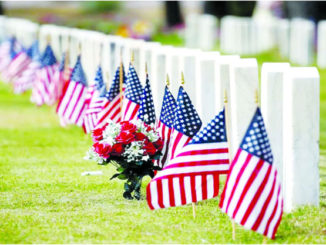
    Some of the graves in a veteran cemetery are well maintained and decorated by families. Bring flowers and lay them by a grave that doesn’t have any.

    HOW TO OBSERVE MEMORIAL DAY

    Pay your respects

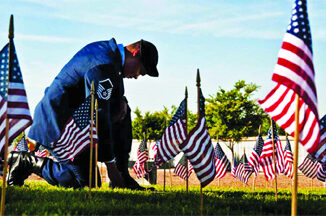
    Lay flowers on the grave of a family member or friend who died while serving. If you don’t personally know any fallen soldiers, visit a local cemetery anyway. After all, they made the ultimate sacrifice for you.

    Participate in the National Moment of Remembrance

    By doing so, you’ll be joining millions of Americans in national unity to honor Memorial Day for what it truly is — a day to remember those who laid down their lives in service of their country and its citizens.

    Fly the flag

    If you have an American flag at home, be sure to fly it at half-mast until noon, then raise it to full mast for the rest of the day. The practice of lowering and then raising the flag has been observed for over 100 years to symbolize America’s persistence in the face of loss.

    CREATIVE WAYS TO DECORATE

    FOR MEMORIAL DAY

    Unfurl those flags

    Often people store their American flags and raise them only during patriotic holidays. This is definitely one of those days.

    Line your walkway with mini flags

    Nothing honors our deceased veterans like dozens (or even hundreds) of flags in your front lawn and entryway.

    Red, white, and blue layered cake

    It’s a decoration you can eat.

    Stars and Stripes windsocks

    It’s festive, fun, and patriotic. Need we say more?

    Symbolic flowers

    Even if you haven’t lost a loved one who served in the military, you can still honor the fallen with flowers at home. Red, navy, and blue dahlias combined with white rose silk flowers can make a stunning visual combination.

    WHY MEMORIAL DAY IS IMPORTANT

    Reflection

    While the outdoor grilling, parades, and beautiful summer weather are some of our favorite perks of Memorial Day, the last Monday in May is the best time of year to quietly reflect on the men and women who made the ultimate sacrifice for our country. They make us feel inspired and challenged to be better— and that’s a wonderful feeling!

    Summer – almost

    We know, we know — summer officially begins on June 21. But in the minds of all Americans, summer actually begins on Memorial Day. That means it’s totally okay to dust off the grill, fill up the pool, and unplug.

    Family

    Since Memorial Day is a federal holiday with a built-in three-day weekend, we have an extra day to catch up on quality time with family members. For those of us with relatives who died while serving in the military, Memorial Day is sacred.

    2022 Memorial Day Events

    Arlington National Cemetery

    The Arlington National Cemetery Memorial Day ceremony takes place at the Amphitheater. The president of the United States typically delivers an address at the Memorial Day ceremony. Numerous military and government organizations also conduct services. All ceremonies and special events are free and open to the public.

    National Memorial Day Concert

    The National Memorial Day Concert will be broadcast on Sunday, May 29, 2022, at 8 p.m. Eastern.

    National Memorial Day Parade

    Hosted by the American Veterans Center, the National Memorial Day Parade returns in person for 2022 along Constitution Avenue in Washington, D.C. The event begins at 2 p.m. Monday, May 30, 2022.

    National WWI Museum and Memorial

    The National WWI Museum and Memorial’s annual ceremony in Kansas City, Missouri, will feature keynote speaker Retired U.S. Army Lt. Gen. Larry R. Jordan. It takes place from 10-11 a.m. Monday, May 30, 2022, and is free to the public. The museum is also hosting a slate of other events and observances on Memorial Day and during the days leading up to the holiday.

    “Rolling To Remember” rally

    A series of events to honor the nation’s prisoners of war and missing-in-action is set to take place over the Memorial Day weekend in Washington, D.C. The “Rolling To Remember” rally is scheduled to conclude with a ride by thousands of bikers from RFK to the National Mall on Sunday, May 29. The motorcycle demonstration ride, hosted by AMVETS, is also a call for action to prevent veteran suicides.

    Heroes Honor Festival

    The Heroes Honor Festival, hosted by military-empowerment nonprofit Engage Your Destiny and sponsored by Fox Nation, takes place at Daytona Speedway in Florida on May 27-28. The event, with planned appearances by Gov. Ron DeSantis and entertainers Toby Keith and Ann-Margret, is free for veterans and their families.

  • Memorial Day : Remembering the fallen heroes

    Memorial Day : Remembering the fallen heroes

    Memorial Day, May 31, for many Americans, conjures up images of hamburgers, hot dogs, swimming pools, and summertime . But the last Monday in May serves, most importantly, as a time to honor those who died while fighting in the U.S. Armed Forces. It’s a holiday steeped in somber American history and tradition. The day actually began as “Decoration Day,” following the Civil War, when mourners placed flowers on the graves of Union and Confederate soldiers. Yes, Memorial Day has also come to signify the “unofficial” start of summer, but let’s remember the heroes who made it all possible.

    HISTORY OF MEMORIAL DAY

    The Civil War ended in the spring of 1865 when Robert E. Lee surrendered the last major Confederate army to Ulysses S. Grant at the Appomattox Courthouse onmApril 9. Over 620,000 soldiers died in the four-year conflict. Gen. John A. Logan of the Grand Army of the Republic (an organization of Union veterans) would eventually select May 30, 1868, as a day to pay tribute to the fallen: “The 30th of May, 1868, is designated for the purpose of strewing with flowers, or otherwise decorating the graves of comrades who died in defense of their country during the late rebellion, and whose bodies now lie in almost every city, village and hamlet churchyard in the land…” Logan apparently chose May 30 because flowers would be in bloom all over the country. By the end of the 19th century, Memorial Day ceremonies were being held on May 30 throughout the nation. States passed proclamations, and the Army and Navy adopted rules for proper observance at their facilities.

    The crowd attending the first Memorial Day ceremony at Arlington National Cemetery was approximately the same size as those that attend today’s observance, about 5,000 people. Then, as now, small American flags were placed on each grave — a tradition followed at many national cemeteries today. In recent years, the custom has grown in many families to decorate the graves of all departed loved ones.

    By 1890 each Northern state had made Decoration Day an official holiday. Not so for the South, where states continued to honor their dead on separate days until after the first World War.

    The May 30 date held for decades. But in 1968 Congress passed the Uniform Monday Holiday Act, which established Memorial Day as the last Monday in May in order to create a three-day weekend for federal employees. The change took place in 1971. The same law also declared Memorial Day a federal holiday.

    TRADITIONS OF THE DAY

    Many Americans observe Memorial Day by visiting cemeteries or memorials, holding family gatherings, and participating in parades. It’s the three-day weekend that kicks off the summer season and the time for hanging at the beach and lakes, and barbecuing with friends and family. But Memorial Day is also the most solemn American holiday — a day to remember those who made the ultimate sacrifice while defending their nation.

    Towns and cities across the country host grand Memorial Day parades every year, often featuring senior veterans and military personnel. Some of the biggest parades take place in New York, Chicago, and Washington, D.C. Cemeteries and memorials are also visited by Americans, with some citizens wearing or holding red poppies to symbolize those who have fallen in war. This tradition has been around since World War I. Weekend trips and parties are also arranged to balance out the somberness of the day and welcome the summer.

    HOW TO OBSERVE THE DAY?

    Pay your respects

    Lay flowers on the grave of a family member or friend who died while serving. If you don’t personally know any fallen soldiers, visit a local cemetery anyway. After all, you would not be here if it weren’t for their sacrifice. Participate in the National Moment of Remembrance

    By doing so, you’ll be joining millions of Americans in national unity to honor Memorial Day for what it truly is — a day for those who made the ultimate sacrifice.

    Fly the flag

    If you have an American flag at home, be sure to fly it at half-mast until noon, then raise it to full mast for the rest of the day. The practice of lowering and then raising the flag has been observed for over 100 years to symbolize America’s persistence in the face of loss.

    CREATIVE WAYS TO DECORATE FOR MEMORIAL DAY

    Unfurl those flags

    Often people store their American flags and raise them only during patriotic holidays. This is definitely one of those days.

    Line your walkway with mini flags

    Nothing honors our deceased veterans like dozens (or even hundreds) of flags in your front lawn and entryway.

    Red, white, and blue layered cake

    It’s a decoration you can eat.

    Stars and Stripes windsocks

    It’s festive, fun, and patriotic.

    Symbolic flowers

    Even if you haven’t lost a loved one who served in the military, you can still honor the fallen with flowers at home. Red, navy, and blue dahlias combined with white rose silk flowers can make a stunning visual combination.

    WHY MEMORIAL DAY IS IMPORTANT?

    Reflection

    While the outdoor grilling, parades, and beautiful summer weather are some of our favorite perks of Memorial Day, the last Monday in May is the best time of year to quietly reflect on the men and women who made the ultimate sacrifice for our country. They make us feel inspired and challenged to be better— and that’s a wonderful feeling!

    Summer — almost

    We know, we know — summer officially begins on June 21. But in the minds of all Americans, summer actually begins on Memorial Day. That means it’s totally okay to dust off the grill, fill up the pool, and unplug.

    Family

    Since Memorial Day is a federal holiday with a built-in three-day weekend, we have an extra day to catch up on quality time with family members. For those of us with relatives who died while serving in the military, Memorial Day is sacred.

    From its Civil War origins to its modern-day traditions

    While the first commemorative Memorial Day events weren’t held in the United States until the late 19th century, the practice of honoring those who have fallen in battle dates back thousands of years. The ancient Greeks and Romans held annual days of remembrance for loved ones (including soldiers) each year, festooning their graves with flowers and holding public festivals and feasts in their honor. In Athens, public funerals for fallen soldiers were held after each battle, with the remains of the dead on display for public mourning before a funeral procession took them to their internment in the Kerameikos, one of the city’s most prestigious cemeteries. One of the first known public tributes to war dead was in 431 B.C., when the Athenian general and statesman Pericles delivered a funeral oration praising the sacrifice and valor of those killed in the Peloponnesian War—a speech that some have compared in tone to Abraham Lincoln’s Gettysburg Address.

    As the Civil War neared its end, thousands of Union soldiers, held as prisoners of war, were herded into a series of hastily assembled camps in Charleston, South Carolina. Conditions at one camp, a former racetrack near the city’s Citadel, were so bad that more than 250 prisoners died from disease or exposure, and were buried in a mass grave behind the track’s grandstand.

    Three weeks after the Confederate surrender, an unusual procession entered the former camp: On May 1, 1865, more than 1,000 people recently freed from enslavement, accompanied by regiments of the U.S. Colored Troops (including the Massachusetts 54th Infantry) and a handful of white Charlestonians, gathered in the camp to consecrate a new, proper burial site for the Union dead. The group sang hymns, gave readings and distributed flowers around the cemetery, which they dedicated to the “Martyrs of the Race Course.”

    It didn’t become a federal holiday until 1971

    American’s embraced the notion of “Decoration Day” immediately. That first year, more than 27 states held some sort of ceremony, with more than 5,000 people in attendance at a ceremony at Arlington National Cemetery. By 1890, every former state of the Union had adopted it as an official holiday. But for more than 50 years, the holiday was used to commemorate those killed just in the Civil War, not in any other American conflict. It wasn’t until America’s entry into World War I that the tradition was expanded to include those killed in all wars, and Memorial Day was not officially recognized nationwide until the 1970s, with America deeply embroiled in the Vietnam War.

    long road from Decoration Day to an official Memorial Day

    Although the term Memorial Day was used beginning in the 1880s, the holiday was officially known as Decoration Day for more than a century, when it was changed by federal law. Four years later, the Uniform Monday Holiday Act of 1968 finally went into effect, moving Memorial Day from its traditional observance on May 30 (regardless of the day of the week), to a set day—the last Monday in May. The move has not been without controversy, though. Veterans groups, concerned that more Americans associate the holiday with first long weekend of the summer and not its intended purpose to honor the nation’s war dead, continue to lobby for a return to the May 30 observances. For more than 20 years, their cause was championed by Hawaiian Senator—and decorated World War II veteran—Daniel Inouye, who until his 2012 death reintroduced legislation in support of the change at the start of every Congressional term.

    More than 20 towns claim to be the holiday’s ‘birthplace’—but only one has federal recognition.

    For almost as long as there’s been a holiday, there’s been a rivalry about who celebrated it first. Boalsburg, Pennsylvania, bases its claim on an 1864 gathering of women to mourn those recently killed at Gettysburg. In Carbondale, Illinois, they’re certain that they were first, thanks to an 1866 parade led, in part, by John Logan who two years later would lead the charge for an official holiday. There are even two dueling Columbus challengers (one in Mississippi, the other in Georgia) who have battled it out for Memorial Day supremacy for decades. Only one town, however, has received the official seal of approval from the U.S. government. In 1966, 100 years after the town of Waterloo, New York, shuttered its businesses and took to the streets for the first of many continuous, community-wide celebrations, President Lyndon Johnson signed legislation, recently passed by the U.S. Congress, declaring the tiny upstate village the “official” birthplace of Memorial Day.