Tag: Migrants

  • Supreme Court Orders States to provide free food, shelter and travel to migrant workers

    Supreme Court Orders States to provide free food, shelter and travel to migrant workers

    NEW DELHI (TIP): The Supreme Court on Thursday, May 28, ordered states to provide free food and shelter to thousands of migrant workers stranded in various parts of the country due to COVID-19 lockdown.

    A three-judge Bench headed by Justice Ashok Bhushan also ordered that no fare either by train or bus shall be charged for migrant workers and railway fare will have to be shared by states.

    “All Migrant workers who are stranded at various places shall be provided food by the concerned state and UT at places which shall be publicized and notified to them for the period they are waiting for their turn to board a train or a bus, said the Bench — which also included Justice SK Kaul and Justice MR Shah.

    It said originating state shall provide meal and water at the station and during the journey, railways to provide meal and water to migrant workers.

    It emphasized the need for coordinated efforts to deal with the crisis. “There are different mechanisms for different states. How do you ensure that nobody asks the migrant to pay or troubles him? What we are saying is that the migrants should be least concerned with the means of payment,” it said.

    “The state shall oversee the registration of migrant workers and states to ensure that after registration, they are made to board the train or bus at an early date,” the Bench said.

    “We further direct that those migrant workers found walking on the roads, immediately be taken to shelters and provided food and all facilities should be provided to them,” it said, adding, “As and when the state governments put in a request for trains, railways has to provide them.”

    “All necessary details regarding number of migrants, plan for transportation mechanism of registration and other details should be brought on record in the reply,” the Bench said.

    After hearing Solicitor General Tushar Mehta, senior counsel Kapil Sibal, Colin Gonsalves, Indira Jaising, PS Narsimha and other advocates representing various states, the Bench went on to issue the directions saying, “At present we are looking at the miseries of the migrant workers, we are of the view that some interim directions need to be issued.”

    “We believe that the center and state governments require to be given some time to bring the steps taken by them on record, it said directing them to file detailed replies by June 5 –the next date of hearing.

    During the hearing, the Solicitor General faced a volley of questions from the Bench on food, shelter, transportation and as to who would foot the bill.

    Terming it an “unprecedented crisis”, Mehta said around 91 lakh migrant workers had been transported to their native states since special trains started on May 1.

    However, Sibal, Jaising and Gonsalves contradicted him saying the way migrant workers were being sent back to their native states it would take several months to complete the process.

    At the very outset, Mehta said, “We are immensely grateful to the Supreme Court for taking cognizance of the issue. Due to this, states and Centre have an August forum now to discuss the migrant crisis issue. Some unfortunate things have happened, and it is being flashed again and again.

    “We are not disputing the fact that Centre has not taken steps. But whoever needs help is not getting that help. States are not doing their bit,” the Bench said.

    Mehta assured the Bench that the government will not stop its efforts until every willing migrant laborer is sent to his village. He, however, said many of the migrants didn’t want to go back as lockdown has been relaxed and activities have resumed.

    The Solicitor General said a large number of steps were taken by the government and the Supreme Court was fully satisfied about it earlier. “We have something called prophets of doom who only spread negativity. All these people writing on social media, giving interviews cannot even acknowledge what is being done,” he said.

    Mehta said people are working tirelessly. From the safai karamcharis to the PM… State governments and ministers are working overnight. None of these people acknowledge that. Human race is facing a difficult challenge.”

    On intervention applications, Mehta said, “Don’t let anyone use this platform to become a political platform.”

    He also drew the court’s attention to a letter written by some senior advocates to the CJI on the issue. “See the letter which is doing the rounds.”

    “People who have been part of the institution, if they believe they can run down the institution it is unfortunate. We have to go by our conscience,” said Justice Kaul.

  • Migrant crisis may help plan viable roadmap

    Migrant crisis may help plan viable roadmap

    By BL Vohra

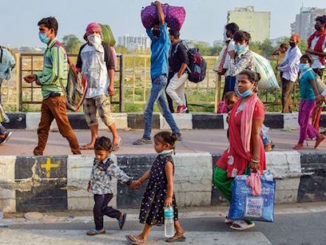
    Since the beginning of the nationwide lockdown due to the Covid-19 pandemic, India and the world have seen on TV channels disturbing pictures of thousands of migrant workers — including women and children — walking on foot or some other means of transport, to reach their home states hundreds of miles away from the places where they have been working for a livelihood. We have also seen the images of protests by those wanting to go home at railway stations at many places.

    More technocrats should head senior positions. By chance, we do have a doctor as the Health Minister but the officials working in the ministries and at the cutting-edge level are not medicos. It’s important to have technocrats in such positions because today it is a health problem, tomorrow it can be a problem in space or cyber fields.

    Since the beginning of the nationwide lockdown due to the Covid-19 pandemic, India and the world have seen on TV channels disturbing pictures of thousands of migrant workers — including women and children — walking on foot or some other means of transport, to reach their home states hundreds of miles away from the places where they have been working for a livelihood. We have also seen the images of protests by those wanting to go home at railway stations at many places.

    Such images continue even today. Heart-wrenching stories of their misfortune in not getting shelter or food and being stopped every now and then with some brutality at times at the hands of the police disappoint a lot. Some of them have lost their lives in accidents. Though trains and earlier buses have been used to ferry them, their number is too big. Besides, many of them don’t have money to buy tickets though most of the bill is being footed by the government. This has sullied the image of India even though they had been advised by the government against moving like this, and shelter and food is being provided to most of them by the state and Central governments, and by NGOs, corporates and well-meaning individuals.

    The Prime Minister announced a sum of Rs one thousand crore from the PM Cares Fund for these migrants recently. And the Union Finance Minister has announced free distribution of ration to them for two months; more work under MGNREGA once they are back to their villages etc. But basically, their demand now is psychological — to reach home come what may. But this problem has also given a lot of ammunition to the Opposition, who are criticizing the Centre for not looking after these people. This has also given a cause to many activists who have been approaching the Supreme Court, trying to get directions to the Central government to look after these migrant workers, financially and otherwise, helping them in reaching home, while accusing it of being insensitive to the needs of the poor folk.

    In the process, the rosy picture of India emerging as a superpower has taken a beating. It won’t be fair to lay the entire blame on the doorsteps of the Central government and its leadership for this situation. After all, it was a sudden calamity, not only for India but the whole world. Many powerful countries with less population and rich economy and much better healthcare systems have fallen by the wayside. The government had to respond quickly and rightly leading to a lockdown which has caused this hardship to millions of migrant workers.

    The way forward should be to ease their pain as much as possible and learn lessons so that we’re better prepared in the future when such situations arise. The two examples of sudden demonetization and lockdown leading to hardships are sufficient for us to learn lessons and plan a roadmap. Some of the suggested steps are as follows:

    First, there should be no sudden announcements as far as possible. Of course, in a war-like situation, such sudden action can’t be ruled out.

    Secondly, there should be careful planning to ensure that the poor don’t suffer from hardships. The Central and state governments should prepare contingency plans based on past experience in India and abroad, and about an unlikely situation like the coronavirus. It should include possible situations in areas like defense, warfare of different kinds including those in space and cyber fields, internal security, medical situations, severe natural disasters and many more. Such a planning will help. I recall today with satisfaction that as the Director General, Civil Defence, Government of India, I had formulated the proposal of raising the NDRF in 2003, considering the necessity which fructified and now we have this force doing a great service.

    Thirdly, for putting every plan in action, there should be SOPs and rehearsals as per these like it is done in disaster management situations or war exercises.

    The lost childhood

    Fourthly, where a large-scale movement of the working class is inevitable, plans should be prepared to keep the movement to the minimum and take care of their comfort. The lessons learnt during the current Covid crisis will be a good foundation to work on these plans.

    Fifthly, there should be heavy investment in education and healthcare. Had it been done earlier, migrant workers would have behaved differently, and we wouldn’t have been struggling to put up a healthcare system to match the current need. Luckily, we haven’t failed because the problem is not that big in India so far.

    Sixthly, and very importantly, the bureaucracy has to be more nimble-footed. As per the general perception, it hasn’t covered itself with glory during this recent tragedy. For these, large-scale changes are required, from recruitment to training and attitude etc. The PM must give a push to this like Margaret Thatcher, the then British PM, had done during her tenure in the UK. It is also suggested that senior bureaucrats should be hired or employed for a ten-year period and their tenure getting extended for the next ten years should depend on their performance during the first term. In all, there should be two extensions, i.e. they shouldn’t serve for more than 30 years. It should apply to all services.

    Seventhly, more technocrats should head senior positions like secretaries and joint secretaries. In the recent case, we do have a doctor by chance as the Union Health Minister but the officials working in the ministries and at the cutting-edge level are not medicos. It’s important that we have technocrats in such positions because today it is a health problem, tomorrow it can be a problem in the space or cyber field. So, those knowledgeable in such areas will do a much better job.

    Next, the wages and other facilities or service conditions of the technocrats and others like the police should be at par with the top civil service to acknowledge their contribution. Today, even though the technocrats are more qualified, they serve under non-technical persons and have a lower position in society.

    Also, departments like the police, health, space and others should be reporting directly to the ministers rather than through the senior bureaucracy.

    Lastly, political parties need to be more sensitive to the needs of the country and society. Politicking should be avoided. The good of the nation and showing unity to the world in adversity should be the aim of parties. It doesn’t mean that they shouldn’t find fault with each other for the wrongs that are being done in their assessment, but the tools used to criticize should be decent. They shouldn’t oppose always for the sake of opposing.

    India is great and so are Indians. Nobody can stop our march to being a super-power in the current century, but for that, a lot of hard work is required, and specially to acquire competency in dealing with sudden situations for which we should be well prepared.

    (The author is a former DGP, Tripura)