Tag: Mohandas Karamchand Gandhi

  • Remembering Mahatma Gandhi on his death anniversary

    Martyrs’ Day is observed on January 30 to commemorate the death of Mahatma Gandhi, who was assassinated on the same day in 1948

    Born Mohandas Karamchand Gandhi, he is widely regarded as ‘Bapu’, or ‘Father of the nation’ in India. Gandhi, regarded as one of the most iconic figures of the 20th century, bravely led his country to freedom — but was killed by the bullets of violent extremists. Indians commemorate the day by remembering his ultimate sacrifice to the nation and preaching his values of non-violence, unity, and morality.

    Martyrs’ Day is observed on the death anniversary of Mahatma Gandhi, who successfully led his country to freedom from the British Empire. Born in the small town of Gujarat, Gandhi studied to become a barrister and lived a pretty austere life, until he made his first trip to South Africa, and everything changed.

    Life in South Africa exposed him to the deep class divisions of society and the evils of inequality. Gandhi’s life experiences shaped his worldviews. The discrimination he suffered in South Africa inspired him to fight for equality, the pain of losing his first child at the age of 16 made him a furious opponent of child marriage, and so on.

    During India’s struggle for freedom, Gandhi advocated for peaceful demonstrations and inspired everyone to lead by example. He negotiated many peace treaties with the Britishers, before giving them the final ultimatum of departure. As the Indian constitution came into ratification, Gandhi took on the impossible task of building a country out of many provinces and territories.

    Gandhi was vehemently opposed to the idea of partition of India. Even after the declaration of independence, he held regular demonstrations to establish his resistance. Gandhi’s objection to the partition was met harshly with Hindu nationalists, who accused him of appeasing the Muslims. On the eve of January 30, Nathuram Vinayak Godse, a notorious Hindu nationalist, shot Gandhi three times at point-blank.

    Gandhi’s lifelong quest for non-violence ended with a bullet in his chest. On Martyrs’ Day, Indians from all around the world come together to celebrate the legacy of a great hero and acknowledge the futile destruction caused by violent extremism.

    Monhandas Karamchand Gandhi was born in the small town of Porbandar, on the west coast of India, on October 2 1869. He belonged by birth to the Vaishya, or trading caste. His father died when he was 15 years old, and apart from that time, his mother became the greatest influence in his life. Her spiritual teacher was a Jain devotee. Among the Jains in India the central doctrine is the “sanctity of all life,” or Ahimsa, which is often translated as “non-violence.” This teaching remained paramount with Gandhi.

    In South Africa

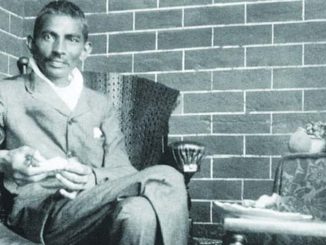
    When 19, he came to London, qualified as a barrister (being “called” at the Inner Temple), and, returning to Bombay in 1892, set up a practice.

    In 1896 he went to the Transvaal to help a client in a legal suit. That visit changed the whole course of his life. Seeing the social and political disabilities of his fellow-countrymen in South Africa, he decided to stay and help them and soon he had become their political leader and adviser. Meanwhile a religious conflict was taking place in within him. He read Tolstoy and corresponded with him: the result was an experiment in the simple communal life conducted by a small band of enthusiasts whom he had gathered together. He became an ascetic of the most rigorous type, setting great store by fasting and every form of self-denial. To the end of his life he remained a devout Hindu, but declared if ever “untouchability” were made part of Hinduism he would cease to be a Hindu. Perhaps the greatest religious effort of his life was to break down “untouchability.”

    He went on steadily preparing his followers in South Africa for the struggle which was to end the indignities under which they suffered. Three times he went to prison. Little by little, the Indians gained the respect of the Europeans in South Africa by the faith with which they obeyed their leader in his campaigns of passive resistance. The summer of 1914 brought victory for the cause, and in July of that year the Gandhi-Smuts Settlement was signed.

    When the war of 1914-18 broke out he came to Britain to organise an Indian ambulance corps (he had done ambulance work in both the Zulu campaign and the Boer War), but was taken so seriously ill the doctors sent him back to India. He founded a religious retreat on Tolstoyan lines near Ahmedabad, the Viceroy conferred on him the Kalsar-Hind Gold Medal for distinguished humanitarian work in South Africa, and, by general consent, he began to be called by the name Mahatma, which means literally “Great Soul.”

    Non-Co-operation

    A series of events quickly following each other at the end of the war brought him back into political leadership. The first was the passing of the Rowlatt Act, the second the tragedy of the Punjab and Amritsar, the third was what was regarded in India as the betrayal of the Indian Moslems by the Treaty of Sevres. He launched a non-co-operation movement in September,1920, but the non-violence which he demanded from his followers was broken. Congress revolted against his authority and the government selected the moment for eliminating him from the political scene. He was arrested, brought to trial for promoting disaffection, and sentenced to six years imprisonment.

    On his return to politics he found himself a stranger in the existing atmosphere of disillusioned realism. He yielded the leadership to C.R. Das and Motilal Nehru, and retired to hand-spinning and the editing of his weekly paper. He showed no desire to resume his old position as dictator, and for that reason his moral supremacy was recognised even by his political rivals. So when at the time of the Simon Commission the old Congress leaders found that the young men were heading for revolution they decided that the only remedy was to call him back.The last phase

    The last phase

    His internment ended in April, 1945. He was then 76 and though his hold over the country was unshaken, he allowed the leadership in policies to pass increasingly into the hands of Mr. Patel and Nehru. After the election of the Labour Government, Great Britain made absolutely clear that it would lay down its power in India, and the principal question was whether it should transfer power to a unitary India or to two separate Governments of Hindu and Moslem India. Mr. Gandhi was known to believe that the division of India would be a calamity. At one time in the negotiations between Congress and the British he seemed to acquiesce in division, as the price of freedom, but later he reverted to unqualified opposition. Opinion in the Congress Working Committee was, however, for division as the only solution, and Mr. Gandhi therefore stood aside and left the decision to the younger men, believing that they were taking a disastrous course, but believing too that the leadership must now be in their hands.

    His last few months he spent in continuous and not unsuccessful attempts to restore peace in one area after another as communal hostility flared up into massacre and calamity after the withdrawal of the British power. With a number of disciples he made a progress through the disturbed parts of Bengal, awing the excited masses into peace by the prestige of his name and his asceticism. His reply to a renewal of violence in Calcutta in September was a complete fast from everything but water. After three days peace was restored and his fast was broken. Again early this month he met communal disturbances in Delhi with another fast – of five days – which had great moral effect and led to solemn assurances of consideration for the Moslem minority. Less than a fortnight later he was to meet his death while engaged in religious observances.

    Thus at the end of his career he appeared more than ever before in his life a being strayed out of the Middle Ages. And these last few months of his life, a kind of coda, may have touched the Indian imagination more creatively than any previous actions and have larger consequences.

  • Mahatma Gandhi – the unarmed warrior

    Mahatma Gandhi – the unarmed warrior

    Mohandas Karamchand Gandhi, popularly known as Mahatma Gandhi,  was born on October 2, 1869, at Porbandar in Gujarat. He was an Indian lawyer, politician, social activist, and writer who led the independence movement against British rule. And during this process, people started to call him the father of the nation (Bapu). Mahatma Gandhi died on January 30, 1948.

    Regarded as the Father of Nation, Gandhi was a social reformist and leader of Indian Independence Movement who introduced the idea of non-violent resistance called Satyagrah. After organising a civil disobedience movement for Indians living in South Africa, he returned to India in 1915. In India, he set out on a train journey to different parts of the country trying to understand problems of farmers, peasants and urban labourers and organising protests for them.

    He assumbed the leadership of Indian National Congress in 1921 and rose to become its most prominent leader and an iconic figure in Indian politics. He organised the Dandi Salt March in 1930 and Quit India Movement in 1942.

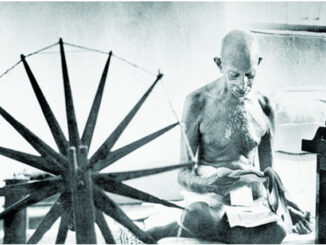
    He also worked for the upliftment of untouchables and have them a new name ‘Harijan’ meaning the children of God. Gandhi also wrote extensively for various newspapers and his symbol of self-reliance – the spinning wheel – became a popular symbol of Indian Independence Movement. Gandhi played a key role in pacifying people and averting the Hindu-Muslim riots as tensions rose before and during the partition of the country. He was shot dead by Nathuram Godse on January 31, 1948.

    Gandhi was a warrior leader, with a vision of free India, who conceived a shrewd strategy of using peace and non-violence, as the chief weapons, to achieve the objective of liberating India from the clutches of the most powerful colonial power of the time. Training his weapons of non-violence and non-cooperation at the enemy’s mind, with a view to disinfecting it from its unjust rule, he declared that he loved the English people but abhorred their despicable way of governance.

    He could throw the British into the shade in argument, in tactics and, the most important of all, to make them feel embarrassed in the cherished field of morality. He galvanized the Indian public to rally behind him to fight the war of freedom, with the superior non-war weapons of peace, thus rousing the enemy’s conscience and the world opinion in favor of the Indian cause, which ultimately forced the enemy to quit the battlefield. According to a historian, “Gandhi’s mystique consisted of a union of original ideas, with remarkable knack for tactics and the uncanny insight into the mass mind.”

    Gandhi had indeed read the pulse of his age right, had the vision of selecting the best suited plan of action and was able to realize the dream of his people. True to the Hindu principle of avatar (Incarnation), “When religion declines and the evil doers are to be destroyed, I shall be born, from time to time,” (Gita), Gandhi came as the divinely inspired leader to inject a spark of nationalism, and the will to fight against foreign oppression and social evils, that had infected the society. His army came from all sections of the society – the majority came from its lower strata. In his personal code of conduct of high ethics, and the burning passion for universal well-being, he was an incarnation of Rama, which gave him ready acceptability as a leader. His belief in human rights often led him into collision, not only with the British and South Africa but also with the attitude of several Hindus towards the untouchables.

    Gandhi advocated and effectively employed the superior weapons of resistance with peace and ‘non-cooperation’ against the enemy’s unrighteous ways. Hard to believe that Gandhi’s school of resistance could generate such a moral strength in his teeming unarmed soldiery, who fell with their cracked skulls, but got up and surged forward repeatedly, with wounded bodies, fighting the white terror, “Kill us, but we shall not quit.” That he could inspire and elevate his followers to such a degree of physical, mental and spiritual strength will remain a wonder of human race for times to come.

    The turning point came on April 13, 1919, when Brigadier General Dyer (British) ordered firing on a peaceful rally in which 1,650 rounds were fired, killing 1,516 peaceful protestors at Jallianwala Bagh (Amritsar). Gandhi said, “I love the British people but henceforth, I am the deadliest enemy of the wrong form of government that the British may impose upon India.” It is erroneous to call Gandhi’s strategy of non-violence as passive or inactive. Gandhi was a strong-willed realist, who adopted a strategy of proactive non-violence against the British, because he had no wherewithal to fight the colonial power.

    As a national leader, a number of commendable leadership traits were found in Gandhi, but two innate soldierly attributes for which he stands apart, were: One, his strength of courage lay both in the physical and moral planes. Two, forever he led from the front. In Gandhi, Indians saw a ray of hope to alleviate them from the age-old political and social suffering. The intrinsic nobility of his cause, the grand vision of a free India and the will to sacrifice all for the fulfillment of this dream, despite myriad problems, raised him to the stature of a prophet, and a successful one. It was the grandeur of Gandhi’s dream, which galvanized Indians. For centuries, no one had talked of a liberated and united India. The fantasy of freedom caught every Indian’s aspiration and dream, for which one was prepared to pay any price. After all, he was talking of the Indian nation, which had almost relapsed from the Indian mind. As the momentum of the Independence Movement gained strength, his dream seemed to be a winning vision, which drew to his following columns even the fence sitters. Soon the common person started perceiving the nation’s vision as tall as the Himalayas and as deep as the ocean. Where the centuries-old resistance and revolts had failed, the crown of ultimate victory to win freedom was to adorn Gandhi’s head. What truly characterizes this saint leader is the leadership trait firmly rooted in spirituality. Spirituality entails belief in universal goodwill and sensibility to a common thread running through the entire humankind. It was Gandhi’s Himalayan determination and Ganga-like purity of purpose, which shook the British Empire. Natural faith in the Hindu Dharma had inspired in him the spirit of fighting for the righteous cause, and that tolerating injustice was as much a sin as inflicting it. In his fight for the national cause, Gandhi transformed non-violence into his main weapon to resist injustice and violence. Gandhi had rightly symbolized India’s love for freedom and its inherent guts to fight to win, and indeed was one of the most amazing paradoxes of history. “Coming generations will scarce believe that such a man, in flesh and blood, lived upon this earth,” said Einstein about Gandhi.

  • Mahatma Gandhi: The leader of India’s non-violent independence movement

    Mahatma Gandhi: The leader of India’s non-violent independence movement

    Mahatma Gandhi was the primary leader of India’s independence movement and also the architect of a form of non-violent civil disobedience that would influence the world. Until Gandhi was assassinated in 1948, his life and teachings inspired activists including Martin Luther King Jr. and Nelson Mandela.

    Mahatma Gandhi was the leader of India’s non-violent independence movement against British rule and in South Africa who advocated for the civil rights of Indians. Born in Porbandar, India, Gandhi studied law and organized boycotts against British institutions in peaceful forms of civil disobedience. He was killed by a fanatic in 1948.
    Early Life and Education
    Indian nationalist leader Gandhi (born Mohandas Karamchand Gandhi) was born on October 2, 1869, in Porbandar, Kathiawar, India, which was then part of the British Empire.
    Gandhi’s father, Karamchand Gandhi, served as a chief minister in Porbandar and other states in western India. His mother, Putlibai, was a deeply religious woman who fasted regularly.
    Young Gandhi was a shy, unremarkable student who was so timid that he slept with the lights on even as a teenager. In the ensuing years, the teenager rebelled by smoking, eating meat and stealing change from household servants.
    Although Gandhi was interested in becoming a doctor, his father hoped he would also become a government minister and steered him to enter the legal profession. In 1888, 18-year-old Gandhi sailed for London, England, to study law. The young Indian struggled with the transition to Western culture.
    Upon returning to India in 1891, Gandhi learned that his mother had died just weeks earlier. He struggled to gain his footing as a lawyer. In his first courtroom case, a nervous Gandhi blanked when the time came to cross-examine a witness. He immediately fled the courtroom after reimbursing his client for his legal fees.
    Gandhi’s Religion and Beliefs
    Gandhi grew up worshiping the Hindu god Vishnu and following Jainism, a morally rigorous ancient Indian religion that espoused non-violence, fasting, meditation and vegetarianism.
    During Gandhi’s first stay in London, from 1888 to 1891, he became more committed to a meatless diet, joining the executive committee of the London Vegetarian Society, and started to read a variety of sacred texts to learn more about world religions.
    Living in South Africa, Gandhi continued to study world religions. “The religious spirit within me became a living force,” he wrote of his time there. He immersed himself in sacred Hindu spiritual texts and adopted a life of simplicity, austerity, fasting and celibacy that was free of material goods.
    Gandhi in South Africa
    After struggling to find work as a lawyer in India, Gandhi obtained a one-year contract to perform legal services in South Africa. In April 1893, he sailed for Durban in the South African state of Natal.
    When Gandhi arrived in South Africa, he was quickly appalled by the discrimination and racial segregation faced by Indian immigrants at the hands of white British and Boer authorities. Upon his first appearance in a Durban courtroom, Gandhi was asked to remove his turban. He refused and left the court instead. The Natal Advertiser mocked him in print as “an unwelcome visitor.”
    Nonviolent Civil Disobedience
    A seminal moment occurred on June 7, 1893, during a train trip to Pretoria, South Africa, when a white man objected to Gandhi’s presence in the first-class railway compartment, although he had a ticket. Refusing to move to the back of the train, Gandhi was forcibly removed and thrown off the train at a station in Pietermaritzburg.
    Gandhi’s act of civil disobedience awoke in him a determination to devote himself to fighting the “deep disease of color prejudice.” He vowed that night to “try, if possible, to root out the disease and suffer hardships in the process.”
    From that night forward, the small, unassuming man would grow into a giant force for civil rights. Gandhi formed the Natal Indian Congress in 1894 to fight discrimination.
    Gandhi prepared to return to India at the end of his year-long contract until he learned, at his farewell party, of a bill before the Natal Legislative Assembly that would deprive Indians of the right to vote. Fellow immigrants convinced Gandhi to stay and lead the fight against the legislation. Although Gandhi could not prevent the law’s passage, he drew international attention to the injustice.
    After a brief trip to India in late 1896 and early 1897, Gandhi returned to South Africa with his wife and children. Gandhi ran a thriving legal practice, and at the outbreak of the Boer War, he raised an all-Indian ambulance corps of 1,100 volunteers to support the British cause, arguing that if Indians expected to have full rights of citizenship in the British Empire, they also needed to shoulder their responsibilities.
    Satyagraha
    In 1906, Gandhi organized his first mass civil-disobedience campaign, which he called “Satyagraha” (“truth and firmness”), in reaction to the South African Transvaal government’s new restrictions on the rights of Indians, including the refusal to recognize Hindu marriages.
    After years of protests, the government imprisoned hundreds of Indians in 1913, including Gandhi. Under pressure, the South African government accepted a compromise negotiated by Gandhi and General Jan Christian Smuts that included recognition of Hindu marriages and the abolition of a poll tax for Indians.
    Return to India
    When Gandhi sailed from South Africa in 1914 to return home, Smuts wrote, “The saint has left our shores, I sincerely hope forever.” At the outbreak of World War I, Gandhi spent several months in London.
    In 1915 Gandhi founded an ashram in Ahmedabad, India, that was open to all castes. Wearing a simple loincloth and shawl, Gandhi lived an austere life devoted to prayer, fasting and meditation. He became known as “Mahatma,” which means “great soul.”
    Opposition to British Rule in India
    In 1919, with India still under the firm control of the British, Gandhi had a political reawakening when the newly enacted Rowlatt Act authorized British authorities to imprison people suspected of sedition without trial. In response, Gandhi called for a Satyagraha campaign of peaceful protests and strikes.
    Violence broke out instead, which culminated on April 13, 1919, in the Massacre of Amritsar. Troops led by British Brigadier General Reginald Dyer fired machine guns into a crowd of unarmed demonstrators and killed nearly 400 people.
    No longer able to pledge allegiance to the British government, Gandhi returned the medals he earned for his military service in South Africa and opposed Britain’s mandatory military draft of Indians to serve in World War I.
    Gandhi became a leading figure in the Indian home-rule movement. Calling for mass boycotts, he urged government officials to stop working for the Crown, students to stop attending government schools, soldiers to leave their posts and citizens to stop paying taxes and purchasing British goods.
    Rather than buy British-manufactured clothes, he began to use a portable spinning wheel to produce his own cloth. The spinning wheel soon became a symbol of Indian independence and self-reliance.
    Gandhi assumed the leadership of the Indian National Congress and advocated a policy of non-violence and non-cooperation to achieve home rule.
    After British authorities arrested Gandhi in 1922, he pleaded guilty to three counts of sedition. Although sentenced to a six-year imprisonment, Gandhi was released in February 1924 after appendicitis surgery.
    He discovered upon his release that relations between India’s Hindus and Muslims devolved during his time in jail. When violence between the two religious groups flared again, Gandhi began a three-week fast in the autumn of 1924 to urge unity. He remained away from active politics during much of the latter 1920s.
    Gandhi and the Salt March
    Gandhi returned to active politics in 1930 to protest Britain’s Salt Acts, which not only prohibited Indians from collecting or selling salt—a dietary staple—but imposed a heavy tax that hit the country’s poorest particularly hard. Gandhi planned a new Satyagraha campaign, The Salt March, that entailed a 390-kilometer/240-mile march to the Arabian Sea, where he would collect salt in symbolic defiance of the government monopoly.
    “My ambition is no less than to convert the British people through non-violence and thus make them see the wrong they have done to India,” he wrote days before the march to the British viceroy, Lord Irwin.
    Wearing a homespun white shawl and sandals and carrying a walking stick, Gandhi set out from his religious retreat in Sabarmati on March 12, 1930, with a few dozen followers. By the time he arrived 24 days later in the coastal town of Dandi, the ranks of the marchers swelled, and Gandhi broke the law by making salt from evaporated seawater.
    The Salt March sparked similar protests, and mass civil disobedience swept across India. Approximately 60,000 Indians were jailed for breaking the Salt Acts, including Gandhi, who was imprisoned in May 1930.
    Still, the protests against the Salt Acts elevated Gandhi into a transcendent figure around the world. He was named Time magazine’s “Man of the Year” for 1930.
    Gandhi was released from prison in January 1931, and two months later he made an agreement with Lord Irwin to end the Salt Satyagraha in exchange for concessions that included the release of thousands of political prisoners. The agreement, however, largely kept the Salt Acts intact. But it did give those who lived on the coasts the right to harvest salt from the sea.
    Hoping that the agreement would be a stepping-stone to home rule, Gandhi attended the London Round Table Conference on Indian constitutional reform in August 1931 as the sole representative of the Indian National Congress. The conference, however, proved fruitless.
    Protesting “Untouchables” Segregation
    Gandhi returned to India to find himself imprisoned once again in January 1932 during a crackdown by India’s new viceroy, Lord Willingdon. He embarked on a six-day fast to protest the British decision to segregate the “untouchables,” those on the lowest rung of India’s caste system, by allotting them separate electorates. The public outcry forced the British to amend the proposal.
    After his eventual release, Gandhi left the Indian National Congress in 1934, and leadership passed to his protégé Jawaharlal Nehru. He again stepped away from politics to focus on education, poverty and the problems afflicting India’s rural areas.
    India’s Independence from Great Britain
    As Great Britain found itself engulfed in World War II in 1942, Gandhi launched the “Quit India” movement that called for the immediate British withdrawal from the country. In August 1942, the British arrested Gandhi, his wife and other leaders of the Indian National Congress and detained them in the Aga Khan Palace in present-day Pune.
    “I have not become the King’s First Minister in order to preside at the liquidation of the British Empire,” Prime Minister Winston Churchill told Parliament in support of the crackdown.
    With his health failing, Gandhi was released after a 19-month detainment in 1944.
    After the Labour Party defeated Churchill’s Conservatives in the British general election of 1945, it began negotiations for Indian independence with the Indian National Congress and Mohammad Ali Jinnah’s Muslim League. Gandhi played an active role in the negotiations, but he could not prevail in his hope for a unified India. Instead, the final plan called for the partition of the subcontinent along religious lines into two independent states—predominantly Hindu India and predominantly Muslim Pakistan.
    Violence between Hindus and Muslims flared even before independence took effect on August 15, 1947. Afterwards, the killings multiplied. Gandhi toured riot-torn areas in an appeal for peace and fasted in an attempt to end the bloodshed. Some Hindus, however, increasingly viewed Gandhi as a traitor for expressing sympathy toward Muslims.
    Gandhi’s Wife and Kids
    At the age of 13, Gandhi wed Kasturba Makanji, a merchant’s daughter, in an arranged marriage. She died in Gandhi’s arms in February 1944 at the age of 74.
    In 1885, Gandhi endured the passing of his father and shortly after that the death of his young baby.
    In 1888, Gandhi’s wife gave birth to the first of four surviving sons. A second son was born in India 1893. Kasturba gave birth to two more sons while living in South Africa, one in 1897 and one in 1900.
    Assassination of Mahatma Gandhi
    On January 30, 1948, 78-year-old Gandhi was shot and killed by Hindu extremist Nathuram Godse, who was upset at Gandhi’s tolerance of Muslims.
    Weakened from repeated hunger strikes, Gandhi clung to his two grandnieces as they led him from his living quarters in New Delhi’s Birla House to a late-afternoon prayer meeting. Godse knelt before the Mahatma before pulling out a semiautomatic pistol and shooting him three times at point-blank range. The violent act took the life of a pacifist who spent his life preaching nonviolence.
    Godse and a co-conspirator were executed by hanging in November 1949. Additional conspirators were sentenced to life in prison.
    Legacy
    Even after Gandhi’s assassination, his commitment to nonviolence and his belief in simple living — making his own clothes, eating a vegetarian diet and using fasts for self-purification as well as a means of protest — have been a beacon of hope for oppressed and marginalized people throughout the world.
    Satyagraha remains one of the most potent philosophies in freedom struggles throughout the world today. Gandhi’s actions inspired future human rights movements around the globe, including those of civil rights leader Martin Luther King Jr. in the United States and Nelson Mandela in South Africa.

  • Gandhi Jayanti: Remembering Father of the Nation

    Gandhi Jayanti: Remembering Father of the Nation

    Gandhi Jayanti is observed on October 2 every year to honor Mahatma Gandhi for his invaluable contributions to India’s freedom struggle. The Indian Panorama pays tribute to Father of the Nation on his 152nd birth anniversary.

    Gandhi Jayanti is celebrated on October 2 every year to mark the birth anniversary of Mohandas Karamchand Gandhi, popularly known as Mahatma Gandhi. Known as the ‘Father of the Nation’, the ideologies, struggles and kindness of Gandhi drove India to its independence. One of the most prominent leaders of India’s independence movement, Gandhi was the man behind non-violent civil disobedience.

    This year will mark the 152nd birth anniversary of Mahatma Gandhi and the entire world observes this day as ‘Gandhi Jayanti’. It is a national holiday in India to honour the legendary leader without whom India wouldn’t have tasted independence. The United Nations also observe Gandhi Jayanti as ‘International Day of Non-Violence’ every year.

    Gandhi played a key role in India’s freedom movement and his philosophies towards India have impacted people’s lives. His method of non-violence inspired many civil rights movements in the world and he also fought to bring significant changes in society.

    Born on October 2, 1869, in Porbandar in Gujarat, Mahatma Gandhi is considered as the nation’s tallest leader of the independence movement. As a child, he always expressed his feelings about patriotism and united India with his thoughts and ideologies to fight for freedom.

    He successfully led India’s non-violent movement against the colonial British empire. He went to South Africa to study law and led nationwide campaigns for farmers and labourers and also fought against caste discrimination and was vocal about expanding women’s rights.

    He led the Dandi Salt March in 1930, a movement which was joined by many Indians to break the salt law. He was also at the forefront of the Quit India Movement in 1942, which compelled the Britishers to move out of India. Gandhi was a great supporter of truth and non-violence and he left behind his valuable teachings that are still remembered and valued by people of all age groups.

    Gandhi Jayanti is observed to honour and pay rich tributes to the Father of the Nation and on this day, people remember his invaluable contributions to India’s freedom struggle and independence movement. His path-breaking principles of ahimsa and swaraj are observed across all the institutions in India. People celebrate his teachings through various initiatives that can lead to the betterment of our surroundings, the city and eventually the country.

    Mahatma Gandhi quotes

    “Live as if you were to die tomorrow. Learn as if you were to live forever.”

    “If we could change ourselves, the tendencies in the world would also change. As a man changes his own nature, so does the attitude of the world change towards him. We need not wait to see what others do.”

    “A man is but the product of his thoughts. What he thinks, he becomes.”

    “The greatness of humanity is not in being human, but in being humane.”

    “Earth provides enough to satisfy every man’s needs, but not every man’s greed.”

    “You must not lose faith in humanity. Humanity is like an ocean; if a few drops of the ocean are dirty, the ocean does not become dirty.”

    “An error does not become truth by reason of multiplied propagation, nor does truth become error because nobody sees it.Truth stands, even if there be no public support. It is self sustained.”

    “I will not let anyone walk through my mind with their dirty feet.”

    “In a gentle way, you can shake the world.”

    “Nobody can hurt me without my permission.”

    “Happiness is when what you think, what you say, and what you do are in harmony.”

    “We may never be strong enough to be entirely nonviolent in thought, word and deed. But we must keep nonviolence as our goal and make strong progress towards it.”

    “Change yourself you are in control.”

    “When restraint and courtesy are added to strength, the latter becomes irresistible.”

    “The weak can never forgive. Forgiveness is the attribute of the strong.”

    “It is unwise to be too sure of one’s own wisdom. It is healthy to be reminded that the strongest might weaken and the wisest might err.”

    “Nearly everything you do is of no importance, but it is important that you do it.”

  • Mahatma Gandhi and the Indian Freedom Movement

    Mahatma Gandhi and the Indian Freedom Movement

    Remembering the Father of the Indian Nation on his 152nd birthday anniversary

    “It has been my experience, living and working with Gandhiji that what he achieved by his Satyagraha appeared at the time to be small but the rest was subsequently accomplished through the combination of various circumstances. It is also true that if the first small step had not been taken by Gandhiji the other forces that brought about the final result might have remained dormant for a long time”. – Acharya Kriplani

    Billions of Indians identified themselves with the scantily covered Mahatma Gandhi

    The British Empire’s most talented and Powerful pro-consul in India, Lord Curzon has said, “India is the pivot of our British empire. If the Empire loses any other part of its, we can survive, but if we lose India, the sun of our Empire will set.” Even Churchill said, “the loss of India would mark and consummate the downfall of the British empire from such a catastrophe there should be no recovery.” One can understand how difficult it was to secure Independence from dominion of Britishers.

     Gandhi’s advent and Rise:

    1919 was a twilight year in the history of Indo-British relations. The harsh Rowlett act met with Universal opposition in the Imperial legislative council and outside. Gandhi was challenged with such a situation. There was the Jallianwala Bag massacre. An armed rebellion was out of question in a country forcibly disarmed and deliberately emasculated for about a century. Gandhi changed this situation into an opportunity.

    The unique weapon

    1. The strategy of Satyagraha i.e., non-violent direct action was preferred by Gandhi.
    2. This strategy of Satygraha is no oriental mystic doctrine baffling the oriental mind but a hardheaded mass pressure technique to ensure social, political and economic change. Satyagraha demands public spirit, self-sacrifice, organization, endurance and discipline for its successful operation.

    Three pillars of Satyagraha

    1. Sat implies openness, honesty and fairness.
    2. Ahimsa- non –injury is refusal to inflict injury to others. Ahimsa is an expression of our concern that our own and other’s humanity be manifested and respected; and we must learn to genuinely love our opponents in order to practice Ahimsa.
    3. Tapasya – willingness for self-sacrifice:

    A Satyagrahi (one who practices Satyagraha) must be willing to shoulder any sacrifice which is occasioned by the struggle which they have initiated, rather than pushing such sacrifice or suffering onto their opponent. The goal is to discover a wider vista of truth and justice, not to achieve victory over the opponent.

    NON-COOPERATION- 1920-22

     The weapon of Non-cooperation was designed and developed in order to further the inter-related aims of inculcating Satyagraha among as many Indian social groups as possible.  The reaction of the British to this unusual non-violent struggle was best summed up by the then Governor of Bombay, George Llyod: “Gandhi gave us a scare. Gandhi’s was the most colossal experiment in world history, and it came within an inch of succeeding. “The first experiment with non-violent direct action on a national scale suffered an abortive end. Although it failed to obtain its immediate objective, it was immensely successful in awakening India to the consciousness of her own potential power. Moreover, the experience gathered during the non-cooperation movement paved the way for India’s next great movement of 1930.

    CIVIL DISOBEDIENCE MOVEMENT – 1930-1934

    The radical youth groups and the labor organizations were not convinced of the compelling power of non-violent direct action. However, the ideology of Satyagraha aroused widespread academic interest and discussion. The conspicuous success of the Bardoli Satyagraha of 1928 had already infused new hope in the people and revived a general confidence in Gandhi’s method. The absence of any Indian representative on the Simon commission drew the Liberal and the Moderate elements to the Congress fold. It clearly appeared that the nation was again full of all energy and enthusiasm.

    Gandhi decided to initiate Civil Disobedience movement by a dramatic breach of the salt law. This was a law which affected all and for many years, Gandhi had considered taxation on one of the vital needs like salt to be an immoral law. The incidence of tax was a symbol of human oppression and through this little gesture Gandhi transcended the limitation of human condition.

    After a full year of struggle, the Government gave in and began negotiations with the Congress high command. Gandhi and the members of the working committee of the Congress were released and Gandhi was invited to Delhi.

    For the first time in history on March 5, 1931, the representative of His Majesty signed a treaty with Gandhi. The main demands of the people were granted in the treaty, thereafter, known as the “Gandhi-Irwin Pact act” and the stage was set for further negotiations with a view to evolving of Free India.

    But then he found his pact with Irwin violated by the Government. He also discovered that the bureaucracy was in a belligerent mood and did not mean to carry out the terms of the Pact. Thereupon Gandhi was forced to revive Satyagraha.

    THE QUIT INDIA MOVEMENT

    The Second World War was real life and death struggle for the British people. In the year 1940-41 they made their last heroic stand as a world power. Gandhi’s revulsion from the great slaughter and desire for the universal peace and his hostility to the raj further soured his relations with the British rulers.

    Then Gandhi initiated the Individual Civil Disobedience movement, which was undertaken for the vindication of Freedom of Speech. Individuals carefully chosen by Gandhi himself were instructed to move from place to place on foot, explain to the people the implications of the formula. Sir Stafford Cripps with an offer of political settlement met the political leaders. The terms were however found unacceptable by all parties with the result that Cripps returned to England, disappointed. Soon after this event, Gandhi received a cable from England, in reply to which he gave expression, for the first time, to the demand for British withdrawal as an immediate necessity.

    Gandhi was a charismatic leader who was loved and respected. A sea of humanity poured in to catch a glimpse of him and listen to his words.

    The city of Bombay, after experiencing an unusual wave of jubilation and fighting fervor, lay in the quiet of the exhausted in the early hours of August 9, 1942. On the previous day, Gandhi had electrified the masses attending the momentous August 8th meeting of the AICC by unequivocally demanding that the British should Quit India. His slogan was “Do or Die”. Gandhi however, cautioned his followers that it would be weeks before a civil disobedience could be launched.

    Although more than 60,000 people were arrested, 18,000 kept in prison while 940 were shot dead and about 1630 injured by firing, the people’s violence was limited to objects which were considered to belong to Government, and it did not extend any further. There might have been defeat, but the people’s forces had succeeded in recovering and preserving their morale and this was no small gain. “The British Empire is a Satanic System and I have dedicated my life to destroy it” Gandhiji declared.

    CONCLUSION

    To conclude in the memorable words of Acharya Kriplani, the lifelong colleague of Gandhi, as a fitting tribute to the efficacy of Gandhi’s unique weapon of Satyagraha: “It has been my experience, living and working with Gandhiji that what he achieved by his Satyagraha appeared at the time to be small but the rest was subsequently accomplished through the combination of various circumstances. It is also true that if the first small step had not been taken by Gandhiji the other forces that brought about the final result might have remained dormant for a long time.”

     (Compiled by Rajendar Dichpally and his colleagues. Mr. Dichpally is a General Secretary of Indian Overseas Congress USA. He can be reached at dichpally@aol.com)