Tag: Moira Donegan

  • What’s going on with Donald Trump’s health?

    What’s going on with Donald Trump’s health?

    The president’s appearance and schedule have sparked speculation – perhaps fueled in part by his political fortunes

    “Now, questions about Trump’s own health and fitness for office are beginning to simmer. Trump revealed that he received an MRI in October, though he declined to elaborate on what his physicians were looking for, or what they found. “I have no idea what they analyzed,” he asserted to reporters on Air Force One. “But whatever they analyzed, they analyzed it well, and they said that I had as good a result as they’ve ever seen.” The president’s physician said in a letter that the scan was used to image Trump’s heart and abdomen, and that it was “preventative”. But experts countered that an MRI would not typically be used as preventative care, saying that the kind of scan that Trump received would usually be requested to monitor existing heart conditions or another underlying disease.”

    By Moira Donegan

    Recently, he’s looked tired. His famous fake tan is a bit more sallow than usual and seems painted on more thickly and clumsily than it was before. He appears to nod off in front of cameras more and more often, including in cabinet meetings and press events in the Oval Office. His public schedule is light: he is often at his golf clubs, has traveled around the country less frequently than at this point in his first term, and now only rarely holds the stadium rallies that once defined his preferred style of politics. He tends to sit, even when others are standing, and has shortened his daily schedule, often not conducting official duties before noon. A New York Times report found that his public appearances have declined by nearly 40% compared to his first year in office. He sometimes disappears from public view for days as he did in the late summer, and he and his administration have released unclear and conflicting information about his health. His right hand seems to be experiencing frequent injury or discoloration – it will often be covered with a band-aid or smeared with makeup; the White House has claimed, implausibly, that he is bruised from shaking too many hands. In some images, his ankles are visibly swollen.

    Trump, at 79, is the oldest man to ever be elected to the presidency. And he ascended to the office after making his own harsh criticisms of Joe Biden, whose age became the subject of scandal after stiff, stumbling, and incoherent public appearances provoked speculation that his staff were concealing the extent of his decline. In 2024, Trump made Biden’s age and infirmity into a symbol of the inadequacy of the Democratic party, and the Washington elites’ unwillingness to combat America’s backward slide. When he took office early in 2025, he placed a picture of an autopen – the device that became a stand-in for Biden’s incapacity in the rightwing imagination – in the place where Biden’s official portrait would have been on the “presidential walk of fame” that Trump installed. The notion was that Biden, too old to hold the office, was out to lunch, running the administration on autopilot – a kind of virtual stand-in rather than a responsible wielder of power.

    Now, questions about Trump’s own health and fitness for office are beginning to simmer. Trump revealed that he received an MRI in October, though he declined to elaborate on what his physicians were looking for, or what they found. “I have no idea what they analyzed,” he asserted to reporters on Air Force One. “But whatever they analyzed, they analyzed it well, and they said that I had as good a result as they’ve ever seen.” The president’s physician said in a letter that the scan was used to image Trump’s heart and abdomen, and that it was “preventative”. But experts countered that an MRI would not typically be used as preventative care, saying that the kind of scan that Trump received would usually be requested to monitor existing heart conditions or another underlying disease.

    Trump also offered that “I took a cognitive test and I aced it.”

    It’s not clear that anything is specifically wrong with Trump’s health, and it would be irresponsible to attempt to diagnose him here. But the speculation about his age and physical decline reflect a reality of his regime: that Trump is mortal, and that he is old. His reign—as the president, as the head of the Republican party, and as the gravitational center of American politics—is going to end.

    It is possible that Trump’s health would not have become the subject of so much speculation if his polling was better. The president has experienced a dramatic cratering in the public’s esteem; recent polls show him underwater in a majority of states and with almost every demographic. The shock-and-awe first months of his second term, in which he made sweeping changes to the federal bureaucracy and attempted to use the force of the executive branch to impose huge cultural changes at universities, corporations and other institutions reliant on government funding, has given way to a more tepid era, in which Trump’s power has diminished as it becomes clear how shallow much of his support really is. People are more willing to push back on him when his approval rating is in the toilet, and this pushback in turn makes him seem less mighty, less effective.

    If Trump seems weak physically, then, it might in part be because he is at his weakest politically. The changing winds of public opinion have now seemed to quiet Trump’s ambitions to seek an unconstitutional third term, at least for the time being: Republicans are less willing to stick their necks out to help Trump attempt something so obviously illegal when his own ability to pull it off seems so slim. And with that change has come a broad recognition that Trump is a lame duck.

    US democracy – or what remains of it – is not safe. It would not be safe if Trump was still at his most formidable, and it would not be safe if he vacated his office tomorrow. But his increasingly obvious mortality is beginning to change everyone’s calculations. Even, it seems, his own. Trump seems increasingly ponderous and reflective in his old age, and lately, he’s been talking about death more often. “I think I’m not maybe heaven-bound,” he said in October. “I’m not sure if I’m going to be able to make heaven.”

    (Moira Donegan is writer in residence for the Clayman Institute, Stanford University)

  • We are witnessing slow constitutional collapse in the US

    We are witnessing slow constitutional collapse in the US

    “Now, the Trump administration seems to have also usurped Congress’s power of the purse for the executive, declaring that the president may refuse to appropriate congressionally allocated funds by personal fiat. This is a profound constitutional change, one that shifts a massive power into the hands of one man; and again, Congress does not seem to be interested in this assault on its own prerogatives, with even many Democratic leaders seemingly preferring to have less power – and, hence, less responsibility.”

    By Moira Donegan

    It’s possible that later, when we know more about how the Trump regime reshapes the US and about how it ultimately comes to an end, we will look back at this moment in 2025 and conclude that we were already living under an autocracy. Checks on executive power seem to have all but vanished; the Trump administration is not acting like either the courts, the judiciary or the people have any prerogatives that they must respect.

    Science is suffering: massive cuts to federal funding of research into medicine, climate change or anything that might include a word on a long list of banned ones – like “transition” – has decimated research, made the US a global laughingstock, and set the cause of human thriving back by years. The economy is in chaos, and the bribery is all but out in the open; it no longer seems to occur to many Americans that their politicians should not be on the take.

    Immigrants appear to have lost the entitlement to due process, and the administration appears to be trying to deport as many of them as possible, paying smaller countries in the American sphere of influence to imprison them at forced labor camps from which they have no means of petitioning for their own release. Dissidents are being captured on the streets, kidnapped from their homes and arrested in the courtrooms they preside over as punishment for their speech. In light of all this, even without the benefit of hindsight, it is already becoming more difficult to speak of American “democracy” with a straight face.

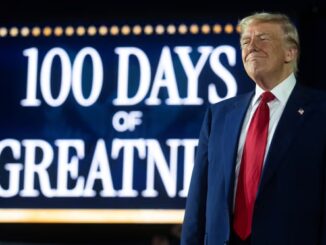
    Which is not to say that the developments of the past few months are unprecedented. In many ways, the first 100 days of Trump’s restoration are much like the first 100 of his initial term, in 2017: they are marked by a dizzying whirlwind of scandals, so numerous and preposterous as to be difficult to keep up with; by a cartoonish incompetence; and by public displays of aggression, cruelty, malice and dominance – be it over the federal workforce, his political rivals, foreign leaders, major institutions or the American people themselves.

    But the second Trump term has also been more reckless, more focused and more frictionless in its work to consolidate power and cut off its political opposition. Long gone are the first-term administration staff members who sought to have some sort of moderating influence on Trump – the bureaucrats and institutionalists who thought they could slow him down with procedure, the more cynical Republican opportunists who thought they could bend his charisma to their own ends. What is left in Trumpworld are only the true believers, or those with the zeal of converts. They are no longer being slowed down from the inside.

    Nor are they being opposed much from without. In 2017, when liberal Americans could still comfort themselves with the notion that Trump’s election was an anomaly, and in the early months of Trump’s first term, an uncharacteristic level of civic engagement and pride sprang up. The Women’s Marches attracted millions, and crowds swarmed the airports to lend support to travelers from the countries that Trump had targeted with his Muslim ban. But while the early resistance movement had tremendous amounts of feeling, it ultimately lacked direction: all that outrage did not find a useful place to go, and eventually it ebbed. It is hard to find hopefulness, now, among American liberals, and the Democratic party is showing few signs of life. On the Sunday talkshows last week, the Senate minority leader Chuck Schumer was asked about the administration’s attacks on institutions of higher education, which have lost federal funding as the regime attempts to restructure their curricula and faculties. Schumer replied that he had sent a strongly worded letter.

    The United States has long been in a state of constitutional erosion. The role of Congress, the most representative of the federal branches, has been dwindling for decades, as gerrymandering and malapportionment have made its two chambers less competitive and more partisan, leading to permanent gridlock and dysfunction. Congress was once endowed with both the power of the purse and the sole power to declare war; it has largely handed the latter off to the executive, endowing the president with broad powers to use the US military abroad even without congressional approval and has not seemed interested in taking that power back.

    Now, the Trump administration seems to have also usurped Congress’s power of the purse for the executive, declaring that the president may refuse to appropriate congressionally allocated funds by personal fiat. This is a profound constitutional change, one that shifts a massive power into the hands of one man; and again, Congress does not seem to be interested in this assault on its own prerogatives, with even many Democratic leaders seemingly preferring to have less power – and, hence, less responsibility.

    For a long time, the decline of Congress meant the ascent of the federal judiciary, which appropriated large swaths of de facto policymaking authority to itself in light of congressional paralysis. This was already a degradation of democracy: the unelected judges came to have far too much influence over federal policy. And the judges were not the neutral, non-ideological referees that they claimed to be: many interpreted the law to be maximally deferential to the whims of the powerful and only minimally respectful to the rights of the less powerful.

    The US supreme court, in particular, seemed to change its doctrine almost as whim based on whatever outcome would best serve conservative priorities. Indeed, the judiciary itself seemed more than willing to share in democratically unaccountable power with the president, so long as that president was a Republican: it declared last year that the executive was immune from almost all criminal prosecution, thereby carving out a category of person – Donald Trump – to whom federal criminal law mostly does not apply. But even this wildly partisan federal judiciary does not seem to be good enough for the restored Trump regime, which wants to eliminate all possibility that its agenda might be checked by the courts: JD Vance, the vice-president, has taken to complaining in public when judges rule against the administration, claiming, falsely, that they do not have the authority to check the executive. But such petulant little demonstrations may not long be necessary: increasingly, the Trump regime is simply ignoring judicial orders that it does not like.

    Critics of the Trump administration have called this state of affairs a constitutional crisis. I have come to think of it more like a constitutional collapse: long vacant, the vestiges of the US’s democracy are crumbling to the ground, falling like an empty tent. We don’t yet know what, exactly, will be erected in its place.

    (The author is a Guardian US columnist)