NEW YORK (TIP): The Indian Consulate in New York is preparing to launch new services on August 1, including new satellite centers in Boston, Columbus, Ohio, and Edison, New Jersey, to provide comprehensive consular services. These centers will handle passports, visas, OCI cards, and miscellaneous services, with a uniform service fee of $19. The consulate also aims to engage more with the Indian American community, particularly students, who number 117,000 in their jurisdiction, and the second and third-generation Indian Americans. The consulate is also working to support Indian women facing challenges and promote Indian culture, which is increasingly mainstream in the U.S.
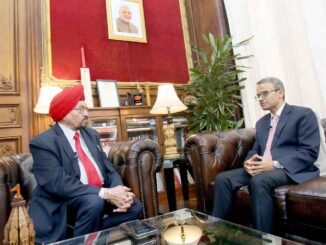
This information was provided by Mr. Binaya Srikanta Pradhan, Consul General of India in New York, in an interview with The Indian Panorama Chief Editor Prof. Indrajit S Saluja on July 30.
Here are excerpts from the Interview.
TIP
I want The Indian Panorama readers to know what is going to come from you on the coming Independence Day.
CG
Let’s come to that. So, from first of August, we are going to have a few additional services in a decentralized manner. For example, in this consular jurisdiction, will be having three new satellite centers which will be providing all Indian consular services. And when I say consular services, it is not only passport, visa and OCI card. It also includes the miscellaneous services, which include, like attestation, power of attorney, giving a death certificate, a birth certificate, registering your will, giving the notary, and any kind of consular services that we offer. The same services would now be dealt with by the satellite centers. At the moment, our service provider is a company called VSF Global. At present, people deal with VSF Global in New York City. From the first of August we will be having centers from VSF Global opened in Boston, in Columbus, Ohio, and in Edison, New Jersey. So, these are the three new centers which are being opened here. Similar centers are being opened in other parts of the country. But in our jurisdiction, we are having three additional centers. In other words, people in those regions do not have to come to New York City to avail those services. They can go to those centers. The second thing we are doing is that hereafter, VSF would not be limited to dealing with passport, OCI and visa. They will be dealing with all the miscellaneous services which were so far being dealt with by only the consulate in this building. So now you are going to be getting those facilities in all the VSF centers, from New York to Boston to in addition to Ohio, Columbus. Third, people will be paying a uniform service fee of $19 that is one nine- $19, which would be taking care of, almost all needs. If you are coming to a VSF center and you require somebody to help you to fill up the application, that will be provided as part of the services. If you have not got your right photographs, or you have forgotten to get your photographs, the VSF center will take your photograph, and provide you four photographs free of cost. Photocopy of your documents will be provided free of cost. And the courier service, the return courier service, is a part of that $19 service charge. So earlier, you give an envelope with the required fees so that the envelope can go back to you. Now it is provided as part of the $19 service fee. I would say that these are the new services that we are providing and helping people to fill in the application form, so that they are not having trouble understanding the guidelines or understanding the instructions. It is going to be a new thing, because many a time we come across complaints that people are unable to understand how to complete the application form. Now you can go to the VFS center. They will help you to fill it up without any additional charge. So, that is the new features in this service. And more importantly, earlier VSF was open from Monday to Friday. Hereafter, it would be open from Monday to Saturday. So only Sunday would be the holiday. So, Monday to Saturday, all these four places in our jurisdiction, New York, Boston, Edison and Columbus in Ohio, would be open from 9 am to 6 pm. I would say this is a substantial improvement in terms of both the duration of time that they would be open to quality service they would provide in a more intimate engagement with the people who would come for services. So, I’m sure this would improve the experience that our people had in terms of getting Indian consular services.
TIP
Surely. There are people who work for five days a week, and they can’t leave their job to go to VS. And if it is open now on Saturdays, it becomes very convenient for them to visit a VSF center in case they have to transact a business with it. And also, nobody would mind paying a fee of $19 and be assured of all the services you have just mentioned. I think people will be happy with the new services being launched from August 1.
CG
For comparison, I would urge you to check about the service fees other countries charge. You would find that this is a very small amount compared to what other countries will charge. $19 which would include your photocopy to photograph, to return courier service. I would say, it is a very, very competitive service.
TIP
The services that you have just now detailed would probably be taken as an Independence Day gift by the community here. Thank you for thinking of launching the new services a few days before the 79th Independence Day of India.
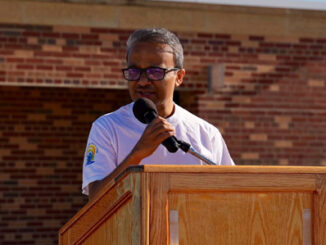
HICKSVILLE, NY (TIP): The Indian Consulate, in collaboration with Shanti Fund, organized on Sunday, May 18, a Yoga session – Sunrise Yoga- at Jones Beach, followed by beach cleaning. Consul General of India Mr. Binaya Srikanta Pradhan, accompanied by Consul Pragya Singh and a few others from the Consulate, enthusiastically participated. Speaking on the occasion, Mr. Pradhan welcomed the participants and appreciated the initiative taken by Mr. Vora of Shanti Fund. He also spoke about the upcoming International Day of Yoga on June 21.
Yoga Guru Anita Rana conducted the Yoga session, which the 50 odd participants thoroughly enjoyed.
The consulate provided T-shirts, yoga mats, luncheon, and beverages to all.
At hand were officials from the Parks and Beach division of the County who took great care of the volunteers.
Consul General with some participants ready for beach cleaning.A group of volunteers doing beach cleaning
Consulate General of India and FIA Host the 7th Annual International Women’s Day
NEW YORK (TIP): The Consulate General of India in New York, in collaboration with the Federation of Indian Associations (FIA) of NY-NJ-CT-NE, hosted the prestigious 7th Annual International Women’s Day celebration at India House, New York City, on the eve of International Women’s Day. Graced by Honorable Union Minister of Women & Child Development, Smt. Annapurna Devi as the chief guest, the event honored four exceptional women for their remarkable contributions across diverse fields, reinforcing a steadfast commitment to women’s empowerment and recognition.
Honorees with the chief guest Union Minister Smt. Annapurna Devi, Consul General Mr. Binaya Srikanta Pradhan, Ms. Anu Sehgal, Moderator of Panel Discussion, and FIA officials Chairman Ankur Vaidya, President Saurin Parikh, Payal Shah, Chair of International Women’s Day , and Smita Miki Patel, Co-Chair of International Women’s Day.
The evening commenced with a welcoming reception, followed by an inspiring digital presentation highlighting FIA’s ongoing initiatives promoting diversity and gender equality. Ms. Payal Shah, Chair of International Women’s Day, adeptly managed the proceedings as emcee, ensuring a seamless and engaging experience.
In her keynote address, Union Minister Smt. Annapurna Devi emphasized the crucial role women have played in strengthening bilateral relations between India and the United States. “Women of both countries and the diaspora have consistently been at the forefront of developing and nurturing the relationship between America and India,” she noted. The Minister also highlighted her recent initiative launched on February 13th, 2025, in Washington DC, aimed at fostering women’s development across both nations in socio-economic, financial, and technological sectors. This collaborative program underscores both countries’ commitment to women’s empowerment on a global scale.
Ankur Vaidya presents Union Minister Smt. Annapurna Devi with a commemorative memento in recognition of her leadership in women’s development. Seen in the picture, from L to R: Smita Miki Patel, Mr. Binaya Srikanta Pradhan, Smt. Annapurna Devi, Ankur Vaidya, Payal Shah
A significant highlight of the celebration was an enlightening panel discussion moderated by Ms. Anu Sehgal of The Culture Tree. During this insightful conversation, the honorees shared their personal journeys, discussing the challenges they overcame in their respective fields and the pivotal moments that shaped their success. They spoke passionately about their entrepreneurial experiences and acknowledged the women who had inspired them throughout their careers. The discussion provided attendees with valuable perspectives on perseverance, leadership, and breaking barriers in male-dominated industries.
A view of the gathering
The FIA and Indian Consulate continued their tradition of recognizing women who have made indelible marks in their respective fields. Through compelling video presentations, the event celebrated both past honorees and introduced this year’s distinguished awardees. The primary objective remained inspiring women to rise above challenges and make meaningful contributions to their families, communities, and professional domains.
2025 Honorees:
Ms. Anu Aiyengar – Global Head of Advisory and Mergers & Acquisitions, J.P. Morgan
Ms. Anjula Acharia – CEO and Founder, A-Series Management & Investments
Ms. Wendy E. Diamond – CEO & Founder, LDP Ventures, Founder, Women’s Entrepreneurship Day Organization
Ms. Seema Mody – Reporter & Anchor, CNBC
The celebration featured heartfelt addresses from distinguished guests, including FIA Chairman Ankur Vaidya, FIA President Saurin Parikh, and the Consul General of India, Mr. Binaya Srikanta Pradhan. Each speaker acknowledged women’s indispensable role in society and highlighted the significant progress made toward women’s empowerment in India.
During the award ceremony, Consul General Pradhan and Minister Annapurna Devi presented each honoree with a sash, trophy, bouquet, and proclamation, recognizing their outstanding achievements. The awardees expressed profound gratitude for the recognition and shared their visions for a more inclusive and progressive future.
The evening concluded with a vote of thanks by Smita Miki Patel, Co-Chair of International Women’s Day, followed by a special dinner catered by Andaaz Caterers. This annual observance serves as a testament to the FIA’s unwavering dedication to promoting gender equality and empowering women to effect positive change in society.
Mr. Binaya Srikanta Pradhan, Consul General of India, on July 23, 2024 sat with The Indian Panorama Chief Editor Prof. Indrajit S Saluja for an interview. It was the day when the Interim Budget was presented in the Indian Parliament by India’s Finance Minister Nirmala Seetharaman.
Our conversation began with my request for the Consul General’s comment on the budget. And the Consul General obliged with his comments, saying that he had not studied the budget in detail yet. But since the interview is being published on the eve of the Independence Day of India, I am omitting a large part of conversation on the Budget, as such, only retaining the part dealing with budgetary provisions for students, at home and abroad.
The long interview has been edited , but the spirit of the comments made by the Consul General has been kept intact.
Here are excerpts from the interview.
TIP: You had expressed anxiety about Indian students here, some of them committing suicide, some of them dying unnatural deaths, and you wanted the Indian American diaspora here to, to take care of them. Why I said that because that is indicative of your concern for the youth and the students? What do you think the interim budget has offered our youth in India, our students in India? What is there for students in the Budget?
CG: In the recent budget announcement, a new provision has been introduced aimed at encouraging students to pursue higher education within the country. The scheme includes an incentive for students to take loans for their higher education in India, thus motivating them to stay within the country for their academic pursuits. This initiative is seen as a significant move to retain talent within India and reduce the financial burden on students who choose to study domestically.
Now, we are talking about a different issue here. At the moment, we have about 350,000 Indian students in the U.S., a dramatic rise from approximately 200,000 just two years ago. This surge has brought attention to several issues, including unfortunate incidents involving accidents and other causes of death among the student population. The consulate has been actively working with the families of the affected students, American authorities, and Indian community leaders to address and prevent such incidents.
Efforts have been made to connect Indian student communities with the broader Indian diaspora in the U.S. The consulate has launched a portal specifically for Indian students, providing access to resources such as a list of doctors offering free consultations, internship opportunities with over 30 companies, and legal experts who can assist in case of any legal requirements. With 113,000 Indian students under the jurisdiction of the consulate, there is a significant responsibility to ensure their safety and well-being.
The consulate has been engaging with universities and student communities to raise awareness about the local laws, culture, and job market, emphasizing the importance of navigating the initial months in a new country with caution. The consulate has also organized various events and visits to university campuses to interact with students and university authorities. Notable Indian figures, including Indra Nooyi, have been involved in initiatives to guide and support new Indian students in the U.S.
With 113,000 Indian students under the jurisdiction of the consulate, there is a significant responsibility to ensure their safety and well-being.
TIP: Did you during your interaction with the academicians at the universities and colleges and the students come across any complaint that Indian students are taking drugs ?
CG: Indian students are generally viewed as disciplined and responsible. Concerns raised by students tend to be more related to their lack of awareness about the legal system, job market challenges, and access to internships, rather than issues like drug use or lack of medical insurance.
TIP: Is there any provision here for them that they are provided health insurance?
CG: I’m not having great expertise on this particular issue. I have come across students who are here with insurance. Many universities are providing those facilities. So, I really don’t know in great detail, but I understand that that is not a major issue that the students are facing in terms of not having access to medical care, that is not an issue.
TIP: Let me then take you to another question. If at all, medical insurance is not provided by the educational institutions, where they are studying, or where the students are not in a position to buy their medical insurance, do you think government of India could ever think of taking on the burden of providing them the required medical care.
CG: That’s a theoretical question. Let me not get into that because we have over 4 million strong Indian community over here. Out of which about 2 million are Indian passport holders. Are you suggesting that anybody who is coming to US, if they don’t have access to medical care, they should be provided medical care at government of India expense?
TIP: No. Only the students I’m talking about.
CG: I think, let me not make a comment. Like I said in my six months having interacted with a large number of Indian students community, this is not one among the concerns I have come across. I have come across, you know, their access to let’s say, the internship, their access to job. These are the concerns that I come across. The legal challenges they face at times when they don’t know and violate a law, unintentionally or unknowingly. Those are the challenges, I’m yet to come across a case where an Indian student is not having access to medical care. I can assure you that if we come across such a case, we’ll take care of that as a Consulate. So, rather than getting into a policy issue of whether government of India is having a provision or not, let me assure that if there is a case like that, we are there to find a solution that is so crucial. So that is that.
TIP: So, you have a panel of legal advisors?
CG: The consulate has established a panel of legal advisors available through the student portal, ensuring that students have access to legal support if needed. The overall message is one of ongoing efforts to support Indian students abroad, ensuring they are well-prepared, safe, and able to succeed whether they choose to stay in the U.S. or return to India with the skills they have acquired.
TIP: What are the various schemes available for Indian nationals, particularly those providing legal assistance? There is a lack of widespread awareness about these schemes.
CG: I acknowledge the importance of publicizing these initiatives and efforts have been made to reach out to the public, including holding a press conference when the consulate announced it would remain open 365 days a year to provide emergency services. There is a need for consistent communication to ensure that the wider Indian community is aware of these services, even though these initiatives have already received some media coverage in both the local and Indian media.
TIP: You may utilize the robust local media in the U.S., which includes various community-specific newspapers and TV channels, to disseminate information more effectively.
CG: I appreciate this suggestion and, also understand the importance of continuous engagement with the media to keep the community informed. In fact, we have plans for another press conference in August to brief the media about new initiatives and services offered by the consulate.
TIP: What has been your experience over the past six months you have been here?
CG: As You know we have ten states under New York Consulate’s jurisdiction. It is a large constituency. And it has to be served well. The consulate’s primary functions include consular duties, promoting trade and commerce, and engaging in political, cultural, and media activities. One of the important tasks is a smooth operation of consular services, highlighting the positive feedback received through reviews and the proactive approach in addressing complaints, particularly with the involvement of VFS, the outsourced agency handling visa and passport services.
The Consulate plays a significant role in fostering trade and economic relations between India and the U.S. The ten states covered by the consulate account for about $43 billion in trade, a substantial portion of the overall India-U.S. trade. There has been an active participation of business delegations from both countries, with numerous economic events organized to promote trade and investment opportunities. I am satisfied with an increasing interest among American stakeholders in engaging with India economically.
TIP: What other areas of India-US relationship do you see?
CG: The political, cultural, and media engagement are other key areas. There is a strong and evolving relationship between India and the U.S. The bilateral ties have reached a point where they are irreversible and poised for continued growth. And the Consulate plays a significant role in maintaining this relationship through regular interactions with elected representatives and media outlets. The consulate’s efforts to engage with both mainstream and Indian-origin media are essential for providing accurate information about India and its developments.
TIP: How do you look at the balance of trade between India and the US?
CG: The trade between the two countries is growing on both sides, with the trade balance becoming more balanced over time. The increasing volume of energy imports from the U.S. to India is an example of new trade segments being developed..
I welcome feedback from the Indian-origin community in the U.S. Their input helps a lot in strengthening India-U.S. economic relations. There have been instances in the past where community feedback led to successful initiatives. The Consulate is committed to openness in receiving ideas and suggestions for future collaborations.
The trade between the two countries is growing on both sides, with the trade balance becoming more balanced over time.
TIP: There is a growing sentiment among the Indian diaspora that now is an opportune time for India to become a global manufacturing hub for various small-scale products that China previously dominated. Given the current geopolitical climate, especially with the strained relationship between the U.S. and China, India could step in to fill this gap. India could capitalize on this opportunity, providing employment to its vast workforce by manufacturing and exporting goods like jute products and carpets, which are already in demand in international markets.
CG: Yes, manufacturing is indeed a priority for India. India initiated the “Make in India” campaign, which has been instrumental in promoting this sector. The recent budget documents highlight the government’s ongoing efforts to boost manufacturing across various sectors, particularly by supporting the Micro, Small, and Medium Enterprises (MSME) sector with credit facilities. It is important not just creating manufacturing capabilities but also ensuring market access, which is crucial for sustaining growth in international trade.
In order to achieve the ambitious goal of $500 billion in trade, India must explore and tap into new areas of trade, including those smaller but essential products that can be manufactured domestically and exported globally. It is equally important to diversify supply chains, a lesson reinforced by the COVID-19 pandemic. India is increasingly being seen as an attractive alternative for sourcing not only smaller goods but also more complex products like semiconductors and electronics.
TIP: Look at the textile industry. Clothes available in American markets are often from countries like Bangladesh, Pakistan, and Indonesia. Indian textiles, known for their superior quality, could capture a significant share of this market if India refocused on revitalizing its textile mills and exporting these products.
CG: I agree. Indian handloom and handicraft products are already widely available in U.S. markets and are recognized for their high quality. During a recent Indian Handloom Fair in the U.S., most exhibitors were already exporting their products to the country, indicating a strong market presence. However, while Indian products are already well-received in the U.S., there is still room to expand and increase exports, thereby generating more foreign exchange and contributing to India’s economic growth. There is potential for India to enhance its manufacturing capabilities, tap into new markets, and address rural unemployment by turning this potential into reality.
TIP: India could benefit from feedback from the Indian diaspora in the U.S. to address issues like unemployment and poverty in India. Many people of Indian origin in the U.S. have valuable ideas and solutions that could help India develop, and they want these ideas to be communicated back to the Indian government.
CG: While there is progress, more acceleration is needed. Indian exporters and government bodies are actively working to increase exports and tap into new markets, but trade is a competitive field, not one of charity.
TIP: How do you view the Indian-American community’s relationship with the U.S. government?
CG: Recently, I was going through the report that was prepared by the Boston Consultancy Group, which highlighted the significant contributions of the Indian community in various sectors, including public office. The Indian-American community is increasingly holding elected positions and contributing to mainstream governance in the U.S., which reflects the healthy relationship between the community and the broader American society.
The Indian-American community plays a vital role in strengthening the India-U.S. relationship. Prime Minister Narendra Modi recently acknowledged that the Indian-American community is the “main engine” driving this relationship. This sentiment was echoed by President Biden, who described the India-U.S. relationship as one of the most consequential of the 21st century.
Today, India is held in respect; India is looked upon as a growing country and doing well. It is because of the effort of the Indian American community.
The fact that when we meet the elected Congressmen , Senators, or governors, the kind of goodwill they express when they talk about the Indian community, the warmth with which they kind of appreciate the contribution of our community , it shows there is wider acceptance and appreciation of o our community by the government here, and I am sure, going forward, we are going to see that increasing. Today, India is held in respect; India is looked upon as a growing country and doing well. It is because of the effort of the Indian American community.
TIP: How far , do you think, Indian culture has been helpful in building this relationship or strengthening this relationship?
CG: I met somebody who is a professor from India, who, after studying at prominent universities in the U.S., is writing a book on how the Indian value system contributes to the success of the Indian-American community. This professor suggests that the emphasis on education, strong family values, and support within the community are key factors behind the Indian-American community’s success, including their higher per capita income compared to the mainstream American population. These cultural values likely play a significant role.
TIP: What are you doing at the Consulate level to promote Indian values and Indian culture?
CG: We work with the Indian community. Besides, there are events that we do ourselves. Recently, we celebrated International Yoga Day across all ten states under the consulate’s jurisdiction, which involved not only the Indian community but also many Americans. A survey reveals that 10% of Americans practice yoga, with 36,000 yoga studios across the country. This in itself is illustrative of how Indian cultural practices have been embraced in mainstream America.
The same goes for the Indian art forms within the Indian-American community. For example, during a visit to New Jersey, I witnessed 700 young Indian kids dancing together on one stage, a sight I hadn’t even seen in India. The consulate actively collaborates with Indian community groups to ensure that cultural heritage is passed down to younger generations, including teaching them their mother tongues and keeping them connected to Indian cuisine, costumes, and traditions.
Indian culture has already found a strong foothold in the U.S., with Indian food, festivals, and clothing becoming increasingly popular. The consulate works closely with the community to support and celebrate these cultural expressions, hosting and participating in various events and festivals, thereby fostering a deeper cultural connection between India and the U.S.
TIP: How does the Consulate support various Indian organizations, particularly those organizing parades and other events?
CG:The Consulate offers support to all Indian community organizations that request assistance, though most large-scale events, like parades, are primarily funded and organized by the communities themselves. The consulate works in partnership with these organizations, providing modest support when needed.
TIP: How about the bigger events, like Jaipur Literary Festival?
CG : Such events are typically organized independently but the Consulate is open to offering assistance if approached. The Consulate’s support is guided by its core principles and the requests it receives from the Indian-American community.
It’s a true honor to be working in this country very closely with the Indian American community. (Photos: Jay Mandal- on assignment)
TIP: What are the plans of the Consulate for the upcoming Independence Day celebrations?
CG: This is the first time I will be part of the Independence Day celebrations here. Besides the celebration we do at the Consulate, we do celebrate Independence Day at prominent places in multiple states. This year, events will take place from August 10th to August 17th, with invitations already received from seven states and 15 cities. The consulate plans to attend as many events as possible to show solidarity with the community.
TIP: What do you plan to do for the segments of the Indians here who face certain challenges?
CG: There is a need of a better connect of Indian students with the broader community to provide them with support in emergencies. While most students are doing well, there is a need for stronger ties between them and the established Indian-American community. 6% of the Indian-American community is not as privileged and requires assistance, particularly women facing legal and economic challenges.
There is a need to raise awareness about the available support systems. Media and community organizations play a crucial role in bridging the gap between those in need and the resources available. I was pleased to know about Indian-American doctors providing scholarships for distressed women to attend community colleges, thereby upgrading their skills and improving their employment prospects. There should be a better collaboration between the consulate, media, and community organizations to ensure that those in need receive the help they require.
TIP: What , do you think, is the impact of Indian values in the U.S.?
CG: Indian-American community has distinguished itself for upholding values such as service and responsibility. These values have helped integrate the community into American society. Indian-origin doctors, who make up 10% of the medical professionals in the U.S. but treat 30% of the patients. It’s a testament to the community’s commitment to giving back.
TIP: Indian values have even influenced mainstream American families, with many non-Indians embracing these values through their relationships with Indian-Americans. Look at Tulsi Gabbard.
CG: Yes. She’s deep into Indian value system. She’s not an Indian. She’s an American, Hawaiian. There are many such cases.
TIP: What is your Message for the Indian American community on the eve of the 15th of August?
CG: I would say it’s a true honor to be working in this country very closely with the Indian American community. The contribution you have made , not only to the American society , American nation building, , and also the contribution you have made in terms of cementing the relationship between India and the US is exemplary. So, we look forward to work with you very closely. Like the Prime minister said, our relationship with you is not a passport. So, it’s a different relationship. And I remain committed to work in that spirit with the Indian American community for the larger end, objective, of bringing a win win proposition and cementing the relationship between the two nations.
GLEN COVE, NY (TIP): Gobind Munjal, the National President of The Association of Indians in America (AIA), was sworn-in once again for the 2nd term 2024 & 2025 along with his National Executive Committee in an exciting Inauguration ceremony arranged at Metropolitan Caterers in Glen Cove, Long Island on Saturday, March 16th, 2024. Since AIA is a National organization, its out of State Members attended the ceremony via zoom.
The occasion was graced by the chief guest Honorable Consul General Binaya S. Pradhan. The Inauguration and Oath ceremony was attended by about one hundred attendees. This included AIA founding members, board of Trustees, AIA National Past Presidents, chapter Presidents, community leaders, AIA members, friends, and the media partners.
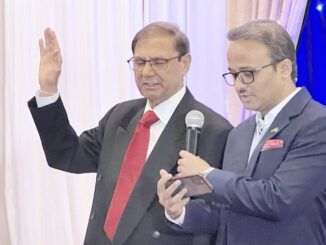
Members of Executive are being sworn in
Chief Guest Hon. Consul General of India in New York, Binaya S. Pradhan, in his opening Remarks, praised AIA for all that it has done for the community during its 56 years of history and commended the organization for its various achievements. He also suggested that if AIA could work on supporting the students coming from India to study here in the United States to get them internships and/or jobs, that will be very helpful. Consul General however pledged to work with AIA for outreach to the community.
National President Gobind Munjal was sworn-in by Honorable Consul General, Binaya Pradhan ji, who also administered the oath to Vice Presidents; Uma Swaminathan (NJ), Sushma Kotahwala (NY), Dr. Yash Pal Arya (NY), Santosh Pandey (IL), Secretary Gunjan Rastogi (NY) and Treasurer Gobind Bathija (NY). He also administered the oath to the members at large from all the states, namely Anita Thakkar (NY), Aridaman Jain (NJ), Beena Kothari (NY), Indu Gajwani (NY), Jasbir Singh (NY), Manoranjan Mishra (IL), Mohinder Taneja (NY). Neelam Modi (NY), Om Dhirgra (IL), Prem Mehrotra (IL), Rajeev Chaudhary(NY), Ram Tirumala (NJ), Ramola Motwani (FL), Salil Misra (IL), Santosh Khera (CA), Satish Anand (NY), Sharmistha Dutta (FL), Shashi Malik (NY), Sujata Seth (NY), Uma Eniasivam (FL), Usha Bansal (NY), Vijay Sharma (WI).
Gobind Munjal Addresses
In his speech, National President Munjal welcomed everyone and shared some of the NEC’s achievements during his first term. o Honor Banquet and Celebration of 75th Anniversary of India’s Independence on May 6th, 2023 – attended by Senate Majority Leader Chuck Schumer & NYC Mayor Eric Adams. o RESTARTED AIA National Newsletter (“BETWEEN US”) after a gap of about 20 years o INITIATED Investment Advisory Committee to invest life membership funds for income and long-term growth,
Amended Bylaws of National AIA in 2023 after 30 years of gap. o Energized young members and made them life members o Energized and Improved communications between the chapters
AIA past presidents and Gobind Munjal with the Consul General
President also shared his Vision for the 2nd term:
He reiterated that since the elections are over now, we will all work together as a unified team.
In pursuing the AIA’s moto of “Indian Heritage and American Commitment”, he emphasized that:
“We are here to serve the community needs. As we continue to direct our help to the people in India, our homeland, we should equally remain committed to the community right here in the United States, our adopted country. We hope to work towards increasing that commitment.
As the demographic profile of the Indian American Community has changed in past 5 decades since the founding of AIA, so are their needs. We remain committed to understanding the changing requirements of the community, and then will develop Programs to help both – the Youth and the Elderly. NEC pledges support to all the Chapter Presidents and its members, so they all can build and expand on these programs across the nation. This way together, we can make the next two years most productive.
President Munjal also shared his initiative of working on the immigration bill to reduce the time delay for Indian citizens to get the green card as well as H1 B visas. He said “AIA (NEC) is joining GOPIO International and rallying some other organizations to join us in this initiative. Today it takes almost 15 to 20 years for an Indian citizen to get a green card, whereas some other nationalities get a green card in 1 year. We all are planning to go to Washington DC sometime in the end of April 2024 to meet the congressional leaders requesting them to support this bill”
All AIA leadership extended their good wishes and support. The program concluded with a traditional vote of thanks by the secretary.
The Association of Indians in America (AIA) is the oldest not-for-profit organization of Asian Indians in America founded on August 20, 1967. It is the grassroots national organization of Asian immigrants in United States. With chapters and membership spread across the United States of America, AIA represents the hopes and aspirations of those immigrants who are united by their common bond of Indian Heritage and American Commitment.
A view of the gathering
Signup to our Newsletter!
Don’t miss out on all the happenings around the world