Tag: Muslim

  • Overarching Indianness transcends differences among groups

    Overarching Indianness transcends differences among groups

    India is one of the few nations in the world that has resolved the problem of separatism in so many states

    Over the decades, Gorkhas, Sikhs, Nagas, Manipuris and Kashmiris — to name only the most well-known — have declared their disaffection with the Indian state to be such as to merit breaking away. No one ever followed up on this intention. India is one of the few nations in the world that has successfully resolved the problem of separatism in so many states.

    “Indians call themselves — and quite assertively — Bengali, Tamil, Punjabi, Christian, Hindu, Muslim, Sikh, Jain, Parsi, Buddhist, etc. But from this, it does not follow that there is no such thing as India. Those are ascriptive identities that do not rule out the overarching identity of being Indian.”

    By M Rajivlochan

    As electioneering in India becomes more strident and voters are wooed by a focus on the faultlines in society, it would do us good to recall the nature of our nationhood. Countries come into existence because we focus on what is common among us rather than what is different. The ‘moral spirit of combination’ holds a nation together, wrote Rabindranath Tagore in 1917, when he was worried about the war that was going on in Europe and soldiers being pulled from all over the world into the battleground. In an essay on India’s nationhood, he said it was quite evident that this was a war of nations rather than that of tribes or religions. After all, Tagore wondered, being a nation was a much more evolved state for a society, since it enabled a much larger number of people to come together and harmonize their actions for the common good. Then, he penned down his thoughts on how different nations had been formed and the positive and negative consequences of it. The most visible negative consequence was that since 1914, European nations had been at war with one another, and millions of young men from India and Africa had been sent to Europe to fight. On the positive side, nations had ensured that people from diverse backgrounds — different from each other in language, religion and ethnicity — had come together and created a society and polity that benefited everyone.

    Tagore noted that nations were the highest form of social evolution. Thereby lies a very important insight for us to understand our own existence in the present times.

    Overcoming the natural differences of ethnicity, language and religion, nations came into being when their people wished to live together. Diversity, faultlines due to ethnicity, religion and language — all these come with birth. The desire to live together does not; it is crafted by human beings. What makes India unique in the comity of nations is the perpetual desire of people to live together, which is manifested in the fact that not only do we survive, we also make constant efforts to stay together.

    This has been so throughout history. There are ancient texts in which we referred to ourselves as the people of Jambudwipa, the land of the jamun tree. In the Kusa Jataka from the fourth century BC, Sakra, the king of the gods, gave the ugly Prince Kusha a necklace of pearls and told him to wear it, saying, “Tie this on you, then there will not be your equal for beauty in all Jambudvipa.” In later times, with an increasing contact with the outside world, those across the Sindhu river were referred to as Al-hind. Later, various East India companies came into being, not ‘South Asia companies’. India has been a singular civilization in history.

    This continues to be the case even today. Statements made by leaders of various groups that have taken up arms against the Indian state in modern times are interesting.

    Eno Rh Raising, the self-styled ‘home minister of the Government of the People’s Republic of Nagalim’, said in 2015 that the Nagas were a separate people with a history different from that of Indians. The occasion was the signing of a peace accord with the Indian Union. On August 3, 2015, the National Socialist Council of Nagaland (NSCN)-IM, the largest of the seven Naga insurgent groups, announced a historic peace agreement with the Centre, agreeing to create mechanisms for greater autonomy for Naga tribes living in Manipur and decommissioning of arms held by the NSCN (IM). Neither the Nagas nor the media reporting these twin statements saw anything contradictory in the spectacle of the leader of a people with a history different from that of India signing a peace accord with the very entity they were fighting against, while at the same time asserting their separate identity.

    Over the decades, Gorkhas, Sikhs, Nagas, Manipuris and Kashmiris — to name only the most well-known — have declared their disaffection with the Indian state to be such as to merit breaking away. No one ever followed up on this intention. India is one of the few nations in the world that has successfully resolved the problem of separatism in so many states.

    Speaking at a public forum last year, Bipul Kalita, an ex-member of the ULFA (United Liberation Front of Asom), said they laid down arms when they realized that 98 per cent of the people of Assam did not support militancy.

    The more simple-minded among intellectuals writing on India take these assertions of separateness literally to be a sign that the Indian Union barely exists, that it was brought into existence by the British; the presumption being that there was no entity called India before that.

    For Westerners to see us like that makes sense to them. Perhaps they see nations as monolithic entities. For Indians to imbibe and regurgitate this merely shows a people unaware of their own strengths and their long civilizational memories. Abrahamic benchmarks of nation and religion are of little use to us. Unlike Europe — which was troubled by religious wars from the times of the Crusades right up to the 19th century, marked by mass killings every few years — Indians did not carry out large-scale slayings.

    Exceptions prove the rule. The one fault line that resulted in the partition of the country expressed the one conflict that Indians were unable to resolve amicably. About this, the Congress Report on Communalism, published in 1931, mentioned that the so-called Muslim problem in India was entirely the creation of the British administration trying to divide India and Indians in ways that were not natural to the country. Subsequent events only substantiated the findings of the report. Even after Pakistan had been created as a country for Muslims, millions of them continued to live in India of their own volition. As a recent study by economist Shamika Ravi says, Muslims flourished in India. Their numbers went up from about 8 per cent in 1950 to around 14 per cent in the present times, even as the number of Hindus in Pakistan went down from 25 per cent to about 2 per cent in the same period.

    Indians call themselves — and quite assertively — Bengali, Tamil, Punjabi, Christian, Hindu, Muslim, Sikh, Jain, Parsi, Buddhist, etc. But from this, it does not follow that there is no such thing as India. Those are ascriptive identities that do not rule out the overarching identity of being Indian.
    (The author is a Historian)

  • Multifaith prayers offered at Mahatma Gandhi’s Punya Tithi

    The welcome note was given by Arvind Vora who was instrumental in getting the Gandhi statue installed in the foyer of the HL Dennison building, the seat of Suffolk County.
    The author led a short meditation at multifaith prayers offered at Mahatma Gandhi’s Punya Tithi.

    Parveen Chopra

    LONG ISLAND, NY (TIP): Is there God? What about the afterlife? There is no conclusive answer or consensus on such questions. So, it is best to change the subject. As we do in ALotusInTheMud.com that I founded recently. In this web magazine, we try to curate content that people can use in their lives to be happier, healthier, productive and peaceful. So too when I was invited by Shanti Fund to do a presentation on my wellness + spirituality webzine at their Gandhi Punya Tithi prayers event on January 30, I skipped the speech and did something else altogether.

    The venue of the event co-hosted by Long Island Multi Faith Forum (LIMFF) was the foyer of H L Dennison building, seat of the Suffolk County, where a life size statue of Mahatma Gandhi welcomes you. The 150 strong gathering was multi-religious. Multifaith prayers followed one after the other, Christian, Hindu, Jain, Buddhist, Jewish, Muslim, Sikh, even Zoroastrian, Brahma Kumaris, and Bahai’s as well as by an eclectic group called Gathering of Light. Towards the end of the program when I was given the mike, I gave people the shortest meditation instruction possible: Close your eyes. Choose a short monosyllabic mantra, or name of your favorite deity or any name of God in your religion. Start repeating that word or mantra softly, mentally only. Continue till the mantra goes away and thoughts arise. When you become aware that you’ve lost your mantra, return to it gently. Don’t fight with thoughts or try to drive them away. It was a brief meditation session, 5-6 minutes only. But suddenly there was pin drop silence, suffused with spirituality. It was nice, some people told me at the vegetarian dinner that followed.

    A highlight of the program was Chui Chai Dance, from the Thai dramatic and dance repertoire.

    In his welcome note at the event, Arvind Vora, Chairman of LIMFF, mentioned that besides the Punya Tithi another annual event held in memory of Gandhi Ji at this location is the Mahatma’s birthday on October 2. Bakul Matalia of Shanti Fund conducted the program which began with the Mahatma’s favorite bhajan, ‘Vaishnav Jan to Tene Kahiye’ (Real devotees of God are those who feel the pain of others, who help those who are in misery but never let ego or conceit enter their mind), by Volunteers of Gayatri Pariwar. Organizers aimed for youth participation to get them exposed to the diversity of different faiths. Indeed, three presentations were made by youths – a Bahai group, Gayatri Gyan Kendra Youth and Look N Learn Jain Gyan Dhama.

    What I enjoyed the most was singing, and drum beat during the Jewish presentation by Cantor Lisa Ann Wharton and Akiva the Believer. They had the audience sing along and clap rhythmically. A highlight of the program was Chui Chai Dance, from the Thai dramatic and dance repertoire. It followed the Buddhist Presentation of Metta Sutta by two Thai monks. While rooted in your own cultural or religious tradition and yet be able to admire, interact with and learn about others’ traditions is what interfaith is – much needed in the multicultural polity and world we are living in.

    (small logo of Alotusinthemud.com. Parveen Chopra is the founder of ALotusInTheMud.com, a wellness and spirituality web magazine launched recently. He can be contacted at editor@alotusinthemud.com, Ph 5167100508.)

  • Sectarian strife in Pakistan

    Sectarian strife in Pakistan

    By G Parthasarathy

    Deobandi and Bareilvi alignments a challenge to governance and peace

     India has done well to establish a back channel for talks with Pakistan’s military. A major result has been the signing of an agreement for a ceasefire across the LoC in J&K.

    The two major schools of Islam, which emerged in the 19th century in the territories of present-day India, have traditionally been described as Deobandi and Bareilvi. The sects emerged from the efforts of many Muslim clerics and thinkers who fled from Delhi following their persecution by the British after the Mughal rule ended. Deobandi practices were widely adopted in Pakistan’s Khyber Pakhtunkhwa province, and by virtually all Pashtuns in Afghanistan. The Deobandis thus established a firm foothold amongst the Pashtun population in both Pakistan and Afghanistan. Most importantly, while the Bareilvis remained content with their influence in the subcontinent, the Deobandis reached out to people in the Arabian Peninsula in the 19th century. This was an initiative that has paid rich dividends through Saudi financial backing of Deobandi organizations.

    Thanks to the FATF and actions by the US and its allies, Pakistan is being squeezed to end support to such groups.

    The most far-reaching decision by India’s Deobandi leaders was to make common cause with the secular ideals of India, while supporting the struggle led by Mahatma Gandhi for India’s independence. The main center for study and learning of the Deobandi school of Islam was and remains the Darul Uloom, located at Deoband in UP. While sections of the Bareilvi leadership initially shared the views of their Deobandi compatriots, those mainly living in Pakistan, eventually chose to support the Partition. On November 3, 2009, Jamiat-i-Ulama-i-Hind, a group of Deobandi scholars, dedicated to the welfare of Muslims in India, met at Deoband and condemned suicide bombings and attacks targeting innocent civilians. This amounted to direct criticism of Pakistan’s propensity to use terrorism as an instrument of state policy.

    The Bareilvi population in Pakistan’s Punjab province soon found that it had little political space to operate in. The military extended support to groups like the Lashkar-e-Taiba (LeT), the Jaish-e-Mohammed (JeM) and the Afghan Taliban that worked jointly with the military establishment. While the JeM organized the attack on the Indian Parliament in 2001, the 2008 Mumbai terrorist attack was masterminded by the LeT. Moreover, the ISI midwifed the close relations of these groups with the Taliban in Afghanistan. The Bareilvis were soon finding that despite their influence and political support in Pakistani Punjab, they were losing political relevance in Pakistan. Ever since the Soviet invasion of Afghanistan, the Pashtuns, who are predominantly Deobandi, dominated the attention and patronage of the ISI, and, indeed, in the world. The Taliban also have what they believe to be Deobandi credentials and collaborate closely with Wahhabi-oriented groups like the LeT and the JeM.

    Pashtun Deobandis in Pakistan’s northwest and in southern Afghanistan became natural allies of Gen Zia-ul-Haq, after he overthrew and hanged ex-PM Zulfiqar Ali Bhutto. General Zia brought in a new phase of ‘Islamization’ of politics and developed close relations with radical Islamic elements in Pakistan, most notably the Jamaat-e-Islami in Punjab and Sind, and the Pashtun Deobandis in the north. The Soviet Union then made the folly of invading Afghanistan, enabling the US to join Pakistan in waging a Saudi-backed, Deobandi-oriented jihad against the Soviet forces. Wahhabi-oriented organizations in Pakistan joined this jihad. The ISI developed links with the Jamaat-e-Islami in J&K and used this Deobandi-oriented force to facilitate its jihad in J&K.

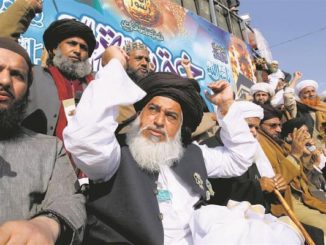
    Given Bareilvi practices of virtually worshipping the Prophet, Saudi Arabia treats them as heretics. According to Najam Sethi, the Editor of Pakistan’s Friday Times, the Bareilvis in Pakistan, and particularly in the majority Punjab province, have responded to critics by actions ‘borne of the religious passion to defend and uphold the Prophet of Islam, from blasphemy by Muslims and non-Muslims alike, at home and abroad’. This led to the establishment of a politically oriented, militant organization called the Tehriq-e-Labaik, which soon swept across towns and villages, preaching religious intolerance in Pakistan’s military-dominated Punjab.

    The first victim was a Punjabi Hindu woman, Asia Noreen, popularly known as Asia Bibi, who was convicted and sentenced to death for allegedly making blasphemous comments. She was arbitrarily handed the death sentence by hanging — a verdict that was overturned by the Supreme Court in 2011. She, thereafter, immediately fled to Canada.

    The Tehriq-e-Labaik attained notoriety, when one of its members, a security guard, assassinated the Governor of Punjab, Salman Taseer, for supporting Asia Bibi. The guard was treated like a revolutionary hero by the outfit. It now has substantial political clout in the Punjab province. It virtually brought Punjab to a standstill during recent demonstrations to demand the expulsion of the French ambassador, because of alleged disrespect shown in France to the Prophet.

    Thanks to the threats of sanctions by the Financial Action Task Force and strong actions by the US and its European allies, Pakistan is being squeezed to end support to such groups. Pakistan is also realizing that faith alone cannot hold a nation together, especially in the face of sectarian differences. Neither the Tehriq-e-Taliban, which is now waging a low-intensity conflict within Pakistan, or even the Taliban leadership in Afghanistan has ever recognized the Durand Line as an international border.

    India has done well to establish a back channel for talks with Pakistan’s military. A major result has been the signing of an agreement for a ceasefire across the LoC in J&K. Pakistan’s mercurial PM, Imran Khan, meanwhile, has rejected a proposal to import Indian agricultural products, which he had initiated and approved earlier. He certainly does not enjoy global popularity. The world has noted that it was General Bajwa who first met Crown Prince Salman in Saudi Arabia, before the Crown Prince gave an audience to Imran Khan last week. US President Biden is yet to meet or speak to Imran Khan.

    (The author is Chancellor, Jammu Central University & former High Commissioner to Pakistan)