Tag: Namita Gokhale

  • JLF to revolve around Tulsidas and the Ramcharit Manas sessions this year

    JLF to revolve around Tulsidas and the Ramcharit Manas sessions this year

    By Dr Yash Goyal

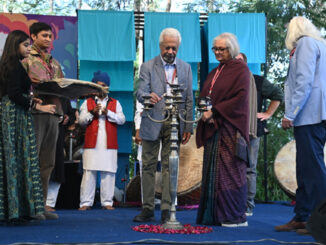
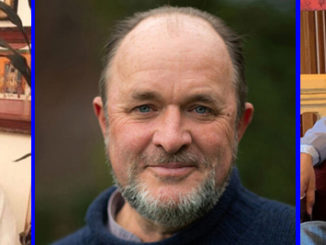
    The Jaipur Literature Festival (JLF) is an annual literary festival that takes place in Pink City every year. Founded in 2006, the 17th JLF is scheduled in Jaipur from February 1-5. The festival is an initiative of Jaipur Virasat Foundation which was founded by Faith Singh, originally as a segment of the Jaipur Heritage International Festival and developed into a free-standing festival of literature with international fame. In 2012, a number of events occurred related to Salman Rushdie and the Satanic Verses controversy. JLF has reached every literary corner of the world. What used to be virtual during the Corona period is now becoming visible in foreign cities. The credit to create literary sensation and others to organise similar events in parts of India certainly goes to Sanjay Roy, William Dalrymple and Namita Gokhale.

    Namita, co-founder and co-director of JLF, is a well-known litterateur. r. She is the author of 23 works of fiction and non-fiction. Her acclaimed debut novel, Paro: Dreams of Passion, was published in 1984. She is the recipient of various prizes and awards, including the prestigious Sahitya Akademi (National Academy of Literature) Award 2021 for her novel Things to Leave Behind. Following are the excerpts of her Online 10 Q-A with Dr Yash Goyal.

    Namita Gokhale, co-founder and co-director of JLF

    Q. The 17th edition of Jaipur Literature Festival 2024 will begin next month. With what intention did you guys start JLF in Jaipur? 

    A. We began with a love for literature, across borders, and a deep belief in Indian writing in all its avatars.

    Q. Since this festival started from Jaipur, how much literary benefit did Rajasthan’s writers get from it? What is the criteria for selecting a writer?

    A. We try to programme a range of writers from Jaipur and different parts of Rajasthan. We include new voices, women writers, and the oral heritage as well as established writers and Sahitya Akademi awardees. Shri Nand Bharadwaj and Shri CP Deval have also guided us over the years.

    Q. This festival also focuses on Rajasthani language and its litterateurs. But Rajasthani language did not get constitutional recognition in 17 years. What do you think of it. 
    A. It is a complex issue. Rajasthani certain deserves constitutional recognition but the many dialects are cited as a factor in this delay in giving the language its due.

    Q. Lok Sabha elections are going to be held soon. There is an atmosphere of Ayodhya and Lord Ram in the entire country. Would JLF want to know the minds of litterateurs on this very religious subject in any of this year’s sessions?

    A. We have a session on Tulsidas and the Ramcharit Manas which should be of interest to our audiences.

    Q. From a commercial point of view, JLF has now become global. Has this created any bridge between Indian and foreign writers?

    A. The global editions have led to deepened ties with diasporic authors of Indian origin and creative exchanges with international writers we interact with. Many valuable initiatives have resulted from this.

    Q. What are the reasons for the popularity of JLF in India and abroad? Now there are many such literary festivals in almost every state, do you guys feel any competition with them?

    A. The Jaipur Literature Festival draws international audiences because the programming is creative, rooted, and provides many different perspectives and points of view. As for competition – we welcome it, for we can all constantly learn from each other.

    Q. How much did JLF’s sponsors increase in these 17 years? Do they also have to compete for admission in JLF?

    A. We have had many wonderful and supportive sponsors, but these things took a hit during the pandemic years.

    Q. You are also a great writer, what kind of writing do you have preferred in your literature? Your novel ‘Things to liv behind’ received the Sahitya Academy Award, what is it all about? 

    A.I have written 23 books by now – including novels, short stories, anthologies, with themes around the Himalaya, and religion, and the interpretation of myth. There is also a play co-authored with Malashri Lal on the life of Michael Madhusudan Dutt.

    ‘Things to Leave Behind’ is a work of historical fiction set in Kumaon in the years 1840 to 1912. I am a Kumaoni and ‘Things to Leave Behind’ is a tribute to the rich heritage of the region.

    Q. Your another novel ‘Never Never Land’, why is this getting popularity?

    A. My new novel ‘Never Never Land’ will be released soon. It is set in the familiar landscape of the Himalayas. Let’s see how readers respond to it.

    Q. JLF’s every session has a record number of young boys’ and girls’ footfall, whether they attend the session or not? Don’t you think JLF emerged as the best fashion and a joint for youngsters at least in Pink City? 

    A. I think it’s wonderful that so many young people attend the festival as a lifestyle choice. Reading is to be enjoyed, it’s a pleasurable activity, and it’s good that they enjoy being there.

    Q. What is the future of JLF in the next 5 years? 

    A. The future can never be foretold – but of this I’m sure, that reading will never go out of fashion. We will go from strength to strength as we continue to creatively interpret the role of the LitFest.
    (Yashpal Goyal is Special Correspondent, TIP, Jaipur)

  • Resistance in writing also attracts forgetfulness, distraction, neglect: Nobel laureate Abdulrazak Gurnah

    Resistance in writing also attracts forgetfulness, distraction, neglect: Nobel laureate Abdulrazak Gurnah

    • TIP Special Correspondent, Jaipur

    JAIPUR (TIP): Inaugurating the 16th session of Jaipur Literature Festival here, Nobel Laureate Abdulrazak Gurnah on Thursday, January 19, said that writing is not just a form of resistance but it is also about resistance to distraction, neglect, and forgetfulness.

    In his keynote address on ‘writing as a form of resistance’, the Tanzanian-born British author of 10 novels and Nobel Laureate in literature in 2021,  said, “It is a good way of describing what writing is. It sounds noble, brave and taking on whatever–resisting. But resisting what? Or what is it that writing is resistant to ? Or can there be resistance too ?”.

    “It really is not about nobility or bravery alone. It is also about just working. And working at perhaps things which go on over time, rather than inspirations or sudden epiphanies”, he said. Probably resistance to forgetfulness, resistance to distraction and resistance to neglect were the three other forms of writing as a form of resistance, Gurnah said.

    “It is resistance to neglect, to ensure that the things we care for, the things that are important, are not neglected, are not distorted by other narratives, are not pushed away by people who wish to inform us that the world is different from what all knowledge tells us”, he who has been professor of English at Cantt University, explained.

    Above all, he said, “It is upholding those ideas and beliefs that we think are important and that we value. So if somebody says writing is resistance, those are the kind of things I think of, rather than necessarily fighting tyrants or necessarily standing on platforms and making powerful speeches to energize people”.

    “Writing is a continuous process. This should be a part of your daily routine… While writing, don’t think that you have to become someone’s inspiration, or that you will get an award, or that you will ever be noticed. You just have to keep away from distractions. And that’s the truth… In the process you will find it easier to have thoughts and beliefs that are important and matter to you”, he suggested.

    In the inaugural session the festival was opened with the melodious vocals of Sushma Soma, award winning singer of Carnatic music. Among others who addressed the inaugural address included Sanjoy K Roy, its producer & director, and two co-directors Namita Gokhale and William Dalyrymple. The magnificent and diverse programme for the much awaited 16th edition will as always feature some of the most celebrated and extraordinary minds of the world. It will display 21 Indian and 14 International languages with sessions spread across five venues.

    The festival is hosting 350 speakers from across a vast array of nationalities, as well as recipients of major awards such as the Nobel, the Booker, International Booker, the Pulitzer, the Sahitya Akademi, Baillie Gifford, Pen America Literary Awards, the DSC Prize for South Asian Literature and JCB Prize for literature, Namita Gokhale, its founder co-director said here today.

    JLF is featuring some of the greatest literary minds including Nobel laureate  Gurnah, international booker prize winner Geetanjali Shree, author and translator Daisy Rockwell, lyricist and author Gulzar, filmmaker and producer Onir.

  • Jaipur Literature Festival Goes Virtual from February 19

    Jaipur Literature Festival Goes Virtual from February 19

    Dr. Yash Goyal

    The world-famous Jaipur Literature Festival (JLf) this year not only rescheduled its date but is also going with a stellar online programme, spread over 10 days, for its 14th edition between 19th and 28th February 2021. The ‘greatest literary show on Earth’ returns in a virtual avatar, featuring a spectacular line-up of speakers from across the world, consisting of writers, poets, playwrights, thinkers, politicians, journalists, cultural icons and recipients of major literary awards including the Man Booker, the Pulitzer, JCB Prize for Literature, Commonwealth, European Union Prize, the DSC Prize for South Asian Literature, PEN Award for Poetry in Translation etc.

    Facing the strict Corona-19 guidelines, author and Festival Co-Director Namita Gokhale said, “It’s been a joyous challenge to work on the programming for Jaipur Literature Festival 2021. We look at our transformative times and try to understand the future through the lens of the present and the past.  Our hybrid digital outreach has opened up a new universe of possibilities. I’m excited at having Italian astrophysicist and writer Carlo Rovelli in conversation with Professor Priyamvada Natarajan, on Nagarjuna, Sunyata, and Stardust. Winner of the 2020 Booker prize, Douglas Stuart, speaks of his award-winning debut novel. We rediscover Emperor Ashoka’s ancient edicts through music with T.M. Krishna.”

    Some highlights from the programme include Glasgow-born author Douglas Stuart whose 2020 Booker Prize-winning debut novel Shuggie Bain evokes the essence of addiction, parenthood, courage and love.

    Celebrated American linguist, philosopher, cognitive scientist, historian, social critic, and political activist Noam Chomsky’s latest book, Requiem for the American Dream: The 10 Principles of Concentration of Wealth & Power, sharply questions the utopian idea of neoliberalism and the consequences of markets dictating all aspects of society. Covering the ongoing pandemic, doctors and co-authors RandeepGuleria, Chandrakant Lahariya and Gagandeep Kang will discuss their exciting new project in conversation with award-winning journalist Maya Mirchandani.

    During the Festival, award-winning Irish writer Colm Tóibín will take us through the rhythm and roots of his writing process and celebrated career.

    Marina Wheeler, a Queen’s Counsel in England, opens the portals of memory as the daughter of a woman traumatized by the Partition of 1947 that divided British India into Pakistan and India.

    Acclaimed author and historian Vincent Brown’s groundbreaking geopolitical thriller Tacky′s Revolt: The Story of an Atlantic Slave War takes on the Atlantic slave trade with a subversive and powerful reconstruction of the history of insurgency, rebellion, victory and defeat.

    Journalist and writer George Packer’s Our Man: Richard Holbrooke and the End of the American Century is an enduring account of the force behind the Dayton Accords which famously ended the Balkan wars.

    Sanjoy K. Roy, Managing Director of Teamwork Arts, producer of the Jaipur Literature Festival, said, “A year after the world was felled by the pandemic, we have persevered and shown that human endurance can and will prevail, fueled by knowledge and information, empathy and the right to justice. The Jaipur Literature Festival is representative of these ideals and will continue to be a platform to celebrate the joy of knowledge.”

    For more information about the festival, please email to jlf@teamworkarts.com

    www.jaipurliteraturefestival.org

     (Dr. Yash Goyal is Foreign Correspondent for The Indian Panorama, based in Jaipur, India. He has been a correspondent with the Tribune.  He can be reached at tribune.yg@gmail.com )