
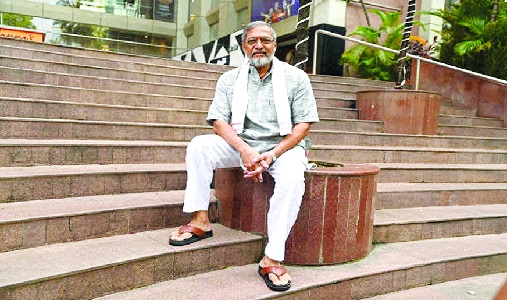

From theatre’s raw intimacy to Bollywood’s biggest screens, he built a career on intensity, authenticity and unforgettable characters.
Indian cinema has lost one of its most distinctive voices. Nana Patekar, the actor whose eyes could intimidate, whose silences could speak and whose dialogue delivery could turn a scene into an event, died on October 8, 2026, at the age of 75. He suffered a cardiac arrest at his residence in Goa and was declared dead at 5.20 am after doctors attempted to revive him.
Born Vishwanath Patekar on January 1, 1951, in Maharashtra, Nana came to cinema through theatre and a life marked by struggle rather than privilege. His early years helped shape the rawness and authenticity that would eventually become the hallmark of his performances. He made his Hindi-film debut with Gaman in 1978, beginning a career that would span nearly five decades and encompass Hindi and Marathi cinema, theatre, direction and writing.
He was never a conventional Bollywood hero. Nana did not need romantic songs, glamorous costumes or elaborate entrances to command attention. His greatest weapon was his ability to inhabit complicated men – angry, wounded, patriotic, ruthless, vulnerable, comic and deeply human.
His breakthrough came with Salaam Bombay! (1988), followed by his unforgettable performance as the underworld figure Anna in Vidhu Vinod Chopra’s Parinda (1989). The role won him the National Film Award for Best Supporting Actor and a Filmfare Award, establishing him as one of the most formidable performers of his generation.
Then came a run of performances that became part of Indian popular culture: Angaar, Tirangaa, Krantiveer, Agni Sakshi, Khamoshi: The Musical, Yeshwant and Ab Tak Chhappan.
A KRANTIVEER ON SCREEN
If one performance came to define Nana’s volcanic screen presence, it was Pratap Narayan Tilak in Krantiveer (1994). His performance earned him the National Film Award for Best Actor. The National Film Awards’ citation praised his portrayal of a man who lives life on his own terms and awakens the hidden strength of the common person.
Nana’s acting was instinctive, but never careless. His pauses, expressions, body language and distinctive voice gave his characters an individuality that could not easily be imitated.
He was equally convincing as a soldier in Prahaar: The Final Attack, which also marked his directorial debut in 1991. His commitment to the film’s military setting extended beyond acting: he underwent military training and later served with the Territorial Army.
THREE NATIONAL AWARDS — AND COUNTLESS CHARACTERS
Nana became a three-time National Film Award winner: Best Supporting Actor for Parinda, Best Actor for Krantiveer, and Best Supporting Actor for Agni Sakshi. He also won multiple Filmfare awards, including recognition for Best Supporting Actor, Best Actor and Best Villain. His range was extraordinary. The man who could play a terrifying criminal could also make audiences laugh.That side of Nana exploded into popular consciousness with Welcome (2007), where his portrayal of Uday Shetty transformed him into a comedy favourite for a new generation. The character’s bluster, insecurity and impeccable comic timing became instantly memorable. He later reprised the role in Welcome Back.Nana Patekar’s genius was that he could move from gravitas to comedy without losing himself. Whether playing a cop, gangster, soldier, politician, father or ageing stage actor, he brought the same uncompromising honesty.
FROM NAT SAMRAT TO THE HEART OF RURAL INDIA
Nana’s later career showed that his artistry had not diminished with age. In Natsamrat (2016), the Marathi adaptation of V. V. Shirwadkar’s celebrated play, he delivered one of the most acclaimed performances of his later years. He also acted in films such as Aapla Manus, Kaala, The Vaccine War, Vanvaas and Housefull 5, continuing to move between serious drama and mainstream entertainment.
His association with the stage remained important throughout his life. The theatre artiste in him was always visible on screen: he understood pauses, space, silence and the emotional weight of a single line.
But Nana’s legacy extended beyond cinema.
He was known for his commitment to social causes, particularly the plight of farmers and rural communities.
Along with actor Makarand Anaspure, he co-founded the NAAM Foundation, which worked with drought-affected communities in Maharashtra, supporting farmers and families and promoting water conservation and rural development.
That public service sat comfortably alongside the simplicity for which he was known. Nana often seemed more comfortable away from the machinery of celebrity – farming, spending time in rural Maharashtra and speaking bluntly about issues that mattered to him.
He was honoured with the Padma Shri in 2013 for his contribution to cinema and the arts.
THE FINAL GOODBYE
News of his death brought an immediate wave of grief across politics and the film industry.
Prime Minister Narendra Modi described Nana as an actor with “intensity, individuality and unmistakable presence”, adding that his contribution to Hindi and Marathi cinema was immense and that his passing had left a deep void.
Union minister Nitin Gadkari, who shared a close friendship with the actor, remembered him with an emotional tribute and wrote, “Om Shanti.”
Maharashtra Chief Minister Devendra Fadnavis recalled Nana’s forthright personality and his social work, particularly his efforts for farmers through NAAM Foundation.
Karnataka Chief Minister DK Shivakumar remembered his “extraordinary talent” and powerful screen presence, while highlighting his compassion for farmers and commitment to society.
West Bengal Chief Minister Suvendu Adhikari called him one of Indian cinema’s “fiercest, most genuine and irreplaceable voices”.
From the film fraternity, Rajinikanth mourned the death of his Kaala co-star and friend, expressing disbelief that his “dear friend” was no longer with them.
Akshay Kumar, who worked with Nana in Welcome and Housefull 5, remembered him as an actor who never needed to do too much to command attention. He praised Nana’s “voice”, “intensity” and “honesty” in performance and said it was hard to believe he was gone.
Riteish Deshmukh, among others, also expressed shock and grief, while casting director Mukesh Chhabra remembered the actor as “Nana Bhai” and said he was “just shocked” by the news.
THE LASTING LEGACY
Nana Patekar leaves behind more than a filmography.
He leaves behind a style of acting that was impossible to manufacture – fierce but vulnerable, explosive but controlled, theatrical yet startlingly real.
He proved that an actor did not have to conform to the traditional idea of a leading man to become unforgettable. He could be the villain, the revolutionary, the soldier, the cop, the ageing actor, the gangster or the comic anti-hero – and somehow, Nana Patekar remained unmistakably Nana Patekar.
His characters will continue to speak.
His voice will continue to echo.
And Indian cinema will continue to measure intensity against the standard he set.



Be the first to comment