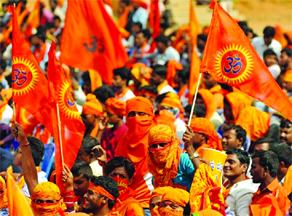
In the complex realm of Indian politics, the relentless surge of Hindutva under Prime Minister Narendra Modi’s leadership has triggered profound alarm among critics and concerned citizens. The concept of Hindutva, an ideology with historical roots dating back to the early 20th century and led by influential thinkers like V.D. Savarkar and M.S. Golwalkar, sought to uphold the significance of Hindu culture amidst India’s religious diversity. However, the forceful institutionalisation of this ideology has birthed an era where “cultural nationalism” takes precedence, even if it leads to ignoring the essential idea of treating everyone equally, regardless of their religion.
The BJP’s unwavering pursuit of cultural nationalism has been nothing less than alarming and highly divisive. By placing the Hindu cultural identity on a pedestal and attempting to assimilate diverse communities into this narrow framework, the party has demonstrated a dangerous disregard for India’s pluralism and religious diversity. This analysis delves into the unsettling consequences of Hindutva evolving from an ideology to an imposing institution, making India’s diverse ways irrelevant and prompting debates about the nation’s cherished pluralism and democratic principles.
Promised on its 2014 and 2019 manifestos, the BJP’s steadfast emphasis was on matters such as the construction of the Ram Mandir in Ayodhya (a pet project for the BJP, which has now become a reality) and the revocation of Article 370 in Jammu and Kashmir. These actions have played a significant role in worsening societal rifts and escalating communal strains. The party’s persistent emphasis on these matters, propelled by its Hindutva ideology, has deepened pre-existing fault lines and sowed discord among religious and regional communities. The construction of the Ram Mandir, though celebrated by Hindus, has been viewed as a symbol of exclusion and bias, leaving other religious groups feeling marginalised and disregarded.
Similarly, the abrupt abrogation of Article 370 has stoked feelings of alienation and discontent among the Muslim-majority Kashmiri population, further distressing communal relations in the region. These actions, backed by various laws and measures, have engendered legitimate concerns regarding the potential dilution of India’s secular values and its commitment to fostering an inclusive and harmonious society. Moreover, such steps seem to prioritise divisive identity politics over the pursuit of genuine national unity.
In the prevailing circumstances, the BJP’s steadfast emphasis on Hindutva principles and identity-based politics has faced substantial backlash. The rise of communal violence and the polarising impact of divisive rhetoric have deeply unsettled India’s social fabric, posing a grave threat to the state’s ethos of religious harmony and pluralism. The BJP’s focus on Hindutva politics has been a driving force behind communal disharmony, raising serious apprehensions about the party’s commitment to promoting a united and inclusive society for all citizens, regardless of their faith or ethnicity. The party leaders, through their controversial statements and actions, have played a significant role in cultivating an atmosphere of intolerance where minority groups feel increasingly excluded and targeted. This has been attributed to the escalation of communal tensions, evident in the surge of communal violence in places like Manipur. Additionally, this approach has been criticised for contributing to the marginalisation of religious and ethnic minorities, with particular attention to the Muslim community.
Under the guise of promoting Indian culture, the BJP has marginalised religious and ethnic minorities, with a notable focus on Muslims, by stigmatising their customs and traditions. Modi’s policies towards Muslims are part of broader measures that may contribute to the discrimination of the Muslim population in India. For instance, the cow protection agenda has been wielded to target Muslims, leading to violence and instilling apprehension among those who do not align with Hindu convictions. Similarly, the BJP’s attempts to rewrite historical narratives and promote a skewed portrayal of Indian heritage can be characterised as a kind of propaganda. By engaging in the manipulation of school curricula and promoting a distorted narrative of ancient India, the party is attempting to erase the contributions and historical legacies of non-Hindu communities, thereby alienating them from the broader national narrative.
As India approaches the impending 2024 general election, the BJP retains a formidable stance on its skewed perspective, with Prime Minister Modi’s widespread popularity and the party’s organisational strength and resources giving it a significant advantage. However, despite the apparent dominance, the BJP is not without its concerns. The party’s continued focus on institutionalising Hindutva ideology in Indian polity raises potential concerns of discrimination and racism, and it may exacerbate regional tensions and deepen social divisions. With Article 370 scrapped and the Ram temple in Ayodhya well on its course, a Uniform Civil Code (UCC) remains among the last unfulfilled items as part of the BJP’s manifesto promise in the upcoming elections. A UCC is conceptualised as a set of laws that govern personal matters, including marriage, divorce, adoption, inheritance, and succession, for all citizens regardless of their religion. It aims to replace the existing diverse personal laws that vary based on religious affiliations. The party’s push for UCC, despite India’s diverse population, could raise further alarm, potentially eroding the rights and freedoms of religious minorities and fueling apprehensions about India’s secular fabric. While the BJP’s base remains committed, there are signs of quiet worry within the party as it faces an unprecedented set of political dilemmas heading into the election. The next year holds uncertainties, and the political landscape could deteriorate dramatically, making the 2024 election a highly contested and controversial event in Indian politics.
Source: CSCR.PK
Tag: Narendra Mod
-

New politics of religion a challenge to secular character of Republic
-

Modi arrives in Washington, DC to a warm welcome by the Indian American community
Sept 23 engagements include meeting with US Vice President Kamala Harris and bilateral with Japanese and Australian PMs
TIP Special Correspondent
WASHINGTON, DC (TIP): Prime Minister Narendra Modi on Thursday, September 23, a day after his arrival here, is scheduled to have as many as eight meetings, including one with Vice President Kamala Harris, on the first working day of his current US trip. Apart from meeting Harris at the White House, the Prime minister will have two bilateral meetings with his Australian and Japanese counterparts — Scott Morrison and Yoshihide Suga.
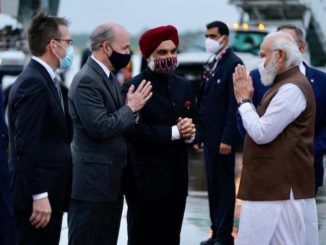
Prime Minister Modi was received on arrival at the Andrews airbase by Mr. T. H. Brian McKeon, Deputy Secretary of State for Management and Resources on behalf of the government of the USA and India’s Ambassador to the US Taranjit Singh Sandhu. A large number of Indian Americans had gathered at the airport, despite rain, to welcome Mr. Modi. Touched by the love and warmth of the Indian American community, Modi later tweeted:
Narendra Modi
@narendramodi
Grateful to the Indian community in Washington DC for the warm welcome. Our diaspora is our strength. It is commendable how the Indian diaspora has distinguished itself across the world.
7:58 PM · Sep 22, 2021·Twitter for iPhone
Modi would kick off his day’s engagements with a series of one-on-one meetings with five top American CEOs representing diverse areas from technology, the IT sector to finance, defense and renewable energy.
These CEO’s include Shantanu Narayen from Adobe and Vivek Lall from General Atomics, Cristiano E Amon from Qualcomm, Mark Widmar from First Solar and Stephen A Schwarzman from Blackstone.
According to sources, these CEOs represent fairly large corporate interests, companies that have particular expertise, have invested in India and have the potential to invest significantly there.
In the afternoon, Modi is scheduled to have a bilateral with Prime Minister Morrison of Australia. The two leaders have met in the past on a number of occasions on the sidelines of various international conferences.
Morrison had recently called Modi to brief him about planning to go ahead with the AUKUS alliance.

Modi meeting the enthusiastic Indian Americans who had gathered at the airport and on way to hotel, despite rain, to welcome him Photo/Twitter The US, Britain and Australia last week announced the AUKUS alliance for the Indo-Pacific to take on the threats of the 21st century and allow for greater sharing of defense capabilities, including help Australia acquire nuclear-powered submarines, in a bid to counter China’s growing power in the strategically vital region. Morrison was to visit India in January last year which he had to postpone because of a massive fire in Australia. Another trip to India in May had to be postponed due to the COVID-19 situation. After meeting with Morrison, Modi would drive down to the White House for a meeting with Indian-origin US Vice President Kamala Harris at her ceremonial office. The maiden meeting between the two leaders has been scheduled for an hour. The two leaders are likely to talk to the press. According to sources, they are expected to talk on a range of issues that interest both sides — from the management of COVID-19 to issues like cooperation in the high tech and space sectors. Prime Minister Modi is looking forward to his first meeting with Vice President Harris, sources said. The two leaders have earlier spoken to each other over the phone during the COVID-19 crisis in June. Later in the day, the prime minister is scheduled to meet prime minister Suga of Japan. The two leaders have been speaking to each other quite frequently. On Friday, the Prime Minister would spend most of his time at the White House, first a bilateral meeting in the Oval Office with President Biden. This would be followed by the first-ever in-person Quad summit.
In November 2017, India, Japan, the US and Australia gave shape to the long-pending proposal of setting up the Quad to develop a new strategy to keep the critical sea routes in the Indo-Pacific free of any influence.
The prime minister will then leave for New York. He is the first speaker scheduled to address the UN General Assembly on September 25.
-
S&P affirms India’s rating at lowest investment grade
S&P Global Ratings has kept India’s sovereign rating unchanged at the lowest investment grade of ‘BBB-’ for the 14th year in a row, and said the government’s ability to execute additional economic reforms that spur investment and create jobs will be crucial for recovery from the current economic slowdown. S&P projected a 9.5% GDP growth in the current fiscal year that began in April and a 7.8% expansion in the following year. The GDP which shrank from $2.87 trillion in 2019-20 to $2.66 trillion in the following year is projected to expand to $3.96 trillion in 2024-25. Prime Minister Narendra Modi in 2019 envisioned making India a $5 trillion economy and a global economic powerhouse by 2024-25.