Tag: Nawaz Sharif

  • Pakistan: Nawaz Sharif officially nominates brother Shehbaz for PM’s post

    Pakistan: Nawaz Sharif officially nominates brother Shehbaz for PM’s post

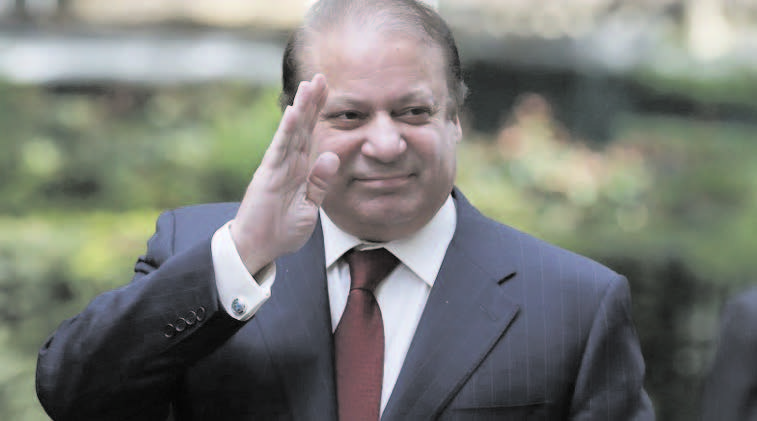
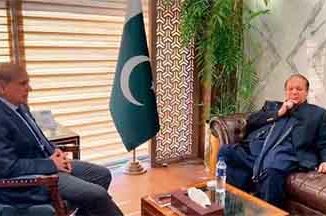
    Islamabad/Lahore (TIP): The parliamentary party of the PML-N headed by three-time former Pakistan premier Nawaz Sharif on February 27 formally nominated his younger brother Shehbaz Sharif for the post of prime minister to head a coalition government.
    The parliamentary members’ meeting of the Pakistan Muslim League-Nawaz (PML-N) was held in Islamabad with party supremo Nawaz Sharif, 74, in the chair. Shehbaz, 72, had led a coalition government for 16 months till August 2023 before the caretaker government took over following the announcement of elections.
    The nomination of Shehbaz Sharif as the next prime minister by the elder brother, who himself was eyeing the plum post for a record fourth time, had surprised many within and outside the party. Outgoing National Assembly Speaker Raja Pervaiz Ashraf has called the National Assembly session on Thursday. (PTI)

  • Nawaz Sharif, Bilawal Bhutto begin parleys to keep Imran Khan away from power as Pakistan poll results drag on

    Nawaz Sharif, Bilawal Bhutto begin parleys to keep Imran Khan away from power as Pakistan poll results drag on

    ISLAMABAD (TIP): Even as final results of the Pakistan general elections are awaited, PTI founder Imran Khan and PML(N) supremo Nawaz Sharif have claimed win and delivered victory speeches.

    Now, since PML(N) has failed to get majority in the polls but has emerged as the “single largest party”, it is in talks with PPP chairman Bilawal Bhutoo Zardari, Dawn reported.

    On Friday night, former president Asif Ali Zardari and Bilawal met with former prime minister and PML(N) President Shehbaz Sharif in Lahore and exchanged views on government formation, Radio Pakistan reported.

    Both parties have agreed to work together to achieve political and economic stability in the country, it added.
    (Source: IANS)

  • India on moon, Pakistan still begging, says Nawaz Sharif

    Lahore (TIP): Pakistan’s self-exiled former PM Nawaz Sharif has said that his country was begging money from the world while India had reached the moon and hosted the G20 summit, blaming the country’s former generals and judges for its economic woes.
    Pakistan’s economy has been in a free fall mode for the last many years, bringing untold pressure on the poor masses in the form of unchecked double-digit inflation. “Why Pakistan couldn’t achieve the feats India did?” Sharif asked at a party meeting in Lahore from London via video link.
    The73-year-old supreme leader of the Pakistan Muslim League-Nawaz (PML-N) party further said that India had followed the economic reforms initiated by his government in 1990. “When Atal Bihari Vajpayee became the PM of India, it had only a billion dollars in kitty but now India’s foreign exchange reserves have risen up to $600 billion,” he added. (PTI)

  • Assassination attempts are nothing new to politics in South Asia

    Assassination attempts are nothing new to politics in South Asia

    “India, too, had its share of political assassinations. Two of Indian Prime Ministers, Indira Gandhi, and her son, Rajiv Gandhi, were assassinated while in power. Similarly,  Chief Minister Beant Singh was killed outside his fortified Punjab Civil Secretariat office. Before him, Punjab’s Finance Minister Balwant Singh, too, was ambushed and killed in a terrorist attack in Chandigarh.” 

    Difference of opinion is an accepted aspect of a democratic process. But extending this differentiation of opinion to liquidation is extremely deplorable. Unfortunately, political assassinations have refused elimination as democracies, both controlled and liberal, face new  and uphill challenges.

    By Prabhjot Singh

    When an attempt on the life of former Pakistan Prime Minister Imran Khan was made on Thursday, October 27, it was a revival of an unfortunate and  gory aspect of Pakistan’s recent political history. After Pakistan came into existence in 1947, similar attempts, including a few fatal, have dotted the history of this trouble-torn nation. Cricketer-turned politician Imran Khan was shot in the shin  during his anti-government protest last Thursday. Imran Khan’s convoy was  attacked in the east of the country in what his aides said was a  clear attempt on the life of the immediate past  Prime Minister of Pakistan. Pakistan has a long history of political coups and unrest. Rawalpindi has been notorious for its history of political assassinations. At least two former Prime Ministers had been assassinated on the streets of this twin city of capital Islamabad. It all started in 1951 when the country’s first Prime Minister Liaquat Ali Khan, after the 1947 partition of India, was shot dead at a political rally in Rawalpindi.

    Another Prime Minister to be assassinated during a political event  in Rawalpindi was none other than Benazir Bhutto.

    Two-time Prime Minister Benazir Bhutto was assassinated in a gun and bomb attack after holding an election rally in Rawalpindi. A few months before her death, she had survived a suicide bomb assassination attempt in Karachi, where at least 139 people were killed. It was  one of Pakistan’s deadliest attacks at a political rally.

    In 1988 Military ruler President Mohammad Zia ul Haq was killed  in an air crash. He was travelling in a Hercules C-130 aircraft that crashed in mysterious circumstances. Several conspiracy theories shrouded the crash. Some of these theorists suggested a case of mangoes being loaded in the plane shortly before its take-off. The box of mangoes was suspected to  contain a timer device that released gas to knock out the cockpit crew. Besides attempted political assassinations, Pakistan’s history is also dotted by political bosses abandoning country’s shores after being thrown out of power.

    Former army chief-turned President Pervez Musharraf annexed power in a bloodless coup. He was sworn in as president and head of state in June 2001. He resigned in 2008 and Asif Ali Zardari, Benazir Bhutto’s husband, succeeded him  as president.

    Zulfiqar Ali Bhutto, the father of Benazir who was elected as Prime Minister in 1970, was hanged  following  conviction that remained mired in controversies.

    In 1977, Zia ul Haq seized power after a coup against the Bhutto government. He put Bhutto under house arrest, imposed martial law, suspended the constitution and put a blanket ban on political parties. It was not the first military coup in Pakistan.

    Pakistan’s first military coup was in 1958 when  Governor-General Sikander Mirza enforced martial law with General Ayyub Khan as chief martial law administrator. Ayyub Khan later assumed the presidency and sacked Mirza, who  later exiled as was subsequently done by Parvez Musharraf and Nawaz Sharif.

    India, too, had its share of political assassinations. Two of Indian Prime Ministers, Indira Gandhi, and her son, Rajiv Gandhi, were assassinated while in power. Similarly,  Chief Minister Beant Singh was killed outside his fortified Punjab Civil Secretariat office. Before him, Punjab’s Finance Minister Balwant Singh, too, was ambushed and killed in a terrorist attack in Chandigarh.

    Difference of opinion is an accepted aspect of a democratic process. But extending this differentiation of opinion to liquidation is extremely deplorable. Unfortunately, political assassinations have refused elimination as democracies, both controlled and liberal, face new  and uphill challenges.

    Tail piece : Now when Imran Khan is in the news again, it may not be way off  the context to recall my interaction with him (that appeared in The Tribune) during the 1989 World Cup Cricket Tournament:

    My piece: On meeting a Sikh journalist

    On professional assignments outside Chandigarh, whenever I introduce myself as Prabhjot Singh from The Tribune, the question comes to me: “Are you from Punjabi Tribune?” Perhaps implying thereby that a Sikh cannot write: English. I often laugh away such queries. There could be many reasons for such a question. There were not many Sikhs who took to newspaper reporting, especially as Staff Correspondents of The Tribune.

    I had gone to Pakistan to cover the World Cricket Tournament for the Reliance Cup. Accompanied by other Indian and foreign journalists. I went to the National Stadium at Lahore on the eve of Pakistan’s match against England.

    Pakistani players were at the nets.

    We were engrossed in a discussion when I found someone touching my shoulder. I looked back. It was none other than Pakistan’s freak leg spinner, Abdul Qadir. “Sardarji, sada kaptan tuhanu bulanda je” (Sardarji, our skipper is calling you), said Abdul Qadir, pointing towards the Pakistani tent where Imran Khan sat in a chair.

    I told Qadir that I would come in a few minutes.

    Imran Khan was all smiles as he admired me from head to toe. He enquired: “Sardarji, Punjabon aye ho?” (Sardarji, have you come from (East) Punjab?)

    “Ji”, I replied.

    “Match dekhan aye ho ke ghuman phiran aye ho?” (Have you come to watch matches or for sightseeing?)

    “Matchan layi aya haan”. (I have come for the matches).

    “Ki kam karde ho?” (What do you do?)

    “Main ik akhbar wich kam karda haan”. (I work on a newspaper).

    “Aacha; tusee taan te pher ik sahafi ho?” (I see, then you are a journalist), he said, and started laughing. He hugged me and said: “Kasam Khuda di aaj main pehli var koi Sikh sahafi takya je”. (By God, I have seen a Sikh journalist for the first time).

    “Sikh lok te vaise ve kaat hi cricket khed de ne. Par Sikh Sahafi dekh ke tan barri hairangi hoi je. Koi sewa hoi taan dasna”, he said. (Not many Sikhs play cricket.

    But seeing a Sikh journalist is a greater surprise. Let me know if I can be of any help.)

    Afterwards, throughout the tournament, whenever Imran Khan would see me he would wave and shout; “Sardarji, Sat Sri Akal.”

    (Prabhjot Singh is a veteran journalist with over three decades of experience covering a wide spectrum of subjects and stories. He has covered  Punjab and Sikh affairs for more than three decades besides covering seven Olympics and several major sporting events and hosting TV shows. For more in-depth analysis please visit probingeye.com  or follow him on Twitter.com/probingeye)

  • Nawaz Sharif to return to Pakistan after Eid: PML-N leader

    Islamabad (TIP): Deposed Pakistan prime minister Nawaz Sharif is expected to return from London next month after Eid, a senior PML-N leader has said, amid a whirlwind of political developments that have embroiled the country following Imran Khan’s ignominious ouster from power.

    MianJavedLatif said a decision on PML-N supremo and the three-time prime minister Sharif’s anticipated return will be discussed with the coalition partners.

    All decisions would be first brought up with constituent parties of the coalition, The Express Tribune newspaper quoted him as saying.

    Eid will be celebrated in the first week of May.

    Several corruption cases have been launched by the government of prime minister Khan against the 72-year-old supremo of the Pakistan Muslim League-Nawaz since his ouster from the office by the Supreme Court in July 2017 in the Panama Papers case.

    Sharif in November 2019 left for London after the Lahore High Court granted him a four-week permission allowing him to go abroad for his treatment.

    He had given an undertaking to the Lahore High Court to return to Pakistan, citing his record to face the process of law and justice within four weeks or as soon as he is declared healthy and fit to travel by doctors.

    Sharif was also given bail in the Al-Azizia Mills corruption case in which he was serving seven-year imprisonment in Lahore’s KotLakhpat jail.

    Commenting on the political uncertainty in the country, Latif said the coalition government will not last longer than six months and the only solution to the prevailing woes was to hold fresh elections.

    “However, there was this task of election reforms that had to be done prior to elections,” he said. (PTI)

  • Pakistan’s PM has been exposed as ‘corrupt and dishonest con man’: Nawaz Sharif on PTI’s foreign funding fraud

    Pakistan’s PM has been exposed as ‘corrupt and dishonest con man’: Nawaz Sharif on PTI’s foreign funding fraud

    Lahore (TIP): Pakistan’s deposed premier Nawaz Sharif has slammed Prime Minister Imran Khan for the “fraud” detected in the ruling Pakistan Tehreek-i-Insaf party’s foreign funding, saying that he has been exposed as a “corrupt and dishonest political con man”. According to a damning report by the Election Commission recently, Prime Minister Khan’s ruling Pakistan Tehreek-i-Insaf (PTI) party grossly under-reported funds received from foreign nationals, firms, and also concealed its bank accounts. The ruling party has under-reported an amount of PKR 312 million over a four-year period, between FY 2009-10 and FY 2012-13. The year-wise details reveal that an amount in excess of PKR 145 million was under-reported in FY 2012-13 alone.

    “Finally, ‘Mr Clean’ has been exposed as a corrupt and dishonest political con-man. And the other dishonourable man (former chief justice of Pakistan Saqib Nisar) who declared him ‘Sadiq & Amin (honest)’ to engineer my ouster has already been heard admitting his crime. Divine justice is done, only the legal one remains to be seen & done,” Sharif, who is also the Pakistan Muslim League-Nawaz (PML-N) supreme leader, said in a tweet on Tuesday.

    Sharif has been living in the UK in self-exile since November 2019. He had gone to London after the Lahore High Court granted him bail for four-weeks to get his treatment abroad. He was serving a seven-year term at Lahore’s Kot Lakhpat jail in a corruption case.

    Sharif said the ECP’s report not only has exposed Prime Minister Khan and PTI but what would happen when they would have to tell the names from whom they had taken money and where they spent it.

    “You (Imran) have not only committed financial fraud but also insulted the title of Sadiq aur Ameen,” he said.

    His younger brother and Opposition leader in National Assembly Shehbaz Sharif said, “It has been clear now as to why the PTI was running away from the foreign funding case for the last seven years. Truth has a strange way of exposing people. The Scrutiny Committee’s report is a damning indictment of IK (Imran Khan). The facade of ‘Sadiq aur Ameen (honesty)’ has been shredded into pieces”.

    Sharif’s daughter and PML-N vice president Maryam Nawaz said, “If you (Imran Khan) welcome the ECP’s report, then why didn’t you let this case proceed for the last seven years through force. Why did you keep running away (from the ECP’s scrutiny of PTI foreign funding) for so many years and pleading not to make the scrutiny committee’s report public? Do you think the people are fools who believe whatever you say… be ready as the time of your accountability is near.” —PTI

  • Pakistan PM names ‘common friend’ who offered Rs 1K crore bribe to withdraw case against Nawaz Sharif

    Pakistan PM names ‘common friend’ who offered Rs 1K crore bribe to withdraw case against Nawaz Sharif

    Lahore (TIP): Pakistan Prime Minister Imran Khan has finally filed a reply in a defamation case and identified a “common friend” who allegedly offered him Rs 1,000 crore on behalf of Shahbaz Sharif to withdraw the Panama Papers case in the Supreme Court against then prime minister Nawaz Sharif.

    Khan in 2017 had alleged that Pakistan Muslim League-Nawaz (PML-N) president Shabaz offered him Rs 1,000 crore through a “common friend” to withdraw the Panama Papers case in the Supreme Court against then prime minister Nawaz Sharif.

    Khan at that time did not disclose the identity of the person who offered him the bribe on behalf of Shahbaz.

    Shahbaz, 69, is the younger brother of 71-year-old Nawaz Sharif.

    Following Khan’s allegation, Shahbaz filed a defamation case against the cricketer-turned-politician.

    In a written reply to Lahore session court on Tuesday in response to the defamation suit, Prime Minister Khan disclosed the name of the person who offered him Rs 1,000 crore to withdraw the Panama Papers case against Sharif as Omar Farooq.

    “Omar Farooq—a common friend—made this offer to Imran Khan,” the prime minister’s counsel told the court.

    The counsel said the incident was disclosed for the consumption of the public at large and in the interest of the public good which does not constitute any defamation.

    He said the plaintiff and the defendant are political rivals and have been facing each other in the political arena for more than two decades.

    Shahbaz himself made numerous “defaming and malicious” statements against Khan and other leaders of the ruling Pakistan Tehreek-i-Insaf (PTI) as well as other political parties in the past, the counsel said, requesting the court to dismiss the suit as the PML-N leader is not entitled to any damages.

    Additional District and Sessions Judge Mudassir Farid adjourned the hearing till August 4.

    In the four years, Khan’s legal team sought adjournments on at least 50 hearings.

    In his petition, Shahbaz requested the court to issue a decree for recovery of Rs 1,000 crore as compensation for the “defamatory” comment, which caused great damage to his reputation in the public. In a statement on Wednesday, PML-N spokesperson Marriyum Auranzeb demanded an apology from Prime Minister Khan for levelling baseless allegations against the Opposition leader. (PTI)

  • Pakistani court dismisses former PM Nawaz Sharif’s appeal against convictions in 2 corruption cases

    Pakistani court dismisses former PM Nawaz Sharif’s appeal against convictions in 2 corruption cases

    Islamabad (TIP): A top Pakistani court on June 24 dismissed appeals by former Prime Minister Nawaz Sharif against his conviction in two corruption cases by an accountability court, as it described him as a “fugitive from law”.

    “There is nothing in the Constitution or the rules to compel the court to decide on merits of an appeal filed by an accused person who has chosen to be fugitive from justice and while remaining so decides to disobey or frustrate the orders, directions and process of the court from which he seeks justice,” the Islamabad High Court Bench said.

    A Bench comprising Justices Aamer Farooq and Mohsin Akhtar Kayani, in its nine-page judgment, said Sharif was a “fugitive from law hence has lost his right of audience before this court and we are left with no choice except to dismiss his appeal”. However, the court stated that Sharif can appeal for reinstatement of his pleas on return to the country. Sharif, 70, the Pakistan Muslim League Nawaz (PML-N) supremo, has been living in London since November 2019 after the Lahore High Court granted him permission to go abroad for four weeks for treatment.

    The three-time former prime minister—convicted in two corruption cases Avenfield properties and Al-Azizia Steel Mills—was declared a proclaimed offender in December 2019 by the Islamabad High Court after he failed to appear before it despite several warnings.

    Sharif, who resigned as Pakistan prime minister in 2017, had sought quashing of the sentences handed to him by the National Accountability Bureau (NAB) court in the two corruption cases in 2018.

    The court had reserved its verdict on Wednesday after hearing from the NAB Additional Prosecutor Jahanzeb Khan Bharwana.

    After dismissal of the pleas, the original sentence in the two cases have been reinstated.

    The accountability court had in 2018 sentenced Sharif to 10 years in prison for owning assets beyond known income and one year for not cooperating with NAB in the Avenfield case. His daughter, Maryam, was handed seven years imprisonment for abetment.

    In the same year, he was sentenced to seven years imprisonment in the Al-Azizia Steel Mills corruption case, where illegal investments were detected.

    Earlier, the Islamabad High Court has given multiple opportunities to Sharif to return to Pakistan and appear before the court to pursue his appeals.

    However, the former prime minister’s family has maintained that there is a health risk in travel.

    “[Nawaz] proceeded abroad and did not appear before this court despite [being] on bail and without any justification or basis, remained absent on a number of dates of hearing, hence this court was left with no option but to follow the procedure … and declared him as fugitive from law,” according to the judgement. (PTI)

  • For 3rd time, Pak asks UK to deport Sharif

    For 3rd time, Pak asks UK to deport Sharif

    Islamabad (TIP): Pakistan has requested the UK for the third time to deport former Prime Minister Nawaz Sharif from London to serve his prison term in the country after being sentenced in corruption cases.
    Sharif, the 70-year-old supremo of the Pakistan Muslim League (Nawaz) who was ousted from power in 2017 by the Supreme Court on corruption charges, is in London for medical treatment. A letter for the deportation of the three-time Prime Minister was handed over personally to the British High Commissioner here some three weeks ago.
    In the letter, the Pakistan Government asked the British authorities to consider cancelling Sharif’s visit visa, which has allowed him to live in London on medical grounds since November.
    The letter has cited Britain’s own immigration laws of 1974 under which any person sentenced to imprisonment of more than four years had to be deported to the country of his/her origin. — PTI

  • Pakistan SC’s verdict on Nawaz Sharif in Panamagate

    Pakistan SC’s verdict on Nawaz Sharif in Panamagate

    ISLAMABAD (TIP): Pakistan’s Supreme Court is pronouncing its verdict on Nawaz Sharif in the Panamagate case in which he and his family are accused of corruption. Stay with us for latest updates.

    Meanwhile, interior minister Chaudhry Nisar Ali Khan on Thursday said that he would resign and quit politics after the Supreme Court judgment on the Panamagate case.

    Nawaz Sharif leads Pakistan’s most powerful political family and the ruling PML-N party. Sharif, who has been the prime minister of Pakistan for a record three time, faces the risk of being disqualified if the court finds him guilty of corruption and money laundering.

    What is Panamagate

    The scandal is about alleged money laundering by Sharif in 1990s, when he twice served as prime minister, to purchase assets in London. The assets surfaced when Panama Papers leak last year revealed that they were managed through offshore companies owned by Sharif’s children.

  • Modi says hello to Sharif at SCO summit

    ASTANA (TIP): PM Modi on June 8 met with his Pakistani counterpart Nawaz Sharif in Astana, capital city of Kazakhstan, ahead of the Shanghai Cooperation Organisation (SCO) summit. Modi and Sharif attended a welcome banquet to the small grouping that comprises China, Russia, Uzbekistan, Kazakhstan, Kyrgyzstan and Tajikistan. India and Pakistan will be inducted as full members at the summit.

    Sources said the two Prime Ministers exchanged pleasantries at the function, but no bilateral meeting was expected.

    “Since it was the first occasion when the two leaders came across each other after Sharif’s operation, Modi enquired about his health. He also enquired about Sharif’s mother and family,” an official source present there, said.

  • A reprieve for Jadhav

    A reprieve for Jadhav

    Time to activate other channels

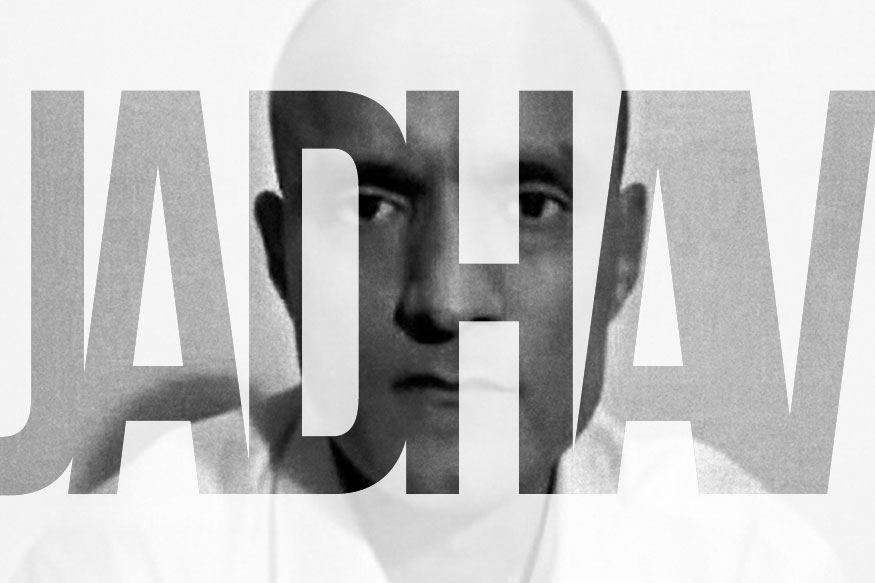
    India has collectively heaved a sigh of relief after the International Court of Justice (ICJ) provisionally stayed the death sentence on Kulbhushan Jadhav till its final verdict in August. This `victory’ should not waterproof India against the harsh reality that even if Jadhav escapes the noose, he would spend his lifetime in Pakistani prisons. The Indian appeal was limited to ensuring Jadhav gets all due courtesies enshrined in the Vienna Convention. At some stage, New Delhi will have to consider the staple recourse in such situations – backchannel diplomacy – to get our man back. That option suffered a setback when two Indian security personnel were beheaded on the border with Pakistan. The general wisdom is that the calculated mutilation was its army’s response to sabotage Prime Minister Narendra Modi’s attempt to open back-channel negotiations with his Pakistani counterpart, Nawaz Sharif, via an industrialist.

    Prime Minister Modi will reap the benefits of popular adulation because the Indian media treated the entire process at the ICJ like a 20:20 cricket match. In sports parlance, India is leading at half time. Foreign Minister Sushma Swaraj has indicated that much when she said while the verdict has brought relief to Jadhav’s family, India will leave no stone unturned to save him. Pakistani prisons are notorious for their rough treatment of Indians. Jadhav’s wellbeing could be in danger because Pakistan has labelled him a spy and tried to hang a number of numbing terrorist incidents around his neck even though the Tehrike Taliban Pakistan had earlier taken responsibility for them.

    Sooner or later, India may want to try its hand at exploring creative possibilities of diplomacy to resolve a number of issues, including the Jadhav case. After the legal arguments are over, its soft power will have to take charge. It is hard to predict when this will take place because Union Home Minister Rajnath Singh has indicated that India is yet to settle the scores for the beheading of its two security personnel. Time is always a great healer. Once Jadhav is let off the death row, as it seems he might well be, a quid pro quo may become a workable proposition.

    (The Tribune)


  • Nawaz Sharif briefs General Bajwa about Jindal visit

    Nawaz Sharif briefs General Bajwa about Jindal visit: Report

    ISLAMABAD (TIP): Pakistan’s civilian leadership informed the military top brass that the recent meeting between Prime Minister Nawaz Sharif and Indian steel magnate Sajjan Jindal was part of back-channel diplomacy, BBC’s Urdu service reported on Thursday.

    This was on a day leading Pakistan daily ‘The Nation’ quoted Sharif ‘s advisor on foreign affairs, Sartaj Aziz, as saying that he would not rule out a meeting between the Pakistan PM and his Indian counterpart, Narendra Modi, on the sidelines of Shanghai. Cooperation Organisation summit in June in Kazakhstan.

    “Pakistan could consider the meeting if interest was shown from the other side,” Aziz told the paper, with the report adding that the Indian businessman, Sajjan Jindal, had “conveyed a message of the Indian Premier to the Pakistani leader”.

    Meanwhile, the BBC report stated that during one of the recent meetings, Sharif had taken the Army chief, General Qamar Javed Bajwa, into confidence over his parleys with Jindal at the hill resort of Murree. General Bajwa subsequently took his officials into confidence over the matter. “The Army chief told his officers that the meeting was a part of back-channel diplomacy,” the report stated. Pakistan’s foreign office declined to comment on the meeting, saying it was of private nature. Maryam Nawaz, Sharif ‘s daughter, tweeted, “Mr Jindal is an old friend of the Prime Minister. There was nothing secret about the meeting and it should not be blown out of proportion. Thank you.”

    According to sources, Jindal visited Pakistan upon the insistence of important Indian officials, calling it an endeavour on India’s part to reduce friction between the two countries.

    Jindal’s visit came at a time when Sharif was under pressure from the Supreme Court over a probe into his offshore assets revealed in the Panama Papers leak. The meeting sparked speculation with several politicians and analysts suggesting it was aimed at a possible Sharif-Modi meeting in the near future.

    Others suggested that the unannounced visit was to talk about the release of Kulbhushan Jadhav, an alleged Indian spy sentenced to death by a Pakistani military court. Many of Sharif’s opponents had claimed that whenever his government comes under pressure, “the Modi government” comes to his rescue. (TOI)


  • US reaffirms India’s designation as major defence partner as Modi meets US NSA

    US reaffirms India’s designation as major defence partner as Modi meets US NSA

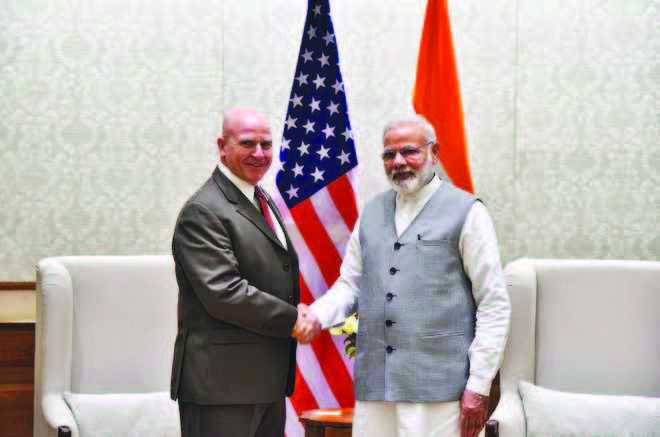
    NEW DELHI (TIP): US National Security Adviser HR McMaster and Indian NSA held a two-hour long meeting in New Delhi today.

    According to sources from the government – the issue of terrorism and Indo-US Cooperation was prominently discussed. India and US agreed to increase military cooperation and more active information exchange on counter terror operations.

    McMaster also discussed regional security issues with his Indian counterpart Ajit Doval.

    Indian side emphasized that the terrorism emanating from Pakistan is posing serious threat to regional stability and security. India and US have very good cooperation.

    McMaster  also to met Prime Minister Narendra Modi at Lok Kalyan Marg. He may also meet External Affairs Minister Sushma Swaraj. McMaster arrived in Islamabad, Pakistan on Monday, barely a day after the United States reinstated its tough stance on Pakistan.

    Incidentally, this was the first visit by a top member from the Donald Trump administration. McMaster arrived in Pakistan after a brief stop in Afghanistan.

    Following the meet in Pakistan, Prime Minister Nawaz Sharif’s office issued a statement saying that McMaster had assured the PM that the Trump administration was dedicated to strengthening bilateral relations and working with Pakistan.

    New Delhi hopes discussions with Herbert Raymond McMaster will provide clarity on US President Donald Trump’s policy for South Asia.

  • UN report blames Pakistan for delay in resolution of Indus water issues with India

    UN report blames Pakistan for delay in resolution of Indus water issues with India

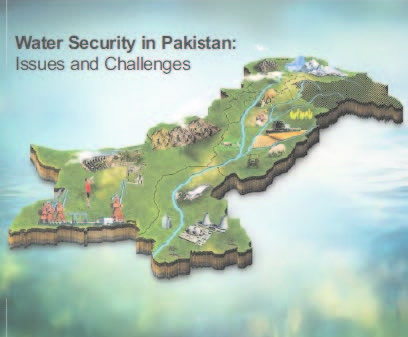
    Pakistan has neglected to resolve trans-border water issues and delayed presenting the cases of dispute with India to the Water Commission related to the Indus Waters Treaty, a United Nation Development Programme (UNDP) report said on Tuesday.

    The report titled “Development Advocate Pakistan”, released in Pakistan, said, “Pakistan’s negligence in conducting a sound analysis of trans-boundary water issues and delays in presenting the cases of dispute with India to the Indus Water Commission or the World Bank on the issues related to the Indus Waters Treaty have caused the issues to linger on and remain unaddressed.”

    “Pakistan has gone as far as calling the treaty an inefficient forum for resolving water issues, elevating the water issue to a “core issue” and including it in the composite dialogue. But India has refused to include the issue in the composite dialogue because it is not ready to discard the treaty,” the report said.

    “The treaty permitted India to create storage on the western rivers of 1.25, 1.60 and 0.75 million acre feet (MAF) for general, power and flood storages, respectively, amounting to a total permissible storage of 3.6 MAF,” it added.

    The report also claims that the 40-year-old Indus Water Treaty between India and Pakistan has been an outstanding example of conflict resolution but scarcity of water in the basin states since the early 1990s has brought the agreement under strain and its “survival appears weak”.

    “The treaty fails to address two issues: the division of shortages in dry years between India and Pakistan, when flows are almost half as compared to wet years, and the cumulative impact of storages on the flows of the River Chenab into Pakistan,” the UNDP report said.

    Wular Barrage and Kishenganga project on the Jhelum and Neelum rivers present a similar problem whereby water storage during the Rabi season is critical as flows are almost one-fifth of the Kharif season, according the report.

    Last week, Pakistan Prime Minister Nawaz Sharif met the World Bank Chief Executive Officer Kristalina Georgieva and raised the Indus Water Treaty dispute.

    Sharif expressed hope that a Court of Arbitration would solve the Indus Water Treaty dispute with India. New Delhi has requested the World Bank to appoint a ‘neutral expert’ to resolve the water-sharing disagreement.

  • Pak committed to discouraging regional arms race: Sharif

    Pak committed to discouraging regional arms race: Sharif

    Islamabad, Nov 22 (PTI) Pakistan discourages any arms race in the region today, Prime Minister Nawaz Sharif said, underlining that the country is exploring the way forward for peace and stability in South Asia.

    Addressing at the inauguration of the ninth International Defence Exhibition and Seminar (IDEAS) here, Sharif said Pakistan was committed to discouraging arms race and promoting “the motto of arms for peace, which has always been the tagline of IDEAS”.

    He expressed Pakistans commitment to regional peace, saying that, “we will explore the way forward for peace and stability in the world in general and our region in particular”.

    Sharif said the environment for foreign investment was encouraging in the country in view of improved law and order situation, besides power projects being completed on time.

    The Prime Minister said Pakistan had achieved self-reliance in defence production and mentioned that IDEAS-2016 was a demonstration of the collaboration of local and foreign technologies.

    He said over 2,000 weapons system and equipment on display at the exhibition reflected broad-based participation of the countrys public and private sector in defence production, supported by research and development.

    The Prime Minister said the country?s defence products were state-of-the-art and stood fully tested by its armed forces.

    “Our defence products have made their mark in many countries of the world,” he said, adding there still existed many opportunities for further growth and exploration of new markets.

    He said Pakistan was fast emerging producer of quality defence products.

    The Prime Minister invited foreign companies to expand their business linkages with Pakistan in the field of defence production.

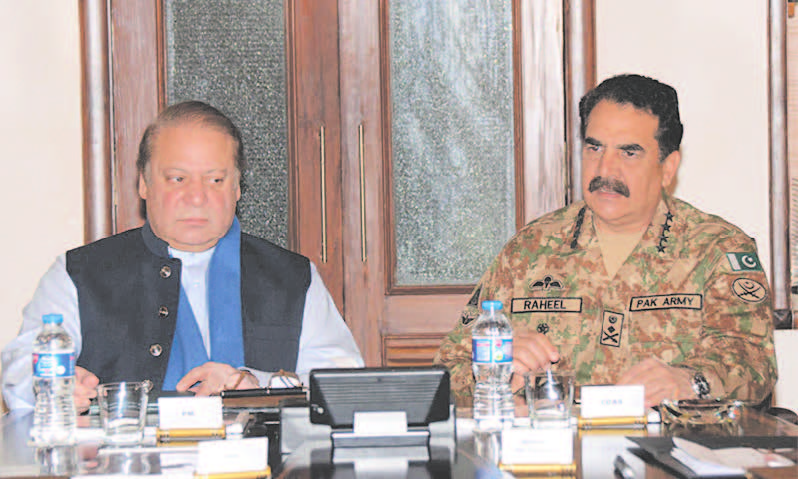
    Later, Prime Minister Nawaz Sharif inaugurated the exhibition, flanked by Defence Minister Khwaja Asif, Army Chief General Raheel Sharif, Chief of Naval Staff (CNS) Admiral Mohammad Zakaullah and Chief of the Air Staff Air Chief Marshal Sohail Aman.

    34 countries and a total of 418 companies are participating in IDEAS 2016, including 261 foreign and 157 Pakistani companies. The exhibition will continue till November 25.

  • The end game: It is Nawaz Sharif versus Raheel Sharif

    The end game: It is Nawaz Sharif versus Raheel Sharif

    “Sharif’s relations with the army have been no less tumultuous in his third term. Like in the case of his appointment of Musharraf, Sharif erred in this third term by his appointment of Gen Raheel Sharif as army chief. He ignored the fact that General Raheel was a protégé of General Musharraf, who would challenge the PM’s efforts to have Musharraf tried for treason”, says the author – G Parthasarathy


    Relations between Pakistan’s elected government and the country’s all-powerful military establishment become tense and coup prone whenever Nawaz Sharif is elected Prime Minister. This is rather ironical since Sharif entered politics with the blessings of the military in the early 1980s. The then military dictator General Zia-ul-Haq had sought the support of Nawaz’s father – industrialist and steel magnate, Mian Mohamed Sharif – to contribute for the establishment of a new Muslim League Party. General Zia’s military Governor in Lahore, Lt Gen Ghulam Gilani Khan, duly provided the support for Nawaz’s meteoric rise in politics. It was the backing of the military and the ISI chief, Lt Gen Asad Durrani, that enabled Sharif to cobble together an alliance of Islamist parties to prevail over Benazir Bhutto’s Peoples’ Party in 1992.

    Sharif’s whimsical and authoritarian functioning thereafter led to serious differences with then President Ghulam Ishaq Khan. The President was infuriated by the involvement of Sharif and his handpicked ISI chief Lt Gen Javed Nasir, in the 1993 Bombay bomb blasts. In the meantime, Sharif had developed an acrimonious relationship with his army chief, Gen Asif Nawaz, whose sudden death, attributed to arsenic poisoning, led to suspicions of Sharif’s involvement. Sharif was duly sacked by President Ishaq Khan, but briefly restored to office by the Supreme Court. The army chief, Gen Waheed Kakkar, forced both Sharif and the President, out of office shortly thereafter. Sharif’s relationship with the army was equally stormy in his second term. He peremptorily sacked his highly respected and apolitical army chief, Gen Jehangir Karamat. He was then ousted, jailed and exiled by Karamat’s successor, Pervez Musharraf, following differences over who was responsible for the Kargil fiasco.

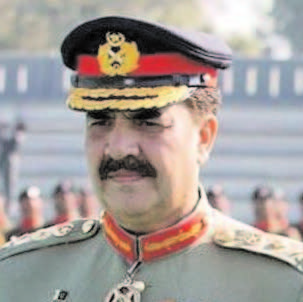
    Sharif’s relations with the army have been no less tumultuous in his third term. Like in the case of his appointment of Musharraf, Sharif erred in this third term by his appointment of Gen Raheel Sharif as army chief. He ignored the fact that General Raheel was a protégé of General Musharraf, who would challenge the PM’s efforts to have Musharraf tried for treason. Raheel Sharif predictably warned not only Nawaz, but also the Supreme Court, to back off from efforts to arrest and imprison Musharraf. His success in this effort only whetted Raheel’s appetite for taking over control of foreign policy, particularly relations with India, Afghanistan and even the US. China duly played on the General’s huge ego, by suggesting that it was the Pakistan army alone that could provide security for its $46 billion ‘One-Belt, One-Road’project.

    Over the past three years, Raheel Sharif has taken over control of Pakistan’s foreign policy and the country’s internal security. He undermined the successful meeting that Nawaz had with Mr. Modi in Ufa by not permitting his DGMO to meet his Indian counterpart. He then undermined any chance of a rapprochement with India by the attack on the Pathankot air base, just after Mr. Modi had extended a hand of friendship by visiting Lahore during the wedding of Nawaz Sharif’s daughter. General Sharif has taken over the conduct of relations with Afghanistan to such an extent that when the Taliban, which has links with the ISI across the border, mounts terrorist strikes in Afghanistan, Afghan President Ashraf Ghani speaks to him rather than Nawaz Sharif !

    General Sharif has shown similar disregard for constitutional norms on issues of internal security. He mounted a large-scale attack on the Pashtun tribal areas bordering Afghanistan, ruthlessly using artillery and air strikes after the Pakistani Taliban attack on the Army School in Peshawar. These operations, named Zarb-e-Azb, have rendered 8,00,000 tribals homeless, with an estimated 50,000 fleeing into Afghanistan. The entire operation was mounted in the face of opposition from both provincial and federal governments and without parliamentary approval. Raheel Sharif showed similar disregard for the views of these governments in his crackdown using the army-controlled Paramilitary Rangers to crush the MQM Party in Karachi. In the meantime, the brutal army repression in Balochistan continues. Despite being lauded as a “savior” by sections in Pakistan, Raheel Sharif has laid the foundations for prolonged unrest in three of Pakistan’s four provinces.

    In these circumstances, the Nawaz government hit back with leaks to the Dawn newspaper, alleging that support of the army and ISI for groups like Lashkar-e-Taiba, JeM and the Haqqani Network in Afghanistan had led to the diplomatic isolation of Pakistan, with even “all-weather friend” China expressing misgivings. This sentiment echoed widely in Pakistan’s parliament. The fact that India’s surgical strikes has been welcomed by the US and European parliament and that this has accompanied a boycott of the SAARC Summit in Islamabad, has given Nawaz Sharif more political space to act. He can now move to replace Raheel Sharif, who is due to retire on November 29, with a person of his choice. This will happen, unless, in the meantime, the Supreme Court acts against Nawaz Sharif on allegations of corruption and money laundering, or if a proposed agitation by Imran Khan paralyses Sharif’s government and invites army intervention. Nawaz Sharif may, therefore, name the new army chief well before November 29.

    General Sharif will likely recommend the most senior officer, Lt Gen Zubair Hayat, presently the chief of general staff, to be the next army chief. Hayat is highly regarded and briefly headed the Strategic Plans Division of Pakistan’s Nuclear Command Authority. But Sharif will be wary of appointing a trusted buddy of General Sharif as the next chief. Hayat could well be “kicked upstairs” to the largely ceremonial, but senior-most post of chairman of the Joint Chiefs of Staff Committee (CJCSC). As the CJCSC heads the Nuclear Command Authority, Hayat’s appointment could be justified on the grounds of his earlier association with it. In that case, Sharif could look lower down the list and could possibly appoint Lt Gen Iqbal Ramaday, who has impeccable family credentials and is presently Corps Commander Bahawalpur, or Lt Gen Qamar Bajwa, said to be a competent officer, who evidently has reservations about extremist jehadi outfits. Bajwa presently holds the same post that Raheel Sharif did before he was appointed as army chief.

    (The author is a career diplomat. He has been India’s High Commissioner in Islamabad, besides other postings)

  • Rift between Pakistan government, army over backing militant groups

    Rift between Pakistan government, army over backing militant groups

    ISLAMABAD/NEW DELHI (TIP):A media report suggesting that the Pakistan military has been asked not to “interfere” in action against militant groups considered “off limits” gave rise to heated speculation of a rift between the Nawaz Sharif government+ and the army brass even though the account was forcefully denied.

    A report in Pakistan’s Dawn newspaper said a meeting of civilian leaders, including PM Nawaz Sharif and the ISI chief Rizwan Akhtar, on Monday saw foreign secretary Aizaz Chaudhry bluntly say that Pakistan faced diplomatic isolation+ and was under pressure to act against Jaish-e-Mohammed+ and the Haqqani network, and move forward on the Pathankot investigation.

    The development seemed an attempt by Pakistani Prime Minister Nawaz Sharif to flex muscles against the army but the denial soon after dampened such expectations. The initial denial referred to “half truth” which was revised to “fabrication”, and the addition of a paragraph on the role of the army and ISI working against terrorists of “all hues” made it clear that Sharif had backtracked. The PM’s office said the report was misleading and an amalgam of “fiction and fabrication”.

    The addition that “the intelligence agencies, particularly ISI, are working in line with the state policy in the best interest of the nation both at the federal and provincial levels” clearly underlined that the civilian “revolt” might be short-lived.

    But the official denial could not quell speculation over a major publication carrying a detailed report about the Sharif government calling for an urgent change of direction with regard to jihadi organisations operating in Pakistan. Some Pakistan watchers felt the account of foreign secretary Aizaz Chaudhry’s remarks rang true given his proximity to Sharif.

    Most observers feel the alleged takeaways from the meeting — Pakistan NSA Nasser Janjua and ISI chief Rizwan Akhtar are to ask ISI commanders not to prevent action against militants and fresh attempts are to be made to conclude the Mumbai and Pathankot probes —may never come to pass. There are doubts whether Sharif has the political will or clout to pursue such a policy. (PTI)

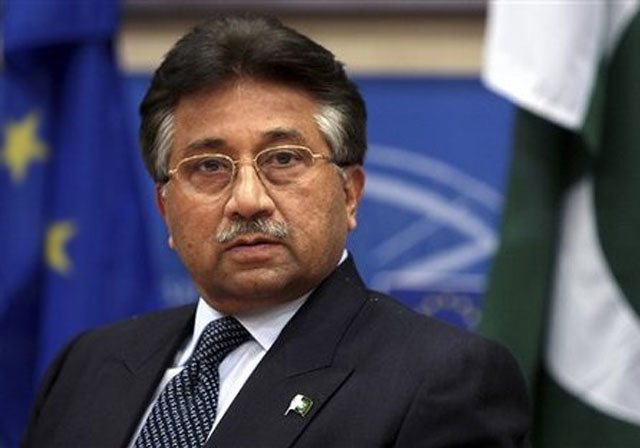
  • ‘Pakistan WEAK,’ admits Former President Pervez Musharraf

    ‘Pakistan WEAK,’ admits Former President Pervez Musharraf

    As the world unites against Islamabad terror agenda following the Uri terror attack, former Pakistan President Pervez Musharraf admitted that Pakistan has been isolated globally.

    He went on to blame PM Nawaz Sharif for his “wrong policies” that have tarnished Pakistan’s image.

    While Islamabad is getting marginalized globally, Musharraf added that Prime Minister Sharif is getting no love from his countrymen either. The former President said that anger against Pakistan is growing every day.

    “These things happen when we are internally weak, when external policies are not good, when there is mismanagement then such things happen. These are our weaknesses, said former Pakistan President Pervez Musharraf.

    Additionally, Musharraf accepted the fact that India is garnering more support and growing stronger than Pakistan internationally. He warned the Sharif administration of serious consequences if the country doesn’t counter India’s growing support across the globe.

    Talking about Pakistan-US relationship, Musharraf revealed that it has turned sour over the past few years. And, immediate measures need to be taken.

    “Our relations with America during my regime do not exist anymore. America is upset with us. Under such circumstances, a nation becomes weak. It becomes internationally weak,” said Musharraf.

    The comments from Pervez Musharraf came in after Pakistan-sponsored terrorists carried out attacks in Uri and Baramulla, and India intensified its military and diplomatic offensive against Pakistan.

  • Hitting where it hurts: India must keep up the momentum

    Hitting where it hurts: India must keep up the momentum

    As I write these lines, Pakistan has strongly denied that the Indian army carried out surgical strikes across the LoC. It has claimed, indeed asserted, through the official army spokesman that the Indian action was confined to the traditional exchange of fire across the LoC which the two armies have undertaken many times in the past, including heavy fire last year. In doing so, as of now, Pakistan has obviously sought to ensure that it does not come under pressure from its domestic public opinion to adequately respond to uphold the country’s honor. For if it acknowledges that Indian soldiers crossed the LoC, even by a short distance of a couple of kilometers, the Pakistani people, more so, Pakistani soldiers and officers will demand of its generals, especially army chief General Raheel Sharif, that the Indian Army be soonest taught a lesson so it does not undertake such an action again. This refrain would be heard the loudest from the jehadi tanzeems.

    Raheel Sharif has an image to live up to – his elder brother and maternal uncle were decorated with the Naishan-e-Haider, Pakistan’s highest gallantry award, and the Sharif family is greatly respected in army circles and by the public at large. Raheel Sharif is also credited with successful action in North Waziristan to clear Tehrik-e-Taliban-e-Pakistan cadres under the Zarb-e-Arz operation. Thus more than Prime Minister Nawaz Sharif, it is the General who is under greater scrutiny. It is obvious that his initial reaction has been not to immediately get into a tit-for-tat situation and to move cautiously. That is not unnatural, for the Pakistan General staff would need to carefully weigh all options, especially as the international community knows that Pakistan has provoked India continuously over two decades with its pursuit of cross-border terrorism and that no army would take the Uri terrorist attack lying down.

    The major powers, especially the US, have advised Pakistan that it has to take action against all terrorist groups, not only those that have turned against the state. This counsel has fallen on deaf ears, for there is no evidence that Pakistan army is willing to take a re-look at its security doctrines. These prescribe the pursuit of low-intensity conflict to contain India by keeping it off-balance. The fact is that despite the Pathankot attack and India’s acceptance of a Pakistani joint investigation team, including an ISI representative, to visit the Pathankot air base, it continued to essentially remain in denial, which is a clear evidence of its unwillingness to modify its security approaches. As India has crossed a threshold, Pakistan’s security planners will be under international pressure to modify their policies on the use of terror, even as they will not easily give it up. Why?

    The major powers, including Pakistan’s all-weather friend, China, do not want a conflagration between two countries with nuclear weapons. As India has always acted “responsibly”, it has ironically been under greater pressure to avoid taking any step that would enhance the chance of escalation. This has been so after every significant terrorist provocation, including the Parliament attack and the Mumbai outrage. Each time, India absorbed terrorist action, despite the loss of life. Indeed, influential sections of the Indian political and security classes advanced the view that terrorism did pose a real security challenge to the country. Thus Pakistan-sponsored terrorism was cynically relegated to a matter of political management. If this was the view of those who governed the country, the international community naturally went along. The Pakistan Generals too felt secure that India’s political masters would not really react with force. They were initially concerned that Prime Minister Narendra Modi may be different and they tested him even prior to his taking oath when the Indian consulate-general in Herat was attacked. When Modi flip-flopped, laying down red lines only to dissolve them, they felt that he was no different from his predecessors. They will now have to reassess.

    The only time the global powers brought pressure to bear on Pakistan was during the Kargil encroachment. Then India acted with determination to throw out Pakistan forces that had occupied the Kargil heights. It is because India refused to accept Pakistani action and the Indian Army started meeting with success despite great odds that the US put pressure on Pakistan to abandon its unacceptable misadventure. The US pressure was a contributory factor to Pakistan’s decision to withdraw. The Kargil lesson was that if India showed resolve and acted then Pakistan was asked to act responsibly. The key factor in all such situations is calm and sober resolve and deliberate action. Now after the surgical strikes, which have been undertaken with precision, it would be Pakistan that would be under pressure not to notch up the situation. That would be the quiet message that the Chinese would also give, notwithstanding the public postures that they may take.

    Modi government has also done well not to have undertaken the surgical strikes in isolation, but as part of a package of measures to show that India is re-examining the premises of its Pakistan policy. No previous government has focused on the Indus Waters Treaty and Pakistan’s MFN status. Nor has any government raised Pakistan’s human rights record in Balochistan internationally, that too at the UN. Most importantly, the withdrawal from the SAARC Summit -and, it is obvious that Afghanistan, Bangladesh, Bhutan and India have consulted on this matter – would not have gone unnoticed in important capital cities. While there will be routine counsels of restraint, there is no doubt that there will be an understanding that India has suffered much and Modi expended much political capital and the present action – with no intention, at present, to undertake any other surgical strike – was neither adventurous nor unnatural.

    There is little doubt that Pakistan will loudly proclaim the dangers of Indian action leading to the danger of acquiring a nuclear dimension. This is hogwash and self-serving. Pakistan will also renew efforts to draw attention to the Kashmir situation, but global indifference to developments in the Valley will continue as no country wants to intervene in it.

    So, how will Pakistan respond? Indian security managers should redouble their vigilance against a major terrorist strike.

    (The author is a former Secretary, Ministry of External Affairs)

  • I will show Nawaz Sharif how to respond to Modi, says Imran

    I will show Nawaz Sharif how to respond to Modi, says Imran

    ISLAMABAD (TIP): Following Indian claims of “surgical strikes” at the terror launch pads in Pakistani Kashmir, Pakistan opposition party leader Imran Khan said he will show his Prime Minister Nawaz Sharif how to react to such “aggressions”.

    “Initially I had to give a message to Nawaz Sharif, but tomorrow I will send a message to Modi too,” the cricketer-turned politician said.

    Khan also urged people to participate in the march. “People from all over Pakistan should participate in the march to display unit,” he said, adding that “I will show Nawaz Sharif how to respond to Modi”.

    The Pakistan Tehreek-i-Insaf chief also referred to Nawaz Sharif’s “inability to govern” and said, “(Army Chief) Gen Raheel is representing the nation.”

    Pakistan has rejected the Indian claim of “surgical strikes” but confirmed that two of its soldiers were killed when the Indian military resorted to firing across the LoC, which divides Jammu and Kashmir between the two countries, on Sept 29.

  • Skirmish on LoC being called a strike, Pakistan army

    Skirmish on LoC being called a strike, Pakistan army

    ISLAMABAD (TIP): The Pakistan Army on Sept 29 denied the Indian Army’s claim of surgical strikes across the LoC, saying it forcefully responded to “cross-border fire” in which “two Pakistani soldiers were killed and nine injured”. Condemning the “firing on LoC”, PM Nawaz Sharif said Pakistan’s intent for peace should not be seen as its weakness. “Pakistan army is fully capable of defending the country and is ready to combat Indian forces,” he said. “We’ll give a befitting response if our sovereignty faces any danger,” he said.

    Defence minister Khwaja Muhammed Asif, widely quoted as having said that Pakistan would use nuclear weapons if it feels threatened, said “small firearms were used by India during the skirmish across the LoC”. “India is trying to present LoC violation as a surgical strike,” he said. Asif further said the Kashmir issue is not going to die down and Pakistan will fully support the freedom movement there.

    A statement from army’s media wing said, “There had been no surgical strike, instead a cross border fire was initiated by India.” The firing, the statement said, began after midnight and continued till 8 am. “Two Pakistani soldiers were martyred,” it said.

    Army spokesman Lt Gen Asim Saleem Bajwa told TV channels Pakistan was acting responsibly despite provocations. He said DGMOs of both countries talked over the phone where the Indian counterpart said they had witnessed movement at LoC, which they interpreted as possible infiltration. “But when we checked on the ground, we found nothing.” Dismissing that Indian paratroopers had entered Pakistan, Bajwa said, “It’s not possible….”

    About Indian claims of Pakistan’s involvement in the Uri attack, the spokesperson said India has a 3 to 4-km deep anti-infiltration grid.”There is also a three-layer fence which would electrocute even a bird that flies past,” he said. “Are they saying all these failed and infiltration occurred?” he asked.(TNN)

  • Rice phones Doval to put US support behind India, warns Pak on terror

    Rice phones Doval to put US support behind India, warns Pak on terror

    WASHINGTON (TIP): The Obama administration on Sept 28 affirmed its support to New Delhi on the issue of cross-border terrorism ahead of India’s surgical strike inside Pakistan occupied Kashmir, while putting Islamabad on notice for its failure to act against UN-designated terrorists and entities.

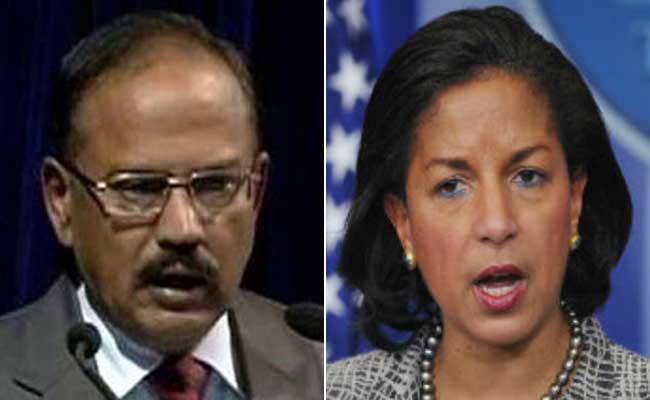
    US National Security Advisor Susan Rice spoke to her Indian counterpart Ajit Doval to offer condolences to families of the Uri attack victims and express support for India on the issue of terrorism, White House National Security Council spokesman Ned Price said in a read-out on the call. The call was initiated by Washington and took place before the Indian strike beyond the Line of Control.

    Although the statement did not explicitly pin the Uri attack on Pakistan, there was a broad censure of Islamabad for continuing to harbor proscribe terrorists and terrorist outfits, with a pledge that Washington would “deepen collaboration on counter-terrorism matters including on UN terrorist designations.”

    “Highlighting the danger that cross-border terrorism poses to the region, Ambassador Rice reiterated our expectation that Pakistan take effective action to combat and delegitimize United Nations-designated terrorist individuals and entities, including Lashkar-e-Tayyiba, Jaish-e-Muhammad, and their affiliates,” the statement said, in an unequivocal recognition of the Indian position that state-backed terrorist proxies have a free run in Pakistan. India has blamed Jaish operatives for the Uri attack, and has more recently identified the attackers and the camps in Pakistan-occupied Kashmir they came from.

    The US statement came amid recrimination from some Indian commentators that the Obama administration was hedging on backing India fully and was not putting pressure on Pakistan after the Uri attack. Although Secretary of State John Kerry gave Pakistan’s Prime Minister Nawaz Sharif an earful at the UN General Assembly last week, some analysts and retired Indian officials selectively highlighted pabulum in the statement to suggest that New Delhi had taken false comfort about US support, and everything was hunky-dory in Islamabad’s ties with Washington.

    The US statement on the Rice-Doval call leaves no doubt where Washington stands on the latest developments in the region, with none of the comforting crumbs that lower level US officials throw out for Pakistanis to feast on, such as recognizing Pakistan’s progress in the war on terror, commiserating with its claim that it is a victim etc.

    “There are no nuances here. The message to Pakistan is very clear,” a senior Indian diplomat said, as New Delhi stepped up international pressure on Islamabad.

    In fact, the Rice-Doval phone conversation, coming after New Delhi’s call to torpedo the SAARC meet, virtually endorses India’s decision to scupper the summit, without the salutary advice that the State Department invariably essays about the need for dialogue. (PTI)

  • India ‘launches surgical strikes against militants’ in POK: Uri avenged

    India ‘launches surgical strikes against militants’ in POK: Uri avenged

    NEW DELHI (TIP): Mounting a swift counter-terror operation across the Line of Control in Jammu and Kashmir, the Indian Army announced, September 29 that it had neutralized terrorists waiting to infiltrate. The brave military man oeuvre has been hailed across the country.

    The operation was aimed at preventing attacks being planned by Pakistan-based militants, a senior army official said.He said “significant casualties have been caused to the terrorists and those who are trying to support them”.

    At a joint press briefing by the army and the foreign ministry, officials said the “motive of the operation was to hit out at terrorists who were planning to infiltrate into our territory”.

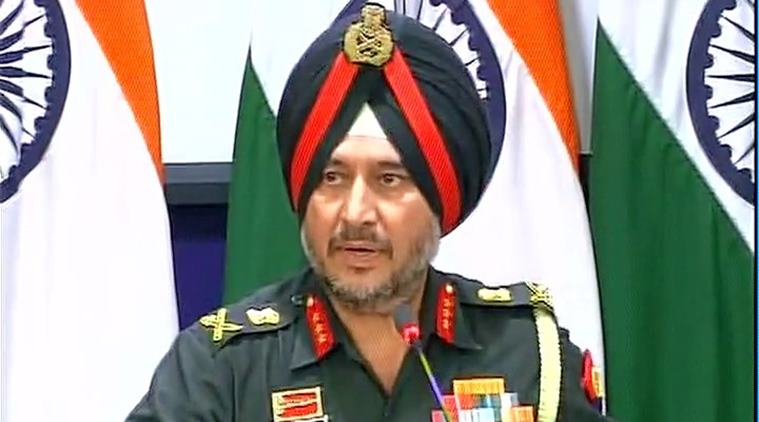
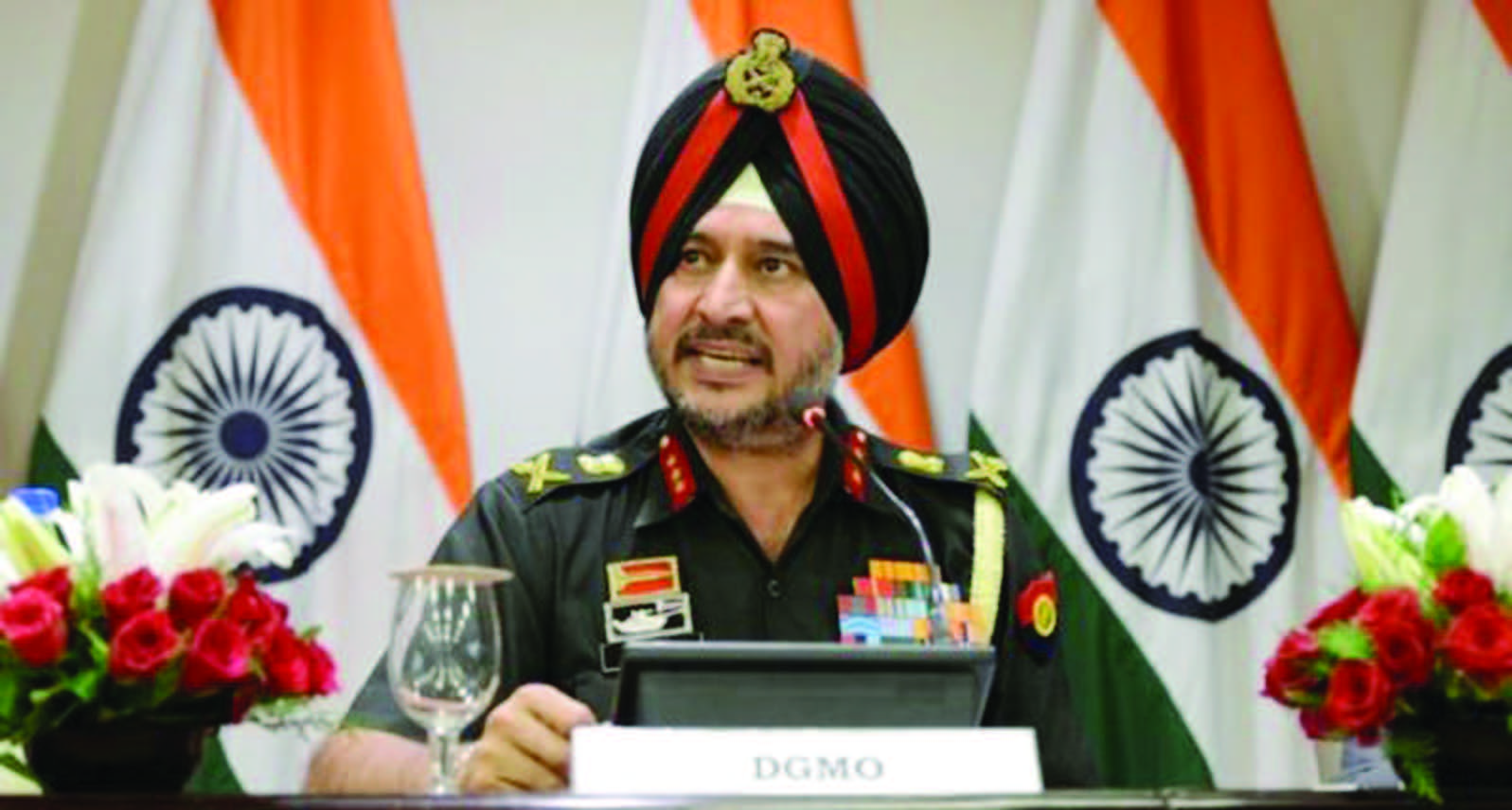
    India’s Director General of Military Operations, Lt Gen Ranbir Singh, also blamed Pakistan for “being unable to control terror activities in territories under its control”.

    “Based on receiving specific and credible inputs that some terrorist teams had positioned themselves at launch pads along the Line of Control to carry out infiltration and conduct terrorist strikes inside Jammu and Kashmir and in various metros in other states, the Indian army conducted surgical strikes at several of these launch pads to pre-empt infiltration by terrorists,” a statement said.

    It said the “surgical strikes” had caused “significant damage to terrorists”.

    The Press Trust of India quoted sources saying the operation took place between midnight and 04:30 local time on Thursday, September 29, that it was a combination of helicopter and ground forces, and seven militant “launch pads” had been targeted.

    Some unconfirmed Indian media reports said more than 30 militants had been killed in the operation.

    The entire operation was monitored for the entire night by Defence Minister Manohar Parrikar, Army chief General Dalbir Singh Suhag, and National Security Advisor Ajit Doval from the Army headquarters in New Delhi.

    Narendra Modi’s BJP government swept to power promising a tough line on Pakistan, so it has been under tremendous pressure to retaliate after the 18 September attack on the army base in Uri in Indian-administered Kashmir. The raid was the deadliest of its kind for years.

    “I assure the nation that those behind this despicable attack will not go unpunished,” Mr. Modi declared just hours after the base was attacked.

    There was also much talk of whether India should continue with its doctrine of “strategic restraint” against Pakistan.

    The response in India has been predictably supportive of the army. The Indian Panorama received reports of ecstatic celebrations of the Indian military strike in various parts of India. All political parties, regardless of differences with the ruling BJP have expressed total approval of the military action. That is the strength of democracy in India.

    Pakistan prime minister, Nawaz Sharif, criticized the “unprovoked and naked aggression of Indian forces” and said his military was capable of thwarting “any evil design to undermine the sovereignty of Pakistan”.

    Islamabad says India’s stance is a “blatant attempt” to deflect attention from human rights abuses in the region.

    Meanwhile, nations across the world are watching the situation. Britain on Thursday asked India and Pakistan to exercise restraint in the wake of surgical strikes by Indian troops across the Line of Control, while China said it was in touch with both countries to reduce tensions.

    A spokeswoman for Britain’s Foreign Office said: “We are monitoring the situation closely following reports of strikes carried out by the Indian Army over the LoC in Kashmir. We call on both sides to exercise restraint and to open dialogue.”

    In Beijing, foreign ministry spokesman Geng Shuang told a media briefing that China was in “communication with both sides through different channels” and hoped Indian and Pakistan “can enhance communication, properly deal with differences and work jointly to maintain peace and security”.

    Shuang was responding to questions on whether tensions between India and Pakistan after the terror attack in Uri had figured in the first anti-terror dialogue between New Delhi and Beijing earlier this week.

    A foreign ministry statement issued on Wednesday had said China values Pakistan’s position on Kashmir but hopes Islamabad and New Delhi will resolve the issue through dialogue and “maintain regional peace and stability by joint efforts”.

    India has “all legal and internationally accepted rights” to respond to any attack on her sovereignty and territory, Iqbal Chowdhury, advisor to Bangladesh Prime Minister Sheikh Hasina, said after the surgical strikes.

    Chowdhury said there had been a “violation from the other side andBangladesh always believes that any aggression or attack on the sovereignty…and legal right of a country is not acceptable”. He appealed for “restraint” from all sides to ensure peace in the region.

    There was no immediate reaction from the US to the surgical strikes. Hours before India announced it had carried out the strikes, US National Security Advisor Susan Rice called on Pakistan to “combat and delegitimize” terror groups operating from its soil, including Jaish-e-Muhammad, which Indian blamed for the attack in Uri that killed 18 soldiers.

    Rice condemned the “cross-border attack” on an Indian Army camp in Uri and highlighted the “danger that cross-border terrorism poses to the region” during a phone call to her Indian counterpart Ajit Doval. She said the US expects Pakistan to take “effective action to combat and delegitimize United Nations-designated terrorist individuals and entities, including Lashkar-e-Taiba, Jaish-e-Muhammad, and their affiliates”.

    This was seen as a major snub for Pakistan after Prime Minister Nawaz Sharif’s attack on India in his speech at the UN General Assembly.

    “It were as if Rice was rebutting Sharif here,” said an Indian diplomat obviously pleased with the US response, which some in India had perceived as insipid so far, given the context of terrorism being a shared challenge.

    Rice’s comments were also seen as significant against the backdrop of the foreign policy crisis in South Asia over India’s boycott of the South Asian Association for Regional Cooperation (Saarc) Summit in Islamabad.

    Rice’s remarks, reaffirming President Barack Obama’s “commitment to redouble our efforts to bring to justice the perpetrators of terrorism throughout the world”, were seen as an endorsement of India’s position. The US had not named Pakistan in its first reaction to the Uri attack.

    The statement also tapped into a growing sense of dissatisfaction and frustration with Pakistan, a non-NATO ally and a major beneficiary of US financial aid and arms supplies.


  • Isolate nations which nurture, peddle and export terrorism: Indian foreign minister at UNGA

    Isolate nations which nurture, peddle and export terrorism: Indian foreign minister at UNGA

    UNITED NATIONS: Indian Minister for External Affairs Sushma Swaraj, speaking at the 71st United Nations General Assembly, said on Monday that it was time to identify nations who nurture, peddle and export terrorism and isolate them if they don’t join the global fight against terrorism.

    “In our midst, there are nations that still speak the language of terrorism, that nurture it, peddle it, and export it,” said Swaraj in a veiled reference to Pakistan.

    The harsh India rhetoric at the UNGA comes after the attack on an Indian army base in India-held Kashmir earlier this month. The attack killed 18 Indian army personnel. India immediately blamed Pakistan for the attack.

    The Indian minister added it had become the calling card of such nations to shelter terrorists, and urged the United Nations (UN) to hold such nations to account.

    “These nations, in which UN declared terrorists roam freely, lead processions and deliver their poisonous sermons of hate with impunity, are as culpable as the very terrorists they harbour,” said Swaraj.

    She also said that “such countries should have no place in the comity of nations”.

    Swaraj referred to the speech of Prime Minister Nawaz Sharif at the UNGA, and said the allegations levelled against India were “baseless”.

    “Prime Minister of Pakistan used this podium to make baseless allegations about human rights violations in my country.”

    The Indian foreign minister stated that Pakistan should introspect and see the abuses being carried out in Balochistan.

    She also added that the “brutality against the Baloch people represents the worst form of state oppression”.

    It is pertinent to mention that the brutal and heavy-handed tactics used by Indian security forces in India-held Kashmir has led to the deaths of more than 100 people, hundreds have been blinded by ‘non-lethal pellet guns’ and over a thousand people have been injured.

    Swaraj claimed that India had no preconditions for talks with Pakistan and said India wants to resolve issues not on the basis of conditions, but on the basis of friendship.

    She further alleged that India did not receive the appropriate response from Pakistan and instead got a reply in the form of “Pathankot, Bahadur Ali, and Uri”.

    “Bahadur Ali is a terrorist in our custody, whose confession is a living proof of Pakistan’s complicity in cross-border terror,” claimed the foreign minister.

    Referring to Kashmir, she ‘advised’ Pakistan to abandon the dream of having control of India-held Kashmir.

    “My firm advice to Pakistan is: abandon this dream. Let me state unequivocally that Jammu and Kashmir is an integral part of India and will always remain so,” Swaraj said.

    ‘India not serious about resolving Kashmir issue’
    Chief of Army Staff General Raheel Sharif, while addressing a US CENTCOM conference in Germany, said India is not serious about resolving the issue of Kashmir.

    “Pakistan has suffered the most by terrorism losing lives more than any other country in the world,” said the army chief.

    General Raheel added that terrorists could move across borders because of no effective border management systems in place and it is exploited by anti-Pakistan intelligence agencies such as RAW.