Tag: Nawaz Sharif

  • Pakistan votes for Change

    Pakistan votes for Change

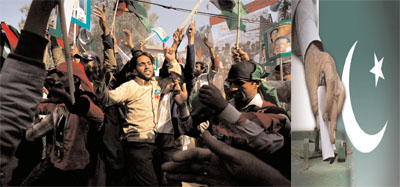
    People of Pakistan have spoken out loud and clear. They have voted for change. Whether it is for Nawaz Sharif’s The Pakistan Muslim League (N) or Imran Khan’s Pakistan-Tehreek-e-Insaf, the electorate’s intentions are clearly known. They want change.

    For the first time in the history of Islamic Republic of Pakistan, a civilian government has completed a full five year term. And, more appreciably, it is the first time again, that transition of power from one civilian government to another is taking place peacefully in Pakistan. Another appreciable aspect of the recent elections in Pakistan is the people’s resolute disapproval and disregard for violence perpetrated by the Taliban to disrupt the elections.

    Despite a number of violent incidents, the people of Pakistan bravely came out in large numbers to vote and be counted. People of Pakistan have conveyed in unequivocal terms their preference for a democratic change. They have thrown out the Pakistan Peoples Party whose government failed to govern the nation. People now expect the new government of Nawaz Sharif to deal with the nation’s problems effectively and govern the nation well. Nawaz Sharif will not find it easy to grapple with an enormity of problems facing Pakistan. He has to provide stability to a country reeling under multiple challenges.

    First and foremost is putting a check on violence perpetrated by fundamentalists. Pakistan has to have peace before it can tackle the problems of economy at home and having better relations with the world, more importantly, with India. Nawaz Sharif is aware of the challenges facing him. In fact, he referred to the problems of unemployment and poverty in his first victory speech.

    He knows he has to turn around the economy. He will need a lot of investment in the country that lacks the very basic infrastructure. There are patriotic people of Pakistani origin abroad who would love to invest in Pakistan but for that Sharif will have to create conditions in the country that will attract investors. Again, peace is the first requisite. Sharif will do well to build confidence of non-resident Pakistanis before any investment could flow in. The youth are restless. They want education and employment.

    A resurging economy can provide jobs and the youth can provide productivity and the combination can work wonders for Pakistan Nawaz Sharif will have to go an extra mile to have cordial working relationship with Military in Pakistan.With gun in hand, Pakistan military is in a position to dictate terms, as it has done in the past.

    Ten years have gone by since Sharif’s last confrontation with General Parvez Musharaf and he certainly would have worked out some plans to have the Military on his side which, however, does not mean bending backwards all the way. India will be keenly watching Nawaz Sharif’s steps and will expect India- Pakistan relations to improve in times to come. India of course will wish him all success in his third stint as Prime Minister of Pakistan.

  • Democracy wins, federation loses

    Democracy wins, federation loses

    While Nawaz Sharif has won the election decisively, he faces the challenge of reaching out beyond his main base in Punjab to the rest of Pakistan
    Pakistan achieved a historic landmark with the completion of its five-year term by the civilian coalition government led by the Pakistan Peoples Party (PPP) and the successful completion of elections resulting in the clear victory for Nawaz Sharif’s Pakistan Muslim League (PML-N). The election results, surprising for many, point to the challenges ahead for the country. Although the PML won enough seats to be able to form the government without having to bargain too much with too many factions, its success comes entirely through the support of one ethnic group – the Punjabis. Every Pakistani province appears to have chosen a different party to represent it. The overall high turnout nationwide masks the harsh reality that very few people voted in Balochistan, where alienation from the centre has been growing.

    Ethnicity
    There is no doubt that people voted out the incumbents amid questions about their performance. But the virtual wiping out of the PPP in Punjab means that each Pakistani political party now reflects the dominant sentiment of a particular ethnic group. The PPP was the only party that had representation from all four provinces of Pakistan in the outgoing Parliament. The election result may be a step forward for Pakistani democracy. It is a step backward for the Pakistani federation. Given the history of complaints about Punjabi domination, Nawaz Sharif will have to reach out to the leaders of other provinces. Authoritarian rule has undermined national unity in the past because of Punjab’s overwhelming supremacy in the armed forces, judiciary and civil services.

    Democracy should not breed similar resentment among smaller ethnic groups through virtual exclusion from power at the centre. In addition to bringing the provinces other than Punjab on board, Sharif’s other major headache would be to evolve a functioning relationship with Pakistan’s military establishment. Although he rose to prominence as General Zia-ul Haq’s protégé, Sharif clashed with General Pervez Musharraf over civilian control of the military. He might be tempted to settle that issue once and for all, partly because of the sentiment generated by his overthrow and imprisonment by Musharraf. Changing the civil-military balance in favor of the civilians would be a good thing. But if it is done without forethought and caution, it could end up risking the democratic gains of the last several years. The PML-N’s view of Pakistani national identity being rooted in Islam and the two-nation theory does not differ much from that of the Pakistani establishment. His real difference with the establishment is over his belief that he, as the elected leader, and not the military must run the country.

    Foreign policy
    Sharif has publicly stated his intention to pick up the threads of the peace process he initiated with Atal Behari Vajpayee in 1999. That process was undermined by the Kargil war, which Sharif now says was initiated by Musharraf without his authority. There can be no assurance that the establishment will let Sharif move forward over changing Pakistan’s posture towards Afghanistan and India, something it did not allow the PPP-led coalition to pursue. Moreover, having been elected with the support of hardline conservative Punjabis, how far can Sharif go against the wishes of his base? During the election campaign, Sharif said little about Afghanistan. In his previous two terms he maintained close ties with the United States but did nothing against the jihadi groups.

    It was under Sharif’s rule that Pakistan officially recognized the Taliban regime and established diplomatic relations. This time, he has spoken of good relations with the West but his voters are overwhelmingly anti-American. The best he might be able to do on foreign policy would be to say the right things publicly without making tough policy decisions. The Punjab electorate, in particular, and some parts of Khyber-Pukhtunkhwa were clearly swayed by a hypernationalist tide, with tinges of Islamist grandiloquence.

    Sharif’s PML-N and Imran Khan’s PTI used similar hypernationalist, anti-American language about Pakistan no longer asking the West for aid. Both parties courted Islamist extremists to bolster their respective vote banks. It might be difficult for them to get off that tiger any time soon. The National Assembly seat break-up is skewed in favor of one province, the largest province of Punjab. Punjab sends 148 general and 35 women’s seats or a total of 183 out of 342 seats which is more than half the seats in the lower house of Parliament.With deep ethnic, linguistic and economic diversity among the provinces, with trust between the provinces being at an all-time low and with the challenge of terrorism facing the country, there is a need for Mr. Sharif to show statesmanship and to appeal beyond his urban Punjabi base.

    Other players
    Sharif is not the only one facing challenges. The PPP has suffered a national setback but has held onto its base in Sindh. It is now time for the party to look inwards and understand that the country has changed. It is growing more urban and Sindh is also doing so. The party is down but not out. It will have to reinvigorate itself by asserting its liberal, social democratic roots. Like the Congress in India, it can continue to seek unity in leadership from the family of Zulfikar Ali Bhutto and Benazir Bhutto. But it has to be a party that is not dismissed as a family enterprise. As for Imran Khan, he achieved a breakthrough by mobilizing disenchanted, apolitical youth. But if he seeks to remain relevant he must realize that there is more to politics than slogans and catch-all phrases. Railing against corrupt and patronage-based politicians is one thing, offering a viable democratic alternative is quite another.

  • India Hopes Pakistan Election Throws Up Clear Winner

    India Hopes Pakistan Election Throws Up Clear Winner

    NEW DELHI (TIP): As Pakistan takes baby steps into democracy, India is looking on with apprehension at the plethora of violence that may prevent the new government after Saturday’s election from being the kind that India would like to see. “Our best bet in Pakistan is a strong civilian government that can change the India narrative to something we can work with,” high level sources said.

    At this point, the dominant narrative is driven by the India-obsessed Pakistan army-ISI combine, which gives oxygen to jihadi groups like Lashkar-e-Taiba and its affiliates. Support to terrorism against India therefore has official sanction. The most important challenge for Pakistanis — candidates and voters alike — is that these elections have been dominated more by terror attacks than anything else. Indians hoping for a free election have been dismayed at the relentless violence that threatens to keep many indoors on polling day.

    India is hoping against hope that the election throws up a clear mandate for one of the mainstream parties. All signs point to the fact that Asif Zardari’s PPP might fall prey to antiincumbency and Nawaz Sharif appears the front-runner. Many believe that Sharif, who was last tossed out by General Pervez Musharraf’s coup, will not be particularly enamoured of the Pakistan army. But Sharif is accommodating of many of the Islamist groups.

    That bothers the west, but India appears more resigned to it. For India, its important that the new government takes the right economic and trade decisions for a start. That would put energy into the bilateral relationship even if other indices are more difficult to fulfil. Pakistan analyst Mosharraf Zaidi said in Foreign Policy, “This is not to say that Pakistanis embrace their neighbour. They are still smart about India’s role in separating Pakistan from Bangladesh, and still view with acrimony India’s administration over large parts of Kashmir.

    Yet, for all the bitterness and baggage, even the juiciest volleys from India are now returned with a disengaged ‘meh’. This will likely remain the status quo for a while. As long as it does, the doors remain open for India to tap into an unprecedented national appetite for normalcy.” A Pew survey tellingly found most Pakistanis deeply sceptical of Taliban and America alike.

    The study said, “About 80% think the Pakistani military, which for decades has been an important player in the country’s politics, is having a positive influence on the nation. Solid majorities say religious leaders (69%), the media (68%) and the courts (58%) are having a good impact on the country.” This doesn’t hold out much hope for the kind of government India wants in Pakistan.

    Sharif faces a challenge from Imran Khan and his Tehreek-e-Insaaf, which is seeing a bounce in the election campaigns largely due to his “outsider” tag; while the Sharifs are playing the governance card, they are also seen as the same old political class that has let Pakistan down.

  • Hopes And Fears Ahead Of Pakistan Polls

    Hopes And Fears Ahead Of Pakistan Polls

    LAHORE (TIP): All was quiet on the streets of Lahore on Friday as people geared up for the elections. The provincial government announced a holiday across Punjab around noon on Thursday, shutting down local businesses and giving people one extra day to get home to their villages to cast their vote in what appears to be the first historic elections since Zulfiquar Bhutto’s party, the PPP won the elections in 1977 by a wide margin. There are more than 200 parties in the electoral process, 86 million voters and 5,000 candidates.

    Yet across the country there are only two names being bandied about: Imran Khan and Nawaz Sharif. The third hidden voice of the PPP’s Asif Ali Zardari is expected to emerge with news of the election results. Across social media, in cafes and on the roadside, there is a sense that Imran Khan – whether or not you support him – has roused election fever in everyone, not just the youth. The young, the middle aged and the youth are repeating the mantra “This is the first time I’m going to vote”.

    Even those cynical about the elections process admit that the energy on ground is palpable. “Benazir Bhutto was the last charismatic leader we had,” said Shahvaar Ali Khan, a musician whose ad company, Farigh Four launched PTI’s media campaign for change with the slogan, “Naya Pakistan’ or a New Pakistan. “Now (the leader) is Imran despite his simplistic, yet sincere and honest political analysis.”

    Indeed, in the urban centres of Pakistan many people, across the age spectrum are expressing their support for this reality. Some have read the PTI’s manifesto, many haven’t. But they’re hoping that Imran Khan will deliver guidance in governance, just as he did on the cricket field. This means that Sharif is finding a deep challenge in his stomping grounds. Across Lahore there is evidence that longtime former supporters of the PML-N aren’t going to vote for him. “I’m going to vote for Imran Khan,” said a businessman who didn’t want to be named.

    “But I’m going to walk into my polling station announcing that I’m voting for Nawaz Sharif.” In Lahore on Thursday evening, the last day for rallying before today’s elections, people thronged on Mall Road, and around Liberty Market, the city’s commercial areas. Mothers came with their children dressed in their preferred party colours, many of them showing off the PTI’s red, white and green.

    “I’m so excited. It was so much fun to see so many people all looking forward to a change,” said Moosa Baksh, a 21-year-old architecture student who joined the Liberty Market crowd with his friends. Asked what he’d feel if Imran Khan didn’t win. “I’ll be really sad,” he said. There is also a sense that Imran Khan’s superstar status is helping get women out of their homes and into the polling stations.

    “In a lot of our families many of the husbands are voting for Nawaz Sharif and our wives are voting for Imran Khan,” said Mian Raza Mansha, a prominent Pakistani businessman. “I’ve heard a lot of men saying they’re going to try and prevent their wives from going to the polling stations,” he laughed. With so much focus on Pakistan’s big cities, it is unclear what the mood in Pakistan’s rural areas is, where a majority of the electorate lives.

    Voters tied as serfs to their landowners have traditionally voted for their caste and biradari. PTI, with no links to the biradari system has promised to break that hold. In the cities there a sense of a newly mobilized voting class that has long been enfranchised to vote but has not felt compelled to make it to a polling station on elections day. Outside a polling station where workers were setting up the booths, three men sat outside discussing the potential election results.

    “It’s going to be a hung parliament,” said Omar Farooq, 48, an electrician. “I’ve been listening to the radio all morning. ” “Nonsense,” said his friend, Asif Ali, 36. “It’s going to be an Imran Khan sweep. He’s going to take the entire country.”

  • Pakistan Votes In Landmark Election, Coalition Govt Likely

    Pakistan Votes In Landmark Election, Coalition Govt Likely

    ISLAMABAD (TIP): Despite a bloody campaign marred by Taliban attacks, Pakistan was holding historic elections on Saturday pitting a former cricket star against a two-time prime minister once exiled by the army and an incumbent blamed for power blackouts and inflation. Polls opened on Saturday morning across the nation in what is a closely watched race to determine the fate of this nuclear-armed country crucial to stability in the region.

    The vote marks the first time in Pakistan’s 65-year history that a civilian government has completed its full term and handed over power in democratic elections. Previous governments have been toppled by military coups or sacked by presidents allied with the powerful army. Deadly violence struck again on Friday, with a pair of bombings against election offices in northwest Pakistan that killed three people and a shooting that killed a candidate in the southern city of Karachi.

    More than 130 people have been killed in the run-up to the vote, mostly secular party candidates and workers. Most attacks have been traced to Taliban militants, who have vowed to disrupt a democratic process they say runs counter to Islam. The vote is being watched closely by Washington since the US relies on the country of 180 million people for help in fighting Islamic militants and negotiating an end to the war in neighboring Afghanistan.

    The rise of former cricket star Imran Khan, who has almost mythical status in Pakistan, has challenged the dominance of the country’s two main political parties, making the outcome of the election very hard to call. “I think it is the most unpredictable election Pakistan has ever had,” said Moeed Yusuf, South Asia adviser at the United States Institute of Peace.

    “The two-party dominance has broken down, and now you have a real third force challenging these parties.” The election of both the national and provincial assemblies comes at a time of widespread despair in Pakistan, as the country suffers from weak economic growth, rampant electricity and gas shortages, and a deadly Taliban insurgency. The bombings that killed three people on Friday occurred in Miran Shah, the main town in the North Waziristan tribal area, a major sanctuary for the Pakistani Taliban.

    The blasts also wounded 15 people, said intelligence officials, speaking on condition of anonymity because they were not authorized to talk to the media. The candidate who was gunned down in Karachi, Shakil Ahmed, was running as an independent for the provincial assembly, said police officer Mirza Ahmed Baig.

    There is concern that the violence could benefit Islamist parties and those who take a softer line toward the militants, including Khan and former Prime Minister Nawaz Sharif, because they were able to campaign more freely. The government said it would deploy 600,000 security personnel on election day.

    After more than a decade in the political wilderness, the Oxford-educated Khan has emerged as a force in the last two years with the simple message of “change.” He has tapped into the frustrations of millions of Pakistanis – especially urban middle class youth – who believe the traditional politicians have been more interested in enriching themselves through corruption than governing.

    The two main parties that have dominated politics – the Pakistan People’s Party, which led the most recent government, and Sharif’s Pakistan Muslim League-N – have ruled the country a total of five times in the past 25 years. Khan has also struck a chord by criticizing Pakistan’s unpopular alliance with the US and controversial American drone attacks against Islamic militants in the country’s northwest tribal region.

    “I am happy to vote for the person of my choice,” said Mohammed Ayub, who was the first man to vote at a polling station in Islamabad. “I am voting for Imran as he is a strong voice against wrongs.” Support for the 60-year-old Khan may have increased out of sympathy following a freak accident this week at a political rally in which he fell 15 feet (4.5 meters) off a forklift, fracturing three vertebrae and a rib. He is expected to make a full recovery and seems to be making the most of the accident.

    The party has repeatedly aired an interview he did from his hospital bed hours after the fall as a paid advertisement on TV. Nobody is sure how effective he will be in translating his widespread popularity into votes, especially considering he boycotted the 2008 election and only got one seat in 2002. Turnout will be critical, especially among the youth.

    Almost half of Pakistan’s more than 80 million registered voters are under the age of 35, but young people have often stayed away from the polls in the past. Khan faces a stiff challenge from the two main parties, which have spent decades honing vote-getting systems based on feudal ties and political patronage, such as granting supporters government jobs. Because of the strength of this old-style politics and unhappiness with the outgoing government, many analysts see the Pakistan Muslim League-N as the front-runner in the election.

    Sharif has twice served as prime minister and is best known for testing Pakistan’s first nuclear weapon in 1998. Sharif was toppled in a military coup by then-army chief General Pervez Musharraf in 1999 and spent years in exile in Saudi Arabia before returning to the country in 2007. His party, known for its pro-business policies, came in second in the 2008 elections and is seen as more religiously conservative than the Pakistan People’s Party

  • The End of Road for Musharraf

    The End of Road for Musharraf

    Whichever way the Hitchcockian drama in Islamabad plays out there is at least one certainty in the grand confusion: that Pervez Musharraf, arguably the most delusional of the four military dictators that have ruled Pakistan for nearly half its existence, has reached the end of the road. His pipedream of landing in his country after five years of exile, like a triumphant Caesar – in the hope of being welcomed by people still nostalgic about what he had done for them in the past and anxious to give him another chance to lead them – has turned out to be a nightmare.

    He can now rue over his folly during his house arrest in his sprawling farmhouse at the edge of the Pakistani capital. As a matter of fact, Islamabad-based foreign correspondents who had gone to Karachi to cover Musharraf’s “momentous arrival” have reported that it should have been clear from that moment that the former president had no future. His candidature in the four constituencies has already been rejected and most of the political leaders he expected to be with him have already joined other mainstream parties.

    He has no role in the ongoing elections or any influence on their outcome. Incidentally, the most delightful and appropriate comment on his present plight has come from Xinhua, the official news agency of China, Pakistan’s “all-weather” friend where at one time Musharraf used to be welcome. There was, says Xinhua, “poetic justice” in Pakistan when the Islamabad Supreme Court issued an arrest warrant against the former president – something he had done “against dozens of judges when he arrested them in 2007”. On the fate that awaits him, opinions differ widely.

    Some hope, rather than think, that the judiciary that he humiliated so disgracefully in 2007 would not be content without hanging him, especially because the three main charges against him are heinous and include the assassination of Benazir Bhutto and the murder in cold blood of the eminent Baloch leader, Sardar Mohammed Akbar Bugti. Some others believe that if the law and the judicial process don’t get Musharraf, the lawless Taliban would. In my view, this possibility should also be ruled out in view of the enormous commando security the Pakistan Army has provided this former commando general. As of now, the most plausible scenario seems to be that Musharraf’s judicial custody up to May 4 will be extended beyond the date of elections that is May 11. Thereafter his trial can begin, if the judiciary and the new government insist on it. But then it can go on and on for years, if only because in this and many other basic practices the underlying unity of the subcontinent endures. However, overall it is a safe bet that Pakistan’s power structure cannot afford to hurt the sentiments of the all-powerful Army by executing or even imprisoning a former army chief.

    According to available information, General Ashfaque Pervez Kayani, though a one-time protégé of Musharraf, did not want him to come home, leave alone take part in the elections. It is said that messages to this effect were sent to him several times. However, when the megalomaniac former military ruler having hallucinations about his popularity with the Pakistani masses did arrive, the Army considered it its bounden duty to see to it that no harm came to his person and that his, and more importantly, the Army’s izzat (an expression dear to both the Indian and Pakistani armies) was not besmirched in any way. This situation will prevail regardless of the dispensation resulting from the May 11 poll. It would be no surprise if some kind of an understanding already exists among the major stakeholders in Pakistan on this subject.

    Come to think of it, even under a caretaker government, whose only duty is to hold free and fair elections, all concerned have treated Musharraf with kid gloves. Remarkably, Xinhua has taken note of “the speculations” that despite the apex court’s clear order to arrest him, “some bigwigs” in the government told the police to “go slow on Musharraf”.

    It would, indeed, be instructive to look back on the events in 1999 when, after his successful coup, Musharraf wanted to “fix well and proper” his bete noir and then Prime Minister, Nawaz Sharif. But then Saudi Arabia intervened and the military dictator agreed to let Sharif go in exile to Saudi Arabia for 10 years. Today, the Saudi stakes in the stability of Pakistan are even higher than before.

    There are two other points that call for comment. The first is the rather intriguing fact that the United States is refusing to comment on Musharraf”s house arrest one way or the other. Does this lend any credence to his calculation while planning his strategy to take part in elections that, given the configuration of forces in the post-poll Pakistan, the Americans would prefer a government led by him?

    After all it was he who, on the morrow of 9/11, had reversed Pakistan’s policy on Afghanistan and lined up his country with the US in the “war on terror”. Moreover, as revealed only recently, in 2003Musharraf unhesitatingly allowed the Americans to use drones to kill as they wished in North Waziristan as long as they left the Lashkar-e-Toiba (LeT), Jaish-e- Mohammmed and other Pakistani terrorist outfits operating against India well alone?

    Today, the US desperately needs Pakistani cooperation for its plan to withdraw its combat troops from Afghanistan by the end of 2014.

    Secondly, the speculation in some quarters in both India and Pakistan that should the civilian government resist the Army’s demand to let Musharraf go, Kayani and the Army would stage a coup should be dismissed.

    Firstly, over the years Gen Kayani has demonstrated repeatedly that he sees no point in directly taking over when the Army can get its way anyhow. Furthermore, gone are the days of the Cold War when the US had a vested interest in embracing and coddling military dictators in Pakistan. Samuel P. Huntington had then written a book to press home the point that in newly independent countries the armed forces were the best instrument for stability.

    Those days are gone. Today, America is the super-salesman of democracy across the world. It can ill-afford a military takeover in Pakistan, never mind the adverse reaction of the world community in general.

  • Pervez Musharraf barred from one Pakistani election constituency

    Pervez Musharraf barred from one Pakistani election constituency

    ISLAMABAD (TIP): Pakistan’s election board barred on Friday former President Pervez Musharraf from contesting polls in one constituency and the Supreme Court agreed to look into a treason complaint against him, hurting his efforts to win back influence. The former army chief returned last month after nearly four years of self-imposed exile to contest a May 11 general election despite the possibility of arrest on various charges and death threats from the Pakistani Taliban. The Election Commission barred Musharraf from the polls in Kasur in Punjab province because of court cases against him, commission officials said. He could also face disqualification in the three other constituencies where he plans to run.

    The officials, who declined to be identified, also said the decision was based on a clause in the constitution which requires candidates to be of good character and the fact that he had not declared all of his assets. “Musharraf has been disqualified under articles 62 and 63 of the constitution, among other reasons,” an election commission official said, referring to clauses that require a candidate to be “of good character”, among other things. Neither Musharraf nor a spokesman for him were available for comment.

    Musharraf faces charges of failing to provide adequate security to former prime minister Benazir Bhutto before her assassination in 2007. He also faces accusations in connection with the death of a separatist leader in the southwestern province of Baluchistan. He denies any wrongdoing. A petition which will be heard by the Supreme Court on Monday accuses Musharraf of committing treason when he sacked senior judges and declared emergency rule while in power.

    The current chief justice, Iftikhar Chaudhry, was embroiled in a confrontation with Musharraf, who removed him from office in 2007 after he opposed plans to extend the general’s term in office. He was later reinstated. Musharraf had hoped to compete in the election. Former Prime Minister Nawaz Sharif, the man Musharraf ousted in a coup in 1999, is seen as the front runner. Musharraf, a former commando, has been far removed from Pakistan’s troubles during his exile in London and Dubai, where he lived in a posh part of the Gulf Arab emirate.

    Pakistan’s military has ruled the nation for more than half of its 66- year history, through coups and from behind the scenes. It sets foreign and security policy, even when civilian administrations are in power. But current commanders have meddled far less in politics than during Musharraf’s era, preferring instead to let civilian governments take the heat for the country’s failures.

  • Pak Strategy: Deny India Nuclear Victory

    Pak Strategy: Deny India Nuclear Victory

    Pakistan’s relations with two of its neighbors-India and Afghanistan – are strained, and a third border, with Iran, marks the Sunni-Shia divide within Islam. Domestic social services are in decline. Governance is widely conceded to be poor at both the national and provincial level. Many extremist groups have found shelter in Pakistan.

    Some fight the military, others have colluded with it. Over the past five years, Pakistan ranks second (only to Iraq) in the incidence of mass-casualty deaths due to sectarian and politicallyinspired domestic violence.

    Amidst these indicators of national decline – and in the face of concerted efforts by the US and other nations to prevent Pakistan from crossing key production thresholds — Pakistan now possesses a considerable and growing nuclear arsenal, which is publicly estimated to include perhaps 90-110 weapons.

    It is hard to identify another governmental or military enterprise in contemporary Pakistan that has been more successful in identifying goals and implementing them than Pakistan’s nuclear weapon-related programs. Most Pakistanis who bemoan the problems they face in everyday life feel pride in the accomplishments of testing and producing nuclear weapons. They begrudge governmental corruption and incompetence, but not money spent on the Bomb.

    Start of N-pursuit
    Pakistan’s serious pursuit of nuclear weapons began with Zulfikar Ali Bhutto, who famously declared in 1965 — well before taking charge of the country and the program that his compatriots would “eat grass” and suffer other deprivations in order to possess nuclear weapons. This priority became more focused after the 1971 war with India that resulted in Pakistan’s grave humiliation, vivisection, and Bhutto’s ascendancy as President, and subsequently, as Prime Minister.

    Ghulam Ishaq Khan, a powerful political figure who became President of Pakistan from 1988 to 1993, provided continuity of oversight over the nuclear program after Bhutto’s demise and during a period of revolving Prime Ministers. As with other nuclear programs in other countries, “first generation” scientists in defense establishments also played key roles in nuclear development programs, most notably Munir Khan and Samar Mubarakmand of Pakistan’s Atomic Energy Commission and A.Q. Khan of the Khan Research Laboratories.

    The transfer of Pakistan’s nuclear weapon-related programs to military control was realized in stages, beginning with the imprisonment in 1977 and subsequent execution of Zulfikar Ali Bhutto by General Zia-ul-Haq. Military supremacy in all military-related nuclear matters was reaffirmed after Ghulam Ishaq Khan’s forced resignation from the Presidency in 1993, and was consolidated further when, in February, 2000, then-Chief Executive and Chief of Army Staff, Gen. Pervez Musharraf, implemented plans for a directorate to focus on operational issues — the Strategic Plans Division (SPD) at Joint Staff Headquarters — that the recently deposed Prime Minister Nawaz Sharif had dawdled over.

    High-end nuclear strikes
    While high-end Pakistani nuclear strike packages probably include some military targets, the standard way for new nuclearweapon states to define minimal, credible deterrence is by means of counter-value targeting, i.e., being able to destroy an adversary’s large metropolitan areas. There are ten cities in India with populations over three million: Mumbai, Delhi, Bangalore, Hyderabad, Ahmedabad, Chennai, Kolkata, Surat, Pune, and Jaipur.

    Mumbai is a centre of commerce, culture, and nuclear infrastructure. New Delhi is the seat of government. Chennai and Kolkata are significant regional hubs. Bangalore and Hyderabad represent the new, “rising” India, fueling India’s economic growth. Placing these cities, some of which contain very significant Muslim populations, at risk is one way to check perceived Indian designs on Pakistan’s territorial integrity.

    This analysis hypothesizes very modest requirements for Pakistani counter-value targeting. Assuming ten cities and three weapons per city, thirty weapons delivered on targets would be required. These numbers are notional; they may vary from city to city and could be revised upward or downward. Those responsible in Pakistan for planning counter-value targeting against Indian cities would also have to assume losses of nuclear weapon delivery vehicles and storage sites to Indian preemptive or retaliatory strikes.

    Consequently, if there is a fixed requirement for the laydown of a certain number of weapons against Indian cities, a multiple of this number would presumably be applied to compensate for expected losses. In any event, counter-value strikes against Indian cities could entail a very substantial use of nuclear weapons.

    All of these planning factors are closely held, so this assessment is highly conjectural. Indian leaders and hawkish analysts have expressed the view that their country could survive a nuclear war, whereas Pakistan would not.

    As former Defense Minister George Fernandes said in a 2002 interview, “[I]f he should finally take that kind of step, perhaps out of desperation, he should realize that India can survive a nuclear attack, but Pakistan cannot.” Army Chief S. Padmanabhan echoed these sentiments when he reportedly said that “India would severely punish any state that is ‘mad enough to use nuclear weapons against any of our assets.’ Padmanabhan added, ‘the perpetrator shall be so severely punished that his very existence will be in doubt. We are ready for a second strike.’” Likewise, hawkish analyst Bharat Karnad wrote, “The problem here is not one of preventing nuclear war, but with believing that Pakistan can annihilate India, which is not possible, even as the reverse is eminently true.”

    A targeting doctrine
    These assertions have not gone unnoticed by those who set Pakistan’s requirements for nuclear weapons. It would be out of character for Pakistan’s military leadership to accept the survival of India and the death of Pakistan in a nuclear war. Thus, in this conjectural analysis, Rawalpindi is likely to pursue a “victory denial” strategy in the event of a complete breakdown in deterrence.

    The growth of Pakistan’s nuclear stockpile is commensurate with a targeting objective to exact overwhelming damage sufficient to prevent India from recovering as a functioning society. Denying India “victory” in a nuclear war would constitute the high end of Pakistan’s targeting objectives. These might include, in addition to India’s largest cities, its leadership, key industrial facilities, ports, nuclear power plants, dams, and other critical infrastructure that are not necessarily situated in large metropolitan areas.

    A targeting doctrine to deny India victory in a nuclear slugfest would be an unusual and exacting way to define minimal, credible deterrence, but it could well explain Pakistan’s production capacity for nuclear weapons and the prospective growth of its stockpile. Peter R. Lavoy has argued that Pakistan’s nuclear deterrence strategy is predicated on a commitment to “escalation dominance.” During the Cold War, hawkish US strategists held the view that victory was still possible in nuclear exchanges, even at great cost. Failing that, an adversary’s victory could still be denied – and deterrence reaffirmed – by means of expansive nuclear inventories and targeting capabilities.

    Do the managers of Pakistan’s nuclear deterrent believe that they can fight and win a nuclear war with India? In their foundational essay, Agha Shahi, Zulfiqar Ali Khan and Abdul Sattar wrote that Pakistan was “not so unrealistic as to entertain” thoughts of the “use of nuclear weapons for war-fighting or seek to develop capability for preemptive attack.” These authors argue that, “India is too large and too well armed to be vulnerable to a disabling strike.” This line of reasoning is reaffirmed as long as India’s strategic assets grow, are properly diversified, become more operationalized for deterrence purposes, and if New Delhi becomes more serious about command and control arrangements.

    It would not require Herculean efforts for Indian leaders to dissuade Rawalpindi that a Pakistani victory in the event of a nuclear war is not achievable.

    A strong case can be made, however, that New Delhi has been lax in assuring retaliatory capabilities and proper force management. While the achievement of victory by Pakistan in a nuclear war with India seems far-fetched, the denial of an Indian victory is another matter.

    The build-up of Pakistan’s nuclear forces is entirely consistent with this objective. Pakistan’s nuclear requirements are set by very few military officers and one retired officer, Lt. General Khalid Kidwai, with very little civilian oversight or ability to question military requirements. After taking charge of the SPD in 2000, Gen. Kidwai was promoted to Lt. General in October, 2001, and then received an extension in service in 2004 to stay at its helm – a highly unusual personnel action. Gen. Kidwai faced retirement in 2005 because his time on active duty would extend beyond those who were about to outrank him.

    His boss, Chief of Army Staff (and President of Pakistan) Pervez Musharraf decided on his retirement, while keeping him in place at the SPD. While many retired military officers have been given plum assignments overseeing civilian institutions in Pakistan, the appointment of a retired military officer to be in charge of a most sensitive joint staff assignment is unprecedented. Gen. Musharraf’s decision survived his banishment from Pakistan. Gen. Kidwai’s extended tenure at the SPD has meant that his views regarding Pakistan’s nuclear requirements will be very hard to overrule. How many other individuals help determine the requirements to implement nuclear doctrine is a matter of conjecture.

    Presumably, a small core group of very senior military officers are instrumental in making such decisions, beginning with the Chief of Army Staff, the Chairman of the Joint Chiefs of Staff Committee, the head of the Strategic Forces Command, and the Chiefs of the Air Force and Navy. A larger group of military officers, scientists, and civil servants provides input to these decisions and implements them.

    Decisions on nuclear matters

    Sitting atop Pakistan’s National Command Authority, which was initially promulgated as an administrative regulation at the outset of Gen. Musharraf’s rule, and then codified into an ordinance nearing the end of his tenure, is the Head of Government. With Musharraf’s exit, the Head of Government became a civilian in the person of President, Asif Ali Zardari. In November, 2009, President Zardari revised this ordnance, placing the Prime Minister, then Yusuf Reza Gilani, at the top of the NCA. This passing of the baton was orchestrated in the context of clarifying the transition from a Presidential- to a Prime Ministerial-led government.

    Under the Musharraf set-up, the Prime Minister served as Vice Chairman of the NCA. Now it appears that the Vice Chairmanship is vacant. Two subsidiary bodies of the NCA – an Employment Control Committee and a Development Control Committee — have Deputy Chairmen. The Deputy Chairman of the all-important Employment Control Committee is the Foreign Minister, a position currently held by Hina Rabbani Khar. The Deputy Chairman of the Development Control Committee is the Chairman of the Joint Chiefs of Staff Committee.

    Three civilian Cabinet Ministers also serve on the Employment Control Committee: the Minister for Defense; the Minister for Interior, and the Minister for Finance. According to an interview Gen. Kidwai gave in 2002, when Gen. Musharraf sat atop the NCA, “practically all (99%) of the nuclear decisions pertain[ed] to the Head of Government.” One can certainly envision that when the Army Chief of Staff sat atop the NCA, he held the ultimate authority in determining employment and developmental decisions relating to nuclear weapons. It would strain credulity to assert that this remains the case under a civilian Head of Government – Prime Minister Gilani, his successor, Raja Pervaiz Ashraf, and under the Deputy Chairmanship of Foreign Minister Khar.

    While notional authority now resides in the office of the Prime Minister, and while Cabinet Ministers on the NCA are involved in these decisions, real authority lies with the Chief of Army Staff, the Chairman of the Joint Chiefs of Staff, Gen. Kidwai, and a few others, some of whom may not be involved in decision-making under extreme duress.

  • Pak Strategy in Afghanistan Time for hard decisions

    Pak Strategy in Afghanistan Time for hard decisions

    On December 6, Asadullah Khalid, Head of Afghanistan’s intelligence set-up, the National Directorate of Security, was seriously injured in a bomb attack by a Taliban suicide bomber posing as a peace envoy. President Karzai announced the next day that the suicide bomber had come from Pakistan. While not directly naming the ISI, President Karzai described the suicide bombing as a “very sophisticated and complicated act by a professional intelligence service”. Asadullah Khalid is one of President Karzai’s closest aides and has held crucial gubernatorial appointments in Ghazni and Kandahar.

    He had escaped Taliban assassination attempts in 2007 and 2011. He was playing a crucial role in attempts to wean away Pashtun tribal support from the Taliban, as the American “end game” in Afghanistan picks up momentum. Asadullah Khalid is seen as a dangerous adversary in Pakistan. Unlike his Tajik predecessor, Amrollah Saleh, against whom the ISI could whip up Pashtun nationalistic sentiments, he is a blue-blooded Pashtun, who can better deal with Pakistani machinations, which seek to unite Pashtuns under the tutelage of the Mullah Omar-led Quetta Shura and their protégés in the North Waziristanbased Haqqani network.

    In its quest for “strategic depth,” the Pakistan military establishment has based its entire political strategy on pretending to champion the cause of Pashtuns, who constitute 40 per cent of Afghanistan’s population, with the Tajiks constituting 33 per cent of the population and the Shia Hazaras and Uzbeks comprising 11 per cent and 9 per cent, respectively. Interestingly, the language which unites Afghanistan is not Pashtu, which is spoken by 35 per cent of the population and almost exclusively by Pashtuns, but Dari, spoken by 50 per cent of the country’s people.Within the Pashtuns, the ruling class has predominantly been drawn from the landowning Durrani clan. Apart from Nur Mohammed Tarraki and his Soviet-backed successors, the only non-Durrani leader of Afghanistan from the influential Ghilzai clan was Mullah Omar.

    Two-thirds of all Pashtuns belong to the Durrani-Ghilzai confederacy. The Taliban, though led by a Ghilzai, have drawn in a large number of Durrani fighters. In addition, they enjoy the backing of the Haqqani network, led by Jalaluddin Haqqani, operating out of the tribal belt of Pakistan in North Waziristan. The Haqqani network also exercises predominant control over the bordering Afghan provinces Khost – Paktia and Paktika. Pakistan’s strategy is to pretend that it supports an “Afghan-led” process of national reconciliation while ensuring that the Quetta Shura and the Haqqani network, which has strong ties with Al- Qaeda and international Islamist causes, negotiate from a position of strength, so that Southern Afghanistan initially, and thereafter the entire Pashtun belt, come under the control of its “strategic assets”.

    This would be a prelude to the Taliban obtaining a dominant role across the entire country. It is primarily in pursuit of this objective that the senior-most Taliban leader from the Durrani tribe,Mullah Abdul Ghani Baradar, has been incarcerated and kept incommunicado in Pakistan. Mullah Baradar, like Karzai, hails from the Popalzai tribe of Durrani Pashtuns and was known to be close to and in touch with President Karzai. While championing the cause of Pashtuns, Pakistan will not permit any Pashtun leader to undermine its larger ambitions. Pakistan has its own Achilles’ heel. Firstly, no Pashtun worth his salt recognizes the Durand Line.

    Moreover, after the Pakistan army’s assault on the Lal Masjid in 2007, the Tehriq-e-Taliban Pakistan (TTP) has made common cause with other jihadi outfits in Pakistan to challenge the writ of the Pakistan army and the Pakistan state. Unable to directly take on the TTP, the Pakistan army is fomenting tribal animosities between the Mehsud and Waziri tribes in South Waziristan. It is also clear that should a government led by either Imran Khan’s Tehriq-e-Insaf or Nawaz Sharif’s PML (N) assume office after the 2013 elections in Pakistan, one can write off any prospect of the Pakistan army taking action whatsoever against the Haqqani network or other Al-Qaeda-affiliated groups, as the American drawdown in Afghanistan proceeds.

    Chinese officials were among the only non-Muslims to meet Mullah Omar in Kandahar in the 1990s, promising him diplomatic recognition and telecom projects. China has maintained contacts with the Quetta Shura in the aftermath of Operation Enduring Freedom. These contacts, with Pakistani facilitation, have reportedly been increasing. Thus, while the Chinese may have misgivings and concerns about a possible return of the Taliban to power in Afghanistan, they appear to believe that their interests in Afghanistan would be protected by Pakistan. In these circumstances, there are now concerns that if not properly equipped, motivated and backed, the Afghan National Army (ANA) could well lose control of the entire Pashtun belt in the country.

    This could have serious consequences for the very unity of Afghanistan. It is significant that influential Afghan leaders like Mohammed Atta and Ismail Khan are preparing the ground to be able to defend areas they control, in the event of the ANA being unable to effectively deal with the Taliban challenge. There should also be no doubt that the primary objective of the Taliban would be to seize control of Kandahar because of its importance in Pashtun minds as the traditional and spiritual capital of the country. There would also be efforts by the Taliban to block the line of communications from Khyber to Jalalabad. India would have to work closely with foreign partners, including the US, its NATO allies, Russia, Iran and Saudi Arabia to ensure that the international community remains on course to back the elected government in Afghanistan, economically and militarily.

    While India has already provided Afghanistan with substantial economic assistance and is preparing the ground for large-scale investments in areas like iron ore, coal, steel, copper and gold, the military cooperation envisaged in its strategic partnership agreement with Afghanistan remains relatively modest. Indian military analysts, with expertise on Afghanistan’s armed forces, note that in order to ensure that the ANA can stand up to challenges from across the Durand Line, India should readily supply 105 mm Mountain Artillery, armored personnel carriers, Vijayanta Tanks, apart from transportation, demining and communications equipment.

    It remains to be seen whether an establishment wedded to its “Aman Ki Asha” illusions will act decisively on major security challenges emerging in our neighborhood. Equally importantly, India and its partner-states need to recognize that given Pashtun sentiments and historic realities, we should agree that the Durand Line is a “disputed boundary” between Pakistan and Afghanistan, while expressing the hope that the dispute will be resolved peacefully, keeping in view the Pashtun sentiments.

  • Pakistan opposition thwarts anti-terror move

    Pakistan opposition thwarts anti-terror move

    ISLAMABAD: Pakistan government was forced to drop a move to seek parliament’s support for action against militants in the wake of the Taliban attack on teenage rights activist Malala Yousufzai, due to stiff opposition from PML-N of former PM Nawaz Sharif. The PPP-led ruling coalition dropped its plans to introduce a resolution in the National Assembly on Wednesday after opposition from the PML-N. Sources said the resolution called for “practical measures” against militants after the shooting of the 14-year-old schoolgirl.

    Senior PML-N leader Chaudhry Nisar Ali Khan, the leader of opposition, said the resolution was a precursor to a military operation in the Waziristan tribal region though Mualana Fazlullah, considered the mastermind of the attack on Malala, was hiding in Kunar province of Afghanistan. Khan also accused the government of failing to implement previous parliamentary resolutions aimed at tackling militancy. Religious affairs minister Khursheed Ahmed Shah rejected Khan’s allegations and said there was no mention of Waziristan in the proposed resolution. He said the PML-N could make changes to the draft or move a separate resolution on the issue. However, Khan insisted that the government merely wanted to get the opposition’s mandate to launch an operation in North Waziristan.

  • SC Confirms Death For Kasab

    SC Confirms Death For Kasab

    India’s Supreme Court on August 29 upheld the death sentence of Ajmal Amir Kasab, rejecting a plea by the lone surviving terrorist of the 2008 Mumbai attacks to commute the capital punishment.Observing that the primary and foremost offence that Kasab was charged with was waging war against India, the apex court bench comprising of justice Aftab Alam and justice CK Prasad passed the verdict saying, “We are left with no option, but to uphold the sentence.”

    Kasab wanted his death sentence pronounced by a trial court to be reversed.Following the verdict Kasab can now file a review petition in the Supreme Court within the next 30 days which will be examined by the same bench, on the rejection of which a curative petition can be filed, which will be examined by a different bench in the court.
    If the curative petition is also dismissed, Kasab can appeal for clemency and file a mercy petition with the President PranabMukherjee, who reach a decision based on a recommendation by the Union Home Ministry. Kasab had appealed to the Bombay High Court first which upheld the trial court order in October last year and now the Supreme Court also upheld the trial court order of May 2010. The court had earlier reserved the order after hearing the arguments of both the prosecution and defense counsels for more than two-and-a-half months. After the verdict, Special Public Prosecutor Ujjwal Nikam said the verdict is an important one. “I am very satisfied that for the first time we proved in a court of law that Kasab and his nine associates had been sponsored by Pakistan. Pakistan’s army and terror outfit Lashkar were behind it,” Nikam said. “Pakistan encourages terrorism and now if the country is serious about curbing it it should also act against those who were behind Kasab,” he said. In his judgment Justice Prasad said, “I am more than certain that the planning and conspiracy to commit the crime were hatched in Pakistan, the perpetrators of crime were Pakistani trained at different centres in that country, and the devastation which took place at various places in the city of Mumbai, were executed by the appellant in furtherance thereof.” Kasab argued that he was denied free and fair trial and he was not part of a larger conspiracy of engaging into a war against a nation. Kasab had filed the appeal from the prison that challenged his conviction and death sentence. Raju Ramachandran was appointed by the Supreme Court to represent Kasab as an amicus curiae. After the judgment, Ramachandran said he “bows before the verdict of the Supreme Court.” He said he was given full opportunity to say what he wanted in defence of Kasab. Union Home Minister Sushil Kumar Shinde on Wednesday said the government would see that if Ajmal Amir Kasab, the lone surviving Pakistani terrorist in 26/11 Mumbai attacks, files a mercy plea then it is disposed of in minimum time. “In case Ajmal Kasab files a mercy plea then we will ensure that it is disposed of in minimum time,” Shinde told reporters on Wednesday. Indian External Affairs minister S M Krishna on Wednesday said Pakistan should take ‘note’ of the Supreme Court’s decision that upheld the sentence of Kasab who had challenged the trial court verdict in the 26/11 attacks in Mumbai in the apex court. “The Supreme Court is the highest court; whenever it pronounces its verdict it becomes the law of the land,” Krishna told reporters in Tehran. “I am sure Pakistan did not fail to take note of the verdict,” he said. Politicians across party lines on Wednesday welcomed the Supreme Court’s decision on Kasab. Bharatiya Janata Party (BJP) leader Mukhtar Abbas Naqvi said: “The terrorists had challenged the security and peace of the nation. If there were more stringent punishments then it should have been given to him (Kasab). There should not be any delay in execution of the verdict.” Congress spokesperson Rashid Alvi said: “The entire country knew or I should say every country knew the role of Kasab, who had come to this nation from Pakistan. We have our own legal procedures. The Supreme Court upheld the decision. Everything became clear today. The world realized the situation.” Welcoming the verdict, Union Home Secretary RK Singh said: “In our judicial system everyone has opportunity to go to the highest court in the land.” “Mercy petition has not been filed,” he said while speakig on Kasab’s mercy plea issue. Kasab has been lodged in a Mumbai jail since being captured following the Mumbai terror attacks that left 166 people dead and over 300 injured. He had been convicted and sentenced to death by a trial court court in Mumbai and later by the Bombay High Court in February last year. Kasab was one of the ten Pakistan-based militants who launched coordinated strikes in vital places of India’s financial capital including two luxury hotels, a hospital, a Jewish centre and a railway station on Nov 26, 2008. Ajmal Kasab’s journey from petty crime to jihad He belonged to a poor family, in an impoverished part of Pakistan. Mohammed Ajmal Amir Kasab’s journey from crime to jihad and to India began after his father refused to buy him new clothes on Eid. Until then, the now 25-year-old Kasab — whose death sentence was upheld Wednesday by the Supreme Court of India – – led a simple life in Pakistani Punjab’s Okara district. His father was a food vendor while a brother was a laborer in Lahore. Kasab decided to quit home in 2005 after quarrelling with his father, who could not provide him new clothes because of poverty. The disgusted young man then took to petty crime, graduating to armed robbery. A chance encounter with Jama’at-ud- Da’wah, the political wing of Lashkar-e- Toiba, changed his life forever. It did not take long for him to sign up for training with the bitterly anti-India Lashkar. He was last seen in his village some six months before the November 2008 Mumbai attack. Apparently, he had sought blessings from his mother to wage jihad. Kasab was among the terrorists who underwent strenuous training that is said to have had the backing of Pakistan’s Inter- Services Intelligence (ISI) agency. The Lashkar reportedly offered to pay his family Rs.150,000 for his participation in the Mumbai attack — on the assumption that he would become a “shaheed” (martyr). Kasab and the nine other Pakistani terrorists sailed to Mumbai in two hijacked vessels with three targets in mind: the iconic Taj Mahal Palace Hotel, Oberoi Trident Hotel and Nariman House. Technology proved to be Kasab’s undoing. He was captured on CCTV when he unleashed mayhem at the crowded Chhatrapati Shivaji railway terminus along with fellow terrorist Ismail Khan. He was filmed carrying an AK-47, ammunition and dried fruit. Kasab and Khan then hijacked a police vehicle after killing, among others, Maharashtra Anti-Terrorism Squad chief Hemant Karkare. As they drove drove towards Metro cinema, Kasab reportedly cracked jokes about the bulletproof vests worn by the police. As fate would have it, one of the tyres suffered a puncture, so they stole another vehicle. This ran into a police barricade at Chowpatty. Kasab and Khan tried to make a U-turn. The alert policemen opened fire, killing Khan. A panicky Kasab pretended as if he was dead. But when assistant sub-inspector Tukaram Omble approached him, Kasab opened fire, killing him. Omble took five bullets but — in an act of bravery that made him a posthumous hero – – held on to Kasab’s weapon, enabling his colleagues to overpower him. The entire incident was captured on video — for posterity. Once in police custody, Kasab begged his interrogators to kill him, saying he feared for the safety of his family in Pakistan. He knew he had violated a cardinal jihadi principle: Never surrender. It was Kasab who first revealed that he and the other terrorists were in touch with their handlers in Karachi throughout the murderous mission. Pakistan initially maintained that Kasab was not a Pakistani. But the Pakistani media was the first to disprove the claim. Former Pakistan prime minister Nawaz Sharif confirmed his nationality. Kasab’s father eventually revealed that Kasab was his son. With nothing left to conceal, Islamabad finally admitted in January 2009 that the Urdu speaking man was indeed a Pakistani. In December 2009, Kasab retracted his confession. He said he had come to Mumbai to act in Bollywood films! Expedite 26/11… Asked about Zardari’s response to the demand for speeding up the 26/11 trial, Mathai quoted the president as reiterating his commitment to bring to justice the perpetrators but saying he was facing a judicial roadblock. Zardari, Mathai said, ‘mentioned they have had the processes taken up in the court and the court had taken a different view when the trial resumed. Thus, they have requested a repeat visit’ of the judicial commission that come to India to examine the witnesses in the trial of Ajmal Amir Kasab, the lone terrorist captured alive in the Nov 26-29, 2008 attack that claimed 166 lives. On August 29, the Indian Supreme Court had confirmed the death sentence handed to Kasab for his role in the attack. However, the Kasab issue did not figure in the meeting, Mathai said. Asked about Pakistan’s fresh request on the judicial commission, the foreign secretary said: ‘Earlier, the question was whether our processes would allow the questioning of the three indivduals (Pakistan) had sought. The home minister has said that let the visit take place.’ ‘This time, we will have to get a judicial view on whether cross-examination is possible,’ he said, adding that no time line had been set. Both leaders also felt that the meeting between the foreign ministers of the two countries early next month ‘would be an opportunity’ to chart out the roadmap for further dialogue. Trade issues were also discussed, with Zardari saying that given the ‘great scope for regional economic cooperation, Pakistan can be a catalyst in this process. The prime minister welcomed this approach,’ the foreign secretary said. Responding to a question on the US placing eight more members of the Lashkar-e-Taiba, including the son of its founder Hafiz Saeed, on the terror list, Mathai said: ‘We welcome all steps to combat global terror.’ India says Hafiz Saeed masterminded the Mumbai attack.