Canada PM Trudeau looks set to lose power after key ally vows to topple him
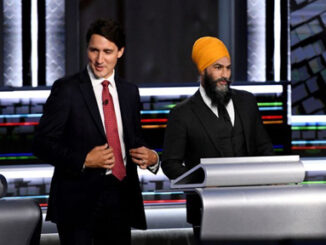
OTTAWA (TIP): Canadian Prime Minister Justin Trudeau on Friday looked set to lose power early next year after a key ally said he would move to bring down the minority Liberal government and trigger an election.
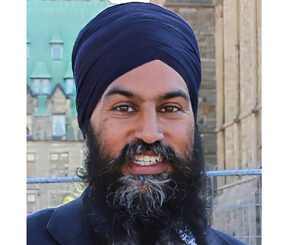
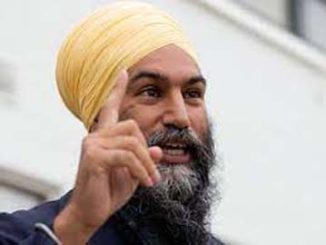
New Democratic Party leader Jagmeet Singh, who has been helping keep Trudeau in office, said he would present a formal motion of no-confidence after the House of Commons elected chamber returns from a winter break on Jan. 27. If all the opposition parties back the motion, Trudeau will be out of office after more than nine years as prime minister and an election will take place.
A string of polls over the last 18 months shows the Liberals, suffering from voter fatigue and anger over high prices and a housing crisis, would be badly defeated by the official opposition right-of-center Conservatives.
The New Democrats, who like the Liberals aim to attract the support of center-left voters, complain Trudeau is too beholden to big business.
“No matter who is leading the Liberal Party, this government’s time is up. We will put forward a clear motion of non-confidence in the next sitting of the House of Commons,” said Singh.
The leader of the Bloc Quebecois, a larger opposition party, promised to back the motion and said there was no scenario where Trudeau survived.
The Conservatives said they would ask Governor General Mary Simon – the personal representative of King Charles, Canada’s head of state – to recall Parliament to hold a no-confidence vote before the end of the year. Constitutional experts say Simon would reject such a move.
“We cannot have a chaotic clown show running our government into the ground. What is clear is that Justin Trudeau does not have the confidence of Parliament,” Conservative leader Pierre Poilievre told reporters. Shortly after Singh issued his letter a smiling Trudeau, under growing pressure to quit after the shock resignation of his finance minister this week, presided over a cabinet shuffle. Trudeau’s office was not immediately available for comment.
Trudeau, who has not publicly spoken about Freeland’s exit, usually addresses reporters after cabinet shuffles but left without saying a word. Major domestic media organizations said his office had canceled traditional end-of-year interviews.
Votes on budgets and other spending are considered confidence measures. Additionally, the government must allocate a few days each session to opposition parties when they can unveil motions on any matter, including non-confidence. Singh’s move is a political risk, since the polls showing a bad defeat for the Liberals also have bad news for the NDP.
Darrell Bricker, CEO of polling firm Ipsos-Reid, said Singh saw a chance to replace the Liberals as the first choice for voters who opposed the Conservatives.
“Waiting to give the Liberals and even Trudeau a chance to get off the mat is ill-advised,” he said by email.
Before Singh made his announcement, a source close to Trudeau said the prime minister would take the Christmas break to ponder his future and was unlikely to make any announcement before January.
Liberal leaders are elected by special conventions of party members, which take months to arrange.
Singh’s promise to act quickly means that even if Trudeau were to resign now, the Liberals could not find a new permanent leader in time for the next election. The party would then have to contest the vote with an interim leader, which has never happened before in Canada.
So far around 20 Liberal legislators are openly calling for Trudeau to step down but his cabinet has stayed loyal.
The timing of the crisis comes at a critical time, since U.S. President-elect Donald Trump is due to take office on Jan. 20 and is promising to impose a 25% tariff on all imports from Canada, which would badly hurt the economy.
The premiers of the 10 provinces, seeking to create a united approach to the tariffs, are complaining about what they call chaos in Ottawa.
(Agencies)
OTTAWA (TIP): After losing the first two battles to bring down the minority Liberal government, Conservatives, the Official Opposition Party, tabled its third successive no-confidence motion in the penultimate week sitting of the House of Commons. The House of Commons will adjourn for holiday break at the end of next week. Unmindful of the earlier failed attempts to topple Justin Trudeau’s Government and force an early election to the House of Commons, Conservative Leader Pierre Poilievre tabled his motion before the House of Commons on Thursday.
Structuring its no-confidence motion on the past criticisms, especially the quotes from the statements the NDP leader Jagmeet Singh made while tearing down the supply and confidence agreement with the Liberals.
Earlier no-confidence motions moved by Conservatives in September and October failed. The minority Liberals are likely to survive the third no-confidence motion as well as the NDP leader had already declared that his party would not play Pierre Poilievre’s game. The Liberals need the support of one of the other parties – Bloc Quebecois or NDP – in the House of Commons to continue in the saddle in the New Year. Voting on the no-confidence motion will take next week when the House of Commons resumes its sitting on Monday.
While introducing the motion on Thursday afternoon, Pierre Poilievre said he was presenting this motion in the “spirit of non-partisanship.”
The language of the motion refers to a statement the NDP Leader Jagmeet Singh made when he announced in September that his party was pulling out of the supply-and-confidence agreement with the Liberal government.
Pierre Poilievre said, “I rise today in the spirit of non-partisanship, put our differences aside and take a good idea and a good perspective no matter where it comes from.” He further commented, “Too often in this place, we refuse to accept ideas or input from other people and so I thought I would remedy that by taking the words and the message of the leader of the NDP and putting them in a Conservative motion so that all of us could vote for the very wise things that he said.”
“Whereas the NDP Leader said, ‘the Liberals are too weak, too selfish and too beholden to corporate interests to fight for people,’” the motion states in the preamble and continues to ask that: “Therefore, the House agrees with the NDP Leader and the House proclaims it has lost confidence in the Prime Minister and the Government.”
The motion further includes Singh’s comment criticizing the Liberal government for imposing binding arbitration to end the railway shutdown in August.
The minority Liberals are likely to survive the third no-confidence motion as the NDP leader had already declared that his party would not play Pierre Poilievre’s game.
As the debate on the motion started, the Conservatives held that the next federal election would be an axe Carbon tax election that would bring face-to-face the Conservatives vs the rest – the Liberals, NDP, Bloc Quebecois and Greens. Pierre Poilievre while moving the motion held that Labour Minister Steven MacKinnon’s order to impose binding arbitration on railway workers violated their right to strike. In a debate that followed the tabling of the motion, MacKinnon accused Poilievre of backing anti-union bills.
“On the other hand, Mr. Speaker, Liberals have been there for workers from day one. On this side of the House, we stand on our record, not an empty slogan,” MacKinnon said.
Since the NDP leader Jagmeet Singh was not at the debate, NDP MP Matthew Green criticized Poilievre’s stance on workers’ rights. “Despite all this cosplay we see in front of us … has this member ever once in his life visited a picket line?” he asked. To which Poilievre responded: “Yes, Mr. Speaker.”
Early this week, when the Conservative leader revealed the content of the next no-confidence motion, Jagmeet Singh reacted by saying he won’t play Conservative Leader Pierre Poilievre’s games. He maintained he was not going to vote non-confidence and trigger an election as he believed Pierre Poilievre would cut programs the NDP fought for, like dental care and pharma care.
“I am not going to be playing Pierre Poilievre’s games. I have no interest in that. We are frankly not going to allow him to cut the things that people need. I want to have dental care expanded, I want people to start to benefit from the pharma care legislation we passed,” Singh said.
Another two Conservative motions would be heard Monday, December 9 and Tuesday, December 10, with both set for a vote on Tuesday, December 10, barring changes to those plans.
(Prabhjot Singh is a Toronto based award-winning senior journalist. He can be reached at prabhjot416@gmail.com)
New Democratic Party and Conservative Party win 46 and 45 seats, respectively, while Green Party wins two seats in 93-member House
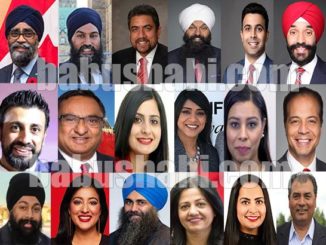
VANCOUVER (TIP): Thirteen candidates having roots in Punjab have won in the recent British Columbia provincial elections, further cementing the community’s influence in Canadian politics. The victories come as the Indo-Canadian population, particularly the Punjabi community, continues to grow in size and prominence, especially in British Columbia.
The New Democratic Party (NDP) and the Conservative Party won 46 and 45 seats, respectively, while the Green Party emerged victorious on two seats in the 93-member House.
The successful candidates hail from different political backgrounds, representing both the NDP and the Conservative Party. They contested on diverse platforms, advocating issues such as healthcare reforms, economic development, climate action and greater support for immigrants.
Among the prominent winners was housing minister Ravi Kahlon, who retained his Delta North seat with a significant margin. Kahlon has been instrumental in driving policies related to housing and climate change.
Another notable victor is Raj Chauhan, the outgoing speaker of the British Columbia assembly. Winning for the record sixth time, he had earlier served as the assistant deputy speaker from 2013 to 2017 and the deputy speaker from 2017 to 2020.
Minister of state for trade Jagrup Brar won from Surrey Fleetwood for the seventh time. Born in Bathinda, Brar was once part of the Indian national basketball team. Later, he moved to Canada for studies and settled here. He has been active in politics since 2004 when he was elected as an MLA.
Conservative Party candidate Mandeep Dhaliwal defeated minister of education and childcare Rachna Singh from Surrey North. However, prominent Punjabi leader Jinny Sims lost from Surrey Panorama.
NDP candidates Ravi Parmar won from Langford Highland, Sunita Dhir from Vancouver Langara, Reah Arora from Burnaby East and Harwinder Kaur Sandhu from Vernon Monashee. Harwinder won for the second time from the seat.
Attorney General Nikki Sharma won again from Vancouver Hastings, while Jessie Sunner triumphed from Surrey Newton.
Conservative leader Harman Singh Bhangu has emerged victorious from Langley Abbotsford constituency, Honveer Singh Randhawa from Surrey Guildford and Tody Toor from Langley Willowbrook.
Their victories mark a significant moment for the Punjabi community, which has long played a vital role in the socio-economic fabric of British Columbia, particularly in the cities like Surrey and Abbotsford, where a large number of Indo-Canadian population resides. These regions have seen increased political mobilization in recent years, with local community leaders emphasizing the importance of political representation.
TORONTO (TIP): As many as 15 candidates of Punjab origin are in the fray for the Alberta provincial elections in Canada for which the polling is scheduled to be held on May 29 for all 87 constituencies.
The two major political outfits — National Democratic Party (NDP) and United Conservative Party of Alberta (UCP) — are not only banking heavily on South Asians and Punjabis in particular, they have also given “adequate representation” to their communities by fielding them. Punjabis are mostly contesting in Calgary and Edmonton area seats. The major Punjabi candidates who are contesting the polls are Rajan Sawhney (Cabinet Minister for Trade, Immigration and Multiculturism), contesting from Calgary North-West on a UCP ticket, MLA Devinder Toor, seeking re-election on a UCP ticket from Calgary-Falconridge and MLA Jasvir Deol, contesting from Edmonton Meadows on an NDP ticket. In 2019, Sawhney had won from Calgary North-East riding and earlier this year, she had announced that she wouldn’t seek re-election from here, but after the UCP Environment Minister and sitting Calgary Northwest candidate Sonya Savage announced retirement from politics, UCP announced Sawhney as a candidate.
Sawhney has degrees in economics and political science from the University of Calgary, besides an MBA. Prior to her political stint, she worked in the oil and gas industry for over 20 years. Rajan Sawhney said, “I will work hard every day to see Calgary North-West move forward with growth, prosperity & a more affordable Alberta because we can’t afford to go back to decline, high taxes & the failed policies of the NDP.”
The UCP has also fielded Amanpreet Singh Gill from Calgary-Bhullar-Mccall, Inder Grewal from Calgary North-East, R Singh Bath from Edmonton Ellerslie, Amritpal Singh Matharu from Edmonton Meadows and Raman Athwal from Edmonton Mill Woods. Other Punjabi candidates fielded by the NDP are Gurinder Singh Gill from Calgary-Cross, Parmeet Singh Boparai from Calgary-Falconridge, Gurinder Brar from Calgary North-East, Harry Singh from Drayton Valley-Devon. Aman Sandhu is contesting on a Green Party of Alberta (GPA) ticket from Calgary-Cross, Jeewan Mangat on Wildrose Independence Party of Alberta (WIPA) from Innisfail-Sylvan Lake and Braham Luddu on Alberta Party (AP) from Lethbridge-West.
By Prabhjot SinghFormer Ontario NDP leader Andrea Horwath announces bid for Hamilton mayor while Sukh Dhaliwal is to run for mayor of Surrey
Politics is a game of beautiful uncertainties. Essentially mandated to serve people at large, politicians are known for sudden shifts in their roles. The shifts are mostly induced by denial of roles they wanted to perform. Being a Federal or a Provincial Minister once, some find it little hard to subsequently adjust as an elected representative alone. There may be other reasons for changing priorities or offices they want to hold in a system full of opportunities for those who have enjoyed electoral success at some level. It keeps them moving ahead, eyeing new opportunities. It is perhaps the dynamics of politics that has seen many senior parliamentarians opting to serve their local communities as Mayors. Most recent example has been Andrea Horwath, who until last month was in the running for Premiership of Ontario as the leader of the NDP, is now running for mayor in Hamilton to help the city “realize its potential.” In British Columbia, long time MP from Surrey Newton, Sukh Dhaliwal, has also announced his candidature for Mayor of Surrey. Another former MP and MPP, Jinny Sims, too, is in the running for Mayor of Surrey, the second biggest city of British Columbia.
Mayoral elections are due in October.
Andrea Horwath, the former leader of the Ontario New Democratic Party (NDP) has announced to quit her post as Member of Provincial Parliament (MPP) for Hamilton Centre to enter the mayoral race. She says the work she has done all her political life is for her city of Hamilton. It would be a really exciting time to be part of the realization of the great opportunities that are ahead, she told select media ahead of her public announcement. Horwath joins three others in the race for the job: former mayor Bob Bratina, newcomer to politics Keanin Loomis and labor advocate Ejaz Butt. Current Mayor Fred Eisenberger announced last month he would not be seeking re-election.
Horwath, born and raised in the city, was Ward 2 city councilor from 1997 to 2004 before becoming Hamilton East MPP for the NDP. In 2007, she became Hamilton Centre MPP and eventually leader of the Ontario NDP.
During her time as leader, she helped the NDP go from not having official party status to being official opposition twice. The party won 40 seats in 2018 but the recent election in June saw that number decrease to 31. She announced her resignation as party leader the evening of June 2 within hours of the declaration of the results.
If she wins the Mayoral election, she will be the first woman in 175 years to do so. Many believe that change of course followed Horwath’s unsuccessful attempt to become Ontario premier. Coming to British Columbia, where the leadership race has been thrown open by Premier Horgan deciding to quit before next leadership election for which eight of Ministers have said no to join the race, decks are almost clear for the Attorney General David Eby to be the next Premier.
Olympian-turned politician and Job Minister Ravi Kahlon who was considered a possible choice for Premiership has already said he would not run . He has, instead, supported his cabinet colleague David Eby for the top spot.
After Ravi Kahlon made clear his position, several other Ministers including Finance Minister Selina Robinson, Health Minister Adrian Dix, Lands Minister Josie Osborne, Municipal Affairs Minister Nathan Cullen, Tourism Minister Melanie Mark, Minister of State for Infrastructure Bowinn Ma and Minister of State for Childcare Katrina Chen, have said they will not run for leadership.
This leaves the field open for David Eby. His election may be unanimous as of today there appears to be no other candidate willing to join the leadership race. Since no one was coming forward, the announcement made by David Eby about his candidature for the Premiership ended weeks of speculation over who might replace John Horgan as party leader and premier of British Columbia. Interestingly all other high-profile New Democrats have bowed out of this fall’s leadership election. As of now, David Eby looks the frontrunner and perhaps the only candidate for the leadership to be decided on December 3. Born in Kitchener, David Eby will turn 46 on Thursday (today).
Yet another Member of Parliament has decided to run for Mayoral post. This time, it is none other than Sukh Dhaliwal, the sitting MP from Surrey Newton. He made his decision known on Monday that he will be joining the race for the position of Mayor of Surrey, the second largest city of British Columbia. Before him, three MPs, including ex-MPs, have moved from federal to local politics. One of them, who was a cabinet minister in the previous Justin Trudeau Government, Amarjit Sohi, is Mayor of Edmonton.
Another ex-MP, Jinny Sims, who after a stint in the House of Commons, moved to provincial politics, has now decided to opt for local politics. She had announced her candidature for the post of Mayor of Surrey last month.
Bal Gosal, who incidentally was one of the first MPs, to try his luck in Mayoral politics, was unsuccessful in the Indian-immigrant rich city of Brampton from where Patrick Brown was elected Mayor in the last elections.
Incidentally, Patrick Brown, who was in the run for the Conservative Party leadership but faced “disqualification” on grounds of violating the election laws, has announced his decision to re-run for the Mayoral post in October.
The race for Surrey mayor, however, has assumed special importance as it is set to witness a quadrangular contest involving a former NDP MP, Jinny Sims, current sitting MP Sukh Dhaliwal, Councilor Brenda Locke and incumbent Mayor Doug McCallum.
Sukh Dhaliwal’s decision to move back from Ottawa to Surrey came after months of deliberations and speculation. “Over the last four years, we have seen divisive politics, unprecedented division, partisanship, no focus on the citizens of Surrey,” he said.
Calling Surrey’s current council “secretive” and “biased,” Dhaliwal added that he plans to “repair a divided city,” media reports quoting him from his Monday’s Press Conference said. Dhaliwal has run against Sims in three federal elections and was a key organizer for McCallum when he was first mayor in the 1990s. Dhaliwal announced his action plan while setting his election campaign in motion.
If elected, he says, there will be a roll back of a $200 increase to the yearly parcel tax that Surrey council enacted in 2020, besides “an immediate one-year tax freeze.” This will help the people that need the help now, because we are going through unprecedented uncertainty, he said. To meet the loss on account of tax cut, Dhaliwal hopes to meet it through Surrey’s accumulated surplus that would facilitate the changes. “We have accumulated wealth, almost $300 million and we can use that money that we have accumulated to make sure that we are able to help the ones that need the most by freezing those taxes,” he told a section of media.
Dhaliwal said he has no intention of reversing the biggest development of McCallum’s tenure — the transition to an independent municipal police force from the Surrey RCMP. While Locke is promising to overturn the transition and Sims has promised to study the details before making a decision, Dhaliwal says the move is too far underway to reverse now.
“It is my understanding that almost 300 people are already hired in the city police. We have come a long way.”
With Sukh Dhaliwal joining the race, it could split the strong Indo-Canadian community in the second largest city of British Columbia. If it happens, the chances of incumbent McCallum winning another term in office may brighten up. Academicians and other experts also hold that Surrey residents may also want a clean slate after McCallum dominated news headlines for many years in controversial ways, including a criminal charge for mischief that won’t be fought in court until after the election. The field is still open for more candidates to join the Mayoral race as a former White Rock mayor, MLA and MP Gordie Hogg, may also throw his hat in the ring.
(Prabhjot Singh is a veteran journalist with over three decades of experience covering a wide spectrum of subjects and stories. He has covered Punjab and Sikh affairs for more than three decades besides covering seven Olympics and several major sporting events and hosting TV shows. For more in-depth analysis please visit probingeye.com or follow him on Twitter.com/probingeye. He can be reached at prabhjot416@gmail.com)
“Punjabis love diversity, be it in making a choice of their immigrant destination or politics. Their ability to relocate and adjust to new environments are tremendous. Many of them may not be able to read or write local languages of their new countries of abode but their matchless ability to converse in local languages facilitates their quick assimilation in alien lands.” Once Jagrup Brar, a sitting member of the British Columbia Assembly, told me that every migrant Punjabi in Canada has two hearts. While one beats for Canada, the other throbs for Punjab. Jagrup, a former international in basketball, had a point. It gets corroborated every time there is an election in either “Desi” or Indian Punjab or “Videshi” Punjab i.e., Canada.
Like “Desi” Punjab has two parts – “Lehnda” and “Charhdha” Punjab – “Videshi” Punjab, too, has two parts. One is in Ontario and the other one in British Columbia. Going by the growing influence of Punjabis and their clout in provincial and federal politics, a third part of “Videshi” Punjab is fast emerging on the Canadian horizon in Calgary of Alberta province. Last weekend, when Sikh Day Parade dedicated to “Khalsa Divas” was organized, its massive turnout was as good as it is in Toronto or Vancouver. While “Desi” Punjab had its assembly elections in February, the Ontario based “Videshi” Punjab is now in election mode. It will elect its new Assembly on June 2.
Of a record number of 900 candidates, representing 25 different political parties, 60 of the contestants are of South Asian origin. More than one third of them are Punjabis.
“Videshi” Punjabis of Ontario are as democratic as their counterparts in “Desi” Punjab by sharing their loyalties with all major political parties. A couple of them are also testing their political acumen as Independents.
It is interesting to study the election process in “Desi” and “Videshi” Punjab. Punjabis love diversity, be it in making a choice of their immigrant destination or politics. Their ability to relocate and adjust to new environments are tremendous. Many of them may not be able to read or write local languages of their new countries of abode but their matchless ability to converse in local languages facilitates their quick assimilation in alien lands.
Studies conducted from time to time reveal that political influence wielded by the Punjabi community overseas remains mostly confined to suburbs of major cities. In Canada, for example, if the community has made inroads into provincial and federal politics, it is through the suburbs. There are not many South Asian migrants in general and Punjabi in particular, who made it to provincial or federal politics from major cities like Toronto. On doing analysis of their phenomenal growth in politics, one can safely infer that suburbs of big towns have helped them to script their success stories. A total of 900 candidates and 25 parties are running in this election. In 2018, there were 825 candidates and 28 parties on the ballot. This represents a 9% increase in the number of candidates and a 10.7% decrease in the number of parties participating.
The coming June 2 election is no different. Five ridings in Brampton – North, South, East, West, and Centre – are dominant Punjabi Ridings. From Brampton East, for example, all the three major political parties – ruling Conservatives, NDP and Liberals – have put up Sikh candidates. The NDP is represented by Gurratan Singh, younger brother of the federal NDP leader Jagmeet Singh. Then Jannat Grewal is from Liberal while Hardeep Grewal represents the ruling Conservatives.
From Brampton North, it is Harinder Malhi contesting on Liberal ticket. Her father, Gurbax Singh Malhi, was the first turbaned Sikh to sit n House of Commons. He remained MP for five consecutive terms. She is facing Sandeep Singh of NDP while the third candidate of South Asian origin is Aneep Dhade contesting on the Green Party ticket.
Mississauga and Scarborough are the other important parts of the Greater Toronto Area that are represented both in provincial and federal parliaments by South Asian migrants. Eight South Asian migrants are contesting from three different Mississauga Ridings.
Bampton West presents a unique picture. Of the four Punjabi contestants, the community has shown excellent gender equality by fielding an equal number of men and women candidates. Rimmy Jhajj (Liberal), and Navjit Kaur (NDP) represent the women while Amarjot Sandhu, a sitting MLA of ruling Conservatives, and Manjot Sekhon of Ontario Party, are men candidates.
From five Brampton Ridings, there are 13 Punjabi candidates. One of them, Sara Singh (NDP), the first Canadian of Indo-Caribbean origin to sit in Ontario Provincial Assembly, has an opponent from Pakistani Punjab, Safdar Hussain (Liberal). Another candidate from Pakistan Punjab is Zaigham Butt from Hamilton East-Stoney Creek. He is a candidate of the NDP. A sizable section of Pakistani Punjabis in Ontario has been a supporter of Jagmeet Singh.
Among the South Asian migrants contesting the June 2 Ontario assembly elections are Sara Singh, Gurratan Singh, Sandeep Singh, Navjit Kaur, Aisha Jahangir, Faheem Alim, Zaigham Butt, Farina Hassan, Khalid Ahmed, Raymond Bhushan, Neethan Shan, Doly Begum, Jasleen Kambo, and Pasma Chandra (all from NDP), Abhjeet Manay, Aneep Dhade, Fatima Faruq, Mini Batra, Nira Dookeran, Priyan De Silva, Rizwan Khan, Shanta Sundarason, Sheefaza Esmail and Syam Chandra (all from Green Party), Aman Gill, Anita Anandarajan, Dipika Damerla, Harinder Malhi, Imran Mian, Jannat Grewal, Kaviz Mouli, Lisa Patel, Mohammed Adil, Manpreet Brar, Mazhar Shafir, Rimmy Jhajj, Ruby Toor, Safdar Hussain, Sam Bhalesar, Sameera Ali, Shubha Sandil, Surekha Shenoy, Zeba Hashmi , and Aziz Choudery (all from Liberals), Hardeep Grewal, Prabhmeet Singh Sarkaria, Amarjot Sandhu. Goldie Ghamari, Logan Kanapathi, Parm Gill, Kaleed Rasheed, Deepak Anand, Nina Tangri, Vijay Thangasalam, and Husain Neemuchwala (all from Progressive Conservative), Manjot Sekhon (Ontario Party), Sadiq Nadia (Ontario Provincial Confederation), Hiten Patel and Birinder Singh Ahluwalia (Independents).
(Prabhjot Singh is a veteran journalist with over three decades of experience covering a wide spectrum of subjects and stories. He has covered Punjab and Sikh affairs for more than three decades besides covering seven Olympics and several major sporting events and hosting TV shows. For more in-depth analysis please visit probingeye.com or follow him on Twitter.com/probingeye. He can be reached at prabhjot416@gmail.com)
It was not easy. The early migrants from South Asia were not welcome to Canada. They not only suffered numerous hardships but were also denied the right for a decent living. They had no voting rights. In fact, the concept of the Nagar Kirtan processions, or the Sikh Parades, proved to be an effective tool for the overseas Sikh community to introduce itself as a peaceful and hard-working group that had no qualms of making countries of their present abode as their homes. The first ever-Sikh Parade or Nagar Kirtan procession was organized on January 19, 1908, along Second Avenue in Vancouver.
It has been this commitment that has helped them to script an unprecedented success story the world over. Though the Punjabis – initially described as Hindus – started reaching Canada in early 1900, they were denied voting rights in British Columbia from 1907 onwards. They had to wait for 40 long years to win back the right to vote. In 1947, the requirement to be a voter was changed to Canadian citizenship in addition to being a British subject. It was in 1950 that the first Sikh – Naranjan Singh Grewall – was elected to the City Council of Mission in British Columbia.
He became the first “Hindu” (the colloquial term for South Asians at the time) elected to any political position in Canada. Later, he became the first South Asian migrant to become Mayor of the Mission City Council in 1954. Grewall’s run for a seat in the BC Legislature as a member of the CCF surprised no one. He was first and foremost a man of the people. He lost the assembly election in a close battle.
The Indo-Canadian community was waiting for the break Naranjan Singh Grewall had provided. Once the process of its assimilation in mainstream politics started, the Punjabi migrant community set its goals high. And before the turn of the century, it had three of its nominees – Gurbax Malhi, Herb Dhaliwal, and Jag Bhaduria – sitting in the House of Commons in Ottawa.
And long before their journey to Ottawa started, the beginning, though unsuccessful, was made in late 60s and early 70s. In 1970, a new party was born. It was headed by an Indo-Canadian. Called Communist Party of Canada (Marxist-Leninist), it was founded by Hardial Singh Bains, a trained Bacteriologist. Born in Mahilpur in Hoshiarpur, Hardial moved to Vancouver when he was 19. Much before Jagmeet Singh became the President of the NDP, Hardial Singh Bains had earned the distinction of leading a national political party in Canada.
After studying in Canada, England, and Ireland, Hardial Singh Bains returned to Canada and spearheaded the workers movement. Since Elections Canada does not allow the use of the word “communist” in the name of any party, Hardial Singh Bains got his party registered as Marxist-Leninist Party of Canada in 1974. Before his death in 1997, the Marxist-Leninist Party contested the 1974, 1979, 1980, 1993 and 1997 federal elections. Though the party has never succeeded in sending any of its members to the House of Commons, it fielded its largest number of candidates,177, in 1980. Many of these candidates were migrants, including those from India. Amarjit Dhillon, who was the party candidate from Vancouver South, both in 1979 and 1980, polled only 91 and 63 votes. Overall, though the party never aggregated 0.20 per cent of total votes polled, still it never gave up its fight and contested the last federal elections in 2021 by fielding 36 candidates.
It was in 1974 when Hari Singh, a teacher, contested on Liberal ticket from Okanagan-Kootenay. Though it was a Liberal stronghold, but Hari Singh lost. After his defeat, he accused the majority community of Liberals of voting against him. Subsequently, the Liberals retained the seat.
Ten years later in 1984, another teacher, Harkirpal Singh Sora, contested from Vancouver South. He too was unsuccessful. Deepak Obhrai was the longest serving MP from Calgary East. Long before he emerged on the scene, in 1988 this riding had tried to elect Anil Giga, a Liberal, to the House of Commons. He, however, was defeated by Alex Kindy by 18,227 votes. The Bramalea-Gore-Malton Riding has always remained a stronghold of the Punjabi migrants. The first attempt by the community to get into the House of Commons was in 1988, when the Liberals put up Gurjit Grewal, who lost by 2,185 votes to Harry Chadwik of the CP.
Palbinder Shergill, a young amritdhari Sikh and a practicing lawyer, was one of the first Punjabi women to contest federal elections. She was unsuccessful along with another Punjabi Indo-Canadian candidate from the Surrey Central Riding. The other candidate was Charan Gill who had earlier made an attempt to get into the House of Commons in 1988 but was defeated by Benno Friesen of the PC. He represented the NDP.
Sikh Turban has become an integral part of Canadian Parliament
Two turbaned Sikh politicians – one from yesteryear, and another from now – Gurbax Singh Malhi and Jagmeet SinghJagmeet Singh
October 25, 1993 would go down in the annals of history of the Canadian House of Commons as a golden letter day. It was on this day that Canada earned the distinction of electing the first turbaned Sikh MP to any Parliament outside India. The honor went to Gurbax Singh Malhi as he was declared successful from Bramalea-Gore-Malton riding. Though two more MPs of Indian origin – Harbance (Herb) Singh Dhaliwal and Jagdish Bhaduria – also made their debut in the Canadian House of Commons simultaneously, the spotlight was on Gurbax Singh Malhi. Since then, no Canadian Parliament has been complete without a turbaned Sikh represented on it.
Starting with three MPs in 1993, now the Indo-Canadian community has grown six times in its strength in the House of Commons. It represents all three major parties – the ruling Liberals, the main Opposition party the Conservatives, and the third major party NDP headed by an Indo-Canadian Jagmeet Singh. Incidentally, Jagmeet Singh is the lone Indo-Canadian NDP in the current House of Commons.
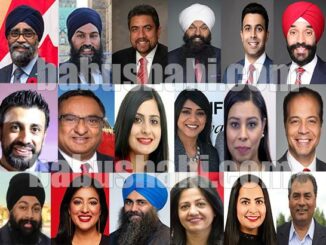
Of 42 MPs of Indian origin elected to House of Commons since 1993, Navdeep Singh Bains, Tim Uppal, Jagmeet Singh, Randeep Sarai, Harjit Singh Sajjan, Darshan Singh Kang, Raj Grewal, Jasraj Singh Hallan and Iqwinder Singh Gaheer, are among those who earned special limelight because of their colorful turbans.
Incidentally, Gurbax Singh Malhi has till date remained the longest serving Sikh MP representing the Liberals. He was elected five times starting in 1993 till he lost the 2011 elections. Otherwise, Deepak Obhrai, who was born in Tanzania, earned the distinction of longest serving Canadian MP of Indian origin. He retained his House of Commons seat for seven consecutive terms mostly as a nominee of Conservatives.
While Gurbax Singh Malhi, Jag Bhaduria and Herb Dhaliwal were the first representatives of Liberals in Canadian Parliament, the honor for giving representation to Indo-Canadians in the House of Commons on behalf of Conservatives went to Deepak Obhrai and Gurmant Grewal. Subsequently, Jasbir Singh Sandhu and Jinny Jogindera Sims were the first Indo Canadians to represent NDP in the Canadian Parliament.
Women of Indo-Canadian descent did not take along to reach Ottawa’s Parliament Hill. Ruby Dhalla (Liberal from Ontario) and Nina Grewal (Conservative from British Columbia) became the torch bearers. They were followed by Jinny Jogindera Sims (NDP).
Sonia Sidhu, Ruby Sahota, Kamal Khera, Bardish Chagger and Anju Dhillon created ripples when they all made their entry into the 42nd Parliament and are all continuing in the current 44th Parliament. In the 43rd Parliament they were joined by Anita Anand, the first Indo-Canadian woman politician to hold the important portfolio of Defense. Also, a new entrant was Jag Sahota, the ninth woman of Indian origin to enter Canadian Parliament.
These Canadian MPs of Indian origins have several other firsts to their credit. For example, Gurmant Singh Grewal and Nina Grewal were the first couple to sit in the same House. Herb Dhaliwal was the first from the group to be inducted in the Canadian Cabinet as a Minister for Oceans. Many of them have remained Parliamentary Secretaries attached with important ministries.
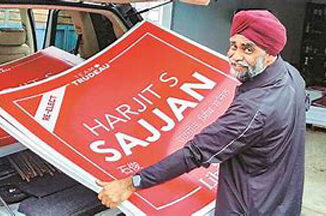
In the previous Liberal Government, Harjit Singh Sajjan, became the toast of not only the Indo-Canadian community but also of the rapidly growing Indian Diaspora after he was named the Defense Minister of Canada.
Bardish Chagger hawked media headlines on becoming the first woman leader of the House of Commons. And late last year, Anita Anand stole the limelight as the first Indo-Canadian woman to hold the portfolio of Defense Minister. Incidentally, the last two Liberal Governments had an Indo-Canadian as Defense Minister.
There have been Indo-Canadians who created history both in provincial and federal politics. The shining example has been of Ujjal Dosanjh who after his phenomenal rise as the first Indo-Canadian Premier of British Columbia later held the portfolio of the Canadian Health Minister. A couple of MPs, including Jinny Jogendra Sims and Parm Gill, later made their debut in provincial politics and held positions as Cabinet Ministers in British Columbia and Ontario, respectively. Amarjit Sohi, who held an important cabinet portfolio in the previous Justin Trudeau government is now a Mayor of Edmonton in Alberta since last year.
MPs of Indian origin
Gurbax Singh Malhi
Harbance (Herb) Singh Dhaliwal
Jag Bhaduria
Deepak Obhrai
Gurmant Grewal
Rahim Jaffer
Nina Grewal
Ruby Dhalla
Ujjal Dosanjh
Navdeep Bains
Sukh Dhaliwal
Tim Uppal
Jinny Jogindera Sims
Devinder Shory
Jasbir Sandhu
Bal Gosal
Parm Gill
Joe Daniel
Amarjit Sohi
Jagmeet Singh
Gagan Sikand
Sonia Sidhu
Jati Sidhu
Bob Saroya
Randeep Singh Sarai
Ramesh Sangha
Harjit Singh Sajjan
Raj Saini
Ruby Sahota
Kamal Khera
Darshan Singh Kang
Raj Grewal
Anju Dhillon
Bardish Chagger
Chandra Arya
Maninder Sidhu
Jag Sahota
Jasraj Sigh Hallan
Anita Anand
Iqwinder Singh Gaheer
George Chahal
Parm Bains
-To be concluded
(Prabhjot Singh is a veteran journalist with over three decades of experience covering a wide spectrum of subjects and stories. He has covered Punjab and Sikh affairs for more than three decades besides covering seven Olympics and several major sporting events and hosting TV shows. For more in-depth analysis please visit probingeye.com or follow him on Twitter.com/probingeye. He can be reached at prabhjot416@gmail.com)
Indo-Canadian politicians after establishing their credibility at the community level, and now, on the basis of their track record, are emerging as a strong political entity with their growing presence on the provincial and federal stage. When Ontario goes to polls in first week of June, they will be major playmakers, says Prabhjot Singh, holding their past record since their entry in provincial politics in British Columbia in 1986 has been a success story that every immigrant community across the globe should emulate.
After making a dent in the political scenario of the province of British Columbia in Canada in the early 80s when they sent Moe Sihota to the state legislature as an elected MLA on the New Democratic Party ticket, South Asian politicians have come a long way. They have not only scripted a success story but are a vibrant and rapidly growing political entity that has successfully spread its wings as both federal and provincial lawmakers.
Born in Duncan, Moe – Munmohan Singh – Sihota has been the second generation politician of Indian origin who served on the BC Cabinet in different capacities before heading the BC NDP.
“Immigrants from South Asia take more interest in politics back home than flex theirpolitical sinews in the new countries of their domicile. They, somehow, do not get assimilated in their new political environments.” This observation, made by one of the scholars-cum-writers on the Indian diaspora about 30 years ago, now needs to be revised. The South Asian politicians are now more into Canadian politics at all levels – from municipal to federal – than remaining involved in politics back home. Their diminishing interest in politics back home was evident from their token presence in the just concluded Punjab Vidhan Sabha elections that gave a landslide win to the Aam Aadmi party with 92 of 117 seats.
South Asian immigrants now not only occupy 20 odd seats in the House of Commons but also have one of them as the leader of a major federal party, the NDP. It is this leader, Jagmeet Singh, who earlier sat in the Ontario Provincial Parliament for nearly two terms, signed an agreement with the minority Liberal Government of Justin Trudeau to keep it in office till the completion of its term in 2024, for getting important demands of NDP, including free dental care, accepted.
What started as a single seat in the British Columbia Provincial Parliament in October 1986 has now spread to five Provincial Parliaments that have South Asian politicians as members. The latest on the list is Saskatchewan that had in 2020 elected its first ever Indo-Canadian Gary Grewal from Regina.
The South Asian politicians in general and Indo-Canadians in particular will now be sending 50-odd candidates for the ensuing elections to the Ontario Provincial Parliament in the first week of June. Besides representing the ruling Conservatives, they will also be contesting under the banners of Liberal, NDP, Green and other parties.
Interestingly, most of these candidates are not only second generation Canadians but are also well qualified professionals, including lawyers, teachers, nurses, engineers and social activists with degrees from top universities in Canada. Only a handful of first generation politicians will be in fray for the June polls.
The growth of Indo-Canadian politicians has been phenomenal. Fourteen years after Moe Sihota was elected to British Columbia Provincial Parliament, Ujjal Dosanjh earned the distinction of becoming the first Indo-Canadian to take oath as Premier of British Columbia. The Indo-Canadian community, especially Punjabis, have, since then, not looked back. Though initial political successes came in British Columbia under the banner of NDP, the South Asian politicians jumped on the Liberal bandwagon for rapid strides in Canadian politics.
The 1990 Calgary Convention of the Liberal Party, leading to the election of Jean Chretien as its leader, was a milestone, for it formed a solid, loyal voting block for the future Prime Minister of Canada. It was the first time the community organized itself as a political force.
Some still believe that the events back home in 1984 was a strong factor that mobilized a small but highly vociferous community into a political group.
Now 30 years later, the Indo-Canadian community not only boasts of Indo-Canadian as Defense Ministers of Canada in Harjit Singh Sajjan or Anita Anand or a Punjabi as the first woman Leader of the House of Commons in Bardish Chagger or first Punjabi Premier of British Columbia in Ujjal Dosanjh but also several ministers starting with Herb Dhaliwal, Navdeep Bains, and Amarjit Sohi ; Gurbax Malhi, the first turbaned Sikh as Member of the House of Commons for five successive terms; and Grewals, Gurmant and wife Neena, as the first Punjabi couple in Parliament, but also several Punjabis sitting in Provincial Parliaments of Ontario, British Columbia, Manitoba, Alberta and Saskatchewan.
In Ontario , Raminder Gill, who represented the Conservative Party, was one of pioneers of Punjabi politicians to be elected as a Member of the Provincial Parliament. Since then, the number of Punjabi politicians as MPPs (Members of Provincial Parliament or MLAs in common parlance) has been growing with every election.
Dr Gulzar Cheema has the distinction of sitting in both Manitoba and British Columbia Provincial Parliaments.
Besides the 1990 Calgary convention of the Liberals, the emergence of this new phenomenon of ethno-politics in Canada is also linked more to the election of three Indo-Canadians to the House of Commons in 1993 — Herb Dhaliwal, Gurbax Singh Malhi and Jag Bhaduria — it has been gradually gaining ground to what the Canadian media used to describe as the “apna factor”, symbolizing a movement that was gaining strength using the “block voting” technique. Arguments given in favor of the “apna factor” and “block voting” techniques were substantiated by the fact that most of the political success stories, for example in Ontario, came from the suburbs of major cities like Brampton, Mississauga and Scarborough of the Greater Toronto Area. It is true that not many politicians of South Asian origin have won from the main cities. But things are changing.
Late Deepak Obhrai, who won from Calgary East for a record number of times, used to attribute the influence of the Indo-Canadian community to a passion for politics that he believed was rooted in a movement that led to India’s Independence from Britain in 1947.
It is pertinent to mention here that Kamagata Maru or the Ghadar Movement, too, took off from the shores of British Columbia in Canada, the region from where the battle for political recognition began. The then Indo-Canadians or Indian immigrants worked as lumberjacksand participated in development projects, before getting together and heading homewards to get their motherland freed.
It was argued that the freedom movement galvanized the whole nation as every cross-section of society was involved. It infused Indians with an intense interest in politics that is still palpable in the Indo-Canadian community, which has been called the “most politically active ethnic group in Canada now.”
Interestingly, the Indo-Canadian community mostly supported the NDP inBritish Columbia in provincial elections. It also ensured that Sukh Dhaliwal now and HerbDhaliwal earlier retained their seat in the House of Commons as Liberals. In Alberta, the Indo-Canadian community, though small in number, elected more Reform or Conservative MPs. In Ontario, initially they used to go with Liberals in Federalelections but gradually started supporting Conservatives also. It has supported both Liberals and Conservatives in the provincial elections.
That diversity of view is seen at the elected level, where there are MPPs or MPs with the Reform, Liberals, NDP and Conservative parties. Some former Canadian MPs of Punjabi origin, including Gurbax Malhi, used to attribute the success of Indo-Canadian politicians totiming rather than to the “apna factor”. They argued that Indo-Canadian politicians had spent many years establishing their credibility at the community level, and now on the basis of their track record, they are getting widespread voter support to jump to the provincial or federal stage.
(To be concluded)
(Prabhjot Singh is a veteran journalist with over three decades of experience covering a wide spectrum of subjects and stories. He has covered Punjab and Sikh affairs for more than three decades besides covering seven Olympics and several major sporting events and hosting TV shows. For more in-depth analysis please visit probingeye.com or follow him on Twitter.com/probingeye. He can be reached at prabhjot416@gmail.com)
Indo-Canadian politicians after establishing their credibility at the community level, and now, on the basis of their track record, are emerging as a strong political entity with their growing presence on the provincial and federal stage. When Ontario goes to polls in first week of June, they will be major playmakers, says Prabhjot Singh, holding their past record since their entry in provincial politics in British Columbia in 1986 has been a success story that every immigrant community across the globe should emulate.
After making a dent in the political scenario of the province of British Columbia in Canada in the early 80s when they sent Moe Sihota to the state legislature as an elected MLA on the New Democratic Party ticket, South Asian politicians have come a long way. They have not only scripted a success story but are a vibrant and rapidly growing political entity that has successfully spread its wings as both federal and provincial lawmakers.
Born in Duncan, Moe – Munmohan Singh – Sihota has been the second generation politician of Indian origin who served on the BC Cabinet in different capacities before heading the BC NDP. “Immigrants from South Asia take more interest in politics back home than flex theirpolitical sinews in the new countries of their domicile. They, somehow, do not get assimilated in their new political environments.” This observation, made by one of the scholars-cum-writers on the Indian diaspora about 30 years ago, now needs to be revised.
The South Asian politicians are now more into Canadian politics at all levels – from municipal to federal – than remaining involved in politics back home. Their diminishing interest in politics back home was evident from their token presence in the just concluded Punjab Vidhan Sabha elections that gave a landslide win to the Aam Aadmi party with 92 of 117 seats.
South Asian immigrants now not only occupy 20 odd seats in the House of Commons but also have one of them as the leader of a major federal party, the NDP. It is this leader, Jagmeet Singh, who earlier sat in the Ontario Provincial Parliament for nearly two terms, signed an agreement with the minority Liberal Government of Justin Trudeau to keep it in office till the completion of its term in 2024, for getting important demands of NDP, including free dental care, accepted.
What started as a single seat in the British Columbia Provincial Parliament in October 1986 has now spread to five Provincial Parliaments that have South Asian politicians as members. The latest on the list is Saskatchewan that had in 2020 elected its first ever Indo-Canadian Gary Grewal from Regina.
The South Asian politicians in general and Indo-Canadians in particular will now be sending 50-odd candidates for the ensuing elections to the Ontario Provincial Parliament in the first week of June. Besides representing the ruling Conservatives, they will also be contesting under the banners of Liberal, NDP, Green and other parties.
Interestingly, most of these candidates are not only second generation Canadians but are also well qualified professionals, including lawyers, teachers, nurses, engineers and social activists with degrees from top universities in Canada. Only a handful of first generation politicians will be in fray for the June polls. The growth of Indo-Canadian politicians has been phenomenal. Fourteen years after Moe Sihota was elected to British Columbia Provincial Parliament, Ujjal Dosanjh earned the distinction of becoming the first Indo-Canadian to take oath as Premier of British Columbia. The Indo-Canadian community, especially Punjabis, have, since then, not looked back.
Though initial political successes came in British Columbia under the banner of NDP, the South Asian politicians jumped on the Liberal bandwagon for rapid strides in Canadian politics.
The 1990 Calgary Convention of the Liberal Party, leading to the election of Jean Chretien as its leader, was a milestone, for it formed a solid, loyal voting block for the future Prime Minister of Canada. It was the first time the community organized itself as a political force. Some still believe that the events back home in 1984 was a strong factor that mobilized a small but highly vociferous community into a political group.
Now 30 years later, the Indo-Canadian community not only boasts of Indo-Canadian as Defense Ministers of Canada in Harjit Singh Sajjan or Anita Anand or a Punjabi as the first woman Leader of the House of Commons in Bardish Chagger or first Punjabi Premier of British Columbia in Ujjal Dosanjh but also several ministers starting with Herb Dhaliwal, Navdeep Bains, and Amarjit Sohi ; Gurbax Malhi, the first turbaned Sikh as Member of the House of Commons for five successive terms; and Grewals, Gurmant and wife Neena, as the first Punjabi couple in Parliament, but also several Punjabis sitting in Provincial Parliaments of Ontario, British Columbia, Manitoba, Alberta and Saskatchewan.
In Ontario , Raminder Gill, who represented the Conservative Party, was one of pioneers of Punjabi politicians to be elected as a Member of the Provincial Parliament. Since then, the number of Punjabi politicians as MPPs (Members of Provincial Parliament or MLAs in common parlance) has been growing with every election.
Dr Gulzar Cheema has the distinction of sitting in both Manitoba and British Columbia Provincial Parliaments.
Besides the 1990 Calgary convention of the Liberals, the emergence of this new phenomenon of ethno-politics in Canada is also linked more to the election of three Indo-Canadians to the House of Commons in 1993 — Herb Dhaliwal, Gurbax Singh Malhi and Jag Bhaduria — it has been gradually gaining ground to what the Canadian media used to describe as the “apna factor”, symbolizing a movement that was gaining strength using the “block voting” technique.
Arguments given in favor of the “apna factor” and “block voting” techniques were substantiated by the fact that most of the political success stories, for example in Ontario, came from the suburbs of major cities like Brampton, Mississauga and Scarborough of the Greater Toronto Area. It is true that not many politicians of South Asian origin have won from the main cities. But things are changing.
Late Deepak Obhrai, who won from Calgary East for a record number of times, used to attribute the influence of the Indo-Canadian community to a passion for politics that he believed was rooted in a movement that led to India’s Independence from Britain in 1947.
It is pertinent to mention here that Kamagata Maru or the Ghadar Movement, too, took off from the shores of British Columbia in Canada, the region from where the battle for political recognition began. The then Indo-Canadians or Indian immigrants worked as lumberjacksand participated in development projects, before getting together and heading homewards to get their motherland freed.
It was argued that the freedom movement galvanized the whole nation as every cross-section of society was involved. It infused Indians with an intense interest in politics that is still palpable in the Indo-Canadian community, which has been called the “most politically active ethnic group in Canada now.”
Interestingly, the Indo-Canadian community mostly supported the NDP inBritish Columbia in provincial elections. It also ensured that Sukh Dhaliwal now and HerbDhaliwal earlier retained their seat in the House of Commons as Liberals. In Alberta, the Indo-Canadian community, though small in number, elected more Reform or Conservative MPs. In Ontario, initially they used to go with Liberals in Federalelections but gradually started supporting Conservatives also. It has supported both Liberals and Conservatives in the provincial elections.
That diversity of view is seen at the elected level, where there are MPPs or MPs with the Reform, Liberals, NDP and Conservative parties. Some former Canadian MPs of Punjabi origin, including Gurbax Malhi, used to attribute the success of Indo-Canadian politicians totiming rather than to the “apna factor”. They argued that Indo-Canadian politicians had spent many years establishing their credibility at the community level, and now on the basis of their track record, they are getting widespread voter support to jump to the provincial or federal stage.
(To be concluded)
(Prabhjot Singh is a veteran journalist with over three decades of experience covering a wide spectrum of subjects and stories. He has covered Punjab and Sikh affairs for more than three decades besides covering seven Olympics and several major sporting events and hosting TV shows. For more in-depth analysis please visit probingeye.com or follow him on Twitter.com/probingeye. He can be reached at prabhjot416@gmail.com)
BARNALA / BARNABY (TIP): Residents of Thikriwala village in Barnala district of Punjab performed an ardas in the gurdwara on Wednesday, September 22 to celebrate the success of National Democratic Party (NDP) leader Jagmeet Singh, who belongs to this village, in Canadian elections. Though they expected Singh to increase his seat tally from last elections 24 to above 50 this time, they are happy, as he will be a kingmaker again.
“We are proud of the achievement of Jagmeet. He has put the name of Thikriwala village on the global map,” said Thikriwala resident Balwant Singh Bhullar, who is posted as Treasury Officer Barnala.
Visited in 1993
Some people still remember that Jagmeet Singh visited the village in 1993, when the family sponsored a room in the school in memory of his grandfather. Proud of his feat
We are proud of the achievement of Jagmeet. He has put the name of Thikriwala village on the global map. — Balwant S Bhullar, Thikriwala resident and Founder of Praja Mandal, a self-rule movement in princely states during the British rule, martyr Sewa Singh Thikriwala and Jagmeet’s great-grandfather Captain Hira Singh were cousins. Sewa Singh was jailed on a fabricated theft charge by the rulers of the erstwhile Patiala princely state where he died during a hunger strike in 1935. Some elderly people still remember that Jagmeet visited the village only once. It was in 1993, when the family sponsored a room in the village government school in memory of his grandfather Shamsher Singh, who worked as an Army engineer. “We have never met neither Jagmeet nor his any family member. But we feel connected whenever there is election in Canada. This time, we had high hopes that he would cross the tally of 50 seats, still happy that he has increased from past 24 to 25. Our village would perform an ardas on Wednesday to celebrate his success” said Nardev Singh, Vice president of Shaheed Sewa Singh Thikriwala Evergreen Society Regd Thikriwala. Sarpanch Kiranjit Singh said Jagmeet was an inspiration for all youth.
OTTAWA (TIP): The New Democratic Party (NDP), led by Punjab-origin Canadian Jagmeet Singh, can again prove to be a “kingmaker” in the country’s federal election scheduled for September 20.
As the latest trends indicate a neck and neck fight between Liberals and Conservatives, the party with small but crucial number of seats would be important if both main parties fail to get majority. In 2019, Justin Trudeau’s Liberal Party got 157 seats, 13 short of majority in the 338 House of Commons and Conservative got 121 seats. The NDP had won 24 seats. Trudeau formed a minority government with the support of NDP.
Repeat of 2019?
In 2019, Justin Trudeau’s Liberal Party formed a minority government with the support of NDP
Liberals had won 157 seats, 13 short of majority in the 338 House of Commons, and Conservatives won 121 seats. The NDP had won 24 seats
Eying to convert his minority government into majority and confident of getting support for his work during the Covid-19 pandemic, Trudeau called mid-term snap polls, but as opinion polls and trends are to be believed, the Opposition is catching up with Liberals over the “high cost” of housing.
Conservative party leader Erin O’Toole is getting support of young voters, whereas the NDP has good base in two thickly populated areas of British Colombia and Ontario and is getting good support from Indian and Asian communities. As per opinion polls, the NDP is expected to increase its seats this time from the previous tally of 24.
The Indian diaspora in Canada is much sought after as a support base as they tend to be high-income professionals and educated. As a group, the people of Indian origin, especially the Sikh diaspora, have become a powerful group and prominent voice in domestic political space.
As many as 47 Punjabi NRIs are in the fray this time. The main issues being raised by the Punjabi NRIs are direct flight ban from India, racism and high housing cost. A political expert claims that many Indo-Canadians stranded in India due to the ban on direct flights will not be able to cast vote and are being deprived of their rights.
Signup to our Newsletter!
Don’t miss out on all the happenings around the world