Tag: Nepal

  • Diplomats celebrate the festival of Spring, Holi

    Diplomats celebrate the festival of Spring, Holi

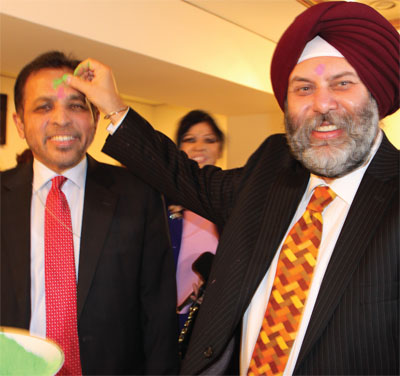
    NEW YORK (TIP): The Permanent Mission of India to the United Nations celebrated Holi at the permanent mission here on Wednesday, March 27, in style and with great enthusiasm. Colors and flower petals expressed the feeling of joy and delight that pervaded the atmosphere.

    Holi is one of the most popular festive occasions in India. The holiday celebrated mainly by the Hindus in India and Nepal marks the beginning of spring and the triumph of good over evil. Bonfires are set on the eve of Holi, and the next day the Hindus throw colored dry powder and water in celebration. It is also observed by the minority Hindus in Bangladesh and Pakistan as well in countries with large Indian Diaspora populations following Hinduism, such as Suriname, Malaysia, Guyana, South Africa, Trinidad and Tobago, the United Kingdom, the United States, Mauritius, and Fiji. Holi is of particular significance in the Braj region of North India, which includes locations traditionally connected to the Lord Krishna: Mathura, Vrindavan, Nandagaon, and Barsana, which become tourist destinations during the season of Holi. There is a legend associated with celebration of Holi. The word Holi originated from “Holika”, sister of Hiranyakashipu.

    The festival of Holi is celebrated because of a story in the old Hindu religion. In Vaishnavism, Hiranyakashipu is the great king of demons, and he had been granted a boon by Brahma, which made it almost impossible for him to be killed. The boon was due to his long penance, after which he had demanded that he not be killed “during day or night; inside the home or outside, not on earth or in the sky; neither by a man nor an animal; neither by astra nor by shastra”. Consequently, he grew arrogant and attacked the Heavens and the Earth. He demanded that people stop worshipping gods and start praising respectfully to him.

    According to this belief, Hiranyakashipu’s own son, Prahlada, was a devotee of Vishnu. In spite of several threats from Hiranyakashipu, Prahlada continued offering prayers to Vishnu. He was poisoned by Hiranyakashipu, but the poison turned to nectar in his mouth. He was ordered to be trampled by elephants yet remained unharmed. He was put in a room with hungry, poisonous snakes and survived. All of Hiranyakashipu’s attempts to kill his son failed. Finally, he ordered young Prahlada to sit on a pyre in the lap of Holika, Hiranyakashipu’s demoness sister, who also could not die because she had a boon preventing her from being burned by fire. Prahlada readily accepted his father’s orders, and prayed to Lord Vishnu to keep him safe. When the fire started, everyone watched in amazement as Holika burnt to death, while Prahlada survived unharmed.

    The salvation of Prahlada and burning of Holika is celebrated as Holi. In Mathura, where Krishna grew up, the festival is celebrated for 16 days (until Rangpanchmi) in commemoration of the divine love of Radha for Krishna. The festivities officially usher in spring, the celebrated season of love. The party at the Permanent Mission of India was hosted by Acting Permanent Representative Ambassador Manjeev S. Puri and his staff, who were in the best of spirits of Holi throughout the evening. Mrs. Puri who was dressed in a beautiful multicolored Saree for the multicolored occasion was enthusiastically going round, supervising arrangements and taking care of guests.

    The event was attended by Permanent Representative of Sri Lanka, Ambassador Palitha Kohona, and Permanent Representative of Republic of Singapore, Ambassador Albert Chua besides diplomats from many countries, and officials at the UN. Ambassador Puri was seen applying colors on his guests and welcoming them to the heavily attended celebratory party. He joyously threw flower petals and colors at the guests, as is the custom during Holi. The authentic Indian menu included Thandai, a special drink made during Holi and much other Holi specialty food that included chats and sweets, among many other delicacies.

  • Delhi Police Arrest  Suspected Hizbul  Operative, Foil Terror  Attack In National  Capital

    Delhi Police Arrest Suspected Hizbul Operative, Foil Terror Attack In National Capital

    NEW DELHI (TIP): The special cell of Delhi Police foiled a terror attack in the national capital after apprehending a suspected Hizbul Mujahideen operative from Gorakhpur, near Nepal border, in Uttar Pradesh. The suspect has been identified as Liaqat Ali who ‘came’ to Delhi by Kosi Express, a source in Delhi Police said. Liaqat Ali is considered a hardcore terrorist, who initially underwent rigorous training in Pakistan, and has been associated with Hizbul Mujahideen for the last 15 years, the source added.

    He has been involved in several operations. Based on inputs provided by him, the cops raided a guest house in Jama Masjid area on March 21 night. Special police teams and bomb squads reached the Hazi Arafat guest house in Jama Masjid area of central Delhi at 10.30pm and cordoned it off. They recovered assault rifles, hand grenades and more than 2kg of explosives from room number 304 of the guest house. The room was later sealed.

    The ammunition was delivered in the room by a third person and was reportedly to be used by Liaqat Ali, cops say. Two of the guest house staff were taken into custody for questioning but were let off later after the sleuths found nothing against them. They provided information about the identity of the accused who visited the guest house. The cops suspect that the terrorists had planned a huge strike in the national capital to avenge the executions of Parliament attack convict Afzal Guru and Mumbai terror attack convict Azmal Kasab.

    The officers, though, have not confirmed if the cricket Test match between India and Austrailia at Ferozeshah Kotla was the target of the terrorists. The stadium is barely 4 km away from the hotel. Liaqat Ali has told the cops about the presence of his associates in the national capital after which a manhunt has been launched to nab them.

  • Chief justice takes oath as Nepal PM, to oversee polls

    Chief justice takes oath as Nepal PM, to oversee polls

    KATHMANDU (TIP): Following weeks of negotiations, Nepal’s chief justice Khil Raj Regmi was Thursday sworn in as the new head of government, the msain task of which will be to hold general elections by June 21.

    The main political parties reached an agreement late on Wednesday on the 63- year-old Regmi to be the chairman of the council of ministers, since he was seen as a neutral candidate to hold elections. He will hold a small cabinet of 11 members. The parties have agreed to have former bureaucrats as ministers.

    According to the amendment of the constitution, Regmi will not be performing his duties as the chief justice while he is the chairman of the council of ministers but will go back to the judiciary after elections. There has been widespread opposition to the appointment the chief justice as head of government from smaller political parties and the civil society. While President Ram Baran Yadav was swearing in Regmi, there were protest rallies outside.

    Opposing parties contend that making the chief justice as the head of government is against the principle of the separation of the judiciary and the executive. The country has been facing political uncertainty since May after the parliament was dissolved.

  • Gender equality in India among worst in world: UN

    Gender equality in India among worst in world: UN

    NEW DELHI (TIP): When India’s Human Development Index is adjusted for gender inequality, it becomes south Asia’s worst performing country after Afghanistan, new numbers in the UNDP’s Human Development Report 2013 show. Pakistan, Nepal and Bangladesh, which are poorer than India and have lower HDIs, all do comparatively better than India when it comes to gender equality. The new UNDP report, released on March 14, ranks India 136th out of 186 countries, five ranks below postwar Iraq, on the HDI.

    The HDI is a composite indicator composed of three equally weighted measures for education, health and income. On the newly constituted Multidimensional Poverty Index (MPI), which identifies multiple deprivations in the same households in education, health and standard of living, only 29 countries do worse than India (though data-sets are from varying periods of time across nations). The MPI puts India’s poverty headcount ratio at 54%, higher than Bangladesh and Nepal.

    This was even as India did extremely well economically. India and China doubled output per capita in less than 20 years, at a scale the UNDP has said was “unprecedented in speed and scale”. “Never in history have the living conditions and prospects of so many people changed so dramatically and so fast,” the UNDP said; it took Britain 150 years to do the same after the Industrial Revolution and the United States, which industrialized later, took 50 years. On the whole, developing countries have been steadily improving their human development records, some faster than others.

    No country has done worse in 2012 than in 2000, while the same was not true for the preceding decade. India, Bangladesh and China are among 40 countries that have done better on the HDI than was predicted for them in 1990. By 2030, more than 80% of the world’s middle class is projected to be in the global South; within Asia, India and China will make up 75% of the middle class. The HDR identifies three drivers of human development transformation in the countries of the global South – proactive developmental states, tapping of global markets and determined social policy innovation.

  • NACSAA’s ‘Thomas Jefferson’s Eternal Vigilance’ Awards Presented

    NACSAA’s ‘Thomas Jefferson’s Eternal Vigilance’ Awards Presented

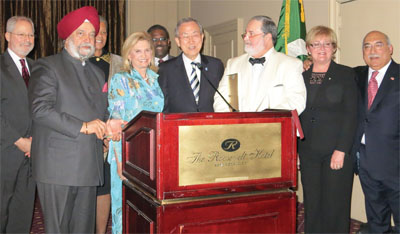
    NEW YORK (TIP): National Advisory Council on South Asian Affairs’ (NACSAA’s) “Thomas Jefferson’s Eternal Vigilance” Awards were presented to Ambassador Abdullah Hussain Haroon and Ambassador Hardeep Singh Puri on March 8, 2013, at the Roosevelt Hotel here.

    While Congresswoman Caroline Maloney presented the award to Ambassador Abdullah Hussain Haroon , Secretary General Ban Ki Moon presented the award to Ambassador Hardeep Singh Puri. Each was recognized for “for his exemplary service to humanity, unflinching dedication to freedom, the rule of law and helping ‘…form a more perfect world.’” In addition, Cong. Maloney presented Ambassador Haroon with a Congressional Record issued in his honor.

    At the event held in honor of UN Secretary General Ban Ki Moon, Ambassador Haroon spoke of the need for nations to keep talking in earnest, for as long as they are talking war is avoided. SG Ban spoke of the need to find a unified vision, with respect and friendship amongst nations, so humanity may better enjoy peace and prosperity.

    img2

    The select audience of over 130 guests was made up of members of the United Nations Security Council, Permanent Representatives, national, state and local elected officials, and dignitaries, including Congressman Gary L. Ackerman, Chef de Cabinet Susana Malcorra and Mrs. Ban. Congressman Meeks was unable to attend the event, as he was part of the official United States delegation to attend the funeral of President Hugo Chavez in Venezuela. Prior Thomas Jefferson Eternal Vigilance Award recipients include United States Assistant Secretary of State Richard Boucher, and Congressmen Gary L. Ackerman, Eliot L. Engel and inter alia, Gregory W. Meeks. NACSAA is made up of Americans with ancestry from, inter alia, Afghanistan, Pakistan, India, Sri Lanka, Nepal and/or Bangladesh.

  • Ajanta Caves A Legacy From The Golden Age

    Ajanta Caves A Legacy From The Golden Age

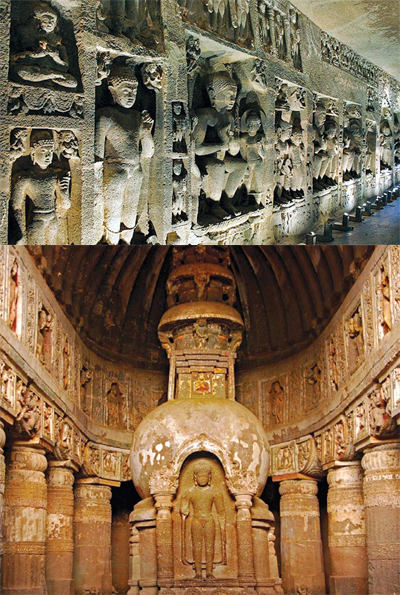
    Ajanta and Ellora are the pride of Maharashtra. The rock-cut caves of both these sites are world famous and illustrate the degree of skill and artistry that Indian craftsmen had achieved several hundred years ago. Ajanta dates from 100 B.C. while Ellora is younger by some 600 years. The village of Ajanta is in the Sahyadri hills, about 99 kms. From Aurangabad; a few miles away in a mammoth horseshoe-formed rock, are 30 caves overlooking a gorge, `each forming a room in the hill and some with inner rooms.

    Al these have been carved out of solid rock with little more than a hammer and chisel and the faith and inspiration of Buddhism. Here, for the Buddhist monks, the artisans excavated Chaityas (chapels) for prayer and Viharas (monasteries) where they lived and taught. Many of the caves have the most exquisite detailed carvings on the walls, pillars and entrances as well as magnificent wall paintings.

    These caves were discovered early in the 19th century quite by chance by a party of British Officers on manoeuvres. Today the paintings and sculptures on Buddha’s life, belonging to the more mellow and ritualistic Mahayana Buddhism period, are world famous. Copies of them were shown in the Crystal Palace exhibition in London in 1866. These were destroyed in a fire there.

    Further copies were published soon afterwards and four volumes of reproductions were brought out in 1933 by Ghulam Yazdani, the Director of Archaeology of the then Hyderabad State. Ajanta has formed an epicentre of interest for those who appreciate and are eager to know more about Indian history and art. It is a protected monument under the Archaeological Survey of India and has been listed in the World Heritage list of monuments.

    The 30 caves of Ajanta were created over a span of some 600 years. In their range of time and treatments they provide a panorama of life in ancient India and are a source of all kinds of information… hair styles, ornaments, textiles, musical instruments, details of architecture, customs etc.

    It was from this collection of classical Indian art that a particular style was formed that traveled with Buddhism to many parts of the world. Similar paintings can be seen in Sigiriya in Sri Lanka, Bamiyan in Afghanistan, temples and shrines in Tibet, Nepal, China and Japan. Royal patronage made Ajanta possible. Professional artists carried out much of the work and each contributed his own individual skill and devotion to this monumental work.

    Visitors often ask how the artist who painted the detailed frescoes and chiseled out the intricate carvings, managed to work in the dark interiors of the caves. It has been noticed that the caves are illuminated by natural light for part of the day and it is presumed that metal mirrors or sheets of white cloth were used to reflect sunlight into the inner recesses.

    Here, briefly, are some of the highlights of the caves. In the Cave 26, the sculpture is elaborate and beautiful though the painted frescoes are incomplete. The arched chapel window set in an elegantly simple façade, is repeated in an elaborate frontage in Cave 19 with its complete Chaitya and a slender votive stupa enclosing a standing Buddha at the far end. Of particular note is a sculpture of a seated Nagaraja with his consort and female attendant.

    Cave 16 is an elegant Vihara with an inscription that mentions the king and his minister who had the cave built. Here a towering Buddha sits preaching. He is flanked by attendants with fly whisks.

    There are undamaged portions of the wall paintings that are clear and vibrant in Caves 1, 2, 16 and 17. Cave I has the well known Bodhisattva Padmapani which is a wonderful portrayal of tender compassion. A gentle figure holding a lotus delicately in one hand. In the same cave is the golden figure of Avalokiteswara, elaborately adorned. The women, nymphs, princess and attendants are elegant and beautifully attired.

    Here also is a lively panel of dancing girls and musicians. In Cave 2 there is a detailed panel of Queen Maya’s dream, of the white elephant which was interpreted by royal astrologers to mean the birth of an illustrious son. The row upon row of Buddhas, can be seen in this cave. In Cave 17, there is a flying apsara in a fashionable embroidered turban and splendid jewellery.

    It is worth walking away from the caves in order to look back on to the horseshoe gorge. The ingenuous water cistern system can be seen which must have provided water for the monks and their visitors. Ajanta was on the ancient trade route leading to the coast so there must have been considerable activity and many visitors. Nobody really knows what life was like in those times and visitors can interpret the past as they wish, which is perhaps yet another secret charm of Ajanta.

  • Darjeeling walking along the memory lane

    Darjeeling walking along the memory lane

    Travelling in Darjeeling is like walking along the memory lanes during the time of the British Raj. Located in the cozy and inviting lap of the Kanchan Junga, Darjeeling the dramatic land is amazingly blessed with the superb beauty of the nature, fantastic sightseeing places, ornamental monasteries, mystic hill, alluring tea gardens, refreshing and healthy climatic condition and warm hospitality.

    Darjeeling is truly a gem in the crown of the Himalayas that invites the foot falls of thousands and thousands of tourists from across the globe. Darjeeling in true sense is a paradise on earth as the showers of blessing from the heaven in poured in Darjeeling in the form of the natural beauty, blissful ambiance and the cool weather conditions that keeps this scenic hill town pure and pristine all the year round.

    So due to the copious natural beauty, cool climatic condition, tempting culture and friendly hospitality, tourist throngs the year round to for holidays in Darjeeling. Darjeeling tourism has great potential the hill town supports varieties of tourism options including tea tourism, monsoon tourism, medical tourism, wildlife tourism, flowers tourism and culture tourism, which have their own resemblance, but different from rest of the world.

    So come and soak in the heavenly beauty of the nature as well as explore the fascinating charm of tourism in Darjeeling with much pleasure, fun and joy. Beside the inviting tourist places, the speciality of Darjeeling tourism lies in the tea gardens, which are not just the main tourist attraction but are the back bone of Darjeeling tourism.

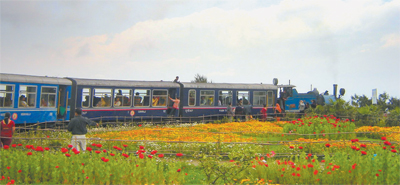
    The vast stretches of the emerald green tea gardens are the main source from where the world’s best tea leaves are obtained and are made ready for the international market supply. Darjeeling Himalayan railway is also the iconic attraction which is also the major tourist attraction and the iconic symbol of Darjeeling tourism.

    Talking more on Darjeeling tourism, the hill town has its own unique culture and festivals like Tihar, Dasai, Losar (Tibetan Festival), Makar Sankranti and Durga Puja is celebrate with great enthusiasm by all the local communities.

    More of all Darjeeling is the gastronomy paradise, where one can satisfy the appetite by enjoy the verities of delicious Himalayan cuisines and specialities including “Momos”, “Thukpas”, Sael Roti and mood making local wine called Chhaang and Tongba. So in short, Darjeeling tourism has everything that makes the vacation a complete package packed with fun delights, thrill, adventure and lots of happiness.
    PLACES TO VISIT
    Dhoom Gompa
    About 8 kms from Darjeeling is the Dhoom Gompa. Here a very beautiful statue of the Maitrayie Buddha is established. The Monastery has also preserved some of the rare handwritten Buddhist manuscripts.

    The Mall
    The Mall is Darjeeling’s popular commercial street. It is lined with Tibetans selling hand-knitted sweaters and souvenir shops chock-full of Himalayan artifacts and both real and imitation antiques. Photo shops carry turn-of-the-century photos as well as specialising in hand-painted black and white prints with glowing oil colours. The Mall leads to Chaurasta, a square, which doubles as a bandstand, a pony riding arena for children and a haven for lovers.

    Chowrasta

    The Chowrasta, meaning crossroad, is a hive of commercial activity. The Mall Road originates and culminates at the Chowrasta. This is the heart of Victorian Darjeeling. Here hotels, restaurants and shops brush against each other. The shops and stalls are a veritable paradise for souvenir collectors. The Bhutanese sellers display their wares. Woollen garments, tribal ornaments, Thankas, rosaries, brass statuettes and Gorkha daggers are kept on display for sale. Foreign goods are also available in some shops. Local handicrafts are much in demand.

    Obeservatory Hill
    The oldest site in Darjeeling is Observatory Hill, known locally as “Makal- Babu-Ko-Thaan”. According to legend, a Red Hat Buddhist Monastery called Dorje Ling, or ‘place of the Thunderbolt’, stood at this very spot. The Nepalis destroyed it in the 19th century. The Shivas and Buddhists share the temple that stands there today.

    Himalayan Mountaineering Institute
    A spot not to be missed is the Himalayan Mountaineering Institute created by the late Tenzing Norgay, the Sherpa who conquered Mt Everest with Sir Edmund Hillary on 29 May 1953. A display of equipment used on the climb is one of the highlights. A zoological garden nearby has an assortment of wildlife such as yaks, Siberian tigers and red pandas who call the region their home.

    Rangeet Valley Passenger Ropeway
    At North Point about 3-km from the town, this is the first passenger ropeway in India. For reservation of ropeway seats please contact – officer in-charge, Darjeeling Rangeet Valley Ropeway Station, North Point, Darjeeling. Regular share taxi service is available from Market Motor and Taxi Stand is to the Ropeway Station.
    Book This Now
    Nearby Attractions
    Tibetan Refuge Camp
    The area in and around Darjeeling is a treasure chest of interesting destinations. The Tibetan Refugee self-help scheme produces traditional artifacts, jewellery and carpets for tourist consumption.

    Lloyd’s Botanical Garden
    Lloyd’s Botanical Garden displays a fine collection of Himalayan fauna for those with an interest, and for punters there is horseracing at Lebong, the smallest and highest racecourse in the world.

    Tiger Hill
    Situated at an altitude of 2,590m (8,482 ft.) and 13-km from the town, this spot has earned international fame for the magnificent view of the sunrise over “Kanchenjunga” and the great Eastern Himalayan Mountains. Even Mount Everest, the world’s highest peak, is visible from here.

    Phalut & Sandakphu
    A week’s smallest-trip of Phalut and Sandakphu will get one within reach of the high peaks; for the onlooker it affords a more spectacular panorama than at Tiger Hill. Giant flowering Rhododendron trees, a pointillism of reds pinks and whites Dwarfs comprise of the en route trail. On attaining heights of over 3,048m, one is surrounded by skeletal trees devoid of leaves and branches, which are especially eerie when the clouds roll in and envelop the area.

    Pashupati

    Further afield, in Pashupati on the Nepal border, one can purchase foreign goods at reasonable prices, view wildlife such as the endangered one-horned Rhino, Deer, Gaur, and wild boar while seated atop an Elephant’s back at Jaldapara Game Park; learn of the Lepcha legend at the confluence of the Teesta and Ranjeet Rivers; relive Kalimpong’s past glory as a trading post by visiting the market filled with traditional Tibetan medicine, spices, musk, wool and silk; or for the truly adventurous-hire some ponies and a crew and take to the hills.

    Kurseong
    Kurseong is mid-way between Siliguri and Darjeeling. The way from Darjeeling to Kurseong is generally open through out the year. So, the toy train is not coming to Siliguri then one can come up to Kurseong. This place is equally beautiful and is full of natural splendour

  • Nepal Maoists Lock Up School For Including Indian Syllabus

    Nepal Maoists Lock Up School For Including Indian Syllabus

    KATHMANDU (TIP): Teachers backed by the breakaway CPNMaoistfaction in Nepal have forcibly shut down a local schoolallegedly for including Indian course syllabus as part of theircurriculum.Some 3,000 students have been left in the lurch after the DAVSushil Kedia Vishwa Bharati Higher Secondary School situatedin Lalitpur district was locked up by the school’s teachers’ unionaffiliated to CPN-Maoist led by Mohan Vaidya, the breakawayfaction of UCPN-Maoist.

    Although the teachers’ union apparently acted in protestagainst the sacking of two teachers of the school, the schoolmanagement says the real reason behind the closure is theinclusion of India’s CBSE course syllabus in the schoolcurriculum.The teachers’ union have locked up the school since January 6,according to the management.They have also threatened retaliation if the locks are openedwith the help of administration.There are some 14 schools in Nepal which have beenconducting CBSE examinations for more than a decade.

    The teachers’ union has been threatening schools againstincluding Indian curriculum saying that it goes against thenational interest.They have also demanded scrapping of the CBSEexaminations.”We are trying to hold dialogue with the agitating teachers andwe hope that the issue will be settled through dialogue,” saidprincipal of the school, Bhubaneshwari Rao.Last year, CPN-Maoist had imposed a ban on screening ofIndian movies and entry of vehicles with Indian number plates.

  • The Republic Of India

    The Republic Of India

    The Republic of India is a large South Asian country rich in ethnic diversity,with over one billion people speaking hundreds of languages. Politically it is the world’s largest liberal democracy. The Indian economy is the fourth largest in the world, in terms of purchasing power parity, and is the world’s second-fastest growing economy. India is also the second most populated country in the world. India has grown significantly, in terms of both population and strategic importance, in the last twenty years attributed to economic reforms. Strategically located in Asia,constituting most of the Indian subcontinent,India straddles many busy trade routes. It shares its borders with Pakistan,the People’s Republic of China,Myanmar,Bangladesh,Nepal,Bhutan and Afghanistan.Sri Lanka,the Maldives and Indonesia are the nearby island nations in the Indian Ocean. Home to some of the most ancient civilisations in the world, India was formally ruled by the British for almost ninety years before gaining independence in 1947.

    Origin of India’s name:
    The official name India is derived from Sindhu, the historic local appellation for the river Indus and is the most internationally recognisable of the country. The Constitution of India and general usage also recognises Bharat as the other official name of equal status. Bharat comes from the name of an ancient Hindu king and means seeker of knowledge. The third name is Hindustan, meaning land of the Hindus (where Hindu refers to those who dwell to the right of the Indus/Sindhu river) used from the Mughal times onwards. India,a sub-continent with 5000 year old History. A civilization united by its diversity,richness of culture,the glory of past,the turbulences and triumphs. The landmarks of each era,the achievements of a change,the legacy of a regime.

    As we walk through the history,India is an amazing discovery and its history is a unique tale of the past. With the arrival of the Portuguese, French and English traders, advantage was taken of the fractured, debilitate kingdoms to colonise India. In 1857, an insurrection amongst the army sepoys ensued in the popular Revolt of 1857 against the powerful British East India Company; this mobilised resistance, though short-lasting, was caused by the widespread resentment against discriminatory policies of the British. After the revolt, the Indian independence movements started demanding complete independence. On August 15th, 1947, India was finally granted independence from British rule and became a secular republic.

    January 26 (Republic Day of India): Republic Day is one of the greatest national celebrations observed throughout the country on January 26 every year. India became Republic on the 26th Jan, 1950. The country became a sovereign democratic republic with a written constitution and an elected parliament. At the time of independence, although India was under British rule, there were 565 Princely States, big and small, ruled by powerful sovereigns who were protected by treaties of alliance with the British Crown.

    Without bringing them together, the fundamental unity of the country was not possible. This unification was accomplished by Sardar Vallabhbhai Patel, whose statesmanship helped to integrate the country into one nation. In a little less than 2 years, all the princely States became a part of the Republic of India. It was on this date in 1927 that the Indian National Congress, then fighting its nonviolent war for freedom, voted for complete independence as against ‘dominion status’. When members of the INC took the pledge to work towards a ‘sovereign democratic republic’ of India.

  • Global Flooding

    Global Flooding

    In July at least 37 people were killed by flood waters inand around the city of Beijing, China. In the rural andsuburban areas outside Beijing, many more people died inas a result of flooding, which was said to be the region’sworst in 60 years.Floods occurred in southwest Russia inearly July, mainly in Krasnodar Krai, near the coast of theBlack Sea. Five months‚Äô worth of rain fell overnight insome southern parts of the country, leaving 144 people deadand damaging the homes of nearly 13,000 people. Othermassive flooding events occurred in Asia’s BrahmaputraRiver, Great Britain, Ireland, Loreto, Nigeria, North Korea,the Philippines, Romania, Fiji, Nepal, and Pakistan.

  • World Kabaddi Cup a Step in the Right Direction

    World Kabaddi Cup a Step in the Right Direction

    The ancient game of Kabaddi is enshrined permanently in the mind of every son of the soil Punjabi. In olden times, it used to be played on the dusty grounds of village common land. There used to be no hard and fast rules of the game. Sometimes the raiders indulged in tactical cheating during chanting of words “Kabaddi Kabaddi” or “Kaudi Kaudi”. In Punjabi style one raider was the attacker and one defender used to stop him. A deliberate touch by a raider targeting two attackers resulted in the point going to the defenders. In a reverse situation, if two stoppers tried to stop the raider one after the other or simultaneously, the point went to the raider.

    Throwing the opponent, raider or defender, out of the ground resulted in a point. This has always been the game of strength, stamina, lung power and agility on the part of the raiders and the defenders. Prior to the independence of India, this game was quite popular in all the five administrative divisions of the Province of Punjab. It was more popular in Lahore and Jalandhar divisions and least popular in Ambala division.

    But now it is popular all over the Indian Punjab and is played equally passionately across the Radcliffe Line in Pakistan’s Punjab. Needing just a pair of shorts and not even requiring formal shoes, this used to be and still is a very inexpensive game. But in order to stay physically fit, the player has to be given strength and stamina building diet and exercise. In olden times a lot of stress was laid on eating butter.

    This culture still prevails, but now some of the athletes are eating a lot more diverse diet. During the nineteen fifties, a lot of Sikh youths settled in the United Kingdom. At about the same time and a decade and two later, Sikh Diaspora spread to Canada also. These expatriate Sikhs passionately love Kabaddi. When they visit their ancestral homes in India, they want to see Kabaddi being played in their respective villages. In order to see that they spend quite a considerable amount of money to arrange Kabaddi tournaments in their mostly non-descript villages. These impromptu tournaments have become very popular in the rural areas of the Punjab.

    In the last two decades there were hundreds of such tournaments held in villages all across Punjab during the six month window from October to April. As the game is flourishing, rules are also getting defined and enforced meticulously. Now the raider has to return to the dividing line in half a minute. Crossing to one’s own side after touching a defender at any spot, other than the designated return line, results in a point being awarded to the defender.

    Slapping the opponent, raider or the defender, results in point being awarded to the opponent. Sensing the enormous popularity of Kabaddi, the Punjab Government in India decided to embrace it. Deputy Chief Minister Sukhbir Singh Badal started the first edition of World Kabaddi Cup in 2010 in a grand style. The matches were held over several venues all over the Punjab. Kabaddi is now played regularly in Pakistan, the United Kingdom, Canada and the United States. India won the inaugural cup and a handsome amount of money.

    The tournament was telecast by PTC TV channel all over India and in several countries, where PTC’s footprint exists. Last year (2011) saw more teams participating. Nice arrangements were made for board and lodging of the teams. Italy was a surprise entry into the semifinal. Several players from the United States and the Canadian teams were disqualified after being found positive in dope tests. In addition to men, several women’s teams were also invited to participate. This created gender equality in this hitherto rural sport. India had a decisive edge in women’s group. In the year 2012, the “Third World Cup Kabaddi Tournament” was held from the first to the 15th of December. The matches were spread in several locations all over the state.

    A glittering several hours long opening ceremony was held in Bathinda on December 1st. The other venues included the holy and premier tourist city of Amritsar, Gurdaspur, Chohla Sahib (Tarntaran), Jalandhar, Hoshiarpur, Fazilka, Faridkot, Mansa, Sangrur, Ropar, Bathinda and Ludhiana. In the men’s category in addition to the host nation India, Argentina, the USA, Canada, England, Scotland, Norwey, Italy, Sierra Leone, Kenya, Iran, Afghanistan, Pakistan, New Zealand and Srilanka accepted the invitation to participate.

    In the women’s section, USA, Canada, England, Denmark, Malaysia, Turkmenistan and India participated. Nepal eventually failed to show up for the matches. The winning team in men’s section in 2012 was offered two crore of rupees and the runners-up team was offered a prize of one crore of rupees. The team finishing at number three was offered half a crore of rupees. These are indeed huge prizes unseen in the history of the game. There have been some problems in the organizational structure of the tournament.

    The buildings of the stadiums are quite good, but the playing fields left much to be desired. Barring a couple of stadiums in Amritsar and Ludhiana, rest of the playing fields were devoid of a decent grass cover and the soil was very hard. Kabaddi players in the European and American countries are used to play on lush green grass turfs. When they are made to play on hard dry soil, their performance level suffers. That is one reason as to why the Canadian and the American teams could not perform to their capacity.

    The teams that entered the semifinal included three teams from Asia. These are Iran, Pakistan and India. The fourth qualifier was the Canadian team. The team from the USA was narrowly beaten by Iran. Both India and Pakistan toyed with their semifinalist rivals. Indian crushed Iran and Pakistan mauled team Canada. In the women’s group also the competition in 2012 was of a much higher level. The Canadian and the Malaysian teams consisted of mostly players of Indian descent. The out of practice Canadian girls played poorly, but the hard working Malaysians covered themselves with glory and entered the final. Two European teams, the English and the Denmark teams also were impressive. Turkmenistan team was very good too. But the Indian players were outstanding.

    This successfully conducted tournament is likely to boost the economy of Punjab. A lot of tourists have been visiting the state to watch this tournament. Some of the participating teams are staying behind in Punjab to play in several village level tournaments to be held in the months of December and January. The two African teams Kenya and Sierra Leone are also staying behind to get more match practice and to master the finer points of the game.

    Both finals and the grand closing ceremony were held in the multipurpose Guru Nanak Stadium in Ludhiana on the night of Saturday December 15th. In the men’s final India crushed arch rivals Pakistan by 59 points to 22. Canada crushed Iran on December 13th in Jalandhar to win the third place and a prize of one hundred thousand dollars. In the final of women’s category on December 15th, in a one sided encounter India toyed with Malaysia.

    The third place in women’s group was won by Denmark by defeating England on December 13th. This was a very closely contested match. The young school and college going girls from Denmark impressed everyone. The dazzling closing ceremony was dominated by the film industry of Bollywood. Katrina Kaif was the star of the night. Film and pop singers Diljit Singh and Sukhvinder Singh kept the jam-packed stadium entertained. Punjab’s most popular TV anchor Satinder Satti was the master of ceremony. In the end there was an impressive show of fireworks. At the end the flame was extinguished, with a promise to hold another edition in 2013. Katrina Kaif and troupe entertain at one of the venues

  • Nasa Photo Error Puts Mount Everest In India

    Nasa Photo Error Puts Mount Everest In India

    KATHMANDU (TIP): The world’s highest mountain should not be hard to spot but American space agency Nasa has admitted it mistook a summit in India for Mount Everest, which straddles the border of Nepal and China. The agency said on its website that Russian cosmonaut Yuri Malenchenko’s snap from the International Space Station, 370 kilometres above Earth, showed Everest lightly dusted with snow.

    The picture spread rapidly via Twitter and was picked up by media around the world, including the USbased magazine The Atlantic, astronomy website Space.com and US cable news channel MSNBC. But Nepalis smelt a rat and voiced their suspicions on social media. Journalist Kunda Dixit, an authority on the Himalayas, tweeted: “Sorry guys, but the tall peak with the shadow in the middle is not Mt Everest.” Nasa confirmed on Thursday that it had made a mistake and removed the picture from its website.

    “It is not Everest. It is Saser Muztagh, in the Karakoram Range of the Kashmir region of India,” a spokesman admitted in an email to AFP. “The view is in mid-afternoon light looking northeastward.” He did not explain how the picture from the space station, a joint project of the US, Russia, Japan, Canada and Europe, had been wrongly identified. Everest, which is 8,848 metres (29,028 feet) high, is an sought-after photographic target for astronauts in orbit but is tricky to capture, according to astronaut Ron Garan, who lived on the International Space Station last year. “No time is allotted in our work day normally for Earth pictures. So if we want to capture a specific point on the ground we have to first know exactly when we will fly over that spot,” he told The Atlantic.

  • An Indian grammar for International Studies

    An Indian grammar for International Studies

    A little over three years ago I wrote in The Hindu that at a time when interest in India and India’s interest in the world are arguably at their highest, Indian scholarship on global issues is showing few signs of responding to this challenge and that this could well stunt India’s ability to influence the international system.

    As we meet here now, at the first real convention of scholars (and practitioners) of International Studies from throughout India, we can take some comfort. A quick, albeit anecdotal, audit of the study of International Studies would suggest that the last three years have been unusually productive.

    So much so, that we are now, I believe, at a veritable “tipping point” in our emergence as an intellectual power in the discipline. Hoffman, Professor of International Relations (IR) at Harvard, once famously remarked that IR was an American social science.

    The blinding nexus between knowledge and power (particularly stark in the case of IR in the United States) perhaps made him forget that while the first modern IR departments were created in Aberystwyth and in Geneva, thinking on international relations went back, in the case of the Indian, Chinese and other great civilizations, to well before the West even began to think of the world outside their living space. Having absorbed the grammar of Western international relations, and transited to a phase of greater self-confidence, it is now opportune for us to also use the vocabulary of our past as a guide to the future.

    2011 survey
    Recovery of these Indian ideas should not be seen as part of a revivalist project or as an exercise that seeks to reify so-called Indian exceptionalism. Rather, interrogating our rich past with its deeply argumentative tradition is, as Amartya Sen put it, “partly a celebration, partly an invitation to criticality, partly a reason for further exploration, and partly also an incitement to get more people into the argument.”

    In the context of international relations it offers the intellectual promise of going beyond the Manichean opposition between power and principle; and between the world of ideas and norms on the one hand, and that of statecraft and even machtpolitik, on the other. In doing so we are not being particularly subversive.

    A 2011 survey of American IR scholars by Foreign Policy found that 22 per cent adopted a Constructivist approach (with its privileging of ideas and identity in shaping state preferences and international outcomes), 21 per cent adopted a Liberal approach, only 16 per cent a Realist approach, and a tiny two per cent a Marxist approach. When academics were asked to “list their peers who have had the greatest influence on them and the discipline,” the most influential was Alexander Wendt, the Constructivist, and neither the Liberal, Robert Koehane, nor the Realists, Kenneth Waltz or James Mearisheimer.

    Mohandas Gandhi once said that “if all the Upanishads and all the other scriptures happened all of a sudden to be reduced to ashes, and if only the first verse in the Ishopanishad were left in the memory of the Hindus, Hinduism would live forever.” Let me make what may seem like another astounding claim, and which I hope, in the best argumentative tradition, will be heavily contested.

    If all the books on war and peace were to suddenly disappear from the world, and only the Mahabharata remained, it would be good enough to capture almost all the possible debates on order, justice, force and the moral dilemmas associated with choices that are made on these issues within the realm of international politics.

    Uncertainty in the region

    Beyond theory, we are faced with a period of extraordinary uncertainty in the international system and in our region. Multilateralism is in serious crisis. While the U.N. Security Council remains deadlocked on key issues, there is little progress on most other issues of global concern, be it trade, sustainable development or climate change. As academics, we cannot remain unconcerned about these critical failures.

    Our continent is being defined and redefined over time. Regions are, after all, as much shaped by the powerful whose interests they seek to advance as by any objective reality. Whatever nomenclature we adopt, and whatever definition we accept, we are faced with, what Evan Feigenbaum and Robert Manning described as two Asias: the ‘Economic Asia’ whose $19 trillion regional economy drives global growth; the “Security Asia,” a “dysfunctional region of mistrustful powers, prone to nationalism and irredentism, escalating their territorial disputes over tiny rocks and shoals, and arming for conflict.” The Asian Development Bank says that by nearly doubling its share of global GDP to 52 per cent by 2050, Asia could regain the dominant economic position it held 300 years ago.

    Yet, as several academics have pointed out “it is beset by interstate rivalries that resemble 19th century Europe,” as well the new challenges of the 21st century: environmental catastrophes, natural disasters, climate change, terrorism, cyber security and maritime issues. An increasingly assertive China that has abandoned Deng Xiaoping’s 24-character strategy of hiding its light and keeping its head low, adds to the uncertainty of the prevailing strategic environment. India’s military and economic prowess are greater than ever before, yet its ability to influence South Asian countries is less than what it was, say, 30 years ago.

    An unstable Nepal with widespread anti-India sentiment, a triumphalist Sri Lanka where Sinhalese chauvinism shows no signs of accommodating legitimate Tamil aspirations, a chaotic Pakistan unwilling to even reassure New Delhi on future terrorist strikes, are symptomatic of a region being pulled in different directions. Can our thinking from the past help us navigate through this troubled present? Pankaj Mishra, in his brilliant book, From the Ruins of Empire: the Revolt Against the West and the Remaking of Asia, describes how three 19th century thinkers, the Persian Jamal-al Din al-Afghani, Liang Qichao from China and India’s Rabindranath Tagore, navigated through Eastern tradition and the Western onslaught to think of creative ways to strike a balance and find harmony.

    In many ways, these ideas remain relevant today as well. For if Asia merely mimics the West in its quest for economic growth and conspicuous consumption, and thAlittle over three years ago I wrote in The Hindu that at a time when interest in India and India’s interest in the world are arguably at their highest, Indian scholarship on global issues is showing few signs of responding to this challenge and that this could well stunt India’s ability to influence the international system. As we meet here now, at the first real convention of scholars (and practitioners) of International Studies from throughout India, we can take some comfort. A quick, albeit anecdotal, audit of the study of International Studies would suggest that the last three years have been unusually productive. So much so, that we are now, I believe, at a veritable “tipping point” in our emergence as an intellectual power in the discipline. Hoffman, Professor of International Relations (IR) at Harvard, once famously remarked that IR was an American social science. The blinding nexus between knowledge and power (particularly stark in the case of IR in the United States) perhaps made him forget that while the first modern IR departments were created in Aberystwyth and in Geneva, thinking on international relations went back, in the case of the Indian, Chinese and other great civilizations, to well before the West even began to think of the world outside their living space. Having absorbed the grammar of Western international relations, and transited to a phase of greater self-confidence, it is now opportune for us to also use the vocabulary of our past as a guide to the future. 2011 survey Recovery of these Indian ideas should not be seen as part of a revivalist project or as an exercise that seeks to reify so-called Indian exceptionalism.

    Rather, interrogating our rich past with its deeply argumentative tradition is, as Amartya Sen put it, “partly a celebration, partly an invitation to criticality, partly a reason for further exploration, and partly also an incitement to get more people into the argument.” In the context of international relations it offers the intellectual promise of going beyond the Manichean opposition between power and principle; and between the world of ideas and norms on the one hand, and that of statecraft and even machtpolitik, on the other. In doing so we are not being particularly subversive.

    A 2011 survey of American IR scholars by Foreign Policy found that 22 per cent adopted a Constructivist approach (with its privileging of ideas and identity in shaping state preferences and international outcomes), 21 per cent adopted a Liberal approach, only 16 per cent a Realist approach, and a tiny two per cent a Marxist approach. When academics were asked to “list their peers who have had the greatest influence on them and the discipline,” the most influential was Alexander Wendt, the Constructivist, and neither the Liberal, Robert Koehane, nor the Realists, Kenneth Waltz or James Mearisheimer.

    Mohandas Gandhi once said that “if all the Upanishads and all the other scriptures happened all of a sudden to be reduced to ashes, and if only the first verse in the Ishopanishad were left in the memory of the Hindus, Hinduism would live forever.” Let me make what may seem like another astounding claim, and which I hope, in the best argumentative tradition, will be heavily contested. If all the books on war and peace were to suddenly disappear from the world, and only the Mahabharata remained, it would be good enough to capture almost all the possible debates on order, justice, force and the moral dilemmas associated with choices that are made on these issues within the realm of international politics. Uncertainty in the region Beyond theory, we are faced with a period of extraordinary uncertainty in the international system and in our region. Multilateralism is in serious crisis. While the U.N. Security Council remains deadlocked on key issues, there is little progress on most other issues of global concern, be it trade, sustainable development or climate change. As academics, we cannot remain unconcerned about these critical failures. Our continent is being defined and redefined over time. Regions are, after all, as much shaped by the powerful whose interests they seek to advance as by any objective reality.

    Whatever nomenclature we adopt, and whatever definition we accept, we are faced with, what Evan Feigenbaum and Robert Manning described as two Asias: the ‘Economic Asia’ whose $19 trillion regional economy drives global growth; the “Security Asia,” a “dysfunctional region of mistrustful powers, prone to nationalism and irredentism, escalating their territorial disputes over tiny rocks and shoals, and arming for conflict.” The Asian Development Bank says that by nearly doubling its share of global GDP to 52 per cent by 2050, Asia could regain the dominant economic position it held 300 years ago.

    Yet, as several academics have pointed out “it is beset by interstate rivalries that resemble 19th century Europe,” as well the new challenges of the 21st century: environmental catastrophes, natural disasters, climate change, terrorism, cyber security and maritime issues. An increasingly assertive China that has abandoned Deng Xiaoping’s 24-character strategy of hiding its light and keeping its head low, adds to the uncertainty of the prevailing strategic environment.

    India’s military and economic prowess are greater than ever before, yet its ability to influence South Asian countries is less than what it was, say, 30 years ago. An unstable Nepal with widespread anti-India sentiment, a triumphalist Sri Lanka where Sinhalese chauvinism shows no signs of accommodating legitimate Tamil aspirations, a chaotic Pakistan unwilling to even reassure New Delhi on future terrorist strikes, are symptomatic of a region being pulled in different directions.

    Can our thinking from the past help us navigate through this troubled present? Pankaj Mishra, in his brilliant book, From the Ruins of Empire: the Revolt Against the West and the Remaking of Asia, describes how three 19th century thinkers, the Persian Jamal-al Din al-Afghani, Liang Qichao from China and India’s Rabindranath Tagore, navigated through Eastern tradition and the Western onslaught to think of creative ways to strike a balance and find harmony.

    In many ways, these ideas remain relevant today as well. For if Asia merely mimics the West in its quest for economic growth and conspicuous consumption, and the attendant conflict over economic resources and military prowess, the “revenge of the East” in the Asian century and “all its victories” will remain “truly Pyrrhic.”e attendant conflict over economic resources and military prowess, the “revenge of the East” in the Asian century and “all its victories” will remain “truly Pyrrhic.”

  • SIKKIM beckons you

    SIKKIM beckons you

    Sikkim, a mountainous region in the eastern Himalayas, has 600 species of birds, or about half of the over 1200 species to be found in India. Perched between Nepal in the west, Bhutan in the east, and Tibet( China) in the north, Sikkim is 7300 square miles in area and contains Mount Khangchendzonga, the third-highest peak in the world. Formerly a kingdom, since 1975 it has been a tiny land -locked province to India.

    Sikkim, with its rich biodiversity, has 150 lakes ranging in altitude from 200 meters to almost 8000 meters. Besides birds, Sikkim has 4000 species of flowering plants, making it a botanist’s paradise. It has 600 species of orchids, and 40 species of rhododendrons. With the introduction of eco-tourism, including serious birding, Sikkim has begun to focus on enterprise-based conservation.

    BIRD WATCHING
    Sikkim is considered a hot spot of biodiversity in the Himalayas. Sikkim is rich in avifauna and is considered to be a birdwatchers paradise. Its avian population extends to almost 550 species. The climate varies between the tropical heat of the valleys and the alpine cold of the snowy regions.

    The altitudinal zones of vegetation range from tropical, sub tropical, temperate to Alpine. In some places only 10 Kms in a direct line separate the warm valleys from perpetual snow.

    The telescoping of terrain has created marked altitudinal zonation in the humidity, rainfall, climate and vegetation. This factor is responsible for the great variety and abundance of the resident bird life, making this area arguably one of the richest areas of its size anywhere in the world.

    PLACES TO SEE
    The terrain of Sikkim, being rugged, is not conducive to agriculture and even industrialization here is not updated. So the bulk of the economy of the state of Sikkim is shared by the tourism industry of the place.

    There are some fabulous places to see in Sikkim, making it one of the most frequented tourist destinations in the north eastern part of India.

    The variety of sightseeing spots in Sikkim ranges from parks to lakes, monasteries to political buildings, from sanctuaries to research institutes. Some of the places to see in Sikkim are:
    ENCHEY MONASTERY:
    This most important ‘stupa’ of Buddhism, a 200 years old monumental building is the seat of the Nyigma order.
    RUMTEK DHARMA CHAKRA
    CENTER: Built in 1960 by the 16th Gyalwa Karmapa, it is a replica of the original Kagyurpa Monastery in Tibet.
    TSOMGO LAKE: Home of Brahmini and other migratory ducks, it is situated at an altitude of 1200 ft. NATHULA PASS: It is situated on the Indo-Chinese border, hale a day’s ride from Gangtok.
    HIMALAYAN ZOOLOGICAL PARK: Covering 205 hectares, this park houses barking deers, bears, red pandas and a variety of Himalayan birds. The park also exhibits hundreds orchids and flowers.
    SIKKIM RESEARCH INSTITUTE OF TIBETOLOGY: This is an internationally acclaimed center of Buddhism and Tibetan studies.
    PELLING: Located about 4 hours ride from Gangtok, this place has some voluminous waterfalls.
    WHITE HALL: 5 minutes from Gangtok, it was built in 1932 to commemorate the first Political Officer of Sikkim.
    TASHI VIEW POINT: This spot presents a scenic view of the majestic Kanchenjunga and other surrounding hills. Apart from these beautiful spots, there are other sightseeing spots in Sikkim.
    They are:
    1)Hanuman Tok
    2)Ganesh Tok
    3)Shri Nalanda Institute for Higher
    Buddhist Studies
    Water Garden
    Jawaharlal Nehru Botanical Garden
    Sa-Ngor-Chotshog Center
    Ridge Park, Deer Park
    Do-Drul Chorten
    Government Institute of Cottage Industry
    Saramsa Garden
    Menmecho Lake
    Fambong La Wildlife Sanctuary and many more to make Sikkim a tourist’s nirvana

  • Ghaziabad to Host Interpol Program

    Ghaziabad to Host Interpol Program

    NEW DELHI (TIP): India has requested Interpol to come up with a special notice for terror cases, which is not a part of the existing red corner notice. The request was made at the recently concluded general assembly of Interpol in Rome, which was attended by home minister Sushil Kumar Shinde and CBI director A P Singh. “It will simplify the process for all the investigating agencies to know about terror suspects if the notice’s colour or style is changed,” said an officer. Interpol is reported to be examining the request.

    In the general assembly, it was also decided that Interpol will hold training programmes at the CBI academy in Ghaziabad, for the Asia-Pacific nations. Training will be imparted to law enforcement officers of various countries on bio-terrorism, investigation of maritime piracy and anti-corruption cases, and there will be focused attention on fugitives involved in terror cases. “This was agreed upon at the Interpol’s 81st general assembly which was held in Rome last week. In a series of meetings, Interpol secretary general, Ronald Noble, sought India’s contribution for officers to the Interpol Global Complex for Innovation (IGCI) in Singapore. He also emphasized on the development of a mechanism for informal cooperation with national central bureau (NCB) – India, relating to investigation of cyber crimes,” said CBI spokesperson Dharini Mishra.

    CBI officials also held separate meetings with Saudi Arabia, the US, South Africa, the Netherlands, France, Malaysia, Nepal, Pakistan, Jordan, Bhutan, Portugal, South Korea and others to discuss pending bilateral policing issues like letters rogatory, extradition requests etc. Issues discussed at the Interpol general assembly included cooperation in combating terrorism, crime against children and environmental crime, international notices system, disaster victim identification, intellectual property crime, human trafficking, Interpol travel documents, stolen travel document database, Interpol confidentiality regime and Interpol databases . The Interpol general secretariat resolved to support NCB’s to combat transnational organized crime, corruption and money laundering and recover criminal proceeds.

    The general assembly also decided to set up a communication system to respond in real time to requests for help from countries on cyber crime.

  • Manipal University  inks pacts with 2  Chinese varsities

    Manipal University inks pacts with 2 Chinese varsities

    Mangalore (TIP): Manipal University has signed agreements with Shanghai’s Tongji and Tianjin universities for mutual, comprehensive partnerships.

    Quoting the Vice-Chancellor of Manipal University, K. Ramnarayan, a press release said here on Monday that the MoUs are for mutual, comprehensive partnerships in the areas of student exchange, faculty exchange, joint degrees, twinning programmes, and the exchange of research scholars and post-doctoral fellows.

    It will also facilitate exchange of academic publications, materials and information.

    Ramnarayan signed the documents on behalf of Manipal University, and Xia Liping, Dean of Politics and International Relations of Tongji University, and Li Jiajun of Tianjin University, signed the documents on the behalf of their respective universities.

    “It is a step towards Manipal University’s long-term plan of opening the first-ever campus of an Indian university in China. Eventually we would like to see free creative flow both ways, as we have between India and the United States. For some reason, we have ignored the potential of China, and that is something we want to tap,” Ramnarayan said.

    The release said that Manipal University is in talks with Chinese officials to open a campus there. Now Manipal University has campuses in Dubai, Nepal, Antigua and Malaysia.

    Ramnarayan said he is keen to bring Chinese students to India, as an increasing number of their students are pursuing higher education overseas. China is beginning to recognise the qualities of Indian universities, he added.
    A delegation from Manipal University had visited these universities in June and last week, the release added.

  • Krishna Pokhrel elected to New York  Life Chairman’s Council

    Krishna Pokhrel elected to New York Life Chairman’s Council

    NEW YORK, NY (TIP): Krishna Pokhrel, LUTCF has been elected a member of the 2012 Chairman’s Council of New York Life Insurance Company today, says a Press Release issued by New York Life on October 12, 2012. Members of the elite Chairman’s Cabinet rank in the top three percent of New York Life’s elite sales force of more than 11,900 licensed agents.

    Mr. Pokhrel has been a New York Life agent since 2010, and is associated with New York Life’s Queens General Office in Rego Park, NY. He also qualified for membership in the Million Dollar Round Table (MDRT) for two consecutive years in 2010 and 2011. MDRT is an international, independent association of the world’s best life insurance and financial services professionals. MDRT membership represents the top life insurance and financial service professionals worldwide. Krishna’s consistent hard work and dedication has resulted in many families attaining financial security through insurance protection.

    Krishna is a member of National Association of Insurance and Financial Advisors, and has recently completed all educational requirements to earn the prestigious Industry designation of Life Underwriting Council Fellowship (LUTCF) from American College in Bryn Mawr, PA. He received a Master’s degree in Sociology and Anthropology from Tribhuvan University in Nepal.

    Krishna is actively involved in various US-Nepalese community based organizations, and resides in New Hyde Park, NY with his wife Rachana, daughter Kriti, and Son Krish.

    About New York Life: New York Life Insurance Company, a Fortune 100 company founded in 1845, is the largest mutual life insurance company in the United States* and one of the largest life insurers in the world. New York Life has the highest possible financial strength ratings currently awarded to any life insurer from all four of the major credit rating agencies: A.M. Best (A++), Fitch (AAA), Moody’s Investors Service (Aaa), Standard & Poor’s (AA+).** Headquartered in New York City, New York Life’s family of companies offers life insurance, retirement income, investments and long-term care insurance. New York Life Investments*** provides institutional asset management and retirement plan services. Other New York Life affiliates provide an array of securities products and services, as well as retail mutual funds.

    Please visit New York Life’s Web site at www.newyorklife.com for more information.

  • Prof. P. Chandra Sekharan’s book on Lip Forensics released in NY Book Fair

    Prof. P. Chandra Sekharan’s book on Lip Forensics released in NY Book Fair

    NEW YORK (TIP): “Lip Forensics”- authored by renowned Indian forensic scientist Padma Bhushan Prof. Dr P. Chandra Sekharan was released at Seventh NY Book Fair Expo held at Queens Museum of Art (QMA) recently. Authors, books, live music and a reception were at the center of the Seventh Annual Book Fair, celebrating the release of the book, Languages of New York, as well as the talent of local and international writers. The New York Book Fair, established in 2005 by Jacqueline Donado has been held annually at The Queens Museum of Art. New York. Due to the Book Fair’s success and continued efforts to bridge the literary world and urban communities, the event has established venues across the city and the country. The book describes sight recognition technique to identify criminals, especially terrorists, to be learnt by police and public. Prof. Chandra Sekharan is the only author from India to participate in the New York Book Fair this year.

    “A careful glimpse of the lips instantly tells us the mood of the individual. The lips are the most expressive and the most mobile, or flexible facial feature, but in its normal relaxed state, it can be described quite accurately. Since the tendency is to watch the lips of another when he or she speaks, sight recognition of the lips should have a more lasting impression and the witness will be able to describe the lips better than any other facial feature. Thus the description of lips becomes an important aspect in facial recognition and identification,” said Prof. P.Chandra Sekharan. The macrostructure, the size of the lips, the shape of the oral fissure, upper and lower vermillion borders and protrusion of lips are age stable and environmental stable. Therefore the classification system of macrostructure can be potentially used for the processes of personal appearance identification, he said.

    “In one of the sensational case investigated by the Qbranch police of the state of Tamil Nadu the system developed in this work has already been successfully put into use in identifying a terrorist-suspect as per the description of the lips given by the witnesses,” he said.

    “The Audiovisual unit attached to the Anna University, Chennai with the financial assistance from University Grant Commission, New Delhi produced two TV programs on Forensic Cheiloscopy to inculcate the awareness of public participation in crime investigation and to stress the importance of sight recognition of lips in terrorists’ activities,” he added. “Prof P. Chandra Sekharan, an international celebrity in Forensic Science, has established for the first time a comprehensive classification system for the micro and macro structural pattern of lips,” said Jacqueline Donado introducing the author from India. The author has developed a universally applicable language to obviate the difficulty in using proper terminology by the witnesses and the inability of the investigating police to understand what the witnesses speak. The terminology developed by the author could easily be used by the witnesses and could easily be understood by the investigating police.”

    “This book, besides being useful to the researchers and scientists, shall serve as a hand book to all investigating police officers and a useful guide to all men and women who are interested in combating crime by helping the police investigator and in propagating as well the concept of public participation in crime investigation,” she added. Prof. Chandra Sekharan who has been invited as a special guest of International Conference on Forensic Research and Technology in Chicago between Oct 15 and 17 is also giving a seminar on “Lip Forensics for identification of criminals” to international scientists and forensic experts from different parts of the world.

    Professor Chandra Sekharan’s Tamil book “Kalavu Pona En Kadavulum, Kanal Pona En Kathaliyum’ (Stolen God and missing girl friend) was released at a function organized by New York Tamil Sangam in New York. John Joseph, committee member welcomed the gathering and the first copy of the book was received by Thenmozhi Gajendran and Sankalp Shettar, son of Karnataka Chief Minister Jagadish Shettar. A Professor Emeritus of Dr Ambedkar Law University, Chennai and Visiting Professor, National Law School of India University [NLSIU], Bangalore, Chandra Sekharan has also served as Pro Vice- Chancellor and Director-Professor, Centre for Forensic Sciences, National Law University at Jodhpur. He was awarded Padma Bhushan by the Government of India for his investigations in forensic science.

    He was also Professor-Director, Forensic Sciences Department of Government of Tamil Nadu; UGC Professor, Faculty of Forensic Engineering, Anna University; UGC Emeritus Fellow of University of Madras and Professor of Forensic Sciences at NLSIU, Bangalore. The scientist provided scientific evidence in more than a 100,000 cases and some of the world-class cases include identification of killers in Rajiv Gandhi assassination case; identification of Nataraja idols in Pathur Nataraja Case at Royal High Court in London; document forgery case at Malaysian High Court, Kuala Lumpur; cases of suspected signature forgery in High Court, Singapore; facsimile (Fax) forgery appeared as prosecution witness, Singapore Courts; signature forgery case Colombo High Court; auto Shankar multiple murder case and several drug murder cases. Advised, assisted and trained personnel for the establishment of National Forensic Science Laboratory, Kathmandu, Nepal.

  • UN human rights chief wants Nepal to look into war abuses

    UN human rights chief wants Nepal to look into war abuses

    GENEVA: Nepal should proceed with long-delayed plans to investigate its 10-year civil war ending in 2006 which saw abuses by both sides, UN high commissioner for human rights Navi Pillay said. “Perpetrators of serious violations on both sides have not been held accountable, (and) in some cases have been promoted and may now even be offered an amnesty,” Pillay wrote in an introduction to an online report documenting the violations

    (www.nepalconflictreport.ohchr.org). Despite the pact between the government then in power, and Maoist rebels, she said, “The transitional justice mechanisms promised in the peace accords have still not been established, and successive governments have withdrawn cases that were before the courts.” Pillay’s Geneva office, the OHCHR, said the report and a linked database of some 30,000 documents detailing atrocities in the conflict, were intended to help Nepalese official bodies and non-government organisations to tackle the issue.

  • Maoist diktat says no Hindi Films in Nepal

    Maoist diktat says no Hindi Films in Nepal

    Kathmandu (TIP): The Maoists have succeeded in preventing the supply of Bollywood films to Nepal after blocking all traffic via Maharajganj in Uttar Pradesh. As a result, there is no cinema hall in Nepal showing a Hindi film at present. The Communist Party of Nepal (Maoist), a radical faction of the ruling Unified Communist Party of Nepal (Maoist), led by Mohan Kiran Vaidya had threatened last week that supporters would attack cinema halls if they continued screening Hindi films. Simultaneously, several Maoist groups owing allegiance to Vaidya established their camps in Nepal’s border area of Bhairahwan near Nautanwa in Maharajganj on the UP side and stopped all vehicles from plying between the two countries.

    Vaidya had alleged that Hindi movies created hatred against Nepal. “They show Nepalis as servants only and portray us in bad light,” he said. Raj Kumar Rai, president of Nepal Film Producers Association, was quoted as saying that cinema halls across Nepal will incur a loss of several crores. “Since most of the people go to cinema halls to see Hindi movies, they are now deprived of entertainment here.

  • 19 people killed as private aircraft crashes in Nepal

    19 people killed as private aircraft crashes in Nepal

    KATHMANDU (TIP): All 19 people, mostly foreigners, aboard a Dornier aircraft of a private airline were killed today as the plane crashed minutes after taking off from the Tribhuvan International Airport here. Sixteen passengers and three crew members who were heading towards Lukla, gateway to Mt Everest, were killed when the small aircraft belonging to Sita Airways crashed two minutes after it took off at 6:15 am (local time), airport officials said. The plane had caught fire as soon as it took off and it crashed at the bank of the Manahara river in Koteshwor region, near a slum area, just 2-3 km south of the airport, the officials said. All the passengers are said to be foreigners and most of them are Italian tourists, according to preliminary reports. The crew members are identified as Captain Bijaya Tandukar, co-Pilot Takeshi Thapa and airhostess Ruja Shakya.

  • Buddhists do battle in world’s highest horse race

    Buddhists do battle in world’s highest horse race

    UPPER DOLPA(Nepal) (TIP):The clansmen and monks of the mystical land of Upper Dolpa first gathered eight centuries ago to pray, feast, fight over property and vie for the title of fastest horseman in the Himalayas. They have met every 12 years since in the Tibetan Year of the Dragon for a festival in modern-day Nepal centred around the world’s highest horse race, although these days they ride for honour rather than land. Around 50 cavaliers who have come from tiny villages dotted all over the Himalayas prepare to run the perilous course, a narrow strip of rocky river bed 4,300m (14,107 ft) above sea level in the rarified air of the world’s tallest mountain range. A horn signals the start and men in silk head dresses, leather coats lined with yak fur, golden chains and icons of the gods of animistic folk religions swinging from their necks gallop away on their ornately adorned ponies.

    Thousands of monks and other devotees who have walked for days to the Shey Dragon Festival roar on their favourites and wave the flags of their gurus. The eight furlong (1.6 kilometre) course is essentially a ravine studded with boulders, ditches and a not inconsiderable stream of treacherously cold water. It is not long before the riders succumb to the hazardous terrain. After the half-way turn three of the runners lose their balance, stumbling on the rocks along the jagged bed of the stream before a pile-up takes out another five near the end. One horse tumbles to an almighty splash after clattering into a felled co-competitor, braying loudly as if to let the crowd know straight from the horse’s mouth how unpleasant the icy stream feels. The winner, by a clear distance, is a 23-year-old farmer named Tenzin Gurung from the neighbouring former kingdom of Mustang, whose mount, a chestnut brown Tibetan pony called Tika, has ridden the race of her life. The organisers consider the idea of gambling and big cash awards somewhat “un-Buddhist” but Gurung’s prize is to run Tika in a meadow dotted with around half a dozen 1,000-rupee notes ($11.50), provided by the organisers.

  • Diplomat involved in 1999 hijack: Terrorist

    Diplomat involved in 1999 hijack: Terrorist

    SRINAGAR/JAMMU (TIP): Intelligence sources called the arrest of Mehrajuddin Wani alias Javed Dand —one of the terrorists who arranged logistics for the Kandahar hijackers—a big catch, and the terror suspect appeared to conform to that billing when he, according to the J&K police, disclosed that the diplomat of an unspecified embassy (in Nepal) was closely involved in the 1999 hijacking plot.

    “We are investigating all this,” said Dilbagh Singh, IGP of Jammu. Intelligence sources in Delhi said that he could shed new light on hijackers, who had killed one young Indian traveler, Rupen Katyal, and how they managed to pull off the audacious hijacking. The hijacking, in which the then Taliban regime had colluded, resulted in the release of three terrorists, including Maulana Masood Azhar, Mustaq Ahmed Zargar and Omar Saeed Sheikh, in exchange of hostages of the ill-fated aircraft.

    Azhar had set up one of deadliest terror outfits Jaish-e- Mohammed (JeM), while Sheikh ended up kidnapping and murdering the Wall Street Journal journalist Daniel Pearl in Pakistan in 2002. The hijacking, which dealt a heavy blow to BJP’s “tough-on-terror” credentials, embittered the already strained ties with Pakistan that allowed Azhar and Sheikh to roam in full public view and carry on with their anti-India activities.

    The IGP said that police, acting on specific intelligence inputs, launched a search operation and arrested Mehrajuddin – a close associate of United Jihad Council chief Syed Salahuddin as well as underworld don Dawood Ibrahim – on Jammu-Srinagar highway while he was travelling from Nepal to Kashmir on Wednesday night. “We suspect that his services have been used (in the hijacking).

    He was there (in Nepal) when the aircraft was hijacked in 1999,” Singh said. Mehrajuddin, undergoing treatment for brain tumour in Nepal, was on his way to Sopore to meet his family members and relatives. Police suspect that Mehrajuddin — once an ordinary tailor at Nigeen Bagh in Sopore — has strong links with Pakistan’s ISI, and is also believed to be engaged in raising funds for terror activities. He is also suspected to be involved in smuggling weapons, ammunition and fake currency into India with the help of the diplomat

  • Breathe in the fresh mountain air of Sikkim

    Breathe in the fresh mountain air of Sikkim

    Bordered by China, Nepal and Bhutan, Sikkim has long been regarded as one of the last Himalayan Shangri-las. Because of its remoteness and the fact that permits are required, Sikkim isn’t the most accessible area to visit in India. However, it certainly is one of the most energetic and refreshing. There’s something very soothing to the soul about the mountainous beauty and ancient Tibetan Buddhist culture in Sikkim

    Monasteries

    In testament to the fact that Sikkim is a marvelous place for meditation, almost 200 monasteries dot the divine hilltops. The most visited monasteries in Sikkim are Rumtek (overlooking Gangtok), Pemayangtse (near Pelling in West Sikkim),and Tashiding (also in West Sikkim). Other monasteries that are worth visiting include the Karma Kagyu monastery with its 200 year old murals (in Phodong in North Sikkim), the Enchey monastery (in Gangtok), and the old Sanga-Choeling monastey (only accessible on foot from Pelling). The monasteries hold many festivals, particularly around Losar in February/March. Tse Chu, in July, features Buddhist dancing at Rumtek. Enchey also hosts a Chaarm festvial in December/January.

    Yuksom and the Dzongri Trail

    Sikkim is a trekker’s paradise. The trek from Yuksom to Dzongri Peak, and further on to Goecha Peak if you’re up for the challenge, is the most popular trek in Sikkim. It passes through the unspoiled forests, magnificent rhododendron gardens, and powerful rivers of Kachenjunga National Park. Additional trekking permits are mandatory for foreigners. These are available at Tourism offices in Gangtok, or else contact Sikkim House in Chanakyapuri, New Delhi.

    Teesta River Rafting

    River rafting is the latest adventure activity to arrive in Sikkim, and the Teesta River offers some world class opportunities. The major route is Makha-Sirwani- Bardang-Rongpo. Grade 2 to 4 rapids are interspersed with placid patches to float along, and plenty of white sandy beaches exist for overnight camping. High cliffs and gorges, along with bolder-strewn river beds, add to the thrill. The Rangeet River, with its more turbulent waters, also offers advanced rafting opportunities from Sikip-Jorethang- Majitar-Melli. The best time for rafting in Sikkim is from March to May and October to December.

    Flora and Fauna Sanctuaries

    Sikkim is renowned for its astounding variety of birds, animals, and flowers — over 450 species of birds, 400 species of butterflies, 450 varieties of orchids, and 40 species of rhododendron. Two of the best places to see them are the Deorali Orchid Sanctuary in south Gangtok (visit from March to early May and the end of September to early December), and Kyongnosia Alpine Sanctuary around an hour from Gangtok on the way to Tsomg Lake and Nathu La (vist from June until October).

    Nathu La Pass and the Old Silk Route

    If you’re really feeling adventurous, nothing compares to a journey along the former Old Silk Route to Nathu La, three hours from Gangtok on the Chinese border. The border consists of a lone barbed wire fence, and you’ll get the strange thrill of seeing the Chinese soldiers on the other side. Unfortunately, only Indians are allowed to travel this far though, and only on Wednesdays, Thursdays, Saturdays and Sundays. A permit is also required, obtainable through a registered travel agency. Foreigners can go up to Tsomgo Lake, also called Changu Lake, 27 kilometers (17 miles) short of Nathu La. This spectacular high-altitude (12,400 feet) glacier lake remains frozen until May. For a quirky experience, ride a yak there!