Tag: Nepal

  • ECUADOR GROUNDS MADE-IN-INDIA DHRUV CHOPPER, TERMINATES CONTRACT

    NEW DELHI (TIP): Ecuador has unilaterally terminated a contract with Hindustan Aeronautics Limited (HAL) after four of the seven Dhruv advanced light helicopters bought from the state-run Indian firm were involved in crashes.

    Defense minister Fernando Cordero announced the action during a news conference on Wednesday. He said two of the crashes were caused by mechanical failures. The three remaining Dhruv helicopters have been grounded.

    The development is a major setback for HAL, which has sought to market the Dhruv as a low-cost alternative to military and utility helicopters from Western nations. Work on the Dhruv began in 1984 and it first flew in 2002 after a troubled development programme.

    Four of the seven Dhruv helicopters delivered to Ecuador between 2009 and 2012 have crashed. One was assigned to transport President Rafael Correa, though he was not in the aircraft at the time.

    Ecuador earlier complained that HAL had failed to ship some parts for the helicopters, which were bought for a total of $45.2 million.

    HAL, which completed deliveries of the helicopters in 2012, has contested Ecuadorian claims that it failed to ship spares on schedule. A HAL spokesperson told leading defence publication Jane’s that maintaining the aircraft was “exclusively” the responsibility of the Ecuadorian Air Force as the 24-month warranty period for HAL to provide after-sales service support for the seven helicopters had long expired.

    Besides Ecuador, the Dhruv is also operated by the security forces of Nepal, Mauritius and the Maldives. The Dhruv has also been offered to Malaysia and Indonesia.

    More than 200 Dhruv helicopters are in service with the Indian military. They have been used extensively in relief operations after natural disasters such as the flash floods in Uttarakhand in 2013.

  • Nepal govt mulls airlifting fuel to ease crisis

    Nepal govt mulls airlifting fuel to ease crisis

    KATHMANDU (TIP): Nepal is mulling airlifting fuel either from Bangladesh or Malaysia and may build a petroleum storage plant near its border with China as the fuel crisis deepened due to continued blockade of land trade points with India amid protests over the new constitution.

    Nepal Oil Corporation (NOC) has been tasked to prepare alternative plans for fuel import by the commerce ministry following the blockade, The Kathmandu Post reported.

    In its proposal, the state-owned enterprise has drawn short- and long-term plans for fuel import. The NOC has planned to import fuel either from Bangladesh or Malaysia as short term solution. “The NOC meeting on Wednesday has considered air-lifting fuel as an option for now. However, we are yet to reach to any conclusion,” said an NOC source told the paper. In the long term plan, the NOC has recommended for importing fuel from China and sending a technical team there for a feasibility study.

  • Why  is the Cow a Political Animal?

    Why is the Cow a Political Animal?

    Vinoba  Bhave said, ” We stand on the shoulders of our ancestors so we can see much further than they saw, not be limited by their limitations.”

    Chaturvedi said the most appealing explanation he found for this transition was in the thoughts of Vinoba Bhave, MK Gandhi’s spiritual successor. A Sanskrit scholar who trusted his own reading over any rhetoric, Bhave was a complex figure, an ascetic with a fine aesthetic sense; one of modern India’s least understood leaders.

    “Several scholars have shown how the existing Hindu identity – or at least a significant part of it -draws from the colonial encounter. So, while some groups in India have eaten meat and beef since forever, the values of vegetarianism, non-violence and cow veneration have also been common”, says the author.

    In 1979, Bhave sat on a fast, demanding a ban on cow slaughter in Kerala and West Bengal, perpetrating a political crisis for the Morarji Desai government. (In fact, the satyagraha Bhave began became India’s longest-running fast, ending only recently after the Maharashtra government banned cow slaughter in the state.) Yet, in his speeches, he made it clear that if tractors kept rolling in, people should prepare to slaughter bullocks and eat them.

    Bhave’s most striking observation, Chaturvedi stressed, was his frank acknowledgement that ancient Sanskrit texts mention the eating of beef. So I pulled out my copy of Bhave’s Gita-Pravachan and found the section where he says we should not be surprised when we find out that some ancient rishis ate beef and meat was commonly eaten in India. He maintained it is a sign of evolution that such a large population accepted non-violence and turned vegetarian. Bhave said, “we stand on the shoulders of our ancestors so we can see much further than they saw, not be limited by their limitations.”

    I have looked for years, and not met any cow protection activists with the courage to accept the uncomfortable truth with such courage. They tend to emphasize only their reading of the Vedas, determined to bring back the Golden Vedic Age through cow protection. Which alienates me.

    My upbringing in a Hindu family has exposed me to the Gita and the Ramcharitmanas and the Bhagwat Puran, but never to the Vedas. When they need recourse to faith, most Hindus draw upon the devotional poetry of Tulsidas, Gyaneshwar, Meerabai, Raheem and scores of others; they do not chant verses from the Rigveda. In fact, ‘Vediya Dhor’ is an old term in folk culture to mock the carrier of Vedic knowledge as a beast of burden. The Vedic figure of Indra attracts little devotion, even as his nemesis Krishna is perhaps the most popular Hindu god.

    A summary for those not familiar with the story from the Bhagwat Puran: the boy Krishna stops his father from making sacrificial offerings to Indra. The god of rain gets angry and sends down a seven-day-seven-night deluge, causing a flood. Krishna lifts the Govardhan hill as refuge from the flood. Indra is humiliated. The story is as much about appreciating nature and ecology over and above a tyrannical god, as it is a lesson in karma-yog, which is explained in greater detail in the Gita.

    “Laws against cow slaughter will only criminalize the livestock trade, not protect the animals, said Ghotge. Only the smugglers and the law enforcement officials will benefit from the ban on cow slaughter, not the poor farmers or the livestock. Like the agriculture scientist Ramanjaneyulu, Ghotge holds that the cow protection laws are unjust; it is about powerful urban people outsourcing the burden of cow protection on the rural poor.”

    I noticed even at a young age that the term ‘Hindu’ doesn’t occur in any religious text. Several scholars have shown how the existing Hindu identity – or at least a significant part of it – draws from the colonial encounter. So, while some groups in India have eaten meat and beef since forever, the values of vegetarianism, non-violence and cow veneration have also been common – and not just in one or two caste groups, either. Despite the practice of sacrificing animals coming down sharply in the past century or so, several Hindus in India and Nepal still practice the rites of Bali, most prominently during the festival of Gadhimai and at the Kamakhya temple in Assam.

    This co-existence of meat-eating and vegetarianism is unique to India. How did this happen? In his Indian Food: A Historical Companion, after several pages describing meats eaten in India, Achaya explored the roots of vegetarianism and the beef taboo. He referred to the “sheer abundance and wide range of foodstuffs available even from Harappan times that could fashion vegetarian meals of high nutritional quality, and gustatory and aesthetic appeal. It is perhaps no exaggeration to say that nowhere else in the world except in India would it have even been possible to be a vegetarian in 1000 BC.”

    Then I stumbled into a remarkable book: The History of Vegetarianism and Cow-Veneration in India. First published in German in 1962, its English translation appeared in 2010. The author, German Indologist Ludwig Alsdorf, had spent several years studying Jainism, and is regarded the first man to apply the historical method to the vegetarianism question. While it extensively deals with material that Jha also uses, Alsdorf’s writing is free of polemics.

    Vegetarianism and cow-veneration are not directly related in history, neither was vegetarianism the basis of ahimsa (non-violence) to begin with, Alsdorf wrote. The idea of non-violence predates Jainism and Buddhism, even if it was the two movements that really made it popular in the face of Vedic sacrificial rituals. For example, it is believed that the ritual offering of coconut smeared with vermilion is a substitute for the severed head of an animal or even a human sacrificed at the altar; even Achaya refers to it. Which points to what Vinoba Bhave said about accepting our gory past.

    The Buddha was against ritual sacrifice of animals, but not against consumption of meat. His instruction to his monks was that no animal should be killed to feed them; but they were allowed to eat any food they received in alms, including meat. It is widely understood that the Buddha had consumed pork before he died. Yet the origin of vegetarianism and cow-veneration may never get elucidated by available sources, Alsdorf concluded: “For the Indologist, it is indeed not a new experience that the pursuit of pressing problems in the present leads him back to the dim and distant past.”

    The father of the ideology of Hindutva, Vinayak Damodar ‘Veer’ Savarkar, had a complex position on cow protection and cow worship. He saw cow protection as a symbol of compassion and humanism, but no holiness was above logic and nationalism for him. “When humanitarian interests are not served and in fact harmed by the cow and when humanism is shamed, self-defeating extreme cow protection should be rejected,” he wrote. “A substance is edible to the extent that it is beneficial to man. Attributing religious qualities to it gives it a godly status. Such a superstitious mindset destroys the nation’s intellect.”

    Every now and then, an admirer of Savarkar raises the topic. “Can anyone imagine that the ‘Father of Hindutva’ advocated beef-eating (in special circumstances), rejected the divinity of the Vedas, denounced the sanctity of the caste system and launched a virulent attack on the hypocrisy of the priests?” wrote Ved Pratap Vaidik, a journalist close to several Hindutva figures. “Incidentally, Savarkar was a beef-eater,” wrote Varsha Bhonsle on Savarkar’s birth anniversary, February 26, in 1998. “For he was, above all else, a rationalist – a true Hindu – and eons ahead of contemporary Hindutvawadis.”

    The cow’s holiness has long been a source of hurt and humiliation for Dalit communities.
    “There is no untouchable community which has not something to do with the dead cow. Some eat her flesh, some remove the skin, some manufacture articles out of her skin and bones,” wrote BR Ambedkar, the architect of India’s Constitution, in his 1948 book The Untouchables: Who Were They And Why They Became Untouchables.

    Dalit activists and scholars find the ban on cattle meat unethical and another example of caste hypocrisy. “Such laws are immoral,” said ‘Kuffir’ Naren Bedide, a thinker and social activist in Hyderabad, one of the editors behind Round Table India. He said this is about powerful castes imposing their sensibility on people who have consistently consumed beef, a source of cheap nutrition for poor people.

    “Caste-Hindus say this is a matter of their religious sensitivity. What about Dalit traditions and sensitivities? Are they worth nothing?” he asked.

    Why is an animal so sacred when human beings are considered so impure?

    Who needs cow protection laws?

    Not the farmers who are getting rid of cows and bullocks in favor of buffaloes and tractors. So will livestock breeders benefit from it? “Such laws will harm the poorest,” said Nitya Sambamurti Ghotge, a veterinary surgeon who heads Anthra, a group in Pune that has worked with rural livestock rearers since 1992.

    Giving the example of the Rajasthan government amending its cow protection laws to register cattle breeders, and track their animals through microchips, Ghotge called cow protection laws “environmentally daft”, because this will put a great burden on shrinking pastures and fodder resources. “The rich will anyway get what they want, but how will the poor farmers and animal rearers get so much fodder?” she asked. Historically, farmers and animal rearers have been able to get rid of animals in difficult times for their survival, she said; now, that will become difficult.

    Laws against cow slaughter will only criminalize the livestock trade, not protect the animals, said Ghotge. Only the smugglers and the law enforcement officials will benefit from the ban on cow slaughter, not the poor farmers or the livestock. Like the agriculture scientist

    Ramanjaneyulu, Ghotge holds that the cow protection laws are unjust; it is about powerful urban people outsourcing the burden of cow protection on the rural poor, she said.

    (Excerpted from the article “Why is the Cow a Political Animal?” by  Sopan Joshi. Read Full article: https://in.news.yahoo.com/why-is-the-cow-a-political-animal-110119929.html)

  • Small plane with 2 foreigners on board goes missing in Nepal

    Small plane with 2 foreigners on board goes missing in Nepal

    KATHMANDU (TIP): An ultra-light aircraft with two foreigners on board that took off from Pokhara went missing today during a sightseeing flight of the country’s snow-capped peaks.

    The aircraft, owned by Pokhara ultralight company, had taken off at 10:35am for the purpose of sight seeing and was out of contact after about an hour while flying near the Machhapuchhre mountain, the police officer said.

    The pilot was identified as 50-year-old Russian national Valerie Putin while the passenger is Elizabeth Well, 40, from South Africa, said Pokhara airport chief Dipak Baral.

    The aircraft is missing since 11:30am, according to a police officer. A helicopter has been dispatched for the search and rescue operation works, the police officer added.

    Pokhara, a famous tourist hub of western Nepal, about 150 kilometres west of Kathmandu and flanked by the majestic Annapurna range, attracts thousands of visitors annually.

  • Former US president Carter to build homes in Nepal

    KATHMANDU (TIP): Former US president Jimmy Carter who has been diagnosed with cancer will travel to quake-hit Nepal to build homes with 1,500 volunteers in November.

    In August, 90-year-old Carter said he had been diagnosed with cancer in his brain but still hoped to make a scheduled trip to Nepal.

    “I really wanted to go to Nepal to build houses,” he had said.

    NGO Habitat for Humanity in a press statement today said that Carter had received consent from his medical team to travel to Nepal.

    Carter and his wife Rosalynn will participate in Habitat for Humanity’s 32nd annual Jimmy & Rosalynn Carter Work Project from November 1 to 6 in Chitwan in southern Nepal.

    During the week, 1,500 volunteers from within Nepal and around the world will join him in building permanent homes in partnership with low-income families in Nayabasti Gairigaun village in the district.

    A majority of these families are Dalits, according to the Carter Centre.

    Nepal was devastated by a massive earthquake that struck the Himalayan nation on April 25 killing over 9,000 people while many more were left without shelter.

    Carter, the 39th US president and recipient of the Nobel Peace Prize, who founded the Carter Centre, has travelled the world as a peace broker and human rights advocate.

    He had also visited Kathmandu in November, 2013 to observe Nepal’s second Constituent Assembly election.

  • Nepal Crisis Deepens; India Rejects Allegations of Blockade

    Nepal Crisis Deepens; India Rejects Allegations of Blockade

    NEW DELHI  (TIP): Ethnic groups’ protests have erupted in Nepal after the Himalayan nation adopted its first democratic constitution in Sep, 2015. Nepal saw an end to a decade-long Maoist insurgency in 2006 and abolished its centuries-old monarchy two years later.

    It spent years since then grappling with writing a new constitution in an attempt to end a period of political drift. India stepped in  two phases to help resolve the issues. Firstly, some BJP leaders said they wanted Nepal to become a Hindu state. Later, the NDA government began to negotiate with Nepal on behalf of the madhesis, which the Nepali leadership took as “an external interference”. Indian foreign secretary S. Jaishankar’s last-minute meetings with the Nepali leadership bore no fruit. This was followed by an indefinite economic blockade of Nepal by madhesi agitators.

    Nepal has been brought to a standstill after India imposed an “unofficial economic blockade,” according to officials in Kathmandu, following a row over its new constitution. India has rejected these allegations as “totally false”, saying it is the responsibility of the Nepal government to facilitate the entry of trucks.

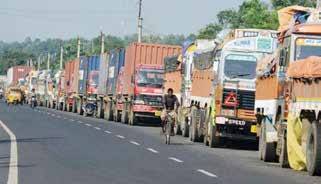
    Hundreds of trucks and tankers carrying everyday supplies have been halted at the Indian border, preventing them from entering Nepal, a landlocked country that has open borders with India to the south, east, and west, and relies on supplies – most importantly food and fuel – coming across.

    This is in reminiscent of the closure of 20 of the 22 official entry points by India in 1989, which, most Nepalis say, happened after King Birendra reportedly turned down a breakfast invitation by Rajiv Gandhi in Pakistan during a SAARC meeting.

    India has expressed concern over growing anti-India sentiment in Nepal saying it “won’t do any good to both countries”.

    “We have noticed anti-India sentiment in a section of media, in social (networking) sites and on the streets. We have taken it up seriously and we have brought it to the notice of the government of Nepal,” India’s ambassador to Nepal, Ranjit Rae  said at a press conference in Kathmandu on Wednesday night.

    Student wings of Nepal’s political parties have been staging protests in front of the Indian embassy in Kathmandu almost every day after supplies from the Indian side stopped last week.

    Expressing concern over anti-India protests in Nepal, the ambassador said the agitation in the Terai districts and difficulties faced in bringing supplies from India were being used to spread anti-India sentiments. “This is Nepal’s internal affair, not an issue between Nepal and India,” he said.

    “Torching India’s flag and effigy of Prime Minister Narendra Modi won’t do any good to both countries. That such incidents are happening is a serious matter,” Rae added.

    Here are the latest developments:

    • “We can only take goods up to the border and beyond the border, it is the responsibility of the Nepalese side to ensure that there is adequate safety and security for the trucks to enter that side,” External Affairs Ministry Spokesperson Vikas Swarup said October 2.
    • Long lines of trucks, extending as far as 10 kilometers, have been stranded on the Indian side of the border for over five days. The government says that the trucks are unable to proceed due to the disturbed security situation in the southern Terai region of Nepal.
    • But top Nepalese leaders have accused India of violating international laws by halting cross-border trade. “We are not getting fuel, cooking gas and vegetables from India and we don’t want such kind of friendship,” said KP Oli, chief of the ruling UML party, who is tipped to be the next prime minister.
    • Amid rising tension with India, there has been increased speculation in Kathmandu over whether fuel could be imported to Nepal from its other neighbor China. But Nepalese officials were quick to play down the reports. “There is no alternative to the road to India,” Prakash Adhikari, press advisor to Prime Minister Sushil Koirala told Reuters. “Getting petrol and petroleum products from mainland China is difficult due to the terrain.”
    • In capital Kathmandu, the government has begun rationing of petroleum products to tackle the fuel crisis. “Beginning on Thursday, we are further restricting distribution due to the very limited supplies we have. Private vehicles will not be able to purchase petrol or diesel,” said Laxmi Prasad Dhakal, a home ministry spokesman.
    • On Wednesday, trucks from India carrying essential goods and petroleum products started entering Nepal – about 100 cargo trucks entered the country from the Sunauli border in Uttar Pradesh.
  • Nepal’s constitution promulgation enters final phase

    KATHMANDU (TIP): Nepal on september 12 entered the final phase of promulgating its new Constitution with the three major parties going ahead with clause-wise voting on the final draft of the statute despite a boycott by Madhesi parties and violent protests that have claimed nearly 40 lives.

    Top leaders of major political parties, including Prime Minister Sushil Koirala of the Nepali Congress, CPN-UML chairman KP Sharma Oli and UCPN-Maoist chairman Prachanda addressed the Constituent Assembly before the voting began.

    Koirala said the major political parties are in their final efforts to promulgate a new Constitution with federalism, republic, democracy and inclusion.

    “We will succeed in promulgating the new Constitution as we succeeded in resolving problems including through the comprehensive peace accord in the past,” Koirala said.

    He expressed concern over efforts being made to spread communal hatred and damage economic activities and called upon the agitating sides to come forward for a meaningful dialogue to guide the nation towards a new direction.

    Urging the disgruntled parties to engage in talks, Koirala said, “I call all the people not to have any doubt as consensus has been forged to move ahead with unity through the medium of talks, discussion, consensus and reconciliation.

    Some amendments could still be made even after promulgation of new Constitution if there are some weaknesses, he said.

    Koirala urged the international community to extend support to the Constituting drafting process and expressed confidence that the international community will support the move.

    “I have got assurance from the international community that they would extend support to the process of drafting the new Constitution. They have asked us to move forward by accommodating all sides and we are making every efforts towards that direction,” Koirala said.

    Out of total of 598 valid members of the 601-member constituent assembly, only 538 are taking part in the Constitution voting process as 60 members of Madhesi parties are boycotting the sitting.

    The Madhesi parties are protesting against the seven province model of the federal structure as proposed by the major political parties.

    Southern Nepal has witnessed turmoil since lawmakers from major political parties struck a breakthrough deal on August 15 to divide the country into seven provinces. The protests have resulted in clashes between demonstrators and police, leaving 37 people, including policemen, dead.

  • This year, only one man plans to climb Everest

    KATHMANDU (TIP): Ang Kami Sherpa is one of Nepal’s most experienced “ice doctors” — the mountaineers who brave Mount Everest’s treacherous Khumbu icefall to prepare it for the climbing season — but even he is more nervous than usual this time round.

    Sherpa is among a group of ice doctors who returned to the 8,848-metre (29,029-foot) mountain in August — four months after a huge earthquake that triggered a deadly avalanche at its base camp.

    They are readying the route for the autumn season, when even in a normal year only a handful of climbers attempt the summit, most opting for the more favourable conditions of spring.

    This year, Japan’s Nobokazu Kuriki is the only climber planning an attempt on the summit, although a six-person support team is expected to accompany him to Camp 2, about 6,400 metres high and usually around two days of trekking beyond base camp.

    At 63, Sherpa is more familiar with Everest than most, having kicked off his mountaineering career in 1975 when he assisted Japan’s Junko Tabei in her successful bid to become the first woman to summit the peak.

    But this time, the veteran ice doctor says even he is worried after April’s quake, which killed nearly 9,000 people, 18 of them on the world’s highest peak.

    “Our job is more difficult this year, the mountain has changed (after the quake),” Sherpa told AFP by phone from Everest base camp, where the ice doctors have already begun work. “There is always a risk up here but we are a little more scared this year.”

    Highly-skilled mountaineers like Sherpa are the first men on the peak every season, using ropes and ladders to build a route across plunging crevasses and constantly shifting ice.

  • Four months after quakes, Nepal fails to spend any of $4.1 billion donor money

    Four months after quakes, Nepal fails to spend any of $4.1 billion donor money

    KATHMANDU (TIP): Two months after foreign countries and international agencies pledged $4.1 billion to help Nepal recover from its worst natural disaster, the government has yet to make arrangements to receive the money and has spent nothing on reconstruction.

    The United Nations estimates almost three million survivors of twin earthquakes in April and May – around 10 percent of the Himalayan nation’s population – need shelter, food and basic medical care, many in mountainous, hard-to-reach areas.

    Govind Raj Pokharel, chief executive officer of the newly created National Reconstruction Authority, said the government was unlikely to start spending the money until October at the earliest because of delays in approving plans and concerns about starting building work in the monsoon season.

    “The government’s response has been slow. I accept that,” said Pokharel.

    Nepal has been criticised for its chaotic response to the quakes that killed almost 9,000 people. The country failed to adequately prepare even though experts had predicted an earthquake was likely. And then the government struggled to cope with relief.Four months later, many partially damaged buildings in Kathmandu are still standing and rubble is strewn across public parks.

  • Zee TV Canada now available on Jadoo TV

    Zee TV Canada now available on Jadoo TV

    August 28, 2015 New York: Zee TV, the No.1 South Asian Network will now be available on Jadoo TV in Canada. The company has reached a subscriber licensing agreement for its flagship networks Zee TV Canada, Zee Punjabi and Zee Cinema with Jadoo TV. Beginning September 1st 2015, the three Zee networks will be available to all Jadoo TV subscribers in Canada. Zee TV Canada is currently available on all satellite, cable, telco and IPTV platforms and, is one of the fastest growing international channels in Canada. Zee TV Canada will be available in High Definition to all Jadoo TV subscribers.

    “Canada is one of the fastest growing markets for us. Our business has more than tripled in last 2 years. This move helps us to further consolidate our position in the market. Jadoo TV has been one of the pioneers in over the top play, which has been the fastest growing category of access”, added Sameer Targe, General Manager, Asia TV USA Ltd.

    We’re excited about bringing Zee TV channels to the largest South Asian viewership base in Canada on JadooTV. Zee TV is not only popular amongst the Indian diaspora in Canada, but also has great appeal amongst the greater South Asian community. The addition of Zee TV, Zee Cinema, and Zee Punjabi will enhance our entertainment offering, making JadooTV the best value for end users. With this agreement, Jadoo TV has further cemented its position as market leader in the OTT space for South Asian diaspora worldwide” said Sajid Sohail, Founder & CEO of JadooTV, Inc.

    jadooAbout JadooTV, Inc.

    JadooTV is a consumer technology and content services company based in Silicon Valley committed to delivering Live and On-Demand content to viewers via its proprietary Internet based set-top box (STB). JadooTV is the leading distributor of Internet based South Asian television content, bringing Television, Movies, and Music to South Asian diaspora from India, Pakistan, Bangladesh, Afghanistan, Nepal, and Middle East. JadooTV is privately held and backed by Intel Capital. For further information please visit: www.jadootv.com

  • Protests over Nepal statute kill at least 9

    KATHMANDU (TIP): At least nine people, including six policemen, were killed and several others injured as thousands of ethnic protesters demanding a separate state in the proposed new Constitution on August 24 attacked police with axes, spears and bricks in a western Nepal district bordering India.

    The clash erupted after about 20,000 demonstrators from the Tharu ethnic group breached the prohibitory orders and attacked police with weapons in Tikapur in Kailali district on the issue of dividing the country in seven provinces, a home ministry spokesperson said.

    The situation turned violent after the demonstrators surrounded police who were enforcing a curfew in Tikapur and attacked security officials with bricks, spears and knives, killing six policemen, including an SSP, the spokesperson said. SSP Laxman Neupane was hacked to death while a head constable was burned alive by the protestors, officials said, adding that three demonstrators were also killed in the clash.

    The injured were taken to regional hospitals and the death toll was expected to rise, they said. Some local media reports put the death toll at 20 that include 17 policemen. However, there was no official confirmation.

    Home Minister Bam Dev Gautam said the government has also sent troops to the area to try to bring the situation under control.

    A new national Constitution presented in the constituent assembly , the national parliament, on Sunday aims to restructure Nepal as a federal state made up of seven provinces. Demonstrators have been protesting against the draft charter, saying the proposed provinces fail to ensure political representation for marginalised communities.

    The Tharu protesters are demanding a separate state in the new Constitution.Since the last two weeks, Tharuhat United Struggle Committee has been staging agitation in the western Terai region demanding autonomous Tharuhat province, including Kanchanpur and Kailai districts, in the new federal structure.

  • Nepal opens Everest expedition after earthquake

    KATHMANDU (TIP): A Japanese climber will be the first to attempt to scale Mount Everest since a massive earthquake in April triggered avalanches that killed 18 climbers, shutting an industry that feeds thousands of people across Nepal.

    Nobukazu Kuriki, 33, of Tokyo will make a solo attempt on the 8,850-metre (29,035 feet) Everest summit along the normal Southeast Ridge route pioneered by Sir Edmund Hillary and Sherpa Tenzing Norgay in 1953, the Nepal government said on August 22.

    “I have chosen to come now to help Nepal, which is in troubles because of the earthquake,” Kuriki told reporters.

    Kuriki will climb in the autumn season that starts next month, which is not usually popular among climbers because of extreme cold and shorter periods of daylight.

    “Kuriki is climbing at a time when there is confusion in the world about the safety in Nepal after the earthquake,” Nepal’s tourism minister Kripasur Sherpa said after handing out the climbing permit.

    “This will be an example for other visitors to come to Nepal which is safe for mountain climbing.”

    Two earthquakes in April and May killed 8,900 people in Nepal, including scores of climbers and foreign trekkers.

    About 400 foreign climbers who were at the Everest base camp at the time of the earthquakes were forced to abandon their attempt after avalanches destroyed their route through the Khumbu Icefall and sherpas said the slopes were too dangerous to climb.

  • Indian American Girl from NJ Crowned Miss Nepal US-Ambassador

    Indian American Girl from NJ Crowned Miss Nepal US-Ambassador

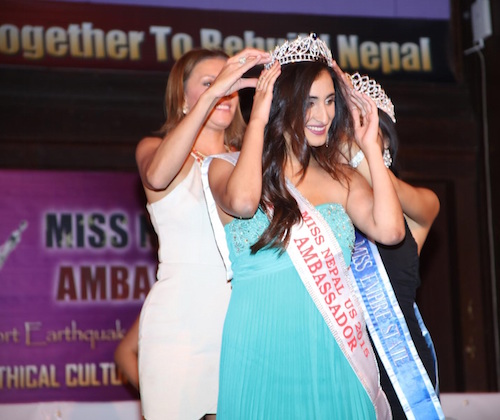
    NEW YORK CITY (TIP): Nisha Kalamdani, a resident of New Jersey was crowned Miss Nepal US Ambassador 2015, on Saturday August 22nd at the New York Society for Ethical Culture in New York City. Nisha is the first ever Indian American to win the crown.

    The star-studded event; 5th Miss Nepal US with the theme of “Rebuilding Nepal” primarily focusing on charity for Nepal’s earthquake disaster relief in the hopes of recovering and rebuilding was organized by Event Planet Inc. in association with Consulate General of Nepal in New York & Nepalese American Foundation.

    Bollywood actress & Goodwill Ambassador of Nepal Government PM Fund for Disaster; Manisha Koirala graced the occasion as a Guest of Honor & Chief Jury along with several other dignitaries.

    With their annual Miss Nepal USA pageant, the organizers opened up a new platform this year to elect an Ambassador from American females of all races, in an effort to strengthen the Nepalese-American Youth relationship and to give opportunities to those who want to help Nepal, and have elaborately formulated relief effort concepts to support the Nepal earthquake victims and thus give an opportunity to the winner to help in the development of a newer Nepal.

    Nisha was bestowed this honor by the unanimous vote of the judges. Nisha will be representing the USA and will also be visiting Nepal for an official trip to meet with the Government officials, including the President and  the Prime Minister of the country to formulate a plan to work on her project related to support Rebuilding Nepal campaign. The organizers of the Miss Nepal US Ambassador are currently working with the Consulate General of Nepal with the required formalities. It is a proud moment for all Indians and Americans, as Nisha is the first  Miss Nepal US Ambassador, as well as the first  American of Indian descent to get  this high honor.

    Nisha has been doing volunteer work since her high school days, be it for Autism Awareness, Cancer patients at the Robert Wood Johnson Hospital, Veteran’s Home in New Jersey, Indian Soldiers, The Lions Club or other such causes.

    Nisha is a fashion model and an actress. She has done many fashion shows as a showstopper for Indian & Main stream American designers. She has been featured in 3 American magazines. She has also done several commercials in the US and shot for products for print ads in India. She has acted in short films and a couple of feature films. One of her feature films ‘Uncommitted‘ has been awarded Best Narrative Feature at The World Indie Film Fest (TWIFF). Uncommitted also bagged another award – Best Feature Film at Online Film Festival (#TOFF) in June 2015. Uncommitted was officially selected by The Los Angeles CineFest and Brooklyn, New York City based ‘Festival of Colors 2015’. The movie world premier will be held by TWIFF on September 26th, 2015 at New People Cinema in San Francisco, CA.

    Nisha has recently completed a Gujarati feature film ‘Romance Complicated‘. The movie has been shot in New York, New Jersey, Florida, Ahmedabad & Rajkot.

    Last year, Nisha was selected as the TOP 5 finalists at the Miss India USA 2014 pageant, where she also won the Miss Beautiful Hair award. Later, she also won the Miss Photogenic at the IMIFF 2015. In addition, she has walked the ramp at the exclusive fashion show, as a Showstopper for Silk Threads by Designer Ruby Bhandari at the recently concluded 2-day Glorious Gujarat 2015 in New Jersey.

    Always a photographer’s delight, she plans to Major in Acting, pursue her career as a Model & Actor and is keen to do some quality work in this profession.

    Nisha says, ” It’s a great feeling to be receiving the honor that I was given. I think it’s very important for anyone who is given such platform to utilize it and make a difference in people’s lives. I believe it’s even more important for me because my generation is the one that should make the most difference, as we are the next leaders. With this Miss Nepal US Ambassador platform I plan on raising awareness and knowledge around the world. I think in America we are blessed with resources and education, but it’s important for us to extend beyond that to help the less privileged. As a Miss Nepal US Ambassador, I plan to truly help rebuild Nepal and make a difference in their lives. I feel that through this honor and platform, I will have more access to the needed resources and thus help the less fortunate in a better way. I hope that my friends and colleagues will further assist me in every possible way to help those affected. This is not a task that any single person can accomplish. It is a joint effort and I request each and every one to do their little bit in this mammoth task of rebuilding our neighbor – “Rebuilding Nepal”.

  • Nepal police shoot anti-charter protester dead

    KATHMANDU (TIP): Nepal police Tuesday fired into a crowd of demonstrators, killing one during protests against a proposed new constitution, as deepening discord spurred lawmakers from a regional party to resign from parliament.

    National police spokesman Kamal Singh Bam said the clashes broke out in the southeastern district of Saptari when protesters tried to block a major national highway.

    Hundreds threw petrol bombs and stones at security forces, attacking their vehicles and vandalizing a local police station, he said.

    “One person was killed and five were injured after police were forced to fire to control the violent mob,” Bam told AFP.

    Regional parties representing the Madhesi ethnic minority who live in the area called an indefinite strike on Tuesday to protest plans in the constitution to divide Nepal into six provinces.

  • A mild tremor felt in Kathmandu

    KATHMANDU (TIP): A mild quake measuring 4 on the Richter Scale rocked Nepal early on August 14, triggering panic among the people who rushed out of their houses.

    The epicenter of the tremor was at Kathmandu and it was recorded at 1.49am today, according to the National Seismological Centre.

    A total of 476 aftershocks with 4 or more magnitude have been recorded after the Gorkha earthquake of April 25 that killed some 9,000 people.

  • Fears grow over Nepal’s ‘anti-women’ constitution

    KATHMANDU (TIP): Nepal’s proposed new constitution has sparked fury from women who say their citizenship, property and other rights are being curtailed by the document designed to draw a line under centuries of inequality.

    Lawmakers tabled a draft in parliament in June shortly after bickering political parties struck an historic deal on the long-awaited charter, spurred to negotiation by an earthquake in March that killed more than 8,800 people.

    But a series of sometimes violent protests have since hit the impoverished, Himalayan nation, with activists saying the charter has failed to address a string of concerns.

    Forty-year-old shop owner Rama Bista says the charter poses a major step back for women, in a country that has long favoured men.

    Bista, who is married to an Indian man based in Nepal, has spent the last four years trying to secure citizenship for her two sons — their legal right under the current constitution.

    “I cannot even speak of some of the things I’ve been told. They tell me my children are not Nepali, that I should go to my husband’s country,” Bista told AFP.

    But Bista’s already tough struggle is set to become impossible under the new charter which bars single parents from passing on their citizenship to their children and additionally says both parents must be Nepalese.

    It will overturn a 2006 act that says children are eligible for citizenship as long as one parent is Nepalese.

    Activists say the move could leave a million people stateless and will disproportionately affect women, who account for the vast majority of single parents in Nepal.Bista says she is anxious about the future for her sons since citizenship is needed to get anything in Nepal from a driving licence to a bank account.

    The draft also makes it easier for a Nepalese man to confer citizenship on his foreign spouse, while a Nepalese woman needs to be married 15 years to her foreign husband before even being allowed to apply.Instead of specifying that daughters can inherit ancestral property, the draft vaguely says “all children”. Activists are concerned this could be interpreted as sons and unmarried daughters only – the wording used in the country’s civil code.

  • Nepal temple bans animal sacrifice

    Nepal temple bans animal sacrifice

    NEW DELHI (TIP): In a significant move that will save millions of animals, Nepal’s Gadhimai temple trust on July 29 announced a ban on animal sacrifice at the Gadhimai festival, the world’s biggest animal sacrifice event held every five years.

    The trust also urged devotees not to bring animals to the festival, a Hindu religious practice which has been continuing for the last 300 years. The decision will make it a bloodless festival where devotees can pray and celebrate without indulging in animal sacrifice in the hope of a better life.

    “The Gadhimai temple trust hereby declares our formal decision to end animal sacrifice. With your help, we can ensure the festival in 2019 is free from bloodshed. Moreover, we can ensure Gadhimai 2019 is a momentous celebration of life,” chairman of the temple trust Ram Chandra Shah said.

    The ban comes in the wake of India’s Supreme Court recently prohibiting movement of animals from India to Nepal for the festival. Animal rights activists in India and Nepal had been demanding such a ban for long.

    Shah said, “For generations, pilgrims have sacrificed animals to the Goddess Gadhimai, in the hope of a better life. For every life taken, our heart is heavy. The time has come to transform an old tradition. The time has come to replace killing and violence with peaceful worship and celebration.”

  • Landslides kill 24 in Nepal monsoon misery

    Landslides kill 24 in Nepal monsoon misery

    KATHMANDU (TIP): Landslides triggered by heavy rains killed at least 24 people July 30 and left more than a dozen missing as homes were swept away in three districts of quake-hit Nepal.

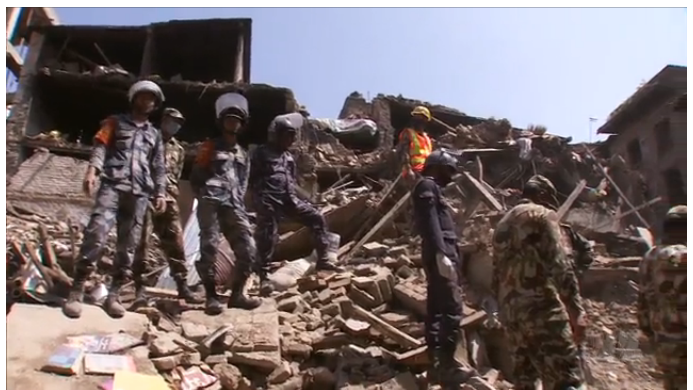
    Rescuers are still searching through rubble for around 20 more people believed missing in the western district of Kaski in the foothills of the Himalayas, around 150 kilometres (90 miles) west of the capital Kathmandu.

    “The number of dead has risen to 21,” said Kaski police chief Kedar Rajaure from the site.

    “The search and rescue operation is continuing.”

    Eighteen people injured in the disaster have been taken to local hospitals for treatment, he said.

    Three more people, including an 83-year-old man, were killed in two landslides in the neighbouring districts of Myagdi and Baglung, according to a statement released by authorities.

    Scores of people die every year from flooding and landslides during the monsoon season in the Himalayan nation.

    Two weeks ago a student was killed when a landslide buried part of a school in the nearby town of Pokhara, and 35 people died last month when a landslide crushed villages in northeastern Nepal.

    The monsoon rains are also hampering delivery of relief supplies to mountainous villages devastated by the massive earthquake that struck the Himalayan nation on April 25.

    More than 8,800 people were killed by the quake and a large aftershock, and many more were left without shelter.

  • Quake-hit Nepal to train 50,000 people for reconstruction

    Quake-hit Nepal to train 50,000 people for reconstruction

    KATHMANDU (TIP): Earthquake-hit Nepal is planning to train 50,000 workers in a bid to carry out massive reconstruction works, the biggest skill development programme as the country braces for the slowest economic growth rate in eight years.

    Delivering the annual budget, Finance Minister Ram Sharan Mahat Mahat said the government will train thousands of people to work as carpenters, plumbers, electricians and masons. “This will help the country to adjust the shortage of labourers as hundreds of thousands of youths travel to the Middle East and other foreign countries to work in various sectors,” he said yesterday.

    Mahat said the country’s economy is likely to grow at 3 per cent this fiscal year, the lowest rate since 2007.

    Officials said that the reconstruction work will help boost growth to 6 per cent next year.

    The government has allocated USD 910 million this year to rebuild infrastructure, public buildings, monuments, and private homes which were destroyed by the earthquakes.

    The Nepal government has said it needs USD 6.6 billion to rebuild the country after twin earthquakes hit the country, in April and May.

  • CNN’s Sanjay Gupta under scrutiny for misidentifying patient

    CNN’s Sanjay Gupta under scrutiny for misidentifying patient

    NEW YORK (TIP): American TV network CNN’s Indian-origin medical correspondent Sanjay Gupta is under scrutiny after it emerged that a child he had operated upon during the earthquake in Nepal had been wrongly identified by him, even as the network rallied behind him.

    Gupta, CNN’s chief medical correspondent and a practicing neurosurgeon, clarified yesterday that he did perform brain surgery on a 14-year-old girl following the earthquake in Nepal in April but acknowledged he may have misidentified the patient as being eight-year-old, according to a post on the CNN website.

    “We are trying to independently verify exactly which child it was,” Gupta said on CNN’s “New Day”.

    The clarification came after the website Global Press Journal reported that the 8-year-old identified by CNN “never underwent surgery of any kind.”

    Gupta had travelled to Nepal in the days following the earthquake to cover the devastating natural calamity and had operated on a girl on April 27 at Kathmandu’s Bir Hospital.

    The Global Press Journal reported that according to the girl’s family and doctors, Salina Dahal was never operated on. Instead, Gupta had operated on 14-year-old Sandhya Chalise. CNN rallied behind Gupta, saying he had the network’s support and that it was proud of his or.

    Gupta has our “full and unequivocal support,” CNN said in a statement.

    “As we reported, he assisted the surgeons at Bir Hospital by performing a craniotomy on a young victim,” the network said.

    “Some reporting has suggested it was not the young girl we, at the time of our own reporting in the midst of the crisis, believed her to be. We will try to verify that.”

    It said Gupta had spent a week in Nepal, “helped save a young life in the operating room, and we couldn’t be prouder of him.” Gupta’s medical assistance, particularly in disaster zones, is sometimes shown on the network’s newscasts. CNN had provided video to Global Press Journal more than a week ago that showed Gupta’s role in the surgery, contradicting the initial claim that he hadn’t helped at all.

    “He was, if anything, relatively modest on the air in characterising his own role. He simply appears to have been fundamentally wrong about the identity of his patient,” said NPR’s David Folkenflik, who was informed of the journal’s reporting ahead of time.

  • New constitution in two months: Nepal deputy PM

    KATHMANDU (TIP): Nepal’s deputy Prime Minister Bamdev Gautam has expressed confidence that a new constitution will be promulgated in the country in two months and said the devastating earthquake on April 25 brought the quibbling political parties together in finalizing the much-delayed document.

    “We would be able to declare the constitution in two months from now,” Gautam told IANS in an interview at his residence here last week. Gautam said the new constitution will be secular and the state will not create any obstacle in the practise of religion.

    He said people who had lost their houses during the devastating April earthquake and the aftershocks that followed were being provided temporary shelters during the monsoon and the task of reconstruction will be taken up in full swing once the rains get over.

    “We have reached the last stage of relief work. After this, we will engage in rebuilding and rehabilitation. A plan has been made and it will be implemented. It (the earthquake) is a national calamity and one needs courage to fight an adversity. We have sought to boost the morale of the people,” Gautam told IANS.

    Over 8,500 people were killed and more than 23,000 injured in Nepal’s devastating earthquake that also flattened numerous villages in central and western regions of the Himalayan nation rendering hundreds of thousands of people homeless.

    Asked about the ongoing constitution-making process in the country, Gautam said 90 percent of the political parties were in favour of promulgating the new constitution soonest but there had been some disturbances by the dissenting minority during meetings of the Constituent Assembly recently.

    He said that after Nepal’s four major political parties gave their nod to a federal model following a 16-point agreement in June, there was hope that the Constitution will be promulgated in a month. The hurdles that cropped up from time to time were being sorted out through discussions, he added.

    The 16-point agreement was signed by the Nepali Congress, Communist Party of Nepal (Unified Marxist-Leninist) [CPN-UML], Unified Communist Party of Nepal (Maoist) [UCPN-Maoist] and the terai-based Madhesi Janadhikar Forum-Loktantrik (MJF-L) with the objective of speedily resolving the key contentious issues in formally proclaiming the new Constitution.

    The deal came after several years of protracted negotiations.

    Nepal’s Maoist rebels had in 2006 agreed to lay down arms after more than a decade-long insurgency and join the democratic process.

    A constituent assembly was elected in 2008 to a two-year term to frame a secular democratic federal constitution for the former Hindu kingdom. The first CA, however, suffered several extensions with the political parties failing to find consensus on various contentious issues including the number of federal provinces, the form of government, electoral system and judiciary.

    In 2012, a second house was elected and this, too, initially suffered the same malaise that had affected the first –protracted wranglings and continued differences over the form and content of the much-awaited document.

    Finally, jolted by the devastating temblor of July 25, the squabbling politicians in the CA sprung to cobbling a document that met the aspirations of the majority among them — the four major political parties agreed on June 8 on the modus operandi to be adopted to speedily finalise a new constitution.

    Asked if the agreement was propelled by the need to show political unity at a time of crisis for the country in the wake of the earthquake, Gautam said the quake united the people of the country like never before.

    “It brought together political parties. This should have happened earlier. And using this, we made a proposal to all parties to get united to finalise the constitution. Four major political parties joined it.

  • 5 aftershocks recorded in Nepal

    KATHMAMNDU (TIP): Five mild aftershocks have been recorded in Nepal in the last two days as the country was still reeling under the impact of the deadly temblor that struck two months ago and claimed nearly 9,000 lives.

    An aftershock measuring magnitude 4 was recorded at 3.33 am today with epicenter located at Sindhupalchowk district, near the Tibetan border.

    Another aftershock measuring magnitude 4 was recorded at 9.12 am with epicenter located at Dolakha district, according to the National Seismological Centre.

    Another mild tremor was felt yesterday of 4.4 magnitude at 3.31 am with epicenter located at Kavre district, 50 km east of Kathmandu.

    In past two days a total of five aftershocks were recorded.

    Two minor aftershocks were recorded in the interval of 7 minutes on Monday night. The first one with 4.1 on the Richter scale occurred at 11:27 pm while the second one with 4 magnitude was recorded at 11:34 pm. Both the aftershocks had Sindhupalchowk epicenter.

    In total 335 numbers of aftershocks with 4 or more magnitude have been so far recorded after the devastating earthquake that rocked Nepal on April 25.

  • INDIA’S PUSH TO SAVE ITS COWS STARVES BANGLADESH OF BEEF

    DHAKA (TIP): Some 30,000 Indian soldiers guarding the border with Bangladesh have a new mandate under Prime Minister Narendra Modi’s government this year — stop cattle from crossing illegally into the Muslim-majority neighbour.

    Roughly every other night, troops armed with bamboo sticks and ropes wade through jute and paddy fields and swim across ponds to chase ageing bovines, and smugglers, headed for markets in Bangladesh.

    The crackdown is one of the clearest signs yet of how Indian policies are having an economic impact on neighbouring countries.

    About 2 million head of cattle are smuggled into Bangladesh annually from India. The $600 million-a-year trade has flourished over the past four decades and is considered legal by Dhaka.

    Modi’s government wants to put an end to it.

    Union home minister Rajnath Singh travelled this spring to the frontier with Bangladesh, calling on the Border Security Force (BSF) to halt cattle smuggling completely so that the “people of Bangladesh give up eating beef”, media reported at the time.

    “Killing or smuggling a cow is equivalent to raping a Hindu girl or destroying a Hindu temple,” said Jishnu Basu, an RSS spokesman in West Bengal, which shares a 2,216km (1,375 miles) border with Bangladesh.

    Beef prices up, exports down 

    So far this year, BSF soldiers have seized 90,000 cattle and caught 400 Indian and Bangladeshi smugglers.

    Bangladeshi traders who operate auctions to facilitate the sale of cattle to slaughter houses, beef processing units, tanneries and bone crushing factories estimate the industry contributed 3 percent to the country’s $190 billion economy.

    The hit to GDP from India’s policies is not yet known. But HT Imam, a political adviser to Bangladesh Prime Minister Sheikh Hasina, said there was “absolutely no doubt” that the beef trade and leather industry were suffering.

    Syed Hasan Habib of Bengal Meat, Bangladesh’s top beef exporter, said it had to cut international orders by 75 percent. The company exports 125 tonnes of beef a year to Gulf countries.

    He said the price of cows had gone up by 40 percent over the past six months because of India’s move, and they had been forced to close two processing units.

    Habib plans to import cows from Nepal, Bhutan and Myanmar to meet domestic demand, but he said Indian cows had better quality meat and raw hide.Bangladesh Tanners Association president Shaheen Ahmed said 30 of 190 tanneries had suspended work due to lack of hides, and about 4,000 workers were jobless.

    A senior official in India’s home ministry said Bangladesh should find new sources of beef because India would stick to its stance.

    Cow protection force 

    India is home to 300 million cattle and is the world’s largest beef exporter and fifth-biggest consumer.But since Modi’s Bharatiya Janata Party (BJP), which is closely linked to the RSS, came to power last year, the rhetoric on cow protection and the beef ban has increased.

    Critics say tougher anti-beef laws discriminate against Muslims, Christians and lower-caste Hindus who rely on the cheap meat for protein. Butchers and cattle traders, many of them Muslim, say the push threatens thousands of jobs.

    The rhetoric has also emboldened vigilante cow protectors.

    “I was chained to a tree and beaten by members of the cow protection force. They forced me to recite a Hindu prayer,” said Mohammed Tarafdar, who was caught smuggling two calves near the Bangladesh border in April.

    “My religion permits me to eat and sell beef, so why should Hindus have a problem?” said Tarafdar, sitting in a crammed prison cell in Basirhat district. Some BSF soldiers said they could not understand why they were chasing cows. Some animals are caught and auctioned by the BSF, only to be bought and smuggled again.

    Two soldiers were killed by a gang of Bangladeshi smugglers, while three dozen have been injured by the animals.

  • India ranks 143rd on global peace index topped by Iceland

    India ranks 143rd on global peace index topped by Iceland

    India ranks a lowly 143rd on a global peace index, lagging way behind the likes of Bhutan, Nepal, Sri Lanka and Bangladesh with Iceland emerging as the most peaceful nation in the world.

    According to the nonprofit Institute for Economics and Peace, Iceland, the thinly populated island in the midst of the North Atlantic has retained its place as the most peaceful country in the world.

    The institute released its Global Peace Index for 2015 recently, which ranks 162 nations around the globe based on factors like the level of violent crime, involvement in conflicts and the degree of militarisation. The nations are given a score on that basis. The more the score, the less peaceful the country is.

    India is ranked at 143 on the index with a score of 2.504. “The number of casualties from internal conflict also rose in India where a Maoist insurgency stills runs rife. The downgrade in India’s score is tempered, however, by an improvement in political stability. The world’s second most populous country witnessed an historic election in 2014 as the Bharatiya Janata Party secured India’s first one-party majority since the mid-1980s,” the report said.

    Six out of the top 10 most peaceful countries were European, with Denmark and Austria holding the second and third spots.

    “Europe maintained its position as the most peaceful region in the world, supported by a lack of domestic and external conflicts,” the report said.

    Pakistan fares badly ranked at 154 with its score deteriorating on the back of a worsening of its perceptions of criminality, as a result, the country remains second from the bottom in South Asia.

    “The country’s dire domestic security situation continues to be hampered by the presence of Islamist militant groups. Even though the number of deaths from internal conflict did not worsen significantly over the past twelve months, Pakistan suffered a handful of high-profile incidents — most notably the separate attacks on Jinnah International Airport and an army-run school in Peshawar,” the report said.

    Afghanistan remains the most lowly ranked in South Asia at 160. Bhutan (18), Nepal (62), Bangladesh (84) and Sri Lanka (114) are all ranked above India, Pakistan and Afghanistan.
    US is also ranked at a lowly 94 scoring badly in terms of militarisation, homicides and fear of violence. China is ranked 124.

    Syria and Iraq where the Islamic State terror group has taken over large swathes of land are at the bottom of the table as the least peaceful countries.

  • Temporary Protected Status for Citizens of Nepal in the wake of devastating Earthquake

    Temporary Protected Status for Citizens of Nepal in the wake of devastating Earthquake

    NEW YORK (TIP): U.S. Reps. Joe Crowley (D-Queens, the Bronx), Vice Chair of the Democratic Caucus, and Grace Meng (D-Queens), a member of the House Foreign Affairs Committee and its Subcommittee on Asia and the Pacific, announced, June 24, that in the wake of the devastating earthquake in Nepal, the United States government is granting Temporary Protected Status (TPS) to Nepalese nationals presently in the U.S.

    The move protects citizens of Nepal from deportation or detainment so that they are not forced to return to dangerous and unsafe conditions that the earthquake caused in their country. The decision comes after Crowley and Meng led dozens of Congress members in a letter urging Homeland Security Secretary Jeh Johnson and Secretary of State John Kerry to grant TPS to Nepalese nationals.

    “As the people of Nepal continue to mourn the lives lost and struggle to recover from this terrible tragedy, I’m proud our nation will continue its tradition of humanitarian support by granting TPS to Nepalis currently in our country,” said Crowley. “This is a critical step that will allow those in Queens and in communities across the country to remain here until the Nepali government is better suited to handle their return, thus helping Nepal’s government focus on their important recovery efforts.”

    “My heart continues to ache for all those impacted by the terrible tragedy in Nepal,” said Meng. “Allowing citizens of Nepal who are in Queens and throughout the nation to remain in the U.S. until it’s safe to return is the right and decent thing to do, and I thank Secretary Johnson and Secretary Kerry for being responsive to our request. As Nepal continues to recover, the U.S. and international community must continue to assist the country with needed relief efforts.” Watch Meng call for TPS during a recent Foreign Affairs Committee hearing:

    “The Nepali community in the U.S. is relieved that we don’t have to worry about our visas. We can now focus on supporting our friends and families back home and contribute towards rebuilding our homeland,” said Luna Ranjit, Executive Director of Adhikaar. “We would like to thank Congressman Crowley and Congresswoman Meng for visiting us and listening to our stories, and pushing for TPS for Nepal.”

    Under the Immigration and Nationality Act, the U.S. can provide TPS when conditions in a country prevent its citizens from returning safely such as natural disaster, civil war, or other extraordinary and temporary conditions.

    In order to qualify for TPS, applicants must have been continuously present in the U.S. since June 24, 2015. TPS will be in place for 18 months, until December 24, 2016. Applicants must apply for this status by December 21, 2015.

    For more information on TPS, including guidance on the application process and additional information on eligibility, please visit the U.S. Citizenship and Immigration Services (USCIS) TPS website
    atwww.uscis.gov/tps.