Tag: Nepal

  • With aid not getting through, relief trucks looted in Nepal

    SINDHUPALCHOWK: Homeless, exhausted and angry, Nepal quake survivors on Thursday began attacking relief convoys as complaints of tardy aid distribution piled up despite a glut of relief material clogging the airport and relief hubs.

    Wet and chilly weather hampered relief work as residents remained on edge due to aftershocks that have rattled the country since the Saturday quake that has destroyed thousands of buildings. The official death toll so far is 5,800 but Nepal Army chief General Gaurav Rana, who is leading the nationwide rescue effort, told NBC News, “Our estimates are not looking good. We are thinking that 10,000 to 15,000 may be killed.”

  • NEPAL CITIZENS GET ON WITH JOB WHILE GOVERNMENT DITHERS

    NEPAL CITIZENS GET ON WITH JOB WHILE GOVERNMENT DITHERS

    The magnitude 7.8 earthquake in Nepal was one that many had anticipated, although there was little strategic planning or advance preparation.

    The youthful tectonic plate wrinkle called the Himalayas was long overdue to shake up the region.

    The initial days after the quake have proven unstable and insecure, both literally in terms of the hourly aftershocks that have made sleep impossible and politically in the global response to this disaster.

    This event threatens to become a catastrophe, largely because of the difficult relationship that has long existed between Nepal and the international development industry.

    As aid arrives into the country, old patterns are emerging. International aid responses have mimicked the petty bureaucratization that hampered reactions in Haiti in 2010. Diplomatic and political concerns are taking precedence over saving lives, as they did in New Orleans in 2005.

    Likewise, Nepal’s own governmental instability is staying the course, as politicians unable to write a constitution for seven years are proving (unsurprisingly) also unable to direct relief within their own country, although they are showing a strong desire to control priorities.

    Having closely watched Nepal’s interactions with the development apparatus for some time now, I believe there here is an opportunity to change the patterns of behavior that have made the development industry a domain of despair rather than hope.

    To do this, two groups have to behave differently- the Nepali people and the global public sphere.

    Only the first have already taken up the challenge.

    I find myself glued to my computer, watching with amazement as youth groups mobilize to send support to inaccessible areas.

    As one of my research collaborators said, “My family is okay but other things are very bad here. I took my family to a safer place and now we youth are sending volunteers, medicine, tents and food to villages.”

    A group called “Bibeksheel Nepalis” or “Responsible Nepalis” is organizing online to send volunteer teams to various neighborhoods to distribute supplies and recruit those with vehicles to rescue the injured.

    Dozens of social service organizations in Nepal’s vibrant civil society like the Association of Youth Organizations of Nepal (AYON) have set up bases under whatever tarps they can find to protect them from the rain and are organizing water distribution and creating emergency supply kits.

    This is a citizenry that has long known it cannot rely on its government, and in this time of crisis one sees the very best of the country’s character.

    Nepal cannot wait seven years for water or electricity as it has waited futilely for seven years for a constitution.

    I am less confident about the international community’s ability to change their modes of response to distant disasters.

    Far too much media coverage has focused on Mount Everest and the climbers.

    While we all mourn those who died on Sagarmatha, there are pressing issues across the country. Every few hours I receive messages from friends and colleagues across Nepal describing their decimated villages and how they have yet to see anyone from the outside.

    Unreachable except by helicopter at present, these remote towns will not make the cover of the newspaper. If events like Haiti and Fukushima have taught us anything, it is that recovery from disaster is both a short and a long-term process.

    It is incumbent upon everyone to learn more about this event that is becoming a catastrophe to look beyond the celebrity endorsements and heart-wrenching stories to ask questions about the region, about aid efforts and how priorities are being set.

    In the current era of clickable humanitarianism, it is easy to text-to-donate for the latest cause and then move on to the next social media event.

    Currently, there is a desperate need to get bandages, clean water and medical teams to remote areas quickly. Even as that immediate need occurs, we are also seeing preventable secondary calamities erupt.

    People are sheltering in tents out of fear of aftershocks and the limited-sanitation provided in these open-air camps provide the ideal conditions for a cholera epidemic. Without a forward-thinking aid plan, these concerns could last for years and kill far more people than the initial quake.

    Latrines are not a great seller on social media.

    In both acute crises and long-term development, aid priorities are often overwhelmed by politics – both national and international.

    Soon, we will approach a stage where a more substantial and long-lasting process of rebuilding will begin, a new area that will require foreign aid to serve civil society, not the reverse.

    But Nepal’s relationship to international aid is deeply conflicted.

    Nepalese scholars like Dor Bahadur Bista, Nanda Shrestha, and Devendra Raj Panday question the progress that more than a half century of engagement with development has brought to Nepal. These authors suggest that the priorities of aid in Nepal have often been decided by Nepal’s elites or the donor countries’ and organizations’ priorities, rather than the needs of the people.

    A silver lining?

    The devastation of this earthquake provides an opportunity for a new mode of international development, one that is driven by voices on the ground, rather than the ever-changing fashions of the aid industry. Connecting people to people, without the politics of government or the bureaucratization of the traditional aid community is the best hope for Nepal’s recovery.

    This would require caring members of the global community to do some research, move beyond the easy-to-click buttons, and understand more about the situation in Nepal – and then demand that the organizations they give to do the same due diligence.

    The youth of Nepal are stepping forward to rebuild their own country. The international aid community and the world can do is meet them half-way.

    (The author is Associate Professor, Department of Asian Studies at University of Texas at Austin, Texas).

  • Nepal a rubble house as the Worst earthquake in 80 years kills more than 5800

    Nepal a rubble house as the Worst earthquake in 80 years kills more than 5800

    KATHMANDU (TIP): The April 25  earthquake and its aftershocks have turned one of the world’s most scenic regions in the world  into a desolation and devastation.

    [quote_box_right]

    • More than 5,800 are confirmed dead as per the official death toll
    • Nepal’s PM says death toll could more than double
    • More than 14 international medical teams in search-and-rescue operations
    • India, US, Britain, UAE, Poland, France, Swiss, Israel, Italy, Canada & UN all providing support to Nepal

    [/quote_box_right]

    Thousands of people have lost their lives and thousands more have been injured in a 7.8-magnitude earthquake that hit Nepal’s capital Kathmandu and its surrounding areas. Mount Everest was also struck by deadly avalanches after the quake on Saturday.

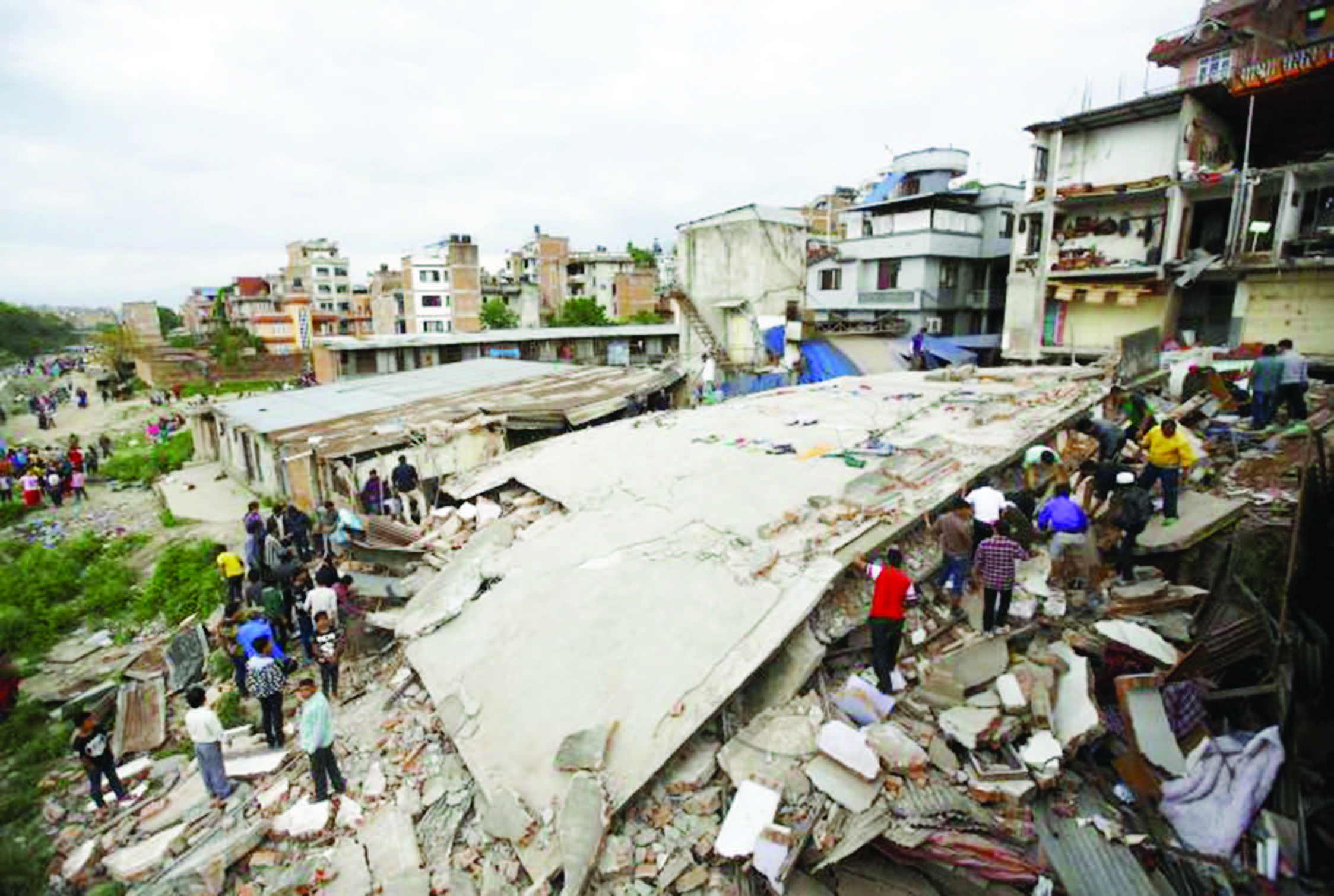
    Rescue crews and residents in Nepal began the desperate search for survivors near the capital of Kathmandu. The devastation is massive with flattened homes, buildings and temples, causing widespread damage across the region and killing more than 5800 and rising.

    Whole streets and squares in the capital of more than 1 million people were covered in rubble. Stunned residents stared at temples that were once part of their daily lives and now were reduced to nothing.

    Locals and tourists ferreted through mounds of debris in search of survivors.

    Officials have warned that the number of casualties could rise as rescue teams reach remote mountainous areas of western Nepal.nepal

    “Our estimates are not looking good. We are thinking that 10,000 to 15,000 may be killed,” said Gen. Gaurav Rana, who is leading the nationwide rescue effort.

    Rana acknowledged that massive temblor left officials struggling to cope with the aftermath – including the risk of disease and growing public anger at the pace of the rescue effort.

    “There is unrest, and we are watching it. Yes, there is the threat of an epidemic, and we are watching it,” he said.

    Rana said he understood how many people “would be angry” about the government’s response, stressing that the army was working with the police to “identify local hot spots and control.”

    [quote_box_center]India gives massive help[/quote_box_center]

    A defense ministry handout shows teams from the National Disaster Relief Force (NDRF) and Indian Air Force material on their way to earthquake-hit Nepal. Indian planes were the first to land in Kathmandu with water, food, earthmoving equipment, tents, blankets, mobile hospitals, specialized rescue teams and specialized manpower to help restore electricity supply-a combination of rescue and relief.

    Indian planes were the first to land in Kathmandu with water, food, earthmoving equipment, tents, blankets, mobile hospitals, specialized rescue teams and specialized manpower to help restore electricity supply-a combination of rescue and relief. Increasingly, as Nepal’s only airport gets crowded with flights from other nations, India has been moving most of its material by road to Nepal.

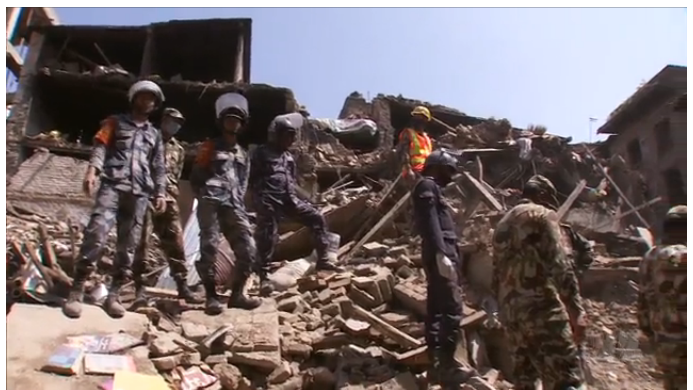
    National Disaster Response Force (NDRF) teams, a home ministry force, have fanned out beyond Kathmandu to try and reach wrecked villages and hamlets lying in inaccessible and remote parts.

    Military helicopters have conducted reconnaissance flights, and what they report about the extent of the devastation is said to be pretty grim.

    Alongside, showing his personal involvement in the relief effort, Prime Minister Narendra Modi, in a series of tweets on 27 April, thanked the NDRF teams, armed forces, doctors, volunteers,
    “enthusiastic youngsters”, state governments that were helping out, the media (“they are bravely covering the disaster from the ground”), and saluted “the resilience of our sisters & brothers in Nepal & parts of India, for their courage in the face of disaster”.

  • Indian Americans mobilize support for Nepal quake victims

    WASHINGTON (TIP): Indian Americans from across the country are mobilizing support for the victims of the devastating earthquake in Nepal, with a large number of organizations raising funds for the people of the quake-ravaged country.

    Organizations like Aim for Seva, BAPS Charities, ISKCON – Food for Life, India Development and Relief Fund (IDRF) and SEWA International are contributing in numerous ways — from providing recovery assistance and urgent medical care to healthy meals and temporary shelter, a media release said.

    “This devastating earthquake was centered in Nepal’s Kathmandu valley whose effect was strongly felt deep inside India. Nearly 4,000 people are dead and counting. Several thousand people were displaced and lost everything,” Chandrakant Patel, president of Overseas Friends of BJP-USA, said urging Indian Americans to make generous contributions to the cause.

    Another organization, The United Sikhs said that their relief team has reached Nepal to carry out work in those areas where aid is most critically needed.

    “Our medical team of doctors will arrive by Friday equipped with medical supplies to assist the injured,” added the US-based organization.

    American India Foundation said 100 per cent of its donations would go to the Nepal quake victims.

    “This fund will support the rehabilitation of lost livelihoods for communities across Nepal, to rebuild and provide a new life filled with dignity, opportunity, and hope,” said M A Ravi Kumar, CEO of American India Foundation.

    Meanwhile, Congresswoman Grace Meng announced to have co-sponsored the legislation that grants Temporary Protected Status to Nepalese citizens presently in the United States who have been impacted by the devastating earthquake that struck their country on Saturday.

    The Temporary Protected Status Act of 2015 would protect citizens of Nepal from deportation or detainment so that they are not forced to return to unsafe conditions in their homeland.

    “The US and international community must continue to assist with much needed relief and recovery efforts, and this legislation would help as well by ensuring that citizens of Nepal are not forced to return to the dangerous and disastrous conditions that the earthquake has caused in their country,” said Meng, a member of the House Foreign Affairs Committee and its Subcommittee on Asia and the Pacific.

    Congresswoman Yvette D Clarke, in a statement, extended her condolences to the victims of the earthquake in Nepal and their families.

    “In such times of tragedy, as when an earthquake devastated Haiti in 2010 or when the United States was attacked by terrorists on September 11, 2001, the people of Brooklyn have been involved in relief efforts as volunteers and contributors, offering their prayers and their donations and their talents for assisting people who are suffering and supporting their efforts to rebuild,” she said.

    “Our thoughts are with the people of Nepal and their families. My heart sank when I heard about the 7. 8-magnitude earthquake and its unthinkable devastation,” Congresswoman Suzan DelBene said while speaking on the floor of the US House of Representatives.

    The International Food Policy Research Institute, an agricultural research centre, said the devastating earthquake, which has affected more than eight million people, will strike a blow to the country’s already fragile food security and nutrition situation.

    It also urged national and international organizations to provide immediate aid to ensure adequate access to nutritious food for everyone in the country.

  • U.S. Praises India’s Role in Nepal Quake Relief Efforts

    New Delhi April 28 (TIP) : US praised India’s leadership role in helping earthquake-hit Nepal and persons of different nationalities stranded in war-ravaged Yemen.

    “India has demonstrated its global leadership in recent weeks, first in Yemen and now in Nepal. We are grateful; we are impressed; we are inspired.

    “And because our cooperation is expanding, India is using C-17s and C-130s on the front lines of its response,” US Ambassador to India Richard Verma said here at the Amcham function.

    He said that the US side has received administrative clearances for its relief efforts in Nepal without delay.

    “As our relationship progresses, we will be able to do even more together,” he added.

    India was the first to respond to the Nepal crisis and it immediately sent relief material.

    The death toll in the devastating earthquake that rocked Nepal has climbed to over 4,350 today with more than 8,000 injured.

    Crisis loomed over quake-hit Nepal with an acute shortage of food, water, electricity and medicines as fear of another quake kept tens of thousands of people out in the open.

    Verma also said that the US has provided USD 10 million in humanitarian funding.

    He said that the embassy has deployed personnel and disaster response resources to Nepal to participate in the rescue effort.

    Source : PTI

  • Nepal Earthquake: Rescuers Struggle to Reach Villages as Toll Tops 3,800

    Nepal Earthquake: Rescuers Struggle to Reach Villages as Toll Tops 3,800

    BHAKTAPUR, Nepal — Rescuers struggled to reach Nepal’s more rural communities on Monday to assess the damage from a devastating earthquake that has left more than 3,800 people dead.

    [quote_box_right]Hit by severe shortage of food, water, electricity and medicines and buffeted by fear, tens of thousands of people are out in the open here as quake-hit Nepal today desperately sought international help to tide over a looming crisis with death toll soaring.[/quote_box_right]

    The 7.8-magnitude earthquake struck Saturday, killing thousands and flattening centuries-old buildings in the capital city of Kathmandu. The temblor also sparked a deadly avalanche on Mount Everest.

    Kathmandu residents were continuing to sleep outside following two days of powerful aftershocks. The official death toll jumped above 3,800 on Monday, with more than 7,100 others injured, according to Nepal’s National Emergency Operation Center. Aid agencies warned that figure could leap higher once rescuers make it to isolated rural communities.

    “Villages in the areas affected near the epicenter are literally perched on the sides of large mountain faces and are made from simple stone and rock construction,” Matt Darvas, a Nepal-based worker with the Christian charity World Vision, said in a statement from the group.

    More than 48 hours after the 7.9 magnitude temblor shook the Himalayan nation, injuring more than 8,000 people and leaving thousands more homeless, multi-nation rescue teams, including from India, carried out relief works.

    Armed with modern equipment, dumpers and earth removers and aided by sniffer dogs, disaster relief workers were trying to locate possible survivors against fading hopes.
    The quake that flattened homes and buildings and the subsequent powerful aftershocks forced people out to live in the open under plastic tents barely shielding them from cold and rains that pounded the city last night.

    Fuel and medicines were also in short supply. The picture was the same in suburbs of Kathmandu and in other rural areas.

    Nepal’s top bureaucrat Leela Mani Paudel said the immediate and big challenge was relief. “We urge foreign countries to give us special relief materials and medical teams. We are really desperate for more foreign expertise to pull through this crisis,” he said.

    “We are appealing for tents, dry goods, blankets, mattresses, and 80 different medicines that we desperately need now,” he told a press conference.

    Nepal does not have helicopters or the expertise to rescue survivors. It needs help in the form of orthopaedic doctors, nerve specialists, anaesthetists, surgeons and paramedics, Paudel said.

    Hundreds of people are still trapped under tonnes of rubble in capital Kathmandu and some of the worst-affected remote mountainous areas amid concerns that toll could cross 5,000 mark, authorities said.

    “The death toll in Nepal from the earthquake that struck two days ago has risen to 3,726,” Nepalese police spokesman Kamal Singh Bam said today.

    Home ministry’s disaster management division said nearly 7,000 people were injured. 1,053 people are reported killed in the Kathmandu Valley alone and 875 in Sindhupalchowk.

    Officials and aid agencies have warned that the casualties could rise as rescue teams reach remote mountainous areas of western Nepal.

    “Villages are routinely affected by landslides, and it’s not uncommon for entire villages of 200, 300, up to 1,000 people to be completely buried by rock falls,” aid agency World Vision spokesman Matt Darvas said.

    The blocked roads, downed power lines and overcrowded hospitals along with fresh tremors are hampering rescue efforts to locate survivors of the quake.

    More than 700 disaster relief experts drawn from the National Disaster Relief Force have been deployed by India.

    India has mounted a major rescue and rehabilitation effort, deploying 13 military aircraft which carried field hospitals, medicines, blankets, 50 tonnes of water and other materials.

    A senior-level inter-ministerial team from India has arrived here to assess how India can assist in the relief operations. Teams of health experts from AIIMS and Safdarjung hospital Delhi have also been deployed.

    Mass cremations are being held here continuously. As the death toll rises, the authorities are working on disposing of the bodies as quickly as possible to prevent a health hazard.
    Nepal has declared a state of emergency in the wake of the disaster, the worst in over 80 years.

    Aid flights are coming in continuously due to which Kathmandu airport is running out of parking bays. Many planes are having to wait before getting permission to land.
    Chaos prevailed in the country’s only international airport here with hundreds waiting to be evacuated.

    While 2,500 Indians have been evacuated so far, scores of people were still waiting outside the Tribhuvan International Airport to board commercial and defence aircraft to head for home.

    UN agencies say Nepal is running out of water and food and nearly one million children urgently need humanitarian assistance as they were particularly vulnerable.

  • Alarm bells for India? China plans to build rail link with Nepal through Mt Everest

    Alarm bells for India? China plans to build rail link with Nepal through Mt Everest

    BEIJING (TIP): China is planning to build a tunnel under Mount Everest, called Qomolangma in Tibetan, as part of its plan to extend its rail link to Nepal, the state run China Daily said on April 9.

    “The line will probably have to go through Qomolangma so that workers may have to dig some very long tunnels,” railway expert Wang Mengshu told China Daily.

    He said that the changes in elevation along the line were remarkable and added that the speed of trains on the proposed Nepal line would be restricted at 120 km per hour because of the difficult mountain terrain.

    China picking major infrastructure deals in Nepal

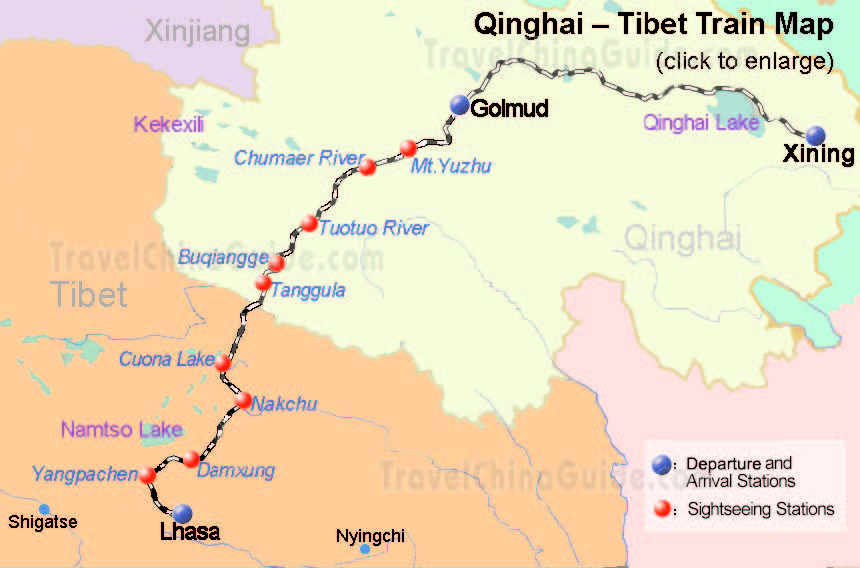
    This is the first time a tunnel plan has been revealed to reach Nepal. China had earlier discussed extending the Qinghai-Lhasa line to the Nepalese border without digging a tunnel.

    Sources said the idea was to find a short route to Nepal for accessing the vast Indian market. Besides, China might be trying to involve Nepal for its Bangladesh-China-India-Myanmar (BCIM) project because New Delhi has shown little enthusiasm for this corridor, sources said.

    “If the proposal becomes a reality, bilateral trade, especially in agricultural products, will get a strong boost, along with tourism and people-to-people exchange,” Wang said.

    The Nepal rail project, which has been taken up at Kathmandu’s request, will be completed by 2020, China Daily quoted a Tibetan official as saying. The project was discussed during the visit of Chinese foreign minister Wang Yi to Kathmandu in December, according to Nepalese reports.

    In August last year, China completed a 253-km long railway line extending the Lhasa line to Xigaze, the second biggest city of Tibet which is closer to the Nepalese border.

    In another move involving India’s neighborhood, China is likely to sign a deal to help Pakistan build a natural gas pipeline to Iran. The contract is expected to be signed during president Xi Jinping’s upcoming visit to Islamabad.

  • Rhino on rampage in Nepal, kills 1, injures several

    Rhino on rampage in Nepal, kills 1, injures several

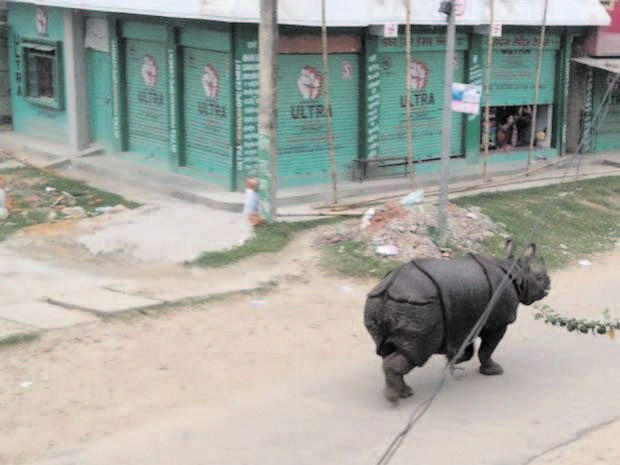
    KATHMANDU (TIP): A wild rhino charged into a city in southern Nepal on March 30, killing a woman, injuring several others and chasing panicked people through the main market and a hospital, an official said.

    Attempts to force the rhino out of Hetauda city by honking car horns and beating drums were unsuccessful, with the animal running from one area to another, government administrator Ram Prasad Thapaliya said.

    Teams with tranquilizer guns were on their way to attempt to capture it, he said.

    Thapaliya said the rhino fatally gored a 61-year-old woman on the outskirts of Hetauda, a city of about 135,000 people that borders a forested area. An unknown number of people were injured, he said.

    It chased people around the main downtown market and the city bus station, he said.

  • Ekal’s ‘Parinam Kumbh’: Huge Success

    Ekal’s ‘Parinam Kumbh’: Huge Success

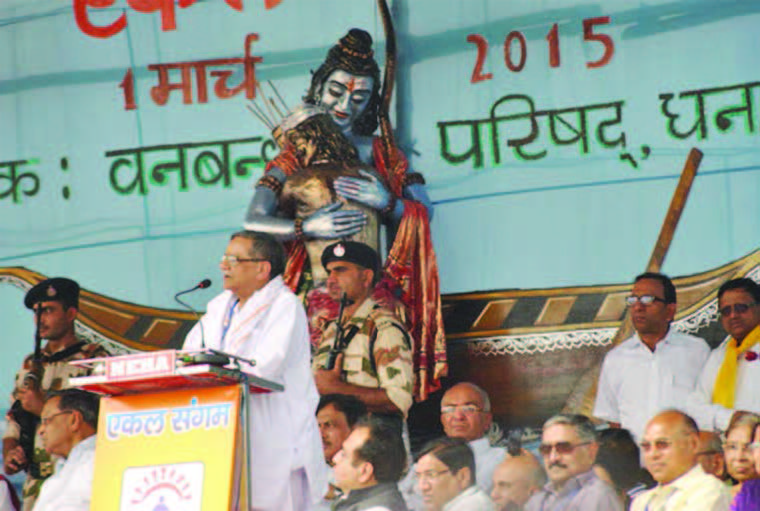
    NEW YORK (TIP): In the first week of March, ‘Parinam Kumbh’ (meaning ‘assessment’) of “Ekal Vidyalaya Foundation”, was convened at Dhanbad, Jharkhand, the birth place of ‘Ekal’, 25 yrs ago. More than2,200 delegates from dozen countries came for this 3-day unique event to witness the transformation “Ekal” had brought to the overall development of rural masses in India. The goal, in the words of convener Shri Yogendra Tulsyan, was not only to bring in active supporters and partner-organizations of “Ekal” under one roof, but also to celebrate and, retrospectively, to take stock of Ekal’s success. It was also an occasion to pay tribute to Ekal’s late founder Shri Madanlalji Agarwala who established first ‘Ekal Vidyalaya’ in November 1988 in Laidvari tribal village near Dhanbad. As a dedicated ‘Pracharak’ of “Rashtriya Swayam Sevak Sangh” (RSS), when he asked the poor farmers how he can be of help to them, they requested him to make at least their children literate, so that they can avoid economic and social subjugation. The seedling that the visionary Madanlalji sowed, quarter century back has now prospered into the largest Literacy, Healthcare and rural development movement in India with supporting chapters in more than a dozen countries. Ekal has now 55,000 schools spread throughout India, including in Jammu-Kashmir and Nepal. Through ‘Ekal,’ almost 1.5 Million children are receiving basic education and healthcare training, each year.

    Ekal’s ‘Parinam Kumbh’ Ekal’s ‘Parinam Kumbh’ Ekal’s ‘Parinam Kumbh’

    The prominent dignitaries who presided over this mega convention were Ekal Chief Shri Shyamji Gupta, Chief Minister Shri Raghuvar Das, VHP Chief Shri Ashokji Singhal, Sadhvi Ritambaraji, and ZEE-TV Chairman Shri Subhashchandraji. At the mammoth public meeting, attended by over 50,000 people, Shri Ashokji, in his address emphasized that India needs to restore its lost identity and true character on the basis of self-respect and self-reliance. He further added that Ekal was started with this objective by late Shri Madanlalji. Shri Shyamji Gupta, who paid an eloquent tribute to Shri Madanlalji Agarwala for his pioneering efforts to spread literacy, gave an overview of the ecliptic progress Ekal had made to uplift forgotten masses in the villages. Di Di Ma Sadhvi Ritambaraji touched on the difficulties faced by the Volunteers and compared them with ever-loyal ‘Hanuman Sena’. The Chief Guest for this occasion was RSS Chief, Shri Mohanji Bhagwat. In his address to the delegates, Shri Mohanji challenged them to explore possibilities where, ‘Ekal’ as a rural support-vehicle, could be taken further with changing times and in favorable political climate. There were several presentations by various Ekal alumni groups whose main theme was the empowerment that Ekal had brought to their lives. According to them, this was facilitated, not only by education, and infrastructure of self-reliance that Ekal had provided, but also, by its awareness campaign for one’s ‘right to information’ in the face of bureaucratic hurdle. Some of these people are now even playing leadership roles at the district level. ‘Pinki Karmakar’ who carried the Olympic torch at London Olympiad and became a national inspiration for the youths few years back, was an Ekal alumnus. There were several testimonials by rural-folks which portrait their success at tackling social ills like bonded labor, mass drunkenness, spread of epidemics, migration of youths to urban areas, and blatant corruption in their community.

    “Ekal Vidyalaya Foundation of USA”, has played a very significant role in the expansion, progress and success of ‘Ekal Abhiyan’ (Ekal-India) for more than two decades. ‘Ekal’ as it is known today had started out as ‘One-Teacher School Project’ in India as well as in USA. For last few years, Ekal-USA has been raising $4 to 5 Million U.S. Dollars through its fund-raising concerts, all over USA. This year’s concerts artists are Bollywood Melody Makers “Rana Chaterjee and Sangeeta Melekar” and they will be performing at more than 50 places. Their sold-out concerts are already under way since February. For more information on Ekal concert in your vicinity and to get involved please kindly visit www.ekal.org.

    Your generous support for this worthy cause shall be appreciated.

  • 18 killed, 11 injured in bus accident in Nepal

    KATHMANDU (TIP): At least 18 people, including a three-month-old baby, were killed and 11 others injured today when a bus skidded off from a rain-drenched mountain road in northwestern Nepal.

    The bus was heading for Nagam in Kalikot district from Jumla district, carrying 29 passengers.

    Thirteen people died on the spot, two others on their way to hospital and another two succumbed to their injuries upon reaching a hospital.

    Three of the injured passengers are said to be in critical condition. One of the passengers escaped unhurt. A three-month-old boy also succumbed to injuries during treatment bringing the death toll to 18, Himalayan Times reported.

    Police Inspector Indra Bahadur Raut said three seriously injured persons were airlifted to Kohalpur Medical College, Banke for treatment.

    Others are being treated at Jumla-based Karnali Institute of Health Sciences. Meanwhile, police have identified all of the victims.

    The incidents of road mishaps have increased in the recent past across the country which are attributed to poor road conditions, old vehicles and negligence of drivers.

    On December 8 last year, at least 18 people were killed and 49 others injured when an overcrowded bus fell off a mountain road and rolled 600 meters down a slope in western Nepal.

  • South Asian Film Festival in Dallas thrills Thousands

    South Asian Film Festival in Dallas thrills Thousands

    DALLAS (TIP) It was a rich fare  for three days  for film lovers in Dallas during the  first ever South Asian film festival held in  Dallas, Texas which saw over a thousand film lovers attending the event that featured films focusing on issues affecting the continent. The three-day Dallas-Fort Worth South Asian Film Festival, held at the Angelika Film Center in Plano, North Texas from Feb. 27 to Mar. 1, featured 14 shorts, documentaries and feature films. Carefully selected films had a focus on issues affecting the South Asian subcontinent and explored the lives and stories of the South Asian Diaspora in the United States.

    “The response was fabulous, especially given the crappy weather as news reports warned North Texans not to leave their homes because of the snowstorm, and we still had completely packed theaters for our screenings. It has been a very humbling experience, and we’re already preparing for DFW SAFF 2016,” said  Jitin Hingorani, Jingo Media CEO and DFW SAFF founder and festival director.

    The Indian Panorama team of editor Prof. Indrajit Saluja, Dallas Bureau Chief Lovllien Kaurr and Photo journalist Zia Khan attended the film festival on Saturday, February 28. Prof. Saluja and Lovllien Kaurr are seen with Jitin Hingorani, Jingo Media CEO and DFW SAFF founder and festival director, and festival organizers
    The Indian Panorama team of editor Prof. Indrajit Saluja, Dallas Bureau Chief Lovllien Kaurr and Photo journalist Zia Khan attended the film festival on Saturday, February 28. Prof. Saluja and Lovllien Kaurr are seen with Jitin Hingorani, Jingo Media CEO and DFW SAFF founder and festival director, and festival organizers


    The producers, directors and actors who attended the festival and walked the red carpet included Viveck Vaswani, Tannistha Chatterjee, Mahesh Pailoor, Jeffrey D. Brown, Jane Charles, Dylan Mohan Gray, Suma Reddy, Fahad Mustafa, Deepti Kakkar, Tarun Verma, Arun Sukumar and Ryan Matthew Chan.

    The festival kicked off with the opening night film “Brahmin Bulls” Feb. 27, followed by shorts and documentaries “Katiyabaaz/Powerless,” “Asian Pride Project,” “Fire in the Blood” and “Tomorrow We Disappear,” and women’s programming “Blouse,” “Happy Raksha Bandhan” and centerpiece film “Sold” Feb. 28.

    Makers of "Sold" and "Blouse" were honored  at Angelika Film Center,  Plano.
    Makers of “Sold” and “Blouse” were honored at Angelika Film Center, Plano.


    The showcase films screened Mar. 1 included family programming “Ravi and Jane” and “The World of Goopi and Bagha,” followed by youth programming shorts “Therapy,” “Just Friends” and “Acceptance.”

    A question answers session on February 28th night  after the screening of “Sold” and “Blouse” was indeed remarkably interesting. The makers of the two films  candidly answered questions from a number of spectators. The Indian Panorama editor Prof. Indrajit Saluja congratulated the director and producer of “Bold” for highlighting the issue of girl trafficking  which  is a serious challenge to  society everywhere, not just Nepal and India, the locations in the movie. He  said the movie had stirred the conscience of viewers.

    Film makers at the film festival  pose for a photograph with Jitin Hingorani
    Film makers at the film festival pose for a photograph with Jitin Hingorani

    “Rough Book.”  was premiered on the closing night.

  • India advance to 2018 Fifa World Cup qualifiers after draw with Nepal

    India advance to 2018 Fifa World Cup qualifiers after draw with Nepal

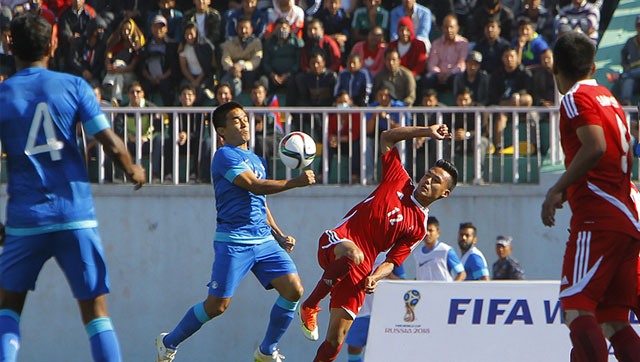
    India advanced to the qualifiers of the 2018 Fifa World Cup and the 2019 Asian Cup with a goalless draw against Nepal in the second leg of the pre-qualifiers in Kathmandu on Tuesday. India had won the first leg in Guwahati 2-0 on March 12.

    Although India’s performance left a lot to be desired, the match had its thrilling moments as a disallowed goal for the visitors and an off-the-post strike from Nepal kept the spectators on the edge of their seats at the Dashrath Rangasala Stadium.

    The first few chances fell for India but striker Sunil Chhetri’s long ranger was off target and then Robin Singh’s shot fizzed over the bar five minutes into the game.

    Playing on their home turf, Nepal then pushed on the offensive. Forward Shantosh Sahukala created a chance in the 18th minute as he headed the ball inside the box. But the ball was collected by India custodian Subrata Paul before it could find its way to a red Nepali shirt.

    Bikram Lama and Shahukhala stitched together some superb balls for striker Bimal Gharti Magar but the Indian rear-guard stood strong as defender Arnab Mondal lunged in for a few strong challenges.

    India coach Stephen Constantine fielded the same 11 as in the first leg but the tourists time and again held on to the ball for too long, allowing the opponents to regroup.

    Magar came close to a breakthrough a minute before half-time but could not beat Paul from close range.

    After the change of ends, both sides stepped on the gas as India started planting in crosses from the flanks and into the opponent’s defensive third while Shahukhala continued to torment the visiting defenders.

    In the 64th minute, Robin put the ball into the net but the referee disallowed the goal, leaving India dumbstruck. Chhetri next tried a right-footer after dribbling past a maze of defenders but his shot was wide off-target.

    At the other end of the pitch, Paul was left stranded as Sandip Rai chipped his free-kick over the wall to Bharat Khawas who only managed to find the post, much to the Indians’ relief.

    Eight minutes from time, Paul had to pull off a brilliant save to thwart Rai’s attempt, thus ensuring a passage to the Asian and World Cup qualifiers.

  • DFW South Asian Film Festival |Feb 27 to Mar 1 | Dallas

    DFW South Asian Film Festival |Feb 27 to Mar 1 | Dallas

    DFW South Asian Film Festival(Dallas, TX – Feb. 18, 2015) Fourteen films, exploring the unique circumstances and complex stories of South Asians living in America, India, Nepal, Australia and Singapore, make their Texas, U.S. and world premieres at the FIRST-EVERDallas/Fort Worth South Asian Film Festival (DFW SAFF) from Friday, February 27 to Sunday, March 1, 2015, at the Angelika Film Center in Plano.

    Produced by JINGO Media, a Dallas and NYC-based PR and events management boutique firm, Etihad Airways & Jet Airways, now offering non-stop flights from DFW to Abu Dhabi, Cambria Hotels & Suites, a brand new hotel property at the Shops at Legacy, and Crow Collection of Asian Art, unveiling its brand new collection of South Asian art, DFW SAFF will bring together directors, actors, producers, community organizations, corporate brands and South Asian cinephiles, over a three-day period. Here are the films that have been consciously-curated for the festival:
     

    Community sponsors & partners of DFW SAFF include: The Container Store, Patrick O’Hara Salon, VelvetCase.com, Living Dreams Foundation, Parish Episcopal School, Milaap, Shraman South Asian Museum and Learning Center Foundation, Forever Rakhi, Indie Meme, Arya Dance Company and New Friends New Life.
     
    Our media partners include: Selig Polyscope Company, Radio Azad, Saavn.com, Radio Hot Pepper, Radio Adda and Desiplaza TV.
     
    “We are so proud and humbled that 30 different community organizations and brands are coming together to support our first-time festival,” said DFW SAFF Festival Director and Principal/CEO of JINGO Media, Jitin Hingorani. “We are certain that North Texas audiences will embrace this festival by giving all our international guests a warm Texas welcome and, hopefully, a few standing ovations.” In addition to film screenings, the festival boasts an opening night red carpet, post-screening Q&As with filmmakers in attendance, after parties and plenty of networking opportunities. For more information and to purchase ticket, please visit www.dfwsaff.com

    Media Contact: Dev Shapiro, Selig Polyscope Company @ 972.965.0899 or Dev@SeligPolyscope.com
     

  • STORM LIGHTING KILLS 3 IN NEPAL, SNOW STORM SWEEPS TREKKING ROUTE

    KATHMANDU (TIP): Police said lighting struck a mountain village in northeast Nepal killing at least three people while a snow storm on a popular trekking route struck a group of hikers.

    Police said february 19 that lighting struck Waku village Wednesday night, killing the three people. The village is just south of Mount Everest.

    Separately, a snow storm on a trekking route caught a group of five Chinese and one Canadian hikers, also on Wednesday. They were rescued by local villagers and suffered only minor injuries.

    They were on the popular Annapurna trekking route. It was early in the trekking season and not many trekkers were on the route.

  • FIRST-EVER DALLAS/FORT WORTH SOUTH ASIAN FILM FESTIVAL

    FIRST-EVER DALLAS/FORT WORTH SOUTH ASIAN FILM FESTIVAL

    DFW South Asian Film Festival(Dallas, TX – Feb. 18, 2015) Fourteen films, exploring the unique circumstances and complex stories of South Asians living in America, India, Nepal, Australia and Singapore, make their Texas, U.S. and world premieres at the FIRST-EVERDallas/Fort Worth South Asian Film Festival (DFW SAFF) from Friday, February 27 to Sunday, March 1, 2015, at the Angelika Film Center in Plano.

    Produced by JINGO Media, a Dallas and NYC-based PR and events management boutique firm, Etihad Airways & Jet Airways, now offering non-stop flights from DFW to Abu Dhabi, Cambria Hotels & Suites, a brand new hotel property at the Shops at Legacy, and Crow Collection of Asian Art, unveiling its brand new collection of South Asian art, DFW SAFF will bring together directors, actors, producers, community organizations, corporate brands and South Asian cinephiles, over a three-day period. Here are the films that have been consciously-curated for the festival:
     

    Community sponsors & partners of DFW SAFF include: The Container Store, Patrick O’Hara Salon, VelvetCase.com, Living Dreams Foundation, Parish Episcopal School, Milaap, Shraman South Asian Museum and Learning Center Foundation, Forever Rakhi, Indie Meme, Arya Dance Company and New Friends New Life.
     
    Our media partners include: Selig Polyscope Company, Radio Azad, Saavn.com, Radio Hot Pepper, Radio Adda and Desiplaza TV.
     
    “We are so proud and humbled that 30 different community organizations and brands are coming together to support our first-time festival,” said DFW SAFF Festival Director and Principal/CEO of JINGO Media, Jitin Hingorani. “We are certain that North Texas audiences will embrace this festival by giving all our international guests a warm Texas welcome and, hopefully, a few standing ovations.” In addition to film screenings, the festival boasts an opening night red carpet, post-screening Q&As with filmmakers in attendance, after parties and plenty of networking opportunities. For more information and to purchase ticket, please visit www.dfwsaff.com

    Media Contact: Dev Shapiro, Selig Polyscope Company @ 972.965.0899 or Dev@SeligPolyscope.com
     

  • NEPAL STEPS UP SECURITY FEARING MORE TROUBLE IN PARLIAMENT

    NEPAL STEPS UP SECURITY FEARING MORE TROUBLE IN PARLIAMENT

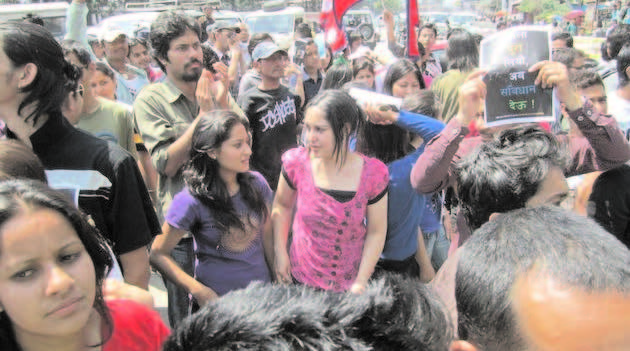
    KATHMANDU, NEPAL (TIP): Nepal has stepped up security in the capital and put police were on alert, anticipating trouble both inside parliament and on the streets because of planned protests by the opposition against governing coalition plans to push through a draft of a new constitution. Chief government administrator of Kathmandu Ek Narayan Aryal said Thursday that thousands of police in riot gear and armed with bamboo batons were guarding the area around the Constitution Assembly and areas of the capital Kathmandu. The opposition has vowed to block the governing parties from pushing through a draft of the constitution, saying it should be done only with a consensus of all the parties.


    An earlier attempt on Tuesday by the governing parties ended in violence in the assembly.

  • NEPAL STEPS UP SECURITY FEARING MORE TROUBLE IN PARLIAMENT

    NEPAL STEPS UP SECURITY FEARING MORE TROUBLE IN PARLIAMENT

    KATHMANDU, Nepal: Nepal has stepped up security in the capital and put police were on alert, anticipating trouble both inside parliament and on the streets because of planned protests by the opposition against governing coalition plans to push through a draft of a new constitution.


    Chief government administrator of Kathmandu Ek Narayan Aryal said Thursday that thousands of police in riot gear and armed with bamboo batons were guarding the area around the Constitution Assembly and areas of the capital Kathmandu.


    The opposition has vowed to block the governing parties from pushing through a draft of the constitution, saying it should be done only with a consensus of all the parties. An earlier attempt on Tuesday by the governing parties ended in violence in the assembly.

  • Nepal MPs brawl as anger over constitution boils over

    Nepal MPs brawl as anger over constitution boils over

    KATHMANDU (TIP): Fighting broke out in Nepal’s parliament early January 20, with Maoist lawmakers throwing chairs and injuring four security officers, as tensions ran high ahead of a deadline to complete a new national constitution.

    Hours later, the opposition Maoists began a nationwide general strike, seeking to prevent the ruling coalition from pushing through proposals without common agreement ahead of Thursday’s deadline.

    They say discussions on the constitution should continue until a final agreement is reached — even if that means missing the deadline.

    January 20’s strike shut down factories, shops, schools and public transport in the Himalayan nation, which has endured prolonged political limbo since 2006, when the Maoists ended their decade-long insurgency.

    Police said they had arrested 19 people for vandalising buses, trucks and cars and the usually gridlocked streets of Kathmandu were clear during rush hour, as many people heeded the Maoist call to stay home.

    Despite extensive discussions, Nepal’s lawmakers have failed to agree on a charter and are widely expected to miss Thursday’s deadline, further deepening popular disillusionment with the political process of the young republic.

    Disagreements persist on crucial issues, with the opposition calling for new provinces to be created along lines that could favour historically marginalised communities such as the “untouchable” Dalit caste and the Madhesi ethnic minority.

    Other parties say such a move would be divisive and a threat to national unity.With just two days left to draft the charter, the Constituent Assembly met late into the night, but Speaker Subash Nembang was forced to halt the debate after Maoist and Madhesi lawmakers scuffled with ruling party politicians.

    Rajan Bhattarai, a lawmaker with the ruling UML party, said two fellow MPs had been struck by flying microphones, and blamed the Maoists for the violence.

    “We condemn this behaviour, especially when Maoist leaders Pushpa Kamal Dahal and Baburam Bhattarai frequently assured of consensus via peaceful methods,” he said, referring to the party’s two highest-profile leaders.

    Nepal has had two elections and six prime ministers since the civil war between Maoist insurgents and the state ended in 2006.

    But its warring political parties have failed to make headway on many disputed issues and conclude the peace process.

    The resulting political instability has deterred investment and pushed annual growth down from 6.1 per cent in 2008 to 3.6 per cent in 2013, according to World Bank data.

    There are also growing signs of popular unrest. Last week police arrested more than 70 protesters for attacking vehicles or coercing shopkeepers to close their stores during a Maoist-led strike in Kathmandu.

    January 20 strike is backed by a hardline group which split from the main Maoist party in June 2012, accusing its leaders of betraying their radical principles.

  • China raises Nepal aid 5-fold to compete with India

    China raises Nepal aid 5-fold to compete with India

    BEIJING (TIP): In what appears to be a straight competition for influence with India, China has increased its official aid to Nepal by more than five times. China has also promised to build electricity infrastructure in Nepal worth $1.6 billion to counter an Indian offer of soft loan for the power sector.

    Chinese aid to the Himalayan nation will rise from the present level of $24 million to $128 million in 2015-16. The announcement came after talks between Chinese foreign minister Wang Yi and his Nepali counterpart Mahendra Bahadur Pandey in Kathmandu on Friday.

    Besides, Beijing is building a police academy for Nepal as a special gift. This is probably because Nepalese police help control the flow of Tibetan refugees trying to enter India through Nepal.”As neighbors China and Nepal have common security needs … we need to work together to crack down on illegal border crossings and transnational crimes,” Wang said.Nepali elite have for sometime complained that India has taken its relationship with the country for granted, and has not done enough to meet its development aspirations.

  • Fifty Shades of Saffron

    Fifty Shades of Saffron

    On December 11, 2014, when the U.N. General Assembly adopted June 21 as the International Day of Yoga, as recommended by Prime Minister Narendra Modi, India rejoiced. Never mind that the day before was the first Human Rights Day under his watch; this crept by unnoticed.

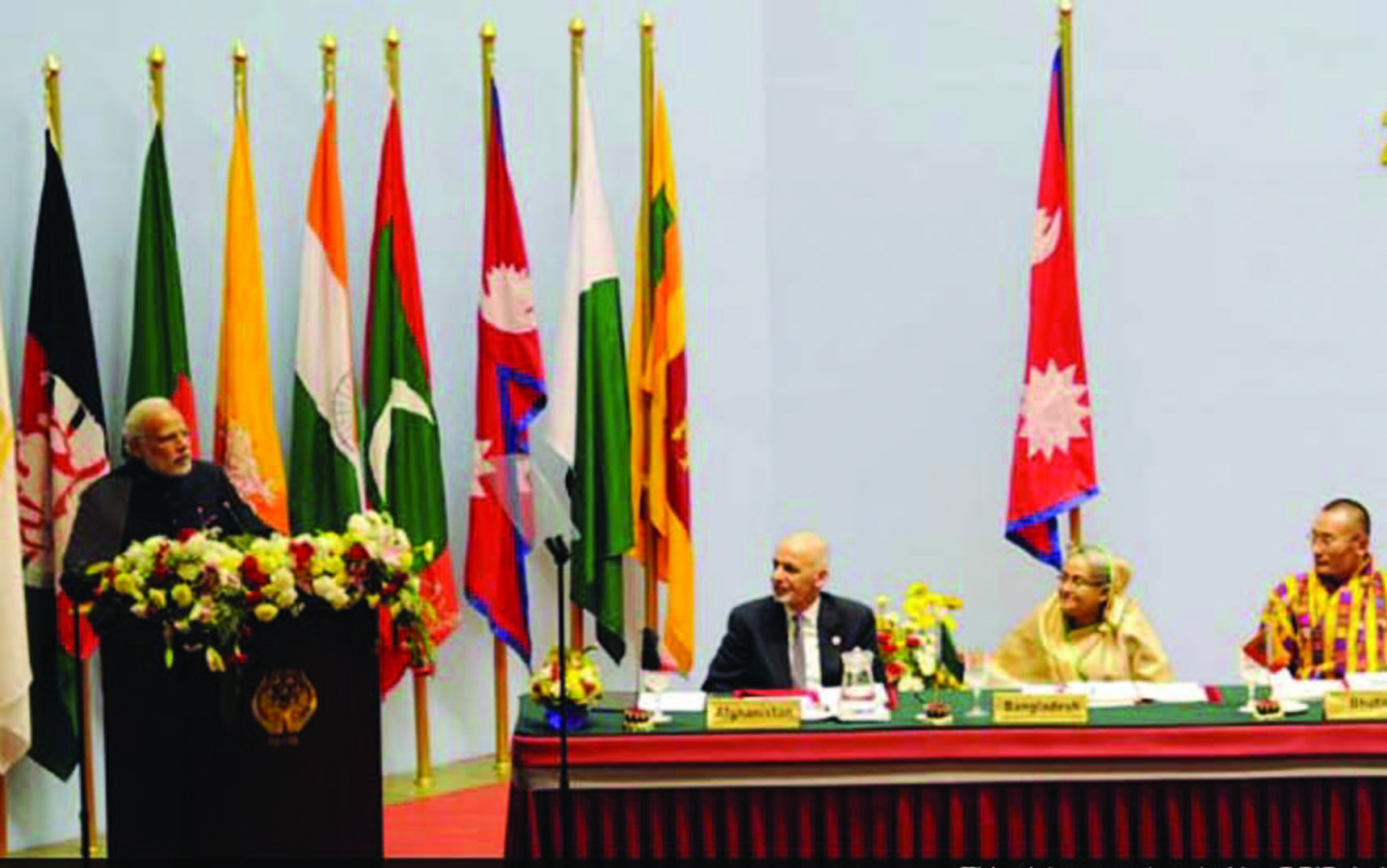
    At the SAARC Summit, Mr. Modi declaimed, “As we seek to build bridges to prosperity, we must not lose sight of our responsibility to the millions living without hope.” He was, as always, matchless as a kathakar, an artiste whose fabulous retelling of fables reinforces them in the minds of the faithful as fact. But while his performances have zero defects, on the lives of the multitudes hanging on to his words, believing in them and daring to hope, they have had zero effect so far, because the responsibility of which the Prime Minister spoke is usually ignored.

    In 1990, the U.N. launched the Human Development Report based on the challenging predicate that “people are the real wealth of a nation.” How wealthy are we really? After two decades of rapid GDP growth, we bestride SAARC like a colossus doing the splits, one foot splayed eastward to keep China out, the other westward to keep Pakistan down. We loom like a giant among midgets, but on every parameter that measures equity in development, there is little to choose between us and our neighbors.

    The Human Development Index (HDI) for 2014 ranks us at 135 among 187 countries; Sri Lanka at 73 did way better than us, and we were shadowed by Bhutan at 136, Bangladesh at 142, Nepal at 145 and Pakistan at 146. The fact that India was a stable democracy, as the others were not, that our economy had galloped along, as theirs had not, had made very little difference to the lives of our citizens.

    Within the HDI, the Gender Inequality Index which measures three critical parameters – reproductive health, women’s empowerment and their participation in the labor market – is particularly important because it shows how a society treats its more vulnerable half. Sri Lanka at 75 is well ahead of us, but so is Nepal at 98, Bhutan at 102 and Bangladesh at 115. India is in lock-step with Pakistan, both ranked at 127. The Criminal Law Amendment Act, which brought in far-reaching measures to protect women, is now almost two years old; sadly, it has made little difference.

    Depth of deprivation

    My five years on the National Human Rights Commission were a humbling experience. In 2009, we had 82,000 complaints, in 2013, a lakh. A five-member Commission could not possibly do justice to more than a fraction of these. We dismissed 60 per cent of complaints in limine, or at the outset, 11 per cent with directions to officials to act (but never had the time to check if they did) and transferred 6 per cent to the State Human Rights Commissions, which were mostly ramshackle.

    Our investigative visits to rural India were dives into the darkness that contained the mass of the iceberg of which the complaints coming to us were only the tip. In a country still largely illiterate, a terrible violation of human rights in itself, very few knew the NHRC existed. Those who did wondered if it would be able to help; many thought it would not. For every complaint that came to us, a hundred did not, but since so many were on systemic problems affecting entire communities, they brought home to us the range, depth and persistence of discrimination and deprivation in India. The two are often linked, and that is the real cause of worry with our new dispensation. The poorest and the most vulnerable – women, Scheduled Tribes, Scheduled Castes and Muslims – suffer because the social bias against them is rooted in Hindu belief and practice, and still so strong that the laws meant to protect them are impotent. Even under a secular government, public servants would plead with the NHRC that there would be law and order problems if they tried to implement these. The danger now is that under a government so overtly Hindu, these practices will flourish even more. The hate speeches of Cabinet members signal where this could lead us.

    “Discrimination and deprivation are often linked to one another, and that is the real cause of worry with our new dispensation”

    Mr. Modi wants his party to be careful with their words, but there are fifty shades of saffron around, most of it strident. He wants civil servants to be sensitive, but they always are, to the wishes of the powers that be. He wants the police to be SMART, but they already are, reporting to the National Crime Records Bureau that in 2013 there were only two incidents of human rights violations by their personnel. The same year, 33,753 complaints to the NHRC, a third of the total received, were against the police, detailing how they preyed on those they should protect.

    In Mr. Modi’s defense, these are national problems he has inherited, not created, but Gujarat is the template he holds up to the rest of India, and there are a range of impartial reports that show how cavalier it has been about the lives of the State’s people. A 2013 Lancet study found that among the 11 rich States, Gujarat had done the worst in bringing down the mortality rate of children under five, one of the Millennium Development Goals. The Census established that the sex ratio in Gujarat has declined from 934 in 1991 to 920 in 2001 to 918 in 2011. Not surprisingly, the NCRB data shows a high incidence of crimes against women. So too, the data shows, are crimes against Scheduled Castes, at levels higher than in the other developed States: Maharashtra, Punjab and Tamil Nadu. The ASER/Pratham Reports on Education show low percentages of students in Standard V who could read a Standard II text, and could do divisions. That is not a model to copy.

    Dreadful cost

    Despite what he said in Kathmandu, Mr. Modi’s record as Gujarat Chief Minister shows that his sights are set on prosperity, not on “the millions living without hope.” ‘Make in India’ is his priority, and there the signs are ominous. A few weeks back, ASSOCHAM issued an advertisement which announced, “Repeal of archaic laws is the need of modern times…ASSOCHAM has identified 105 laws for review, which can promote a better regulatory framework for successfully actualizing Mr. Modi’s vision of ‘Make in India’.” These include 43 laws that protect human rights and safeguard labor welfare, including the Bonded Labor System (Abolition) Act, Protection of Forest Rights Act, Inter-State Migrant Workers Act, Child Labor (Prohibition and Regulation) Act, and the Minimum Wages Act. If these are the voices he listens to, development will come at a dreadful cost.

    India’s governments have so far pursued development with a human face. Vast social welfare programs protect those whom the market forces savage, but these are riddled with huge problems. For instance, hardly any materials go into the rural employment guarantee projects, but each year material costs claimed are well over 20 per cent of its budget. A survey done for the NHRC showed that 60 per cent of the allocation for the Integrated Child Development Services was being stolen. The list goes on. The answer does not lie in jettisoning these programs, but in making them work better. Without them, rural India will empty out.

    Our Prime Minister’s many admirers believe that Sardar Patel’s mantle has descended on him. Vallabhbhai Patel made India, Narendra Modi can unmake it. But with his extraordinary talents, integrity and ability, our Prime Minister can also be the making of India, and make India, all of India, proud. That should be his tribute to his idol, not the monstrous statue of the Sardar now rising in Gujarat like a prelapsarian Ozymandias.

    By Satyabrata Pal

  • 17 killed in Nepal bus accident

    17 killed in Nepal bus accident

    KATMANDU, Nepal: Police say an overcrowded bus has plunged off a mountain road in Nepal, killing at least 17 people and injuring 50 more. Police official Kesh Bahadur Shahi said Monday that the bus veered off the road near Pokharakada village Sunday night and rolled 600 meters (about 2,000 feet) down a slope. Rescuers pulled out 14 bodies while three more died at a hospital. There were 67 people on the bus, which had 38 seats. The bus was driving on a narrow mountain road during the night when the accident happened about 400 kilometers (250 miles) west of the capital, Katmandu.

  • Eternal Vigilance is the Price of Liberty

    Eternal Vigilance is the Price of Liberty

    I.S. Saluja

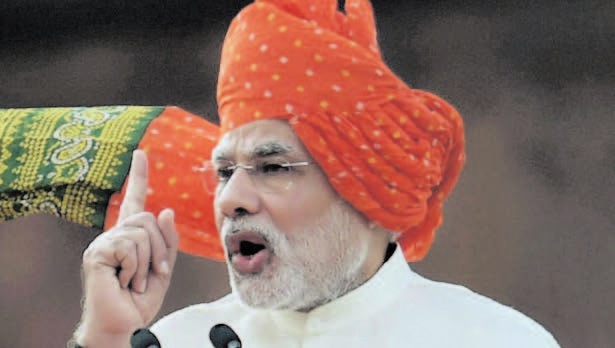
    Prime Minister Narendra Modi addressed the nation from the ramparts of the Red Fort on the 68th Independence Day of India on 15th August, 2014. It has been almost 4 months since he spoke of his vision of India in his first address to the nation as Prime Minister. In his long speech, inter alia, he reminded the people of India that “Eternal vigilance is the price of liberty”.

    I must agree with him as would the whole world. A people need to be vigilant and constantly evaluate their leaders. Hence, we are giving below the full text of Prime Minister Narendra Modi’s address to the nation and would like our readers to evaluate India’s Prime Minister. Please send in your comments to editor@theindianpanorama.news or to salujaindra@gmail.com. We will be happy to publish your valuable evaluation and comments.

    Following is the English rendering of the Prime Minister’s address on the occasion. My dear countrymen,

    Today, all Indians in the country and also abroad are celebrating the festival of independence. On this day of sacred festival of independence, the prime servant of India extends greetings to all dear countrymen. I am present amidst you not as the Prime Minister, but as the Prime Servant. The freedom struggle was fought for so many years, so many generations laid down their lives, innumerable people sacrificed their lives and youth, spent their entire lives behind bars.

    Today, I pay my respect, greetings and homage to all those who laid their lives for the country`s independence. I also pay my respects to the crores of citizens of this country on the pious occasion of India`s independence, and recall all those martyrs who had laid down their lives in India`s struggle for freedom. The day of independence is a festival when we take a solemn pledge of working for the welfare of mother India, and also for the welfare of the poor, oppressed, dalits, the exploited & the backward people of our country.

    What he stressed on during the speech My dear countrymen, a national festival is an occasion to refine and rebuild the national character. This National festival inspires us to resolve ourselves to lead a life where our character gets refined further, to dedicate ourselves to the nation and our every activity is linked to the interest of the nation and only then this festival of freedom can be a festival of inspiration to take India to newer heights. My dear countrymen, this nation has neither been built by political leaders nor by rulers nor by governments. This nation has been built by our farmers, our workers, our mothers and sisters, our youth.

    The country has reached here today because of generation to generation rigours undertaken by our sages, our saints, our maestros, our teachers, our scientists and social workers. These great people and these great generations, who had worked for the country throughout their lives, deserve our deepest respect. This is the beauty of India’s Constitution, this is its capability which has made it possible that today a boy from small town, a poor family has got the opportunity to pay homage to the tri-colour of India at the ramparts of Lal Quila(Red Fort). This is the strength of India’s democracy. This is an invaluable legacy which we have inherited from our architects of the constitution.

    I pay my respects to those architects of the constitution of India today. Brothers and sisters, today if we have reached here after independence, it is because of the contribution of all the PrimeMinisters, all the governments and even the governments of all the States. I want to express my feelings of respect and gratitude to all those previous governments and ex-Prime Ministers who have endeavoured to take our present day India to such heights and who have added to the country’s glory. This country has been built on such foundation of ancient cultural heritage, where we were told of only onemantra during Vedic period, which is indicative of our work culture, which we have learnt, we have memorized – “Sangachchhdhvam Samvadadhvam sam wo manansi jaanataam.” We walk together, we move together, we think together, we resolve together and together we take this country forward. Having imbibed this basic mantra, 125 crores of countrymen have taken the nation forward.

    Yesterday only the first Parliamentary Session of the new Government had concluded. Today, I can proudly say that the Session of Parliament reflects our thinking and it is a reflection of our intentions. We are not for moving forward on the basis of majority, we are not interested to move forward by virtue of majority. We want to move ahead on the basis of strong consensus. “Sangachhadhwam” and, therefore, the nation has witnessed the entire Session of Parliament. Having taken all the Parties and Opposition along while working shoulder to shoulder, we achieved an unprecedented success and the credit for this does not go to the Prime Minister alone, the credit does not go to the people sitting in the Government, the credit for this goes to the Opposition also, the credit goes to all the leaders of Opposition too and also all the Members from Opposition.

    From the ramparts of Red Fort, quite proudly I salute all the Members of Parliament, I also salute all the Political Parties and by virtue of their strong support, we could take some important decisions intended to take the nation forward and yesterday the Session of Parliament had concluded. Brothers and sisters, I am an outsider for Delhi, I am not a native of Delhi. I have no idea about the administration and working of this place. I have been quite isolated from the elite class of this place but during the last two months while being an outsider, I had an insider view and I was astonished.

    It is not a political platform, rather it is a platform of a national policy and, therefore, my views should not be evaluated from a political perspective. I have already said, I salute all the ex-Prime Ministers and earlier governments who have brought the country thus far. But I am going to say something else and it may not be seen from political point of view. When I came to Delhi and noticed an insider view, I felt what it was and I was surprised to see it. It seemed as if dozens of separate governments are running at the same time in one main government.

    It appeared that everyone has its own fiefdom. I could observe disunity and conflict among them. One department is taking on the other department and taking on to the extent that two departments of the same government are fighting against each other by approaching Supreme Court.This disunity, this conflict among people of the same country! How come we can take the country forward? And that is why I have started making efforts for razing those walls; I have started making efforts at making the Government, not an assembled entity, but an organic unity, an organic entity, a harmonious whole- with one aim, one mind, one direction, one energy. Let`s resolve to steer the country to one destination. We have it in us to move in that direction. A few days back…Nowadays newspapers are full of news that Modiji`s Government has come, officers are reaching office on time, offices open in time, and people get there in time. I observed that India`s National newspapers, TV media were carrying these news items prominently.

    As the Head of the Government I could have derived pleasure in the fact that everything started going on time, cleanliness got the attention, but I was not taking pleasure, I was feeling pained. That thing, I want to tell today in public. And why, because if government officers arrive office in time, does that make a news? And if that makes news, it shows how low we have fallen. It becomes a proof of that, and that`s how, brothers and sisters, the governments have run? Today in the face of global competition, when we have to realize the dreams of millions of Indians, the country cannot run on the lines of ” it happens”, ” it goes”. In order to fulfil the aspirations of masses, we have to sharpen the tool called the Government machinery, we have to make it keen, more dynamic, and it is in this direction that we are working.

    My countrymen, it`s not long since I have come from outside Delhi, but I give you an assurance that the people in the Government are very capable – from the peon to the Cabinet Secretary, everybody is capable, everybody has a power, they have experience. I want to awaken that power, I want to unite that power and want to accelerate the pace of the welfare of nation through that power and I shall definitely do it. I want to assure the countrymen that we will achieve that, we will definitely do that. I could not say this on 16th May, but today after my experience of twotwo and half months, keeping the tricolor as witness, I am saying on 15th of August that it is possible, it will be achieved.

    Brothers and sisters, time has come to give a serious thought to the fact that whether we have a duty to create India of the dreams of those great people who gave us freedom, whether we have a national character? Brothers and sisters, can someone please tell me as to whether he or she has ever introspected in the evening after a full day`s work as to whether his or her acts have helped the poor of the country or not, whether his or her actions have resulted in safeguarding the interest of the country or not, whether the actions have been directed in country`s welfare or not? Whether it should not be the motto of one and a quarter billion countrymen that every step in life should be in the country`s interests? Unfortunately, we have an environment today wherein if you approach anyone with some work, he begins by saying “what does it mean for me?” He begins by saying “what does it involve for me?” and when he come to know that it does not entail any benefit for him, immediately he says “why should I bother?” we have to rise above the feelings of “what does it mean for me” and “why should I bother”. Everything is not for self interest only.

    There are certain things which are meant for the country and we have to refine this national character. We have to rise above the feelings of “why should I bother” and “what does it mean for me” and instead we have to think that “I am for nation`s interest and in this field, I am going to lead”. We have to inculcate this sentiment. Brothers and sisters, when we hear about the incidents of rape, we hang our heads in shame. People come out with different arguments, someone indulges in psycho analysis, but brothers and sisters, today from this platform, I want to ask those parents, I want to ask every parent that you have a daughter of 10 or 12 years age, you are always on the alert, every now and then you keep on asking where are you going, when would you come back, inform immediately after you reach.

    Parents ask their daughters hundreds of questions, but have any parents ever dared to ask their son as to where he is going, why he is going out, who his friends are. After all, a rapist is also somebody`s son. He also has parents. As parents, have we ever asked our son as to what he is doing and where he is going. If every parent decides to impose as many restrictions on the sons as have been imposed on our daughters, try to do this with your sons, try to ask such questions of them. \My dear brothers and sisters, the law will take its own course, strict action will be taken, but as a member of the society, as parents, we also have some responsibilities. If somebody tells me that those who have taken guns on their shoulders and kill innocent people are Maoists, are terrorists, but they are also somebody`s children.

    I would like to ask of such parents if they had ever asked their children as to why they were taking a wrong path. Every parent must take this responsibility, he must know that his misguided son is bent on killing innocent people. He is not able to serve himself nor his family nor the country. I want to say to those youngsters who have chosen the path of violence that whatever they are and wherever they are, it is all because of mother India only that they have got it. Whoever you are it is all because of your parents. I want to ask you to think how green, how beautiful and how beneficial this earth can become if you shoulder the plough instead of the gun which spills blood on this land.

    How long shall we have bloodshed on this land, how long shall we take the lives of the innocent people and what have we got after all this? The path of violence has not yielded anything to us. Brothers and sisters, I had gone to Nepal recently. There I said something publicly to draw the attention of the whole world. There was a time when the Emperor Ashoka who had chosen the path of wars, got converted to the path of Buddha at the sight of violence. There was a time in Nepal when their youngsters had opted for the path of violence but today I witness that the same youngsters are waiting for their constitution. The same people associated with them are framing the constitution.

    And I further said that if Nepal could present the best example of moving from the weapons to the books then it could provide inspiration to the youngsters in the world to abandon the path of violence. Brothers and sisters, If Nepal, land of Budha, can give message to the world then why can`t India too do the same? So it`s the call of the hour that we renounce the path of violence and take the path of brotherhood. Brothers and sisters, for one reason or the other, we have had communal tensions for ages. This led to the division of the country. Even after Independence, we have had to face the poison of casteism and communalism. How long these evils will continue? Whom does it benefit? We have had enough of fights, many have been killed. Friends, look behind and you will find that nobody has benefited from it.

    Except casting a slur on Mother India, we have done nothing. Therefore, I appeal to all those people that whether it is the poison of casteism, communalism, regionalism, discrimination on social and economic basis, all these are obstacles in our way forward. Let`s resolve for once in our hearts, let`s put a moratorium on all such activities for ten years, we shall march ahead to a society which will be free from all such tensions. And you will see that how much strength we get from peace, unity, goodwill and brotherhood. Let`s experiment it for once. My dear countrymen, believe in my words, I do assure you. Shun all the sins committed so far, give up that way, follow the way of goodwill and brotherhood, and let`s resolve to take the country forward.

    I believe we can do that. With advancement of science, brothers and sisters, we have a rising feeling of modernity in our mind, but what do we do? Have we ever thought what the sex ratio in the country is like? 940 girls are born against per thousand boys. Who is causing this imbalance in the society? Certainly not God. I request the doctors not to kill the girl growing in the womb of a mother just to line their own pockets. I advise mothers and sisters not to sacrifice daughters in the hope of son. Sometimes mother-father feel tempted to have son in the hope of supporting them in old age.

    I am a person who has worked in public life. I have come across families with five sons, each having bungalows, access to fleet of cars, but parents are forced to live in old-age homes, Vriddhashrams. I have seen such families. I have also seen families with only daughter as progeny, that daughter sacrifices her dreams, doesn`t get married, and spends entire life in taking care of old parents. This disparity points to female foeticide and the polluted and tainted mind the 21st century has.

    We will have to liberate from it, and that is message to us of this Freedom festival. Recently Commonwealth Games were organized. Indian sportspersons brought glory to the country. Nearly 64 of our sportspersons won. Our sportspersons brought 64 medals. But of them 29 are girls. Let`s feel proud and clap for them. Girls also contribute to India`s fame and glory. Let`s recognise it. Let`s take them along, shoulder to shoulder. This way we can get over the evils that have crept in social life. Therefore, brothers and sisters, we have to proceed in that direction as a social and national character.

    Brothers and Sisters, Development is the only way forward for the country. Good governance is the only way. There are only these two tracks to take the country forward – good governance and development, we can move forward only by taking them with us. We wish to move forward with the intent of taking them with us. When I talk of good governance, you tell me, when I ask a person in private job, he tells that he does the job; when you ask the same from a person in government job, he says that I do the service. Both earn, but for one it is job while for the other it is service. I ask a question from all brothers and sisters in government service, whether the word “Service” has not lost its strength, its identity? Persons in government service are not doing “job”, they are doing “service”. We have to revive this feeling, we have to take this feeling forward as a national character, we have to move forward in this direction.

    Brothers and Sisters, whether the citizens of the country should take steps for the welfare of the nation or not? You imagine, ifthis 125 crores of countrymen move one step forward, then the country moves 125 crore steps forward. The meaning of democracy is not just limited to electing a government, but its meaning is that 125 crore of citizens work together joining shoulder with the government to fulfill hopes and aspirations of the country, this is the meaning of democracy. We have to create partnership with the people. We have to proceed under Public-Private Partnership. We have to proceed along with the participation of the people. But, please tell me why our farmers commit suicide? A farmer takes loan from the moneylender, but fails to repay his loans. He takes loan for the wedding of his daughter, but fails to repay.

    He will have to suffer hardships during his whole life. He chooses to commit suicide. Who will save the poor families of such farmers? Brothers and sisters, I have come here with a pledge to launch a scheme on this festival of Freedom. It will be called`Pradhanmantri Jan-Dhan Yojana`. I wish to connect the poorest citizens of the country with the facility of bank accounts through this yojana. There are millions of families who have mobile phones but no bank accounts. We have to change this scenario. Economic resources of the country should be utilized for the well-being of the poor.

    The change will commence from this point. This yojana will open the window. Therefore, an account holder under `Pradhanmantri Jan-Dhan Yojana` will be given a debit card. An insurance of One Lakh Rupees will be guaranteed with that debit card for each poor family, so that such families are covered with the insurance of One Lakh Rupees in case of any crisis in their lives. My brothers and sisters, it is a country of young people. The 65 percent population of the country happens to be under the age of 35 years. Our country has the largest number of youths in the world. Have we ever thought of deriving an advantage out of it? Today, the world needs a skilled workforce. Today, India also needs a skilled workforce. At times, we look for a good driver but he is not available, we look for a plumber, but he is not available.

    If we need a good cook, he is not available. We have young people, they are unemployed but the kind of young people we seek for are not available. If we have to promote the development of our country then our mission has to be `skill development` and `skilled India`. Millions and Millions of Indian youth should go for acquisition of skills and there should be a network across the country for this and not the archaic systems. They should acquire the skills which could contribute towards making India a modern country. Whenever they go to any country in the world, their skills must be appreciated and we want to go for a two pronged development.

    I also want to create a pool of young people who are able to create jobs and the ones who are not capable of creating jobs and do not have the opportunities, they must be in a position to face their counterparts in any corner of the world while keeping their heads high by virtue of their hard work and their dexterity of hands and win the hearts of people around the world through their skills. We want to go for the capacity building of such young people. My brothers and sisters, having taken a resolve to enhance the skill development at a highly rapid pace, I want to accomplish this.

    Brothers and sisters, the world has undergone a change. My dear countrymen, the world has changed. Now India can not decide its future by remaining isolated and sitting alone in a corner. The economics of the world have changed and, therefore, we will have to act accordingly. Government have taken many decisions recently, made some announcements in the budget and I call upon the world and call upon the Indians spread world over that if we have to provide more and more employment to the youth, we will have to promote manufacturing sector. If we have to develop a balance between imports and exports, we will have to strengthen manufacturing sector. If we have to put in use the education, the capability of the youth, we will have to go for manufacturing sector and for this Hindustan also will have to lend its full strength, but we also invite world powers.

    Therefore I want to appeal all the people world over, from the ramparts of the Red Fort, “Come, make in India”, “Come, manufacture in India”. Sell in any country of the world but manufacture here. We have got skill, talent, discipline, and determination to do something. We want to give the world an favourable opportunity that come here, “Come, Make in India” and we will say to the world, from electrical to electronics, “Come, Make in India”, from automobiles to agro value addition “Come, Make in India”, paper or plastic, “Come, Make in India”, satellite or submarine “Come, Make in India”. Our country is powerful. Come, I am giving you an invitation.

    Brothers and sisters, I want to call upon the youth of the country, particularly the small people engaged in the industrial sector. I want to call upon the youth working in the field of technical education in the country. As I say to the world “Come, Make in India”, I say to the youth of the country – it should be our dream that this message reaches every corner of the world, “Made in India”. This should be our dream. Whether, to serve the country, is it necessary for the youth of the country to be hanged like Bhagat Singh? Brothers and sisters, Lal Bahadur Shastri had given the slogan “Jai Jawan, Jai Kisan”.

    A soldier sacrifices himself at the border and protects Mother India. Similarly, a farmer serves Mother India by filling the godowns with grains. This is also nation`s service. Filling the granary is the biggest nation`s service that a farmer provides. That is why Lal Bahadur Shashtri had given the slogan of “Jai Jawan, Jai Kisan”. Brothers and Sisters, I would like to pose a question to my youngsters as to why despite them, we are forced to import even the smallest of things? My country`s youth can resolve it, they should conduct research, try to find out as to what type of items are imported by India and then each one should resolve that, through may be micro or small industries only, he would manufacture atleast one such item so that we need not import the same in future. We should even advance to a situation wherein we are able to export such items.

    If each one of our millions of youngsters resolves to manufacture atleast one such item, India can become a net exporter of goods. I, therefore, urge upon the youth, in particular our small entrepreneurs that they would never compromise, atleast on two counts. First, zero defect and, second again zero effect. We should manufacture goods in such a way that they carry zero defect, that our exported goods are never returned to us. We should manufacture goods with zero effect that they should not have a negative impact on the environment. If we march ahead with the dream of zero defect in the manufacturing sector then, my brothers and sisters, I am confident that we would be able to achieve our goals.

    Brothers and sisters, the youth of India has completely transformed the identity of India in the world. Earlier, in what manner did the world know our country? Till only 25-30 years back, if not more, there were many people in the world who thought that India was a country of snake charmers, it was a country which practiced in black magic. The real identity of India had not reached the world, but my dear brothers and sisters, our youngsters, 20-22-23 years old youngsters have mesmerized the whole world with their skills in computers. Our young I.T. professionals have given a new path of making a new identity of India. If our country has this strength, can we think something about the country? Our dream is, therefore, of “Digital India”. When I talk of “Digital India”, I don`t speak of the elite, it is for the poor people. You can imagine what a quality education the children in villages will get, if all the villages of India are connected with Broadband Connectivity and if we are able to give long distance education to the schools in every remote corner of the villages.

    If we create a network oftelemedicine in the places where there is a shortage of doctors, we can have a clear guideline of the way in which health facilities have to be provided to the poor people living in those areas. The citizens of India have mobile phones in their hands, they have mobile connectivity, but can we walk in the direction of mobile governance? We have to move in a direction where every poor person is able to operate his bank account from his mobile, is able to demand various things from the government, can submit applications, can conduct all his business, while on the move, through mobile governance and if this has to be done, we have to move towards `digital India` and if we have to move towards `digital India` then we have a dream. Today we are importing electronic goods on a large scale. Friends, you will be surprised that we are bringing in these televisions, mobile phones, ipads and all these electronic goods.

    It is a necessity to import petroleum products, oil, diesel and petrol. Second to this is the import of our electronic goods. If we move ahead with the dream of `digital India` to manufacture electronic goods and become self reliant at least there, how big can be the benefit for the treasury! Therefore, e-governance is what we need to take this idea of `digital India` forward. E-governance is easy governance, effective governance and also economic governance. Egovernance paves the way for good governance. There was a time when we used to say that the railways provided connectivity to the country.

    That was it. I say that today it is IT that has the potential to connect each and every citizen of the country and that is why we want to realise the mantra of unity with the help of `digital India`. Brothers and sisters, if we move ahead with all this then I believe that a `digital India` will have the potential to stand with the world on equal footing. Our youth have that capability, it is an opportunity for them. Brothers and sisters, we want to promote tourism. Tourism provides employment to the poorest of the poor. Gram seller earns something, auto-rickshaw driver earns something, pakoda seller earns something and tea seller also earns something. When there is talk of tea seller, I feel a sense of belongingness.

    Tourism provide employment to the poorest of the poor. But there is a big obstacle in promoting tourism and in our national character and that is – the filthiness all around us. Whether after independence, after so many years of independence, when we stand at the threshold of one and half decade of 21stcentury, we still want to live in filthiness? The first work I started here after formation of Government is of cleanliness. People wondered whether it is a work of a Prime Minister? People may feel that it is a trivial work for a Prime Minister but for me this a big work. Cleanliness is very big work.

    Whether our country can not be clean? If one hundred and twenty five crore countrymen decide that they will never spread filthiness, which power in the world has ability to spread filthiness in our cities and villages? Can`t we resolve this much? Brothers and sisters it will be 150th birth anniversary of Mahatma Gandhi in 2019. How do we celebrate 150th birth anniversary of Mahatma Gandhi? Mahatma Gandhi, who gave us freedom, who brought so much honour to such a big country in the world, what do we give to Mahatma Gandhi? Brothers and Sisters, Mahatma Gandhi had cleanliness and sanitation closest to his heart.

    Whether we resolve not to leave a speck of dirt in our village, city, street, area, school, temple, hospital, and what have you, by 2019 when we celebrate 150th anniversary of Mahatma Gandhi? This happens not just with the Government, but with public participation. That`s why we have to do it together. Brother and Sisters, we are living in 21st century. Has it ever pained us that our mothers and sisters have to defecate in open? Whether dignity of women is not our collective responsibility? The poor womenfolk of the village wait for the night; until darkness descends, they can`t go out to defecate.What bodily torture they must be feeling, how many diseases that act might engender.

    Can`t we just make arrangements for toilets for the dignity of our mothers and sisters? Brothers and Sisters, somebody might feel that a big festival like 15th August is an occasion to talk big. Brothers and Sisters, talking big has its importance,making announcements too has importance, but sometimes announcements raise hopes and when the hopes are not fulfilled, the society sinks into a state of despondency. That`s why are in favour of telling those things, which we can fulfil just within our sight. Brothers and sisters, you must be getting shocked to hear the Prime Minister speaking of cleanliness and the need to build toilets from the ramparts of the Red Fort. Brothers and sisters, I do not know how my speech is going to be criticised and how will people take it. But this is my heartfelt conviction.

    I come from a poor family, I have seen poverty. The poor need respect and it begins with cleanliness. I, therefore, have to launch a `clean India` campaign from 2nd October this year and carry it forward in 4 years. I want to make a beginning today itself and that is – all schools in the country should have toilets with separate toilets for girls. Only then our daughters will not be compelled to leave schools midway. Our parliamentarians utilizing MPLAD fund are there. I appeal to them to spend it for constructing toilets in schools for a year. The government should utilise its budget on providing toilets.

    I call upon the corporate sector also to give priority to the provision of toilets in schools with your expenditure under Corporate Social Responsibility. This target should be finished within one year with the help of state governments and on the next 15th August, we should be in a firm position to announce that there is no school in India without separate toilets for boys and girls. Brothers and sisters, if we proceed with the dreams, we are in a position to realise them. Today, I wish to tell one more specific thing. It has its own importance to discuss the matters and express the views of nation`s interest. However, our Members of Parliament do not get opportunity though they are willing to do something.

    They can express themselves, write to the government, agitate, give memoranda. Still they do not get opportunity to do something on their own. Today I have come to you with a new idea. We are running so many schemes in the name of the Prime Minister in our country, there are numerous schemes in the name of various leaders. However, today I am going to announce a scheme on behalf of the Member of Parliament- `Sansad Aadarsh Gram Yojana`. We shall fix some parameters. I urge upon the Members of Parliament to select any one of the villages having population of three to five thousand in your constituency. The parameters will be according to the time, space and situation of that locality.

    It will include the conditions of health, cleanliness, atmosphere, greenery, cordiality etc. On the basis of those parameters, each of our MPs should make one village of his or her constituency a Model Village by 2016. Can`t we do at least this? Shouldn`t we do this? If we have to build a nation, we should start from the village. Make a Model Village. The reason of fixing this target for 2016 is that it is a new scheme. It takes time to formulate a scheme and then to implement it. After 2016, select two more villages for this purpose, before we go for the General Elections in 2019. And after 2019, each Member of Parliament, during his/her tenure of 5 years must establish atleast five model villages in his/her area. I also call upon the Members of Parliament from urban areas to adopt one village of their choice. I also urge upon the Members of Parliament from Rajya Sabha to adopt one of the villages. If we provide one model village in each district of India then the surrounding villages shall be automatically inspired to follow that model.

    Let us establish a model village, let us establish a village well equipped with all systems and facilities. The birth anniversary of Jai Prakash Narayan Ji happens to be on 11th October. On 11th October, the occasion of birth anniversary of Jai Prakash Narayan Ji, I will present a complete blueprint of “S?nsad Adharsh Gr?m Yojana” (Members of Parliament Model Village Scheme) before all Members of Parliament and State Governments, and I urge upon State Governments also that as per the feasibility in their respective states, all the Members of Legislative Assembly resolve to establish a model villageYou can imagine all the Members of Legislative Assembly and all the Members of Parliament in the country establishing a model village.

    All of a sudden, there would be a model village in each block of India which could inspire us to transform the amenities in rural areas and could give us a new direction and, therefore, we want to move ahead under this”S?nsad Adarsh Gr?m Yojana”. My dear brothers and sisters, ever since our government has taken charge, there has been a discussion in the newspapers, on T.V. channels as to what would happen to Planning Commission. I believe that when Planning Commission was constituted, it was done on the basis of the circumstances and the needs of those times. In recent years, Planning Commission has contributed to the growth of the country in its own way. I respect that, I am proud of that, but the prevalent situation in the country is different, global scenario has also changed, governments are no longer the centre of economic activities, the scope of such activities has broadened. State governments have been at the center of development and I consider this a good indication.

    If we have to take India forward, it can happen only by taking the states forward. India`s federal structure is more important today than in the last 60 years. To strengthen our federal structure, to make our federal structure vibrant, to take our federal structure as a heritage of development, a team of Chief Minister and Prime Minister should be there, a joint team of the Centre and the states should move forward, then to do this job, we will have to think about giving the Planning Commission a look. So, I am saying from the rampart of the Red Fort that it is a very old system and it will have to be rejuvenated, it will have to be changed a lot. Sometimes it costs more to repair the old house, but, it gives us no satisfaction.

    Thereafter, we have a feeling that it would be better to construct a new house altogether and therefore within a short period, we will replace the planning commission with a new institution having a new design and structure, a new body, a new soul, a new thinking, a new direction, a new faith towards forging a new direction to lead the country based on creative thinking, public-private partnership, optimum utilization of resources, utilization of youth power of the nation, to promote the aspirations of state governments seeking development, to empower the state governments and to empower the federal structure.

    Very shortly, we are about to move in a direction when this institute would be functioning in place of Planning Commission. Brothers and sisters, today, on 15th August, we also have the birth anniversary of Maharishi Aurobindo. Maharishi Aurobindo, being a rebel, moved on to achieve the status of a Yoga Guru. With regard to the destiny of India, he remarked, “I have a faith that the divine power and spiritual heritage of India will play an important role towards the welfare of the world.” Such sentiments were echoed by Maharishi Arvind. I strongly believe in the words of legends. I have great faith in the statements made by ascetics, sages & saints and that’s why today at the ramparts of Lal Quila I am reminded of the words of Swami Viveknanda. He had said – “I can see before my eyes Mother India awakening once again.

    My Mother India would be seated as the World Guru. Every Indian would render service towards welfare of humanity. This legacy of India would be useful for the welfare of the world”. These words were spoken by Swami Viveknanda ji in his own style. Friends, the words of Viveknanda ji can never be untrue. The words of Viveknanda ji, his dream of seeing India ensconced as World Guru, his vision, it is incumbent upon us to realize that dream. This capable country, blessed with natural bounty, this country of youth can do much for the world in the coming days. Brothers and sisters, our foreign policy is a much talked about issue. I clearly believe that India`s foreign policy can be multidimensional.

    But there is an important issue to which I want to draw your attention that the way we fought for freedom, we fought together, we were not separate at that time. We were together. Which was the government with us? What were the weapons available to us? There was a Gandhi, a Sardar and lakhs of freedom fighters and such a huge empire. Didn`t we win in the struggle of freedom against that empire? Did we not defeat the foreign powers? Did we not force them to leave India? We were the ones, they were our ancestors only who showed this might. If the people of India could remove such a big empire without the power of the government, without weapons and even without resources, then friends, it is the need of the hour to eradicate poverty, can we not overcome poverty? Can we not defeat poverty? My 125 crore dear countrymen, let us resolve to eradicate poverty, to win against it.

    Let us move with the dream of poverty eradication from India. Our neighbouring countries are also faced with the same problem. Why not get together with all the SAARC nations to plan out the fight against poverty? Let`s fight together and defeat poverty. Let us see at-least for once as to how wonderful is the feeling of being alive instead of killing and getting killed. This is the land where incidents from Siddharth`s life happened. One bird was shot with an arrow by one brother and the other took out that arrow to save it. They went to mother- whose bird, whose swan? Whether killer`s or saviour`s, they asked of mother. The mother replied, saviour`s. The saviour has more power than the killer and that makes him Buddha in future. And that`s why I seek cooperation from neighbouring countries for fighting against povertyin concert and cooperate with them, so that together with SAARC countries we can create our importance and emerge as a power in the world.

    It is imperative that we work together with a dream to win a fight against poverty, shoulder to shoulder. I went to Bhutan, Nepal, all the dignitaries from SAARC countries took part in oath-taking ceremony; this marked a good beginning. This will definitely yield good results, it is my belief and this thinking of India, in the country and the world, that we want to do well to the countrymen and be useful for the welfare of the world, India wants such a hand to be extended. We are trying to move forward with these dreams to achieve them. Brothers and Sisters, today on 15th August we will resolve to do something for the country.

    Let`s be useful for the country, we will move ahead with a resolve to take the country forward, and I assure you, Brothers and Sisters, as well as my colleagues in the Government, that if you work for 12 hours, I will do so for 13 hours. If you work for 14 hours, I will do for 15 hours. Why? Because I`m amidst you not as a Prime Minister, but as the first servant. I have formed the Government not as a ruler, but as a servant. Brothers and sisters, I assure that this country has a destiny. It is destined to work for the welfare of the world, it was said by Vivekanand ji. India is born, this Hindustan is born in order to achieve this destiny. One hundred and twenty five crore countrymen have to move forward wholeheartedly for the welfare of the nation. Once again I feel proud of the devotion, the sacrifices of the security forces of the country, para-military forces of the country, all the security forces of the country to protect Mother India. I say to the countrymen, jk”Vª;ke] tkxz;ke~ o;e~ Eternal vigilance is the price of liberty”. The army is vigilant, we should also be vigilant and the country scales new heights, we have to move forward with this resolution. Speak loudly with me with full force –

    Bharat mata ki jai, bharat mata ki jai, bharat mata ki jai. Jai Hind, Jai Hind, Jai Hind. Vande Mataram, Vande Mataram, Vande Mataram!

  • India ban hits Nepal’s mass animal sacrifice

    India ban hits Nepal’s mass animal sacrifice

    KATHMANDU (TIP): Hindu devotees slaughtered an estimated 200,000 animals during a recent festival in Nepal, organizers said on December 2, attributing a sharp fall in numbers to Indian export restrictions. Some 2.5 million worshippers from India and Nepal sacrificed buffaloes, goats and pigeons to the Hindu goddess of power, Gadhimai, on Friday and Saturday, in a ritual held every five years, despite mounting pressure from activists. In 2009 an estimated 300,000 animals had their heads chopped off or throats slit at the Gadhimai festival, held in the remote village of Bariyapur near the Nepal-India border.

    This year, however, a ban on Gadhimai-related animal exports by the Indian Supreme Court provoked police to patrol the border and stop worshippers from taking buffalo and goats across to the temple. “Many devotees were unable to cross the border with animals for sacrifice because of the Indian court order,” said Moti Lal Kasuhawa, secretary of the festival organizing committee. “As a result, we saw a considerable decrease in the number of sacrifices this year,” Kasuhawa told AFP. Animal rights activists applauded the court decision and told AFP they would press on with efforts to ban the slaughter in Nepal. According to legend, the first sacrifices in Bariyapur were conducted several centuries ago when Gadhimai appeared to a prisoner in a dream and asked him to establish a temple to her.

    When he awoke, his shackles had fallen open and he was able to leave the prison and build the temple, where he sacrificed animals to give thanks. The campaign to ban the festival has attracted support from celebrities including British actress Joanna Lumley and French movie legend Brigitte Bardot, who has petitioned Nepal’s president to end the “cruel tradition”.

  • SAARC SUMMIT: ENERGY PACT SEALED, ROAD AND RAIL PACTS ON ANVIL

    SAARC SUMMIT: ENERGY PACT SEALED, ROAD AND RAIL PACTS ON ANVIL

    KATHMANDU (TIP): The 18th SAARC Summit concluded on November 27 in this scenic Nepalese capital with the eight South Asian nations signing a pact on energy cooperation and adoption of the Kathmandu Declaration that called for deeper regional cooperation in core areas of trade, investment, finance, energy, infrastructure and connectivity.

    The two-day South Asian Association for Regional Cooperation summit started on a discordant note on November 26 with Pakistan blocking three proposed agreements. But it ended on a bright and positive note on Thursday with the eight countries signing the Saarc Framework Agreement on Energy Cooperation and promising to sign two other deals — the SAARC Motor Vehicles Agreement for the Regulation of Passenger and Cargo Vehicular Traffic, and the SAARC Regional Agreement on Railways — within three months. The energy agreement will enable greater cooperation in the power sector among South Asian countries.

    It is expected to improve power availability in the entire SAARC region and would facilitate integrated operation of the regional power grid. According to the Kathmandu Declaration adopted at the closing ceremony Thursday, the summit decided to accelerate the process of creating free trade in the region and formulation and implementation of projects, programmes and activities of SAARC in a prioritised, focused and result-oriented manner. Similarly, the summit also agreed to launch regional and sub-regional projects in the agreed areas of cooperation, especially in the area of poverty alleviation, infrastructure building, connectivity and energy.

    Strengthening the SAARC Development Fund, effective implementation of the SAARC Action Plan on Poverty Alleviation with a view to making South Asian free from poverty and hunger and enhancing regional connectivity through building and upgrading roads, railways, waterways infrastructure, energy grids, communications and air links, was also agreed on. The declaration called for combating terrorism in all its forms and manifestations and having effective cooperation among the member states for preventing the trafficking of people, arms and drugs and exploitation of children for forced labour.

    Increasing agricultural productivity and ensuring food and nutritional security is also the part of the Kathmandu Declaration. Providing quality education, eliminating illiteracy, providing vocational education and training, and making South Asia an attractive common tourist destination by promoting public-private partnership, are also mentioned in the declaration. In the opening ceremony on Wednesday, Indian Prime Minister Narendra Modi, who was the cynosure of all eyes, exhorted the eight SAARC member states nations to “walk in step” as he proposed a slew of measures, including ease for business travel, a level playing field in trade, and initiatives in healthcare and tourism.

    He referred to terrorism, especially the 26/11 Mumbai terror attack, in which 10 Pakistani terrorists unleashed mayhem in India’s commercial capital in 2008. “Today, as we remember the horror of the terror attack in Mumbai in 2008, we feel the endless pain of lost lives. Let us work together to fulfill the pledge we have taken to combat terrorism and trans-national crimes,” he said, without naming Pakistan. Urging for seamless connectivity in the region, Modi said “for India, our vision for the region rests on five pillars — trade, investment, assistance, cooperation in every area, and contacts between our people”. “There is a new awakening in South Asia; a new recognition of inter-linked destinies; and a new belief in shared opportunities,” he said. Host of the summit, Nepal Prime Minister Sushil Koirala, said that SAARC would focus on connectivity, security and eradicating extreme poverty.

    While Bangladesh Prime Minister Sheikh Hasina sought implementation of the SAARC free trade agreement (FTA) that was signed nearly a decade ago, Pakistan’s Nawaz Sharif called for a dispute-free South Asia. Afghan President Ashraf Ghani asserted that his country would not endanger regional security. While Maldivian President Abdulla Yameen sought a common SAARC platform on climate change, Bhutan’s Prime Minister Tshering Tobgay called for greater integration among South Asian countries to bolster growth. Sri Lanka President Mahinda Rajapaksa called for a common voice among South Asian nations on international issues and cooperation on eradicating terrorism. The heads of state and government also held bilateral meetings on the sidelines of the summit.

    After having met Nepal Prime Minister Koirala soon after his arrival here on Tuesday, Prime Minister Modi met his Bangladeshi and Bhutanese counterparts Hasina and Tobgay, and later the presidents of Afghanistan, Sri Lanka and Maldives — Ghani, Rajapaksa and Yameen. Though there was no meeting scheduled between the Indian Prime Minister and Pakistan’s Sharif, the two eventually greeted and informally spoke with each other at the retreat organised for the delegates at the Dhulikhel hill resort near Kathmandu on Thursday. Modi and Sharif shaking hands on the podium in the closing ceremony was the lasting image of the summit.

  • Escalating tension is not good for either country

    Escalating tension is not good for either country

    While there will be no open war between India and Pakistan in the normally understood sense, this does not prevent Pakistan from activating its tools of terror

    There has been an escalation of tension between India and Pakistan in the recent few days. The Line of Control (LoC) has witnessed serious exchange of fire at the border for nearly a fortnight. Prime Minister Narendra Modi referred to the border firing in one of his election rallies in Maharashtra. Modi said that Pakistan was getting the befitting lesson and it would not dare to open fire on the border.

    It may be recalled that the cease-fire agreement between India and Pakistan came into effect in November 2003. Thereafter there had been periodic fire from Pakistan side, which had to be routinely returned by the Indian forces posted at the LoC. Union Home Minister, Rajnath Singh made a statement that Pakistan should understand that times have changed in India, an obvious reference to Bharatiya Janata Party under Narendra Modi coming to power at the centre with majority of its own.

    Reverting to the situation on the LoC, the Border Security Force (BSF) was handling the situation on the international border and it was BSF which was doing the firing across the LoC in Poonch, R.S. Pura and Arnia sectors. Reports say that instructions to Director General BSF, D.K. Pathak went out from the National Security Adviser Ajit Doval, who was in direct touch with DG, BSF over the period of 5 days in the first half of October 2014. The BSF reportedly fired more than 10,000 mortar shells, not to speak of countless ammunition, leading to an unprecedented situation in the border.

    Pakistan reported that 2 civilians were killed and about 100 injured on their side and also that scores of villages witnessed vacating of houses by the civilians moving away from the border. The former Chief of BSF E.N. Rammohan commented that earlier the exchange of fire was confined to LMGs and MMGs and now, mortars are being used which spelt danger to civilian lives who lived within 5000 meters range. He went on to comment, “civilians dying like this is absolutely absurd”.

    An analyst had written that the flare up on the border came at the height of campaigning for Assembly elections in Maharashtra and Haryana when Modi referred to Pakistan being taught lesson at a public rally in Maharashtra on October 9. A BSF Commandant said, “I am very proud, nobody, not even Indian Army has fired as much as we have into Pakistan since 1971 war. There were no restrictions this time and we kept on firing. Even the Army cannot boast of so much. At least no Army infantry battalion had fired mortars.”

    In Pakistan, Prime Minister, Nawaz Sharif was a worried man and he summoned all the senior army officers for taking stock of the situation. Nawaz Sharif also dispatched his trusted adviser Shahryar Khan to Delhi for back channel work and to bring out normalcy on the border. Khan is the President of the Pakistan Cricket Control Board and his visit to India was ostensibly to discuss cricket fixtures with India, did not go much beyond that level, since no senior Indian back channel representative met him during his stay in Delhi.

    Prime Minister Narendra Modi, meanwhile held a meeting attended by all senior Army commanders. Prime Minister Modi said that India had to be prepared for a changing world which demanded new thinking on economic, diplomatic and security policies. He asked them to be fully prepared for any eventuality. He also said that security challenges would be more unpredictable and invisible. On the Pakistan side, the Army Chief Gen. Raheel Sharif said at the Military Academy on October 18, that Pakistani forces are fully capable of meeting any external threat and that any aggression against Pakistan would get a befitting response.

    The Pakistani Army chief also digressed to the subject of Kashmir and said that the people of Kashmir should be allowed to decide their fate in the light of UN Resolutions. The growing tension between India and Pakistan had not escaped the attention of foreign observers. The Australian scholar Christopher Snedden, who has specialized on the subject of Kashmir and teaches at the Asia Pacific Centre for Security Studies, Honolulu, has commented that India’s new belligerence towards Pakistan is unhelpful and cited the cancellation of talks by the Indian Foreign Secretary with her counterpart in Pakistan over the Pakistan Ambassador’s meeting with Kashmiri separatists. Snedden went on to say that such meetings had routinely taken place in the past.

    Pakistan Prime Minister, Nawaz Sharif had attended Modi’s oath taking ceremony as the Prime Minister of India in New Delhi, on May 16, 2014, which he did ignoring the advice of the armed forces and hardliners, who were against his visiting India for the occasion. The border tensions and the disproportionate level of Indian reaction would lead to Pakistan analyzing and reviewing various options to retaliate against India. While there would not be any serious flare up between Indian and Pakistani forces in any sector. Pakistan Army Chief and the ISI Chief of Pakistan would be seriously exploring multiple ways of hurting India.

    At the diplomatic level, Pakistan had activated its diplomatic representative to brief UN members on the unfulfilled UN resolution for holding plebiscite in Kashmir for ascertaining views of the Kashmiri people regarding their options between India and Pakistan.

    While there will be no open war between India and Pakistan in the normally understood sense, that does not prevent Pakistan from activating its tools of terror like Lashkar-e-Toiba and Jaish-e-Mohammed in carrying out serious attacks within India. The National Security Guard (NSG) Chief J.N. Choudhury had warned on October 16 that the Al Qaeda and the ISIS may join hands with terror groups like Indian Mujahideen and carry out multicity multiple attacks in the country at the time of their choosing. Terror organizations like Lashkar-e- Toiba and Jaish-e- Muhammed will also be carried along in their dastardly scheme.

    The tensions between the two countries have to be seriously examined and ways and means to bring back normalcy should be worked out and implemented. India stands to lose much more if terrorist organizations are deployed in various cities in the country at a time of Pakistan’s choice. As this possibility is strong, this needs to be given serious consideration. Now that Prime Minister Narendra Modi has demonstrated his strength once again by decisively winning the elections in Maharashtra and Haryana, it is time for him to turn to the important issue of easing tensions between India and Pakistan.

    There was no meeting between Prime Ministers of India and Pakistan during the UN session in October as Modi was not interested in meeting with his Pakistani counterpart. The next opportunity comes up in November during the SAARC meeting in Nepal. It is hoped that the two Prime Ministers will have one to one meeting, with or without officials and work out a road map for future course of action.