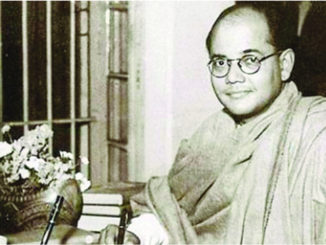
Tag: Netaji Subhash Chandra Bose

  • Netaji Subhash Chandra Bose, an icon of patriotism

    Netaji Subhash Chandra Bose, an icon of patriotism

    Netaji Subhas Chandra Bose ’s life is a story of struggle. It is the story of a young dreamer that tells the saga of consciousness, struggle and success in every eye; one who has the power to rip the ground with his arms; one who talks about making a hole in the sky; one who is anxious to achieve his goals; one who does not accept anything for free; and if he wants freedom, he is ready to spill his blood. Thousands of people sacrificed their lives on Netaji’s call. He created an army against the British in no time.

    Netaji was born in Cuttack in Odisha in 1897, graduated from Kolkata, and proved his mettle by becoming an Indian Civil Services (ICS) officer. But he was not accustomed to a life of comfort and amenities that came with his job. He was a warrior, who had to wage the freedom struggle. Not only did he embrace the freedom movement wholeheartedly, but also became an inspiration for freedom. With the slogan “Give me blood and I will give you freedom”, he started preparing to awaken the country. Such was the charisma of his philosophy and personality that whoever listened to him was attracted to him. His popularity skyrocketed and he became “Netaji” to the general public. He was so fond of Bharat Mata that his country tied to the chains of slavery did not let him live peacefully. People beyond India’s borders also developed a fascination for him. Heads of states of important countries stood by him and Netaji lit the fire of the freedom struggle beyond India’s shores. He built a force and presented that force before the enemies of the country as the Azad Hind Fauj (Indian National Army). He gave the slogan of “Dilli Chalo” with a new spirit. Thousands of soldiers of his 60,000-strong army sacrificed their lives for the country.

    “Success always stands on the pillar of failure.” Bose lived with this philosophy and also inspired others. Netaji encountered failures several times, but he converted those failures to triumph with his struggle. Whether it is municipal politics, the journey from a common Congressman to the Congress president’s position, the formation of the Forward Bloc or the struggle of the Indian National Army, he passed every test with distinction.

    Bose accepted the leadership of Mahatma Gandhi, but ironically, Gandhiji himself became the cause of him leaving the Congress. But the two leaders always had respect for each other.

    At the time of India’s independence, Clement Attlee was the British Prime Minister. He came to Kolkata in 1956. At that time, his host, governor and former Calcutta high court chief justice PB Chakravartti, tried to find out from him the reason behind the British decision to grant freedom to India. In response, Attlee said that the loyalty of the Indian army and navy to the British state was declining due to the increasing military activities of Bose’s Azad Hind Fauj. This was one of the major reasons. This acknowledgement proves the great contribution of Bose to India’s independence. It finds a mention in a letter written to the publisher by Justice Chakravartti in the book “A History of Bengal” by RC Majumdar.

    Jabalpur in Madhya Pradesh had a major contribution in the life of Netaji. The banks of the Narmada transformed his life. The Tripuri Congress session was held from March 4-11, 1939 in Jabalpur. Despite poor health, Netaji had arrived on a stretcher to participate in it. Thereafter, he came again to Jabalpur on July 4, 1939 to form the Forward Bloc. The people of Madhya Pradesh have a deep relationship with Netaji. In every town of the state, there’s a ward in his name. Subhas Chandra Bose’s message to his colleagues was: “Success may be distant, but it is imperative”. Bose used to say, “If a person is not obsessed, he can never become great. But he should also have something else inside him.” Bose is credited with giving global identity to the Indian leadership. Earlier, Swami Vivekananda had enlightened the world about India’s spiritual and cultural superiority and identity.

    Netaji was also fluent in many Indian languages. Bose’s struggle for freedom proved to be an inspiration not just for India, but also for all Third World countries. The Indian freedom struggle and the war of independence led by Bose had a profound impact on those countries. Netaji’s status establishes him as the “hero of freedom” globally.

    Netaji’s birth anniversary to now be part of Republic Day celebrations

    Republic Day celebrations from this year will start on January 23 instead of January 24 to include the birth anniversary of Netaji Subhas Chandra Bose, in line with the Prime Minister Narendra Modi government’s “focus to commemorate important aspects of our history and culture,” an official said. It was not immediately clear what this will entail. One possibility is that the government will count events to commemorate Bose’s birth anniversary held every year to be part of the Republic Day celebrations. Last year, the central government announced that January 23 will be celebrated as Parakram Diwas, or day of valor.

    Other such days, observance of which has become a yearly affair, are August 14 as Partition Horrors Remembrance Day, October 31 as National Unity Day (birth anniversary of Sardar Vallabhbhai Patel), November 15 as Janjatiya Gaurav Divas (Birsa Munda’s birth anniversary), November 26 as Constitution Day, and December 26 as Veer Baal Divas (a tribute to the four sons of Guru Gobind Singh), the official said, requesting anonymity.

    Although it was a good decision, the government needs to understand and implement his ideology to really honour the freedom fighter, according to Chandra Bose, kin of Netaji.

    “Subhas Chandra Bose is extremely relevant in 21st century India. We see all across the country, I don’t suggest any specific political party, all parties are engaged in divisive politics. This must stop,” he said. “Netaji envisioned a united India. If Netaji had returned to India, there would not have been a partition of India or partition of Bengal. India will again get divided, unless you bring Netaji’s ideology into the national mainstream of politics.”

    Ahead of Netaji’s 125th birth anniversary this year, Chandra Bose, who is a member of the ruling Bharatiya Janata Party, had written to Prime Minister Narendra Modi, asking him to have the freedom fighter’s image on currency notes. He also suggested declaring January 23 a national holiday.

  • India in history this Week-January 21, 2022, to january 27, 2022

    India in history this Week-January 21, 2022, to january 27, 2022

    21 JANUARY

    2008       India successfully launched a spy satellite of Israel and installed it in Polar Arbit.

    1958       Copyright Act enacted.

    1945       Renowned lawyer and freedom fighter Ras Bihari Bose died.

    22 JANUARY

    1965       Steel factory started in Durgapur, West Bengal.

    1966       Mughal emperor Shah Jahan died.

    1963       The National Library for the Blind was established in 1963 in Dehradun.

    23 JANUARY

    1897       India’s freedom fighter Netaji Subhash Chandra Bose was born in Cuttack, Odisha.

    1926       Bal Thackeray, Indian politician and founder of Shiv Sena was born.

    1966       Indira Gandhi became the third Prime Minister of India.

    1977       Janata Party was formed.

    2009       The ban on smoking scenes in film and television programs is over.

    24 JANUARY

    1950       On this day, the Constituent Assembly elected the first President of the country. Apart from this, the National Anthem was adopted by the Constituent Assembly on 24 January 1950.

    1966       Air India’s Boeing 707 crashes near the summit of Monblaw in the hills of the Alps. 117 people died in it.

    1950       Jana Gana Mana was accepted as the national anthem.

    1857       University of Calcutta was established.

    1950       Dr. Rajendra Prasad became the first President of independent India.

    1950       Jana-gana-mana got the status of national anthem of India in 1950.

    1951       Prem Mathur became India’s first female commercial pilot in 1951.

    1952       The first International Film Festival was held in Bombay in 1952.

    2002       The Indian satellite INSAT-3C successfully orbited in 2002.

    25 JANUARY

    1971       Himachal Pradesh came into existence as a state.

    1980       The Indian Brahmo Samaj was started in 1880 by the famous social reformer Keshav Chandra Sen.

    1980       After a gap of three years, in 1980, Padma Vibhushan, Bharat Ratna, etc. civil honors started being awarded again.

    1980       The famous philanthropist Mother Teresa was awarded the Bharat Ratna in 1980.

    2002       In 2002, Arjun Singh became the first Air Marshal of the Indian Air Force.

    2009       The Central Government announced the Padma Bhushan and Padma Shri awards in 2009.

    26 JANUARY

    1956       In the year 1956, Humayun, son of Mughal emperor Babur, died.

    1930       Swaraj Day was celebrated for the first time in India under British rule.

    1931       Mahatma Gandhi was released for talks with the British government during the ‘Civil Disobedience Movement’.

    1949       The Constitution of India was made to Dr. Rajendra Prasad, President of Constituent Assembly. The Constitution of India was prepared on this day.

    1950       India is declared a sovereign democratic republic and the Constitution of India comes into force.

    1950       Chakravarti Rajagopalachari, the first and last Governor General of independent India, resigned from his post and Dr. Rajendra Prasad became the first President of the country.

    1950       Ashoka Pillar was adopted as the national emblem.

    1963       The Government of India declared it a national bird on 26 January due to the peacock’s amazing beauty.

    1972       The National Memorial Amar Jawan Jyoti was established at India Gate in Delhi.

    1981       Keeping in mind the ease of air traffic in Northeast India, Air service Vayudoot started.

    1955       The first parade of Republic Day took place on 1955 at Rajpath in Delhi.

    1930       The Indian Constitution was implemented on 26 January keeping in mind the full Swaraj Day (26 January 1930).

    27 JANUARY

    2008       Bird flu spread in 13 districts of West Bengal.

    1974       President VV Giri dedicated the Nehru Memorial Museum at Teen Murti in New Delhi to the nation.

    1988       The helicopter postal service was inaugurated for the first time.

    1922       Famous Indian actor Bharat Bhushan passed away.

    2009       The eighth President of India, Shri. R. Venkataraman died.