Tag: Netanyahu

  • Israeli Cabinet approves ‘outline’ of deal to release hostages held by Hamas

    Israeli Cabinet approves ‘outline’ of deal to release hostages held by Hamas

    The sides appeared closer than they have been in months to ending a war that has killed tens of thousands of Palestinians, reduced much of Gaza to rubble, brought famine to parts of the territory and left dozens of hostages, living and dead, in Gaza

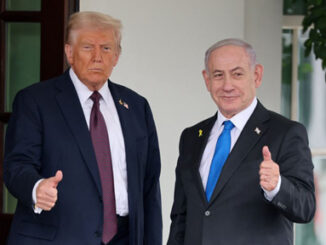
    NEW YORK (TIP): Israel’s Cabinet early on Friday, October 9, 2025,  approved President Donald Trump’s plan for a ceasefire in the Gaza Strip and the release of all the remaining hostages held by Hamas, a key step toward ending a ruinous two-year war that has destabilized the Middle East, AP reports.

    A brief statement from Prime Minister Benjamin Netanyahu’s office said the Cabinet approved the “outline” of a deal to release the hostages, without mentioning other aspects of the plan that are more controversial.

    The broader ceasefire plan included many unanswered questions, such as whether and how Hamas will disarm and who will govern Gaza. But the sides appeared closer than they have been in months to ending a war that has killed tens of thousands of Palestinians, reduced much of Gaza to rubble, brought famine to parts of the territory and left dozens of hostages, living and dead, in Gaza.

    The war, which began with Hamas’ deadly attack on Israel on October 7, 2023, has also triggered other conflicts in the region, sparked worldwide protests and led to allegations of genocide that Israel denies.

    Some 1,200 people were killed in the Hamas-led assault, and 251 were taken hostage. In Israel’s ensuing offensive, more than 67,000 Palestinians have been killed in Gaza and nearly 170,000 wounded, according to Gaza’s Health Ministry, which doesn’t differentiate between civilians and combatants but says around half of the deaths were women and children.

    In the hours leading up to the Israeli Cabinet’s vote, Israeli strikes continued. Explosions were seen on Thursday in northern Gaza, and a strike on a building in Gaza City killed at least two people and left more than 40 trapped under rubble, according to the Palestinian Civil Defense.

    At least 11 dead Palestinians and another 49 who were wounded arrived at hospitals over the past 24 hours, Gaza’s Health Ministry said.

    An Israeli military official who spoke on the condition of anonymity in line with military guidelines said Israel was hitting targets that posed a threat to its troops as they reposition. Hamas blasted Israel over the strike, saying Netanyahu was trying to “shuffle the cards and confuse” efforts by mediators to end the war in Gaza.

    A senior Hamas official and lead negotiator made a speech Thursday laying out what he says are the core elements of the ceasefire deal: Israel releasing around 2,000 Palestinian prisoners, opening the border crossing with Egypt, allowing aid to flow and withdrawing from Gaza.

    Khalil al-Hayya said all women and children held in Israeli jails will also be freed. He did not offer details on the extent of the Israeli withdrawal from Gaza.

    Al-Hayya said the Trump administration and mediators had given assurances that the war is over, and that Hamas and other Palestinian factions will now focus on achieving self-determination and establishing a Palestinian state.

    “We declare today that we have reached an agreement to end the war and the aggression against our people,” Al-Hayya said in a televised speech Thursday, October 9  evening.

    In other developments, US officials announced that they would send about 200 troops to Israel to help support and monitor the ceasefire deal as part of a broader, international team. The officials spoke on condition of anonymity to discuss details not authorized for release. In the southern Gaza city of Khan Younis, reactions to the announcement of a ceasefire were relatively muted and often colored by grief.

    “I am happy and unhappy. We have lost a lot of people and lost loved ones, friends and family. We lost our homes,” said Mohammad Al-Farra. “Despite our happiness, we cannot help but think of what is to come. … The areas we are going back to, or intending to return to, are uninhabitable.”

    In Tel Aviv, families of the remaining hostages popped champagne and cried tears of joy after Trump announced the deal.

    Under the terms, Hamas intends to release all living hostages in a matter of days, while the Israeli military will begin a withdrawal from the majority of Gaza, people familiar with the matter told The Associated Press. They spoke on condition of anonymity to discuss details of an agreement that has not been fully made public. Some 20 of the 48 hostages still in captivity are believed to be alive.

    In a short video posted by US Commerce Secretary Howard Lutnick, Mr. Trump was seen speaking by phone to a group of elated hostage families.“They are all coming back on Monday,” said Trump, who is expected to visit the region in the coming days.

    Tom Fletcher, the UN humanitarian chief, told reporters Thursday that officials have 170,000 metric tons of medicine, aid and other supplies ready for transport into Gaza when they are given a green light.

    The deal, which was expected to be signed in Egypt, will include a list of prisoners to be released and maps for the first phase of an Israeli withdrawal to new positions in Gaza, according to two Egyptian officials briefed on the talks, a Hamas official and another official.

    Israel will publish the list of the prisoners, and victims of their attacks will have 24 hours to lodge objections.

    The withdrawal could start as soon as Thursday evening, said the officials, who spoke on condition of anonymity because they were not authorized to be publicly named speaking about the negotiations. The hostage and prisoner releases are expected to begin Monday, the officials from Egypt and Hamas said, though the other official said they could occur as early as Sunday night.

    What is behind Trump’s Gaza plan?

    Five border crossings would reopen, including the Rafah crossing between Gaza and Egypt, the Egyptian and Hamas officials said. The Trump plan calls for Israel to maintain an open-ended military presence inside Gaza, along its border with Israel. An international force, comprised largely of troops from Arab and Muslim countries, would be responsible for security inside Gaza. The US would lead a massive internationally funded reconstruction effort.

    The plan also envisions an eventual role for the Palestinian Authority — something Netanyahu has long opposed. But it requires the authority, which administers parts of the West Bank, to undergo a sweeping reform program that could take years.

    The Trump plan is even more vague about a future Palestinian state, which Mr. Netanyahu firmly rejects.

    What comes next for Netanyahu

    The days ahead could be politically tricky for Mr. Netanyahu, who has been shadowed by an ongoing corruption trial as he navigated the Gaza war. His grip on power has been largely contingent on the support of hard-line, far-right coalition partners who have urged him to continue operations against Hamas until the group is eliminated.

    But Mr. Trump on Thursday, October 9,  suggested Mr. Netanyahu’s political standing has been bolstered by the ceasefire and hostage deal.

    “He’s much more popular today than he was five days ago,” Mr. Trump said. “I can tell you right now, people shouldn’t run against him. Five days ago, might not have been a bad idea.”

  • India must not miss the fine print of Gaza peace plan

    India must not miss the fine print of Gaza peace plan

    Delhi’s answer must be to keep Gaza de-hyphenated, Kashmir decoupled and the Gulf and Europe on side.

    “India should focus on t

    hree metrics. First, Hamas’s written reply via Qatar. The plan lives or dies there. Second, Israel’s coalition arithmetic. Can Opposition parties provide cover if the far right bolts from Netanyahu’s coalition or does it mean early elections? Third, whether monitors and the ISF secure a legally anchored mandate. Without that, compliance will be challenging.”

    By Syed Akbaruddin

    Peace plans usually begin with borders. US President Donald Trump’s 20-point Gaza ceasefire plan begins with a timer. Within 72 hours of Israeli assent, all hostages, living and deceased, are to be returned. What follows is less a map than a to-do list: transactional, sequenced, and by West Asia’s standards, even audacious.

    Israeli forces would pull back in stages tied to demilitarization milestones. Hamas exits governance, while Gaza’s services pass to a Palestinian technocratic committee overseen by a Trump-chaired ‘Board of Peace,’ which includes former UK Prime Minister Tony Blair. An International Stabilization Force (ISF) would keep order and train vetted Palestinian police.

    The prisoner exchange is choreographed. Nearly 2,000 Palestinians would be freed, including life-term prisoners, balanced by a hostage-for-remains swap and safe passage for militants who disarm. Demilitarization would be monitored independently, with a weapons buy-back. Israel, meanwhile, keeps a “security perimeter presence” until Gaza is deemed “properly secure.” That hinge, temporary or indefinite, is the plan’s make-or-break.

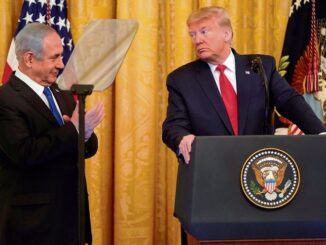
    The optics are unusually broad. Trump is fully invested in it, attaching his name to what he brands the Comprehensive Plan to End the Gaza Conflict. He has given Hamas barely four days to decide, turning a ceasefire into a countdown. Israeli Prime Minister Netanyahu has endorsed it, saying that it “achieves our war aims”.

    The plan also borrows from ideas floated elsewhere. Saudi and French suggestions for international oversight, and Egypt and Jordan’s role in the ISF, draw regional powers into Gaza’s future. That gives it reach, and helps explain why Arab, Muslim and European capitals, as well as China and Russia, have welcomed it. The Palestinian Authority (PA) has offered qualified support. Even Hamas says it will “study” the plan. For once, there is a corridor of possible agreement.

    In a shattered enclave, even small openings can feel tangible. If Hamas engages, a clocked hostage release linked to Israeli withdrawals could still the guns quickly, open space for aid, and ease political pressures. No one would be forced to leave Gaza, and those who do would retain the right to return.

    Humanitarian reset is built in, not appended, with UN and ICRC-channeled assistance, infrastructure rehabilitation, and guaranteed access through Rafah. The humanitarian dividend must be immediate and visible, or the plan will lose legitimacy.

    For families who have buried relatives and queued up for water, sequencing only matters if power returns, clinics are restocked, rubble is cleared and classrooms reopen. That depends on Palestinian buy-in, not as spectators but as co-designers such as doctors, teachers, engineers, civil defense volunteers and others who rebuild daily life.

    Acceptance will hinge on whether aid feels real, governance is credible and disarmament does not erase political voice. Consent is not symbolic but essential. Without it, no board, monitor or mandate will hold.

    Besides, the many hard edges remain sharp. For Hamas and smaller factions, disarmament is existential, not technical. A Trump-led board and an ISF without a clear legal mandate risk thin legitimacy, ambiguous rules of engagement and contested authority. The ISF could well become a peacekeeper with no peace to keep.

    Inside Israel, coalition arithmetic looms large. Netanyahu’s far-right partners reject PA engagement, oppose any pathway to statehood and demand a permanent IDF presence. That stance, combined with Netanyahu’s hints at an indefinite security perimeter while ruling out both Hamas and the PA in governance, creates ambiguity that could fracture his coalition or sink the plan.

    For India, this is not a spectator sport. Its vantage lies at the intersection of principle and prudence. On principle, New Delhi backs a negotiated two-state solution and sustained humanitarian relief. On prudence, it balances a growing partnership with Israel with expanding ties with Arab states.

    That is why Prime Minister Modi swiftly welcomed the plan as a ‘viable pathway to long-term peace.’ This stance has domestic support and reflects both diplomatic calculation and regional balance. The alignment is not accidental. India has steadily increased aid to Palestinians, nearly $80 million in the past decade, and consistently voiced support for Palestinian statehood at the UN, even when abstaining on contentious resolutions.

    There is also a hard-nosed economic stake. Each month of war keeps Red Sea insurance high, shipping costs volatile and inflation pressures alive. India’s Navy has already surged to secure sea lanes. Ending the conflict would lower maritime risk, stabilize prices, protect the arteries of India’s trade and breathe life into projects like the India-Middle East-Europe Economic Corridor (IMEC), which depend on regional peace and predictable politics. Quiet seas, not loud statements, move markets.

    If Pakistan secures a role in the Gaza plan with US backing, the impact on India will be political, not military. Islamabad will surely push Kashmir analogies. Delhi’s answer must be to keep Gaza de-hyphenated, Kashmir decoupled and the Gulf and Europe on side. Even if it materializes, Pakistan’s role will remain that of a follower, not a fulcrum.

    India should focus on three metrics. First, Hamas’s written reply via Qatar. The plan lives or dies there. Second, Israel’s coalition arithmetic. Can Opposition parties provide cover if the far right bolts from Netanyahu’s coalition or does it mean early elections? Third, whether monitors and the ISF secure a legally anchored mandate. Without that, compliance will be challenging.

    This is not Oslo 2.0. It is ceasefire as contract, sequenced, time-stamped, and transactional. It offers direction, not design. The upside is immediate: hostages home, guns silent, humanitarian lifelines restored. The downside is familiar: uncompromising militants, a fractured Israeli ruling coalition, and an international force without authority. The opening chorus is broad, but the structural cracks run deep. India is right to welcome the opening, but must keep its eyes on the fine print. Blueprints win peace, bullet points do not.

    (Syed Akbaruddin is India’s former permanent representative to the UN)

  • Trump won’t guarantee a US-Israel honeymoon

    Trump won’t guarantee a US-Israel honeymoon

    The re-election of Donald Trump does not guarantee a new US-Israel honeymoon

    Trump’s long-held dream has been to be accepted as a peacemaker who excels in cutting deals, including bringing an end to the historic conflict between Jews and Arabs. If that results in his winning the Nobel Peace Prize, he may be prepared to force Israel to make relevant compromises, such as agreeing to the establishment of an independent Palestinian state.

    By Shyam Bhatia

    Israelis may be delighted with the departure of the Biden administration in the United States, but the re-election of Donald Trump does not guarantee a new US-Israel honeymoon.

    Despite the widely publicized pictures of Biden hugging Israeli Prime Minister Benjamin Netanyahu in the wake of the October 7 Hamas attack on Israel, the underlying bilateral tensions were never far from the surface.

    Washington’s pressure on Netanyahu started to intensify as casualties mounted in Gaza and a humanitarian crisis emerged with the killings of thousands of Palestinian civilians. In the weeks leading up to the US presidential election, the crisis between Washington DC and Jerusalem reached a new climax with President Joe Biden reportedly telling Netanyahu “stop bull-shitting me.”

    By all accounts, the frustrated Americans additionally suspended some deliveries of bunker-busting bombs that they believed would increase civilian casualties. So, it was hardly surprising to hear the sighs of relief from the Israeli Prime Minister’s office when the results of the US presidential election started rolling in.

    The humiliating defeat suffered by Biden’s vice-president and chosen successor Kamala Harris generated a euphoria, both within Israel’s far right cabinet and among many Israeli Jewish civilians. What Israelis now hope for is a return to the golden era of the first Trump administration when the US undertook a number of measures that were seen as a full endorsement of the Israeli far right’s ideology.

    These measures included the relocation of the US embassy from Tel Aviv to Jerusalem, the recognition of Jerusalem as the undivided capital of Israel and the further recognition of the Golan Heights — previously Syrian territory — as an integral part of Israel. Contrary to UN resolutions and international law, the Americans, under Trump, also ruled that Israeli settlements in the occupied West Bank were entirely legitimate. US officials even went as far as cutting off all financial aid to the United Nations Relief and Works Agency (UNRWA), which for the past seven decades has been providing vital food, medical and educational services to millions of Palestinian families.

    These policies embraced by Trump allowed him to boast how he was the most pro-Israeli US President in history. Yet, despite his pro-Israel record, which also enraged the Palestinians and other Arabs, it turns out that the vast majority of American Jews opted to vote for his rival Kamala Harris. Most American Jews are known to be traditionally more sympathetic to the Democrats and they expressed their support at the ballot box.

    Among the reasons for their distaste of Trump were media portrayals of the incoming president as a supporter of dictators, including Adolph Hitler, and his alleged hostility towards illegal immigrants who were denounced by him and his supporters as “rapists”, “murderers” and “criminals” who reveled in eating domestic pets like cats and dogs.

    Back in 2020, when Trump lost the election to Joe Biden, the defeated US President was outraged by an “ungrateful” Netanyahu who rushed to congratulate his Democrat rival. Soon afterwards, in a recorded interview with Israeli journalist Barak Ravid, when asked about Netanyahu, Trump responded: “f*** him.”

    Trump’s profile suggests he is a man who harbors grudges against those perceived to be disloyal. So, whether he can now forgive and forget Netanyahu’s past actions, remains to be seen.

    Since Trump’s recent victory was confirmed, Netanyahu was among the first world leaders to offer his congratulations and he has made at least three subsequent telephone calls to the President-elect. These telephone calls reflect the deep concern in Netanyahu’s office that Trump will no longer be the pushover he once was.

    Statements made by Trump in the immediate aftermath of the presidential election have added to the concern of Israeli officials. His declaration that the US is committed to ending conflicts, not prolonging them, has aroused fears that the new US administration will follow the same line as the Biden administration by demanding an immediate cessation of hostilities in West Asia, including the Israeli-led wars in Gaza and Lebanon.

    Israeli officials are also worried by the influence of a new member of the wider Trump family who happens to be a Lebanese Christian. Massad Boulos, father-in-law of Trump’s daughter Tiffany, is believed to have convinced many Arab voters in the US to cast their lot with Trump. Inevitably, Trump now feels indebted to this new block of Arab political supporters who are extremely critical of what they see as Washington’s blind support for Israel.

    In Jerusalem’s multiple think tanks, the talk is all about how it would be a mistake to take Trump for granted in his second and final term in office. This argument goes that the new US administration has excellent ties with the Saudis and Gulf governments and will be more susceptible than before to pressure Israel.

    Trump’s long-held dream has been to be accepted as a peacemaker who excels in cutting deals, including bringing an end to the historic conflict between Jews and Arabs. If that results in his winning the Nobel Peace Prize, he may be prepared to force Israel to make relevant compromises, such as agreeing to the establishment of an independent Palestinian state.

    This is just the kind of policy shift that Trump’s Arab allies are also demanding. First and foremost are the Saudis who say that they are ready to make peace with Israel in return for recognition of a Palestinian state. The Arabs argue that allowing a Palestinian state would undercut Iran’s attempts to dominate the region and isolate the Ayatollahs in Tehran as they move closer to acquiring nuclear weapons capability.

    Fear of Iran’s nuclear ambitions has long been shared by Israelis of all political persuasions. They remember how Biden stopped Israel from bombing Iran’s nuclear and oil facilities. Will Trump do the same?
    (Shyam Bhatia is an Indian-born British journalist, writer and war reporter based in London)

  • Under fire over legal reforms, Israeli PM Netanyahu to face critics in Berlin

    Under fire over legal reforms, Israeli PM Netanyahu to face critics in Berlin

    BERLIN (TIP): Israeli Prime Minister Benjamin Netanyahu, under heavy fire at home over planned legal reforms, was due to arrive March 15 in Berlin where Germany’s leaders will also urge him to reconsider the overhauls.
    The German government is under pressure for hosting Netanyahu at a time of the disputed reforms, with critics urging Berlin to scrap the visit.
    Netanyahu, speaking before boarding his plane to Germany, said Iran would be the “main issue” of his discussions, along with “other topics important to Israel”.
    “The security issues don’t pause, even for a moment,” he added.
    German President Frank-Walter Steinmeier, speaking in Tallinn on Wednesday, said he planned to raise the reforms with Netanyahu when they meet on Thursday.
    Israel is the “only democracy in the whole region, a country with a strong constitutional state”, he said.
    “What I would like to see is that what we have admired about Israel… is preserved.”
    Netanyahu’s government, which includes ultra-Orthodox and extreme-right parties, introduced its judicial reform package in January.
    The changes would allow lawmakers to override Supreme Court decisions that strike down legislation with a parliamentary majority, and then deny the court the right to review such a move.
    It would also make it harder for the Supreme Court to strike down legislation it deems to contravene Basic Laws, Israel’s quasi constitution.
    Corruption charges
    Netanyahu’s government has argued the reforms are needed to limit judicial overreach, but protesters have decried them as threatening Israel’s liberal democracy by weakening key checks and balances.
    Ten consecutive weeks of nationwide demonstrations have followed, with critics also charging that the proposed changes aim to protect Netanyahu as he fights corruption charges in an ongoing court battle.
    Ahead of Netanyahu’s departure, critics took their protests to Ben Gurion airport.
    “Dictator on the run” and “Don’t come back”, read placards held up by demonstrators near the airport, where a convoy of cars bearing Israeli flags circulated between the terminals, making them difficult to access, an AFP correspondent reported.
    Netanyahu’s flight was delayed by five hours as he held talks with his coalition partners.
    President Isaac Herzog, who holds a largely ceremonial role, has for weeks been toiling over a proposal to soften the government’s legal overhaul.
    ‘Worst possible time’
    The controversy in Israel puts Germany in an uncomfortable position.
    Germany and Israel forged strong diplomatic ties in the decades after World War II, with Berlin committed to the preservation of the Israeli state in penance for the Holocaust.
    Successive German governments have described Israel’s national security as a crucial foreign policy priority.
    On the eve of Netanyahu’s departure for Germany and ahead of a planned trip to Britain, 1,000 writers, artists and academics wrote to the two nations’ ambassadors urging their governments to scrap the visits, denouncing what they called his “dangerous and destructive leadership”.
    In Frankfurt, Meron Mendel, who heads the Anne Frank educational centre named for the teenage Holocaust victim, also said Berlin should have declined the visit. (AFP)