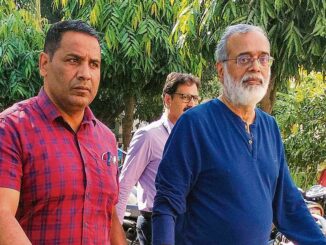
Supreme Court order quashing arrest lays bare police design to circumvent due process
The Supreme Court of India’s order invalidating the arrest and remand of NewsClick founder Prabir Purkayastha is much more than a technical outcome based on the failure of the Delhi police to furnish the grounds for his arrest in writing. It is also an indictment of the clandestine manner in which the police sought to obtain his custody. As if invoking the Unlawful Activities (Prevention) Act against the web portal was not malign enough — the case seems fictional in its entirety, and establishes no overt act that can even be described as unlawful, much less a terrorist act — the police seemed to have resorted to what the Court called a “blatant attempt to circumvent the due process of law”. The Court did not go into the merits of the case at this stage, but said enough to warrant an adverse inference about the absence of bona fides. Mr. Purkayastha was produced before a remand judge before dawn and his police custody obtained at 6 a.m., even though the police had the entire day to comply with the statutory requirement of producing him before a court within 24 hours. The police kept his lawyer in the dark about the early morning proceedings, and instead had a ‘remand advocate’ readily present during the proceedings. The idea was “to confine the accused to police custody without informing him the grounds on which he has been arrested; deprive the accused of the opportunity to avail the services of the legal practitioner of his choice so as to oppose the prayer for police custody remand, seek bail and also to mislead the court”.
The judgment is also notable for extending, to the UAPA, the principle laid down in Pankaj Bansal (2023) that those arrested under the Prevention of Money Laundering Act should be given the grounds of their arrest in writing. In fact, interpreting the relevant constitutional provisions, the Court says this may be required as a matter of course and without any exception for the arrest of any person under the UAPA or any other offences. The police recently filed a charge sheet in this case, which makes the outlandish claim that Mr. Purkayastha was funded by the Chinese government and that he and American millionaire Neville Roy Singham were involved in an alleged conspiracy to replace Indian democracy with a party-state system as in China. It speaks of their support to fomenting riots and protests in India and even funding terrorists. Given the grave, even if far-fetched, nature of the allegations against him, regular bail would have been difficult to come by. Therefore, it is salutary that the Court has treated the level of adherence to procedure — the need to furnish the grounds of arrest in this case — as sacrosanct.
(The Hindu)
Why aren’t district courts and high courts doing their job of providing legal redress in cases of personal liberty?
“We need to focus on why it is that invariably the accused has to travel all the way to the apex court to obtain release. Why aren’t district courts and high courts doing their job of providing legal redress in cases of personal liberty? While the members of the former may not feel sufficiently protected, HC judges have as much constitutional protection for their independence as the judges of the Supreme Court have. What prevents them from stepping up to the plate, especially when the facts are stark enough? The system works well when each level of the judiciary plays its part, and an overdependence on the highest court is not healthy. Even there, we have seen the unusual phenomenon of withdrawal of personal liberty cases of prominent individuals after a noticeable change of the roster.”
By Sriram Panchu
In the film world, we are used to the phenomenon of delayed releases. It seems to be so in the judicial world as well. Arvind Kejriwal has been released after 50 days in captivity, all during peak election campaigning. And now the Supreme Court has set at liberty Prabir Purkayastha after he has been inside a prison for about 225 days. While there is relief at the release, one must question why it takes so long, and what kind of laws keep men behind bars so easily.
Purkayastha is the head of NewsClick, an online journalistic platform known for its sharp reporting, independent views and for not being particularly respectful of the powers that be. People like him are irritants to excessively strong governments, which like media outlets to be supportive by nature or bought out otherwise. How dare he focus on the farmers’ agitation, Covid failures and the like! He was charged with a rather unusual offence — of accepting funds from Chinese sources to influence the political narrative in India. A bit surprising, since one doesn’t remember any pro-Chinese narrative from NewsClick. While one should be wary of China, one would have thought that would extend to preventing border incursions and curbing excessive dependence on imports. But no, Purkayastha is the problem, it seems. An associate turned approver — not much to wonder about that since this is happening pretty regularly now, as witnessed in the Kejriwal case.
The flaw in the case was a gaping one. Purkayastha and his lawyer were not informed about the grounds for his arrest and the remand order was passed before the lawyer had received the remand application. Now this kind of non-conformity with the law is what lawyers and judges call “going to the root of the matter”; it vitiates the entire proceedings. Notice that this flaw happened on day one. Yet, and this is what should disturb us, it has taken the judicial system more than half a year to release him.
We need to focus on why it is that invariably the accused has to travel all the way to the apex court to obtain release. Why aren’t district courts and high courts doing their job of providing legal redress in cases of personal liberty? While the members of the former may not feel sufficiently protected, HC judges have as much constitutional protection for their independence as the judges of the Supreme Court have. What prevents them from stepping up to the plate, especially when the facts are stark enough? The system works well when each level of the judiciary plays its part, and an overdependence on the highest court is not healthy. Even there, we have seen the unusual phenomenon of withdrawal of personal liberty cases of prominent individuals after a noticeable change of the roster.
One cannot blame our judges overmuch, however. The chief problem is the monstrous nature of the laws under which these detentions are made. These are the Unlawful Activities Prevention Act (UAPA), 1967, and the Prevention of Money Laundering Act (PMLA), 2002. Purkayastha, Sudha Bharadwaj, Gautam Navlakha, the late Father Stan Swamy and other Bhima Koregaon accused were held under the first, and Kejriwal, Hemant Soren, K Kavitha, Manish Sisodia and other politicians under the latter. These Acts and later amendments — and here both the BJP and Congress governments are to blame — make it virtually impossible to get bail, mandating that the judge first find that the accused is prima facie innocent; this is an inversion of the time-honored principle of presumption of innocence. This principle is the first rule of civilized societies, and any departure from it, unless justified by extreme risk to society, is an indication that the rule of law has become a casualty to politics. There are other damaging provisions — the authorities can arrest without much cause; the normal criminal law restrictions on the police are absent; confessions obtained in custody are valid. Above all, there is the application of this draconian statute to ordinary offences. Even the dreaded Maintenance of Internal Security Act (MISA), 1976, had an advisory board of high court judges to review detentions during the Emergency; it is noteworthy that the laws in question have no such provision in free India.
The sad part of the story is that the SC has upheld the validity of these laws — lock, stock and barrel — for the State and against citizens. A blot on our judicial landscape is the judgment of Justice AM Khanwilkar in the VM Choudhary case, equaling the constitutional and public damage that was done in that infamous judgment (ADM Jabalpur vs Shivkant Shukla, 1976) where it was held four to one (the great Justice HR Khanna dissented) that with the proclamation of the Emergency and suspension of fundamental rights, citizens were at the mercy of the State. The SC has admitted a review of the Choudhary judgment, but this is another priority case languishing without a hearing. Of cheer today, however, is the judgment of Justices Abhay S Oka and Ujjal Bhuyan, curbing the ED’s power to arrest after the special court takes cognizance of a complaint.
Purkayastha’s long detention is particularly disturbing because courts worldwide are usually quick to examine cases of journalists being held in preventive custody. The judiciary and a free press are pillars of democracy, and the courts must be more vigilant in checking overbearing governments of whichever hue which threaten their members. But recent detentions have lasted long — journalist Siddique Kappan, for example. In contrast, Arnab Goswami (albeit not arrested under these laws) got double-quick release; these are not good messages to send out.
The record of the authorities in proving guilt and securing convictions under these laws is abysmal — as low as 3 per cent. This means that citizens were being held despite being innocent, and often without reasonable cause. When will our laws and courts start thinking about compensation for unjust imprisonment and deprival of liberty? And when will we teach officers of such agencies and their political masters that they do not have immunity for mala fide and wantonly wrongful acts? Is the arm of the law sufficiently long?
(The author is a Senior Advocate. With the assistance of Vikas Muralidharan, lecturer, Sai University, and Aprameya Manthena, advocate, Madras High Court)
There must be no room for suspicion that agencies are being used for curbing dissent
Ordinarily, searches and seizures are the legitimate starting point of an investigation, done on the basis of prior information. But the ED’s raids in the office of independent digital news platform NewsClick, and in the residence of its promoter and editor-in-chief, have invited justified condemnation from organizations representing the media. There is every likelihood that this operation is linked to the platform’s in-depth coverage of ongoing protests as well as the various struggles of the people and the grassroot organizations that represent them. Ostensibly arising from an FIR registered by the Delhi police some months ago, the ED is said to be investigating alleged money-laundering to the tune of ₹30 crore. Not much is known about the nature of the police case, but the agency is empowered by the Prevention of Money-Laundering Act to investigate if the proceeds of crime related to a ‘predicate offence’ have been laundered. Whether such a primary offence has been established or not, and if so, whether NewsClick is in any way linked to it, is unclear. However, in the light of the manner in which the central agency is wont to enter the scene to investigate both real and imaginary allegations against anyone vocally critical of the government, it is difficult to brush aside the suspicion that the website is being targeted for its coverage of the farmers’ agitation as well as last year’s country-wide protests against the Citizenship (Amendment) Act.
The present regime’s record is quite dismal when it comes to the obvious use of central agencies such as the CBI, ED, IT and even the NIA, to rein in dissenting voices. It is unfortunate that specialized agencies are allowing themselves to be used as force multipliers in political battles against sections of the Opposition. Amidst claims that there are varying kinds of conspiracies against the government and India, it is no surprise that relentless journalistic focus on protests, which are basically steps taken in pursuit of redress for public grievances, is inviting repressive action. Laws that are serious in nature and ought not to be invoked lightly are being used with abandon against those seen to have invited the establishment’s wrath. This may explain the frequency with which the offence of sedition is being invoked for speeches and writings, while allegations of anti-national activity peddled by those groomed to build such narratives lead to action under the Unlawful Activities (Prevention) Act. In other instances, cases of promoting social enmity or outraging religious sentiments are also slapped selectively to ‘discipline’ comedians and scriptwriters. The Supreme Court’s intervention has protected prominent journalists from arrest for defamation for tweets that turned out to be incorrect. It no more behoves a responsible and responsive government to dismiss criticism of its treatment of dissenters, including journalists who do not agree with it, as motivated or inspired by foreign elements.
(The Hindu)
Signup to our Newsletter!
Don’t miss out on all the happenings around the world