Tag: NGO

  • Indian-origin professional Aishwarya Thatikonda killed in Texas shooting

    Indian-origin professional Aishwarya Thatikonda killed in Texas shooting

    DALLAS (TIP): Friends from school fondly remember 28-year-old Aishwarya Thatikonda as “Rowdy” – a nickname she earned for her courage and bold personality.
    The young Indian professional was among those who were killed when a gunman opened fire at an outlet mall in Allen near Dallas in Texas. A total of eight people were killed before the police shot the gunman down.
    Thatikonda was with another Indian friend when the gunman opened fire in the outlet mall killing unsuspecting shoppers. Her friend was also injured in the incident.
    She worked as a project manager in Frisco based Perfect General Contractors LLC in Texas and lived in the Dallas suburb of McKinney. Thatikonda hailed from Hyderabad and came to the US for her Masters from Eastern Michigan University after completing her bachelor’s degree in civil engineering from Osmania University.
    Aishwarya did her masters in construction management in the US and was on a work-based visa. Her family hails from Saroornagar in Hyderabad. Her family in Hyderabad are devastated. Aishwarya’s father Narsi Reddy works as a judge in Rangareddy district court in Hyderabad.
    School friends remember Aishwarya as someone who would always step in to help her friends whether it was to clear backlogs or donate money to NGOs.
    The news of an Indian killed among those who lost their lives in Texas shooting, has cast a pall of gloom over the Indian community not just in Dallas, Texas but across the US.
    Thatikonda’s family is now looking to repatriate her mortal remains to India.
    As Vice President Kamala Harris noted in a statement “Allen, Texas was torn apart by a senseless mass shooting at a shopping mall—one of far too many communities impacted by gun violence.”
    “While there is much we do not yet know about this attack, here is what we do know: all Americans deserve to be safe from gun violence. But they are not,” she stated.
    “Not because we do not know the solutions. Not because the American people are divided on this issue – even a majority of gun owners support sensible reforms,” Harris stated calling for gun reforms.

  • ‘Step by step’: Young Georgians shun Moscow, push for EU dream

    ‘Step by step’: Young Georgians shun Moscow, push for EU dream

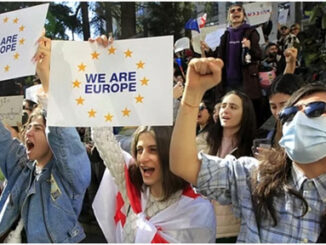
    TBILISI (TIP): Georgia’s young protesters, having forced parliament into a U-turn on controversial new legislation, are determined to maintain the pressure on the government, which they believe is steering the country away from Europe. Thousands of young and mainly peaceful protesters flooded the capital Tbilisi this week. Many of them, speaking to AFP, insisted they were not motivated by party allegiances in the fiercely partisan country.

    The over-arching reason they braved tear gas and water cannon, they said, was a firm belief that the ex-Soviet country should anchor itself to Europe, they said.

    The rallies erupted March 7 when parliament began to introduce “foreign agent” laws reminiscent of Russian legislation used to suppress media and civil society. Under pressure from the protesters, the ruling Georgian Dream party formally voted down the bill Friday to the cheers and whistles of protesters outside parliament, holding signs that read: “We are Europe.”

    “We’re happy the law failed, that Georgians prevailed and that they will continue to fight for their European future,” said 20-year-old student Saba Meurmishvili.

    Meurmishvili said police had arrested him at the rally while he was chanting anti-government slogans. He was held for two days before a court released him with a USD 900 fine. He went right back to demonstrating alongside other students, he said, to “protest this government, which is trying to bring us back to Russia. “I want to build a European country. We are a generation born and raised in a democratic and free Georgia and we want to preserve our peace and our freedom.”

    ‘We are Europe’

    Meurmishvili, the protests that gripped Georgia — a former Soviet republic with a history of political turmoil — were linked to the country’s vibrant civil society, not a political party. “We try to keep our distance from all political parties,” he said.

    On Friday, the Kremlin accused foreign countries of orchestrating “an attempted coup.”

    But Russian influence appears to be waning in Georgia, whose younger generations are strongly pro-European. On Friday, the country’s jailed ex-leader Mikheil Saakashvili praised the protesters for their role in stopping the proposed law. “They were brilliantly resisting brutal force used against them,” Saakashvili wrote on Facebook.

    EU and NATO membership is enshrined in the constitution and backed by some 80 per cent of the population, polls suggest. “We belong in Europe and step by step we are going to become part of the EU,” said Ketevan Kalandadze, a social worker. The government bill had wanted to label any NGO or media outlet that received more than 20 per cent of funding from abroad as a “foreign agent”.

    “We see this in Russia, Belarus, Azerbaijan, and it has worked,” said Ketevan, one of the protesters outside parliament.

    “They have no more opposition, no more civil society watchdog organisations, no more support for NGOs,” the 32-year-old told AFP.

    ‘Russia is prison’

    The protesters’ mood was reminiscent of Kyiv during the 2014 Maidan movement, which brought pro-Western leaders to power and sparked a confrontation with Russia that culminated in an all-out war last year.

    Georgia has its own history of invasion by its giant northern neighbour. In 2008, after years of tensions over Tbilisi’s efforts to forge closer ties with the West, Moscow sent troops to Georgia, which was battling pro-Russian separatists in its South Ossetia and Abkhazia regions.

    After the war, Russia recognised the territories as independent and stationed military bases there, lending further urgency to Georgia’s bid for NATO membership.

    Soon after Russia invaded Ukraine a year ago, Georgia –- together with Ukraine and Moldova — applied for EU membership. At the time, EU leaders put Kyiv and Chisinau on a formal membership path, but deferred Tbilisi’s candidacy, saying it should first implement several reforms.

    (AFP)

  • Ukrainian Nobel winner calls for world to ‘hold Russian war criminals accountable’

    Ukrainian Nobel winner calls for world to ‘hold Russian war criminals accountable’

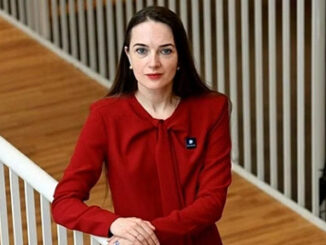
    Kyiv (TIP): Oleksandra Matviichuk, a Ukrainian rights activist whose NGO was co-winner of last year’s Nobel Peace Prize, called February 16 for the world to “hold Russian war criminals accountable,” in an interview with AFP.
    “We must break the circle of impunity,” she said, urging the United Nations and the European Union to back Kyiv’s call for a special tribunal able to judge top Russian officials all the way up to President Vladimir Putin.
    While acknowledging that getting a majority of UN member countries behind that goal was a “hard task,” Matviichuk said it was indispensable for any post-war peace that might follow the end of the conflict in her country.
    “There will not be sustainable peace without justice,” she noted.
    Her demand came nearly a year after Russia’s February 24, 2022 invasion of Ukraine, which followed its 2014 annexation of Crimea and support for pro-Russian separatists in Ukraine’s east.
    She was speaking at Belgium’s University of Louvain just ahead of receiving an honorary doctorate there, alongside Palestinian filmmaker Elia Suleiman and Adelle Blackett, a law professor at Canada’s McGill University.
    The trio were being recognised for the fight for civil rights and a fairer society.
    ‘Everyone’s rights protected’
    The Ukrainian NGO that Matviichuk runs, the Center for Civil Liberties, last year shared the Nobel Peace Prize with the Russian rights organisation Memorial and an imprisoned Belarusian pro-democracy activist, Ales Bialiatski.
    Matviichuk’s Center for Civil Liberties, founded in 2007, has campaigned for rule of law and democracy in Ukraine.
    That struggle has only become harder with Russia’s military offensive, but it has not been forgotten, she said — to the contrary, the values the NGO campaigns on are central to Ukraine’s efforts to one day join the European Union. “We have two main tasks: to survive and to resist, and to continue our democratic path,” Matviichuk said.
    “We’re still a nation in transit, and we can’t concentrate energy only on this reforming path — we have in parallel the war with Russia.
    “But after the large-scale invasion started, we still have no luxury to concentrate only on one goal, we have to fight for our survival. And we have to move on to join to European Union,” she said.
    Ukraine’s ambition to become an EU member state could take many years, EU officials say, though some EU neighbours of Ukraine are lobbying for a faster timeline.
    Becoming part of the European Union means becoming part of the “European civilisation space,” Matviichuk said.
    Joining the EU would mean “we will have a chance to build our country where the rights of everybody are protected,” she said. (AFP)

  • US NGO based in Pakistan associated with terror organizations, alleges Congressman

    US NGO based in Pakistan associated with terror organizations, alleges Congressman

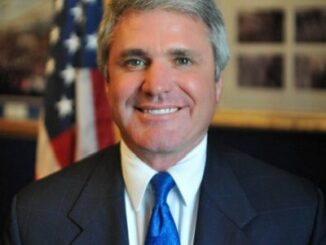
    Congressman Michael McCaul, Chairman of the House Foreign Affairs Committee, seeks a suspension of the funding to the NGO pending a full and thorough review of these allegations

    WASHINGTON, D.C. (TIP): A US NGO based in Pakistan and receiving humanitarian aid from the US Agency for International Development is associated with designated terrorist organizations, an American lawmaker has alleged. In a letter to USAID Administrator Samantha Power on January 24, Congressman Michael McCaul, Chairman of the House Foreign Affairs Committee, sought a suspension of the funding to the NGO pending a full and thorough review of these allegations.

    “This award must immediately be suspended pending a full and thorough review of these accusations,” McCaul said. The Congressman, in the letter, expressed concern that USAID received information from his office more than eight months ago regarding credible allegations that one of its grantees is associated with designated terrorist organizations.

    In October 2021, USAID awarded USD 110,000 to Helping Hand for Relief and Development (HHRD) through the Ocean Freight Reimbursement Program. This award was made despite longstanding, detailed allegations that HHRD is connected to designated terrorist organizations, terror financiers and extremist groups, he said.

    In November 2019, three Members of Congress requested that the State Department review these alleged ties to terrorism in a public letter, he wrote.

    “Please immediately personally review this grant to HHRD. I strongly urge you to pause this grant while you complete a thorough review of the allegations, to include coordination with the intelligence community, federal law enforcement, the State Department Counterterrorism Bureau, and the Department of Homeland Security,” McCaul said.

    The HHRD, a top 4-star rated USA NGO, is also registered in Pakistan with the Ministry of Interior. It is present in all four provinces – Balochistan, Punjab, Sindh, Khyber Pakhtunkhwa – of Pakistan, in addition to Pakistan occupied Kashmir. According to the allegations and media reports, some sponsors of HHRD events in Pakistan include Falah-e-Insaniat Foundation (FIF), the charitable wing of Lashkar-e-Taiba, the terrorist outfit responsible for the 2008 Mumbai attacks. The US in 2016 had designated FIF as a terrorist organization.

    (Source: PTI)

  • Suicide attack in Kabul leaves five dead, 40 injured

    Suicide attack in Kabul leaves five dead, 40 injured

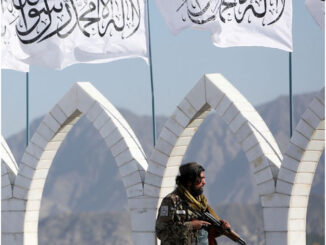
    kabul (TIP): A suicide bomber killed at least five people outside the Afghan foreign ministry on January 11, police said, and a nearby hospital said over 40 people were wounded. Kabul police spokesperson Khalid Zadran said the official confirmed death toll was five. Ustad Fareedun, an official at the Taliban-run information ministry, said 20 people were killed. He said the bomber had planned to enter the foreign ministry but failed. Emergency Hospital, a surgical centre for those wounded by the war run by an Italian NGO, said it had received more than 40 patients following the explosion. The United Nations and several countries, including Pakistan and the United Kingdom, condemned the attack. “The UK rejects such senseless and indiscriminate acts of violence,” said Hugo Shorter, the charge d’affaires for the UK mission to Afghanistan. A photo of the area, confirmed by official sources, showed at least nine dead or wounded lying outside the ministry. The blast hit at about 4 pm (1130 GMT), Zadran said.

    No group immediately claimed responsibility. The Taliban-run administration has faced an insurgency by Islamic State militants who have targeted foreigners, including the Russian and Pakistani embassies and a hotel catering to Chinese businessmen.

    The blast took place during a busy time of day in a heavily fortified area surrounded by checkpoints on a street housing several ministries. Countries, including Turkey and China, have embassies in the area. — Reuters

  • The hint of a ‘one nation one NGO’ regime

    The hint of a ‘one nation one NGO’ regime

    The current purge against civil society organizations seems to be indiscriminate and alarming

    By M.S. Sriram

    “Why foreign funding? As we know, “causes” have no boundaries and funding for such socially desirable belief systems could come from beyond borders. Some causes carried out by organizations such as Doctors Without Borders, or Reporters Without Borders are by definition international in nature. Similar is the case with the Jaipur foot provided by the Bhagwan Mahaveer Viklang Sahayata Samiti. The humanitarian work by the Missionaries of Charity is beyond the capability of a state. Such causes do not have a rational basis to be explained in terms of a financial model; how do you put a price tag to press freedom? The niche funding will happen from agencies that may be beyond the borders. They need to be encouraged.

    On December 31, 2021, the Ministry of Home Affairs issued another public notice extending the validity of registration certificates that were expiring from September 29, 2020, to March 31, 2022, till the latter date, provided that the request for renewal had not been rejected. What should have been a routine activity of the Ministry has turned out to be a fairly detailed exercise of scrutiny, resulting in a paralysis in granting permissions. The levels of due diligence and the information sought on the one hand and the annual declarations to be given by the board members of civil society organizations on the other have increased significantly. The mandatory opening of bank accounts for foreign contributions has been centralized in one branch of the State Bank of India. The linking of Permanent Account Number (PAN), Aadhaar number and mapping it with the bank account/s of the individual board members are happening with gusto. All this has resulted in a chill settling over the people who are and have been associated with civil society organizations serving a social or cultural cause. The registrations under Foreign Contribution (Regulation) Act (FCRA) have been long necessitated in order to undertake due diligence of the causes for which the organization is working for and also to have a handle on the traceability of funds.

    Data on cancellations
    Recently, the Missionaries of Charity established by Nobel Laureate Mother Teresa, was in the news for the cancellation of its permission under the FCRA. A perusal of the statistics available on the website of the Ministry of Home Affairs (https://bit.ly/32Kij6E) reveals an interesting pattern. Of the 20,675 permissions under the FCRA that were cancelled from 2011 onwards, only 89 have been cancelled on request; the rest have been cancelled on violation. Of these 20,675 cancellations, 80% of the cancellations are after 2014, with a massive purge of around 10,003 permissions in the year 2015. The dashboard (https://bit.ly/3sXfOsu) shows a little under 17,000 active organizations — which have either got permission or will know their fate by March 2022, while around 33,000 organizations have either lost their permission or it has expired. These cancellation numbers do not include the rejection of around 600 applications that have been in the news in the recent past, as the website shows only three cancellations in the year 2021 and none in 2020.

    There has been a pattern to the organized attack on civil society organizations and this looks like the final shot. In the past, the amendments in the FCRA that restricted the ability to sub-grant, killed many of the niche organizations working in very remote areas which had no direct access to international funding but were doing it through larger non-governmental organizations. The other amendment restricting the proportion of expenses on administration almost choked organizations that worked for the rights of the disposed. The increasing level of surveillance type of data sought has resulted in many organizations losing people on their governance structure and resulting in problems in funding. The level of the purge is alarming on two fronts. If this purge is because of violations that seem to threaten sovereignty because of evidence of money laundering, subversive activities and violation of the laws, then it is worrying that these organizations survived for all these years. This says a bit about the system of scrutiny that we have had in the past.

    Alternately, if these are organizations that have been purged on xenophobic considerations — because they are activists usually questioning the Government and speaking for the marginalized — organizations working on issues such as human rights, and organizations serving the people whom the state is unable to reach, then it is even more alarming. That is because it is suppressing the concept of antyodaya — reaching the last person with rights, services and entitlements.

    Organizations that are needed
    Why we need civil society organizations is a moot question. We need them because they usually work on what can be called an unreasonable agenda. This unreasonableness falls in three large verticals. The first is that they ask for greater efficiency, delivery and accountability from the state. Whether is it about rehabilitation and compensation in the case of land acquisition or setting up a great accountability framework as was done through the movement led by the Mazdoor Kisan Shakti Sangathan for the Right to Information. The second vertical is in correcting the extractive nature of markets. The groups asking for environmental accountability are looking at inter-generational justice on a matter that is not very precisely measurable but is palpable. The third is basically picking up causes that are so niche that it is beyond the capability of the state to come up with such initiatives such as a school of drama set up by NINASAM (Nilakanteshwara Natyaseva Samgha) in a village called Heggodu, Karnataka, or an idea of distributing clothing for work as done by Goonj. These initiatives cannot be put into specific business plans, spreadsheets or government schemes. They, therefore, need a grant-based, cause-based revenue stream model.

    Issue of funding
    Why foreign funding? As we know, “causes” have no boundaries and funding for such socially desirable belief systems could come from beyond borders. Some causes carried out by organizations such as Doctors Without Borders, or Reporters Without Borders are by definition international in nature. Similar is the case with the Jaipur foot provided by the Bhagwan Mahaveer Viklang Sahayata Samiti. The humanitarian work by the Missionaries of Charity is beyond the capability of a state. Such causes do not have a rational basis to be explained in terms of a financial model; how do you put a price tag to press freedom? The niche funding will happen from agencies that may be beyond the borders. They need to be encouraged.

    In general, past regimes have been tolerant of all developmental and cultural causes; somewhat wary and tolerant of rights-based causes; and largely suspicious of civil society organizations working for human rights and environmental causes. Both human rights and environmental causes put these civil society organizations directly in confrontation with the job of policing/internal security and “development” or economic growth. That is a fight that the civil society organizations were used to.

    Deeper study needed
    However, the current purge seems to be indiscriminate. The depth and the variety of the work of a civil society organization cannot be captured in the annual returns filed on the FCRA portal, where there is no scope for explaining something beyond the binary. There needs to be a study on how many civil society organizations lost their permissions on “expiry” only because the pre-populated dropdowns given by the FCRA portal were unable to capture the work of the organizations.

    The duality of welcoming foreign investments (which takes away capital gains and dividends) while actively discouraging foreign aid to charities is staring us in the face. The definition of what is foreign in the case of electoral bonds and donations to political parties is dodgy at best. This duality is the signature of the current dispensation. Its appetite to collect data is matched only by its reluctance to share data. If the hope, therefore, for civil society organizations is corporate social responsibility funding and funding from Indian philanthropists, watch this space. As cartoonist P. Mahamud indicated in a cartoon, we are moving towards a ‘One Nation One NGO’ regime.

    (Author is Faculty member, Centre for Public Policy, Indian Institute of Management Bangalore. He is on the boards of non-governmental organizations, or NGOs that have applied for FCRA permission. None of those NGOs is mentioned in the article.)

  • Randeep Hooda joins Khalsa Aid to help Covid patients

    Randeep Hooda joins Khalsa Aid to help Covid patients

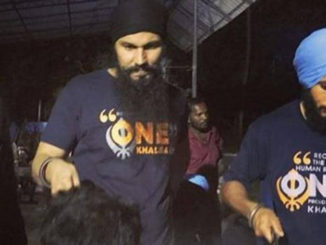
    Amid the pandemic situation going on in the country, people are coming out and offering help in all possible ways. Many celebrities have also joined the campaign and came forward to help common people. Celebrities like Priyanka Chopra Jonas are also trying to raise funds by joining other non-governmental organisations (NGOs). And to join the list is actor Randeep Hooda. He has joined hands with Khalsa Aid and will be providing oxygen concentrators to COVID 19 patients in the country. He shared a video on his official Instagram handle and urged people to come forward and help others. This is a difficult time and we all be needing everyone’s hand in handling this crisis. He wrote, “It’s your chance to save lives! With India facing the worst of the pandemic, people are dying due to lack of oxygen. Let’s come together to help the country fight #COVID and save precious lives. @khalsaaid_india is providing oxygen concentrators and we urge you to come forward and do you bit to help India breathe.”