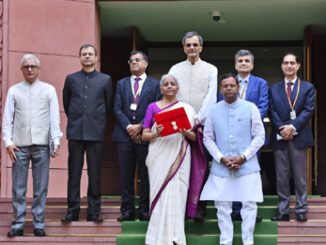
Tag: Nirmala Seetharaman

  • Budget 2024 – long on intent, short on details

    Budget 2024 – long on intent, short on details

    The policy slant highlights good intentions, but the ways and the means to accomplish the ambitious goals set out are hazy

    ‘The fiscal arithmetic and the macro-policy stance in the Budget signal continuity and a carrying on with fiscal consolidation efforts’

    “Barring the announcement of tax benefits for Indian start-ups and their investors, including scrapping the contentious angel tax for all classes of investors and aligning capital gains rates between listed and unlisted equity and the increased limit of Micro Units Development and Refinance Agency Ltd. (MUDRA) loans from ₹10 lakh to ₹20 lakh, the big push for the industrial sector is conspicuously absent in the Budget. Neither was there any mention of the Railways, PLI Scheme, Gati Sakthi and the Census. The list of omissions could be longer, but a lack of clear initiatives towards the education and health sectors to tap demographic dividend might not augur well with the vision of 2047. Equally important is to strike a balance between cities and rural economy and to make a distinction between jobs and internships. With the macroeconomy well poised at the moment, some bold steps and details of the journey to 2047 could have been outlined.”

    By M. Suresh Babu

    The short Budget speech by the Union Finance Minister is marked by clarity on three aspects. First, the intentions and vision for Vikisit Bharat@2047 are spelt out through the nine priority areas, a long-term vision, to which we expect that subsequent Budgets would adhere, to accomplish these goals. Second, there is an explicit recognition of the problem of unemployment in the economy. Addressing this has been a challenge and the Budget devotes considerable space in listing out initiatives towards generating employment. Third, the compulsions of a coalition government surface in parts, but are hidden in some of the specificities. These three have guided the strategy and the approach of the Budget. On the face of it, the policy slant reveals good intentions, but the ways and the means to accomplish the ambitious goals set out are not divulged, casting a shadow on the possibility of realizing the targets set.

    A signal of continuity
    The fiscal arithmetic and the macro-policy stance in the Budget signal continuity and a carrying on with fiscal consolidation efforts. The overall fiscal deficit has been lowered to 4.9% compared to 5.1% targeted in the interim Budget. A large part of the surplus received from the Reserve Bank of India has been used to buttress fiscal prudence. The anticipated reiteration of the reduction in the fiscal deficit to below 4.5% of GDP in FY2026 is welcome. The new medium-term fiscal consolidation path has been linked to a reduction in the debt/GDP ratio instead of continued compression of the fiscal deficit/GDP ratio. This will allow the government flexibility to chart an appropriate fiscal course that builds in higher capital spending as well as support to meeting climate goals in an uncertain global environment.

    The size of the Budget has gone up only marginally. This also means that the overall borrowing programme of the government is almost unchanged — in fact, it has come down marginally though the cut in borrowings is smaller than what could have been possible with the buoyant revenue collections.

    While there has been a slight increase in overall expenditure, capital expenditure remains more or less unchanged. There are two discomforting trends on the expenditure side. First, the Budget estimates for 2024-25 show only marginal increase in allocation in most of the items of expenditure compared to that of 2023-24. In fact, in some of the key items, it shows a decrease. In the case of commerce, industry and energy, we find a decline in Budget estimates for 2024-25. Second, in many items of expenditure, the revised estimates for 2023-24 are lower than the Budget estimates for the same year. Social welfare and scientific departments are notable in this context.

    Effective capital expenditure, which is capital expenditure plus the grant in aid for creation of capital assets, have come down when we compare revised estimates and provisional actuals for 2023-24. The decline in revised estimates compared to Budget estimates is an indication of the lack of capacity of the government to spend, which is likely to undermine the expected multiplier effects of such expenditures. Thus, we need to wait and watch as to how much of the proposed outlays are utilized. Further, the same levels of capital expenditure imply that the government would bank more on private investments, as indicated in the Economic Survey, which has not yet registered a significant increase in recent years.

    Consumption and employment
    The Budget relies on two measures to bolster demand and increase private consumption. It takes the route of tinkering with the new income-tax regime to leave slightly more disposable incomes for a section of taxpayers, which is expected to stimulate demand. Given the growth in indirect tax collections, there was more room for income-tax reliefs, which could have been useful to not only stimulate demand but also increase dwindling household savings. This is an opportunity missed. Second, the Budget expects employment growth to take place, imparting more incomes, and, hence, higher demand in the economy.

    The internship scheme, the direct thrust on channeling funds to first-time employees with commensurate benefits to companies to incentivize a hiring of more people and providing salary top up for first time employed are unlikely to create more jobs as they do not address the questions of social aspirations and technological changes which directly impinge labor market outcomes. Moreover, implementing these schemes is not straightforward. The internship scheme has the additional risk of becoming a short-term urban employment programme, which only creates a pool of the unemployed in the future.

    Employment growth is also expected to take place with the revival of the Micro, Small and Medium Enterprises (MSME) sector through the credit route with a guarantee scheme being launched, besides asking banks to have their own models for lending that is not linked with collateral. Assistance to States such as Andhra Pradesh, Bihar, Odisha and Jharkhand is also expected to give an indirect push to investment and employment along with the thrust to housing in urban and rural areas.

    It needs to be noted that MSMEs need to have not only credit but also a conducive environment to operate for their growth. Hence, the efficacy of providing only credit and leaving the rest to market forces might not generate the desired results.

    The omissions
    Barring the announcement of tax benefits for Indian start-ups and their investors, including scrapping the contentious angel tax for all classes of investors and aligning capital gains rates between listed and unlisted equity and the increased limit of Micro Units Development and Refinance Agency Ltd. (MUDRA) loans from ₹10 lakh to ₹20 lakh, the big push for the industrial sector is conspicuously absent in the Budget. Neither was there any mention of the Railways, PLI Scheme, Gati Sakthi and the Census. The list of omissions could be longer, but a lack of clear initiatives towards the education and health sectors to tap demographic dividend might not augur well with the vision of 2047. Equally important is to strike a balance between cities and rural economy and to make a distinction between jobs and internships. With the macroeconomy well poised at the moment, some bold steps and details of the journey to 2047 could have been outlined.
    (M. Suresh Babu is Director, Madras Institute of Development Studies)


  • Not by GDP Alone

    I am more inclined  to think as a common man rather than come out with a scholarly and pedantic analysis. I shall not go in to the nitty gritty of figures or make a presentation through graphs to exhibit gains and losses because these have only confounded the common man. I will not speak of when India will be a 5 trillion or 7 trillion economy.  I will  not make comment on  the growth of GDP. Nor  would I make any guesses about the fortunes of an Adani or an  Ambani.  I leave that to a Narendra Modi or a Nirmala Seetharaman. I shall be more interested in talking about where India stands when it comes to the people of India and their rights as human beings.

    For every Indian it was a bliss to be alive on 26th January 1950 when the Constitution of Secular India came in to being. For him it was a day when he was promised certain fundamental rights. Readers may please look into the Preamble to the Constitution of India. It is a day when every Indian felt he was going to see a new sunrise. It is a day that promised every single man, woman and child in India end of inequality and exploitation. It is a day that held the prospect of an end to bigotry. It is the day that spoke of an end of illiteracy. It is a day our leaders described as the day of a new awakening. It is a day of new life of liberty and freedom-the most cherished goals of every human being anywhere in the world. Indians bowed their heads in gratitude before the framers of the Constitution, led by the brilliant Dr. Bhim Rao Ambedkar. They felt they were just about to enter the Promised Land.

    Behind the veil of all external growth, all seeming progress, there is decadence in India. To the common people, equality is a word in Dr. Ambedkar’s Constitution of India, not the practice. How can one claim there is equality in India when the majority still is caught in the grinding machine of illiteracy, ignorance and poverty? How can one feel proud of the growing economic stature of the country (India will be a 5 Trillion economy by 2024 and an economic super power by 2050 or even earlier) when one does not get two square meals, is without a home and has neither a present nor a future?

    73 years of Republic and we  have still not been able to ensure justice to our people. “Might is Right” holds true in the land of the Buddha, Nanak and Gandhi. From far flung hamlets to the city, it is the might that rules. Even the politicians who are supposed to act as the custodians of the Constitution subscribe to the dictum. Dalits and minorities are at the receiving end. A case in point is the 1984 anti-Sikh riots in Delhi and elsewhere in India. Ten thousand Sikh men, women and children were butchered in cold blood then. Thousands of Sikh women became widows. Thousands of children became orphans.

    Look at all the cases being reported every day of  rape of dalit women, the police brutality, the gangsters’ reign, the highhandedness of government officials, the loot the politicians engage in day in and day out. Law seems to have taken leave of the country.

    A fresh case is of the top Indian wrestlers who have been forced to gather in Delhi to protest the sexual harassment of players by Brij Bhushan Sharan Singh, the President of Wrestling Federation  of India and his colleagues. Brij Bhushan Sharan Singh should have been arrested and interrogated, if the law had respect in the country, but  he will not be touched, because he belongs to the ruling party, and, on top of it, he is a “Bahubali”. Those who speak of Ram Rajya are the ones who do not practice Ram Rajya.

    The Non-resident Indians have been voicing similar concern at the lawlessness in the country when many pointed out that their property in India was being grabbed by unscrupulous elements and many had been framed in false criminal cases. They pointed the accusing finger at the police and civil officials who connived with criminals to rob the NRI’s of their legitimate property. How can government of India expect the NRI’s to come forward to invest in the country when they feel insecure? Law is on leave, probably a long leave.

    Where is Equality promised in the Constitution of the Republic of India? Where is Freedom? Where is Justice?

    Let us on this Republic Day ask ourselves these questions, for the sake of the Republic of India.

    SATYAMEV JAYATE!
