Tag: Nitish

  • Bihar Elections: India’s Drift Toward One-Party Hegemony

    Bihar Elections: India’s Drift Toward One-Party Hegemony

    “It is a profound irony that a party’s rise to power through a fair, transparent, and democratic process can ultimately weaken the very system that enabled its ascent. It raises questions about India’s political trajectory rather than the outcome of a single election. When one party amasses overwhelming political, financial, and institutional power, it becomes a grave threat to a vibrant democracy. The weakening of institutional autonomy, the erosion of electoral transparency, and the shrinking space for dissent all point toward a structural imbalance that no democracy can afford for long. A diverse nation like India can sustain this democratic experience only if there is contestation of ideas, challenging authority, and keeping those in power truly accountable.”

    By George Abraham

    Oh yes, the BJP won again! And if not for the sheer scale of its victory, there would have been nothing novel or particularly intriguing about these election results. So, what now? Are we heading toward a one-party domination of Indian politics, a situation where a single party holds significant power and influence over the political landscape? Are Modi and his colleagues executing a long-term script envisioned by the RSS from behind the scenes? And has the Congress been reduced to a political non-entity, especially in northern India? These questions are not frivolous, and they demand the nation’s serious attention.

    Undoubtedly, the BJP’s sweeping victory in Bihar will be viewed as a watershed moment for the INDIA coalition, a diverse mix of the Congress and regional parties formed precisely to counter the BJP hegemony. The coalition, which was a significant attempt to unite various political forces against the BJP, had potential, but it struggled to realize it, plagued by internal rivalries and constant jockeying for leadership. The idea of the coalition was based on a sound argument: that the BJP often wins elections with only a plurality of votes. Yet the alliance failed to project a united front or a clear alternative.

    Since the 2024 Lok Sabha elections, the opposition has found itself confronted by a mammoth machinery, one that includes the full strength of the bureaucracy, an increasingly compliant Election Commission, supportive media ecosystems, and virtually unlimited resources from business magnates, electoral bonds, and vested interests. Combined with alleged voter-roll manipulation, which refers to the suspected tampering or removal of voter names from electoral rolls, accusations of EVM vulnerabilities, and selective enforcement of election rules, these forces appear to have contributed to sweeping victories in Haryana, Maharashtra, and now Bihar.

    One wonders whether Nehru and Ambedkar, architects of India’s democratic institutions, could have imagined how far the Election Commission would drift under the current regime. Rahul Gandhi’s explosive revelations on electoral-roll irregularities were met not with alarm but with silence. Even though the data Gandhi cited came directly from the Commission itself, the EC chose not to meaningfully address the complaints or the threat they pose to electoral integrity. Such dismissiveness undermines the very fabric of India’s democratic system.

    According to The Economic Times, the Bihar government under Nitish Kumar credited ₹10,000 each to around 14 million women belonging to self-help groups under the Mukhyamantri Mahila Rojgar Yojana (MMRY). These payments reportedly came just before, or even after, the Model Code of Conduct came into effect. Many analysts and opposition leaders believe this direct cash transfer functioned as a voter-influencing tool targeting a crucial demographic. Sharad Pawar of the NCP even called the payout a “threat to democracy,” arguing it unfairly tilted the electoral playing field toward the ruling coalition.

    This raises another critical question: where did such a massive sum of money suddenly come from? Jan Suraaj leaders allege that World Bank–financed project funds were diverted for this purpose, an accusation, if true, carrying serious governance, legal, and international implications. Even setting that aside, the BJP’s vast reservoir of financial resources or its access to billionaire networks, makes such electoral mobilizations easy to engineer. The result was a record-breaking turnout among women voters in Bihar. If misappropriation of multilateral funds is ultimately proven, it would demand a rigorous investigation.

    Another deeply troubling issue concerns the large-scale removal of voters from the electoral rolls. Reliable reports indicate that around 65 lakh names were deleted prior to the election, potentially disenfranchising marginalized communities and altering outcomes in closely contested constituencies. While the ruling party defends this as a necessary “cleanup,” the unprecedented scale raises serious questions about voter suppression and public trust in the electoral system’s integrity.

    Rahul Gandhi has further demonstrated, using official data, how “ghost voters” proliferate across rolls—names with invalid or nonexistent addresses, large clusters registered at single locations, and even foreign nationals inexplicably listed as Indian voters. These anomalies suggest either a breach of the central voter database or the misuse of authorized access. The existence of such ghost entries conveniently paves the way for manipulating outcomes, especially if combined with EVM systems that the Election Commission refuses to make fully transparent. The software on these machines is not open source, and multi-phase elections often involve long periods during which EVMs are stored without clear public access to CCTV footage that is sometimes destroyed prematurely. These conditions naturally erode public confidence.

    The opposition, for its part, has not helped its own cause. Beyond opposing the BJP, it rarely projected a cohesive ideological narrative. It lacked a compelling alternative vision for development, economic growth, or social welfare. Internal factionalism, weak grassroots organization, and inconsistent messaging have all contributed to its decline. Meanwhile, the NDA’s disciplined focus on religious nationalism and welfare delivery has resonated more effectively with voters.

    In northern India, the Congress has indeed been performing poorly in election after election. Its repeated “introspection” exercises have yielded little. Rahul Gandhi often appears as a lone voice, while many in his party remain disconnected from grassroots realities. It is past time for Congress to adopt serious organizational reforms, demand stronger electoral safeguards, such as paper ballots, and articulate an agenda and engage in a more sustained on the ground campaigning. At the very least, candidate selection must be merit-based, with tickets finalized at least six months in advance to give them any realistic chance of success.

    Meanwhile, the long-term ideological agenda of the RSS is coming increasingly into focus. It appears less interested in preserving the diversity of India’s political ecosystem and more committed to reshaping the nation along lines of cultural and religious conformity. Weakening the independence of institutions such as the Election Commission, judiciary, and media seems central to that strategy, consolidating lasting political dominance.

    It is a profound irony that a party’s rise to power through a fair, transparent, and democratic process can ultimately weaken the very system that enabled its ascent. It raises questions about India’s political trajectory rather than the outcome of a single election. When one party amasses overwhelming political, financial, and institutional power, it becomes a grave threat to a vibrant democracy. The weakening of institutional autonomy, the erosion of electoral transparency, and the shrinking space for dissent all point toward a structural imbalance that no democracy can afford for long. A diverse nation like India can sustain this democratic experience only if there is contestation of ideas, challenging authority, and keeping those in power truly accountable.

    The nation will also need opposition parties not to be fragmented or intimidated, and institutions that safeguard fairness not to be compromised. Elections may continue to be held like in many authoritarian nations, but the spirit of democracy will slowly fade and die. A true democracy requires competition, scrutiny, debate, and accountability, without which the country will move toward conformity and centralized dominance. India now stands at a crossroads, where citizens and institutions must rethink and evaluate the political trajectory we are on, and take a vow to uphold constitutional values. Protecting democracy and the hard-fought freedom won by our great leaders like Mahatma Gandhi and Jawaharlal Nehru do not simply rest in the hands of the opposition, and the nation’s future is shaped not by the will of one single entity, but by the voices and aspirations of all its people.


    (George Abraham is a former Chief Technology Officer of the United Nations. He is vice chair of IOC USA. He can be reached at gta777@gmail.com)

  • Fear of losing ground drives Nitish

    Fear of losing ground drives Nitish

    Kickerline: Bihar Chief Minister has survived despite being an overvalued political asset

    Nitish did not want to be number two in the Opposition ranks. In the NDA, his position is not in the front but he will continue to be the CM.

    “Nitish has literally returned to his den and there he has to remain, even as the BJP gains strength in the state and thinks of ways and means to replace him. But he has a fighting chance in Bihar and can hope to repel his opponents for the time being. INDIA is on a weak wicket for other reasons and this does not have much to do with Nitish leaving it. Nitish is not a strong and tall leader who can make a difference, and he knows it. He also remembers the outcome of the 2014 Lok Sabha elections in the state — the JD(U) fought against the BJP and won just two seats, while the saffron party bagged 22.”

    By Parsa Venkateshwar Rao Jr

    Bihar Chief Minister Nitish Kumar is the proverbial cat with nine lives. He has remained at the helm in state politics for more than 20 years despite his shaky foundations. His party, the Janata Dal (United), is not formidable either in the state or at the national level. But he has tried to stay ahead of his competitors not through numbers but thanks to the fact that the BJP has not been too sure of itself in the state and has been willing to let him have the reins of power. This time, he has dumped the ruling Mahagathbandhan, which includes the Rashtriya Janata Dal (RJD), the Congress and Left parties.

    When Nitish senses that his plan to grow as a national leader does not seem to be working out, he wants to save his position as CM at whatever cost.

    The BJP and the JD(U) had together won 33 of the 40 Lok Sabha seats in Bihar in 2019; the former wants to do an encore in the upcoming General Election. It is for this reason that Nitish has snuggled back into the NDA’s fold. But how well is he placed on his home turf? It is the fear of losing ground that has been driving him hither and thither, first into the arms of the RJD and then the BJP.

    There is speculation that Nitish’s exit from INDIA would weaken Opposition unity so much that there would not be any contest in the parliamentary elections. It is presumed that Nitish was a sort of lynchpin for the bloc and his departure would leave it rudderless. Nitish has for long been an overvalued political asset. He has not stormed the national arena on his own, unlike George Fernandes, his old socialist comrade. Nitish, along with Lalu Yadav, Sharad Yadav and Ram Vilas Paswan, was a product of Jayaprakash Narayan’s protest movement of the early 1970s; they became recognizable faces of a new generation of leaders. But they remained where they were. They did not leverage their success to make an impact on the national stage. A similar thing happened with Jyotiraditya Scindia, Sachin Pilot and Milind Deora in the Congress; Scindia and Deora have since moved on.

    However, Lalu Yadav managed to consolidate his party (RJD) in Bihar, while Nitish’s JD(U) started lagging behind. And it is with the help of BJP that Nitish managed to stabilize his position in the JD(U) and lead it to victory. The JD(U) base in Bihar is not as wide as that of the RJD. In the 2020 Assembly election, the JD(U) had won only 43 seats, well behind the BJP (74) and the RJD (75).

    It is because of his long stay as chief minister that every once in a while, Nitish tries to break out of Bihar and look at the national scene. He thinks that his sobriety gives him an edge over Lalu Yadav’s image of a lovable maverick. But sobriety is not gravitas. Nitish has been overestimating his stature as a leader of national importance.

    And when he senses that his plan to grow as a national leader does not seem to be working out, he wants to save his position as chief minister at whatever cost. In 2013, he wanted to challenge Narendra Modi but soon realized that he was no match for him because the BJP had a larger footprint across the country and there was the RSS network of volunteers working quietly as foot soldiers of the party. The JD(U) could not match the BJP at the organizational level across the country. So, he went back to the NDA camp. When INDIA was being formed, he again sensed an opportunity and thought that he would be given due regard as the CM of Bihar, an important Hindi-speaking state. He expected to be given precedence over West Bengal CM Mamata Banerjee. He wanted to head INDIA, but the honor was denied to him because there was little doubt that the Congress had to be the spearhead, a fact that was realized even by Mamata. When Mamata mischievously proposed that Congress president Mallikarjun Kharge should be declared the prime ministerial candidate of the alliance, a JD(U) leader asked: ‘Who is Kharge?’ It was implied that being a politician from a non-Hindi-speaking state, Kharge could not stake claim to become a national leader, whereas Nitish was fit to play that role.

    Nitish did not want to be number two in the Opposition ranks. In the NDA, his position is not in the front but he will continue to be the CM.

    Notably, Nitish does not have much of a following in neighboring Uttar Pradesh, the hub of the Hindi heartland, and he can hardly hope that JD(U) will make inroads there. Modi made a superb move when he contested from UP in 2019, knowing very well the electoral importance of the state which sends 80 MPs to the Lok Sabha. Nitish and his supporters do not seem to realize that in the Hindi belt, a politician from Bihar does not stand much of a chance outside his state.

    Nitish has literally returned to his den and there he has to remain, even as the BJP gains strength in the state and thinks of ways and means to replace him. But he has a fighting chance in Bihar and can hope to repel his opponents for the time being. INDIA is on a weak wicket for other reasons and this does not have much to do with Nitish leaving it. Nitish is not a strong and tall leader who can make a difference, and he knows it. He also remembers the outcome of the 2014 Lok Sabha elections in the state — the JD(U) fought against the BJP and won just two seats, while the saffron party bagged 22.
    ( The author is a senior journalist)

  • Incorrigible Nitish switches allies yet again

    True to form, Bihar Chief Minister Nitish Kumar has dumped his Mahagathbandhan allies and returned to the NDA’s fold. The Janata Dal (United) chief has formed the government with the BJP, the very party he had snapped ties with just a year and a half ago. His latest U-turn has jolted not only the Mahagathbandhan — which includes the Rashtriya Janata Dal (RJD), the Congress and the Left Front — but also INDIA, the Opposition bloc that was formed last year to take on the BJP in the 2024 General Election. Nitish had projected himself as the face of the alliance, but suggestions about naming Congress president Mallikarjun Kharge as INDIA’s prime ministerial candidate left him fuming.

    It’s nothing new for Nitish to switch allies, but he has been doing it with increasing regularity over the past decade. Having once said ‘Mitti mein mil jaayenge magar BJP ke saath nahin jaaenge,’ Nitish has opportunistically patched up with the saffron party yet again in a bid to survive and thrive. His decision shows that he is anticipating the BJP’s victory and INDIA’s debacle in the General Election. This is also a desperate attempt by him to revitalize his party, which had ended up way behind the RJD and the BJP in the 2020 Assembly election. Though the BJP will be calling the shots in the new government in Bihar, it won’t be easy for the party to justify taking Nitish back on board after having ruled out his return to the NDA.

    Even as Nitish seems to have abandoned his prime ministerial ambitions, INDIA finds itself sinking deeper into the mire. Discord over seat-sharing in West Bengal and Punjab has exposed the alliance’s frailties. Nitish’s crossover indicates that more Opposition leaders might jump ship as the Lok Sabha elections draw nearer.
    (Tribune, India)

  • Nitish inches closer to alliance exit; BJP ready

    Nitish inches closer to alliance exit; BJP ready

    New Delhi/Patna (TIP)- Bihar’s ruling coalition appeared at breaking point on Friday, January 26, with the Janata Dal (United), its ally Rashtriya Janata Dal, and the opposition Bharatiya Janata Party all corralling their lawmakers and calling meetings over the weekend as speculation about chief minister Nitish Kumar’s joining the National Democratic Alliance (NDA) reached fever pitch. If Kumar makes the switch, as rumoured, it will be the fourth such move in the past decade and the second this term.
    Signs of plummeting ties in the ruling alliance were apparent after deputy CM Tejashwi Yadav skipped the Republic Day celebrations at Raj Bhavan, where Kumar was present. The two didn’t exchange a word in the parade held in Patna soon after. “Ask those who were not present why they skipped the function,” said Kumar to reporters. At Raj Bhavan, the CM was seen chatting with the leader of the Opposition Vijay Kumar Sinha, and JD(U) minister Ashok Choudhary was sitting on the chair allotted for the deputy CM. The RJD has called a meeting of its legislators on Saturday, while the JD(U) scheduled its meeting on Sunday even as the BJP indicated it was open to joining hands with its friend-turned-foe-turned-friend-turned-foe.
    “We are keeping an eye on all the developments and if needed an appropriate decision will be taken. No door is permanently closed in politics and the door can be opened if needed,” said BJP’s Rajya Sabha MP and former deputy CM Sushil Modi.
    If Kumar goes with the BJP, he is likely to remain CM till at least the Lok Sabha polls later this year, people aware of developments said. But disagreement is rife over who’d become his deputy — Kumar favours Sushil Modi, with whom he worked for a decade in the past, but the BJP might want to go with another face. “They may prefer someone from an extremely backward caste, or dominant OBC group such as Yadav or Kushwaha,” said a person aware of the negotiations.
    Hectic parleys were on in Delhi and Patna throughout the day as the BJP rushed key leaders to the state after a late-night meeting chaired by Union home minister Amit Shah. Sushil Modi flew to Patna on Friday and the state’s central in-charge Vinod Tawde is scheduled to hold a key meeting in Patna on Saturday. “The home minister’s direction to us is very clear,” said a BJP leader in Patna, on condition of anonymity. “We have to speak to everyone so that we are ready for all eventuality. We are waiting for Nitish Kumar to take the final call and resign. Everything will become clearer tomorrow.”
    In Patna, the leading constituents of the six-party ruling coalition exchanged barbs.
    “There is a lot of confusion which is not in the interest of the people of the state. Only the CM can put an end to the confusion,” said RJD MP Manoj Jha. JD(U) chief spokesperson Neeraj Kumar shot back. “Kumar plays politics from the front. He has no confusion.”
    The timing of these moves is crucial. On Monday, Jan 29, Rahul Gandhi’s Bharat Jodo Nyay Yatra enters Bihar and the Congress had planned a show of strength with all members of the ruling alliance. Source: HT

  • Sense of consensus eludes INDIA

    Sense of consensus eludes INDIA

    At core of predicament is Congress’s inability to mold itself into a leader of a heterogeneous bloc

    “What do the circumstances portend for the Opposition’s coalition? The constituents of INDIA met in New Delhi on December 19, apparently to clear the air of disunity that had begun to cloud the coalition after its earlier sessions and following the differences over seat-sharing between the Congress and the Samajwadi Party, Janata Dal (United) and the Rashtriya Lok Dal before the recent state elections. A sense of cooperation and consensus among the parties —which included a Shiv Sena faction headed by Uddhav Thackeray, the Mandalised bloc from Uttar Pradesh and Bihar, the DMK and its allies and the Aam Aadmi Party — continued to be elusive. It still isn’t clear if the participants were out to score an own-goal by flagging issues that were earlier deemed as ‘irrelevant’ or quite happy to articulate their contradictions.”

    By Radhika Ramaseshan

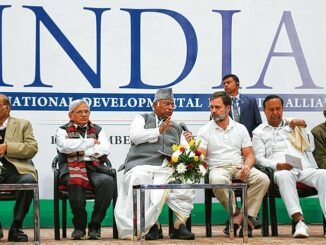
    To see the glass as half full or half empty depends on how buoyant or cynical an observer is. Since its inception in June, the Indian National Developmental Inclusive Alliance (INDIA), comprising 28 parties, has envisaged roping in as many Opposition forces as it can mobilize in a joint front to fight the BJP in the 2024 General Election. The formation of the bloc, in which the Congress is as important an investor as the regional parties, was an admission on the part of the Gandhis that their political legacy was no longer remarkable enough to take on the BJP single-handedly. The series of meetings INDIA held iterated the Congress’s position as an equal and not a first among equals. It still isn’t clear if the participants were out to score an own-goal by flagging issues that were earlier deemed as ‘irrelevant’ or quite happy to articulate their contradictions.

    Ideally, recent events ought to have underscored the need for such a front even more deeply, especially for the Congress, because the favorable atmospherics that prevailed during INDIA’s first congregation at Patna had dissipated. Seven months before that, there was a sense of hope. Rahul Gandhi had completed his marathon Bharat Jodo Yatra, which went some way in reimagining popular perception of the leader who had been seen as a reluctant and naive politician. The Congress scored an impressive win over the BJP in Karnataka and decimated the Janata Dal (Secular), which went on to seek refuge in the NDA’s fold.

    With 2023 nearing its end, the scenario has turned depressing for the Opposition. The BJP swept the elections in three states in the Hindi heartland in a direct faceoff with the Congress. The Congress now exists in slivers in this region. In the ongoing winter session of Parliament, the BJP has reasserted its near-hegemonic position amid projections of a comeback in 2024. It has pulverized the Opposition, which had sought a statement from the government regarding the security breach in Parliament but was rebuffed. Not only did the government reject the suggestion of being accountable to elected MPs, it also passed Bills with far-reaching implications for data security and amendments in the criminal laws without debate and discussion. After the mass suspension of MPs, the Opposition’s presence in the Lok Sabha and Rajya Sabha has shrunk alarmingly. The picture which both Houses presented marked the culmination of a long-cherished RSS project to install an overbearing Centre with the states orbiting around it like satellites.

    What do the circumstances portend for the Opposition’s coalition? The constituents of INDIA met in New Delhi on December 19, apparently to clear the air of disunity that had begun to cloud the coalition after its earlier sessions and following the differences over seat-sharing between the Congress and the Samajwadi Party, Janata Dal (United) and the Rashtriya Lok Dal before the recent state elections. A sense of cooperation and consensus among the parties —which included a Shiv Sena faction headed by Uddhav Thackeray, the Mandalised bloc from Uttar Pradesh and Bihar, the DMK and its allies and the Aam Aadmi Party — continued to be elusive. It still isn’t clear if the participants were out to score an own-goal by flagging issues that were earlier deemed as ‘irrelevant’ or quite happy to articulate their contradictions.

    Mamata Banerjee of the Trinamool Congress and AAP’s Arvind Kejriwal proposed Congress president Mallikarjun Kharge’s name as INDIA’s prime-ministerial candidate. It seemed as if they had only discussed the matter among themselves, believing they could persuade their associates that the time was ripe to raise the pitch for India’s first Dalit PM and counterbalance the BJP’s strategy of consolidating the Other Backward Classes (OBCs). Although JD(U) leader and Bihar CM Nitish Kumar consistently maintained that he did not aspire for the PM’s post, his latent ambitions surfaced through statements by his colleagues in the past. A structured discussion on the PM candidate never took off, especially after Kharge scotched the idea, although some reports quoted him talking about his long years in public service and his conduct as a ‘fighter’ to mean that he was not averse to handling the Mamata-Kejriwal googly. Uddhav stressed that the question of electing a PM arose only if the coalition brought in enough MPs and what INDIA needed immediately was a convener to hold the grouping together.

    Certain red lines, accentuating the existence of a regional cleave and intra-state pinpricks, were drawn. When TR Baalu, a senior DMK representative, sought a translation of Nitish’s speech, he was snubbed by the Bihar CM, who demanded that Baalu should learn Hindi, a ‘national’ language. By juxtaposing the north-south divide that was displayed in Tuesday’s meeting with the BJP’s persistent attempts to shed the tag of being a Hindi-belt party, visible in Prime Minister Narendra Modi’s overtures to Tamil Nadu and Kerala, it becomes clear who — the NDA or INDIA — has the big picture in front and what correctives need to be made.

    While there was a general agreement that the seat-sharing process should be completed by the year-end, where do things stand now? Samajwadi leader Ram Gopal Yadav made it clear that his party would quit INDIA if there was a proposal to accommodate the Bahujan Samaj Party. As Mamata pitched for a year-end deadline, there was no indication from her of wanting to forge a broader alliance involving the TMC, the Left Front and the Congress. Given the mutual antagonism on the ground, it seems unlikely the idea would take off. In Maharashtra, it appears that while Uddhav’s Sena and Sharad Pawar’s Nationalist Congress Party have their terrain mapped out, the Congress is in a quandary over its strong areas, if indeed there are any.

    At the core of the predicament faced by INDIA is the Congress’ inability to mold itself into the leader of an admittedly heterogeneous formation, struggling for a helmsman and a narrative. While everybody conceded the need for a shared agenda and holding collective meetings that didn’t seem unwieldy, the question is: Who will hold the baton for INDIA?
    (The author is a senior journalist)

  • Patna HC stays Bihar caste survey, setback for Nitish

    In a setback for the Opposition’s demand for a nationwide caste census and a similar exercise in states, the Patna High Court on Thursday, May 4, stayed the ongoing caste-based enumeration in Bihar, besides restricting the state government from sharing the already collected data till final orders are passed.
    In an interim order on petitions challenging the Nitish Kumar-led Mahagathbandhan’s move at caste-based survey in the state, Chief Justice K Vinod Chandran and Justice Madhuresh Prasad directed the state to halt the ongoing exercise with immediate effect. The matter has now been posted for July 3. “We are of the considered opinion that the petitioners have made out a prima facie case against the continuation of the process of caste-based survey, as attempted by the state of Bihar. There is also the question raised of data integrity and security, which has to be more elaborately addressed by the state,” the court said after advocate general PK Shahi argued for the state. The move comes at a time when several Opposition parties, including the Congress, JDU, RJD, SP, DMK, BRS and the BJD, have raised the pitch for caste census amid the ruling BJP’s Hindu pitch. Three days ago, Odisha also began an OBC survey on the lines of Bihar.