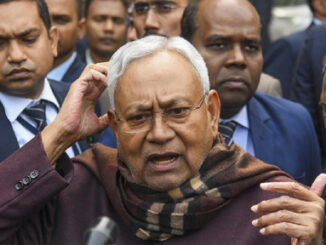
PATNA (TIP): Bihar chief minister Nitish Kumar has come under fire of the Opposition following his ‘erratic’ behaviour during the national anthem played at a sporting event in the state capital.
On Saturday, CPI-ML (Liberation), an ally of RJD led grand alliance, hit out at Nitish, saying that he should resign as he was unable to run the state. CPI-ML (Liberation) general secretary Dipankar Bhattacharya turned to X saying that the recent public utterances and conduct of the chief minister Nitish Kumar were sufficient to prove that he was no longer in a position to discharge his duties as the chief minister of the state.
The CPI-ML (Liberation) leader also criticised the BJP, a major ally of NDA both at the centre and in the state, for maintaining a silence over the health condition of the chief minister even though the saffron party had made it a big issue in Odisha.
“Even PM Narendra Modi had spoken about the health condition of then chief minister Naveen Patnaik. But PM Modi and Union Home Minister Amit Shah were keeping mum over the health condition of Bihar chief minister and JD(U) supremo Nitish Kumar. Everybody is aware of the health condition of Nitish except PM Modi and Home Minister Amit Shah,” Dipankar said, adding that the eccentric behaviour of Nitish during an official function in Patna on Thursday showed that he was not in a position to run the state.
Earlier in the day, RJD pasted posters outside the residence of former Bihar chief minister Rabri Devi criticising Nitish Kumar for disrespecting to the national anthem. The posters, featuring the words ‘Nayak nahi khalnayak hoon main’ (I am not a hero, I am a villain), aimed at expressing the party’s growing discontent with Nitish’s actions. RJD workers also burnt the effigies of the chief minister at district headquarters to vent their protest against the CM’s erratic behaviour and causing disrespect to the national anthem in full public view.
The controversy erupted after a purported video went viral on social media, showing Nitish speaking and greeting while the national anthem played at an official function in the state capital on Thursday. The video caused a backlash, with many calling out the chief minister for disrespecting the national anthem. A complaint petition was also filed in a Muzaffarpur court, seeking action against the chief minister for disrespecting the national anthem. The petition sought action under relevant sections of the Bharatiya Nayaya Sanhita and the Prevention of Insult to the National Honour Act. (TNIE)
Tag: Nitish Kumar
-
Opposition slams CM Nitish Kumar over ‘erratic’ behaviour during national anthem at Patna event
-
‘Won my heart’: RLD chief hints at poll alliance with BJP
Rashtriya Lok Dal chief Jayant Chaudhary on Friday, Feb 9, signalled positive outcomes for the ongoing Lok Sabha pre-poll alliance talks with the ruling BJP saying the government had won his heart by honouring his grandfather and late Prime Minister Chaudhary Charan Singh with the Bharat Ratna.
“Dil jeet liya,” Jayant, currently part of the anti-BJP INDIA bloc, said on X today after the news broke. Describing the feeling as one of absolute elation, Jayant said today was a big day. “It is an emotional moment for me, a memorable occasion. I thank President Droupadi Murmu, the Government of India and especially Prime Minister Narendra Modi for the decision to honour Chaudhary Charan Singh ji with the Bharat Ratna,” Jayant said.
Asked if he would ally with the BJP, Jayant said, “Koi kasar rehti hai? (is anything left to be said?”. He, however, added that he was yet to announce any alliance. Importantly, Bihar Chief Minister Nitish Kumar, chief architect of the INDIA bloc, also returned to the BJP-led NDA days after the announcement of the Bharat Ratna for late OBC icon from the state Karpoori Thakur.
Parallel to the BJP-RLD talks, YSRCP chief YS Jagan Mohan Reddy also met Prime Minister Narendra Modi in Parliament today just two days after TDP president N Chandrababu Naidu held parleys with BJP president JP Nadda and Union Home Minister Amit Shah. Source: TNS -

Fear of losing ground drives Nitish
Kickerline: Bihar Chief Minister has survived despite being an overvalued political asset
Nitish did not want to be number two in the Opposition ranks. In the NDA, his position is not in the front but he will continue to be the CM.
“Nitish has literally returned to his den and there he has to remain, even as the BJP gains strength in the state and thinks of ways and means to replace him. But he has a fighting chance in Bihar and can hope to repel his opponents for the time being. INDIA is on a weak wicket for other reasons and this does not have much to do with Nitish leaving it. Nitish is not a strong and tall leader who can make a difference, and he knows it. He also remembers the outcome of the 2014 Lok Sabha elections in the state — the JD(U) fought against the BJP and won just two seats, while the saffron party bagged 22.”

By Parsa Venkateshwar Rao Jr Bihar Chief Minister Nitish Kumar is the proverbial cat with nine lives. He has remained at the helm in state politics for more than 20 years despite his shaky foundations. His party, the Janata Dal (United), is not formidable either in the state or at the national level. But he has tried to stay ahead of his competitors not through numbers but thanks to the fact that the BJP has not been too sure of itself in the state and has been willing to let him have the reins of power. This time, he has dumped the ruling Mahagathbandhan, which includes the Rashtriya Janata Dal (RJD), the Congress and Left parties.
When Nitish senses that his plan to grow as a national leader does not seem to be working out, he wants to save his position as CM at whatever cost.
The BJP and the JD(U) had together won 33 of the 40 Lok Sabha seats in Bihar in 2019; the former wants to do an encore in the upcoming General Election. It is for this reason that Nitish has snuggled back into the NDA’s fold. But how well is he placed on his home turf? It is the fear of losing ground that has been driving him hither and thither, first into the arms of the RJD and then the BJP.
There is speculation that Nitish’s exit from INDIA would weaken Opposition unity so much that there would not be any contest in the parliamentary elections. It is presumed that Nitish was a sort of lynchpin for the bloc and his departure would leave it rudderless. Nitish has for long been an overvalued political asset. He has not stormed the national arena on his own, unlike George Fernandes, his old socialist comrade. Nitish, along with Lalu Yadav, Sharad Yadav and Ram Vilas Paswan, was a product of Jayaprakash Narayan’s protest movement of the early 1970s; they became recognizable faces of a new generation of leaders. But they remained where they were. They did not leverage their success to make an impact on the national stage. A similar thing happened with Jyotiraditya Scindia, Sachin Pilot and Milind Deora in the Congress; Scindia and Deora have since moved on.
However, Lalu Yadav managed to consolidate his party (RJD) in Bihar, while Nitish’s JD(U) started lagging behind. And it is with the help of BJP that Nitish managed to stabilize his position in the JD(U) and lead it to victory. The JD(U) base in Bihar is not as wide as that of the RJD. In the 2020 Assembly election, the JD(U) had won only 43 seats, well behind the BJP (74) and the RJD (75).
It is because of his long stay as chief minister that every once in a while, Nitish tries to break out of Bihar and look at the national scene. He thinks that his sobriety gives him an edge over Lalu Yadav’s image of a lovable maverick. But sobriety is not gravitas. Nitish has been overestimating his stature as a leader of national importance.
And when he senses that his plan to grow as a national leader does not seem to be working out, he wants to save his position as chief minister at whatever cost. In 2013, he wanted to challenge Narendra Modi but soon realized that he was no match for him because the BJP had a larger footprint across the country and there was the RSS network of volunteers working quietly as foot soldiers of the party. The JD(U) could not match the BJP at the organizational level across the country. So, he went back to the NDA camp. When INDIA was being formed, he again sensed an opportunity and thought that he would be given due regard as the CM of Bihar, an important Hindi-speaking state. He expected to be given precedence over West Bengal CM Mamata Banerjee. He wanted to head INDIA, but the honor was denied to him because there was little doubt that the Congress had to be the spearhead, a fact that was realized even by Mamata. When Mamata mischievously proposed that Congress president Mallikarjun Kharge should be declared the prime ministerial candidate of the alliance, a JD(U) leader asked: ‘Who is Kharge?’ It was implied that being a politician from a non-Hindi-speaking state, Kharge could not stake claim to become a national leader, whereas Nitish was fit to play that role.
Nitish did not want to be number two in the Opposition ranks. In the NDA, his position is not in the front but he will continue to be the CM.
Notably, Nitish does not have much of a following in neighboring Uttar Pradesh, the hub of the Hindi heartland, and he can hardly hope that JD(U) will make inroads there. Modi made a superb move when he contested from UP in 2019, knowing very well the electoral importance of the state which sends 80 MPs to the Lok Sabha. Nitish and his supporters do not seem to realize that in the Hindi belt, a politician from Bihar does not stand much of a chance outside his state.
Nitish has literally returned to his den and there he has to remain, even as the BJP gains strength in the state and thinks of ways and means to replace him. But he has a fighting chance in Bihar and can hope to repel his opponents for the time being. INDIA is on a weak wicket for other reasons and this does not have much to do with Nitish leaving it. Nitish is not a strong and tall leader who can make a difference, and he knows it. He also remembers the outcome of the 2014 Lok Sabha elections in the state — the JD(U) fought against the BJP and won just two seats, while the saffron party bagged 22.
( The author is a senior journalist) -
Incorrigible Nitish switches allies yet again
True to form, Bihar Chief Minister Nitish Kumar has dumped his Mahagathbandhan allies and returned to the NDA’s fold. The Janata Dal (United) chief has formed the government with the BJP, the very party he had snapped ties with just a year and a half ago. His latest U-turn has jolted not only the Mahagathbandhan — which includes the Rashtriya Janata Dal (RJD), the Congress and the Left Front — but also INDIA, the Opposition bloc that was formed last year to take on the BJP in the 2024 General Election. Nitish had projected himself as the face of the alliance, but suggestions about naming Congress president Mallikarjun Kharge as INDIA’s prime ministerial candidate left him fuming.
It’s nothing new for Nitish to switch allies, but he has been doing it with increasing regularity over the past decade. Having once said ‘Mitti mein mil jaayenge magar BJP ke saath nahin jaaenge,’ Nitish has opportunistically patched up with the saffron party yet again in a bid to survive and thrive. His decision shows that he is anticipating the BJP’s victory and INDIA’s debacle in the General Election. This is also a desperate attempt by him to revitalize his party, which had ended up way behind the RJD and the BJP in the 2020 Assembly election. Though the BJP will be calling the shots in the new government in Bihar, it won’t be easy for the party to justify taking Nitish back on board after having ruled out his return to the NDA.
Even as Nitish seems to have abandoned his prime ministerial ambitions, INDIA finds itself sinking deeper into the mire. Discord over seat-sharing in West Bengal and Punjab has exposed the alliance’s frailties. Nitish’s crossover indicates that more Opposition leaders might jump ship as the Lok Sabha elections draw nearer.
(Tribune, India) -

Nitish inches closer to alliance exit; BJP ready
New Delhi/Patna (TIP)- Bihar’s ruling coalition appeared at breaking point on Friday, January 26, with the Janata Dal (United), its ally Rashtriya Janata Dal, and the opposition Bharatiya Janata Party all corralling their lawmakers and calling meetings over the weekend as speculation about chief minister Nitish Kumar’s joining the National Democratic Alliance (NDA) reached fever pitch. If Kumar makes the switch, as rumoured, it will be the fourth such move in the past decade and the second this term.
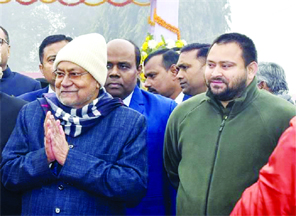
Signs of plummeting ties in the ruling alliance were apparent after deputy CM Tejashwi Yadav skipped the Republic Day celebrations at Raj Bhavan, where Kumar was present. The two didn’t exchange a word in the parade held in Patna soon after. “Ask those who were not present why they skipped the function,” said Kumar to reporters. At Raj Bhavan, the CM was seen chatting with the leader of the Opposition Vijay Kumar Sinha, and JD(U) minister Ashok Choudhary was sitting on the chair allotted for the deputy CM. The RJD has called a meeting of its legislators on Saturday, while the JD(U) scheduled its meeting on Sunday even as the BJP indicated it was open to joining hands with its friend-turned-foe-turned-friend-turned-foe.
“We are keeping an eye on all the developments and if needed an appropriate decision will be taken. No door is permanently closed in politics and the door can be opened if needed,” said BJP’s Rajya Sabha MP and former deputy CM Sushil Modi.
If Kumar goes with the BJP, he is likely to remain CM till at least the Lok Sabha polls later this year, people aware of developments said. But disagreement is rife over who’d become his deputy — Kumar favours Sushil Modi, with whom he worked for a decade in the past, but the BJP might want to go with another face. “They may prefer someone from an extremely backward caste, or dominant OBC group such as Yadav or Kushwaha,” said a person aware of the negotiations.
Hectic parleys were on in Delhi and Patna throughout the day as the BJP rushed key leaders to the state after a late-night meeting chaired by Union home minister Amit Shah. Sushil Modi flew to Patna on Friday and the state’s central in-charge Vinod Tawde is scheduled to hold a key meeting in Patna on Saturday. “The home minister’s direction to us is very clear,” said a BJP leader in Patna, on condition of anonymity. “We have to speak to everyone so that we are ready for all eventuality. We are waiting for Nitish Kumar to take the final call and resign. Everything will become clearer tomorrow.”
In Patna, the leading constituents of the six-party ruling coalition exchanged barbs.
“There is a lot of confusion which is not in the interest of the people of the state. Only the CM can put an end to the confusion,” said RJD MP Manoj Jha. JD(U) chief spokesperson Neeraj Kumar shot back. “Kumar plays politics from the front. He has no confusion.”
The timing of these moves is crucial. On Monday, Jan 29, Rahul Gandhi’s Bharat Jodo Nyay Yatra enters Bihar and the Congress had planned a show of strength with all members of the ruling alliance. Source: HT -

Takeaways from the Ayodhya spectacle
Prime Minister should follow in Lord Rama’s footsteps to ensure justice for all
“Ram Mandir has succeeded in restoring Hindus’ pride in their religion. That is a positive development. What’s left is for Modi to follow the principles of good governance associated with Lord Rama for dispensing justice to all. There were no Muslims and Christians in Bharat in those ancient times. But they are there now. Their only prayer to Modiji is that they be counted as equal citizens of Bharat, as Lord Rama, the epitome of justice and good governance, would have done.”

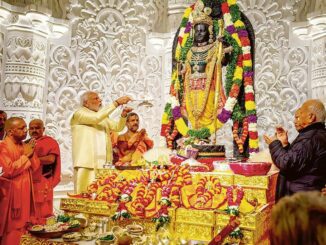
By Julio Ribeiro It was awe-inspiring to watch the consecration of the Ram Janmabhoomi temple in Ayodhya. PM Narendra Modi stole the show with his march to the spot where the idol of Ram Lalla was installed and his unforgettable address to the 7,000-odd guests.
I was moved to instruct my domestic help to light a diya, as our Prime Minister had requested. Even I, normally a critic of the government, was carried away by the moment!
The sheer magic of the occasion, the unmistakable devotion on the faces of the invitees and the pride in being a Hindu that was reflected on the countenance of the diaspora worldwide lent a new dimension to the dharma of our people and our ancestors. I was moved to instruct my domestic help to light a diya, as our Prime Minister had requested. Even I, normally a critic of the government, was carried away by the moment!
The temple will be completed in a year or so, but it has been consecrated ahead of the Lok Sabha elections. It is expected to play the role that the Balakot airstrikes did for the BJP in the 2019 Lok Sabha elections. PM Modi is expected to win a third term.
If the INDIA bloc does not get its act together soon, the ‘mother of democracy’ (our PM’s words) will metamorphose into an autocracy. Even after Rahul Gandhi hinted that Congress chief Mallikarjun Kharge would lead the coalition, Mamata Banerjee announced that the Trinamool Congress would fight the Lok Sabha polls in West Bengal on its own.
Nitish Kumar had expected himself to be anointed as ‘primus inter pares’ (first among equals). He is frustrated because he has to share the honor with Kharge. Arvind Kejriwal wants an all-India footprint for AAP. He demands seats in Gujarat, Haryana and Goa, where his party has a small presence.
Even Akhilesh Yadav, who has been eclipsed by CM Yogi Adityanath in Uttar Pradesh, thought that his Samajwadi Party was entitled to representation in Madhya Pradesh. All in all, the INDIA bloc is hopelessly placed against the BJP’s juggernaut. And with the Ram Temple being projected as Modi’s baby instead of Lal Krishna Advani’s, to whom it legitimately belongs, the battle can be written off as far as INDIA is concerned.
Yogi has captured the imagination of the residents of Uttar Pradesh (which has 80 Lok Sabha seats) with one major achievement — he has brought the state’s criminals to heel. In the beginning of his reign, he encouraged the use of unconventional, even illegal, methods to instill fear in the minds of the law-breakers. Wiser counsel later advised him to change tack. To all appearances, it seems that conventional methods (except the bulldozer) are currently at play.
A newspaper article by a young IPS officer, Vrinda Shukla, currently SP of Bahraich (UP), quotes figures from the National Crime Records Bureau to show that because of “scaled-up monitoring at all levels”, conviction was obtained by the UP police in 71 per cent of the cases of crimes against women in which the trial was completed. The corresponding figures for Rajasthan and Maharashtra are 37.2 per cent and 11.2 per cent, respectively. Public prosecutors, who had stopped taking ownership of the cases and become unaccountable, have begun feeling the heat generated by Yogi, says Vrinda.
Those who dream of forming a government in any state will need to adopt the UP CM’s attitude to corruption and the legal steps he has put in motion to control crime and criminals. More than ‘development’ that our Prime Minister harps on, citizens want security of life and property. He or she who can provide this will win.
In the meantime, Modi will milk the devout Hindu’s devotion to Lord Rama for electoral gains. A politician can hardly be blamed for exploiting public sentiment to influence voters. The only regret a sensitive BJP follower can possibly have is that the originator of the Rath Yatra, Advani, was left out in the cold. But these are games ambitious politicians play. They dump their rivals in their own party when the opportunity beckons. Politics, after all, is a cut-throat enterprise. Only one who is adept at the game comes out on top.
The media shows Modi feeding cows at his home and visiting temples in Kerala and Andhra Pradesh, both southern states where he is keen to open his party’s account. Public memory is notoriously short. The voter may forget our PM’s piety and opt for the communists or the Congress in Kerala and for CM Jagan Mohan Reddy or his sister YS Sharmila, who has taken on the responsibility of resuscitating the Congress in Andhra Pradesh.
A group of 200-odd retired diplomats, civil servants and police officers, called the Constitutional Conduct Group (of which I am a part), had drafted an open letter to the PM, lamenting that he involved his high constitutional office and government agencies in the run-up to the idol’s installation in the Ayodhya temple. A secular country, constitutionally mandated to strictly separate religion from the State, had been subjected to the spectacle of its PM performing puja in South Indian temples and finally in Ram Mandir.
There is no objection to the PM visiting and praying to his god as an individual. But to do so as the country’s pre-eminent elected leader and committing government resources to such an event is neither constitutionally acceptable nor ethical or moral. The Election Commission should decide whether this is permissible under the election laws on the use of religion for garnering votes.
The founders of Pakistan used religion to secure for the Muslims a separate country. The military regime of Gen Zia-ul-Haq Islamized it to the hilt. The results of such religiosity are for all of us to see. Pakistan today needs the US and China to keep itself functioning. There are not many nations today that incorporate religion into governance. Those that follow this path have not prospered.
Ram Mandir has succeeded in restoring Hindus’ pride in their religion. That is a positive development. What’s left is for Modi to follow the principles of good governance associated with Lord Rama for dispensing justice to all. There were no Muslims and Christians in Bharat in those ancient times. But they are there now. Their only prayer to Modiji is that they be counted as equal citizens of Bharat, as Lord Rama, the epitome of justice and good governance, would have done.
(The author is a former governor and a highly decorated retired Indian Police Service (IPS) officer )
-
Patna HC stays Bihar caste survey, setback for Nitish
In a setback for the Opposition’s demand for a nationwide caste census and a similar exercise in states, the Patna High Court on Thursday, May 4, stayed the ongoing caste-based enumeration in Bihar, besides restricting the state government from sharing the already collected data till final orders are passed.
In an interim order on petitions challenging the Nitish Kumar-led Mahagathbandhan’s move at caste-based survey in the state, Chief Justice K Vinod Chandran and Justice Madhuresh Prasad directed the state to halt the ongoing exercise with immediate effect. The matter has now been posted for July 3. “We are of the considered opinion that the petitioners have made out a prima facie case against the continuation of the process of caste-based survey, as attempted by the state of Bihar. There is also the question raised of data integrity and security, which has to be more elaborately addressed by the state,” the court said after advocate general PK Shahi argued for the state. The move comes at a time when several Opposition parties, including the Congress, JDU, RJD, SP, DMK, BRS and the BJD, have raised the pitch for caste census amid the ruling BJP’s Hindu pitch. Three days ago, Odisha also began an OBC survey on the lines of Bihar. -

Yatra lends purpose to Rahul’s political journey
In Indian electoral politics, alliances are formed on the basis of strengths rather than weaknesses of the participants. The aura of success surrounding Rahul’s Bharat Jodo Yatra is set to provide him with moral authority to play a pivotal role. In addition, in Sonia Gandhi, Rahul has a reserve bench of sorts; the former party chief can act as a line of communication with many non-NDA allies, including the Left, to keep the mahagathbandhan going.
This year, the Congress faces a litmus test in Karnataka, Madhya Pradesh, Rajasthan and Chhattisgarh. If it can win these states, the grand old party would emerge as a serious challenger for the 2024 General Election.

By Rashid Kidwai There are many quotes that have been attributed to Mahatma Gandhi. In the Congress party office at 24, Akbar Road, one of them reads, “Kabhi kabhi hum apne virodhiyon ke karan aage badhte hain.” (At times, we move ahead due to our opponents). Then there is another one saying, “Pehle woh aap par dhyan nahin denge, phir who aap par hasenge, phir aapse ladengen, aur tab aap jeet jayenge.”(First they would not pay any attention to you, then they would mock you and then they would fight with you. You would win once these stages are completed).
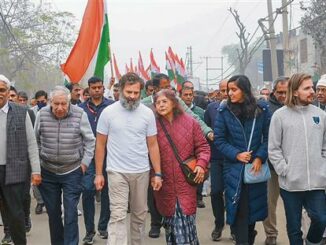
In the context of Rahul Gandhi’s ongoing abstract, yet arduous, Bharat Jodo Yatra, these quotes ring a bell, bringing some relevance and hope for the Congress leader.
There is a broader and growing consensus of sorts among Rahul’s detractors and well-wishers that finally, the Gandhi scion is showing signs of purpose, perseverance and hope in his political journey that began in 2004.
Politically, the yatra may or may not be a game-changer, but it has succeeded in establishing Rahul as a credible politician who can walk the talk, intermingle with the masses and get support from a range of politicians and celebrities — from MK Stalin, Aaditya Thackeray, Supriya Sule and Farooq Abdullah to Raghuram Rajan, AS Dulat, Swara Bhaskar and Kamal Haasan.
More importantly, the BJP’s stringent criticism, Union Health Minister Mansukh Mandaviya’s ‘appeal’ to suspend the yatra over Covid concerns, and the outrage over Rahul’s comments on China allegedly entering Indian territory have helped him become a singular dissenting voice.
When the yatra began from Kanyakumari, Rahul’s popularity ratings were at an all-time low. The Congress organization was in a shambles and the leadership issue was far from settled. While the yatra was on the Kerala-Karnataka border, Rajasthan Chief Minister Ashok Gehlot, at that time tipped to be the next AICC president, stunned friends and foes alike by showing defiance, a throwback to the bygone era of Devaraj Urs, Arjun Singh and other party chief ministers.
But throughout the Congress organizational election process, Rahul stayed away and focused on the yatra. The Assembly polls of Himachal Pradesh and Gujarat offered a mixed bag as the Congress went on to win HP. It was a surprise for those predicting the Congress’ death. The ‘corpse’ is, in fact, very much alive and kicking.
This year, the Congress faces a litmus test in Karnataka, Madhya Pradesh, Rajasthan and Chhattisgarh. If it can win these states, the grand old party would emerge as a serious challenger for the 2024 General Election.
We need to remember that the fortunes of the Congress and other non-BJP parties are closely linked to the 2024 Lok Sabha polls where the non-BJP, non-NDA Opposition and the Congress-UPA partners will have to target the ‘half of half’, i.e. half of the 272 Lok Sabha seats on their own — a challenging but not unmanageable number in the 2024 battle.
There are four crucial states of West Bengal, Bihar, Maharashtra and Karnataka where the BJP-NDA had done exceedingly well in 2019 but the subsequent political developments have unfolded a new scenario. In West Bengal, for example, the BJP had won 18 Lok Sabha seats out of 42, while in Bihar, the alliance with the JD(U) had resulted in its netting 39 out of 40 parliamentary seats. In Karnataka, the BJP had won 25 out of 28 seats, while in Maharashtra, the alliance with the undivided Shiv Sena had resulted in the NDA allies winning 42 out of 48 seats. Imagine a situation if the BJP’s strength from these four states gets reduced to half. A simple majority of 272 would become a distant dream and prospects of a khichdi government a reality.
The Congress, in order to be a contender, has to win 100 or more Lok Sabha seats from states such as Kerala, Chhattisgarh, Maharashtra, Rajasthan, Madhya Pradesh, Assam, Karnataka, Uttarakhand, Himachal Pradesh and a few others where the grand old party has been in direct contest with the BJP or traditionally has a strong presence.
Next year’s parliamentary polls are set to be contested in contrasting styles. If Team Modi is set to make full use of the Prime Minister’s personal ratings, big-ticket projects, Covid-19 handling in the context of the massive vaccination programme, achievements on the diplomatic front and reliance on emotive issues like the Ram Temple, the Congress and its potential allies are prepared to take the battle to the states where regional players are expected to hold sway.
So, if the parties led by Mamata Banerjee, Nitish Kumar, Uddhav Thackeray, Sharad Pawar, MK Stalin, Naveen Patnaik, HD Kumaraswamy, Chandrababu Naidu and Akhilesh Yadav together manage to hold on to a chunk of the parliamentary seats, the Congress has the task of doing well in most of the Hindi-belt states and the Northeast.
In Indian electoral politics, alliances are formed on the basis of strengths rather than weaknesses of the participants. The aura of success surrounding Rahul’s Bharat Jodo Yatra is set to provide him with moral authority to play a pivotal role. In addition, in Sonia Gandhi, Rahul has a reserve bench of sorts; the former party chief can act as a line of communication with many non-NDA allies, including the Left, to keep the mahagathbandhan going.
(Rashid Kidwai is a Senior Journalist and Author)
-

Bihar: Congress to get three berths in Nitish Kumar govt
The Congress will get three ministerial berths in the new Nitish Kumar government in Bihar, a senior party leader said on Sunday, August 15. State Congress in-charge Bhakta Charan Das said two party MLAs would take oath as ministers on August 16, and one more legislator would be inducted when the next Cabinet expansion happened after that. “The number of ministerial berths the Congress will get in the Mahagathbandhan government in Bihar has been finalised. The Congress will get a total of three ministerial berths,” he said. Two Congress legislators will take oath on August 16, when the Chief Minister is expected to expand his Cabinet. One more party legislator will be inducted in the Nitish Kumar Cabinet when the next expansion takes place after August 16,” he added.
Das said the Congress MLAs, who will become the ministers, are yet to be decided.
“We will finalise the names of our legislators who will be part of the Nitsih Kumar Cabinet on Monday,” he said.
Earlier, Congress sources had indicated that the party was looking for four ministerial berths in the new government.
The Cabinet, which at present comprises only the Chief Minister and his deputy Tejashwi Yadav, is due for expansion on August 16. Kumar had taken oath on Wednesday, a day after the JD(U) snapped ties with the BJP-led National Democratic Alliance (NDA) and joined hands with the RJD, the Congress and some other parties to form the Mahagathbandhan government.
-

Opposition cedes space as Congress in decline

By Saba Naqvi “The Opposition space is so badly fragmented that it seems incapable of reaching the critical mass necessary to take on the BJP. At the heart of the problem is the thinly-spread-out Congress that has a notional presence across the country but lacks depth and gets quickly uprooted. Hence, it keeps losing bases to regional forces, such as the recent loss of Punjab to AAP. Attempts to stay afloat in the face of regional powerhouses have also produced dismal results as in Bengal and UP……………
Rational thought demands that the Congress and regional forces unite. It necessitates that the Congress pull itself up by its bootstraps and tie up with strong regional parties — ruling or in the Opposition in the states. But the irrational is happening. Last week, Rahul Gandhi travelled to Telangana, where he launched a scathing attack on Chief Minister K. Chandrashekar Rao. KCR, he tweeted, had single-handedly destroyed the dream of the people of Telangana when statehood was granted. He also said that Telangana was not ruled by the CM but by a ‘Raja’.”
It has been a year since two significant states, West Bengal and Tamil Nadu, were won by two big regional parties, the TMC and DMK, even as the Left Front retained Kerala, giving rise to speculation that some kind of national Opposition could be mustered against the BJP in 2024. But a year down the line, after the BJP’s recent win in state polls in Uttar Pradesh, Uttarakhand, Goa and Manipur, and the continued disarray in the Congress, the vision of a grand Opposition coalition against the BJP has evaporated. Indeed, one may well say that in 2022, two years before the next General Election, the world’s largest democracy is a country without a national Opposition.
This is cause for great concern in Opposition-ruled states: they are owed huge amounts in GST arrears and complain of being deliberately overlooked by the Centre. With inflation skyrocketing, they are coping with increased costs for infrastructure and development schemes even as avenues for raising revenue have shrunk since the roll-out of the GST. While they struggle for funds, both at the party and government levels, the BJP/RSS project of expanding to each part of the country, continues
with purpose and is well funded. For instance, the BJP is opening offices in the districts of Tamil Nadu, a state where they have no real presence, yet are investing in the long game. Opposition states are living through a particularly difficult era as all the niceties of cooperative federalism have been abandoned by the current Central dispensation. The onslaught is pretty ruthless and states not ruled by the national party, complain of being treated as hostile entities with enforcement wings of the Centre routinely used against them. For instance, in Maharashtra, two ministers of the ruling coalition are in jail, while a dozen are being investigated by Central agencies.
As prices soar in India and jobs are not created, in normal times the Opposition should have been emerging with strength and purpose. Instead, political narratives appear to be getting delinked from economic issues. Equally, the Opposition space is so badly fragmented that it seems incapable of reaching the critical mass necessary to take on the BJP. At the heart of the problem is the thinly-spread-out Congress that has a notional national presence across the country but lacks depth and gets quickly uprooted. Hence, it keeps losing bases to regional forces, such as the recent loss of Punjab to AAP. Attempts to stay afloat in the face of regional powerhouses have also produced dismal results, such as getting zero seats in Bengal and one in Uttar Pradesh. And when it comes to Congress vs BJP, even if the Congress wins, the BJP has a high strike rate in toppling the regimes through defections.
Rational thought demands that the Congress and regional forces unite. It necessitates that the Congress pull itself up by its bootstraps and tie up with strong regional parties – ruling or in the Opposition in the states. But the irrational is happening. Last week, Rahul Gandhi travelled to Telangana, where he launched a scathing attack on Chief Minister K. Chandrashekar Rao. KCR, he tweeted, had single-handedly destroyed the dream of the people of Telangana when statehood was granted. He also said that Telangana was not ruled by the CM but by a ‘Raja’.
It may be recalled that it was the Sonia Gandhi-led Congress that took political decisions that effectively destroyed the party’s own bases in erstwhile Andhra Pradesh (the largest chunk of Congress MPs during the decade of UPA rule came from undivided Andhra Pradesh). Central to this success was chief minister YSR Reddy, a pioneer in designing popular welfare schemes (and having links with big business donors). But YSR’s death in a plane crash in 2009, led to chaos that in turn resulted in the Congress national leadership taking decisions that in hindsight only finished them off in both Telangana, carved out of the state in 2014, and in Andhra Pradesh where YSR’s son Jagan Mohan Reddy, denied power by the Congress, is now in power with his party named YSR Congress.
It’s entirely possible that Rahul Gandhi feels compelled to speak up for what remains of his party in those parts; just as he would have been asked to do so by the Congress in Bengal. But surely it is time for the Congress leadership to get a reality check and recognize that ‘the party is over’ in many parts of India and the only way forward is to make arrangements with regional forces even if that involves giving up on what remains in the debris (the best template actually exists in Tamil Nadu where the Congress is the junior partner in the DMK-led alliance).
Presumably, political consultant Prashant Kishor had offered the blueprint of a national plan when he was negotiating to join the Congress last month. It may not have worked but the data with which the consultancy I-PAC, founded by Kishor, works would have been valuable as could have been the professionalism in calibrating other aspects of elections. Ironically, TRS is now reportedly a client of I-PAC just as Jagan Reddy was during the campaign that won him the state. But Kishor, meanwhile, after his talks with the Congress failed, has taken off for his home state Bihar where he has announced a padayatra and the beginning of a process that can culminate in the foundation of another political party/front.
Indeed, the great irony is that while there is not much of a national Opposition, the space is also getting very crowded. AAP is set to contest the Assembly elections in Gujarat and Himachal Pradesh later this year. The TMC has plans in the North-east, even as a foray into Goa was a disaster that did nothing to improve relations with the Congress. Kishor, consultant to various parties, has also begun a political process in Bihar where Chief Minister Nitish Kumar is again making enigmatic moves.
The Congress, meanwhile, has not revealed any plan. Rahul Gandhi is reportedly deeply interested in philosophies of the world and perhaps believes in the live-life-one-day-at-a-time and what-will-be-will-be approach. Currently, the hopes seem to exist on a wing and a prayer, a phrase that comes from a fighter pilot trying to land his aircraft in World War II after a wing was destroyed. The Congress will have a brainstorming meeting in Udaipur between May 13 and 15. Let’s hope the party leaders won’t spend all the time trying to chase their own tails. The expectations are very low, so perhaps they can pull a surprise.
(The author is a senior journalist)
-
Pegasus controversy
Bihar CM Nitish Kumar breaks ranks to demand probe
With the Supreme Court set to hear the pleas seeking a court-monitored probe into the Pegasus snooping row on Thursday, a new dimension has been added to the controversy. Bihar Chief Minister Nitish Kumar, an ally of the BJP-led NDA government at the Centre, has lent his weight to the demand for a probe. The Bihar CM asked the Opposition to put pressure by placing the relevant facts and figures before the government if it was not prepared for an inquiry. Nitish’s demand came on the eve of a meeting of leaders from several Opposition parties convened by Congress leader Rahul Gandhi to present a united front on the Pegasus issue even as the controversy continued to rock both Houses of Parliament, prompting PM Modi to slam the Opposition for its conduct.
Ever since the revelation about the phone-tapping incident was made, there have been demands for an inquiry. The demand was earlier raised by TMC chief and West Bengal Chief Minister Mamata Banerjee who called for an all-party meeting on the issue. West Bengal even constituted a commission to probe the controversy. The Centre, on its part, has continued to deny that it has got anything to do with the snooping row, calling it instead an attack on Indian democracy. With the country figuring on the list of global democracy watchdogs that are concerned over the growing trend towards ‘authoritarianism’ and the plight of minorities, the government may well be on the defensive, but the attempts at stone-walling the Opposition have not helped matters either. In fact, the meetings of the parliamentary panel on information technology have seen BJP members boycott the proceedings and spar with the chairman who is from the Congress.
Allegations of surveillance remain a matter of concern as it is as much about security as about privacy. With France and Israel initiating an inquiry into the Pegasus row, India should also look into ways to prevent such incidents. Democracy is about reconciling governmental concerns with individual rights. Misuse of technology can prove to be detrimental in furthering its cause.
(The Tribune)
-

FARMERS MOVEMENT A STRUGGLE TO SAVE INDIA
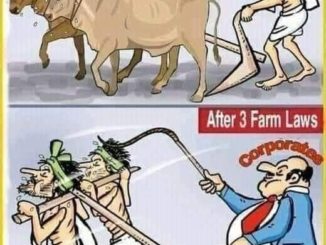
The Farm Bills are designed to benefit the rich corporations. Farming in India is a Rs 4 Lac Crore Industry that employs 42% of the population. If Modi’s draconian & ill-conceived farm laws are not repealed there will be mass poverty, hunger & unemployment in India.Except Modi and his supporters, no sane person around the world has ignored that the millions of Farmers are protesting practically all over India since Nov. 2020 against Modi’s anti-farmer laws to favor the rich. This protest is joined by millions of farmers across caste, creed, religion and region to fight for their rights and their livelihood. Rather, it has become a mass movement to restore democratic republic character of the nation that is being eroded under Modi’s watch.
Indian farmers have been exploited for centuries and, even after independence in 1947, the successive regimes never provided them support and facilities that are available to farmers in other democracies of the world. It is a shame that even after 73 years of independence there is hardly any investment made on irrigation and flood control facilities to save farming lands and the farmers. Instead of improvingtheir lot, in 2015, Modi made it easier for politicians and corporate to take over Farmer’s land at throw away prices in his Farmland Acquisition Act. Now he has come up with another scam by calling it ‘Reforms in Agriculture”.
Modi has pushed through what he calls, long pending reforms in agriculture, in the form of three Farm Acts without any due consideration of the ground realities and comments from the stakeholders – the “Indian Farmers”.
(1) The Farmers’ Produce Trade And Commerce (Promotion And Facilitation) Act, 2020
(2) The Farmers (Empowerment And Protection) Agreement On Price Assurance And Farm Services Act, 2020
(3) The Essential Commodities (Amendment) Act, 2020
Farmers are not against private Agriculture Produce Marketing Committee (APMC) aka Mandis. They are mainly fighting for Minimum Support Price (MSP) for their crops and Modi administration does not want to make it mandatory for the private buyer to pay the MSP.
The farmers want that it should be made a criminal offense for the buyer if they pay less than the MSP. The other thing they want is access to Courts in case of dispute in “Contract Farming”. In Modi laws the final decision is with the bureaucrats that can be influenced easily by big Corporates especially when they are running the government by proxy by influencing the Ruling Class of India.
Modi is forgetting that the backbone of economic activities in India is closely linked to development of agriculture and allied sectors for its significant links with food and nutritional security. How can he forget that there are more than 42% Indians directly involved in agriculture?
How can Modi ignore the plight of farmersin Bihar- a State which abolished APMC and madeMSP a talking tool only in 2006 by CM Nitish Kumar supported by his party-theBJP?
Modi has access to a 2019 report authored by a team led by Professor Sanjib Pohit of the National Council of Applied Economics Research (NCAER), which studied in detail, the impact of Bihar’s farm policies on ground. It clearly states that not only did prices of farm produce crash, but unregulated middlemen and traders forced farmers to pay for their crops to be offloaded and sold.
Economist Abdul Qadir said, “Before the scrapping of the APMC Act, farmers would sell their produce to the market committees where minimum price was guaranteed. But after the repeal of this system, they indulged in distress sale lest their produce would go to waste because they had no storage facility.” He further added that farming has turned out to be a non-viable profession in Bihar over time. “Farmers from Bihar have now been working as laborers in Punjab and Haryana.”
Another Economist DM Diwakar,the former director of Patna-based AN Sinha Institute of Social Studiessaid: “The Modi government says the new farm bills won’t adversely impact the farming community. Given the logic, the financial condition of 94 per cent of farmers in Bihar — who didn’t go to mandis or were not covered under minimum support price (MSP) — should have improved in the past 14 years. But their condition has deteriorated.”Paddy was sold for Rs 900-1,000 a quintal in Bihar, almost half the Rs 1,868 fixed by the Centre as MSP. He further alleged, “nearly half the farmers can’t even recover their investments.”
“In 1968-69, wheat was sold at Rs 76 a quintal while the salary of a schoolteacher was Rs 70-80. That meant a teacher would not be able to buy a quintal of wheat from his one-month salary. In the past five decades, a teacher’s salary has climbed to average Rs 70,000, but wheat price is only around Rs 2,000 a quintal.”
Since 2014 PM Modi has been going to every country in the world and telling investors: ‘Come to India, we will give you cheap land and labor’. PM Modi is telling the truth to them after robbing the farmers of their land, the farmers and their family members have no choice but to become cheap laborers for his financial supporters aka MNC’s and local industrial houses.
Modi’s farm laws will make majority of the Indian farmers bonded labor of rich corporations. The Indian farmer is refusing to be marginalized any more. Their protest has become a historic & largest ever protest in the world that is being supported by non-farmers in India as well as across the world. It has gained wide international support from Farmer Unions, Labor Unions, Human Rights organizations, Celebrities & Politicians.
According to Modi & his supporters; there is nothing wrong if only 4-5 Companies, or just Ambani& Adani control the India’s Food Supply Chain.India with 80% poor & 42% population engaged in agriculture, cannot be compared with USA. There are more than 150 million farmers in India that directly own land and use it for farming. The fact is every country supports its farmers. In2019, USA gave $22 billion in subsidies to 1.3% population (2.6 million) employed in agriculture & India gave a paltry $11 billion to42% population (590million), employed in agriculture. On top of that majority of the subsidy went to Corporations for seeds & fertilizers.
Modi & his supporters must stop preaching what is good for USA; when Farming laws are concerned; it is good for India also. If Modi wants to do that then first, he should come up with similar farming subsidies like USA along with Social Safety Net for farmers like Social Security, Medicare, Financial Aid for students, Unemployment, Food Stamps, Rent and Utilities Assistance for the poor families. Modi & his supporters should know that 40 years ago when Farming was opened for Corporates the Social Safety Net was already in place and marginal farmers could find a job in manufacturing. Where are the jobs in India?
Manufacturing generated 17.4 percent of India’s GDP and employed 26.2% of the population whereas Service sector employs 32.3% with a share of 31% in GDP. Agriculture is the Indian economy’s backbone with 19.9% share in GDP and the largest employer. In 2019 India’s Global Share in manufacturing was 3% vs China’s 28.4% being the biggest manufacturing hub in the world. Has Modi done anything to improve Agriculture or Manufacturing or Service Sector? The answer is big “No”. In the last 7 years Modi has done nothing but killed the Indian economy, jobs and the worst is he has been killing the communal harmony of India for a “Hindu Rashtra” that is nothing but a bonehead idea to disintegrate India.
A new Pew Research Center analysis in Feb. 2021 finds that the middle class in India is estimated to have shrunk by 32 million in 2020. Meanwhile, the number of people who are poor in India (with incomes of $2 or less a day) is estimated to have increased by 75 million. Now India has 850 million poor, the largest in the world. 3,700 PhD’s, 28,000 Postgraduates& 50,000 Graduates applied for 62 Peons post in UP, India in Feb. 2021. This is the extent of job crisis in India today that was never seen before since 1950’s.
The demonetization & GST with multiple slabs was done to benefit rich Corporates so that they can control the retail & wholesale food industry. In the same way, theFarm Bills are designed to benefit them. Farming is a Rs 4 Lac Crore Industry that employs 42% of the population. If Modi’s draconian & ill-conceived farm laws are not repealed there will be mass poverty, hunger & unemployment in India.
The American experience of Big Agriculture should be a lesson for India. Did monopoly power reduce food prices in USA? In the past 40 years, average food prices in America have shot up by more than 200%, while the earnings of the bottom 90% have increased by less than 25%. Joe Maxwell, who leads a campaign group called Family Farm Action, said about entrenched rural poverty, child hunger, and food-insecure homes. Not what you’d expect to hear about the most powerful nation. Today, rural America feels abandoned, its dignity stripped away. As we drove home, one thing had become clear to us: far from being a panacea, the opening up of US agriculture, the elimination of MSP-like parity schemes, and the rise of contract farming has been a lose-lose proposition for everybody other than Big Agriculture.
“This is an eye opener for the majority of India’s middle class who are being fed the narrative that “Big Agriculture” is the panacea for Indian farmers’ difficult situation, and especially for small farmers. BJP’s late Arun Jaitley had argued against Congress initiative bringing in corporate investment to farming by quoting American farmers’ plight! Why are we still so adamant to bring in these new farm lawsthat will only bring mass poverty, hunger & unemployment in India?
Modi must answer.
(Compiled & edited by Dave Makkar, from various sources on the internet. The author can be reached at davemakkar@yahoo.com)
-

PRESIDENTIAL POLL ON MIND, BIHAR CM CALLS ON SONIA
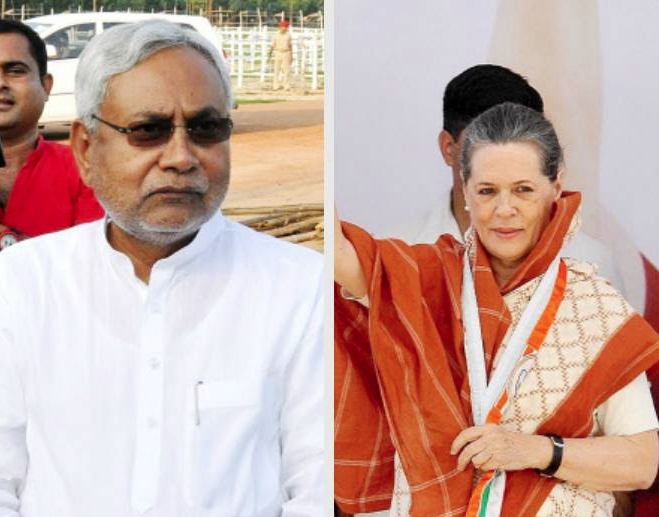
NEW DELHI (TIP): Bihar Chief Minister and Janata Dal (United) president Nitish Kumar met Congress president Sonia Gandhi, setting off speculation on the possibility of a united Opposition fielding a joint candidate for the upcoming Presidential election.
Nitish spent about half an hour with Sonia. It was after a long time that the AICC president met a senior leader after she took ill in August last year. The CPM has already indicated its willingness to back a common nominee against a BJP candidate. Indications are that the Opposition parties may agree on fielding former JD (U) chief Sharad Yadav, a Rajya Sabha MP.
Within the Congress there is an understanding that non-NDA outfits must come together to throw a challenge to the BJP. If the Trinamool Congress (TMC) and Left parties are to come together, the nominee has to be acceptable to both, and Yadav fits the bill, claim sources. “It’s still early. Let us see what happens,” said a Congress source, sounding cautious.