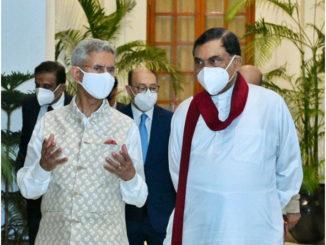
Colombo/New Delhi (TIP): The State Bank of India on March 17 signed an agreement for extending a credit line of $1 billion to Sri Lanka enabling it to buy food, medicine and other essential items. The agreement was signed after Union Ministers S Jaishankar and NirmalaSitharaman held discussions on economic cooperation and “issues of mutual interest’’ with Sri Lanka Finance Minister Basil Rajapaksa, said an official news release. Basil Rajapaksa visited India for financial assistance which will temporarily enable the cash-strapped Sri Lanka to stave off an unprecedented economic crisis.
On the eve of his visit, Colombo sent a positive signal by signing a joint venture with India three days back for a 100 mw solar power plant at Sampur in Trincomalee to compensate for the scrapping of an Indo-Japan coal power project on environmental grounds. On the security side, Colombo last week hosted another conference of NSAs of regional countries for a collective approach to maritime security.
In January, India had bailed out Sri Lanka from its balance of payments difficulties by extending a $400 million swap facility and deferring the settlement of $515.2 million. Thus, the help extended by India is worth over $900 million and about $1.5 billion more is in the pipeline.
Basil Rajapaksa had met PM NarendraModi for the assistance provided to Sri Lanka at this critical time. The two leaders discussed a wide range of issues pertaining to the bilateral relationship. These included agriculture, renewable energy, digitalisation, tourism and fisheries among others, said a release from the Sri Lanka High Commission.
Basil Rajapaksa also held talks with Jaishankar the same evening, which were followed by a working dinner. Rajapaksa was accompanied to the meeting by Sri Lanka’s High Commissioner to India MilindaMoragoda, Secretary to the Ministry of Finance S.R. Attygalle and Sri Lanka’s Deputy High Commissioner to India NilukaKadurugamuwa. (TNS)
NEW DELHI (TIP): The “Indian intelligence service” purchased Pegasus from Israeli company NSO in a deal pegged at “dozens of millions of dollars”, a The New York Times (NYT) reporter involved in the newspaper’s investigation into the use of the surveillance system worldwide has said. The New York Times said the purchase was finalized during the visit of Prime Minister Narendra Modi to Israel and cleared by the then Israeli Prime Minister, Benjamin Netanyahu, in 2017.
Describing the NSO procedure for Pegasus, which is a high-grade cyberweapon on Israel’s export control list, The New York Time’s Tel Aviv-based correspondent Ronen Bergman said the Israeli Ministry of Defense had cleared the contract, and that NSO engineers would have had to travel to India to install the system themselves and Israeli intelligence agency Mossad liaised with them. However, neither the NYT nor Mr. Bergman specified whether they meant the Intelligence Bureau (IB) or the Research and Analysis wing ((R&AW), or any other agency reporting to the National Security Council Secretariat (NSCS) under National Security Adviser (NSA) Ajit Doval.
Mr. Bergman also said that the entity that signed the Pegasus purchase agreement would have had to give three guarantees to the Israeli Ministry of Defense: that it would use it only by itself, that it would get prior written permission to share it with any other entity, and that it would use it Pegasus surveillance against terrorism and organized crime.
“While the ongoing technical maintenance is done by NSO vis-a-vis, in this case, Indian intelligence service, which was the entity that purchased Pegasus – the overall connection is also with the involvement of the agency in Israel that is in charge of running secret intelligence and political relationships, which is the Mossad,” Mr. Bergman said in an interview to Indian news portal The Wire, which had taken part in the global investigation by several agencies that found thousands of phones belonging to civilians, including politicians, judges, journalists, activists with no criminal record had been hacked using the Pegasus software. Journalists belonging to The Wire, The Hindu and other Indian agencies were also on the list. The Ministry of External Affairs and the Ministry of Home Affairs declined to comment on the New York Times story and the latest interview.
Last July, in Parliament, IT and Communications Minister Ashwini Vaishnav, whose phone was also on the list of Pegasus- hacked devices, said the news reports were “sensational” and “had no factual basis and were categorically denied by all parties including in the Supreme Court,” referring to an ongoing case in the apex court, which subsequently ordered its own enquiry committee to investigate the allegations against the government. Separately, the Ministry of Defense had said it had “not had any transactions” with the NSO group.
Significantly, the NSCS had for the first time seen a 10-fold increase in budgetary allocation in 2017-18, when its allocation shot up to ₹333 crore and it was further increased to ₹841.73 crore in 2018-19 but was revised to ₹140.92 crore in 2019-20, and officials did not respond to The Hindu report requesting explanations for the sudden surge in outlay. The functioning of the NSCS, IB and the R&AW are exempted from the provisions of the Right to Information Act (RTI) and also from Parliament scrutiny. The organizations cannot be financially audited by the Comptroller and Auditor General (CAG) also.
In the interview, Mr. Bergman offered no evidence of the NYT’s claims, but detailed the workings of NSO and procedure involved by each of the countries, including India, Mexico, Hungary, Morocco, KSA etc., who had purchased the Pegasus program. He said he couldn’t divulge his sources, but The New York Times had conducted an extensive multi-country investigation based on documents that he was privy to. “Some of the details that are specified, this comes from a very sensitive, a long-time dealing with sources, and, therefore, I’ll be a little bit cagey in some of the details… we have been working for a year in 12 different countries, speaking with intelligence officials, with leaders of law enforcement agencies, politicians, leaders, cyber experts, human rights activists, etc. and I think we got as close as possible to the full picture – if not the whole picture,” Mr. Bergman stated.
As the programme is on a controlled export list, NSO officials have said all their contracts are cleared by the Israeli government. The NYT story had linked the Pegasus purchase in each of the countries to relations between their leaders and Mr. Netanyahu and claimed that those governments had changed their foreign policy, and votes at the United Nations as a result of the relationship.
“[In] India, [there is] the relationship, a close personal relationship between the leaders of India and Israel that gave birth to, I would say, a new generation of military expenditure as well as a new Indian stand, including international public steps towards Israel,” Mr. Bergman said, adding that according to his sources, there was “a specific interest and specific emphasis from the Indian leadership to the Israeli leadership to obtain that specific license” for Pegasus.
WASHINGTON (TIP): An Indian American Democratic lawmaker on Monday, April 26, welcomed the US government’s decision to provide material and healthcare help to India in its fight against a spike in COVID-19 cases, but said this is “no time for symbolism” or “lip service” and the Joe Biden administration must act now.
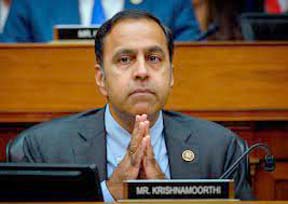
India is struggling with a second wave of the pandemic with more than 3,00,000 daily new coronavirus cases being reported in the past few days, and hospitals in several states are reeling under a shortage of medical oxygen and beds. “The Biden administration’s commitment that it will export raw materials for the Indian manufacturer of the Covishield vaccine is a welcome decision,” Indian American Congressman Raja Krishnamoorthi said.
“However, this is no time for symbolism, half-measures or lip service. We must act now,” he asserted.
The Biden administration had come under criticism from several quarters, including from members and supporters of the Democratic Party, for not releasing surplus COVID-19 vaccines to India when the country was experiencing its worst-ever public health crisis. India had urged the US to supply the raw materials for manufacturing the Covishield vaccine. Following the criticism, US National Security Advisor (NSA) Jake Sullivan in a telephonic call with his Indian counterpart Ajit Doval on Sunday affirmed America’s solidarity with India.
After the phone call, Emily Horne, spokesperson of the US NSA, underlined that America is “working around the clock” to deploy available resources and supplies and has “identified sources of specific raw material urgently required for Indian manufacturer of the Covishield vaccine that will immediately be made available for India”.
Mr Krishnamoorthi, who is also the chair of the Oversight Subcommittee on Economic and Consumer Policy, said it is imperative that the US government double down on its commitment by exporting these materials expeditiously, by opening its stockpile of AstraZeneca vaccines currently sitting unused on shelves.
He said the US government should also follow the actions of other countries this weekend by shipping medical supplies, including oxygen concentrators, to help treat COVID-19 victims in India and other nations hardest-hit by the deadly virus. India logged a record of 3,52,991 new coronavirus infections in a day on Monday, taking its total tally of COVID-19 cases to 1,73,13,163. The death count increased to 1,95,123 with a record 2,812 daily new fatalities, according to the Union Health Ministry data.
“The Lend-Lease Act of World War II states that America could lend or lease supplies to any nation deemed vital to the defense of the US. This is no different. We are fighting a war together with India, Argentina and others. We can only defeat COVID-19 by defeating it everywhere. Our success in ending this pandemic hinges on the leadership of the US and our ability to help allies in need,” said Krishnamoorthi, who also serves on the House Oversight Committee and the House Permanent Select Committee on Intelligence.
Meanwhile, Ro Khanna, another Democratic Indian American Congressman, said international cooperation and humanitarian assistance are the hallmarks of a truly progressive foreign policy.
“In the face of apocalyptic numbers of COVID-19 cases and new variants exploding in India, I applaud the Biden administration’s decision to put people over profits and provide additional Personal Protective Equipment, oxygen and other medical supplies to India,” he said.
Mr. Khanna said he is pleased to see the USAID’s (United States Agency for International Development) work with the Centers for Disease Control and Prevention to expedite the mobilization of emergency resources for India through the Global Fund.
“This must be done with the utmost speed and urgency,” he said, adding that the Biden administration can still do more, like give India its stockpile of AstraZeneca vaccines that won’t be used in the US.
The government should facilitate the Indian community in America to help assist hospitals in India. It can also call on Pfizer and Moderna to provide an intellectual property waiver for six months to a year as India grapples with this health crisis, Mr. Khanna said.
“The White House should also convene Indian business leaders to make the case for why this is in these companies” long-term strategic interest. Many Indian American business leaders such as Vinod Khosla are happy to make the case to them why this is a good business decision,” he said.
The Democratic lawmaker noted that Khosla has committed to financially help any hospitals in India in need of supplies and will also be speaking with the India Caucus leadership to discuss what else can be done to assist.
“This is a very tough time for the Indian people and underscores the continued threat of COVID-19. These new strains of the virus are gravely alarming and could pose a threat here in America and across the globe if we do not do all we can to contain the virus and its new variants,” Mr Khanna said.
US Surgeon General Dr Vivek Murthy said the aid extended by the US to India includes raw material for vaccine production, therapeutics, rapid diagnostic kits, ventilators, oxygen generation and related supplies, financial support for vaccine manufacturing expansion and deployment of American public health teams.
“This is an important step forward,” Indian American Congresswoman Pramila Jayapal said, thanking Joe Biden for recognizing that “our fates” are all tied together.
SC’s caution against harassing those needing help will deter ill-advised action
The Supreme Court has issued a timely warning to the States against any attempt to clamp down on the dissemination of information about the serious health crisis besetting the country, or calls for help through social media from citizens affected by COVID-19. The comment, obviously in response to the utterly despotic threat issued by U.P. Chief Minister Yogi Adityanath that those “spreading misinformation” or “rumor” would be detained under the National Security Act (NSA) and their property seized, will surely help prevent ill-advised action by the police and the administration to treat appeals concerning shortage of hospital beds, medical oxygen and vital drugs as attempts to bring the government into disrepute. The police in Amethi registered an FIR against a man who appealed on Twitter for an oxygen cylinder for a family member for allegedly circulating a rumor and seeking to cause fear and alarm. Mr. Adityanath appears quite convinced that complaints about oxygen shortage in his State are either imaginary or, worse, malicious, and wants to treat them as attempts to “spoil the atmosphere”. While it is entirely in order that the government has directed the police to crack down on the profiteering on medicines in the black market, it is quite a different matter if the administration starts seeing all appeals for help in a grave crisis as nothing more than activities aimed at tarnishing the government’s image.
Given the propensity of such leaders to treat the voicing of grievances by citizens as a personal affront to their administrative capabilities, the Court’s warning that any attempt to stifle the people’s voices would attract action for contempt of court is quite timely and necessary. As Justice D.Y. Chandrachud, who heads the Bench, remarked, any clampdown on information is contrary to basic precepts. He underscored the significance and necessity for the free flow of information during a grave crisis by recalling the role it played in containing a famine in 1970. The Court was apparently drawing inspiration from the theory, articulated by economist Amartya Sen, that the fundamental attributes of democracy — such as a free press and the need to face the people at elections and respond to political criticism — help prevent famines. However, how far the present regime feels itself accountable to the people at large is now unclear. It faces criticism both within the country and from the international media that a major cause of the crisis is its reluctance to acknowledge its own failure to prepare for a calamitous second wave. Questions fired at it by High Courts are also on these lines. Any move to stifle such criticism or believe that this is a problem of managing perceptions will be of no avail if the infections and body count keep rising alarmingly and the health system draws close to a collapse.
In the current crisis, of immediate concern are the disastrous omissions and commissions of the government concerning the building of health infrastructure, including, crucially, the problem with oxygen supplies and its recently announced vaccine policy.
George Floyd’s last words, “I can’t breathe”, resonated across the world to symbolize the brutal reality of a racist police force in the US. Today in India, there is a different context: these tragic words are whispered across homes and outside hospitals as Covid patients struggle to breathe, deprived of life-saving oxygen. “I can’t breathe”, symbolizing the arrogance of a chest-thumping central leadership of the government of India, a leadership that dismissed warnings of the coming Covid tsunami from experts, based on scientific research and concrete data, a leadership mesmerised by its own self-serving propaganda of being the vishwa guru who would save the world, a leadership which led the way in breaking every single rule of Covid-appropriate behavior and encouraged others to do so too, a leadership that promoted a platform of fake nationalism to hide its failures. And echoing the tone and tenor of the top two leaders of the present regime, the Prime Minister and the Home Minister, are their minions across the country who exist because they obey.
In the current crisis, of immediate concern are the disastrous omissions and commissions of the government concerning the building of health infrastructure, including, crucially, the problem with oxygen supplies and its recently announced vaccine policy. As far as the oxygen supply situation is concerned, much is being made of the data put out that there is no shortage of oxygen which is mainly used by industry, but of transportation. The bottom line is that because of lack of planning and execution, people are dying. A few days ago, the Prime Minister made a grand announcement that an additional 150 oxygen plants would be set up – with no explanation as to why the earlier decision taken a year ago to set up 162 oxygen plants is still not implemented. An investigation by the website Scroll showed that till April 2021, only 11 were installed and just three were functional. In response, the Health Ministry claimed that 33 were installed, an official admission nevertheless of the non-implementation of the decision. Take the case of Delhi, the capital of India, which has the highest number of deaths due to oxygen supply shortages. In its recent affidavit in an ongoing petition in the Delhi High Court, the union Health Ministry admitted that of seven oxygen plants to be installed in Delhi, only one oxygen plant had been installed. The government counsel could not say whether it was functional or not. If the central government had acted as it should have, many of the precious lives lost in the capital could have been saved.
By mid-March, there was an alarming rise in cases in Delhi. The central government had usurped all the powers of the elected government in Delhi through the amendments pushed through in the recent session of parliament. Having got the power, where were the central agencies at the time? Was the Lieutenant Governor waiting for instructions from the Home Minister, who was busy campaigning for votes? Why were no preparations made for the inevitable increase in infections and the need for hospitalization? If such assessments had been done, the emergency measures of bringing oxygen through tankers to Delhi would have been in place much earlier.
Delhi’s premier hospitals have flagged oxygen shortage amid spurt in Covid cases.
But equally importantly, the privatization of the health care system has taken its toll. Why do top private hospitals in the capital for example not have their own captive oxygen plants? They charge obscene amounts for medical treatment, including during Covid. Setting up oxygen plants would cut into their profits. Privatization of health care has been a key “reform” measure of successive government since the decade of the 90s. This is reflected in low budgetary allocations. India is paying the price today with the collapse of the system in almost all its states.
Kerala is an exception. For oxygen supplies, Kerala used to depend on other states; today, Kerala has been transformed into an oxygen-surplus state, helping others with oxygen supplies. From March 2020, its government was monitoring the use of oxygen and estimating requirements. The government had invested in state public sector undertakings to increase oxygen production capacity. The state-owned KMML set up an oxygen plant in October last year which produces 70 metric tons a day. Oxygen plants in the public and private sectors have been set up over the past two years which now have a production of 207 metric tons a day. Given the expected increase in oxygen demand with the fast-growing cases in the state, the government is preparing itself to deal with all emergencies. The key has been investment in public health infrastructure.
Just as in its failure to build health infrastructure, including oxygen plants, in the last year, the vaccine policy of the government is going to create havoc and lead to another disaster. The Cowin dashboard shows that from January 2021 till April 24, only 139 million doses of vaccines had been administered. Of these, only 22 million people had been administered their second dose. 117 million people had taken their first dose. This is much below the official first phase target of 300 million to be completed by July.
The current combined numbers of vaccine production is around 7.6 crore doses a month, which, according to recent announcements by manufacturing companies, will be increased to about 13 crore by the end of May. Taking the population as 140 crore people and a projected 60 per cent as eligible, the requirement is of 168 crore doses. Even taking the optimistic and unlikely projections of production as the base, and assuming the entire production will be for domestic use, it will take over a year to vaccinate the adult population.
The central government policy, while opening up the criteria for eligibility, has declared that it will be responsible for providing free vaccines only for those over the age of 45 years and will take control of over 50 per cent of the production for this purpose. States and private hospitals will have to make their own arrangements to divide the remaining 50 per cent between themselves at prices fixed by the companies. The country and indeed the world has watched with dismay and concern the tensions created between states to “capture” oxygen tankers passing through their territories marked for a different destination, the most recent example being that of UP and Madhya Pradesh. This will happen on a much larger scale for vaccines, given the shortage of supplies and the license given to the companies to decide their priorities. Only they will benefit, while India gets divided by a vaccine war initiated by the central government’s policy.
There is a two-fold solution. First, the central government has to withdraw this divisive, market-oriented policy of vaccine access and ensure a universal, free vaccination programme with a scientific method of distribution to each state. It is estimated that the entire cost will be less than one per cent of GDP.
Secondly, public sector vaccine units which were virtually destroyed by “reform” policies have to be swiftly revamped through urgent government investment and involved in the manufacturing of vaccines. Multiple PSUs producing quality vaccines is an urgent necessity. Patent monopolies used by big manufacturers to make super-profits cannot be permitted. It is important to emphasize that Covaxin was developed by the Institute of Virology, a public sector institution under ICMR, in collaboration with a private company, Bharat Biotech. Why did ICMR not include PSUs in this collaborative exercise? India had excellent facilities in at least seven public sector undertakings to produce vaccines which were the driving force behind India’s universal immunization programs for decades. Logically, given the intensity of the pandemic, the central government should have invested funds in these idle units to help them prepare for manufacture of vaccines as part of a private-public partnership. PSUs could have been used as critical platforms to ramp up vaccine supplies. Even today, there are provisions of compulsory licensing in the Patents Law which make transfer of technology to PSUs possible. Under Section 92, pursuant to a notification issued by the central government, if there is either a “national emergency” or “extreme urgency”, or in cases of “public non-commercial use”, such technology transfers are permitted. This clause can and must be used to include PSUs to ramp up manufacture vaccines. However, instead of showing the political will to reboot its approach and policy framework, the Modi Government has resorted to its default mechanism – suppress the facts, the truth, dissent in the name of spreading anti-national fake news.
A cremation ground in Delhi.
The Modi-Shah regime has already sent out warnings to Twitter to delete posts which they describe as “fake news.” Critical views are equated with fake news and are being taken down. The RSS, through a statement by its second-in-command, warned of a “conspiracy “by” destructive and anti-Bharat forces (who) can create a feeling of negativity and mistrust” against the government. Veiled threats were made to be “more restrained and positive on social media.” This has been implemented in UP by an official warning from the Chief Minister and police officials that property would be seized, and the NSA and the Gangster Act used against those “spreading rumors and fake news.” An unnamed hospital that had reported a shortage of oxygen was cited as an example. The message is clear enough: suffer in silence, allow the court jesters the stage for their grotesque competitions in praise of the rulers, or face the consequences.
Truth telling is not a blame game. It is not “playing politics when people are dying.” When people die due to wrong policy decisions, then it is the patriotic duty of every citizen to point it out, to fight and resist it, to force change, to hold governments responsible for omissions and commissions which take people’s lives so as to save others.
(The author is a Politburo member of the CPI(M) and a former Member of the Rajya Sabha)
Signup to our Newsletter!
Don’t miss out on all the happenings around the world