Tag: NSA National Security Agency

  • US hostage negotiator is new NSA

    US hostage negotiator is new NSA

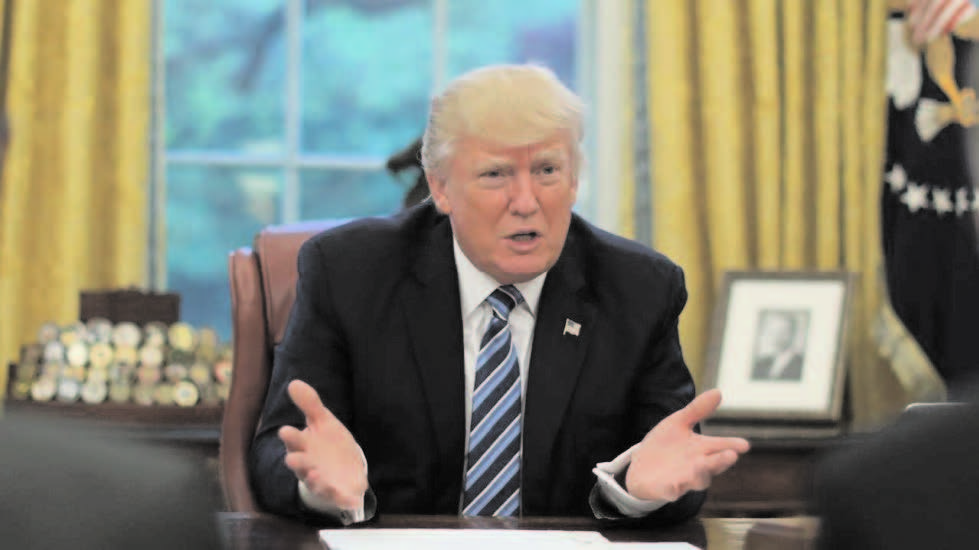
    WASHINGTON(TIP): US President Donald Trump on Wednesday, Sept 18,  named his chief hostage negotiator Robert O’Brien as the new National Security Adviser to replace John Bolton, who was fired last week.

    O’Brien, who has been serving as the special envoy for hostage affairs at the Department of State, has been chosen for the role, Trump tweeted.

    “I am pleased to announce that I will name Robert C O’Brien, currently serving as the very successful Special Presidential Envoy for Hostage Affairs at the State Department, as our new National Security Adviser. I have worked long and hard with Robert. He will do a great job!” he said.

    In his role as special presidential envoy for hostage affairs, O’Brien works with families of American hostages and advises on related issues, including recovery policies. O’Brien would be Trump’s fourth national security adviser of his presidency.

    (With inputs from PTI)

  • Donald Trump: ‘Major, major’ conflict with North Korea possible

    Donald Trump: ‘Major, major’ conflict with North Korea possible

    WASHINGTON (TIP): US President Donald Trump said on April 27 a major conflict with North Korea is possible in the standoff over its nuclear and missile programs, but he would prefer a diplomatic outcome to the dispute.

    “There is a chance that we could end up having a major, major conflict with North Korea. Absolutely,” Trump told Reuters in an Oval Office interview ahead of his 100th day in office on Saturday.

    Nonetheless, Trump said he wanted to peacefully resolve a crisis that has bedeviled multiple US presidents, a path that he and his administration are emphasizing by preparing a variety of new economic sanctions while not taking the military option off the table.

    “We’d love to solve things diplomatically but it’s very difficult,” he said.

    In other highlights of the 42-minute interview, Trump was cool to speaking again with Taiwan’s president after an earlier telephone call with her angered China. He also said he wanted South Korea to pay the cost of the US THAAD anti-missile defense system, which he estimated at $1 billion. He said he intended to renegotiate or terminate a US free trade pact with South Korea because of a deep trade deficit with Seoul.Trump said he was considering adding stops to Israel and Saudi Arabia to a Europe trip next month, emphasizing he wanted to see an Israeli-Palestinian peace. Trump said North Korea was his biggest global challenge. He lavished praise on Chinese President Xi Jinping for Chinese assistance in trying to rein in Pyongyang. The two leaders met in Florida earlier this month. “I believe he is trying very hard. He certainly doesn’t want to see turmoil and death. He doesn’t want to see it. He is a good man. He is a very good man and I got to know him very well.

    “With that being said, he loves China and he loves the people of China. I know he would like to be able to do something, perhaps it’s possible that he can’t,” Trump said.

    ‘I hope he’s rational’ : Trump spoke just a day after he and his top national security advisers briefed US lawmakers on the North Korean threat and one day before Secretary of State Rex Tillerson will press the United Nations Security Council on sanctions to further isolate Pyongyang over its nuclear and missile programs.

    The Trump administration on Wednesday declared North Korea “an urgent national security threat and top foreign policy priority.” It said it was focusing on economic and diplomatic pressure, including Chinese cooperation in containing its defiant neighbor and ally, and remained open to negotiations.

    US officials said military strikes remained an option but played down the prospect, though the administration has sent an aircraft carrier and a nuclear-powered submarine to the region in a show of force. Any direct US military action would run the risk of massive North Korean retaliation and huge casualties in Japan and South Korea and among US forces in both countries.

    Trump, asked if he considered North Korean leader Kim Jong Un to be rational, said he was operating from the assumption that he is rational. He noted that Kim had taken over his country at an early age.

  • US reaffirms India’s designation as major defence partner as Modi meets US NSA

    US reaffirms India’s designation as major defence partner as Modi meets US NSA

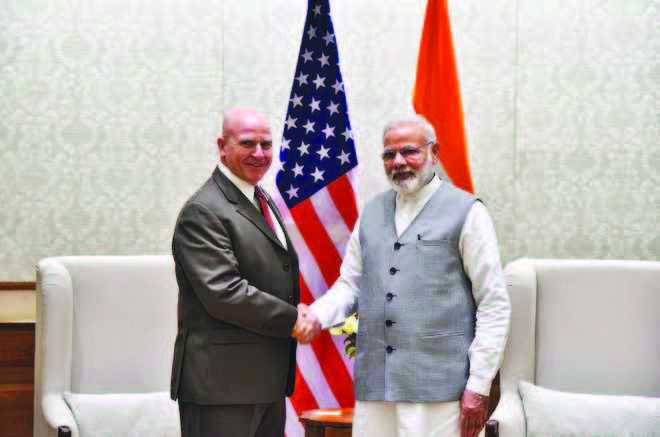
    NEW DELHI (TIP): US National Security Adviser HR McMaster and Indian NSA held a two-hour long meeting in New Delhi today.

    According to sources from the government – the issue of terrorism and Indo-US Cooperation was prominently discussed. India and US agreed to increase military cooperation and more active information exchange on counter terror operations.

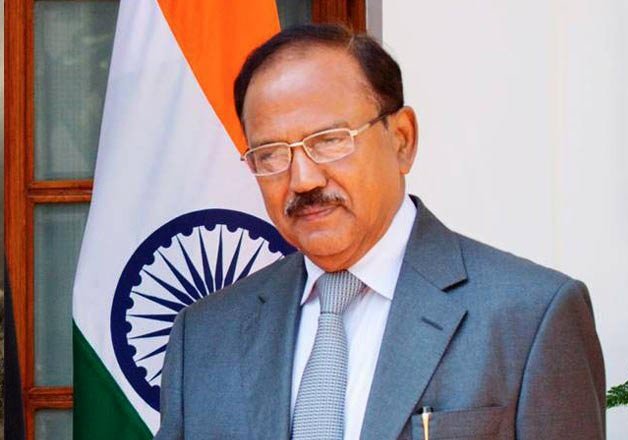
    McMaster also discussed regional security issues with his Indian counterpart Ajit Doval.

    Indian side emphasized that the terrorism emanating from Pakistan is posing serious threat to regional stability and security. India and US have very good cooperation.

    McMaster  also to met Prime Minister Narendra Modi at Lok Kalyan Marg. He may also meet External Affairs Minister Sushma Swaraj. McMaster arrived in Islamabad, Pakistan on Monday, barely a day after the United States reinstated its tough stance on Pakistan.

    Incidentally, this was the first visit by a top member from the Donald Trump administration. McMaster arrived in Pakistan after a brief stop in Afghanistan.

    Following the meet in Pakistan, Prime Minister Nawaz Sharif’s office issued a statement saying that McMaster had assured the PM that the Trump administration was dedicated to strengthening bilateral relations and working with Pakistan.

    New Delhi hopes discussions with Herbert Raymond McMaster will provide clarity on US President Donald Trump’s policy for South Asia.

  • Trump names K.T. McFarland as deputy national security adviser

    Trump names K.T. McFarland as deputy national security adviser

    WASHINGTON (TIP): McFarland, who was previously a national security analyst for Fox News, has served in the Nixon, Ford and Reagan White Houses. She confirmed that she had accepted the position to Fox News, which terminated McFarland’s contributor contract on Friday, November 25.

    “I am proud that KT has once again decided to serve our country and join my national security team,” Trump said in a statement. “She has tremendous experience and innate talent that will complement the fantastic team we are assembling, which is crucial because nothing is more important than keeping our people safe.”

    “The American people chose Donald J. Trump to lead them for a reason,” McFarland said in a statement. “He has the courage, brilliance and energy to Make America Great Again, and nobody has called foreign policy right more than President-elect Trump, and he gets no credit for it. I’m honored and humbled that he has asked me to be part of his team.”

    From 1970-1976 McFarland served as an aide to Dr. Henry Kissinger on the National Security Council. In the Reagan White House she served as a principal deputy assistant secretary of defense Pentagon spokesman.

    She ran unsuccessfully for the Senate in 2006 in New York.

    Her appointment was welcomed on Twitter by retired general Michael Flynn, who will serve as national security adviser.

  • Edward Snowden wasn’t a whistleblower: US House panel

    Edward Snowden wasn’t a whistleblower: US House panel

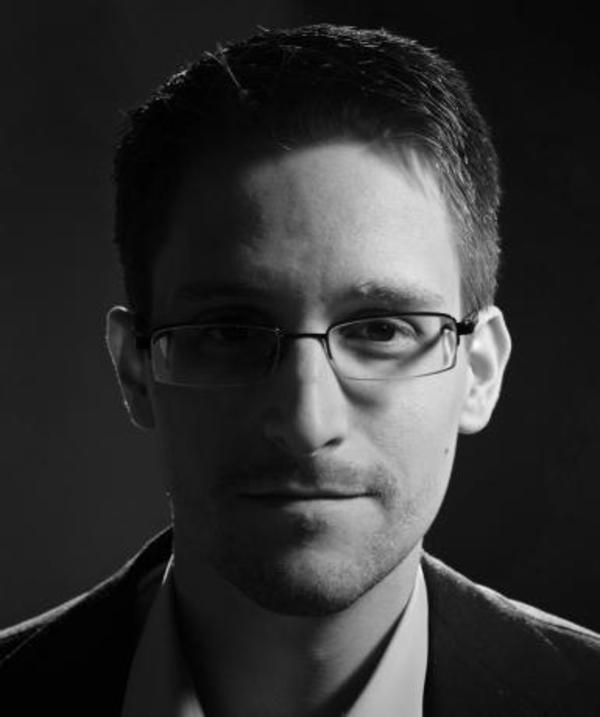
    WASHINGTON (TIP): A US congressional intelligence committee on September 15 issued a scathing report accusing former National Security Agency contractor Edward Snowden of leaking information that “caused tremendous damage” to US. national security, lying about his background and feuding with co-workers.

    In a report endorsed by both its Republican and Democratic leaders, the House intelligence committee said Snowden was “not a whistleblower” as he has claimed.

    Most of the material he stole from the NSA was not about invasions of privacy, but revealed intelligence and defense programs of great interest to America’s foreign adversaries, it said. The committee said that while the “full scope” of damage caused by Snowden’s disclosures remains unknown, a review of materials he allegedly compromised “makes clear that he handed over secrets that protect American troops overseas and secrets that provide vital defenses against terrorists and nation-states.”

    The committee released only a four-page summary of what it said was a 36-page investigative report that remains Top Secret, but the summary contained strong words about Snowden’s actions and background.

    The report contains previously unreported allegations about Snowden and his possible motives for taking government secrets. It alleges that Snowden, who took refuge in Moscow after fleeing to Hong Kong, “was and remains a serial exaggerator and fabricator.”

  • NSA hack suspected, Russia in the dock

    NSA hack suspected, Russia in the dock

    WASHINGTON M(TIP): The release on websites this week of what appears to be top-secret computer code that the National Security Agency has used to break into the networks of foreign governments and other espionage targets has caused deep concern inside US intelligence agencies, raising the question of whether America’s own elite cyberwarriors have been hacked and their methods revealed.

    Most outside experts who examined the posts, by a group calling itself the “Shadow Brokers,” said they contained what appeared to be genuine samples of the code — though somewhat outdated— used in the production of the NSA’s custom-built malware. Most of the code was designed to break through network firewalls and get inside the computer systems of competitors like Russia, China and Iran. That, in turn, allows the NSA to place “implants” in the system, which can lurk unseen for years and be used to monitor network traffic or enable a debilitating computer attack.

    According to these experts, the coding resembled a series of “products” developed inside the NSA’s highly classified “Tailored Access Operations” unit, some of which were described in general terms in documents stolen three years ago by Edward J Snowden, the former NSA contractor now living in Russia.

    But the code does not appear to have come from Snowden’s archive, which was mostly composed of PowerPoint files and other documents that described NSA programs. The documents released by Snowden and his associates contained no actual source code used to break into the networks of foreign powers.

    Whoever obtained the data apparently broke into either the top secret, highly compartmentalized computer servers of the NSA or other servers around the world that the agency would have used to store the files. The code that was published on Monday dates to mid-2013, when, after Snowden’s disclosures, the agency shuttered many of its existing servers and moved code to new ones as a security measure.

    By midday Tuesday Snowden himself, in a Twitter message from his exile in Moscow, declared that “circumstantial evidence and conventional wisdom indicates Russian responsibility” for publication, which he interpreted as a warning shot to the US government in case it was thinking of imposing sanctions against Russia in the cybertheft of documents from the Democratic National Committee.

    “Why did they do it?” Snowden asked. “No one knows, but I suspect this is more diplomacy than intelligence, related to the escalation around the DNC hack.”

    Around the same time, WikiLeaks declared that it had a full set of the files— it did not say how it obtained them —and would release them all in the future. The “Shadow Brokers” had said they would auction them off to the highest bidder.

    “I think it’s Snowden-era stuff, repackaged for resale now,” said James A Lewis, a computer expert at the Center for Strategic and International Studies, a Washington think tank. “This is probably some Russian mind game, down to the bogus accent” of some of the messages sent to media organizations by the Shadow Brokers group, delivered in broken English that seemed right out of a bad spy movie.

    The NSA would say nothing on Tuesday about whether the coding released was real or where it came from. Its public affairs office did not respond to inquiries.

    “It certainly feels all real,” said Bruce Schneier, a leading authority on state-sponsored breaches. “The question is why would someone steal it in 2013 and release it this week? That’s what is making people think this is likely the work of Russian intelligence.”

    There are other theories, including one that some unknown group was trying to impersonate hackers working for Russian or other intelligence agencies. Impersonation is relatively easy on the internet, and it could take considerable time to determine who is behind the release of the code.

    The Shadow Brokers first emerged online on Saturday, creating accounts on sites like Twitter and Tumblr and announcing plans for an auction. The group said that “we give you some Equation Group files free” and that it would auction the best ones. The Equation Group is a code name that Kaspersky Labs, a Russian cybersecurity firm, has given to the NSA.

    While widely considered the most talented group of state-sponsored hackers in the world, the NSA is still recovering from Snowden’s disclosures; it has spent hundreds of millions of dollars reconfiguring and locking down its systems.

    Snowden revealed plans, code names and some operations, including against targets like China. The Shadow Brokers disclosures are much more detailed, the actual code and instructions for breaking into foreign systems as of three summers ago.

    “From an operational standpoint, this is not a catastrophic leak,” Nicholas Weaver, a researcher at the International Computer Science Institute in Berkeley, California, wrote on the Lawfare blog on Tuesday. (PTI)

  • New dates for NSA-level talks likely

    New dates for NSA-level talks likely

    NEW DELHI (TIP): India and Pakistan may announce new dates for the talks between their Prime Ministers’ National Security Advisors, if External Affairs Minister Sushma Swaraj travels to Islamabad to attend a conclave on Afghanistan next week and has a
    “brief and informal courtesy” meeting with her counterpart, Sartaj Aziz, on the sideline.

    The proposal of Swaraj’s visit to Islamabad to attend the “Heart of Asia” conclave on Afghanistan and a bilateral meeting with Aziz are among the elements of Prime Minister Narendra Modi’s latest offer to his Pakistani counterpart Nawaz Sharif to end the impasse in diplomatic engagement between the two neighbours, officials told Deccan Herald on Thursday.

    Modi put forward his offer to Sharif when they had a brief chat on the sideline of the COP 21 climate change summit hosted by United Nations in Paris last Monday.

    Sharif, according to the sources, did not immediately respond to the proposal, but told Modi that he would get back after holding “internal consultations”. New Delhi is likely to take a final call on the external affairs minister’s visit to Pakistan only after factoring in the response from Islamabad.

    Modi and Sharif had met at Ufa in Russia on July 10 last and agreed on a roadmap of engagements, commencing with a meeting between the NSAs of the two prime ministers.Aziz, who was also Sharif ’s NSA then, was expected to meet his counterpart and Modi’s NSA Ajit Doval in New Delhi on August 24.


  • NSA warns Pakistan against Covert Ops

    NSA warns Pakistan against Covert Ops

    NEW DELHI: After Pakistan’s former president General Pervez Musharraf made scathing comments on religious militancy otherwise known as ‘jihadi terrorism’. NSA Ajit Doval on Tuesday, October 27, warned Pakistan not to engage in covert action saying it was a very short-sighted strategy of the neighbouring country.

    He said Pakistan has never realised that it can be “profitable” and “most effective” for its economic growth and stability if it engages with India and rest of the South Asian countries.

    “Till that happens, what can India do. I think one is that we should continue to work hard to persuade Pakistan, to convince Pakistan, through our sincerity, whatever we can do and whatever we think is the language in which the Pakistan can understand it well. We should be able to convey and convince it,” he said.

    Delivering the first ‘Nagendra Singh memorial lecture’ on ‘Ensuring peace in South Asia: Role of India’ organised by the International Goodwill Society of India, he said most of South Asian countries’ security threats are internal.

    “There is only one threat which has got its footprint in almost all of the nations. Problem about this is that its origin, its nursery, is also the member of South Asian region. Islamic terrorism or jihadi terrorism, rather I should use the word, is one of the common threats.

    “Bangladesh is affected by it, Afghanistan is affected, India is affected, Pakistan is affected by it. Sri Lanka is affected,” the NSA said.

    This is one common threat on which there could have been much of cooperation but probably two of the countries Afghanistan and Pakistan have become epicentre of that, he said.

    “Since Pakistan is part of the problem it could not become part of the solution,” Doval said maintaining that “it is only Pakistan with which there have been problems”.

    He said after Prime Minister Narendra Modi came to power, one of the cornerstones of the government’s policy was that “we have got to take all South Asian countries together”.

    “And that was the idea when all the heads of the governments were invited for his swearing-in ceremony. It did start well it did give us lot of dividend. Things with Pakistan have not developed as much but we are sure that some day we will able to do so,” Doval said.

    He said another important requirement will be when Pakistan shifts from its strategic position where it feels that covert action can be an effective low cost option of its security strategy because supporting terrorism or a covert action is a very low cost exercise.


  • India-Pakistan NSA-level talks on August 23

    NEW DELHI (TIP): The India-Pakistan NSA-level dialogue which is meant to address “all issues connected to terrorism” is all set to take place as proposed by India on August 23-24.

    While Indian officials said they were still awaiting an official confirmation, Pakistan NSA and adviser to PM Nawaz Sharif on foreign affairs Sartaj Aziz announced in Islamabad that he will travel to India on August 23 for talks with India’s NSA Ajit Doval.

    Pakistan’s confirmation, even if not official yet, has come almost a couple of weeks after India, as the host nation, proposed dates for the dialogue. It had become important for Pakistan to confirm the talks as the delay had led to speculation in the past few days that the formidable Pakistan army did not want Aziz to travel to New Delhi.

    According to Pakistani sources, the army had no reservation about the Ufa initiative which saw PM Narendra Modi and his counterpart Sharif agreeing to restart the engagement process with a dialogue between the two top security officials. Modi and Sharif had met in Ufa (Russia) last month.

    Pakistani diplomats have maintained for the past two weeks that the dialogue could only take place if India created what they described as an enabling environment. They attributed the delay to a media campaign which they said had been unleashed against Pakistan by Indian officials, especially over the Gurdaspur and Udhampur attacks.

    It was evident all along though that both sides were going to find it difficult to walk away from the talks, the acrimonious exchanges notwithstanding. It was Pakistan which first came up with the idea to have a dialogue between Aziz and Doval as it felt it had enough evidence to confront India with over, as it alleges, New Delhi’s support to insurgency in Balochistan and FATA. When Aziz comes here, he will be armed with “evidence” to prove involvement of India’s agencies in carrying out the Peshawar massacre of 132 children.

    One of the reasons why India accepted Pakistan’s proposal was that Doval himself was keen to engage Pakistan on terrorism. The arrest of a Pakistani terrorist in Udhampur and the Gurdaspur attack perpetrated, as the government said in Parliament, by Pakistani nationals have strengthened Doval’s resolve to discuss terror with Islamabad. Indian officials maintained the dialogue was meant to focus only on terrorism.

  • Deal reached on bill to end NSA phone collection

    House leaders have reached a bipartisan compromise on a bill that would end the National Security Agency’s controversial collection of American phone records, but the measure faces an uncertain future in the Senate.

    The House Judiciary Committee on Thursday overwhelmingly passed the latest version of a bill known as the USA Freedom Act by a bipartisan vote of 25 to 2.  The measure seeks to codify President Barack Obama’s proposal to end the NSA’s collection of domestic calling records.  It would allow the agency to request certain records held by the telephone companies under a court order in terrorism investigations.

    The authority to collect those records and other related surveillance provisions of the Patriot Act will expire June 1 unless Congress passes a law reauthorizing it. The House bill would do that, with changes.  Senate leaders have introduced a bill that would reauthorize the provisions with no changes, allowing the NSA to continue collecting phone records.

    A similar bill to the one that cleared the Judiciary Committee passed the full House last year by a bipartisan vote of 303 to 121 but narrowly failed a procedural vote in the Senate. The Judiciary Committee chairman, Rep.  Bob Goodlatte, R-Va., said the bill’s provisions had been carefully negotiated with both the intelligence committee and intelligence agencies.

    During the hearing, lawmakers said a deal had been reached to bring the USA Freedom Act to the floor without going through the intelligence committee, where many Republicans support continuing the NSA bulk collection.

  • NSA internet spying legal, says Obama-appointed privacy board

    NSA internet spying legal, says Obama-appointed privacy board

    WASHINGTON (TIP)The National Security Agency programmes that collect huge volumes of Internet data within the United States pass are constitutional and employ “reasonable” safeguards designed to protect the rights of Americans, an independent privacy and civil liberties board has found.

    In a report released on Tuesday night, the bipartisan, five-member Privacy and Civil Liberties Oversight Board, appointed by President Barack Obama, largely endorsed a set of NSA surveillance programmes that have provoked worldwide controversy since they were disclosed last year by former NSA systems administrator Edward Snowden.

    Under a provision known as Section 702, added in 2008 to the Foreign Intelligence Surveillance Act of 1978, the NSA uses court orders and taps on fibre optic lines to target the data of foreigners living abroad when their emails, web chats, text messages and other communications traverse the US.

    Section 702 includes the so-called PRISM programme, under which the NSA collects foreign intelligence from Google, Facebook, Microsoft, Apple and nearly every other major US technology firm. Because worldwide Internet communications are intermingled on fibre optic lines and in the cloud, the collection inevitably sweeps in the communications of Americans with no connection to terrorism or foreign intelligence.

    Since the Snowden disclosures, activists have expressed concern that a secret intelligence agency is obtaining private American communications without individual warrants. Some have questioned how such a programme could be legal under the Constitution.

    The board, including a Democratic federal judge, two privacy experts and two former Republican justice department officials, found that the NSA monitoring was legal and reasonable and that the NSA and other agencies take steps to prevent misuse of Americans’ data.

  • House passes NSA reform bill: Privacy advocates not happy

    House passes NSA reform bill: Privacy advocates not happy

    WASHINGTON (TIP):
    The House passed a controversial bill Thursday, May 22, aimed at reforming the National Security Agency’s bulk collection of phone records, a policy that came to light due to documents leaked by former NSA contractor Edward Snowden. The bill, known as the USA Freedom Act, would shift responsibility for retaining telephonic metadata from the government to telephone companies. Providers like AT&T and Verizon would be required to maintain the records for 18 months and let the NSA search them in terrorism investigations when the agency obtains a judicial order or in certain emergency situations.

    The bill passed on a 303 to 121 vote. But privacy advocates, technology companies and lawmakers warned that the version of the bill passed by the House was watered down to the point where they could no longer support it. On Wednesday, the White House endorsed the bill. “The bill ensures our intelligence and law enforcement professionals have the authorities they need to protect the Nation, while further ensuring that individuals’ privacy is appropriately protected when these authorities are employed,” an official statement of policy read.

    “Among other provisions, the bill prohibits bulk collection through the use of Section 215, FISA pen registers, and National Security Letters.” Rep. Jim Sensenbrenner (R-Wis.) was the primary sponsor of the bill and the author of the Patriot Act, legislation passed shortly after the Sept. 11, 2001, terrorist attacks. Section 215 of the Patriot Act was used as the legal basis of the NSA’s phone records collection program.

    In a floor speech before the vote, Sensenbrenner said that the government misapplied that earlier legislation through a feat of “legal gymnastics.” “I don’t blame people for losing trust in their government because the government betrayed their trust,” he said. Sensenbrenner urged his fellow members to support the bill, although he said wished the version of the bill voted on Thursday “did more.”

  • SENATOR RAND PAUL sues Obama over NSA surveillance

    SENATOR RAND PAUL sues Obama over NSA surveillance

    WASHINGTON (TIP): Senator Rand Paul, a possible Republican presidential candidate, sued the Obama administration on February 12 over the National Security Agency’s mass collection of millions of Americans’ phone records. The senator said he and the conservative activist group FreedomWorks filed the suit for themselves and on behalf of “everyone in America that has a phone”.

    The lawsuit argues that the bulk collection program that’s been in existence since 2006 violates the US Constitution’s Fourth Amendment right against unreasonable searches. It calls for an end to the program, which was revealed by former National Security Agency analyst Edward Snowden. The Obama administration maintains that the program, begun under President George W Bush, is legal. Courts have largely sided with the government.

    President Barack Obama has called for reforms to the program in an effort to regain public trust. Others, like Paul, have called for the end of this kind of surveillance. Paul dodged a question about his presidential ambitions during a news conference on Wednesday. But his lawsuit is the latest effort to propel the debate over the once-secret surveillance program into the 2016 presidential campaign. The surveillance debate has exposed intra-party tensions for Republicans. The party split on this issue between its leadership, which backs the program on security grounds, and libertarianminded members who are more wary of government involvement in Americans’ private lives.

    The Republican National Committee, last month, approved a resolution to end the surveillance programs. While some Republicans played down its significance, the nonbinding vote was seen as a nod to Republicans like Paul. The White House and justice department did not comment on the lawsuit specifically, but said they believe the bulk collection of phone records is legal. “This, we believe, will be a historic lawsuit,” Paul said after filing the complaint in US district court in the District of Columbia.

    “We believe that this lawsuit could conceivably represent hundreds of millions of people who have phone lines in this country or cellphones.” Ken Cuccinelli, the former attorney general of Virginia, is the lead counsel for Paul and FreedomWorks on the suit. Paul appeared at campaign rallies last October to support Cuccinelli’s unsuccessful bid for Virginia governor. In December, Paul’s advisers approached Cuccinelli about participating in the lawsuit. “This is a constitutional challenge primarily,” Cuccinelli told The Associated Press.

    “We’re not debating national security policy.” Cuccinelli has sued the Obama administration before — he was the first state attorney general to mount a legal challenge to the constitutionality of the president’s signature health care overhaul. The bulk collection program, which is authorized in Section 215 of the USA Patriot Act, sweeps up what’s known as metadata for every phone call made in the US. It collects the number called, the number from which the call is made and the duration and time of the call. The intelligence community says having this data is key to preventing terrorism.

    While there is little evidence the program has been integral in preventing an attack, the Obama administration argues that being able to rule out a US connection is important because it provides “peace of mind”. Paul’s suit cites arguments made in another lawsuit filed last year by conservative lawyer Larry Klayman. In response to Klayman’s suit, US district court judge Richard Leon ruled that the bulk collection program was likely unconstitutional. It was the first time a judge did not side with the government on the issue. Paul’s lawsuit was filed against Obama; director of national intelligence James Clapper; NSA director Keith Alexander; and FBI director James Comey.

  • Terror suspect challenges NSA surveillance

    Terror suspect challenges NSA surveillance

    DENVER (TIP): Using evidence obtained under the National Security Agency’s warrantless surveillance program violates a terror suspect’s constitutional protection against unreasonable search and seizure, the suspect argued on January 29 in a court document filed with help from the American Civil Liberties Union.

    In the motion filed in federal court in Denver, Jamshid Muhtorov also requested that prosecutors disclose more about how the surveillance law was used in his case. Muhtorov was accused in 2012 of providing material support to an Uzbek terrorist organization active in Afghanistan.

    “We’ve learned over the last few months that the NSA has implemented the law in the broadest possible way, and that the rules that supposedly protect the privacy of innocent people are weak and riddled with exceptions,” Jameel Jaffer, the ACLU’s deputy legal director, said in a statement Wednesday. The Justice Department did not immediately respond to a call seeking comment.

    The challenge had been expected after the Justice Department in October said it intended to use information gleaned from one of the NSA’s warrantless surveillance programs against Muhtorov. It was the first time the department had made such a disclosure. The Supreme Court has so far turned aside challenges to the law on the grounds that people who bring such lawsuits have no evidence they are being targeted.

  • Obama fails to persuade Americans on NSA reform: poll

    Obama fails to persuade Americans on NSA reform: poll

    WASHINGTON (TIOP: Reforms to US surveillance announced by President Barack Obama have failed to reassure most Americans, with three-quarters saying their privacy will not be better protected under the changes, according to a new poll.

    By a margin of 73-21%, Americans who followed Obama’s speech last week on the National Security Agency say his proposals will not make much difference when it comes to safeguarding privacy rights, said the Pew Research Center/USA Today poll published on January 22.

    The poll of 1,504 adults, carried out between Wednesday and Sunday, showed the speech was not widely followed by Americans and that skepticism of the NSA’s electronic spying is growing. The survey said half of those surveyed heard “nothing at all” about Obama’s proposed measures and another 41% said they heard “only a little bit.”

    And fully seven in 10 poll respondents said they should not have to give up privacy to stay safe from potential terror attacks, the poll said. A majority of 53% now disapprove of the NSA’s collection of telephone and internet data. In July, 50% approved and 44% disagreed with the surveillance program.

    The shift in public opinion follows the explosive leak last June of NSA documents by former intelligence contractor Edward Snowden, who has sparked a global uproar over the US government’s far-reaching surveillance. Nearly half of Americans, 48%, said there are insufficient limits on what telephone and internet data the government can collect, while 41% said there are adequate parameters on the government’s spying.

    The survey revealed a division over whether Snowden’s unprecedented disclosures of classified information have damaged the country, with 45% saying the leaks have served the public interest and 43% saying the leaks have harmed it. Snowden faces espionage charges from US authorities over his leaks and has obtained temporary asylum in Russia, where he has said he has been vindicated by the public reaction to the disclosures. However, 56% of Americans say the government should prosecute Snowden while 32% did not favor pursuing criminal charges.

    In his speech last Friday, Obama said a third party – not the government – should hold vast stores of phone metadata, and that the NSA would need a court order to search the data except in genuine emergencies. The US president also promised Washington would no longer eavesdrop on the leaders of friendly foreign governments and that a panel of independent lawyers should be allowed to argue in the interest of privacy rights before the secret court that oversees the NSA surveillance. The poll found 79% of Americans were not worried that Obama’s proposed reforms would undercut the government’s ability to fight terror groups.

  • Barack Obama ponders limiting NSA access to phone records

    Barack Obama ponders limiting NSA access to phone records

    WASHINGTON (TIP): President Barack Obama is expected to rein in spying on foreign leaders and is considering restricting National Security Agency access to Americans’ phone records, according to people familiar with a White House review of the government’s surveillance programs. Obama could unveil his highly anticipated decisions as early as next week. On Thursday, the president met with congressional leaders at the White House to discuss the review, while White House staff planned to meet with privacy advocates.

    Representatives from tech companies are meeting with White House staff on January 10. The White House says Obama is still collecting information before making final decisions. Among the changes Obama is expected to announce is more oversight of the National Intelligence Priorities Framework, a classified document that ranks U.S. intelligence-gathering priorities and is used to make decisions on scrutiny of foreign leaders.

    A presidential review board has recommended increasing the number of policy officials who help establish those priorities, and that could result in limits on surveillance of allies. Documents released by former National Security Agency systems analyst Edward Snowden revealed that the U.S. was monitoring the communications of several friendly foreign leaders, including German Chancellor Angela Merkel.

    The revelations outraged Merkel as well as other leaders, and U.S. officials say the disclosures have damaged Obama’s relations around the world. The president also is said to be considering one of the review board’s most aggressive recommendations, a proposal to strip the NSA of its ability to store telephone records from millions of Americans and instead have phone companies or a third party hold the records. The NSA would be able to access the records only by obtaining separate court approval for each search, though exceptions could be made in the case of a national security emergency.

    It’s unclear whether Obama will ultimately back the proposal or how quickly it could be carried out if he does. A House Intelligence Committee member, Rep. Peter King, R-NY, said he believes the surveillance changes under consideration go too far. But he said if Obama does decide to transfer U.S. phone metadata to a third party, he would work to salvage what he could of the program. “It would be a question of the lesser of two evils,” King said.

    “If by doing that, it protects the program or preserves it, I would do it, even though I don’t think these reforms are necessary.” That White House review followed disclosures from Snowden, who leaked details of several secret government programs. He faces espionage charges in the U.S. but has been granted temporary asylum in Russia. On Thursday, the senior lawmakers on the House Intelligence Committee said a classified Pentagon report showed that Snowden stole approximately 1.7 million intelligence files.

    Most of those documents concern current military operations and could potentially jeopardize U.S. troops overseas, according to Rep. Mike Rogers, R-Mich., and Rep. C.A. “Dutch” Ruppersberger, D-Md. Before making his final decisions, the president is supposed to receive a separate report from a semiindependent commission known as the Privacy and Civil Liberties Oversight Board, which was created by Congress. However, that panel’s report has been delayed without explanation until at least late January, meaning it won’t reach the president until after he makes his decisions public.

    Members of that oversight board met with Obama on Wednesday and have briefed other administration officials on some of their preliminary findings. In a statement, the five-member panel said its meeting with the president focused on the NSA phone collection program and the Foreign Intelligence Surveillance Court, which oversees the data sweeps. It’s unclear why Obama will announce his recommendations before receiving the report from the privacy and civil liberties board.

    One official familiar with the review process said some White House officials were puzzled by the board’s delay. The report would still be available to Congress, where lawmakers are grappling with several bills aimed at dismantling or preserving the NSA’s authority. That official and those familiar with the White House review insisted on anonymity because they were not authorized to discuss the process by name. Obama also met Wednesday with members of the U.S. intelligence community, which largely supports keeping the NSA surveillance programs intact. Shortly after receiving the review board recommendations last month, Obama signaled that he could be open to significant surveillance changes, including to the bulk collecting of phone records.

    “There are ways we can do it, potentially, that gives people greater assurance that there are checks and balances — that there’s sufficient oversight and sufficient transparency,” Obama said at a Dec. 20 news conference. He added that programs like the bulk collection “could be redesigned in ways that give you the same information when you need it without creating these potentials for abuse.

    ” The president also has backed the idea of adding a public advocate position to the Foreign Intelligence Surveillance Court, which rules on many of the domestic surveillance decisions. The court typically hears only from the government as it decides cases, and the advocate would represent privacy and civil liberties concerns.

  • NSA chief says Snowden leaked up to 2,00,000 secret documents

    NSA chief says Snowden leaked up to 2,00,000 secret documents

    WASHINGTON (TIP): Former US National Security Agency contractor Edward Snowden leaked as many as 200,000 classified US documents to the media, according to little-noticed public remarks by the eavesdropping agency’s chief late last month. In a question-and-answer session following a speech to a foreign affairs group in Baltimore on October 31, NSA director general Keith Alexander was asked by a member of the audience what steps US authorities were taking to stop Snowden from leaking additional information to journalists. “I wish there was a way to prevent it. Snowden has shared somewhere between 50 (thousand) and 200,000 documents with reporters. These will continue to come out,” Alexander said. Alexander added that the documents were “being put out in a way that does the maximum damage to NSA and our nation,” according to a transcript of his talk made available by NSA. US officials briefed on investigations into Snowden’s activities have said privately for months that internal government assessments indicate that the number of classified documents to which Snowden got access as a systems operator at NSA installations ran into the hundreds of thousands.

    Officials said that while investigators now believe they know the range of documents that Snowden accessed, they remain unsure which documents he downloaded for leaking to the media. By comparison, the number of Pentagon and State Department documents leaked to WikiLeaks by a disgruntled US Army private was much larger. The antisecrecy group obtained around 400,000 Pentagon reports on the Iraq war, as well as 250,000 State Department cables and tens of thousands of documents on US operations in Afghanistan. None of the WikiLeaks material was classified higher than “Secret” but many NSA documents leaked by Snowden were marked “Top Secret” or with an even more restrictive “Special Intelligence” stamp. The material includes highly technical details on US and allied eavesdropping activities. Snowden’s revelations, which first surfaced in June, are still causing a headache for the government of President Barack Obama, particularly in its dealing with allies. For example, Germany was outraged by reports that the NSA monitored Chancellor Angela Merkel’s cellphone. Matthew Olsen, director of the National Counterterrorism Center in the Office of the Director of National Intelligence, said Snowden’s leaks were “extremely damaging.” “There is no doubt that those disclosures have made our job harder. We’ve seen that terrorists or adversaries are seeking to learn about the ways that we collect intelligence and seeking to adapt and change the ways that they communicate,” he told a congressional hearing on November 14. In the past few days, US officials say, a panel of former officials and experts set up by Obama to review NSA operations in the wake of Snowden’s disclosures has privately reported interim conclusions to the White House. The group’s final report is due on December 15.