Tag: Nuzaira Azam

  • Bridging Heritage and Harmony: AAA-DC’s 49th International Mushaira

    Bridging Heritage and Harmony: AAA-DC’s 49th International Mushaira

    MARYLAND (TIP): The Aligarh Alumni Association of Metro Washington (AAA-DC) hosted its 49th annual International Mushaira on October 20, 2024, in the spacious auditorium of Gaithersburg, Maryland. This celebrated event featured the distinguished poet, lyricist, and screenwriter Javed Akhtar, recipient of the Padma Bhushan from the Government of India and a former Member of India’s Parliament. Other esteemed poets who shared their work included Abdullah Abdullah, Ahmad Salman, Ashfaq Hussain, Masood Ahmad, Mohammed Jaweed, Nikhat Iftikhar, Nusrat Mehdi, Sabiha Saba, Shakeel Azmi, and Vinita Tiwari.

    Another view of the gathering

    Over the years, AAA-DC’s Mushaira has evolved into a cherished cultural tradition for the South Asian diaspora in the Washington area, serving as a bridge to linguistic and literary heritage. The event fosters a dynamic exchange where renowned poets perform alongside emerging voices, sustaining the vibrancy of Urdu poetry. Originally conceived to celebrate Aligarh Muslim University’s (AMU) legacy in Urdu literature, it now draws a global audience, inviting Urdu poetry lovers to savor the beauty of ghazals and nazms.

    Book launching

    A hallmark of the Mushaira is its diverse lineup, featuring poets from India, Pakistan, Europe, the United States, and beyond. Legendary poets like Faiz Ahmad Faiz, Ali Sardar Jafri, Kaifi Azmi, and Ahmad Faraz have graced the event in past years, alongside an array of accomplished poets such as Ahmad Salman, Alok Srivastava, Ambreen Haseeb Ambar, Amjad Islam Amjad, Anwar Masood, Ashok Narain, Dilwar Figar, Gulzar Dehelvi, Hasan Kamal, Iftikhar Arif, Kaleem Aajiz, Khumar Barabankvi, Khushbir Singh Shaad, Khwamkhwa Hyderabadi, Lata Haya, Makhmoor Saeedi, Malikzada Manzoor Ahmad, Munawwar Rana, Nida Fazli, Parveen Shakir, Popular Meerathi, Razi Raziuddin, Sabiha Saba, Saghar Khayyami, Salman Akhtar, Sampat Saral, Satya Pal Anand, Shaharyar, Wali Aasi, Wasim Barelvi, Zehra Nigah, and many others. This blend of voices has cemented the Mushaira’s status as one of the most prestigious South Asian cultural gatherings.

    Nuzaira Azam and Javed Akhtar with Zafar Iqbal standing behind

    The event typically attracts a large audience of Urdu poetry enthusiasts, including dignitaries and representatives from various cultural organizations. Among the attendees were Indian Embassy officials in Washington, Anup Srivastav and Mohammad Bilal Ahmad, along with representatives from groups including the Association of Indian Muslims (AIM), Federation of Aligarh Alumni Associations (FAAA), Global Organization of People of Indian Origin-Metro Washington (GOPIO-DC), Hyderabad Association of Metro Washington Area (HAWMA), Montgomery Nawabs, National Council of Asian Indian Associations, Inc. (NCAIA), University of Karachi Alumni Association (UKAA), and students from the University of Maryland College Park and Baltimore County. Additionally, AAA honors individuals who contribute to Urdu’s promotion, such as Sanjeev Saraf of Rekhta.org, and includes a traditional rendition of AMU’s anthem, Yeh Mera Chaman Hai, adding a nostalgic touch to the gathering.

    A highlight of the evening was Javed Akhtar’s launch of Dr. Abdullah’s new poetry collection, Reyt Ki Lahrein Aur Ankahi Batein. Akhtar commended Dr. Abdullah’s dedication to preserving AMU’s heritage and praised his efforts in uniting alumni from diverse backgrounds, fostering a profound sense of connection and pride in shared roots.

    This year’s AAA Annual Mushaira delighted attendees with its much-anticipated return to an in-person format. Dr. Ishrat Husain, Mr. Kaleem Kawaja, Ambassador Islam Siddiqi, and many others expressed their appreciation for the live gathering. An enthusiastic audience of over 250 gathered in person, marking a joyful return to an in-person Mushaira after several virtual years. Attendees noted the inclusive spirit, with non-Muslim audience members comprising a substantial portion, and poets skillfully incorporating themes from Hindu epics. The significant participation of women poets further added to the event’s success, reflecting the inclusive and diverse nature of the Mushaira and creating an atmosphere of cultural pride and literary richness.

    Javed Akhtar presided over the Mushaira, which was skillfully moderated by A. Abdullah.

    (Based on a Press Release issued by Zafar Iqbal, Ph.D. 1509 Coat Ridge Road,
    Herndon, VA 20170. Cell: 240-328-0162

    Volunteers
  • Awan-e Urdu Florida Organized a literary hangama to pay tribute to legendary Urdu humorist poet Akbar Allahabadi

    Awan-e Urdu Florida Organized a literary hangama to pay tribute to legendary Urdu humorist poet Akbar Allahabadi

    Poets:Ahmed KassooTanhaa, Saadia Khawar Ali, Nuzaira Azam, Salahuddin, Sarfraz Ahmad, Zafar Iqbal.
    Volunteers

    ORLANDO (TIP): Awan-e Urdu Florida Organized a literary hangama to pay tribute to legendary Urdu humorist poet Akbar Allahabadi on May 14, 2022, in Orlando, FL. The event was also celebrated as Eid Milan after a hiatus of over two years due to the pandemic. Awan-e Urdu President Mr. Ahmed KassooTanhaa welcomed the audience and gave a brief overview and history of Awan-e Urdu. He said that the organization has been in existence for more than 20 years in Central Florida, with over 100 members. It is a non-profit organization promoting the Urdu language, literature, and poetry and preserving the Subcontinent’s culture. Although the association has many recognized poets and writers in its membership, it invites poets, writers, and artists from other cities and countries to perform at its events. It also organizes the release of books published by its members. A senior member of the organization pointed out that they have launched at least five books of Urdu poets who currently reside or have resided in Central Florida.

    Dr. Sarfraz Ahmad presented a brief account of the life, works, and accomplishments of Akbar Allahabadi. He said, “Syed Akbar Hussain Akbar Allahabadi (1846-1921) was an Urdu poet in the genre of satire. His poems are a true reflection of his time, giving a comprehensive account of all the moral, cultural, political, and psychological dispositions of the people living in Northern India.” His poetry is a melting pot of revolutionary, classical, innovative, and meticulous creative faculties. He added that Akbar appeared revolutionist and reformer, even though he was fond of traditional values.

    Akbar is considered the expert in satire and humor in Urdu poetry. His keen eyes noticed the quickly changing world and the emergence of new classes. Some looked down on their Indian traditional values as Westernism grew in popularity. To devote his poetry to the service of his country and nation, he uniquely developed a style in which there is outward mockery and humor but inside counsel and criticism. Dr. Sardar Akhtar Aziz and Mr. Salahuddin Siddiqui also presented their commentaries about Akbar’s poetry. This session was devoted to the selected poetry of Akbar Allahabadi recited by several members of the audience. Prof. Syed Khawar Ali, Dr. Sameena Beg, Ms. Ghazala Syed, Mr. Shaikh Naeem, Dr. Shaheda Akhtar, Dr. Mirza Suleman Beg, Mr. Syed Shahab Salim, Mr. Zahid Tufail, Ms. Shaila Siddiqi, Ms. Sadia Ali, Mr. Ghalam Qadir Qureshi, Ms. Sairab Ansari, and Ms. Kausar shared their presentations with the audience.

    The guest of honor, Ms. Nuzaira Azam, a well-known journalist, and writer, came from Washington, DC. She talked briefly about her experience as a political reporter and her books, KhwabBadosh and Anahita ki Janam Basti.

    The second poetic session was devoted to the random recitation of non-specific ghazals, verses, and personal poetry presented by audience members. A Bhojpuri geet sung by Ms. Nuzaira Azam was highly appreciated. Ms. Sadia Khawar Ali and a few other audience members also participated by reciting their favorite poetry.

    The event, attended by more than 70 Urdu enthusiasts from Orlando and nearby towns, was hosted by Mr. and Ms. Waqar Siddiqui and their family friends at their beautiful residence by the lake in Orlando. The attendees were hugely impressed by their warm hospitality and delicious food.

    (Report by Zafar Iqbal, Ph.D. He can be reached at 240-328-0162. Iqbal.Zafar1509@gmail.com. )

  • An Interview with Washington’s Iconic Chili Bowl Restaurant

    An Interview with Washington’s Iconic Chili Bowl Restaurant

    By Nuzaira Azam

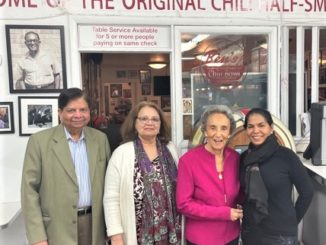
    It was a crisp afternoon in early March when we visited Ben’s Chilly Bowl—an immensely popular restaurant on U Street in Washington DC. I sat down to chat with the founder and owner of this restaurant, Virginia Ali.  A petite lively woman, 87, Virginia still drives and comes to the restaurant every day to meet and greet customers. Ms. Virginia, with her husband Ben Ali, started Ben’s Chilly Bowl after four weeks of their marriage in 1958. Ben Mahboob Ali came to the US from Trinidad for studies at Nebraska University but then decided to go to the Howard University in Washington, DC.

    The restaurant displays living history. President Obama, Dr. Martin Luther King and many iconic figures from all walks of life have visited this iconic restaurant. The life-size pictures of these and several stalwart personalities tell many stories.

    She lamented that once this U street was known as the Black Broadway of Washington. There were theatres, restaurants, nightclubs, and many other places for entertainment. Then came a period when the area became infested with drug addicts and crime. After two decades of instability, the development in this area started erecting chain restaurants and high-rise buildings; however, many expressed that “with all development on U street district, its history is getting lost.”.

    Her children, with her motherly supervision, manage the restaurant. Her youngest son Nizam Ali, who has a J.D (Jurisprudence Doctorate), left his job when his father passed away and started working at Ben’s. Virginia’s eldest son Sage Ali’s wife Vida, who was one of the entertainment industry’s most highly respected publicists in the business in Hollywood for twenty-five years, also left her job and joined the family business.

    “I have heard that Ben Ali came repeatedly to meet you,” I asked.

    She laughed and said that her proper job was at a bank where Ben Ali saw me. He came three days in a row. I served him as others were busy. He left a note for me to call him.  He was a handsome and confident man, but I did not call him as in 1957 ladies were not expected to call men. Our bank closing time was 2:00 pm, he called me at 2:45 and introduced himself and said that he was a student at Howard University at the dental school.

    “I knew some professors at the school, mentioned names of few people whom he also knew. Considering it safe, I gave him my number to call me at home. We went to a dinner escorted by one of our mutual friends. He met my family with our mutual friend and they fixed a date and the rest is history”.

    Q:As a young woman, born in Virginia, raised in the US gets married to a man coming from a foreign country, how did you and your family feel about all this?

    A: My parents were amazing, wonderful people, they raised us as well as anybody else, but not better than anybody else, so we did not have any kind of attitude.  We grew up in an atmosphere where the family remained a focal point of life. We worked hard, went to school, church every Sunday, and have dinner with our uncles and aunts, grandparents, every Sunday. My father was also an entrepreneur, he owned three hundred and fifty acres of farmland.

    Q: How would you describe your relationship with your parents?

    A: My father was a very calm, soft-spoken person, he never raised his voice no matter what happened. I was never spanked or had a threat of a spank. My parents set an example for us; we never heard our parents argue. We enjoyed the extended family system, my uncle’s daughter of my age and I used to spend nights at each other’s home.

    Q: What were the activities of young people in college, in those days?

    A: I went to a small Christian school in Richmond. In those days, young men and women would go to a hall in the college dormitory in the presence of the house mother (warden) for conversation. We could go out in groups and come back at a certain time, so there were strict rules and parents liked this control.

    Q: Back then, there was no concept of girlfriend, boyfriend?

    A: Oh, no, no, no, no. When I was a senior in college and at our Prom, I wanted to go with a little fellow, but there was a “no”, no argument nothing else.

    Q: Children were also listening to their parents in those days?

    A: My parents made us believe that we are incredibly special and could do whatever we wanted but must be respectful to people. When I married Ben, I was anxious to get into the business and grow into it. Ben was a genius in business, and I was more comfortable with people. We established relations with the community as we wanted our business to be community-based and a part of the community.

    Q:So, this restaurant was your first baby?

    A:Oh, yes. We got married in 1958 and within few weeks the restaurant was opened. Our first child was born in 1960.

    Q:Since you both were living in DC, how was the community response?

    A:In those days, society was very segregated. We found artisans, plumbers, electricians, and cabinet makers within a few blocks in the Afro-American community. They supported us and took care of us as and when needed. For example, we could call a plumber at three o’clock in the morning for any plumbing needs, and they would come and fix it. So, we were able to start this business, we made it colorful, bright, and very modern. The window was just a big glass to see outside. We would open it at 11:00 AM and close at 3:00 AM on weekdays and at 4:00 or 5:00 AM on Saturdays. I managed the restaurant during the daytime, while Ben took care of our children at home. He would come to the restaurant at night after I was back with the children at home.

    Q:You have met Dr. Martin Luther King and saw his famous march. How did this march impact the people, especially the African American community?

    A: Dr. King’s office was few blocks away from our restaurant and I had met him briefly when he came for lunch here at the restaurant. He planned his march in 1963 and brought two hundred and fifty thousand people.  I remember him telling me that he met with President John Kennedy and told him that he was going to bring people to protest injustices that were happening to society. President Kennedy said that it was not a good idea to bring so many people as any incident will set your movement back. Dr. King said he promised the president that there will not be any incident. He delivered his famous speech in front of a mammoth gathering. Ben and I were very motivated, people were happy that we were making progress. In 1964, the legislators passed the Civil Rights bill and in 1965 saw the acceptance of the voting rights bill.

    Q:Voting rights for African American people?

    A:Yes, for everybody, including women. We continued the business until April 1968, when Dr. King was assassinated. Those days were exceedingly difficult. When we heard the news about Dr. King, nobody believed that our calm, nonviolent beloved leader was killed, but that was true. People were crying, it was a sad time and that sadness turned into frustration, the frustration led to anger, and then an uprising began. This neighborhood was destroyed. By God’s grace, we were the only place that was permitted to open during three nights of the curfew.

    Q:Your family and restaurant encountered many difficulties, but you survived.

    A: As a result of the riots, the middle class began to move away. Many businesses did not re-open and then the heroine, crack, cocaine moved in and the area became a ghetto. This lasted for about 20 years. In 1988, the construction of a Metro subway station started just in front of our restaurant. They dug the entire street sixty-five feet down. Only three businesses survived in the vicinity, an industrial bank, a flower shop, and Ben’s Chilly Bowl. Lack of customers due to traffic blockade and absence of businesses was not enough to support or maintain our restaurant. My husband looked for alternatives to support the family, became involved in the stock market, that is another story. Although my husband had suggested closing it for a year, I differed with him kept it going.

    Q:How was Washington during the attack on Capitol on January 6, 2021? How was the situation during the George Floyd protests?

    A:When the George Floyd protests started, it was noteworthy to observe that the same injustices we fought back in the sixties were happening now. It was a renewed challenge to the community but this time it was difficult for the people as they did not have a strong leader like Dr. King or others. They did it all on their initiative and thoughts of injustices. Another significant difference was the cooperation of people from all backgrounds, races, religions, and nationalities.  They protested peacefully against injustices, what happened to George Floyd, and what is happening in this country. There is a lot of work ahead of us.

    Q:What kind of change you observed in the African American community after these protests?

    A:There are so many injustices taken place over the years; we cannot forget the time when women did not have equal rights, equal pay, and voting rights. After my father died, my mother could live her life on the land, but she had no right to sell even a small piece of the land.

    Q:Why was that? It was her land.

    A: True, but that was the law in the Virginia State at that time. So, you are fighting for women’s rights, human rights, fighting for justice all around, and that is going on still today. No one would not have imagined the insurrection on the Nation’s sacred building—the Capitol on 6th January. it was unbelievable in this country.

    Q: You just talked about women’s rights, did you see any impact on what Gloria Steinman did for African American and native women?

    A:Yes, she had fought for women and it did positively impact the American women. She worked hard for them [African American and Native women], young women going to college becoming professionals. Sadly, they are still having trouble getting to the top.  However, but it is changing now. Today, we have a woman of color as our Vice President.

    She concluded with a happy note, “I have been here long enough to witness changes in the society and the communities. I talked with Dr. King and welcomed President Obama when he moved to Washington.  Now, we have a woman of color as our Vice President. The History Chanel is doing a documentary on our establishment. I am very blessed to have great children and loyal customers.