
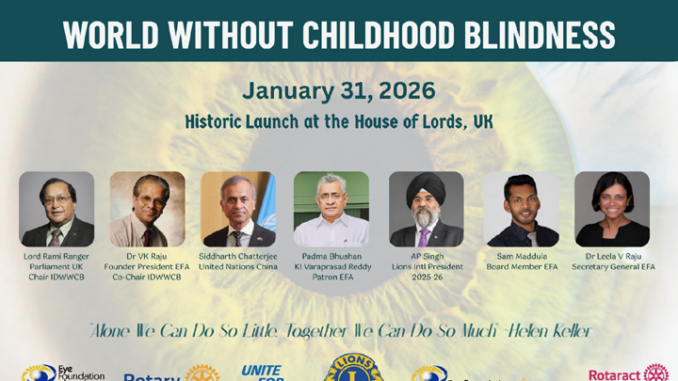

NEW YORK (TIP): On January 31, 2026, history will be made at the House of Lords, London—not through legislation alone, but through conscience, compassion, and collective global resolve. On this landmark day, world leaders, visionaries, humanitarians, and institutions will unite to commemorate and formally launch the International Day for a World Without Childhood Blindness (IDWWCB)—a movement anchored in hope and driven by one unshakable belief: no child should be denied sight because of where they are born.
The choice of January 31 is profoundly symbolic. It traces back to January 31, 1977, when a young ophthalmologist, Dr. V. K. Raju, conducted his first eye camp in Vijayawada, India—unknowingly igniting a mission that would span continents, generations, and millions of lives. Nearly five decades later, that humble act of service has evolved into a global moral movement.
Presiding over this historic commemoration is Lord Rami Ranger, Member of the UK House of Lords and Chair of IDWWCB, whose lifelong commitment to equity, inclusion, and humanitarian causes brings unmatched moral authority and global visibility to the movement. Standing alongside him as Co-Chair is Dr. V. K. Raju, Founder President of the Eye Foundation of America (EFA)—the lighthouse of inspiration whose life’s work has proven that childhood blindness is not inevitable, but preventable.
Global Leadership at the Highest Level
Underscoring the global importance of this movement, the Chief Guest for the commemoration will be Mr. Siddharth Chatterjee, United Nations Resident Coordinator in China—a senior UN leader and a globally respected voice on sustainable development, equity, and human dignity.
In his address, Mr. Chatterjee will reaffirm the United Nations’ commitment to childhood blindness elimination as a core development priority, emphasizing that:
> “Preventing childhood blindness is among the most powerful and cost-effective interventions in global development—protecting not only sight, but education, dignity, productivity, and generational hope.”
His presence powerfully aligns IDWWCB with the United Nations Sustainable Development Goals, particularly SDG-3 (Good Health and Well-Being) and SDG-4 (Quality Education), reinforcing that vision care is not charity—it is nation-building and future-building.
A Visionary Patron and Humanitarian Icon
Adding further gravitas to the occasion is the presence of Padma Bhushan Dr. Vara Prasad Reddy, Founder Chairman of Shantha Biotechnics, global healthcare pioneer, and Patron of the Eye Foundation of America, who will attend as Guest of Honour.
A towering figure in India’s public health and pharmaceutical revolution, Dr. Reddy’s association reflects the movement’s deep commitment to scalable, affordable, and sustainable healthcare solutions. His journey—bringing life-saving vaccines to millions at affordable costs—mirrors the very philosophy of IDWWCB: high impact, low cost, global equity.
Dr. Reddy’s message will echo a powerful truth:
> “If the world could democratize vaccines, it can democratize vision. Childhood blindness is solvable—what we need is collective will and institutional commitment.”
A Convergence of Global Forces
The gathering at the House of Lords represents a rare and powerful convergence. Leaders from the United Nations, Lions Clubs International, Rotary International, Eye Foundation of America, Eye Foundation UK, global medical institutions, CSR champions, philanthropists, and youth movements—including the Rotaract Club of World Without Childhood Blindness—will stand united under one shared conviction.
Helen Keller’s immortal words resonate through the hall:
> “Alone we can do so little; together we can do so much.”
Why This Movement Matters Now
Globally, an estimated 1.4 million children are blind, with millions more suffering from preventable or treatable visual impairment. Conditions such as refractive errors, congenital cataracts, vitamin A deficiency, and Retinopathy of Prematurity (ROP) continue to steal sight at the very start of life. The real tragedy lies not in the statistics—but in the fact that over 75% of childhood blindness is preventable or curable.
Vision is foundational to learning. Over 90% of a child’s learning happens through sight, directly linking childhood eye health to education, employability, and social inclusion. When a child cannot see, the consequences ripple across families, communities, and economies—often for a lifetime. Restoring sight, by contrast, delivers one of the highest returns on investment in global health.
Proof That Change Is Possible
Through the Eye Foundation of America and its partners, millions of children across India, Africa, the United States, the UK, and beyond have already been screened and treated. National ROP programs, school eye health initiatives , and community-based care models have demonstrated that eliminating childhood blindness within a generation is not aspirational—it is achievable, much like the eradication of polio.
The leadership of Lions International , Rotary’s Unite for Good platform, visionary donors like Dr. Sam Maddula, and the disciplined stewardship of Dr. Leela V. Raju, President of EFA, ensure that this movement remains accountable, scalable, and results-driven.
Equally important is the leadership of youth—because this is not only a legacy movement, but a future-defining one.
A Global Moral Commitment
As the lights of the House of Lords illuminate this defining moment, January 31, 2026 will stand as more than a date—it will mark a global moral commitment.
A commitment that geography should not decide destiny.
That poverty should not determine sight.
That every child, everywhere, has the right to see, learn, and dream.
The International Day for a World Without Childhood Blindness is not the culmination of a journey—it is the beginning of global acceleration.
Because when the world comes together for sight, the future becomes brighter—for all.
This initiative is truly inspiring—preventing childhood blindness at scale while building education and dignity for millions. The convergence of UN leadership, humanitarian organizations, and medical institutions shows how serious global commitment can be. Dr. Raju’s journey from a single eye camp in 1977 to this worldwide movement is a powerful reminder that one person’s compassion can transform generations. The focus on cost-effective, preventable solutions makes this not just noble, but pragmatic.
a senior UN leader and a globally respected voice on sustainable development, equity, and human dignity.