Tag: Barack Obama

  • Beau Biden, son of vice president and former Delaware AG, dies at 46

    Beau Biden, son of vice president and former Delaware AG, dies at 46

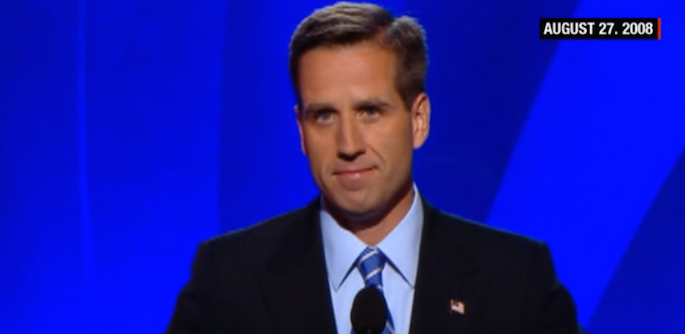
    Beau Biden died of brain cancer at the age of 46 on Saturday. Beau, the son of Vice President Joe Biden, was being treated at the Walter Reed Military Medical Center in Bethesda, MD, at the time of his death. The Iraq War veteran and former attorney general of Delaware had previously planned to run for the state's governorship in 2016.
    Vice President Biden commented on his son's death in the following statement released by the White House:

    It is with broken hearts that Hallie, Hunter, Ashley, Jill and I announce the passing of our husband, brother and son, Beau, after he battled brain cancer with the same integrity, courage and strength he demonstrated every day of his life.

    The entire Biden family is saddened beyond words. We know that Beau’s spirit will live on in all of us—especially through his brave wife, Hallie, and two remarkable children, Natalie and Hunter.

    Beau’s life was defined by service to others. As a young lawyer, he worked to establish the rule of law in war-torn Kosovo. A major in the Delaware National Guard, he was an Iraq War veteran and was awarded the Bronze Star. As Delaware’s Attorney General, he fought for the powerless and made it his mission to protect children from abuse.

    More than his professional accomplishments, Beau measured himself as a husband, father, son and brother. His absolute honor made him a role model for our family. Beau embodied my father’s saying that a parent knows success when his child turns out better than he did.

    In the words of the Biden family: Beau Biden was, quite simply, the finest man any of us have ever known.

    President Barack Obama also honored Beau's memory, sharing his thoughts in the following statement:
    Michelle and I are grieving tonight. Beau Biden was a friend of ours. His beloved family – Hallie, Natalie, and Hunter – are friends of ours. And Joe and Jill Biden are as good as friends get.
    Beau took after Joe. He studied the law, like his dad, even choosing the same law school. He chased a life of public service, like his dad, serving in Iraq and as Delaware's Attorney General. Like his dad, Beau was a good, big-hearted, devoutly Catholic and deeply faithful man, who made a difference in the lives of all he touched – and he lives on in their hearts.
    But for all that Beau Biden achieved in his life, nothing made him prouder; nothing made him happier; nothing claimed a fuller focus of his love and devotion than his family.
    Just like his dad.
    Joe is one of the strongest men we've ever known. He's as strong as they come, and nothing matters to him more than family. It's one of the things we love about him. And it is a testament to Joe and Jill – to who they are – that Beau lived a life that was full; a life that mattered; a life that reflected their reverence for family.
    The Bidens have more family than they know. In the Delaware they love. In the Senate Joe reveres. Across this country that he has served for more than forty years. And they have a family right here in the White House, where hundreds of hearts ache tonight – for Hallie, Natalie, and Hunter; for Joe and for Jill; for Beau's brother, Hunter; his sister, Ashley, and for the entire Biden clan.
    'I have believed the best of every man,' wrote the poet William Butler Yeats, 'And find that to believe it is enough to make a bad man show him at his best or even a good man swing his lantern higher.'
    Beau Biden believed the best of us all. For him, and for his family, we swing our lanterns higher.
    Michelle and I humbly pray for the good Lord to watch over Beau Biden, and to protect and comfort his family here on Earth.
  • Appeals court upholds injunction on Obama immigration actions

    Appeals court upholds injunction on Obama immigration actions

    NEW ORLEANS (TIP): A United States appeals court ruled Tuesday, May 26, against the Obama administration, refusing to lift a temporary hold on the president’s executive orders to shield nearly five million illegal immigrants from deportation.

    The US Justice Department had requested that the US 5th Circuit Court of Appeals overrule a Texas judge who had temporarily blocked the president’s plan in February, after 26 states had filed a lawsuit claiming Obama’s actions were unconstitutional.

    A three-judge panel denied the government’s request by a vote of two to one with the majority ruling the president’s action should remain on hold. Two of three judges on a panel of the United States Court of Appeals for the Fifth Circuit, in New Orleans, left in place an injunction by a Federal District Court judge in Brownsville, Tex. The ruling comes in a lawsuit filed by Texas. Obama’s immigration action was first blocked by Texas Judge Andrew Hanen after he agreed with the 26 states who filed the lawsuit. The states party to the lawsuit alleged that it would be overly burdensome to take in migrants.

    “The president’s attempt to bypass the will of the American people was successfully checked again today,” Texas Governer Greg Abbott said in a news release.

    The White House said the two judges who ruled against the Obama administration chose to “misinterpret the facts and the law.”

    “The president’s actions… are squarely within the bounds of his authority and they are the right thing to do for the country,” White House spokeswoman Brandi Hoffine said.

    A US official speaking anonymously said the Justice Department is currently considering its next steps.

    The 5th circuit will rule in the coming months on whether the Obama administration can appeal the block of the executive order. If it is denied the chance to appeal, government could potentially take its case to the supreme court.

    The first of Obama’s plans, expanding a program that shields young migrants from deportation if they were brought to the US illegally as children was to begin on February 18. The second part of the plans, shielding the parents of US citizens and permanent residents from deportation if they had lived in the US for several years was supposed to take effect May 19.

    Immigration activists said the decision was not unexpected, given the 5th circuit is known as one of the most conservative courts in the nation.

    “We are disappointed, but this is not unexpected at all,” said Merielena Hincapie, executive director of the National Immigration Law Center, adding that she was optimistic Obama’s order would be upheld on appeal. The Obama administration could eventually take its case to the US Supreme Court.

  • DHS starts accepting work permit applications for H4 visa holders

    DHS starts accepting work permit applications for H4 visa holders

    The US Department of Homeland Security (DHS) yesterday started accepting the applications for H-4 visas.

    Issuing employment authorisation card (EAD) to certain category of spouses of H-1B visas is one of the legislative measures taken by President Barack Obama to fix the immigration system of the country.

    As a result, about 1,80,000 would be eligible to work in the US.

    According to the DHS, it will issue EAD within 90 days of receiving the application.

    Under existing regulations, DHS does not extend employment authorisation to dependents (also known as H—4 nonimmigrants) of H—1B nonimmigrant workers.

    The new rules allow H—4 dependent spouses of certain H—1B nonimmigrant workers to request employment authorisation, as long as the H—1B worker has already started the process of seeking lawful permanent residence through employment.

    [quote_box_right]

    H4 Visa Holders EAD Eligibility 2014 Rules

    Firstly, NOT all H4 visa holders are eligible for the Employment Authorization Document ( EAD).  H4 Visa holders have to fall under one of the below category to be eligible for EAD.

    • Have an approved I-140.    or ( The I-140 refers to the Immigrant Petition for Alien work to get permanent residence – aka Green Card – in United states  )
    • Have been granted extension to authorized stay beyond 6 years under AC21 Act. ( The American Competitiveness in the Twenty-first Century Act of 2000 (AC21)  allows H1B visa holders seeking lawful permanent residence ( Green Card) to work and stay in United States beyond the six year limit, if their PERM/Green Card Processing is pending )

    The above rule is Final and has been passed. USCIS will accept applications for H4 visa EAD from May 26, 2015

    [/quote_box_right]

    Also, some stats on the impact about the H4 Visa Holders EAD Eligibility 2014 Rule.

    • This new proposed rule will enable about 97,000 H4 visa holders to be immediately eligible for employment authorization ( EAD)
    • Also, about 30,000 H4 visa holders would be eligible annually going forward to avail this EAD facility.

    The complete details of the proposed rule will be published in the Federal Register soon. The above information is on a high level and does not list all the details.

    Why DHS is giving EAD for H4 Visa holders  ?

    DHS explains in the federal register that the justification to allow H4 visa holders is to reduce the negative economic effects that H1B households face with one income during the lengthy waiting time of adjustment of status to legal permanent residence. Also, this rule will help H1B holders not to quit and leave their Green Card/ Permanent residence application processing because their H4 spouse cannot work.  Also, it explains that the impact of this rule would only have a negligible increase in domestic work force, which should not raise any eyebrows that jobs are reduced for locals.

    Also Read : 

    NO STOPPING | H4 WORK PERMITS A GO: SAVE JOBS USA LAWSUIT DISMISSED

  • 11 Year-Old Indian American Boy Graduates From College

    11 Year-Old Indian American Boy Graduates From College

    Los Angeles:  An Indian-American home-schooled boy has surprised one and all by graduating from a US college at the age of 11 with three associate degrees in mathematics, science and foreign language studies.

    Tanishq Abraham, a native of Sacramento, California, graduated from American River College in Sacramento (ARC), California, alongside 1,800 students.

    Abraham is the youngest person to graduate from American River College this year.

    “The assumption is that he’s the all-time youngest,” American River College spokesman Scott Crow told NBC News.

    Abraham, last year, became one of the youngest ever in the US to graduate high school.

    Home-schooled since the age of 7, Abraham passed a state exam in March last year that certified he had met the appropriate academic standards to receive his high school diploma. His achievement last year had earned the attention of President Barack Obama — who had sent Tanishq a congratulatory letter.

    Abraham joined MENSA, the prominent high IQ society, when he was only four-years-old.

    Abraham told a local TV station that the milestone of graduating from college was not “much of a big thing for me.”

    His mother, Taji Abraham, said he has always been ahead of the class.

    “Even in kindergarten he was pretty ahead, a few years ahead – and then it just went from there,” she told KCRA-TV.

    Abraham said some of the students at the college “were intimidated” by him but a lot of others “were really happy” to have a kid in their classes. He graduated with three associate degrees from the college.

    On his college graduation cap, Abraham wore his favourite “Toy Story” quote: “2 Infinity and Beyond.”

    As for what comes next for the child prodigy, Abraham said: “I want to become a doctor, but I also want to become a medical researcher, and also the president of the United States.”

    “I like to learn. So I just followed my passion of learning, and that’s how I ended up here,” he told Fox News.

  • President Obama names Indian-American Yale Professor to key administrative post

    President Obama names Indian-American Yale Professor to key administrative post

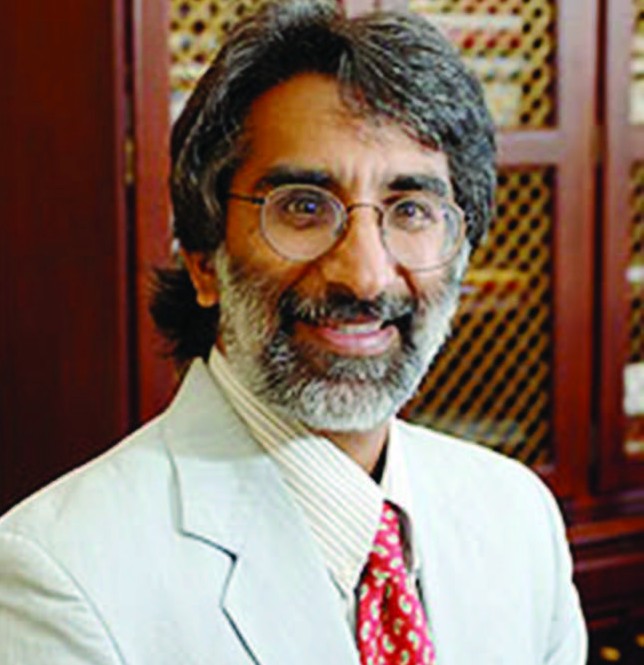
    WASHINGTON (TIP): President Barack Obama has named an Indian-American professor from Yale University as a member of the prestigious National Council on Humanities.

    The nomination of Akhil Amar, Sterling Professor of Law and Political Science at the university since 2008, was announced   by Obama along with other key administration positions.

    “I am confident that these outstanding individuals will serve the American people well, and I look forward to working with them,” the President said in a statement.

    Amar has been a professor at both Yale Law School and Yale College since 1985 and has held various professorships, including Southmayd Professor from 1993 to 2008, Professor from 1990 to 1993, Associate Professor from 1988 to 1990, and Assistant Professor from 1985 to 1988.

    He also worked as a law clerk to Judge Stephen Breyer, then of the US Court of Appeals for the First Circuit, from 1984 to 1985.

    He is co-editor of a constitutional law casebook, ‘Processes of Constitutional Decision-making’, and has written several other books on constitutional law.

    Amar is a member of the Board of Directors of the Constitutional Accountability Center and the Coalition of Freedom Advisory Board of the National Constitution Center.

    He was elected a Fellow of the American Academy of Arts and Sciences in 2007 and was named a Senior Scholar by the National Constitution Center in 2000.

    He received a BA from Yale College and a JD from Yale Law School.

  • Hurdle cleared in Senate on bill to give Obama fast-track authority on Pacific Rim trade deal

    WASHINGTON (TIP): President Obama got a respite when Republicans and a small number of Democrats rescued his trade agenda from the brink of failure Thursday, May 21, clearing a key hurdle in the Senate.

    However, doubts linger about the final outcome. The legislation’s fate in the House remains a tossup because Obama faces entrenched opposition from his own party.

    But the Senate victory on Thursday   kept alive Obama’s bid to secure a broad trade deal with Pacific Rim nations by advancing legislation that would give him expanded authority to complete the accord.

    On a vote of 62 to 38, the measure for fast-track authority received just enough Democratic support to keep it moving, following a last-ditch lobbying effort by Obama and his top advisers. The fate of the legislation, known as trade promotion authority, hung in the balance for more than 30 minutes during the vote.

    During an afternoon meeting with his Cabinet at the White House, Obama thanked the senators who supported his push for fast-track powers, calling the vote “a big step forward this morning on a trade agenda that is consistent with strong labor standards, strong environmental standards and access to markets that too often are closed even as these other countries are selling goods in the United States.”

    “It’s an agenda that is good for U.S. businesses, but most importantly, it is good for American workers,” Obama said.

    Obama has said that he needs fast-track authority to complete the deal with the other nations, which represent about 40 percent of the global economy. If approved by Congress, it would allow for a trade deal to be presented to the House and the Senate under strict timelines and require a simple up-or-down vote without any amendments or requirements of a Senate super-majority to end debate.

    Senate leaders hope to finish with the legislation over the weekend, possibly as early as Friday.

    This week’s near-breakdown came as about 10 Democrats – who wavered over the legislation last week – issued a demand that congressional GOP leaders assure them that they would approve an extension of the federally backed bank that helps U.S. corporations sell their goods abroad. Many conservatives, particularly in the House, oppose renewing the charter of the Export-Import Bank because they consider it a form of corporate welfare that favors large, well-connected businesses, particularly Boeing.

    Republicans, who have worked unusually closely with the Democratic administration over the past few months on their shared goal of advancing global trade, warned before the vote that those senators supporting the Export-Import Bank should not expect help from Senate Majority Leader Mitch McConnell (R-Ky.) if Thursday’s vote failed.

    As the roll call blew beyond the originally planned 15 minutes, the lawmakers reached a deal on the Export-Import Bank that tipped the scales for Cantwell and Sen. Patty Murray (D), senators from Washington State, which relies on the thousands of jobs at Boeing plants that are tied to Export-Import Bank loans. Working with Sen. Lindsey O. Graham (R-S.C.), whose state also has large Boeing factories, they brought with them four additional Democrats to clear the 60-vote hurdle.

    In the end, 49 Republicans and 13 Democrats voted to advance the legislation, while five Republicans and 33 members of the Democratic caucus opposed it.

  • Obama offers Gulf nations  ‘ironclad’ security cooperation

    Obama offers Gulf nations ‘ironclad’ security cooperation

    CAMP DAVID Maryland (TIP) : President Barack Obama pledged America’s ”ironclad commitment” to anxious Persian Gulf nations Thursday to help protect their security, pointedly mentioning the potential use of military force and offering assurances that a potential nuclear agreement with Iran would not leave them more vulnerable.

    At the close of a rare summit at the presidential retreat at Camp David, Obama said the U.S. would join the Gulf Cooperation Council nations “to deter and confront an external threat to any GCC state’s territorial integrity.” The U.S. pledged to bolster its security cooperation with the Gulf on counterterrorism, maritime security, cybersecurity and ballistic missile defense.

    ”Let me underscore, the United States keeps our commitments,” Obama said at a news conference.

    Thursday’s meeting at Obama’s retreat in the Maryland mountains was aimed at quelling the Gulf’s fears of
    U.S.-led nuclear talks with Iran. Gulf states worry that if Iran wins international sanctions relief, the influx of cash would embolden what they see as Tehran’s aggression in the region.

    The president acknowledged those concerns, but said the U.S. believes Iran’s focus would be on shoring up an economy that has struggled under the sanctions pressure.

    Obama and top advisers walked the Gulf nations through the work-in-progress nuclear deal in detail during private meetings Thursday. The president said that while the Gulf leaders hadn’t been asked to ”sign on the bottom line” to approve the framework, they did agree ”that a comprehensive, verifiable solution that fully addresses the regional and international concerns about Iran’s nuclear program is in the security interests of the international community, including our GCC partners.”

    Saudi Foreign Minister Adel al-Jubeir said Arab leaders were ”assured that the objective is to deny Iran the ability to obtain a nuclear weapon” and that all pathways to such a weapon would be cut off.

    He added that it was too early to know if a final nuclear agreement would be acceptable, saying, ”We don’t know if the Iranians will accept the terms they need to accept.”

    The U.S. and five other nations are working to finalize the nuclear deal ahead of an end of June deadline.

    As if to underscore Gulf concerns, an Iranian naval patrol boat fired on a Singapore-flagged commercial ship in the Persian Gulf Thursday. A U.S. official said it was an apparent attempt to disable the ship over a financial dispute involving damage to an Iranian oil platform.

    The incident took place a bit south of the island of Abu Musa just inside the Gulf, according to the U.S. official, who was not authorized to discuss details by name. The White House said no Americans were involved in the incident. Ben Rhodes, Obama’s deputy national security adviser, said that while the incident did not come up in Thursday’s discussions, it was ”exactly the type of challenge” the Gulf nations are focused on.

    Al-Jubeir, for his part, said, ”The Iranians should not be allowed to get away with it.”

    Obama has said he shares the Gulf’s concerns about Iran’s activities in the region. The U.S. has criticized Iran’s support for Hezbollah, as well as attacks carried out by Iran’s Quds Force. In 2011, the Obama administration accused Iran of plotting to kill the Saudi ambassador to the United States in Washington.

    Thursday’s summit marked an unusual investment by Obama in his relationship with the Gulf. He rarely uses Camp David for personal or official business, but White House aides hoped the more intimate setting would lead to a more candid conversation with the Arab allies.

    Just two other heads of state – the emirs of Qatar and Kuwait – joined Obama at Camp David. Saudi Arabia, United Arab Emirates, Oman and Bahrain all sent lower-level but still influential representatives.

    As the leaders gathered around a large table in the Laurel lodge, the most notable absence was Saudi King Salman. On Sunday, Saudi Arabia announced that the king was skipping the summit, two days after the White House said he was coming.

    Crown Prince Mohammed bin Nayef and Deputy Crown Prince Mohammed bin Salman were representing Saudi Arabia instead.

    The White House and Saudi officials insisted the king was not snubbing Obama. But there are indisputable signs of strain in the long relationship between the U.S. and Saudi Arabia, driven not only by Obama’s Iran overtures but also by the rise of Islamic State militants and a lessening U.S. dependency on Saudi oil.

    Among the other issues discussed at the summit were the U.S-led campaign against the Islamic State, the fighting in Syria, and the intractable conflict between Israelis and Palestinians.

    The Saudis are also particularly concerned about the situation in Yemen, where Houthi rebels with ties with Iran have ousted the U.S.- and Saudi-backed leader.

    For more than a month, a Saudi-led coalition has tried to push back the Houthis with a bombing campaign. A five-day humanitarian cease-fire went into effect Tuesday, though the pause in fighting was at risk amid a series of violent incidents.

  • House sends Iran nuclear deal bill to Obama

    House sends Iran nuclear deal bill to Obama

    WASHINGTON (TIP): The House of Representatives approved legislation Thursday, May 14 that allows Congress to review any deal on Iran’s nuclear program negotiated by the Obama Administration.

    The measure passed with an overwhelming bipartisan vote 400-25.

    The bill, which was passed by the Senate last week 98-1, now goes to the President for his signature. Initially the White House resisted efforts to give Congress a role in weighing in on an agreement. But once it became apparent that both Republicans and Democrats had a veto-proof majority, the White House said it would support a compromise crafted by Senate Foreign Relations Committee Chairman Bob Corker, R-Tennessee and the top Democrat on the panel, Sen Ben Cardin, D-Maryland. During the House debate on the bill Republicans emphasized that they were deeply skeptical that the Administration could reach a significant deal with Iran, a country they said repeatedly engaged in state sponsored terrorism.

    “I fear that the agreement that is coming will be too short, sanctions relief will be too rapid, inspectors will be too restricted, and Iran’s missile program will be plain ignored,” Rep. Ed Royce, R-California, the Chairman of the House Foreign Affairs Committee said on the House floor.

    Even Democrats expressed doubt that the Obama Administration could get the kind of agreement they could back.

    “I agree with Secretary Kerry when he says that no deal is better than a bad deal. The question is, we want to make sure a bad deal isn’t sold as a good deal. And that’s why it’s important for Congress to be engaged,” Rep. Eliot Engel, the top Democrat on the House Foreign Relations Committee said on the House floor.

    A group of House conservatives pressed House Republican leaders to allow some changes to the Senate bill, arguing it didn’t go far enough to ensure that the lifting of sanctions didn’t mean Iran could funnel money to terror groups. But their effort was turned down because leaders believed any effort to reopen the compromise would unravel it and leave Congress with no role.

    Instead, as a gesture to these conservatives, GOP leaders allowed a vote on a separate measure that would impose sanctions on any foreign banks who do business with Hezbollah, the Lebanese militant organization. A similar House bill passed unanimously last year, but was never considered by the Senate.

  • US arms Pakistan with combat aircraft, trainer jets

    US arms Pakistan with combat aircraft, trainer jets

    WASHINGTON (TIP): As the United States withdraws its forces from Afghanistan, the Obama administration has armed Pakistan with 14 combat aircraft, 59 military trainer jets and 374 armored personnel carriers, an internal Congressional report has said.

    The major defense articles have been transferred to Pakistan under its ‘Excessive Defense Article’ category, which are mostly from its war combat zones of Afghanistan and Iraq.

    India had in the past have opposed the transfer of such arms to Pakistan as it believes Islamabad would eventually use the fighter jets against it.

    According to an internal report prepared by Congressional Research Service – an independent research wing of the Congress – Pakistan has either made full payment or will make payments from its national funds towards the purchase of 18 new F-16C/D Block 52 Fighting Falcon combat aircraft worth USD1.43 billion.

    This includes F-16 armaments including 500 AMRAAM air-to-air missiles; 1,450 2,000-pound bombs; 500 JDAM Tail Kits for gravity bombs; and 1,600 Enhanced Paveway laser-guided kits. All this has cost Pakistan USD629 million.

    Pakistan has also paid USD298 million for 100 harpoon anti-ship missiles, 500 sidewinder air-to-air missiles (USD95 million); and seven Phalanx Close-In Weapons System naval guns (USD80 million).

    Under Coalition Support Funds (in the Pentagon budget), Pakistan received 26 Bell 412EP utility helicopters, along with related parts and maintenance, valued at USD235 million.

    Pakistan is also receiving military equipment with a mix of its national funds and America’s foreign military funding.

    These include 60 Mid-Life Update kits for F-16A/B combat aircraft (valued at USD891 million, with USD477 million of this in FMF).

    Pakistan has purchased 45 such kits, with all upgrades completed to date. This include 115 M-109 self-propelled howitzers (USD87 million, with USD53 million in FMF).

    Under Frontier Corps, and Pakistan Counterinsurgency Fund authorities, US has provided four Mi-17 multirole helicopters (another six were provided temporarily at no cost), four King Air 350 surveillance aircraft, and 450 vehicles.

    Pakistan has also received 20 Buffalo explosives detection and disposal vehicles, helicopter spare parts, explosives detectors, night vision devices, radios, body armor, helmets, first aid kits, litters, and individual soldier equipment.

    Through International Military Education and Training and other programs, the US has funded and provided training for more than 2,000 Pakistani military officers.

    In April, the State Department approved a possible USD- 952 million FMS deal with Pakistan for 15 AH-1Z Viper attack helicopters and 1,000 Hellfire II missiles.

    Congress has appropriated about USD3.6 billion in Foreign Military Financing for Pakistan since 2001, more than two-thirds of which has been disbursed.

    President Barack Obama has slowed the drawdown of the roughly 10,000 US troops remaining in Afghanistan until at least the end of the year.

  • BOBBY JINDAL: OBAMA TURNING ‘AMERICAN DREAM INTO EUROPEAN NIGHTMARE’

    BOBBY JINDAL: OBAMA TURNING ‘AMERICAN DREAM INTO EUROPEAN NIGHTMARE’

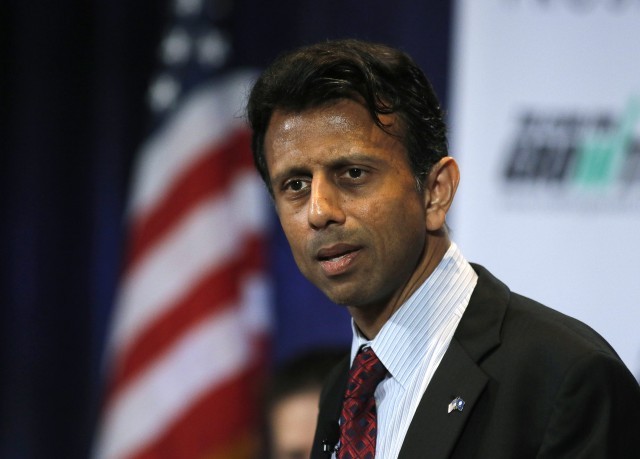
    On Saturday in South Carolina, Louisiana Governor and potential 2016 GOP presidential candidate Bobby Jindal accused President Barack Obama of trying to turn the American Dream into the “European nightmare.”

    Speaking at the Freedom Summit, which was sponsored by Citizens United and Rep. Jeff Duncan (R-SC), Jindal told voters in the first-in-the-South primary state that the “greatest threat we face from the Obama administration” is “what he is doing to redefine the idea of America, the idea of the American Dream.”

    Jindal said after dividing Americans by “race, gender, geography,” Obama is trying to redefine the American Dream “into one about dependence, about government growth, about government spending.”

    He accused Obama of wanting to make “us sound more and more like Europe” and said Obama’s left-leaning policies make it seem like he is intent on turning “the American Dream into the European nightmare.”

    Jindal cited radical Islamic terrorism as an external threat and the assault on religious liberty at home as an internal threat that must be confronted so that America does not fundamentally transform and remains the country his immigrant father loved so much that he told Jindal to pray each day and thank God “that you were blessed to be born in the greatest country in the history of the world.”

    Regarding radical Islamic terrorism, Jindal said “for some reason we have a president who doesn’t even like to use those words to discuss the enemy that we face.” After saying he was thankful that the two terrorists who opened fire last week in Garland Texas at a Mohammed cartoon exhibit that celebrated free speech were “sent to their afterlife,” Jindal said that Muslim leaders have an obligation to denounce individual terrorists by name and make it clear that they are not martyrs who will enjoy rewards in the afterlife but rather “will go straight to hell, where they belong.” He also called on Muslim leaders to declare that they “tolerate and respect the freedoms of others with religious beliefs different from their own.”

    “It is not racist, anti-Muslim to demand that these leaders condemn terrorists, these thugs, these evil, evil individuals,” Jindal said, noting that the left likes to denounce anyone critical of radical Islam as being intolerant or insensitive.

    Jindal also said the “assault on religious liberty we see taking place across the entire country” must be stopped. Citing the Hobby Lobby case, Duck Dynasty patriarch Phil Robertson, and recent religious freedom cases in Indiana and Arkansas, Jindal said “there are no other freedoms without religious liberty” and blasted the left for “trying to silence us” and prevent Americans from living “our lives according to our faith, 24 hours a day, seven days a week.”

    “The United States of America did not create religious liberty,” he said. “Religious liberty created the United States of America.”

    He told the story of his immigrant parents who went from India to Baton Rouge and said he was tired of “hyphenated-Americans.” Jindal said people should be referred to as Americans instead of Indian-Americans, Asian-Americans, African-Americans, etc. He noted that his mother told him that she would have stayed in India if she wanted to raise Jindal as an Indian or an Indian-American and said his mother “came here to be an American.”

    “If we stay united, nobody can beat us,” he said.

  • Obama to enter presidents’ ‘50 state club’

    Obama to enter presidents’ ‘50 state club’

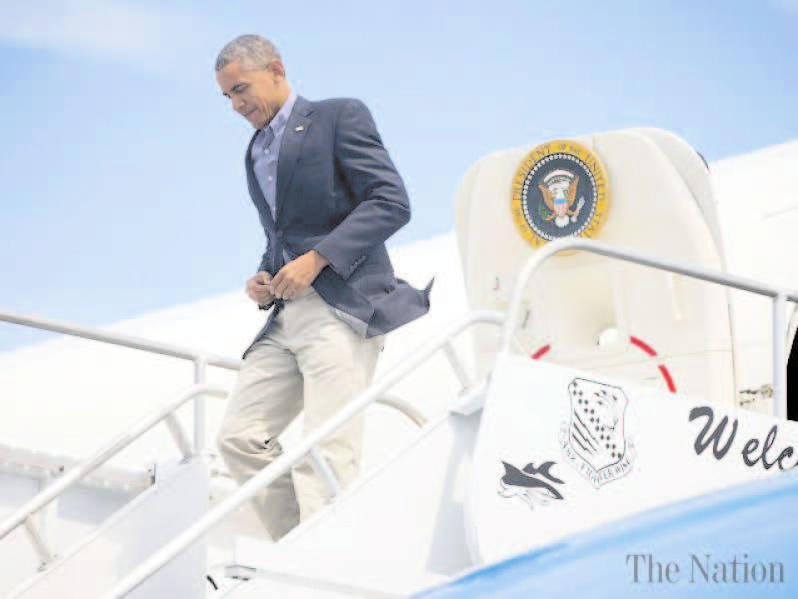
    WASHINGTON (TIP): When Barack Obama steps off Air Force One in South Dakota on May 7, he will join an exclusive group of US presidents who have visited all 50 US states while in office.

    Jimmy Carter, Ronald Reagan and George W Bush didn’t do it.

    After 49 states, Bush did not fancy a trip to liberal Vermont during the financial crisis.

    But Bill Clinton did and George Bush senior managed it in just one term.

    US presidencies are made and measured by big speeches and grand symbolic gestures, but also figures and statistics.

    How many times has the president vetoed a bill from Congress? How many executive orders were issued? How many state dinners were hosted at the White House? And how many states did he visit?

    “Visiting all 50 States is an important goal,” said Brendan Doherty of the politics department at the United States Naval Academy.

    “State identity matters so much in the American system: Presidential elections are held by States, there are equal State representations in the Senate.”

    “Even if they have already visited states where over 99 percent of the American population live, they want to make a visit to each state simply so that they can say that they have.”

    Obama took to local channel KSFY-TV to announce the trip, which will include a commencement address at the Lake Area Technical Institute.

    “May 8th we’re coming,” he said. “I can’t let my South Dakota friends feel neglected.”

    South Dakota secretary of tourism James Hagen, who invited Obama to visit as far back as 2013, said “I am absolutely convinced he is saving the best for last.”

    It might be surprising that such a history-minded president would wait so long to visit the state that is home to Mount Rushmore — a rock face emblazoned with the likenesses of George Washington, Thomas Jefferson, Theodore Roosevelt and Abraham Lincoln. But even in his election drubbings of Republicans John McCain in 2008 and Mitt Romney in 2012, Obama was roundly defeated in the state.

    With a solidly Republican voter base, South Dakota is far from Washington, with a population of less than a million and with only three of 538 electoral votes up for grabs at the presidential elections. It was never going to be top of Obama’s travel list.

    But with no more elections to run, Obama may as well make a visit.

  • Strategic Autonomy as an Indian Foreign Policy Option

    Strategic Autonomy as an Indian Foreign Policy Option

    [quote_right]For a large country like India, which has the potential of becoming a big power in the future, strategic autonomy is a compelling choice. By virtue of its demographic, geographic, economic and military size, India must lead, but does not have yet the comprehensive national power to do so. It cannot subordinate itself to the policies and interests of another country, however powerful, as its political tradition and the functioning of its democracy will not allow this. India may not be strong enough to lead, but it is sufficiently strong not to be led”, says the author.[/quote_right]

    In the joint statement issued during the Indian prime minister’s visit to France in April, the two sides reaffirmed “their independence and strategic autonomy” in joint efforts to tackle global challenges. In the French case, as a member of NATO it is not so clear what strategic autonomy might mean, but in our case it would essentially mean independence in making strategic foreign policy decisions, and, consequently, rejecting any alliance relationship. It would imply the freedom to choose partnerships as suits our national interest and be able to forge productive relationships with countries that may be strategic adversaries among themselves.

    In practical terms, this means that India can improve relations with the United States of America and China while maintaining close ties with Russia. It can forge stronger ties with Japan and still seek a more stable relationship with China. It can forge strong ties with Israel and maintain very productive ties with the Arab world, including backing the Palestinians in the United Nations. It means that India can have strategic partnerships with several countries, as is the case at present with the US, France, Germany, the United Kingdom, the European Union, Russia, China, Japan, Brazil, Saudi Arabia, Australia, Canada, Kazakhstan, Afghanistan, Vietnam, Iran and the like.

    It means that India can be a member of BRICS and the RIC dialogues, as well as IBSA, which exclude the West, and also forge closer political, economic and military ties with the Western countries. Our strategic autonomy is being expressed in other ways too. India is a democracy and believes that its spread favors its interests, but it is against the imposition of democracy by force on any country. If the spread of democracy is in India’s strategic interest, using force to spread it is against its strategic interest too, as is shown by the use of force to bring about democratic changes in West Asia by destroying secular authoritarian regimes and replacing them with Islamic authoritarian regimes. Likewise, India believes in respect for human rights, but is against the use of the human rights agenda to further the geo-political interests of particular countries, essentially Western, on a selective basis.

    For a large country like India, which has the potential of becoming a big power in the future, strategic autonomy is a compelling choice. By virtue of its demographic, geographic, economic and military size, India must lead, but does not have yet the comprehensive national power to do so. It cannot subordinate itself to the policies and interests of another country, however powerful, as its political tradition and the functioning of its democracy will not allow this. India may not be strong enough to lead, but it is sufficiently strong not to be led.

    India preserved its strategic autonomy even in the face of severe technology sanctions from the West on nuclear and missile issues. It preserved it by not signing the non-proliferation treaty and continuing its missile program. By going overtly nuclear in 1998, India once again exercised its strategic autonomy faced with attempts to close the doors permanently on its nuclear program by the permanent extension of the NPT and the comprehensive nuclear test ban treaty and fissile material cutoff treaty initiatives.

    In some quarters in India and abroad, the idea of strategic autonomy is contested as another manifestation of India’s non-aligned mindset, its propensity to sit on the fence, and avoid taking sides and assuming responsibility for upholding the present international order as a rising power should. These critics want India to join the US camp more firmly to realize its great power ambitions. These arguments ignore the reality that while the US has been crucial to China’s economic rise, China has been sitting on the fence for many years, even as a permanent member of the UN security council. Far from sacrificing its strategic autonomy, it has become a strategic challenger of the US.

    To be clear, the US government has officially stated its respect for India’s position on preserving its strategic autonomy, and denies any expectation that India would establish an alliance kind of relationship with it. It is looking for greater convergence in the foreign policies of the two countries, which is being realized.

    During Narendra Modi’s visit to the US in September, 2014, and Barack Obama’s visit to India in January this year, a strategic understanding on Asia Pacific and Indian Ocean issues, encapsulated in the January 2015 joint strategic vision for the Asia Pacific and the Indian Ocean has emerged. This document suggests a shift in India’s strategic thinking, with a more public position against Chinese maritime threat and a willingness to join the US in promoting partnerships in the region.

    Modi chose a striking formulation in his joint press conference with Obama in September when he said that the US was intrinsic to our Look East and Link West policies, which would suggest a growing role for the US in our foreign policy thinking. During Obama’s January visit, the joint statement noted that India’s Act East policy and the US rebalance to Asia provided opportunities for India, the US and other Asia-Pacific countries to work closely to strengthen regional ties. This was the first time that India implicitly endorsed the US rebalance towards Asia and connected our Act East policy to it.

    Rather than interpreting it as watering down our strategic autonomy, one can see it as strengthening it. So far, India has been hesitant to be seen drawing too close strategically to the US because of Chinese sensitivities. China watches closely what it sees are US efforts to rope India into its bid to contain China. At the same time, China continues its policies to strengthen its strategic posture in India’s neighborhood and in the Indian Ocean at India’s expense, besides aggressively claiming Indian territory.

    By strengthening relations with the US (which is strategically an Asian power), Japan and Vietnam, and, at the same time, seeking Chinese investments and maintaining a high-level dialogue with it, India is emulating what China does with India, which is to seek to build overall ties as much as possible on the economic front, disavow any negative anti-India element in its policies in our neighborhood, but pursue, simultaneously, strategic policies intended to contain India’s power in its neighborhood and delay its regional extension to Asia.

    In discussing the scope of our strategic autonomy, one should recognize that the strength of US-China ties, especially economic and financial, far exceeds that of India-US ties. India has to be careful, therefore, in how far it wants to go with the US with a view to improving its bargaining power with China. The other point to consider is the US-Pakistan equation. The US has just announced $1 billion of military aid to Pakistan; its position on the Taliban is against our strategic interests in Afghanistan; its stand on Pakistan’s sponsorship of terrorism against us is not robust enough.

    To conclude, strategic autonomy for India means that it would like to rely as far as possible on its own judgment on international issues, balance its relations with all major countries, forge partnerships with individual powers and take foreign-policy positions based on pragmatism and self-interest, and not any alliance or group compulsion.

    (The author is former foreign secretary of India. He can be reached at sibalkanwal@gmail.com)

  • Is Obama administration soft on Illegal Immigrants?

    Is Obama administration soft on Illegal Immigrants?

    While Republicans may fret and fume over Obama’s executive order on immigration which allows temporary legal status to millions of illegal immigrants, along with an indefinite reprieve from deportation, the fact remains the Obama administration has deported more undocumented immigrants than any other administration in history.

    Facts seem to point out that Obama administration, while being liberal on the Immigration reforms, has however in the past 5 years, deported a record number of illegal immigrants.

    As per a research done by Pew Research Centre, the Obama administration deported a record 438,421 unauthorized immigrants in fiscal year 2013, continuing a streak of stepped up enforcement that has resulted in more than 2 million deportations since Obama took office, released Department of Homeland Security data show.

    The total number of deportations during Obama’s tenure passed 2 million in early 2014.

    Another change that happened in 2013 is that a record 363,000 (83%) of deportations were carried out without appearing before a judge – either through an order issued by an enforcement agent (called expedited removal) or by using a previous order of deportation (called reinstatement of final orders).

    FT_Deportations2013

  • Obama chooses Chicago to host his presidential library

    Obama chooses Chicago to host his presidential library

    WASHINGTON (TIP): President Barack Obama has chosen his hometown of Chicago to host his future presidential library, two individuals with knowledge of the decision said Thursday, placing the permanent monument to his legacy in the city that launched his improbable ascent to the White House.

    Obama’s library will be built on Chicago’s South Side, where the University of Chicago has proposed two potential sites not far from the Obama family’s home. It was unclear which of the two sites had been selected, but officials were expected to make an announcement within weeks.

    The decision brings to a close a hard-fought competition that kicked off in the earliest days of Obama’s second term. From an initial list of about a dozen proposals, the Barack Obama Foundation chose four universities to vie for the library. In recent months it became increasingly clear that the Obamas were leaning toward the University of Chicago, the elite private school where Obama taught law before becoming president.

    The University of Chicago’s victory marks a harsh letdown for the other three schools on the short list: The University of Hawaii, New York’s Columbia University and the University of Illinois at Chicago, a public school that proposed building the library on Chicago’s West Side.

    Obama’s decision to place the library in Chicago was conveyed to The Associated Press by two individuals with direct knowledge of the decision. Both spoke on condition of anonymity because the decision has yet to be publicly announced.

    Obama’s foundation, the University of Chicago and the White House all declined to comment.

  • Indian, American Scientists Chosen for Environmental Prize

    Indian, American Scientists Chosen for Environmental Prize

    LOS ANGELES (TIP): This year’s Tyler Prize for Environmental Achievement is being awarded to two scientists who have worked for conservation on the land and in the ocean.

    Madhav Gadgil of India and Jane Lubchenco of the United States are being honored for working with communities to preserve the environment while protecting people’s livelihoods.

    Bamboo crops in the Western Ghats, a mountain range in western India, have been depleted by the paper industry. Gadgil said that has hurt local villagers who rely on the plants to make baskets and other products.

    Earlier, the crops “were exploited through the state machinery and largely they were auctioned off to  traders, to industries,” said Gadgil, a visiting professor at India’s Goa University who works with villagers to keep the ecosystem balanced and let the bamboo groves flourish. “Now the communities have rights to manage these.”

    He said that for generations, villagers have preserved parts of the forest as sacred, something that also happens in other parts of Asia.

    Gadgil said he serves as a bridge between local people and government, which wants to promote modern management techniques. He has focused on documenting the sacred forests and the kind of biodiversity resources that have been conserved, and finding out “what is now in the current context possible.”

    Gadgil traveled to Los Angeles to receive the Tyler Prize and to meet this year’s other winner, Lubchenco. A marine ecologist, she teaches at Oregon State University and served four years as the head of the U.S. National Oceanic and Atmospheric Administration. Last year, President Barack Obama named her U.S. science envoy for the ocean.

    Lubchenco has worked with American fishermen to restore depleted fisheries through “catch shares,” strategies that grant fishing rights to fishermen but put limits on their catch in affected areas.

    “Our basic idea of oceans is that they are so immense, so bountiful that we can take anything out and put anything in and it would not make much of a difference. And we have discovered that is simply not the case,” she said.

    The system of catch shares gives fishermen a share of the ocean harvest, and those rights can be bought, sold and traded. The system has its critics, but Lubchenco and other supporters point to its success in restoring depleted stocks.

    She said that limiting fishing on the high seas is difficult. “There are a lot of efforts under way to rein in overfishing, but it remains a huge challenge and it has global ramifications,” she said.

    Lubchenco said governments must lead, and local communities must be part of the solution.

    Gadgil said the same is true of the Indian villagers with whom he works.

    “Of course they have a substantial amount of understanding, local understanding, of that resource base and what is impacting it, what might be good sustainable-use practices,” he said.

    The prize winners said the balance of life in the ocean and on land is essential for a healthy planet and healthy communities.

  • Indian, American Scientists Chosen for Environmental Prize

    Indian, American Scientists Chosen for Environmental Prize

    LOS ANGELES (TIP): This year’s Tyler Prize for Environmental Achievement is being awarded to two scientists who have worked for conservation on the land and in the ocean.

    Madhav Gadgil of India and Jane Lubchenco of the United States are being honored for working with communities to preserve the environment while protecting people’s livelihoods.

    Bamboo crops in the Western Ghats, a mountain range in western India, have been depleted by the paper industry. Gadgil said that has hurt local villagers who rely on the plants to make baskets and other products.

    Earlier, the crops “were exploited through the state machinery and largely they were auctioned off to traders, to industries,” said Gadgil, a visiting professor at India’s Goa University who works with villagers to keep the ecosystem balanced and let the bamboo groves flourish. “Now the communities have rights to manage these.”

    He said that for generations, villagers have preserved parts of the forest as sacred, something that also happens in other parts of Asia.

    Gadgil said he serves as a bridge between local people and government, which wants to promote modern management techniques. He has focused on documenting the sacred forests and the kind of biodiversity resources that have been conserved, and finding out “what is now in the current context possible.”

    Gadgil traveled to Los Angeles to receive the Tyler Prize and to meet this year’s other winner, Lubchenco. A marine ecologist, she teaches at Oregon State University and served four years as the head of the U.S. National Oceanic and Atmospheric Administration. Last year, President Barack Obama named her U.S. science envoy for the ocean.

    Lubchenco has worked with American fishermen to restore depleted fisheries through “catch shares,” strategies that grant fishing rights to fishermen but put limits on their catch in affected areas.

    “Our basic idea of oceans is that they are so immense, so bountiful that we can take anything out and put anything in and it would not make much of a difference. And we have discovered that is simply not the case,” she said.

    The system of catch shares gives fishermen a share of the ocean harvest, and those rights can be bought, sold and traded. The system has its critics, but Lubchenco and other supporters point to its success in restoring depleted stocks.

    She said that limiting fishing on the high seas is difficult. “There are a lot of efforts under way to rein in overfishing, but it remains a huge challenge and it has global ramifications,” she said.

    Lubchenco said governments must lead, and local communities must be part of the solution.

    Gadgil said the same is true of the Indian villagers with whom he works.

    “Of course they have a substantial amount of understanding, local understanding, of that resource base and what is impacting it, what might be good sustainable-use practices,” he said.

    The prize winners said the balance of life in the ocean and on land is essential for a healthy planet and healthy communities.

  • Obama amnesty greater threat to blacks than police brutality: experts

    Obama amnesty greater threat to blacks than police brutality: experts

    Economic and civil rights experts say increased immigration spurred by President Obama’s executive orders poses a bigger threat to the black community than police brutality or racial profiling, which have sparked protests in black communities across the country.

    “It’s a bigger threat to black livelihood,” Peter Kirsanow, a member of the U.S. Commission on Civil Rights, said, adding that illegal immigration “dwarfs” the more inflammatory issues of police brutality, saying, “When you look at the hundreds of thousands of blacks thrown out of work over the years as a result of the competitive pressure the downstream effects are profound.”

    The number of unemployed black workers in the U.S. is soaring, according to data from the Bureau of Labor Statistics. Over 12.2 million black people of working age were not in the labor force in March, meaning they had neither been employed nor actively sought a job for at least four weeks.

    The labor force participation rate for black men ages 20 and older is more than 5 percentage points lower than it is for white men, and for those in the labor force, the black unemployment rate is more than double the white unemployment rate, at 10.1 percent versus 4.7 percent.

    Loosened immigration policy will only compound the problem.

    As more illegal immigrants enter the U.S., encouraged by the president’s sweeping executive actions, they flood low-skilled labor markets once dominated by blacks, which ultimately decreases wages and increases job competition for low-skilled black workers, said Mr. Kirsanow.


    “The long-term, large-scale flow of immigration into the United States has worked to erode both the wages and employment prospects of African-American workers,” said Sen. Jeff Sessions, Alabama Republican and chairman of the Senate Judiciary Committee subcommittee on Immigration and the National Interests, in a statement to The Times.

    “Yet the Senate’s ‘Gang of Eight’ plan would have doubled future immigration from its existing record levels. As a nation, our first duty is always to our own citizens, especially those who have sacrificed so much for this country. Any responsible immigration plan must promote higher wages, rising employment and improved working conditions for people already living here,” he said.

    Increasing unemployment rates in the black community can lead to numerous other negative social consequences, Mr. Kirsanow said.

    “When unemployment rates increase, black institutionalization rates also increase. Individuals who don’t have jobs are less likely to be married or to get married, which means you are more likely to have kids out of wedlock. It’s a self-perpetuating negative cycle,” Mr. Kirsanow said. “These are the things that the Congressional Black Caucus and the president have refused to address and are things that are tremendously harmful to the prospects of black Americans economically, socially and culturally.”

    A spokeswoman for the Congressional Black Caucus did not reply to a request by The Times for comment.

    While Mr. Kirsanow opposed the president’s immigration policies, his colleagues on the Civil Rights Commission came out in support of President Obama’s executive orders issued in November, jumping on the political bandwagon at the time.

    However, a 2008 briefing report to the Civil Rights Commission on the effects of immigration on wages and employment opportunities for black workers clearly stated that more illegal immigration hurts low-skilled black workers.

    “About six in 10 adult black males have a high school diploma or less, and black men are disproportionately employed in the low-skilled labor market, where they are more likely to be in labor competition with immigrants,” the report reads. “Illegal immigration to the United States in recent decades has tended to depress both wages and employment rates for low-skilled American citizens, a disproportionate number of whom are black men.”

    Commission Chair Martin Castro, who was not a member of the commission when the 2008 study was conducted, has said that the report was missing key data that contradicted the overall findings and plans to call for a review of the study.

    Some economists say that increased immigration doesn’t hurt low-skilled American workers because the two groups don’t typically do the same jobs.

    Low-skilled Americans, nearly all of whom speak English, tend to work in jobs that require communication skills, while low-skilled immigrants, who mostly don’t, tend to do jobs that require manual labor, Alex Nowrasteh, immigration policy analyst at the Cato Institute, explained.

    He cited research from economists Gianmarco Ottaviano and Giovanni Peri, who found in their studies in 2008 and 2010 that more immigration tends to raise overall wages for U.S.-born workers.

    But while economists agree that immigration improves living standards and wages on average, studies are divided on whether immigration reduces wages for certain groups of workers. Some studies suggest that immigration has reduced wages for low-skilled workers without a high school diploma and college graduates.

    A 2007 study by economists George Borjas and Lawrence Katz found that increases in immigrant workers from 1990 to 2006 reduced the wages of low-skilled workers by 4.7 percent and college graduates by 1.7 percent.

    In 2009 Mr. Borjas, a Harvard professor, specifically studied the effects of immigration on the economic status of black men and found that a 10 percent immigrant-induced increase in the supply of a particular skill group reduced black wages by 2.5 percent, lowered the employment rate of black men by 5.9 percentage points and increased the incarceration rate of blacks by 1.3 percentage points.

    “It is evident that there is a negative correlation between changes in employment propensities and the immigrant share, and that the correlation is stronger for black men,” Mr. Borjas wrote.

    But Mr. Nowrasteh explained that more people coming in to the country is good for the U.S. economy, and said that the bigger threat to wages for low-skilled workers is technological change.

    “Studies on skilled-bias technological change find a lot of the new machines, computers [and] ways to automate manufacturing increase the wages of high-skilled people a lot more and potentially decrease the wages of lower-skilled people,” Mr. Nowrasteh said, adding that the same economic effects have been observed in countries that don’t accept many immigrants.

    Multiple polls show that Americans across the board, regardless of race or political alignment, want less immigration.

    In a nationwide survey conducted between August and October of 2014, The Polling Company, Inc. asked over 1,000 adults: “If U.S. businesses have trouble finding workers, what should happen?”

    In total, 75 percent said businesses should raise wages and improve working conditions to attract American workers, while only 8 percent said more immigrants workers should be allowed in to the country to fill those jobs.

    Eighty-six percent of blacks surveyed said businesses should increase wages rather than hire more immigrants, and 71 percent of Hispanics said the same thing.

    Seventy-four percent of Republican responders and 79 percent of Democratic responders also said businesses should increase wages to attract American employees.

    In a January 2015 Gallup poll, 39 percent of Americans said they were dissatisfied with current immigration levels and wanted less immigration rather than more.

    Factors other than illegal immigration do contribute to black unemployment, and halting illegal immigration is not a panacea for the issues with decreased wages for low-skilled black workers, Mr. Kirsanow explained. But the effect on low-skilled minority workers must be considered by lawmakers in forming comprehensive immigration reform policies, he said, adding that it must start with following the laws already in place.

    “We are not serious about securing the border; we are not serious about enforcement; we are not serious about e-verify. All of these things would be extremely helpful to low-skilled workers and, particularly, black Americans,” Mr. Kirsanow said.

  • Barack Obama gets ‘anger translator’ at WH Correspondents Dinner

    Barack Obama gets ‘anger translator’ at WH Correspondents Dinner

    President Barack Obama boasts comic timing commensurate with his position, and in his jokey routine at this year’s White House Correspondents’ Dinner, he gleefully skewered news channels from CNN to Fox News, Vice Presidents current and former, not to mention the entire Republican presidential field. “A few weeks ago, Dick Cheney says he thinks I’m the worst president of his lifetime,” Mr Obama said. “Which is interesting because I think Dick Cheney is the worst president of my lifetime.”

    Speaking at the dinner on 25 April, held at the Washington DC Hilton, Mr Obama also mocked his own Vice President, who has a habit of giving unprompted back rubs to the unsuspecting. “I feel more loose and relaxed than ever,” Mr Obama said. “Those Joe Biden shoulder massages are like magic. You should try one… Oh, you have?” Despite the teasing, the President said, he and Mr Biden are great friends. “We’ve gotten so close in some places in Indiana, they won’t serve us pizza anymore,” he added.

    On the theme of gay marriage, Mr Obama noted that prospective GOP presidential candidate Rick Santorum recently told an interviewer he would decline an invitation to a same-sex wedding of a friend or loved one, “To which gays and lesbians across the country responded: ‘That’s not going to be a problem. Don’t sweat that one.’”

    The President also introduced “Luther”, his “anger translator” – played by Keegan-Michael Key of the comedy duo Key and Peele. While Mr Obama made his characteristically relaxed pronouncements, “Luther” offered a less mellow translation. “In our fast changing world, traditions like the White House Correspondents’ Dinner are important,” said Mr Obama, translated by an irate Luther as: “I mean really what is this dinner? And why am I required to go to it?”

    United States President Barack Obama, right, uses actor Keegan-Michael Key from Key & Peele to play the part of 'Luther, President Obama's anger translator'
    United States President Barack Obama, right, uses actor Keegan-Michael Key from Key & Peele to play the part of ‘Luther, President Obama’s anger translator’

    The annual event – which brings together politicians, the Washington press corps, and a smattering of Hollywood celebrities – is known to many as “nerd prom”. Guest host Cecily Strong acknowledged as much when she joked, “Some of the cast of the epic fantasy series Game of Thrones is here, and they told me that even they have never seen this many nerds before.”

    Ms Strong, who has a day-job as a cast member on Saturday Night Live, made light of recent controversies concerning the relationship between law enforcement and the black community, saying, “President Obama, your hair is so white now it can talk back to the police.” She also suggested that the Secret Service, which makes up Mr Obama’s security detail, is “the only law enforcement agency that will get in trouble if a black man gets shot.”

    If Hillary Clinton wins the race to the White House in 2016, she will have to address the Correspondents’ Dinner herself the following year. Of Ms Clinton, Ms Strong said, “I think she feels the same way Meryl Streep feels when she’s asked to audition for something: ‘Are you kidding me? You’re making me go through this? You know I’m going to win.’ ”

    Mr Obama, too, joked about his former Secretary of State’s road tripping campaign, saying the US economy had become so dire, “I had a friend, just a few weeks ago, she was making millions of dollars a year – and now she’s living out of a van in Iowa.”

  • US is often unsure about who will die in drone strikes

    US is often unsure about who will die in drone strikes

    WASHINGTON (TIP): Barack Obama inherited two ugly, intractable wars in Iraq and Afghanistan when he became president and set to work to end them. But a third, more covert war he made his own, escalating drone strikes in Pakistan and expanding them to Yemen and Somalia.

    The drone’s vaunted capability for pinpoint killing appealed to a president intrigued by a new technology and determined to try to keep the United States out of new quagmires. Aides said Obama liked the idea of picking off dangerous terrorists a few at a time, without endangering American lives or risking the years long bloodshed of conventional war.

    “Let’s kill the people who are trying to kill us,” he often told aides.

    By most accounts, hundreds of dangerous militants have, indeed, been killed by drones, including some high-ranking al-Qaida figures. But for six years, when the heavy cloak of secrecy has occasionally been breached, the results of some strikes have often turned out to be deeply troubling.

    Every independent investigation of the strikes has found far more civilian casualties than administration officials admit. Gradually, it has become clear that when operators in Nevada fire missiles into remote tribal territories on the other side of the world, they often do not know who they are killing, but are making an imperfect best guess.The president’s announcement on Thursday that a January strike on al-Qaida in Pakistan had killed two Western hostages, and that it took many weeks to confirm their deaths, bolstered the assessments of the program’s harshest outside critics. The dark picture was compounded by the additional disclosure that two American members of al-Qaida were killed in strikes that same month, but neither had been identified in advance and deliberately targeted.

    In all, it was a devastating acknowledgment for Obama, who had hoped to pioneer a new, more discriminating kind of warfare. Whether the episode might bring a long-delayed public reckoning about targeted killings, long hidden by classification rules, remained uncertain.Even some former Obama administration security officials have expressed serious doubts about the wisdom of the program, given the ire it has ignited overseas and the terrorists who have said they plotted attacks because of drones. And outside experts have long called for a candid accounting of the results of strikes.

    “I hope this event allows us at last to have an honest dialogue about the US drone program,” said Rachel Stohl, of the Stimson Center, a Washington research institute. “These are precise weapons. The failure is in the intelligence about who it is that we are killing. “Stohl noted that Obama and his top aides have repeatedly promised greater openness about the drone program but have never really delivered on it.

    In a speech in 2013 about drones, Obama declared that no strike was taken without “near-certainty that ano civilians will be killed or injured.” He added that “nevertheless, it is a hard fact that US strikes have resulted in civilian casualties” and said “those deaths will haunt us as long as we live.”

  • Obama sends chadar to Ajmer Sufi shrine

    Obama sends chadar to Ajmer Sufi shrine

    NEW DELHI: A red coloured Chadar (Holy Cloth), which was sent by US President Barack Obama on the occasion of the 803th annual Urs of Hazrat Khawaja Moinudeen Chishty, was offered at Ajmer Dargah Sharif in Rajasthan on Monday, Press Trust of India said. 

    The Chadar with a message ‘Greeting of Peace’ from Mr Obama was handed over to Haji Syed Salman Chishty, Director of the Chishty Foundation by the US Ambassador in India Richard Verma. 

    According to Haji Chishty, the Chadar was received from the US Embassy a few days back.


    GUEST COMMENTS :

    Thank you Mr. President for this gesture, although a majority of Muslims do not subscribe to this ritual, almost all Indians regardless of their religion respect the Saint and pay a homage to him. It is not an Islamic value, but a cultural value. 

    I’ve been there with my late wife to honor this man who forged healthy relationships between people of different faiths.  I can never forget that day – Najma was around 50 then, and we were not comfortable under the green chaddar (cloth covering the shrine). The Mujawar (care taker of the shrine) suggested that if we do the minnat (wish) for a child, and tie the dhaga (string) to the metal screen around, the saint may bless us to have a child. It is all belief and I wish all the visitors the best. 

    As a Pluralist who admires the pluralistic ethos of India, I welcome this step, and hope Mr. Modi follows it as well. I fully understand Mr. Modi’s predicament, he wants to do a lot of good for “all Indians” but he is not trained to do that. Not all, but many kids coming out of an RSS Madrasa or a Muslim Madrasa have an exclusive language…their language does not figure others, and they don’t know how to talk about all Indians as Indians – A few Muslims talk negatively about Hindus and the same percent of Hindus do the opposite; talk negatively about Muslims. 

    What matters is, if we can have a good heart for all people, every one would be better off. There is no need to do the score keeping either. These are the small things that go a long ways in building better societies, as envisaged by the Vedas – Vasudhaiva Kutumbukum as well as Quran. 

    Mike Ghouse, President
    America Together Foundation
    (214) 325-1916 text/talk


    Mike Ghouse is a public speaker, thinker, writer and a commentator on Pluralism,Islam, India, Israel-Palestine, Politics and other issues of the day. He is a human rights activist, and his book standing up for others will be out soon | He is producing a full feature film ” Sacred” to be released on 9/11 and a documentary “Americans together” for a July 4 release.  He is a frequent guest commentator on Fox News and syndicated Talk Radio shows and a writer at major news papers including Dallas Morning News and Huffington Post. All about him is listed in 63 links atwww.MikeGhouse.net and his writings are at www.TheGhousediary.com – Mike is committed to building cohesive societies and offers pluralistic solutions on issues of the day. 

  • Candidate Hillary

    Candidate Hillary

    OnApril 12, Hillary Clinton moved one step closer to becoming the first-ever woman President of the United States. The 2016 election will be her second presidential run. To succeed this time she will have to eschew the theme of
    “inevitability” that had crept into her bruising primaries battle against Barack Obama in 2008, and that ultimately sank her campaign. The former First Lady was off to a quick start in her campaign video and came out swinging for the fences as a would-be “champion of everyday Americans”. The implied focus on the welfare of the middle class is a throwback to liberal Democratic values and poses a challenge to Republican Party free-marketeers. It may also reflect her intention to separate her record from that of the inc umbent Mr. Obama; this was mostly evident in her comment that “the cards are still stacked” against the common person. Ms. Clinton is indeed a different beast to the President, although pundits predict she will borrow elements of campaign design from her former boss, and indeed the social media strategies employed so ably by Team Modi in 2013-14. Buttressing her nuts-and-bolts approach to campaign management, she can be expected to project her deep understanding of the paralysed politics of Washington, and be unapologetic about her political pedigree.

    But will all this be enough? And if it is, will she reshape the American story to fit better into a turbulent world?The Republican Party is not throwing up any inspiring leaders. Among the hopefuls, Jeb Bush has the clout of his last name but not much else. Ted Cruz is considered to be a fringe candidate, even among Republican heavyweights. Marco Rubio has passable charisma and an important connection to the Latino community, but he would flounder if he went toe-to-toe against a much more experienced Ms. Clinton. Though her entry into the Oval Office is far from being a certainty as of now, the greater challenge for her may be knowing what to do once she gets there. She was, after all, leading the Obama action that fumbled through the Arab Spring. Would she do it differently a second time? The rise of Islamic State will certainly dominate the attention of the next POTUS. She also promised, in a 2010 speech, that the administration would think “smart power” and focus on multilateralism, regional architectures and broad-strategic engagements with countries such as India, Russia and China. Clearly that dream didn’t materialise. On domestic policy , however, the Obama years offer hope. Just as he tackled the inequities of the health-care system head-on, Ms. Clinton could do much to close the gender pay gap, tackle America’s rape crisis, and upgrade its education system to help the millennials thrive in the workforce. That, and much more. Her time is now.

  • Obama Signs Bill Fixing Medicare Doctors’ Pay

    Obama Signs Bill Fixing Medicare Doctors’ Pay

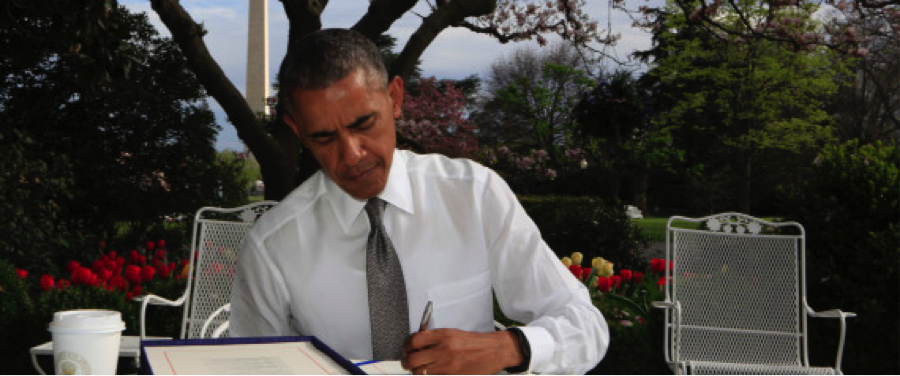
    WASHINGTON, April 16 (Reuters) – U.S. President Barack Obama signed a bill into law on Thursday that repairs the formula for reimbursing Medicare physicians after Congress, in rare bipartisan fashion, passed a fix earlier this week to prevent a 21 percent cut in doctors’ pay.

    Sitting outside in the White House Rose Garden in his shirt sleeves, Obama said he was signing the bill now rather than waiting for a formal ceremony so it could go into force right away.

    “This was a bipartisan effort,” Obama said, adding he hoped the practice of Republicans and Democrats working together would become a habit on Capitol Hill.

    “Because we wanted to make sure doctors’ payments didn’t get cut off, I’m signing it now.”

    The measure replaces a 1990s formula that linked Medicare doctor pay to economic growth, with a new formula more focused on quality of care. It also requires means-testing of Medicare beneficiaries so higher income people pay higher premiums.

  • Obama nominates Indian American Shamina Singh to Key Federal Post

    Obama nominates Indian American Shamina Singh to Key Federal Post

    President Barack Obama makes another Indian-American Appointment; appoints Shamina Singh as member of the Board of Directors of the Corporation for National and Community Service for a term expiring in October 2019.

    The nomination of Shamina Singh, executive director of the MasterCard Centre for Inclusive Growth since December 2013, has been sent to the Senate, according to a White House announcement on Monday.

    She joined MasterCard in 2013 as the global director for government services and solutions where she expanded MasterCard’s business capabilities to digitise social subsidy programmes in over 40 countries.

    Prior to joining MasterCard, Shamina led government and public affairs for Nike and spent five years with Citigroup’s Global Community Development Group.

    Over the course of 15 years in the public sector, she held senior positions within the Clinton Administration and the US House of Representatives.

    She is a Young Global Leader and Member of the Global Agenda Council on India with the World Economic Forum, a Henry Crown Fellow with the Aspen Institute and served on the Presidential Advisory Commission on Military Leadership Diversity.

    Shamina has a graduate degree in public policy from the Lyndon B. Johnson School for Public Affairs at the University of Texas, Austin, and has completed executive programmes at Harvard’s Kennedy School of Government, Yale’s Jackson Institute for Diplomacy and the India School of Business.

    In 2003, she served as a senior advisor to US House Democratic Leader Nancy Pelosi and in 2002 was the deputy campaign manager for the Ron Kirk for US Senate campaign.

    Shamina Singh was executive director for the President’s Advisory Commission on Asian Americans and Pacific Islanders and the White House Initiative on Asian Americans and Pacific Islanders from 1999 to 2001.

  • The GOP Fight Against Obama’s Immigration Order Seems Lost

    The GOP Fight Against Obama’s Immigration Order Seems Lost

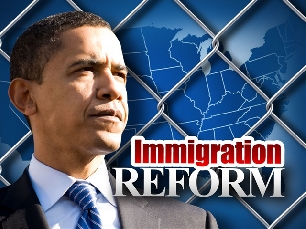
    The White House asked Texas Judge Hanen to stop blocking Obama’s executive orders on immigration. The judge refused, but that might not matter for long, as the appeals court will most likely overturn the ruling. For members of the Republican party, a successful appeal could hurt their standing with fellow conservatives.

    In his ruling, Judge Hanen blasted Obama’s most recent legal defense of his executive orders, which will allow as many as four million undocumented immigrants to avoid deportation.

    “Whether by ignorance, omission, purposeful misdirection, or because they were misled by their clients, the attorneys for the government misrepresented the facts.”

    According to The Hill, Hanen was incensed because the administration failed to report an additional 100,000 work permits for undocumented immigrants until last month. The latest hearing only seemed to steady the Judge’s resolve to stop the immigration orders as long as possible, throwing a few more criticisms at Obama’s attorneys in his ruling.

    “Fabrications, misstatements, half-truths, artful omissions and the failure to correct misstatements may be acceptable, albeit lamentable, in other aspects of life. But in the courtroom, when an attorney knows that both the court and the other side are relying on complete frankness, such conduct is unacceptable.”

    Despite the judge’s indignation, his ruling will face a major challenge on April 17, when the Obama administration brings the case before the United States Court of Appeals for the Fifth Circuit.

    According to the New York Times, the court signaled how it would handle Judge Hanen’s injunction in a ruling on a case similar in many aspects.

    State officials in Mississippi and immigration agents brought a lawsuit against separate immigration orders from Obama in 2012. His executive orders temporarily shielded undocumented immigrants who arrived in the U.S. as minors from deportation, paving the way for the Dreamers Act.

    The Fifth Court of Appeals threw out that lawsuit on Tuesday – the day after Judge Hanen’s ruling. The judges claimed that since the immigration orders didn’t harm the agents or state officials, they had no legal standing to put up the challenge.

    The court will likely overturn Judge Hanen’s injunction using the same logic.

    That could mean a loss of standing to some Republicans on Capitol Hill.

    As Fox News reported last month, Obama’s immigration executive orders were at the center of a battle to defund the Department of Homeland Security. Republicans initially wanted to withhold DHS funding to force a compromise with Obama over the immigration orders. Ultimately, Congress passed a clean DHS funding bill rather than hurt the organization responsible for the defending the homeland, creating a divide in the GOP.

    As previously reported by the Inquisitr, Senator Lindsey Graham was one of the moderate voices rallying against defunding the DHS.

    “I am willing and ready to pass a DHS funding bill and let this play out in court. The worst possible outcome for this nation is to defund the Department of Homeland Security given the multiple threats we face to our homeland. And I will not be part of that.”

    Now, that it looks like the court will likely throw out the injunction, the GOP’s last hope of blocking the Obama’s immigration orders looks bleak, and some members of the Republican Party might have to walk away feeling betrayed by fellow politicians advising them to “leave it to the courts.”

  • Legal Status – Special Free Screening in NY on 12th April – Obama Immigration Plan

    Legal Status – Special Free Screening in NY on 12th April – Obama Immigration Plan

    Commissioner Agarwal announced a Special Free  Screening by trusted attorneys on the12th April where anyone can come and explore his/her case on getting legal status in the United States. The Screening is planned at the  Jewish Temple – Emanu-EL in upper East side (1st East 65th Street) for the 12th April between 11am to 5pm.

    Registration is free and to schedule appointments anyone can register by calling 212 419 3700 

    A guidebook to City , State and Federal laws -Immigrant Rights and Services Manual- in 6 Languages has been prepared to remove the language barrier for the benefit of immigrants.

    New York City’s new Indian American Commissioner Nisha Agarwal has rolled out a special series of engagements with the immigrant community clearly taking the biggest issue of her office bulls on.

    After assuming office in February, 2015 she, along with her team, started with Mayor de Blassio’s Municipal ID Card Program which is open to all NYC residents  regardless of immigration status. The Program has already seen applications in excess of a 100,000 and is growing . More centers  for  application processing are being set up to speed up the process and reduce delays, said Commissioner Nisha Agarwal.

    Commissioner Agarwal has also launched a special initiative to providing Free Legal screening by trusted immigration attorneys and Non-Profit Law firms.

    Commissioner Agarwal at a press briefing, April 2, held at the Centre for Community & Ethnic Media of CUNY Graduate School of Journalism started by saying that they will do everything possible for the over 200,000 illegal immigrants in New York City. She further stated that Obama’s Immigration reform, if approved, will help millions of immigrants get legal status in the United States. She laid special emphasis on reducing and checking Immigration Fraud and how her office is getting the City ready with good legal support for them.