Tag: Barack Obama

  • New York Mayor’s  initiative on Obama’s Executive Order on Immigration

    New York Mayor’s initiative on Obama’s Executive Order on Immigration

    NEW YORK  (TIP) : New York City’s new Indian American Commissioner Nisha Agarwal has rolled out a special series of engagements with the immigrant community clearly taking the biggest issue of her office bulls on.

    After assuming office in February, 2015 she, along with her team, started with Mayor de Blassio’s Municipal ID Card Program which is open to all NYC residents  regardless of immigration status. The Program has already seen applications in excess of a 100,000 and is growing . More centers  for  application processing are being set up to speed up the process and reduce delays, said Commissioner Nisha Agarwal.

    Commissioner Agarwal has also launched a special initiative to providing Free Legal screening by trusted immigration attorneys and Non-Profit Law firms.

    Commissioner Agarwal at a press briefing, April 2, held at the Centre for Community & Ethnic Media of CUNY Graduate School of Journalism started by saying that they will do everything possible for the over 200,000 illegal immigrants in New York City. She further stated that Obama’s Immigration reform, if approved, will help millions of immigrants get legal status in the United States. She laid special emphasis on reducing and checking Immigration Fraud and how her office is getting the City ready with good legal support for them.

    Commissioner Agarwal announced a Special Free  Screening by trusted attorneys on the12th April where anyone can come and explore his/her case on getting legal status in the United States. The Screening is planned at the  Jewish Temple – Emanu-EL in upper East side (1st East 65th Street) for the 12th April between 11am to 5pm.

    Registration is free and to schedule appointments anyone can register by calling 212 419 3700 

    A guidebook to City , State and Federal laws -Immigrant Rights and Services Manual- in 6 Languages has been prepared to remove the language barrier for the benefit of immigrants.

  • Deepening Ties Will Shape Global Balance of Power: Indian-American Diplomat

    Deepening Ties Will Shape Global Balance of Power: Indian-American Diplomat

    NEW YORK:  The deepening India-US ties are among the most significant strategic developments of the past several years and will shape the global balance of power in the years to come, a senior Obama Administration official has said.

    “In South Asia, we’re strengthening our security, economic, and people-to-people ties with India. In my view, India’s revival and deepening US-India ties are among the most significant strategic developments of the past several years,” US Assistant Secretary, Bureau of Political-Military Affairs Puneet Talwar said yesterday.
    “They will shape the global balance of power for many years to come,” the Indian-American diplomat said while addressing a session in San Francisco on US foreign policy priorities in 2015.

     
    He said that as the oldest and largest democracies, the US and India are seeing a natural convergence not only of values, but of “our vision for the future”.

    Mr Talwar cited President Barack Obama’s historic visit to India this year as Chief Guest on the Republic Day in January and said that while India is one of the world’s oldest civilisations, it has the world’s most young people, with a median age of 27 and 600 million people under the age of 25.

  • IRAN NUCLEAR DEAL – framework announced

    IRAN NUCLEAR DEAL – framework announced

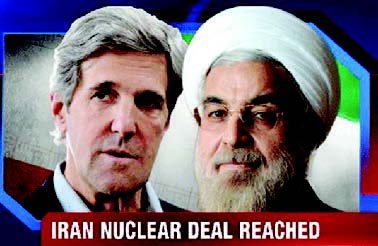
    LAUSANNE, SWITZERLAND (TIP): April 2, 2015 becomes historic as Iran Nuclear deal framework is announced. It is a significant step towards a landmark deal aimed at keeping Iran’s nuclear program peaceful. Iran would reduce its stockpile of low-enriched uranium by 98% and significantly scale back its number of installed centrifuges, according to the plan. In exchange, the United States and the European Union would lift sanctions that have crippled the country’s economy. “It is a good deal, a deal that meets our core objectives,” U.S. President Barack Obama said in a speech from the White House Rose Garden. “This framework would cut off every pathway that Iran could take to develop a nuclear weapon.”

    The deal would include strict verification measures to make sure Iran complies, he said.

    “If Iran cheats,” Obama said, “the world will know it.”

    Given below are the key parameters of a Joint Comprehensive Plan of Action (JCPOA) regarding the Islamic Republic of Iran’s nuclear program that were decided in Lausanne, Switzerland.  These elements form the foundation upon which the final text of the JCPOA will be written between now and June 30, and reflect the significant progress that has been made in discussions between the P5+1, the European Union, and Iran. Important implementation details are still subject to negotiation, and nothing is agreed until everything is agreed. “We will work to conclude the JCPOA based on these parameters over the coming months”, a White House statement said. 

    • Iran has agreed to reduce by approximately two-thirds its installed centrifuges. Iran will go from having about 19,000 installed today to 6,104 installed under the deal, with only 5,060 of these enriching uranium for 10 years. All 6,104 centrifuges will be IR-1s, Iran’s first-generation centrifuge.
    • Iran has agreed to not enrich uranium over 3.67 percent for at least 15 years.
    • Iran has agreed to reduce its current stockpile of about 10,000 kg of low-enriched uranium (LEU) to 300 kg of 3.67 percent LEU for 15 years.
    • All excess centrifuges and enrichment infrastructure will be placed in IAEA monitored storage and will be used only as replacements for operating centrifuges and equipment.
    • Iran has agreed to not build any new facilities for the purpose of enriching uranium for 15 years.
    • Iran’s breakout timeline – the time that it would take for Iran to acquire enough fissile material for one weapon – is currently assessed to be 2 to 3 months. That timeline will be extended to at least one year, for a duration of at least ten years, under this framework. Iran will convert its facility at Fordow so that it is no longer used to enrich uranium 
    • Iran has agreed to not enrich uranium at its Fordow facility for at least 15 years.
    • Iran has agreed to convert its Fordow facility so that it is used for peaceful purposes only – into a nuclear, physics, technology, research center.
    • Iran has agreed to not conduct research and development associated with uranium enrichment at Fordow for 15 years.
    • Iran will not have any fissile material at Fordow for 15 years.
    • Almost two-thirds of Fordow’s centrifuges and infrastructure will be removed. The remaining centrifuges will not enrich uranium. All centrifuges and related infrastructure will be placed under IAEA monitoring. Iran will only enrich uranium at the Natanz facility, with only 5,060 IR-1 first-generation centrifuges for ten years.
    • Iran has agreed to only enrich uranium using its first generation (IR-1 models) centrifuges at Natanz for ten years, removing its more advanced centrifuges.
    • Iran will remove the 1,000 IR-2M centrifuges currently installed at Natanz and place them in IAEA monitored storage for ten years.
    • Iran will not use its IR-2, IR-4, IR-5, IR-6, or IR-8 models to produce enriched uranium for at least ten years. Iran will engage in limited research and development with its advanced centrifuges, according to a schedule and parameters which have been agreed to by the P5+1.
    • For ten years, enrichment and enrichment research and development will be limited to ensure a breakout timeline of at least 1 year. Beyond 10 years, Iran will abide by its enrichment and enrichment R&D plan submitted to the IAEA, and pursuant to the JCPOA, under the Additional Protocol resulting in certain limitations on enrichment capacity. Inspections and Transparency 
    • The IAEA will have regular access to all of Iran’s nuclear facilities, including to Iran’s enrichment facility at Natanz and its former enrichment facility at Fordow, and including the use of the most up-to-date, modern monitoring technologies.
    • Inspectors will have access to the supply chain that supports Iran’s nuclear program. The new transparency and inspections mechanisms will closely monitor materials and/or components to prevent diversion to a secret program.
    • Inspectors will have access to uranium mines and continuous surveillance at uranium mills, where Iran produces yellowcake, for 25 years.
    • Inspectors will have continuous surveillance of Iran’s centrifuge rotors and bellows production and storage facilities for 20 years. Iran’s centrifuge manufacturing base will be frozen and under continuous surveillance.
    • All centrifuges and enrichment infrastructure removed from Fordow and Natanz will be placed under continuous monitoring by the IAEA.
    • A dedicated procurement channel for Iran’s nuclear program will be established to monitor and approve, on a case by case basis, the supply, sale, or transfer to Iran of 3 certain nuclear-related and dual use materials and technology – an additional transparency measure.
    • Iran has agreed to implement the Additional Protocol of the IAEA, providing the IAEA much greater access and information regarding Iran’s nuclear program, including both declared and undeclared facilities.
    • Iran will be required to grant access to the IAEA to investigate suspicious sites or allegations of a covert enrichment facility, conversion facility, centrifuge production facility, or yellowcake production facility anywhere in the country.
    • Iran has agreed to implement Modified Code 3.1 requiring early notification of construction of new facilities.
    • Iran will implement an agreed set of measures to address the IAEA’s concerns regarding the Possible Military Dimensions (PMD) of its program. Reactors and Reprocessing
    • Iran has agreed to redesign and rebuild a heavy water research reactor in Arak, based on a design that is agreed to by the P5+1, which will not produce weapons grade plutonium, and which will support peaceful nuclear research and radioisotope production.
    • The original core of the reactor, which would have enabled the production of significant quantities of weapons-grade plutonium, will be destroyed or removed from the country.
    • Iran will ship all of its spent fuel from the reactor out of the country for the reactor’s lifetime.
    • Iran has committed indefinitely to not conduct reprocessing or reprocessing research and development on spent nuclear fuel.
    • Iran will not accumulate heavy water in excess of the needs of the modified Arak reactor, and will sell any remaining heavy water on the international market for 15 years.
    • Iran will not build any additional heavy water reactors for 15 years. Sanctions o Iran will receive sanctions relief, if it verifiably abides by its commitments.
    • U.S. and E.U. nuclear-related sanctions will be suspended after the IAEA has verified that Iran has taken all of its key nuclear-related steps. If at any time Iran fails to fulfill its commitments, these sanctions will snap back into place.
    • The architecture of U.S. nuclear-related sanctions on Iran will be retained for much of the duration of the deal and allow for snap-back of sanctions in the event of significant non-performance.
    • All past UN Security Council resolutions on the Iran nuclear issue will be lifted simultaneous with the completion, by Iran, of nuclear-related actions addressing all key concerns (enrichment, Fordow, Arak, PMD, and transparency).
    • However, core provisions in the UN Security Council resolutions – those that deal with transfers of sensitive technologies and activities – will be re-established by a new UN Security Council resolution that will endorse the JCPOA and urge its full implementation. It will also create the procurement channel mentioned above, which will serve as a key transparency measure. Important restrictions on conventional arms and ballistic missiles, as well as provisions that allow for related cargo inspections and asset freezes, will also be incorporated by this new resolution.
    • A dispute resolution process will be specified, which enables any JCPOA participant, to seek to resolve disagreements about the performance of JCPOA commitments.
    • If an issue of significant non-performance cannot be resolved through that process, then all previous UN sanctions could be re-imposed.
    • U.S. sanctions on Iran for terrorism, human rights abuses, and ballistic missiles will remain in place under the deal.
    • For fifteen years, Iran will limit additional elements of its program. For instance, Iran will not build new enrichment facilities or heavy water reactors and will limit its stockpile of enriched uranium and accept enhanced transparency procedures. 
    • For ten years, Iran will limit domestic enrichment capacity and research and development – ensuring a breakout timeline of at least one year. Beyond that, Iran will be bound by its longer-term enrichment and enrichment research and development plan it shared with the P5+1.
    • Important inspections and transparency measures will continue well beyond 15 years. Iran’s adherence to the Additional Protocol of the IAEA is permanent, including its significant access and transparency obligations. The robust inspections of Iran’s uranium supply chain will last for 25 years.
    • Even after the period of the most stringent limitations on Iran’s nuclear program, Iran will remain a party to the Nuclear Non-Proliferation Treaty (NPT), which prohibits Iran’s development or acquisition of nuclear weapons and requires IAEA safeguards on its nuclear program.
  • Obama to finally visit fatherland Kenya as president

    Obama to finally visit fatherland Kenya as president

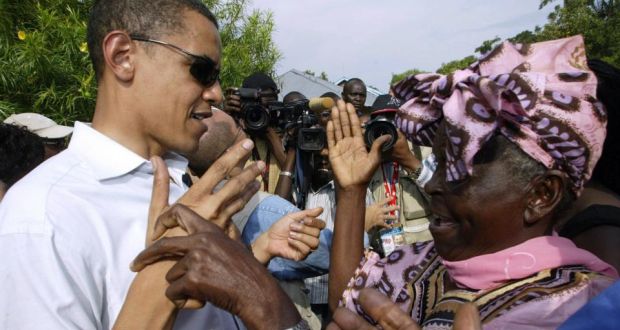
    WASHINGTON (TIP): President Barack Obama will finally visit Kenya, the land of his father and his forbears, in July this year.

    The US President has studiously avoided going to his paternal homeland in the six years plus he has been in the White House, perhaps apprehensive that it would provide political fodder for conservative wingnuts who have doubted if he was born in the United States and questioned his loyalty to the country, aside from his nationality.

    But now that there are no more electoral battles to be fought, the White House on Monday announced that Obama will travel to Kenya in July to co-host a forum on entrepreneurship as part of an effort to support economic development in Africa.

    Although he has been to Kenya thrice before, including once as US Senator, it will be his first visit as President, coming in the seventh year of his Presidency.

    The US President still has family living in Kenya, including half-brother and other siblings, although his father Barack Obama Sr died more than 30 years ago.

    Obama Sr came to the United States from Kenya for higher studies in 1959 and met Ann Durham at the University of Hawaii where they were both attending a Russian language class. They married soon after and Durham gave birth to Barack Obama in 1961.

    They separated soon after, pursuing their own academic careers and divorcing when Barack Obama Jr was only two. The young Obama would see his father only once after that, when he was around ten years old, before Obama Sr returned to Kenya and would die in a road accident in 1982 when Obama Jr was 21.

    The young Obama’s first known trip to Kenya was in 1988, when he spent five weeks there, according to his memoir Dreams from My Father. He returned to Kenya in 1992 with Michelle, then his fiance, and his half sister Auma, and again in 2006 during his first year in the US Senate.

    But Kenya stayed off the radar thereafter although he has visited 47 other countries as President, including neighboring Tanzania and South Africa (twice).

    A White House blog on the upcoming visit made no mention of Obama’s personal ties with Kenya although it alluded to it while pointing out that he has visited sub-Saharan Africa more than any other sitting president.

    ”Just as President Kennedy’s historic visit to Ireland in 1963 celebrated the connections between Irish-Americans and their forefathers, President Obama’s trip will honor the strong historical ties between the United States and Kenya -and all of Africa – from the millions of Americans who trace their ancestry to the African continent, to the more than 100,000 Americans that live in or visit Kenya each year,” it said.

    Inasmuch as Obama is done and dusted with elections, the Kenya trip is certain to stir up the hard right wing which has thrived on the so-called birther controversy -insisting that Obama was not born in the United States and thus ineligible to be President of the United States under Article Two of US Constitution.

    Although Obama released his birth certificate before he became President showing he was born in Hawaii, conspiracy theorists have maintained that it is a fake. Some polls have shown that up to 25 per cent of American still doubt Obama’s US birth.

  • Ex-lawmaker says Obama is like crash co-pilot, stirs row

    Ex-lawmaker says Obama is like crash co-pilot, stirs row

    WASHINGTON(TIP): Even accounting for her outlandish statements in the past, including questioning President Barack Obama’s loyalty to the US accusing a Hillary Clinton staffer of being a Islamic extremist mole, and blaming Democrats Presidents for swine flu, former Congresswoman Michele Bachmann went over the top on Tuesday, comparing Obama to the German pilot whose mass murder—suicide has captured the headlines in recent days.

    “With his Iran deal, Barack Obama is for the 300 million souls of the United States what Andreas Lubitz was for the 150 souls on the German Wings flight – a deranged pilot flying his entire nation into the rocks,” Bachman wrote on her Facebook page this week, adding, for good measure, “After the fact, among the smoldering remains of American cities, the shocked survivors will ask, why did he do it?” 

    Incendiary rhetoric is nothing new for Bachmann, who was once a presidential candidate aspirant before her political career spluttered when she bowed out of electoral politics after four terms in Congress. But in an already polarized and combustible political milieu in the US over Israel, Iran, and Washington’s effort to conclude a nuclear deal, the comments outraged moderate voters all too inured to wacky comments from US politicians, who can leave their Indian counterparts in the dust when it comes to extreme polemics.

    “I’d call her an idiot but I don’t want to offend idiots!” was among the gentler reactions on social media even as the mainstream press tried hard to ignore the Facebook comment that remained unnoticed and unchallenged several hours after it was posted. “I do not believe I have ever read a more disgusting screed in my entire life,” wrote another reader, as her explosive invective filtered out. “Ms. Bachmann trying to score points off of a horrible tragedy? Is she seriously alleging that President Obama is mentally ill? Is she claiming that he is unfit for office because of mental issues?” 

    Such criticism is not new to Bachmann, who once cottoned on to a misreported story out of India to allege that President Obama’s trip to the country cost $200 million a day and he took 2,000 people with him and rented 870 rooms at the Taj Palace Hotel. Another time, she accused Hillary Clinton’s aide Huma Abedin of having connections to the Muslim Brotherhood.

    In an echo of the toxic rhetoric that permeates India’s own political milieu, some of her rants resulted in even the Republican Party leadership, including Senator John McCain and Speaker John Boehner, castigating her and disowning her.

    Evidently, going by her latest rant, it has had no effect. She has set a new benchmark for India’s own poisonous politicians.

  • Obama honours Indian American Professor Murty S. Kambhampati

    Obama honours Indian American Professor Murty S. Kambhampati

    Among the 14 winners of the Presidential Award for Excellence in Science, Mathematics, and Engineering Mentoring (PAESMEM) is Indian American and an Andhra University graduate Murty S. Kambhampati, a professor of biology at Southern University at New Orleans, and Sri Lankan origin Tilak Ratnanather, an associate professor in the biomedical engineering department of the Johns Hopkins University, Maryland will receive his awards at a White House ceremony later this year. 

    “These educators are helping to cultivate America’s future scientists, engineers and mathematicians,” President Barack Obama said announcing the names of the award winners Friday. 

    “They open new worlds to their students, and give them the encouragement they need to learn, discover and innovate. That’s transforming those students’ futures, and our nation’s future, too.” 

    The PAESMEM is awarded by the White House to individuals and organizations to recognize the crucial role that mentoring plays in the academic and personal development of students studying science and engineering-particularly those who belong to groups that are underrepresented in these fields. 

    Kambhampati holds a PhD from Jackson State University in Environmental Science and a PhD from Andhra University, India in Ecology. 

    Over the years, he established excellent collaborations with several instittions to place students for summer internships and ecological field trips. according to his profile. 

    He is an active research mentor for undergraduates and is Southern University at New Orleans’s Beta Kappa Chi/National Institute of Science chapters’ sponsor. 

    He has won several awards for his work as a mentor, including the National Role Model Faculty Award from Minority Access, Inc., in 2008. 

    His research interests are Phytoremediation, Environmental Toxicology, ecological studies on coastal ponds, and Environmental Biotechnology. 

  • GOP’s Presidential Candidate Cruz signs up his family for Obama

    GOP’s Presidential Candidate Cruz signs up his family for Obama

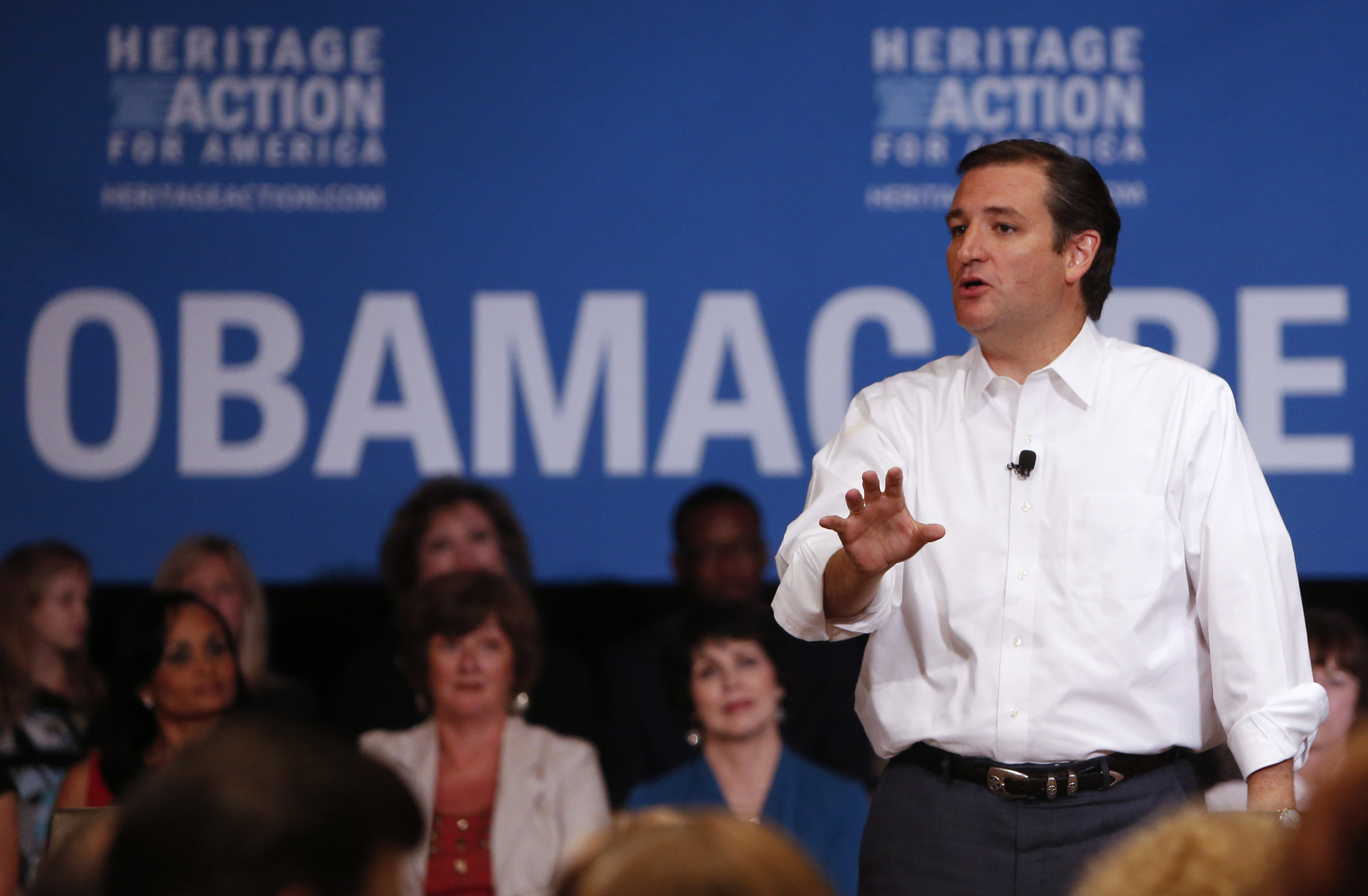
    DALLAS (TIP): A man who had vowed the last five years he would repeal Obamacare, GOP presidential candidate Ted Cruz admitted Friday, March 27, that he has signed up his family for Obamacare coverage. It sounds like he’s trying to soften his conservative image. Next week Ted Cruz plans to marry Barney Frank at a Planned Parenthood clinic.


  • Barack Obama Praises Young Indian-American Teen Scientists

    Barack Obama Praises Young Indian-American Teen Scientists

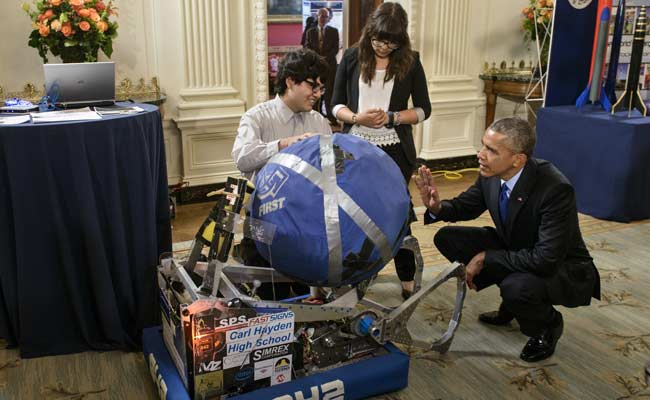
    US President Barack Obama has praised the work of budding Indian-American teenage scientists who showcased their innovative exhibits, including an algorithm to identify potential drugs for cancer, ebola and tuberculosis.

    Anvita Gupta, 17, of Scottsdale, Arizona, winner of Third Place Medal of Distinction for Global Good, was one of the participants of the fifth White House Science Fair which was attended by several other Indian-origin teenagers.

    When Ms Gupta explained how she had used an algorithm to help identify possible new drugs to treat Ebola, cancer and tuberculosis, Mr Obama turned to the press, grinned and said, “I don’t know what you all have been doing. But this is what she has been doing”.

    “It is unbelievable what so many of these young people have accomplished at such an early age,” Mr Obama said after his personal interaction and viewing of some of the exhibits on display.

    This year’s White House Science Fair has a specific focus on diversity and includes more than 100 students from 30 states, representing more than 40 science competitions and organisations.

    35 student teams exhibited their projects. Mr Obama personally viewed 12 of these exhibits.

    Another Indian-American Trisha Prabhu showcased her computer programme ‘Rethink’ that alerts users when an outgoing message contains language that is potentially abusive and hurtful.

    Ninth-grader Sahil Doshi exhibited the design of his innovative carbon-dioxide powered battery called PolluCell.

    Nikhil Behari from Pennsylvania showcased the easy-to-use security system developed by him which is versatile and effective in protecting online data.

    Ruchi Pandya from San Jose exhibited the one-square centimetre carbon nanofibre electrode-based biosensor that has the potential to improve cardiac health diagnostics for patients around the world.

    In his remarks later, Mr Obama specifically mentioned Nikhil. “He’s a freshman in high school, interested in how we can better protect ourselves against hackers and data thieves online. So scientists are already using biometrics to prove that each of us walk in our own distinct ways,” he said.

    “And Nikhil wondered, what if we each type in a distinct ways? So he collected all kinds of data about how a person types – their speed, how often they pause, how much pressure they use and built a special keyboard to test it. And he proved that his hypothesis was correct – that even if somebody knows your password, they don’t necessarily punch it in exactly the way you do,” he said.

    “He asked why – and made discoveries that now could help keep our online accounts more secure. So in the future, if keystroke-based authentication keeps your siblings from breaking into your Facebook account or your Instagram account, you will know who to thank. It will be Nikhil. Congratulations,” Mr Obama said amidst applause.

    Ruchi, Mr Obama said, found a way to use a single drop of blood to test a person’s heart function much like a person with diabetes tests their blood sugar.

    The President did not forget Anvita in his speech. “Anvita used artificial intelligence and biochemistry to identify potential treatments for cancer, tuberculosis, Ebola. What she’s done is she’s developed an algorithm that could potentially significantly speed up the process of finding drugs that might work against these diseases,” he said.

    “Anvita’s algorithm has the potential of speeding up pathways to discovering what drugs would work on what diseases, and is consistent with some of the work that we announced around precision medicine that we are funding at a significant pace here at the White House,” Mr Obama said.

    “Now, I should point out that, like several of the young people here, Anvita and Ruchi are first-generation Americans. Their parents came here, in part, so their kids could develop their talents and make a difference in the world. And we’re really glad they did,” Mr Obama said.

    Mr Obama said these young scientists and engineers teach something beyond the specific topics that they’re exploring.

    “They teach us how to question assumptions, to wonder why something is the way it is, and how we can make it better. They remind us that there’s always something more to learn, and to try, and to discover, and to imagine – and that it’s never too early, or too late to create or discover something new,” he said.

    “It’s a mindset that says we that can use reason and logic and honest inquiry to reach new conclusions and solve big problems. And that’s what we are celebrating here today with these amazing young people,” Mr Obama said.

  • Indian-American journalist’s life saved by Secret Service at WH

    Indian-American journalist’s life saved by Secret Service at WH

    WASHINGTON: An Indian-American journalist suffered a heart attack inside the White House, but a prompt response by US Secret Service personnel saved his life. 

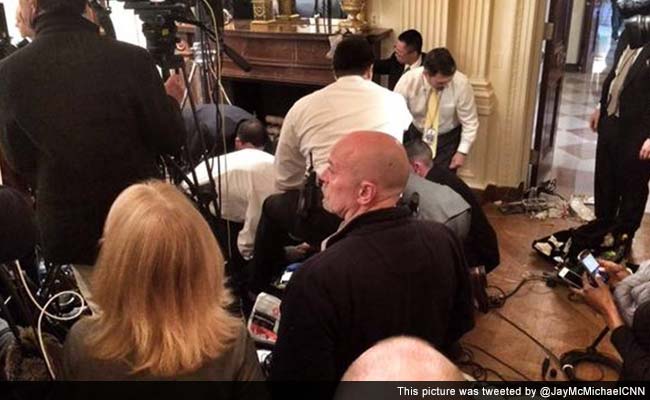
    Manku Singh, the only Sikh journalist accredited to the White House, collapsed in the East Room while covering the White House Science Fair moments before President Barack Obama was to speak. 

    Singh is a community reporter-cum-cameraperson for TV Asia — the largest South Asian cable network in the US

    The alert Secret Service personnel immediately responded to him and called the ambulance. 

    The emergency responders who tried to revive him found that he had no pulse. 

    They used cardiopulmonary resuscitation, which is commonly known as CPR, to try to revive him while administering oxygen. 

    After about four minutes, one of the technicians said, “We have a rhythm.” 

    CPR is an emergency procedure performed in an effort to manually preserve intact brain function until further measures are taken to restore spontaneous blood circulation and breathing in a person who has cardiac arrest. 

    The emergency medical technicians later said Singh had a strong pulse. 

    He was transferred to the nearby George Washington hospital. 

    At the hospital, soon, Singh underwent a heart catheterisation, and the early signs were reported to be encouraging. 

    “Secret Service literally saves a life in back of East Room,” Benjamin Corb, who was in the East Room representing the American Society for Biochemistry and Molecular Biology, tweeted about the incident. 

  • How India is bidding adieu to Non-Alignment

    How India is bidding adieu to Non-Alignment

    The US president’s visit to India in January as the chief guest at the Republic Day celebrations has imparted a new sense of dynamism to a relationship that was seemingly drifting in recent years. A weak government in Delhi coupled with Washington’s lack of interest in India ensured that the two nations continued to talk past the other. The possibilities engendered by the civilian nuclear agreement, announced in 2005 and concluded in 2008, were a thing past with the bilateral relationship becoming a victim of recriminations and unfulfilled expectations.

    Today the relationship stands on the threshold of new possibilities, and much of the credit for this remarkable turnaround should go to India’s Prime Minister Narendra Modi, who in a short eight months has given a new direction to Indian foreign policy.

    For a leader viewed as provincial before elections, Modi has shown great diplomatic agility. The sheer audacity with which he seems to challenge the foreign policy shibboleths of the past is striking. The non-alignment ideologues in India stand confounded by the prime minister’s diplomatic successes. For years, the nation has been told that the only way the foreign policy establishment can secure Indian interests is by working within the rubric of non-alignment. Even a recent template on how Delhi should conduct its foreign and security policy by some of the best and the brightest in the Indian foreign policy establishment was termed “Non-Alignment 2.0.”

    But today Indian foreign policy is being shaped by a government not trapped in the rhetoric of the past, busily engaging major global powers with a confidence not seen in previous administrations. Defensiveness of the past is now replaced by an explicit acknowledgment of convergence with key partners including the US. Though Modi was denied a US visa in 2005, his government boldly reached out to Washington after coming to power. He recognized that the challenges India faces with a domestically fragile Pakistan, political uncertainty in Afghanistan, instability around India’s periphery and an ever-more assertive China cannot be managed without a productive US-India relationship, and Modi lost no time in reaching out to Washington, agreeing on a September 2014 bilateral summit meeting with President Barack Obama in Washington. Modi showed his trademark decisiveness in attempting to mend Indo-US ties, which had tapered off under his predecessor, and underscored the significance of the United States in Indian foreign-policy priorities. Modi cemented his reputation as a leader not only willing to stand up for Indian interests but also ready to find ways to move forward with others after signing a pact on the sidelines of the East Asia Summit in Nay Pyi Daw in November, reassuring the United States that India was not opposed to World Trade Organization’s nearly-completed Trade Facilitation Agreement (TFA).

    The prime minister followed this with a surprising move when he invited Obama to the 2015 Republic Day celebrations – an invite traditionally viewed as a celebration of India’s closest diplomatic partnerships. Obama’s visit to India saw the two leaders trying to sort out issues ranging from the nuclear deal to defense cooperation. The nuclear deal had been held up for six years amid concerns over the liability for any nuclear accident.

    A great leap forward was made after Obama used his executive powers to roll back the condition that US authorities be allowed to monitor use of nuclear material purchased by India even from third countries, and the US agreed to India’s proposal to build a risk-management insurance pool with a liability cap of 15 billion rupees, or US$244 million, to provide cover to suppliers who shunned the civil nuclear agreement over liability in the event of a nuclear accident.

    Bilateral defense cooperation was also energized with the two states agreeing to extend the Defense Cooperation Agreement for another 10 years, expanding its scope by declaring partnerships on issues including “technology transfers, trade, research, co-production and co-development.” Modi’s arrival in office gave new momentum to the India-US Defense Trade and Technology Initiative (DTTI), originally launched in 2012, to promote technological collaboration and co-development of critical defense systems ranging from anti-tank missiles to launch systems for aircraft carriers. There is an attempt underway to make the DTTI more operational and result-oriented. Since its institutionalization in 2012, no major projects emerged, but now scheduling has begun. This is a major step forward and also ambitious, with talk of working groups on aircraft-carrier and jet-engine technologies.

    Apart from the US, the Modi government is trying to increase its scope for diplomatic maneuvering vis-à-vis China by building substantive ties with states like Japan, Vietnam and Australia. This week Modi is visiting Indian Ocean island nations – the Seychelles, Mauritius and Sri Lanka -offering military and civilian assistance and shoring up India’s credibility as a net security provider in a region where China’s dominance has become significant in the last few years.

    At a time when the US-India relationship is being viewed through the prism of strategic changes in the larger Asia-Pacific and Indian Ocean region, it’s striking how marginal Pakistan has become in the relationship. The nation was not mentioned during the joint press conference of Modi and Obama. In their joint statement, the two leaders merely reiterated their call for Pakistan to bring the perpetrators of the 2008 terrorist attack in Mumbai to justice even as they reaffirmed the need for joint and concerted efforts to disrupt entities such as Lashkar-e-Tayyiba, Jaish-e-Mohammad, D Company and the Haqqani network.

    There is growing nervousness in Pakistan about the changing US role in South Asia. Islamabad has moved quickly to reinforce its all-weather partnership with Beijing, and Chinese President Xi Jinping is likely to visit Pakistan sometime this year in what will be the first trip by a Chinese head of state to the western neighbor in nine years. Chinese officials have also now confirmed that Beijing is involved in at least six nuclear power projects in Pakistan and is likely to export more to the country. Taking aim at Obama’s robust support for India’s permanent membership of the UN Security Council, China and Pakistan have underlined that any change in the 15-member body should be achieved through “consensus.”

    Underscoring its desire to play a more active role in South Asia, China has offered in recent months to mediate in stalled efforts to engage the Afghan Taliban in peace negotiations. Though there are tensions in the Sino-Pak bilateral relationship, especially pertaining to the presence in Pakistan of the East Turkestan Islamic Movement, founded by separatists from the Uighur ethnic minority native to the western Chinese region of Xinjiang, both sides have an interest in maintaining a viable partnership, especially as US-India ties take an orbital leap. Pakistan is also reaching out to new actors like Russia from which it hopes to buy three dozen Mi-35 helicopters. With trouble in Russia’s ties with the West and Moscow losing its privileged position in the Indian defense policy, new equations in South Asia won’t be too surprising.

    Under the Modi government, India charts new territory in its foreign policy, predicated on the belief that rather than proclaiming non-alignment as an end in itself, India needs deeper engagement with friends and partners to develop leverage in dealings with adversaries and competitors. The implications are already being felt in the region and beyond as India’s interlocutors try to configure responses to New Delhi’s proactive diplomatic maneuvering.

  • India’s emergence as a major player good for world: Ambassador Richard Verma

    India’s emergence as a major player good for world: Ambassador Richard Verma

    NEW DELHI (TIP): Envoys of six leading world powers — US, Japan, China, Britain, Germany and Canada- hailed, March 14,  India’s emergence as a major player at the “global high table” and complimented the new government for its efforts to stimulate economic growth, says a PTI report.

      The Ambassadors and High Commissioners said India’s role was crucial in combating major challenges facing the globe such as terrorism and climate change while noting that the country has huge untapped potential in trade and economic spheres.

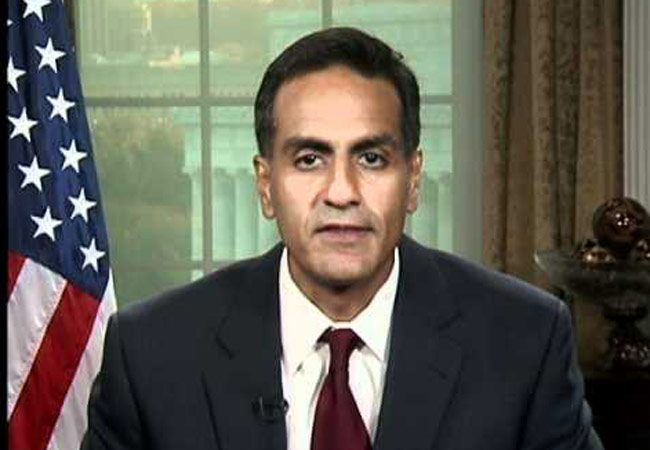
      US Ambassador Richard Verma said the strategic partnership between the two countries has moved into a new phase and that the visit here by President Barack Obama had led to breakthroughs on a number of issues.  

    “Our strategic partnership has moved into a new phase, a more mature one that I would characterize as “strategic plus”.

     Our leaders share an understanding that if our democracies work in tandem, we can have a positive impact on global peace, democracy and economic prosperity,” Verma said addressing the India Today conclave.

    He said since Prime Minister Narendra Modi visited the US in September last year, both sides have “convened, signed, and cooperated on no fewer than 30 dialogues, declarations, and agreements.”

    On India-US partnership on clean energy, he said over USD 2.4 billion has been “mobilized” to invest in clean energy projects.

    “We have agreed to make concrete progress this year towards phasing out hudrofluorocarbons under the Montreal Protocol as well as pursuing a strong global climate agreement in Paris this year,” he said adding US has offered its support to Indian cities to combat air pollution.

    He said last week, a team of experts from the US Environmental Protection Agency met with senior officials and experts of the Ministry of Environment and the Central Pollution Control Board.

  • Talks under way on ending UN sanctions on Iran

    Talks under way on ending UN sanctions on Iran

    UNITED NATIONS (TIP) : Major world powers have begun talks about a United Nations Security Council resolution to lift UN sanctions on Iran if a nuclear agreement is struck with Tehran, a step that could make it harder for the US Congress to undo a deal, Western officials said.

    The talks between Britain, China, France, Russia and the United States -the five permanent members of the Security Council – plus Germany and Iran, are taking place ahead of difficult negotiations that resume next week over constricting Iran’s nuclear ability.

    Some eight UN resolutions – four of them imposing sanctions – ban Iran from uranium enrichment and other sensitive atomic work and bar it from buying and selling atomic technology and anything linked to ballistic missiles. There is also a UN arms embargo.

    Iran sees their removal as crucial as UN measures are a legal basis for more stringent US and European Union measures to be enforced. The US and EU often cite violations of the UN ban on enrichment and other sensitive nuclear work as justification for imposing additional penalties on Iran.

    US Secretary of State John Kerry told Congress on Wednesday that an Iran nuclear deal would not be legally binding, meaning future US presidents could decide not to implement it. That point was emphasized in an open letter by 47 Republican senators sent on Monday to Iran’s leaders asserting any deal could be discarded once President Barack Obama leaves office in January 2017.

    But a Security Council resolution on a nuclear deal with Iran could be legally binding, say Western diplomatic officials. That could complicate and possibly undercut future attempts by Republicans in Washington to unravel an agreement.

    Iran and the six powers are aiming to complete the framework of a nuclear deal by the end of March, and achieve a full agreement by June 30, to curb Iran’s most sensitive nuclear activities for at least 10 years in exchange for a gradual end to all sanctions on the Islamic Republic.

    So far, those talks have focused on separate US and European Union sanctions on Iran’s energy and financial sectors, which Tehran desperately wants removed. The sanctions question is a sticking point in the talks that resume next week in Lausanne, Switzerland, between Iran and the six powers.

    But Western officials involved in the negotiations said they are also discussing elements to include in a draft resolution for the 15-nation Security Council to begin easing UN nuclear-related sanctions that have been in place since December 2006.

  • US probing report Secret Service agents drove car into White House barrier

    WASHINGTON (TIP): The US Secret Service said on March 11 that two agents were under investigation after an incident last week in which they were reported to have driven a government car into White House barricades after drinking at a late-night party.

    The Washington Post reported on Wednesday that one of the agents involved in the alleged March 4 incident was a top member of President Barack Obama’s protective detail.

    The Post quoted current and former government officials familiar with the incident as saying officers on duty wanted to arrest the agents and give them sobriety tests. But a supervisor ordered the agents be sent home, the officials told the paper.

    A Secret Service spokeswoman said in a statement the agency was aware of the allegations against the two agents and that “if misconduct is identified, appropriate action will be taken based on established rules and regulations.” 

  • Obama won’t lock in spending cuts: White House budget director

    WASHINGTON (TIP): US President Barack Obama will not accept action by Congress that “locks in” sequestration spending constraints, White House budget director Shaun Donovan said on March 12 as Republicans prepare to release their budget plans.

    “The president has been very clear. He will not accept a budget that locks in the sequester going forward and he will not accept a budget that severs the vital link between defense and non-defense,” Donovan told a news conference at the Capitol.

    Although the president doesn’t sign the non-binding budget resolution from Congress, he does have the ability to veto spending legislation. Asked if Obama would veto spending bills that conform to the $1.1 trillion across-the-board spending caps for this year, Donovan said those would be reviewed as they are written later this year.

  • It is more about hurting Obama

    It is more about hurting Obama

    What the senators did could technically count as treason. The good news is that Republicans in the Senate have noticed that their government is involved in a negotiation with Iran to prevent it acquiring a nuclear weapon. Well done, all. You’re right, it’s a big deal. But not for the petty partisan, power-envy reasons that have woken you to the issue. It was June 2006 – Margaret Beckett was Foreign Secretary – when all five permanent members of the UN Security Council, plus Germany, began what has been about as painstaking and delicate a diplomatic poker game as you are ever likely to see. And with proportionally high stakes for all of us. Yet it is now that they barge in with their “open letter” to Iran’s leadership.

    “It has come to our attention…” the missive, dispatched this week, ludicrously begins before going on to warn that any deal that might emerge may simply be ripped up in barely two years when – they desperately hope – a Republican may have taken the White House. Senators imply they’re in the dark about what precisely is happening at the negotiating table in Geneva and can’t trust President Barack Obama and his Secretary of State, John Kerry, to deliver what they promise, to keep Iran from becoming a nuclear power. What they are really in the dark about is their own foolishness and how foreign diplomacy works. It doesn’t work by deliberately seeking to cut the legs from under your Commander-in-Chief when he seems within millimeters of an international arms control deal.

    You might almost charge them with treason, under the provisions of the 1799 Logan Act that forbids any American from conferring with a foreign power with intent to “defeat the measures of the US”. No one is suggesting taking that route. But admire the restraint of Mr. Kerry, who recently found himself facing Senator Marco Rubio, a Florida Republican, possible presidential aspirant and signatory of the letter, at a hearing on war powers to tackle Isis. The deal on the table is as described, he said. It is not about making Tehran an ally in the fight against Isis or anything else. It’s about nukes.

    “I think this has been a misread by a lot of people on the Hill to be honest with you,” Mr. Kerry said. “There is no grand bargain being discussed here in the context of this negotiation. This is about nuclear weapon potential. That’s it. It is really almost insulting that the presumption up here is that we are going to negotiate something that allows them to get a nuclear weapon.” Not that he was going to leave without directly mentioning the missive. “My reaction to the letter was utter disbelief,” he declared, adding that in the 25 years that he spent in the Senate he had “never heard of, or heard of being proposed, anything comparable”.

    That’s because the partisan enmity here has never been so acrid. The Republicans now control 70 per cent of all state legislative chambers, the highest in the party’s history. They now rule Congress too. So they just can’t stand it that the White House remains beyond their reach and may elude them again in 2016. And when Mr. Obama tries to circumvent Congress, they go nuts. But when it comes to foreign policy, an American president, of either party, can, in some instances, expect exclusive authority. This is such a case. What the senators have overlooked is that the putative Iran deal will not be a treaty, which would require Congressional approval, but an executive agreement with a foreign state which would not. If concluded, it may also be codified into a UN Security Council resolution. The notion that an incoming Republican president would simply undo it is fanciful.

    But this is far pettier in provenance. It’s about hurting Mr. Obama.

  • 11 presumed dead in US military helicopter crash

    MIAMI (TIP): Seven US Marines and four aircrew were missing and presumed dead Wednesday after their army helicopter crashed during a night training exercise in Florida, military officials said.

    The UH-60 Black Hawk helicopter was reported missing Tuesday around 8:30 pm (0030 GMT Wednesday) near Eglin Air Force Base.

    The area was under heavy fog but it was not immediately clear if that played a part in the accident.

    Base spokesman Andy Bourland said rescue teams located debris from the aircraft at around 2:00 am and an investigation was ongoing.

    “The thoughts and prayers of everybody here at the White House are with the families of those who were killed in this that occurred apparently overnight,” spokesman Josh Earnest said.

    President Barack Obama had expressed his condolences in phone calls with the military commanders affected.

    “The president reassured the commanders of the nation’s deep appreciation for the many sacrifices that our men and women in uniform and their families make to protect and defend our country,” Earnest added.

    A second Black Hawk returned safely to base. The choppers, assigned to the 1-244th Assault Helicopter Battalion in Hammond, Louisiana, were participating in what the military called a routine training mission with the Marine Special Operations Regiment from Camp Lejeune, North Carolina.

    Major General Glenn Curtis said: “As we speak, there’s an ongoing search and rescue operation to search for that aircraft and search for our service members that were on it, and that’s as much as I know at this point.” 

  • Boehner: House to sue Obama

    Boehner: House to sue Obama

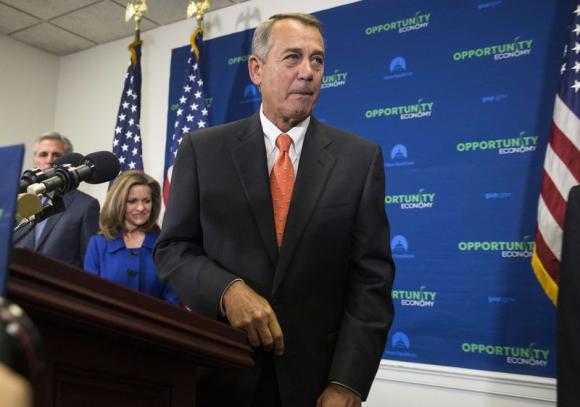
    John Boehner is back with his statements and this time he wants to sue Obama as an individual. 

    The speaker of the House Boehner is planning to hold a House vote authorizing a suit against the president over his executive orders on immigration, which could grant work visas to millions of undocumented immigrants and their spouses.

    Boehner told his conference at a closed-door meeting that he has a team exploring the best options to challenge last year’s executive action, under which the Homeland Security Department will begin granting legal working status to millions of immigrants, according to unnamed sources in the room.

    “Our team has been working on litigation. We are finalizing a plan to authorize litigation on this issue—one we believe gives us the best chance of success,” he said, according to a source in the room.


    Last week the House voted to fund the Homeland Security Department through the end of the budget year. John Boehner’s House passed a funding bill for the Homeland Security Department on Tuesday, with Democrats carrying the ball and Republicans supplying just 75 votes. This, of course, was a complete capitulation from earlier threats to shut down the department rather than acquiesce in President Obama’s unilateral order on immigration.

    And it came after that embarrassing Friday night cliffhanger when a revolt by the hard-line wing defeated Boehner’s bill for a three-week funding extension, and all the House speaker could muster was a one-week stopgap to avoid having the party blamed for a partial shutdown. The Senate, with Mitch McConnell’s help, had already passed a so-called “clean” bill.

    The end result is no one is happy. 
     
    Republicans are worried that the ongoing congressional dysfunction will hurt the party’s chances in 2016. Based on what they’re telling reporters, many Republicans sound downright depressed.

    Politico says GOP lawmakers are “shaken” by the debacle and that “the pessimism is palpable,” with many questioning  “whether their newfound majority can deliver anything significant over the next two years. The fear among House Republicans is that Senate Majority Leader Mitch McConnell will be too quick to heed Democratic demands and push through watered-down bills on education, trade, health care and the budget. And the worry among Senate Republicans is that their House counterparts will scuttle hard-fought compromises that offer the only way to overcome filibusters and get bills to President Barack Obama’s desk.”

  • Immigration: 26 states claim Obama Administration misled judge in lawsuit

    Immigration: 26 states claim Obama Administration misled judge in lawsuit

    HOUSTON (AP) — A coalition of states suing to stop President Barack Obama’s executive action on immigration alleges the government misled a judge about not implementing part of the plan before the judge temporarily halted it.

    The allegation comes after the Justice Department said in court documents this week that federal officials had given 100,000 people three-year reprieves from deportation and granted them work permits under a program that protects young immigrants from deportation if they were brought to the U.S. illegally as children.

    Justice Department attorneys had previously said federal officials wouldn’t accept requests under an expansion of the 2012 Deferred Action for Childhood Arrivals program, known as DACA, until Feb. 18.

    The federal government’s immigration actions regarding DACA as well as a program that would extend deportation protections to parents of U.S. citizens and permanent residents who have been in the country for some years, were put on hold on Feb. 16 by U.S. District Judge Andrew Hanen in Brownsville, Texas. Justice Department attorneys have asked Hanen to lift his hold while they appeal the ruling to the 5th U.S. Circuit Court of Appeals in New Orleans. Hanen has not made a decision on that request.

    Obama’s action, first proposed in November, could spare from deportation as many as 5 million people who are in the U.S. illegally. Many Republicans strongly oppose his action and 26 states, most of them led by Republicans, sought to block the Obama orders as unconstitutional.

    “News that tens of thousands of expanded work permits have already been issued to illegal immigrants while President Obama’s executive action, which we believe is illegal, is being contested in the courts is both outrageous and unacceptable,” Texas Lt. Gov. Dan Patrick said in a statement.

    In court documents filed Tuesday, the Justice Department said that between Nov. 24 and Feb. 16, federal immigration officials granted the three-year reprieves to 100,000 individuals who were already eligible under the original 2012 guidelines of DACA.

    The Justice Department said the federal government recognizes that its identification of Feb. 18 as the date when requests under the new and expanded eligibility would be accepted “may have led to confusion.”

    Justice Department attorneys said they don’t believe the preliminary injunction requires federal officials to take any steps to reverse the three-year reprieves already granted.

    In court documents filed Thursday, the states said they don’t understand why the U.S. government doesn’t consider the approval of the 100,000 reprieves to have been done under the new and expanded guidelines of DACA.

    The 2012 DACA guidelines provided two-year deportation reprieves and work permits. Obama’s new immigration action would expand that to three years.

    “This newly disclosed conduct is difficult to square with (the federal government’s) prior representation to the Court that ‘nothing is going to happen’ until weeks after” a Jan. 15 court hearing on the preliminary injunction request, the states said in court documents.

    The states, led by Texas, asked Hanen to allow them to request additional information from the federal government about how it approved the DACA requests while the lawsuit was going through the courts.

    In his Feb. 16 decision on the injunction, Hanen wrote the federal government had indicated that Feb. 18 would be the date it planned to accept requests under the expansion of DACA. Hanen also wrote that while his injunction did not affect the 2012 DACA program, it did put on hold its expansions and additions proposed by Obama’s action.

    The other major part of Obama’s immigration action extending deportation protections to parents of U.S. citizens and permanent residents who have been in the country for some years, had not been expected to begin until May 19.

  • China Responds to US Concern Over Counterterrorism Law

    China Responds to US Concern Over Counterterrorism Law

    China’s drafting of its first counterterrorism law is a domestic issue, China’s foreign ministry said on Tuesday in response to comments made by the US.

    US President Barack Obama on Monday said he was concerned that the law would require technology firms to hand over encryption keys, the passwords that protect data.

    The formulation of a counterterrorism law is an important step of rule of law and combating terrorism. The content of the draft law is based on real experiences in the fight against terrorism and has taken into account lessons learned by other countries, state-run Xinhua news agency cited foreign ministry spokesperson Hua Chunying as saying at a daily news briefing.

    “The formulation of the counterterrorism law is China’s internal affair. We hope the United States can calmly and objectively handle it,” she said.

    “Every country is taking measures to ensure their information is secure,” Hua said.

    She said China had always opposed network monitoring and supported the drawing up of cyberspace rules within the UN’s framework.

    In September 2011, China, together with Russia, Tajikistan and Uzbekistan, submitted an “International Code of Conduct for Information Security” to the 66th session of the UN General Assembly, which promoted such norms and rules.

    An updated draft was proposed to the UN in January 2015, to promote peace and stability in cyberspace and governance without interference in the domestic affairs of other countries.

  • USAID Woos Indian American Investors for Diaspora Investment Initiative

    USAID Woos Indian American Investors for Diaspora Investment Initiative

    SAN FRANCISCO (TIP): The India Diaspora Investment Initiative, a unique program President Barack Obama unveiled during his visit to India for the Republic Day celebrations, is seeking investment from Indian American and other investors to support sustainable development in India.

    In an interview to the media here Manpreet Singh Anand, deputy assistant administrator in the Asia bureau of the U.S. Agency for International Development, said that it is the first time an initiative earmarked for a specific diaspora community in the U.S. has been launched by USAID.

    If it is successful, he added, it could be a model for the agency in other countries.

    “It is a new model for development,” Anand said. “It is a more efficient use of resources to leverage innovation through the private sector.” USAID staff has been working on the initiative for about a year, he added.

    India was not a random choice for the initiative.

    USAID said in a fact sheet that there are three factors why India was selected: “An increased desire on the part of Indian Americans to make a development impact in their home country; a strengthened diaspora connection to India after the election of Prime Minister Narendra Modi; and a strong demand from Indian social businesses seeking debt capital to scale up their programs targeting ‘Base of the Pyramid’ populations.”

    USAID, working with a partner – Bethesda, Md.-based Calvert Foundation, a nonprofit with experience in offering “Community Investment Notes” for sustainable development – plans to mobilize at least $50 million in debt financing from private sector financial sector institutions in India and abroad over the next 18 months.

    USAID will provide “up to a 50% credit guarantee” to three non-bank finance companies (Caspian Impact Advisors, Intellegrow and Gramen Impact India) and two Indian banks (YES Bank and Ratanakar Bank), who make the loans to small- and medium-sized enterprises in India.

    Anand pointed out that without USAID’s credit guarantee, the barriers for Indian SMEs to get the loans “would be almost impossible to overcome.” “We want the Indian diaspora to become engaged and stay engaged,” he added.

    It works like this: Investors – Indian Americans or those wanting to support sustainable development in India – purchase a Calvert Foundation Investment Note. Investors can receive fixed interest payments every six months and select investment tenors from one, three, five, seven and even 10 years.

    The notes will be available later this year, Anand said. USAID is negotiating on terms of the loan credit guarantees with all five partners.

    Calvert will make the loans to the Indian NBFCs and banks, which invest in social projects in healthcare, small businesses, education, agriculture, renewable energy, and other priority areas for India. USAID provides its 50% loan guarantee.

    “Our new Indian Diaspora Investment Initiative will allow folks back home to generate a new stream of financing for Indian businesses that are investing in non-traditional, and too often overlooked, markets – from providing healthcare to rural communities, to improving water and sanitation, to opening up those new bank accounts,” Obama told the U.S.-India Business Summit in New Delhi Jan. 26.

    USAID Administrator Rajiv Shah, who in February left the agency, said in India in January, “We’ll match the diaspora community’s immense passion and resources to the small businesses that form the backbone of India’s economy.”

    “By creating a transparent investment vehicle, any investor can contribute to sustainable, social businesses that create jobs and train a new generation of local entrepreneurs.”

    USAID’s annual funding to India -negotiated between the Obama administration and Congress – is currently “just short of $100 million a year,” Anand sadi.

    It is the Indian American’s second stint at the agency. Previously, he was a presidential management fellow in the Office of the Global Development Alliance.

    He also worked as a senior policy advisor on geopolitical and socioeconomic issues at Chevron Corp., was a senior policy advisor for South and Central Asia issues on the U.S. House Committee on Foreign Affairs, and served in the Office of the U.S. Trade Representative.

    Married to a physician, Anand has an MBA and an M.A. in international studies from U.C.-Berkeley and a B.S. in electrical engineering from the University of Texas at Austin.

    Another significant program announced by USAID during Obama’s visit was support of Modi’s Jan Dhan initiative to prioritize financial inclusion for all Indian citizens.

    USAID is partnering with over 20 U.S., Indian and international private sector organizations and the World Economic Forum to extend the ability for Indian consumers and businesses to participate in the formal economy.

    “More than 110 million people have signed up in India (under Jan Dhan) for bank accounts in the last few months,” said Anand, who accompanied Shah and Obama on the India trip in January. “It will really empower consumers in India when they can use cards instead of cash.”

    USAID said that currently only six percent of retail enterprises in India can accept digital payments.

    One particular area of focus for USAID in India is reducing child mortality rates. “India constitutes 24 percent of the preventable under-five deaths in the world,” Anand said. “There’s a lot we can and are doing (to reduce child mortality rates) in India.”

    Last year USAID formed the U.S. Global Development Lab within the agency to leverage science and technology advancements for public-private partnerships around the world, Anand said.

    Experts from Google and other technology companies are forming a think-tank within the agency to work with NGOs to solve some of the most pressing social problems around the world.

    For more information on the Diaspora Investment Note, visit:
    http://www.calvertfoundation.org/india.

  • Homeland Security gets another week – proxy battle over President Barack Obama’s immigration reforms

    Homeland Security gets another week – proxy battle over President Barack Obama’s immigration reforms

    Congress narrowly averted a partial shutdown of the Department of Homeland Security (which is responsible for securing the country against terror threats and for border control – The department includes Customs and Border Protection, the Secret Service, the Coast Guard, the Transportation Security Administration and the Federal Emergency Management Agency) late Friday amid a proxy battle over President Barack Obama’s immigration reforms.

    The vote came just hours before the department faced a partial shutdown. Both the House and Senate passed a seven-day extension of funding for the agency, with the House acting just two hours before funding was set to expire at midnight. The House vote was 357-60. The Senate passed the measure by voice vote.

    House Minority Leader Nancy Pelosi, D-Calif., rallied Democrats to support the one-week extension before funding expired. She said that voting for the seven-day measure would put Democrats on a path toward possible passage next week of a $40 billion spending bill that would fund the agency through the end of September.

    The extension was put forward by the Senate as an emergency measure after Republican House Speaker John Boehner, under pressure from his party’s right wing, refused to allow a vote on a comprehensive funding bill cleared by the Senate earlier on Friday.

    “This has been a day of confusion both here in the House and for the men and women of the Department of Homeland Security,” said Rep. Lucille Roybal-Allard, D-Calif., as she urged lawmakers to pass the one-week funding bill.

    House Appropriations Chairman Hal Rogers, R-Ky., also called for passage of the bill, saying that lawmakers would be abdicating their responsibility to the American people if they let DHS shut down.

    President Obama called Pelosi and Senate Minority Leader Harry Reid, D-Nev., on Friday night to “ensure that the Department of Homeland Security does not shut down,” said White House Press Secretary Josh Earnest.

    Conservative Republicans in the House of Representatives were angry that the measure did not include amendments sought by fellow House Republicans to block President Barack Obama’s immigration executive orders protecting millions of illegal immigrants from deportation.

    Boehner instead proposed a three-week DHS spending bill that would have allowed the DHS to function normally and bought time for Republicans to press against Obama’s immigration reforms.

    However, Republicans, who have a large majority in both houses after midterm elections in November, joined with Democrats in voting down that bill 224-203 in the House of Representatives, with conservatives wanting Boehner and others to stick by the amendments to the immigration plan.

    House Democrats said the chamber should instead support the Senate-passed bill to fund DHS through the end of the fiscal year. But a block of conservative Republicans wanted the House to hold firm and continue to demand that the Senate pass legislation the House had already passed that would derail Obama’s immigration programs.

    Earnest said Congress’ struggle to find a final resolution to the funding fight “exposes the danger of playing politics with our homeland security.”

    At the heart of the funding fight was a battle over immigration.

    House Republicans wanted to use the DHS funding bill as leverage to stop Obama’s executive orders on immigration. Obama issued those orders in November to protect about 4 million undocumented immigrants from deportation and allow them to work legally in the USA.

  • Kent: Another hindu temple attack in US – Indians Concerned

    Kent: Another hindu temple attack in US – Indians Concerned

    A Sanatan Dharam temple was vandalised in Washington state with windows broken and the word “Fear” painted on it, less than a fortnight after another temple was attacked.

    Members of the the Sanatan Dharma Temple in Kent, about 30 km from Seattle, who came for worship Friday “were greeted by shards of broken glass after vandals targeted the building,” KING5-TV, a Seattle NBC affiliate, reported. According to the temple web site, “Amalaki Ekadashi” was to be observed Saturday.


    Bricks were used to smash every window of the building and parts of the structure were ripped apart, said KOMO-TV, an ABC affiliate in Seattle. “The crime is small-minded with big intentions, shattering calm with hate,” the station’s reporter, John Humbert, said. “Silence isn’t the answer.”

    Universal Society of Hinduism President Rajan Zed, said: “Hindus nationwide are highly concerned” by the second attack on a temple in recent days.

    “It was shocking for the hard-working, harmonious and peaceful US Hindu community numbering about three million, who had made (a) lot of contribution to the nation and society, to receive such signals of hatred and anger.”

    On February 15, the Hindu Temple Cultural Centre in Bothell city, about 35 km from Seattle, found a swastika painted on it and “Get Out” scrawled in large letters with spray paint. In the US, white supremacists have adopted the Nazi swastika as an ideological symbol.

    The two temple attacks came after President Barack Obama’s criticism of India at an inter-religious prayer meeting earlier in February where he said intolerance there “would have shocked Gandhiji”.

    Both temples do not have security cameras “and info on the vandals remains elusive,” KOMO-TV said. The incidents are under police investigation.

    Several attacks on Hindu temples have taken place across the US in the last few months. In August a murti (idol) of Shiva at the Vishwa Bhavan Hindu Mandir in Monroe in the state of Georgia was desecrated with black paint. The local sheriff’s office arrested two people in connection with the attack.

    Between July and October in Loudon county in Virginia, police have documented 17 separate incidents of anti-Hindu vandalism, the Hindu American Foundation said.

    In a twist to the Kent incident, an Islamic organisation tried to deflect attention away from Hinduism, claiming that the attack was directed against Muslims, even though the building had a large sign, “Kent Hindu Temple.”

    According to KOMO-TV, Arsalan Bukahari of the Washington Council on American-Islamic Relations said many of these acts of aggression target smaller religious groups that some bigots think are Muslim.

    Leading US Christian fundamentalists have attacked Hinduism. Pat Robertson, who has called Hinduism “demonic,” criticised the practice of yoga this week.

    While doing yoga, he said on the 700 Club TV programme, “you don’t know what the Hindu says, but actually it’s a prayer to a Hindu deity and so it sounds like gibberish.” Robertson is a pastor who was once a candidate for the Republican Party’s presidential nomination and has a following of millions.

    Another Christian pastor, Franklin Graham, has denounced Hinduism as a “false religion” and said that “none of their 9,000 gods is going to lead me to salvation. We are fooling ourselves”.

  • US wraps up Ebola military mission in Liberia

    WASHINGTON (TIP): Liberian President Ellen Johnson Sirleaf paid an emotional tribute to the American people as the United States formally wound up its successful five-month mission to combat the west African nation’s Ebola outbreak.

    With Liberia now in recovery from the worst outbreak of the deadly virus in history, the visiting Sirleaf thanked the United States for coming to the region’s aid in its hour of need.

    “America responded, you did not run from Liberia,” Sirleaf told US lawmakers in Washington, expressing the “profound gratitude” of Liberia, Guinea and Sierra Leone.

    Liberia, once the country worst hit by Ebola, has registered 4,037 of around 9,600 deaths in the epidemic, which began in Guinea in December 2013.

    At its height in the final four months of last year, Liberia and Sierra Leone were recording between 300 and 550 confirmed, suspect and probable cases a week.

    It was in some of the darkest days in August when the Liberian leader said she reached out to US President Barack Obama and to the US Congress amid “grim and terrifying” international predictions that before the end of January at least 20,000 people would die every month.

    But with US help, including a military force which reached 2,800 personnel at one point, there are now only one to three new infections each week in Liberia.

    “We are chasing the very last element of the chain of transmission we have,” Sirleaf said, praising all the international and regional military and aid workers who “reached beyond their fears and ran towards the danger and not from it.” Sirleaf is due to meet Obama at the White House today to discuss the Ebola response and the gruelling task of economic recovery.

    The US military wrapped up its operation at a ceremony in Monrovia earlier yesterday, although some troops will remain for several weeks.

    “The importance of the progress we see today means more than just the reduction in the number of new or suspected cases of Ebola,” said mission commander Major General Gary Volesky.

    “This progress is also about Liberians being able to get back to a normal way of life.” 

    The Pentagon says around 100 US troops are to remain in the region to strengthen “disease preparedness and surveillance capacity” of local governments.

  • Obama Vetoes Keystone Pipeline: Earns kudos from environmentalists

    Obama Vetoes Keystone Pipeline: Earns kudos from environmentalists

    WASHINGTON (TIP): Using third veto of his presidency, President Obama on Tuesday, February 24 rejected an attempt by lawmakers to force his hand on the Keystone XL oil pipeline and swept aside one of the first major challenges to his authority by the new Republican Congress.”Because this act of Congress conflicts with established executive branch procedures and cuts short thorough consideration of issues that could bear on our national interest-including our security, safety, and environment-it has earned my veto.” 

    The veto will set a precedent for more political action in the US in the fight against climate change, resource mis-management and habitat destruction, as well as sending a clear message to big oil and gas that we, the people, no longer wish to partake in the dirty dependency on fossil fuels.

    The pipeline was set to cross the nation’s border: stretching almost 1.2k miles from Canada through Montana and North Dakota and ending in Nebraska. This meant that the decision fell squarely under the President’s jurisdiction, rather than Congress’s.

    The Republicans wield a slim Senate majority as well as a strong majority in the House. With this knowledge, the Republicans waited to present the legislation to the President’s desk until they were all in session-allowing them to band together to try to condemn and fight against the veto on the floors of the House and Senate.

    It’s also important to note that though Republicans may condemn Obama’s brazen use of executive action, George W. Bush actually used his veto power on twelve different occasions: 4 times more than our Democratic President (not to mention, Bush Sr. used his veto power a whopping 44 times). Obama has, in fact, used his power to veto fewer times than any other president in office.

    As it stands, the KXL pipeline would have released some of the dirtiest fuel in production (according to leading climate scientist, Dr. James Hansen, “the Keystone Pipeline is the fuse to the biggest carbon bomb on the planet.”), devastating pristine wilderness and allowing for more desperate attempts at maintaining our dependence on non-renewables.

    The oil that would be produced from the KXL pipeline is stripped from tar sands, a type of extraction process that releases 17 percent more greenhouse gases than conventional crude.

    Climate scientists are more or less unanimously in full support of the President’s decision, as they maintain the argument that climate change is here to stay and consequences are already devastating our global climates, seasons and natural equilibriums. They argue that in order to combat and mitigate the destruction, we must keep two thirds of the remaining oil in the ground-the tar sands in Alberta, Canada included.

    Collin O’Mara, president and CEO of the National Wildlife Federation, said:

    “President Obama has taken a stand for America’s wildlife, clean water and stable climate against a polluting project that threatens wildlife every step of the way, from caribou to waterfowl to endangered whooping cranes.”

    Yes, it would provide some 3k+ temporary jobs during the construction phase, but would only provide 50 permanent jobs after construction is complete. In terms of giving our economy a boost, the pipeline is not a long-term solution. According to President Obama,

    “I think that there’s been this tendency to really hype this thing as some magic formula to what ails the U.S. economy.”

    The people have been protesting the pipeline construction for years, and our voices are finally being heard:

    Dr. James Hansen is credited for saying that the passage of the Keystone Pipeline would be, “game over” for the environment. Well, as of today with Obama’s veto, it seems more like game on.

  • US-Israel spat intensifies over Netanyahu speech

    US-Israel spat intensifies over Netanyahu speech

    WASHINGTON: The US and Israel escalated their increasingly public spat on February 25 over Benjamin Netanyahu’s Republican-engineered congressional speech next week, with the Israeli prime minister accusing world powers of rolling over to allow Tehran to develop nuclear weapons. Secretary of State John Kerry openly questioned Netanyahu’s judgment on the issue.

    The comments injected new tension into an already strained relationship between the close allies ahead of Netanyahu’s address to Congress next Tuesday. More Democratic lawmakers announced they would boycott the speech, which was orchestrated by Republican leaders without the Obama administration’s knowledge.

    Netanyahu hopes his speech will strengthen opposition to a potential nuclear deal with Iran, President Barack Obama’s signature foreign policy objective. US and Iranian officials reported progress in negotiations this week on a deal that would clamp down on Tehran’s nuclear activities for at least 10 years but then slowly ease restrictions.

    Netanyahu lashed out at the US and other usual staunch allies of Israel.

    “It appears that they have given up on that commitment and are accepting that Iran will gradually, within a few years, will develop capabilities to produce material for many nuclear weapons,” he said in Israel.

    “They might accept this but I am not willing to accept this,” he said in remarks delivered in Hebrew and translated. “I respect the White House, I respect the president of the United States, but in such a fateful matter that can determine if we exist or not, it is my duty to do everything to prevent this great danger to the state of Israel.” 

    Kerry, testifying in Congress, dismissed Netanyahu’s worries. He argued that a 2013 interim agreement with Iran that the prime minister also opposed had in fact made Israel safer by freezing key aspects of the Islamic republic’s nuclear program.

    “He may have a judgment that just may not be correct here,” Kerry said.

    His comments, as well as statements from other top US officials, made clear the Obama administration had no plans to mask its frustrations during Netanyahu’s visit.

    In an interview Tuesday, National Security Adviser Susan Rice said plans for Netanyahu’s speech had “injected a degree of partisanship” into a US-Israel relationship that should be above politics. “It’s destructive to the fabric of the relationship,” Rice told the Charlie Rose show. “It’s always been bipartisan. We need to keep it that way.” 

    Netanyahu’s plans to speak to Congress have irritated many Democratic members, but also have put them in a difficult spot _ fearing they will look anti-Israel if they don’t attend. Still, a number of Democrats have said they plan to skip the session.

    Senate Democrats invited Netanyahu to meet with them privately while he is in Washington, but the Israeli leader refused the invitation, saying such a meeting could “compound the misperception of partisanship” surrounding his visit.

    “I regret that the invitation to address the special joint session of Congress has been perceived by some to be political or partisan,” Netanyahu wrote in a letter to Sens. Dick Durbin of Illinois and Dianne Feinstein of California. “I can assure you that my sole intention in accepting it was to voice Israel’s grave concerns” about a nuclear deal with Iran.

    Iran insists its nuclear program is for peaceful purposes.

    The White House has been weighing ways to counter Netanyahu’s address to Congress, as well as his separate speech to the annual policy conference of the American Israel Public Affairs Committee. The administration is considering whom to send to the conference, with some officials pushing for a lower-level representative than normal.