Tag: Barack Obama

  • US says 3.3 million have enrolled in private Obamacare coverage

    US says 3.3 million have enrolled in private Obamacare coverage

    WASHINGTON (TIP): About 3.3 million people enrolled in private Obamacare health coverage through new US healthcare marketplaces from October 1 to February 1, the Obama administration said on February 12.

    The nonpartisan Congressional Budget Office had estimated in its latest forecast last week that 6 million people would sign up for private coverage through the marketplaces by March 31, down from an earlier forecast of 7 million. But the report predicted that the program, which was delayed by early technical problems with the HealthCare.gov website last autumn, would eventually overcome the deficit, signing up 24 million people by 2017.

    Government data released on Wednesday also showed that the number of young adult enrollees aged 18 to 34 rose slightly to 25 percent of the total enrollment population. Participation among young adults could be crucial to the success of President Barack Obama’s signature healthcare law because they tend to compensate for higher risks from older or sicker policyholders who represent three-quarters of enrollees.

  • US spied on Merke’s predecessor after he opposed the Iraq war, says report

    US spied on Merke’s predecessor after he opposed the Iraq war, says report

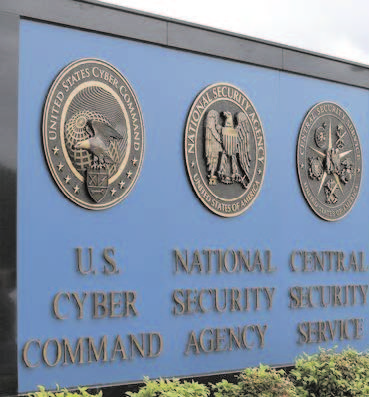
    Snowden’s leaked documents reveal that the US spied on Schroeder for his opposition to the Iraq war.

    WASHINGTON (TIP): American intelligence services had not only spied on German Chancellor Angela Merkel, but also monitored her predecessor Gerhard Schroeder after he opposed the US plans to go to war in Iraq, suggest media reports.

    The Sueddeutsche Zeitung newspaper and the TV channel NDR reported that their investigations based on documents leaked by former National Security Agency (NSA) contractor Edward Snowden showed that Social Democrat (SPD) Chancellor Schroeder was spied on by the NSA at least from 2002. Schroeder, who headed a coalition government with the Green party between 2001 and 2005, was listed under the number 388 in the “National Sigint Requirements List” of the NSA.

    The list contained the names of persons and institutions to be monitored by the spy agency, the reports said. Since a document leaked by Snowden in October revealed that the NSA had eavesdropped on Chancellor Merkel’s mobile phone for several years, there have been speculations that she may not be the only German leader spied on by the NSA.

    The Sueddeutsche Zeitung and NDR said their investigations showed that Schroeder’s phone may have been bugged by the NSA from 2002 and Merkel was spied on by the agency since she began her first term in 2005. US President Barack Obama assured the German chancellor recently that spying on her would not happen again during his presidency and he would not allow US intelligence operations to damage the close friendship and cooperation between the two countries.

    Schroeder’s strong opposition to the Iraq war in 2003 could have made him a target of surveillance by the US intelligence agencies as the US feared a split in the North Atlantic Alliance (NATO), the reports said. Commenting on the revelations, Schroeder said in a statement that when he was in power he “would not have thought about being monitored by American intelligence agencies; now I will not be surprised,” according to the reports.

    Green party parliament member Hans-Christian Stroebele, the only western politician to meet Snowden in Moscow since he was granted a one-year asylum by Russia in August, said he firmly believed that Schroeder and possibly other members of the SPD-Green government were spied on by the NSA. In a TV interview, Stroebele demanded a thorough clarification of the NSA surveillance operations at least since 2002 and an investigation by a German parliamentary inquiry committee, which he expects will be constituted shortly.

  • SIKH GROUPS CALL ON OBAMA TO REINSTATE IRS AGENT FOR WEARING RELIGIOUS ARTICLE OF FAITH

    SIKH GROUPS CALL ON OBAMA TO REINSTATE IRS AGENT FOR WEARING RELIGIOUS ARTICLE OF FAITH

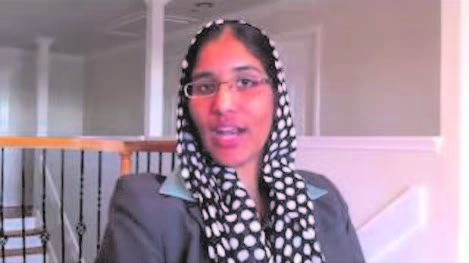
    HOUSTON, TX (TIP): Twelve major American Sikh advocacy organizations, on January 28, 2014 sent letters to President Obama and Attorney General Eric Holder calling on the Obama Administration to immediately reinstate Kawaljeet Tagore, a Sikh IRS Agent based out of Houston, TX fired in July, 2006 for wearing a kirpan, a Sikh religious article of faith.

    Following her termination, Tagore sued the IRS and the Federal Protective Service (FPS),the federal agency responsible for the security of federal buildings, under Title VII and the Religious Freedom Restoration Act for failing to accommodate her Sikh religious practice of wearing the kirpan, a dagger-like article that symbolizes the Sikhs’ commitment to justice.

    Even though FPS and IRS allow saws, box cutters, letter openers, and cake knives into federal buildings for work-related purposes, the IRS and FPS defended Tagore’s lawsuit by claiming that a federal criminal law, 18 U.S.C. section 930, prohibits them from according Tagore any accommodation for her kirpan.

    In 2012, a Houston federal judge sided with the government and dismissed Tagore’s lawsuit. However, on November 13, 2013, the United States Court of Appeals for the Fifth Circuit-relying on a December, 2012 FPS Policy Directive that requires accommodation of kirpans -reversed the federal judge’s ruling in favor of FPS. The Fifth Circuit held that the new FPS Policy Directive “contradicts the arguments previously advanced by the government for denying Tagore an exception or exemption for the wearing of her kirpan.

    Yet, to date, the government has refused to reinstate Tagore to her position as an IRS agent, compensate her, or accommodate her kirpan. “A hard working IRS agent is being kept from work due to her religious beliefs in a country founded on diversity and religious freedom. The FPS has already allowed 2.5 inch kirpans in almost 9,000 federal buildings but will not allow Ms. Tagore to wear her kirpan to work in an IRS building.

    Now that this inconsistency has been addressed by the Fifth Circuit, it is time to give Ms. Tagore her job back,” said Anisha Singh, staff attorney and policy advocate for UNITED SIKHS. In their letter, UNITED SIKHS, along with other Sikh advocacy groups, claim that the IRS and FPS’ continuing violation of Ms. Tagore’s right to religious accommodation is contrary not only to RFRA and FPS Directive 15.9.3.1 but to the guiding principles and tenets of the Obama Administration,” including an Executive Order that requires federal agencies to promote diversity. The Sikh groups call on Obama to “direct the Civil Division of the Department of Justice, IRS, and FPS to appropriately resolve” Tagore’s lawsuit, by “reinstating her employment with the IRS and providing her her with an exemption to wear her kirpan to work.”

  • INCREDIBLE COMPLEXITY

    INCREDIBLE COMPLEXITY

    India’s politics is in disarray at a time when Delhi needs to connect the various dots and come up with a policy matrix of incredible complexity involving several interlocking templates – security situation within Afghanistan; evolving US regional priorities toward Afghanistan, Pakistan and India to optimize its ‘pivot to Asia’; rising tensions in the US’ equations with both China and Russia; US-Iranian engagement; India- Pakistan dialogue,” says the author

    The US-Pakistan Strategic Dialogue took place early last week in Washington after an interruption of three years following the American raid on Osama bin Laden’s secretive residence in Abbottabad in May 2011. These three years have been marked by much US-Pakistan discord and public acrimony.

    A brave attempt was made by both sides during Prime Minister Nawaz Sharif’s visit to the White House last October to put behind the bitterness of betrayal and get on with the relationship. But such deep wounds as Abbottabad take time to heal. At best, they could be cauterized for temporary relief. Indeed, bin Laden’s ghost was present at this week’s cogitation in Washington, as is apparent from the recent US legislation to make financial aid to Pakistan $33 million conditional on Islamabad pardoning and releasing the Pakistani doctor Shakil Afridi (who secretly helped the CIA to track down the elusive al-Qaeda leader’s hideout).

    Whereas Pakistan sees Afridi’s collaboration with the CIA as an “act of treason”, Americans hail him as a hero. In turn, Pakistan seeks the release of lady doctor Aafia Siddiqui whom the US locked up for an 80-year jail term for allegedly firing at US soldiers. While Washington regards her as a cold-blooded murderer, she is the stuff heroism in the Pakistani folklore. Clearly, this is much more than a war of words between two estranged partners.

    There is a crisis of confidence in their “spirit of cooperation”, to borrow the expression from the Pakistani foreign ministry statement condemning the US decision to link Afridi’s case to American aid. Meanwhile, hovering above is also the CIA-controlled drone mission haunting the US-Pakistan ties with President Barack Obama vaguely promising that he’d exercise greater “prudence” when Pakistani air space is violated in future and its citizens killed in missile attacks. The cup of Pakistani anger is overflowing. The testiness in the US-Pakistani ties was apparent at the strategic dialogue.

    Washington tried to inject some romance in the run-up to the strategic dialogue with the US special representative for AfPak James Dobbins even penning an article in the Pakistani media affirming that the meet would be an “important opportunity to advance a comprehensive agenda of mutually beneficial initiatives” and a sign of the “firm US commitment to advancing our relationship with Pakistan.” But in the event, the strategic dialogue ended without a compass to navigate the journey ahead. Sharif has since unilaterally ordered talks with Pakistani Taliban. For the Obama administration, the key agenda item was the post- 2014 Afghan scenario. Pakistan’s foreign and security policy advisor Sartaj Aziz said in his opening statement at the strategic dialogue meeting that the Afghan endgame provided “the overbearing and sobering background in which we are meeting to explore ways and means for transforming the post- 2014 US-Pakistan transactional relationship into a strategic partnership.”

    Strategic relationship
    Pakistan needs to know what is there in it for its interests. To quote Aziz, “At what stage does a normal transactional relationship become strategic? Are there one or more thresholds that must be crossed before a relationship can qualify as a strategic partnership?” Interestingly, Aziz proceeded to spell out the three “important prerequisites” of a US-Pakistan strategic partnership. One, “mutual trust at all levels and among all key institutions”; two, respect for each other’s security concerns; and, three, US willingness to “convey” to India Pakistan’s “legitimate concerns” with the “same intensity” with which Washington exerts “a lot of pressure” on Pakistan over “issues of concern to India”.

    Aziz dwelt on the Afghan scenario at some length to underscore that Pakistan is willing to cooperate with a “responsible and smooth drawdown” in Afghanistan and to facilitate “a continued flow of the lines of communication” as well as to “help in every possible way” the stabilization of Afghanistan “including through a comprehensive reconciliation process” – provided, of course, Islamabad could “at the same time hope that our security concerns are comprehensively addressed.” He then summed up that a resolution of the Kashmir issue would have an all-round salutary effect on the range of issues. To be sure, major security challenges lie ahead for India in the period ahead in its region.

    The USPakistani tango is a high-stakes game for both sides and it has commenced in right earnest at a juncture when the Indian government is in limbo and during the next 3-4 months at the very least, a new political order will be struggling to be born on the Raisina Hills. India’s politics is in disarray at a time when Delhi needs to connect the various dots and come up with a policy matrix of incredible complexity involving several interlocking templates – security situation within Afghanistan; evolving US regional priorities toward Afghanistan, Pakistan and India to optimize its ‘pivot to Asia’; rising tensions in the US’ equations with both China and Russia; USIranian engagement; India-Pakistan dialogue.

    The last point becomes crucial since much time has been lost in engaging Pakistan in a meaningful dialogue due to our competitive domestic politics leading to the April poll. Maybe, the Bharatiya Janata Party estimates that a new government dominated by it can always pick up the threads of Atal Behari Vajpayee’s dalliance with Sharif and, therefore, what is the hurry today about. But, as the USPakistan strategic dialogue forewarns, it will be first-rate naivety to imagine things are as simple as that. Lost time is never found again.

  • Dealing with a toxic legacy

    Dealing with a toxic legacy

    President Barack Obama’s recent statement of his Afghanistan policy has again revealed the intractable situation the United States has faced since it led the invasion of that country in 2001.

    In his State of the Union address to Congress on January 28, Mr. Obama said the mission there would be completed by the end of the year, and that thereafter the U.S. and its allies would support a “unified Afghanistan” as it took responsibility for itself. With the agreement of the Afghan government, a “small force” could remain to train and assist Afghan forces and carry out counterterrorism operations against any al- Qaeda remnants.

    Washington has withdrawn 60,000 of its troops from Afghanistan since Mr. Obama took office in 2009, but 36,500 remain, with 19,000 from other countries in the NATO-ISAF coalition. Western plans are for a residual force of 8,000 to 12,000, two-thirds of them American, but sections of the U.S. military have suggested a U.S. strength of 10,000, with 5,000 from the rest of the coalition. Mr. Obama is discussing the options with senior officers.

    The President wants to avoid a repeat of Iraq, which with the exception of Kurdistan has become a battleground between Sunni and Shia leaders, claiming over 7,000 lives in 2013 alone. But over Afghanistan he is caught in a cleft stick. Afghan President Hamid Karzai is yet to sign the deal for NATO-ISAF troops to stay; he would prefer his successor to sign the agreement after he leaves office in April 2014, but the successor will not take office until September.

    Secondly, Mr. Karzai has infuriated Washington by planning to release 37 Taliban detainees, by blaming American forces for terrorist attacks on civilians, and by calling the U.S. a “colonial power.” Yet the Afghan National Security Forces, which include the police, number 334,000, or about 20,000 below the numbers envisaged for them, and the U.S. Department of Defense has reported to Congress that the ANSF cannot operate on their own.

    The U.S. public have little wish to continue the war, but the military may have its own agenda. The September 2013 quarterly report by the Special Inspector General for Afghan Reconstruction shows that of nearly $100 billion in reconstruction aid, $97 billion went towards counter-narcotics, security, and other operations; only $3 billion was used for humanitarian aid. If the President feels hemmed in, it is because of the toxic legacy of his predecessor George W. Bush who went into the country in search of Osama bin Laden and al-Qaeda. At the end of 12 years of American occupation, Afghanistan has not emerged as a more secure place; nor has the U.S. had much of a success in nation-building.

  • CNN Survey indicates Americans overwhelmingly Favor Path to Citizenship for Undocumented Immigrants

    CNN Survey indicates Americans overwhelmingly Favor Path to Citizenship for Undocumented Immigrants

    WASHINGTON (TIP): A CNN survey conducted February 6, says Americans overwhelmingly favor a bill that would give most undocumented immigrants a pathway towards citizenship, according to a new national poll.

    And a CNN/ORC International survey also indicates that a majority of the public says that the government’s main focus should be legalizing the status of the undocumented rather than border security.

    The poll was released Thursday, the same day that House Speaker John Boehner signaled any action on immigration is unlikely this year because House Republicans don’t trust President Barack Obama on the issue. According to the poll, 54% say the top priority for the government in dealing with the issue of illegal immigration should be developing a plan that would allow undocumented immigrants with jobs to eventually become legal U.S. residents.

    Just over four in ten questioned say the main focus should be developing a plan for stopping the flow of undocumented immigrants into the U.S. and for deporting those already here. “The Republicans’ insistence that border security be the primary focus of U.S. immigration policy may have been a popular stand in 2011, but not necessarily in 2014,” said CNN Polling Director Keating Holland. “American attitudes toward undocumented immigrants have changed. Starting in 2012, most Americans have said that the government’s focus should be on a plan that would allow those immigrants to become legal U.S. residents.

    A majority has consistently taken that position since that time – 56% in 2012, 53% in 2013, and 54% in the current poll,” added Holland. The Democratic-controlled Senate last year passed a bipartisan illegal immigration bill that included an eventual pathway towards citizenship for most of the 11 million undocumented immigrants in the U.S. According to the poll, more than eight in 10 support such a plan.

    There is little partisan divide, with 88% of Democrats, 81% of independents and 72% of Republicans in agreement. The Senate bill stalled in the GOP dominated House. Republicans said they preferred to address the matter incrementally rather than in one comprehensive measure. One idea House Republicans are considering is giving undocumented immigrants legal status to stay in the U.S., but not allow them a pathway towards citizenship. According to the survey, only 35% support such an idea, with just over six in 10 opposed.

    Again, there was no partisan divide, with two-thirds of Democrats and around six in 10 independents and Republicans opposing such a plan. The poll was conducted for CNN by ORC International from Jan. 31-Feb. 2, with 1,010 adults nationwide questioned by telephone. The survey’s overall sampling error is plus or minus three percentage points. Meanwhile, on January 30, the House Republican Leadership released a one-page document entitled “Standards for Immigration Reform”. This is the long-awaited response to the bipartisan immigration reform bill passed by the Senate in June 2013.

    Enforcement
    The Republicans Immigration Principles first address the issue of immigration enforcement. They declare that the following three things must occur before there can be any legalization program: 1) We must secure our borders and verify that they are secure; 2) There must be a functioning entry-exit system to make sure that people do not overstay their visas; 3) There must be a workable electronic employment verification system.

    Reform the Legal Immigration System
    The standards call for increasing the number of employment-based visas, limiting the number of family-based visas and eliminating the visa lottery. They also stressed the need for temporary workers, and explicitly endorse a temporary visa program for agricultural workers.

    Legalization
    With respect to legalization of the 11-12 million persons who are residing in the U.S. without papers, the standards explicitly reject a “special pathway to citizenship”. In order for these persons to be able to legalize their status, they must:
    1) Admit their culpability;
    2) Pass rigorous background checks;
    3) Pay significant fines and back taxes;
    4) Develop proficiency in English and American civics; and
    5) Be able to support themselves and their families without public benefits.

    There will be no legalization program until certain enforcement measures have been implemented and found to be working. The standards do allow an exception for persons who were brought to the United States as children by their parents. They will have a path to citizenship if they meet certain eligibility standards and they either serve in the U.S. military or they obtain a college degree. The standards foreclose the possibility of negotiating a compromise bill with the upper house based on the bill passed by the Senate in 2013. Instead, they call for piecemeal legislation.

    Is a Compromise Possible?
    Given these broad principles, is there any hope for a compromise reform bill to become law in 2014? First, consider that many of these GOP House principles mirror parts of the Senate bill:
    1) Tough border enforcement;
    2) Mandatory E-Verify;
    3) Increasing employment-based immigration;
    4) Reducing family-based immigration and eliminating the visa lottery;
    5) New temporary visa program including one for agricultural workers.

    The main point of contention is the rejection of the Senate’s 13-year Pathway to Citizenship. Is it good policy to legalize millions of undocumented workers without allowing them to become U.S. citizens one day? Here the GOP House Standards threaten to upset the delicate balance worked out between labor and management in crafting the Senate’s compromise legislation. Richard Trumka, the President of the AFL-CIO and a strong supporter of the Senate bill stated that “half-measures that would create a permanent class of noncitizens without access to green cards should be condemned, not applauded.

    Until we create a functioning immigration system with a pathway to citizenship, ruthless employers will continue to exploit low wage workers, pulling down wages for all.” However, Representative Paul Ryan (RWS) who may be a contender for the Presidential nomination in 2016 made statements which show that there is a substantial wiggle room in the Principles for compromise. “If you want to get in line to get a green card like any other immigrant, you can do that. You just have to get at the back of the line so that we preference that legal immigrant who did things right in the first place.”

    So, what’s the bottom line?
    Here is what President Obama had to say: “If the speaker proposes something that says right away, folks aren’t being deported, families aren’t being separated, we’re able to attract top young students to provide the skills or start businesses here, and then there’s a regular process of citizenship, I’m not sure how wide the divide ends up being.” Here is my take: Wait for the Republican primaries to be over in May and June.

    Then, GOP representatives, no longer looking over their right shoulders at Tea Party challengers, will be in a better position to compromise. Notice that while the principles oppose a “special” pathway to citizenship, there is no explicit bar to legalized persons eventually attaining U.S. citizenship. There is room for compromise. Skeptical? Consider how far the GOP has moved toward reality on immigration policy since Mitt Romney’s “selfdeportation” fiasco of 2012.

  • Indian-American student develops 3-D printed loudspeaker

    Indian-American student develops 3-D printed loudspeaker

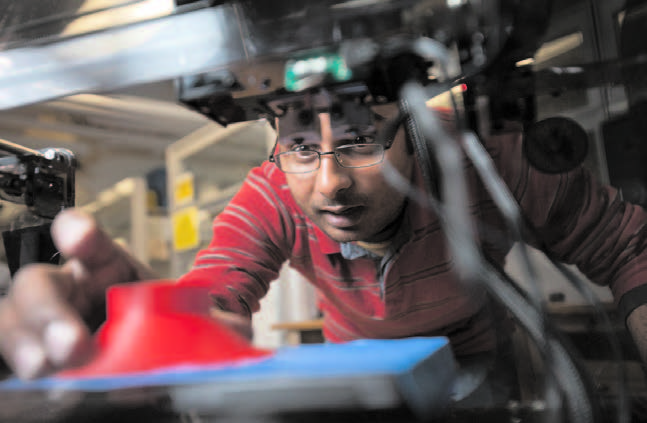
    NEW YORK (TIP): Led by an Indian- American student Apoorva Kiran, scientists at Cornell University have 3-D printed a working loudspeaker – seamlessly integrating the plastic, conductive and magnetic parts – and ready for use almost as soon as it comes out of the printer.

    The thrilling discovery means that rather than assembling consumer products from parts and components, complete functioning products could be fabricated at once, on demand. Kiran and Robert MacCurdy, graduate students in mechanical engineering, worked with Hod Lipson, associate professor of mechanical and aerospace engineering, to develop this unique technique, said a press release by Cornell University.

    “Everything is 3-D printed,” said Kiran, as he launched a demo by connecting the newly-printed mini speaker to amplifier wires. For the demo, the amplifier played a clip from President Barack Obama’s State of the Union speech that mentioned 3-D printing. “A loudspeaker is a relatively simple object. It consists of plastic for the housing, a conductive coil and a magnet. The challenge is coming up with a design and the exact materials that can be co-fabricated into a functional shape,” Kiran said.

    Kiran used one of the lab’s Fab@Homes – a customisable research printer that allows scientists to tinker with different cartridges, control software and other parameters. For the conductor, Kiran used a silver ink. For the magnet, he employed the help of Samanvaya Srivastava, a graduate student in chemical and biomolecular engineering, to come up with a viscous blend of strontium ferrite.

    After making a detailed digital model of the telegraph, they printed it on a research fabber. 3-D printing technology could be moving from printing passive parts toward printing active, integrated systems, added the release. But it will be a while before consumers are printing electronics at home. Most printers cannot efficiently handle multiple materials.

    It’s also difficult to find mutually compatible materials – for example, conductive copper and plastic coming out of the same printer require different temperatures and curing times. Creating a market for printed electronic devices could be like introducing color printers after only black and white had existed. “It opens up a whole new space that makes the old look primitive,” the release added.

  • Another Indian-American jumps into combative US House race

    Another Indian-American jumps into combative US House race

    WASHINGTON (TIP): An Indian-American Republican candidate has jumped into an already combative electoral House race in the Silicon Valley featuring a former aide of President Barack Obama challenging the sitting fellow Democrat.

    The new entrant to the race between the seven-term Democrat incumbent Mike Honda of San Jose and his main challenger, former Obama administration trade representative Ro Khanna, is Vanila Singh, a Stanford Medical Centre anaesthesiologist. India-born Singh, 43, who came to the US as a toddler, says she entered the South Bay contest because it is “time to do my civic duty”.

    But her critics, according to SFGate.com, say the man who recruited her to run, Chicago businessman Shalabh ‘Shalli’ Kumar, “has a far more divisive agenda”. Kumar is founder of the Indian Americans for Freedom, a super PAC or an independent-expenditure only Political Action Committee, which can spend unlimited amounts as long as it doesn’t coordinate directly with the candidate.

    Singh acknowledges that after “multiple conversations” with Kumar and other Republican insiders late last year, she filed to run Dec 26 – a day after switching her voter registration from “declined to state” to Republican. In recent weeks, Singh met Kumar, who chairs the Indian American Advisory Council of the House Republican Conference, in Washington, D.C. said SFGate. Kumar told ethnic publication IndiaWest that he approached Singh to be part of a “project” he founded with Republican House member Pete Sessions to build a Republican congressional “team” that supports a “pro-India” agenda.

    However his critics, according to SFGate.com, suggest his agenda includes securing a visa for Bharatiya Janata Party’s prime ministerial candidate Narendra Modi. Modi’s US visa was revoked in 2005 because of his alleged role or inaction during the 2002 Gujarat riots. Singh, according to SFGate, says she has received no money and “no promises” from Kumar or his super PAC. “I’m not part of his project per se,” and Kumar’s agenda “is not mine”, she was quoted as saying.

  • Justin Bieber charged with assault in Canada

    Justin Bieber charged with assault in Canada

    TORONTO (TIP): Canadian police charged Justin Bieber on January 29 with assaulting a limousine driver in Toronto in December, the latest in a string of legal troubles for the young pop star.

    The incident happened in the early hours of December 30, when the limousine picked up six people including Bieber, 19, outside a Toronto nightclub, police said in a statement. Bieber struck the limousine driver on the back of the head several times during an altercation on the way to a hotel, police said.

    The driver got out and called police, but Bieber left before they arrived, according to the statement. A Canadian lawyer for the pop star issued a statement that said Bieber is innocent and because the matter is before the courts, it would be inappropriate to address the specifics of the allegation. Bieber’s legal team expects the matter will be treated as a summary offence, the equivalent of a misdemeanor in the United States. The pop star is scheduled to appear in a Toronto courtroom on March 10.

    Bieber was charged after appearing at a Toronto police station on Wednesday evening. He arrived in a black SUV and was met by a crowd of journalists and screaming fans, who braved temperatures of minus 10 Celsius (14 Fahrenheit). Wearing a baseball cap on backwards and hooded black coat, Bieber was mobbed by photographers and fans pushing for a closer look as bodyguards and police officers cleared a path for him to enter the station.

    Facing florida charges

    Bieber has been in trouble with authorities in the United States this month. He was charged with driving under the influence in Miami after police say he was caught drag racing a rented Lamborghini. Police said Bieber told them he had taken prescription medicine, smoked marijuana and consumed alcohol.

    According to court records, he pleaded not guilty on Wednesday to those charges. If convicted, Bieber could face up to six months in prison, although experts say he is likely to receive a lighter sentence because it would be his first offence. Bieber is scheduled to make a court appearance on February 14 to formally answer those charges. He was also charged with driving on an expired license and resisting arrest.

    Also on Wednesday, an online petition asking the administration of President Barack Obama to deport Bieber from the United States following his Miami arrest passed the 100,000-signature threshold required for a White House response. Bieber is unlikely to be deported because federal law dictates that a visa can only be revoked or denied for a conviction of a violent crime with a minimum one-year prison sentence.

  • OBAMA VOWS TO ACT ALONE ON ECONOMY

    OBAMA VOWS TO ACT ALONE ON ECONOMY

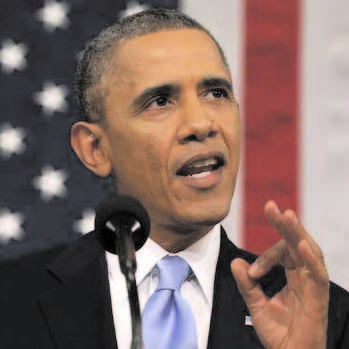
    WASHINGTON (TIP): Declaring that 2014 can be the “breakthrough year” for America and the US is “better-positioned for the 21st century than any other nation on Earth”, US President Barack Obama warned the country’s lawmakers on January 28 that he would use his executive powers to boost economic recovery and narrow the gap between rich and poor if they did not move on critical legislation.

    Obama used his fifth State of the Union address, the first in his second term, to challenge Republicans in a gridlocked Congress that he feels has thrown sand in his economic agenda, urging them to pass laws relating to minimum wage, immigration reform, and tax code, among other issues, to take advantage of the growing momentum in the US economy.

    “For the first time in over a decade, business leaders around the world have declared that China is no longer the world’s number one place to invest; America is… and over half of big manufacturers say they’re thinking of insourcing jobs from abroad,” Obama told lawmakers in a 70-minute address that contained an upbeat assessment of the US economy, even as he railed about stagnant wages — while the rich got richer — because of divisive politics in Washington.

    “So let’s make that decision easier for more companies. Let’s end incentives to ship jobs overseas, and lower tax rates for businesses that create jobs right here at home,” he added, warning that while he was eager to work with Congress on legislation, he would take executive steps whenever and wherever he could to expand opportunity for Americans. The president’s tone could result in a sharp uptick in Washington’s confrontational politics where legislators jealously guard their law-making privileges.

    Obama announced an executive order raising minimum wage for workers employed by federal contractors to $10.10/hour, and urged businesses across the country to follow suit without waiting for legislation. Many lawmakers are reluctant to back this move believing it will adversely affect businesses and their ability to add jobs. In an address that was light on foreign policy and did not contain any reference to India, Obama also outlined a new paradigm on overseas wars, saying he will not send US troops into harm’s way unless it is truly necessary, nor will he allow them to be mired in open-ended conflicts.

    “We must fight the battles that need to be fought, not those that terrorists prefer from us — large-scale deployments that drain our strength and may ultimately feed extremism,” he added, effectively signaling an end to the Bush-era policy of taking on terrorists on their home turf. Specifically on Afghanistan, he said a small force of Americans could remain in the country with Nato allies to carry out two narrow missions: training and assisting Afghan forces and counterterrorism operations to pursue any remnants of al-Qaida. According to a CNN/ORC International survey, only three in 10 Americans think Obama should make unilateral changes to deal with major issues. Forty-four per cent of respondents had a very positive reaction, with 32% saying they had a somewhat positive response and 22%with a negative response.

  • Of hope and reality President Obama seeks to scale down expectations

    Of hope and reality President Obama seeks to scale down expectations

    Obama promised a ‘year of action’ during which he would raise the minimum wage and tackle economic inequality. US President Barack Obama also used his State-of-the-Union Address to bring in a dash of reality into the audacity of hope that aroused high expectations.

    He said he would revamp the US taxation system to decrease the gap between the rich and the poor in the US. He plans to raise the federal minimum wage from $7.25 an hour to $10.10. Naturally, this move is opposed by business leaders, but it would mean a major boost to household incomes across the US.

    The US President also plans to overhaul the country’s immigration laws, withdraw US troops substantially from Afghanistan and act aggressively on climate them. Over the years, President Obama has found his sweeping vision of bipartisan consensus swept away by the partisan reality of politics. The Republican majority in the House of Representatives and their ability to block or delay legislation in the Senate have created a situation where the Democrats have found themselves checkmated on a regular basis.

    No wonder, President Obama said that he would bypass the Congress, if necessary, to usher in the change that he wants. How this confrontational stance plays out remains to be seen; it certainly is going to bring about some interesting times ahead. In fact, confrontation was what the President’s supporters were looking for. In his second term, he can afford to take on the Republicans.

    By an executive order, a US President can make substantial changes in policy, even though these can be reversed by the next incumbent. The State-of-the-Union Address focused largely on domestic policies and many of the issues that President Obama raised find resonance among voters, especially his emphasis on pay-check parity. He will have to find ways to deliver his promises, even if it leads to some confrontation with the Congress, which has hobbled him since 2010 when the Democrats lost their hold.

  • Obama to meet Jordan’s King Abdullah in California in February

    Obama to meet Jordan’s King Abdullah in California in February

    WASHINGTON (TIP): US President Barack Obama will meet Jordan’s King Abdullah II at an exclusive California estate next month, the White House said on January 29.

    The talks, likely to focus on Syria’s refugee crisis and Middle East peace moves, will take place on February 14 at the same desert resort — the Annenberg estate at Sunnylands near Palm Springs — where Obama met China’s President Xi Jinping for an informal summit in June.

    “The president looks forward to discussing with King Abdullah opportunities to strengthen the US-Jordan strategic partnership and how to advance our political, economic and security cooperation,” White House spokesman Jay Carney said in a statement.

    “The two leaders will also continue consultations on regional developments, including Middle East peace and Syria.” The Jordanian embassy in Washington said in a statement that the summit would take place as the king returned from a trip to Mexico and that he would also travel to Washington to meet key officials and lawmakers.

  • Texas Democrats back Obama’s call for wage increase

    Texas Democrats back Obama’s call for wage increase

    WASHINGTON (TIP): For the second straight year, President Obama called for an increase in the national minimum wage during January 28 State of the Union address. Texas Democrats expressed strong support for the proposal.

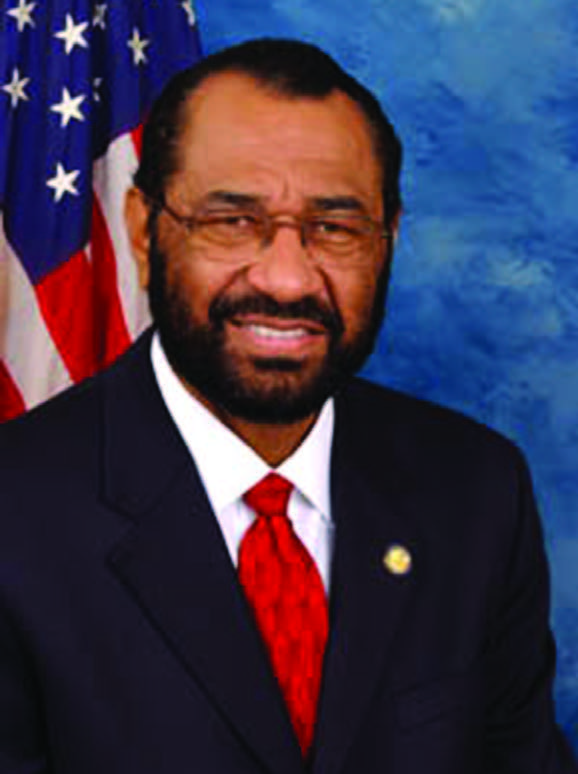
    “This has gained a lot of momentum,” said Rep. Al Green, DHouston. “Every poll that I see indicates that people are for raising the minimum wage. It can make a difference in the lives of people not only at the very bottom in the entry level jobs, but also in the lives of people up the ladder as well, because it tends to raise the other boats as it raises that boat that’s at the very lowest level.”

    Conservatives, however, say that raising wages would add more expenses for business owners already struggling to stay afloat. Many Republicans point to studies suggesting that raising the minimum wage will slow job growth. The current federal minimum wage is $7.25 an hour. Obama called for a boost to $10.10, spotlighting a bill by Sen. Tom Harkin, D-Iowa and Rep. George Miller, DCalif. currently attempting to raise the national minimum wage to that level. The president also announced an executive order to raise the minimum wage paid to federal contractors, to $10.10.

    That came with pledges for other executive orders, drawing the ire of conservatives, who called such actions “imperialist.” “Shame on us,” said Rep. Sheila Jackson Lee, D-Houston, of Congress’ inability to raise the minimum wage. “The actions that the president is taking are not overbearing or far-reaching. They respond to the outcry of the American people for a decent wage and a decent quality of life.” Texas’ minimum wage is the same as the federal minimum. In 2013, Texas had more minimum wage workers than any other state – 452,000 of the 3.6 million nationwide.

    According to the Bureau of Labor Statistics, a quarter of all Texas workers- more than 2.5 million- make less than $10 an hour. More than 700,000 workers in the Dallas metro area make around that level, or less. “I believe in a decent living wage,” said Rep. Eddie Bernice Johnson, D-Dallas. She said businesses she’s spoken to in her district are on board with the boost. “They don’t have a problem with $10 an hour. I’ve talked with fast food owners [and] Costco…. They all feel it’s worthy to get the wages up, to get money in circulation so employees can live a decent life.

  • Obama calls for action, with or without Congress

    Obama calls for action, with or without Congress

    WASHINGTON (TIP): He talked a good game of acting on his own if necessary, calling for 2014 to be a “year of action, but President Barack Obama’s State of the Union address showed he knows that true progress depends on cooperation with a divided and recalcitrant Congress.

    “Sometimes we stumble; we make mistakes; we get frustrated or discouraged,” he said near the end of the more than hour-long speech, seeming to describe his bad 2013 that lowered his approval ratings. “But for more than 200 years, we have put those things aside and placed our collective shoulder to the wheel of progress.”It was vintage Obama, blending hopeful calls for a unified approach with declarations of presidential independence through executive orders.

    There were the now familiar calls to recalibrate the tax code, spend more to rebuild roads and bridges, bolster education and avoid war if at all possible. He brought many to tears with a tribute to Sgt. First Class Cory Remsburg, a disabled war veteran who sat next to first lady Michelle Obama and waved with wounded limbs to a prolonged standing ovation. Even Republicans relentlessly critical of the President conceded his oratorical skill. “A speech by Barack Obama is a lot like sex,” said GOP strategist and CNN contributor Alex Castellanos. “The worst there ever was is still excellent.”

    According to a snap CNN/ORC International poll, 44% of respondents had a “very positive” response to Obama’s speech, while 32% described a “somewhat positive” response and 22% didn’t like it at all. Last year, 53% of respondents in a similar poll rated their response to the 2013 address as very positive. The underlying theme of Obama’s fifth State of the Union address was his call on Tuesday for the government to work on behalf of all Americans in 2014, and his pledge to do so even if Congress refused to join him in an election year. “Let’s make this a year of action,” Obama said. “That’s what most Americans want — for all of us in this chamber to focus on their lives, their hopes, their aspirations.”

    It’s an optimistic goal for a President with a 43% approval rating entering his sixth year in office and facing a determined opposition in the Republican-led House of Representatives with congressional elections looming in November. “What I offer tonight is a set of concrete, practical proposals to speed up growth, strengthen the middle class, and build new ladders of opportunity into the middle class,” Obama said. “Some require congressional action, and I’m eager to work with all of you. But America does not stand still, and neither will I.”

    On issue after issue, he invited Congress to work with him but said he also would go it alone. Obama called for more government support to rebuild the nation’s infrastructure, but also said that “I will act on my own to slash bureaucracy and streamline the permitting process for key projects, so we can get more construction workers on the job as fast as possible.”The President also promised an executive order to raise the minimum wage for some government contract workers.While the action is relatively narrow and affects less than half a million people, Obama urged Congress to follow suit for all low-wage workers in America.

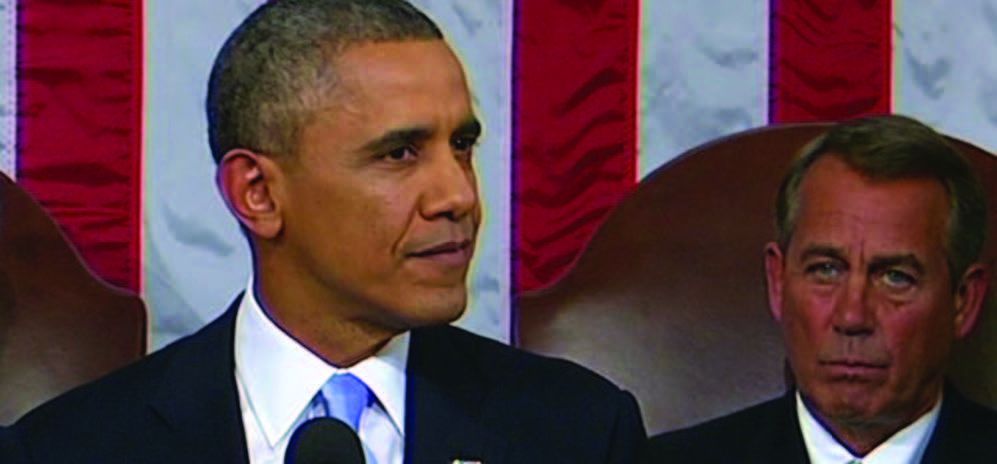
    Earlier Tuesday, House Speaker John Boehner chafed at such unilateral action, telling reporters that Republicans are “just not going to sit here and let the President trample all over us.”In the official Republican response, Rep. Cathy McMorris Rodgers of Washington complained that Obama’s policies “are making people’s lives harder.” “We hope the President will join us in a year of real action — by empowering people — not by making their lives harder with unprecedented spending, higher taxes, and fewer jobs,” she said. One area of possible progress is immigration reform. Obama got a long ovation when he urged Republicans in the House to join Democrats in passing a Senate plan that got bipartisan support.

    McMorris Rodgers also brought up the issue backed by some Republicans as a way to bolster their weak support among Hispanic Americans, the nation’s largest minority demographic. “We’re working on a step-by-step solution to immigration reform by first securing our borders and making sure America will always attract the best, brightest, and hardest working from around the world,” she said in describing the more limited GOP approach to the comprehensive Senate measure that includes a path to legal status for immigrants living illegally in the country.

    On another major reform issue, Obama chided Republicans for trying to undermine his signature health care law that passed in 2010 without GOP support. He cited the millions of people helped by the reforms that ended denial of coverage for pre-existing conditions among its benefits. “The American people aren’t interested in refighting old battles,” Obama said. “Let’s not have another 40-something votes to repeal a law that’s already helping millions of Americans. …The first 40 were plenty. …We all owe it to the American people to say what we’re for, not just what we’re against.”

    In her response, though, McMorris Rodgers continued the GOP attack line on the health care reforms as big government run amok and causing harm to people by raising costs and limiting their personal choices of doctors and medical treatment.The CNN/ORC poll indicated 59% of respondents thought Obama’s policies as presented in the speech would help the economy, a lower figure than in recent years. Obama said he will order the U.S. Treasury to create a new federal retirement savings account called MyRA, a savings bond that would guarantee “a decent return with no risk of losing what you put in.”

    It will be available to those whose jobs don’t offer traditional retirement savings programs, he said. Additionally, Obama called for: — Eliminating $4 billion in tax subsidies for the fossil fuel industries “that don’t need it” and instead “invest more in fuels of the future.” — Equal pay for women, noting they make 77 cents for each dollar a man earns, which he called “wrong” and “an embarrassment” to prompt loud and long applause. — Setting new fuel standards for American trucks to help reduce U.S. oil imports “and what we pay at the pump.”– Reworking the corporate tax code.

    He urged Congress to work with him to close “wasteful, complicated loopholes that punish businesses investing here” and instead “lower tax rates for businesses that create jobs right here at home.”– Congress to lift restrictions on transferring detainees from Guantanamo Bay so the prison cna be closed in 2014.Obama also reiterated that he will veto any new sanctions bill from Congress that would derail talks on preventing Iran from developing a nuclear weapon, adding that “for the sake of our national security, we must give diplomacy a chance to succeed.”

  • FOREIGN RELATIONS OF INDIA

    FOREIGN RELATIONS OF INDIA

    India has formal diplomatic relations with most nations; it is the world’s second most populous country, the world’s mostpopulous democracy and one of the fastest growing major economies. With the world’s seventh largest military expenditure, ninth largest economy by nominal rates and third largest by purchasing power parity, India is a regional power, a nascent great power and a potential superpower.

    India’s growing international influence gives it a prominent voice in global affairs. The Economist magazine argues, however, that underinvestment in diplomacy and a lack of strategic vision have minimised India’s influence in the world. India is a newly industrialised country, it has a long history of collaboration with several countries and is considered one of the leaders of the developing world along with China, Brazil, Russia and South Africa (the BRICS countries). India was one of the founding members of several international organisations, most notably the United Nations, the Asian Development Bank, G20 industrial nations and the founder of the Non-aligned movement.


    32
    India has often represented the interests of developing countries at various international platforms. Shown here is Prime Minister Manmohan Singh with Dmitry Medvedev, Hu Jintao and Luiz Inácio Lula da Silva during BRIC summit

    India has also played an important and influential role in other international organisations like East Asia Summit, World Trade Organisation, International Monetary Fund (IMF), G8+5 and IBSA Dialogue Forum. Regionally, India is a part of SAARC and BIMSTEC. India has taken part in several UN peacekeeping missions and in 2007, it was the secondlargest troop contributor to the United Nations.[12] India is currently seeking a permanent seat in the UN Security Council, along with the G4 nations. India’s relations with the world have evolved since the British Raj (1857–1947), when the British Empire monopolised external and defence relations. When India gained independence in 1947, few Indians had experience in making or conducting foreign policy. However, the country’s oldest political party, the Indian National Congress, had established a small foreign department in 1925 to make overseas contacts and to publicise its freedom struggle.

    From the late 1920s on, Jawaharlal Nehru, who had a longstanding interest in world affairs among independence leaders, formulated the Congress stance on international issues. As a member of the interim government in 1946, Nehru articulated India’s approach to the world. India’s international influence varied over the years after independence. Indian prestige and moral authority were high in the 1950s and facilitated the acquisition of developmental assistance from both East and West. Although the prestige stemmed from India’s nonaligned stance, the nation was unable to prevent Cold War politics from becoming intertwined with interstate relations in South Asia.


    33

    In the 1960s and 1970s India’s international position among developed and developing countries faded in the course of wars with China and Pakistan, disputes with other countries in South Asia, and India’s attempt to balance Pakistan’s support from the United States and China by signing the Indo- Soviet Treaty of Friendship and Cooperation in August 1971. Although India obtained substantial Soviet military and economic aid, which helped to strengthen the nation, India’s influence was undercut regionally and internationally by the perception that its friendship with the Soviet Union prevented a more forthright condemnation of the Soviet presence in Afghanistan. In the late 1980s, India improved relations with the United States, other developed countries, and China while continuing close ties with the Soviet Union. Relations with its South Asian neighbours, especially Pakistan, Sri Lanka, and Nepal, occupied much of the energies of the Ministry of External Affairs.

    In the 1990s, India’s economic problems and the demise of the bipolar world political system forced India to reassess its foreign policy and adjust its foreign relations. Previous policies proved inadequate to cope with the serious domestic and international problems facing India. The end of the Cold War gutted the core meaning of nonalignment and left Indian foreign policy without significant direction. The hard, pragmatic considerations of the early 1990s were still viewed within the nonaligned framework of the past, but the disintegration of the Soviet Union removed much of India’s international leverage, for which relations with Russia and the other post-Soviet states could not compensate. After the dissolution of the Soviet Union, India improved its relations with the United States, Canada, France, Japan and Germany. In 1992, India established formal diplomatic relations with Israel and this relationship grew during the tenures of the Bharatiya Janata Party (BJP) government and the subsequent UPA (United Progressive Alliance) governments.

    In the mid-1990s, India attracted the world attention towards the Pakistan-backed terrorism in Kashmir. The Kargil War resulted in a major diplomatic victory for India. The United States and European Union recognised the fact that Pakistani military had illegally infiltrated into Indian territory and pressured Pakistan to withdraw from Kargil. Several anti-India militant groups based in Pakistan were labeled as terrorist groups by the United States and European Union. India has often represented the interests of developing countries at various international platforms. Shown here are Prime Minister Manmohan Singh with Dmitry Medvedev, Hu Jintao and Luiz Inácio Lula da Silva during BRIC summit in June, 2009. In 1998, India tested nuclear weapons for the second time which resulted in several US, Japanese and European sanctions on India.

    India’s then-defence minister, George Fernandes, said that India’s nuclear programme was necessary as it provided a deterrence to potential Chinese nuclear threat. Most of the sanctions imposed on India were removed by 2001. After the 11 September attacks in 2001, Indian intelligence agencies provided the U.S. with significant information on Al-Qaeda and related groups’ activities in Pakistan and Afghanistan. India’s extensive contribution to the War on Terror, coupled with a surge in its economy, has helped India’s diplomatic relations with several countries. Over the past three years, India has held numerous joint military exercises with U.S. and European nations that have resulted in a strengthened U.S.-India and E.U.-India bilateral relationship. India’s bilateral trade with Europe and United States has more than doubled in the last five years.

    India has been pushing for reforms in the UN and WTO with mixed results. India’s candidature for a permanent seat at the UN Security Council is currently backed by several countries including France, Russia,[50] the United Germany, Japan, Brazil, Australia and UAE. In 2004, the United States signed a nuclear co-operation agreement with India even though the latter is not a part of the Nuclear Non- Proliferation Treaty. The US argued that India’s strong nuclear non-proliferation record made it an exception, however this has not persuaded other Nuclear Suppliers Group members to sign similar deals with India. During a state visit to India in November 2010, US president Barack Obama announced US support for India’s bid for permanent membership to UN Security Council as well as India’s entry to Nuclear Suppliers Group, Wassenaar Arrangement, Australia Group and Missile Technology Control Regime.

  • CREED GUIDING MATURE REPUBLIC

    CREED GUIDING MATURE REPUBLIC

    Modern societies emerge out of their primitive forms. As India enters its 65th year as a republic, it is not what it used to be for the past several centuries: ruled by kings and nawabs, brutalised by Hindu orthodoxies of caste and sati, or dependent on agriculture.

    “India has changed more in last six decades than in six previous centuries,” said president Pranab Mukherjee on the eve of the Republic Day last year, adding: “It will change more in the next ten years than in the previous sixty.” The motor of change is democracy, or the republic’s politics reaffirmed every five years through the conscious act of voting.

    Democracy refers to demokratia—a political system that began in 5th to 4th centuries BC when the people (demos) of Athens revolted against the dynasties of tyrants and established their own kratos (rule). Over past decades, democracy in India has emerged as a revolt against caste and other social inequalities, empowering millions of dalits, minorities and women.


    19

    India still subjugates its women, but it will change as more than a million women, elected to political nurseries of panchayati raj, are about to alter the balance of gender relations. The Indian republic is a Greek city state in microcosm, whose citizens interact with philosophical concepts every day, acquiring new understandings of liberty and rationality. As it matures, it inculcates egalitarian ideals in its citizens who in turn guard demokratia, the republic’s dharma, or creed. The egalitarian Indian defends the order, defeating Indira Gandhi after the Emergency when democracy appeared to be failing, or producing an Aam Aadmi Party when corruption of an industrial scale emerged.

    The republic is nurtured from below. It just gave Kashmiri secessionists a recurring opportunity to prove their worth through the ballot option of NOTA, none of the above. In primitive societies, consensus emanated from similarities of beliefs and identities; in modern India consensus is derived from differences and moderated by media, political parties, voters, and the judiciary. The voter is the sane oracle, inaugurating an era of coalition politics in 1989 and shifting the polity towards federalism, in tune with the diversity of India. From the post-Emergency rise of anti-Congress parties to the AAP, the republic births new parties. It secures the confidence of minorities.

    According to a BJP research, India has seen the emergence of “smaller Muslim parties” that are determining outcomes in states from Assam to Kerala. Indian polity is ripe where any new party could transform into a countrywide behemoth by practising simple politics: electing leaders through organisational polls. There is space for all, as no party has got 50 per cent votes. In some way, parties are dying, or being obscured, eclipsed and forgotten. The Congress is forgotten in UP, Bihar, West Bengal, Delhi and many states; the BJP was reduced to irrelevance as a national opposition until Narendra Modi rose from below; the Rashtriya Janata Dal was dumped; and demokratia caught up with communists in West Bengal in 2011. It happens due to parties’ failure to abide by the republic’s dharma: more politics, more democracy. Politics has its own independent dignity.

    More parties could thrive if their funds were audited and if they held polls to elect party leaders or used secret ballot to elect chief ministers or Prime Minister. If the Congress practised politics, US-style primaries to elect party leaders could herald a revolution. Among democracies, some are religious states such as Britain whose societies are overwhelmingly secular; some are secular states like the US and India whose societies are predominantly religious. Religious neutrality, established first by Akbar, characterises the Indian state. The founders—Gandhi, Nehru and Ambedkar— wrote an array of liberties into the Constitution: equality of rights, multi-party elections, free press, individual freedoms, rule of law, independent judiciary, etcetera. Speaking at Oxford in 2005, Prime Minister Manmohan Singh noted that the founders were “greatly influenced by the ideas associated with the age of Enlightenment in Europe.”

    The political and religious freedoms Indians enjoy would not be possible if the British hadn’t arrived in India. Democracy is defined as the majority rule, but the majority is of the people, not of communities. For those who feed pessimism among minorities, the day is not far when India will see a Muslim prime minister, as religion will become irrelevant. For now, a Muslim politician is yet to be born who could read the republic’s political mind, the way Barack Obama read the American mind. There are reasons: Muslims must shed the fear of the BJP; the politics of secularism and reservation must be defeated by effective policing and through job creation by people. Primitive societies were dependent on agriculture.

    In a modern nation, while the agricultural output grows, its share in the gross domestic product must decline, accompanied by growth in knowledge sectors like biotechnology and financial services. Once seen by the West as the land of snake charmers, India is transformed into an information technology destination today. However, it is an inward-looking mystical civilisation, failing to grasp notions of power. India contemplated sending troops to Iraq in 2003, but succumbed to a perennial weakness to comprehend its place in the international state system. There were military roles in Bangladesh, Sri Lanka and Maldives that indicate India could exercise hard power abroad. Amid problems, the republic is maturing, aided by the Supreme Court which forced candidates to declare assets and criminal antecedents, disqualified elected representatives upon conviction in criminal cases, and enshrined negative voting through NOTA.

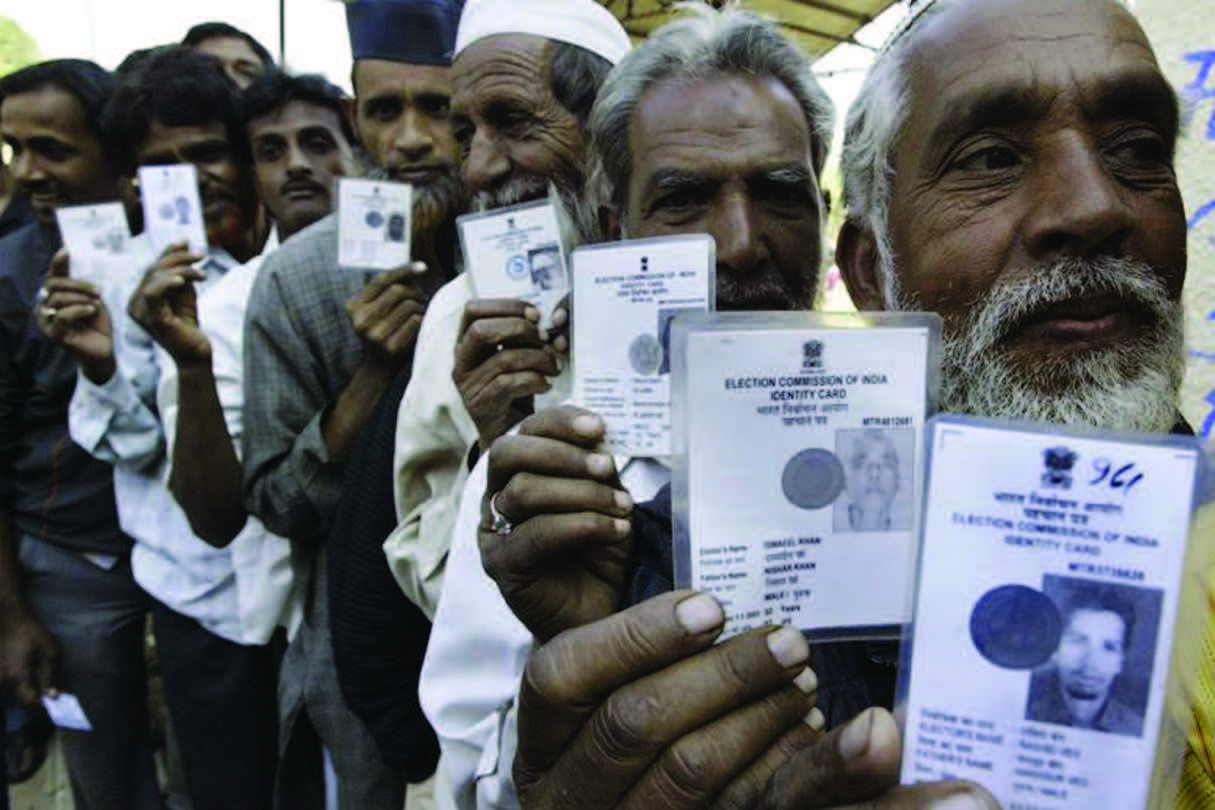
    If T N Seshan alone could retrieve autonomy of the election commission, it appears the Central Bureau of Investigation and other government institutions could cease being the ruling party’s mistress. At the heart of the country’s politics is the sane oracle, the voter: the elderly who walk to polling booths, tribesmen who defy Naxalites to vote, women who stand with men, youth who secure their aspirations in ballots. Of 790 million voters, 120 million are 18-23-yearolds, the first-time voters who must establish a relationship with people, not leaders, to secure the republic for their next generations. (The writer, Tufail Ahmad, is director of South Asia Studies Project at the Middle East Media Research Institute, Washington DC.)

  • 6.3 million eligible for Medicaid since Obamacare launch: US agency

    6.3 million eligible for Medicaid since Obamacare launch: US agency

    NEW YORK (TIP): More than 6.3 million Americans were deemed eligible for government healthcare plans for the poor since the October 1 launch of President Barack Obama’s healthcare law through December, federal officials reported on Wednesday.

    The swelling rolls for Medicaid and the Children’s Health Insurance Program (CHIP) reflect both an expansion of Medicaid under Obama’s Affordable Care Act (ACA) and what healthcare policy analysts call an “out-of-the-woodwork effect,” in which people who heard about Obamacare sought to obtain health insurance and discovered that they had qualified for Medicaid even before the law expanded eligibility.

    “We have people who for the first time will have some health security that they never had before,” Kathleen Sebelius, secretary of the Department of Health and Human Services, said of the Medicaid numbers at the winter meeting of the U.S. Conference of Mayors in Washington, D.C. It was not clear how much credit goes to the healthcare law, however.

    “What many people don’t read far enough to learn is that this number also can include people in some states who are eligible under pre-expansion — the woodwork effect — and whose Medicaid enrollment was simply renewed,” said Matt Salo, executive director of the National Association of Medicaid Directors. The 6.3 million people determined eligible for Medicaid or CHIP last fall swamps the 2.2 million people who had purchased private health insurance on the state-based Obamacare marketplaces that launched on Oct. 1.

    The ACA also raised the income threshold for Medicaid eligibility to 138 percent of the federal poverty level, or $15,856 for a single person. A Supreme Court decision in 2012 allowed each U.S. state to decide whether to accept the expansion. So far, 25 states have reached an agreement with the administration to do so. Prior to the ACA, just over 60 million Americans were covered by Medicaid. In December alone, 2.3 million individuals were determined eligible to enroll in Medicaid or CHIP, an increase of over 20 percent from November, according to the report from the Centers for Medicare & Medicaid Services (CMS), the lead Obamacare agency.

    About 1.2 million of these were in the 25 states (and the District of Columbia) already expanding Medicaid, and just over 1 million were in the 25 states that have not. The CMS figures refer to the number of people that meet Medicaid eligibility rather than actual enrollment in the program due to the troubled HealthCare.gov website, which is run by the federal government to serve Obamacare sign-ups in 36 states.

    For months, the website did not correctly transmit information that applicants are eligible for Medicaid to their state Medicaid program. The state offices do the actual enrollment, and have been scrambling to send out tens of thousands of letters to residents to actually enroll them, the Washington Post reported this month. At the same time, the national figures mirror what many of the Medicaid-expansion states have reported. In California, for instance, 625,000 individuals have gained coverage through private policies purchased on the state’s Obamacare exchange, Covered California, while 1.2 million enrolled in Medi-Cal, the state’s Medicaid program.

    The websites through which people can shop for insurance under Obamacare are required to have what the Obama administration calls a “no wrong door” policy, meaning that even if people went to their state’s exchange expecting to buy private insurance, the site would determine if they were instead eligible for Medicaid or CHIP, which generally charge zero premiums. Several states have gone beyond that, seeking out Medicaid-eligible people by contacting those who receive food stamps or other benefits that indicate they have very low incomes

  • Obama fails to persuade Americans on NSA reform: poll

    Obama fails to persuade Americans on NSA reform: poll

    WASHINGTON (TIOP: Reforms to US surveillance announced by President Barack Obama have failed to reassure most Americans, with three-quarters saying their privacy will not be better protected under the changes, according to a new poll.

    By a margin of 73-21%, Americans who followed Obama’s speech last week on the National Security Agency say his proposals will not make much difference when it comes to safeguarding privacy rights, said the Pew Research Center/USA Today poll published on January 22.

    The poll of 1,504 adults, carried out between Wednesday and Sunday, showed the speech was not widely followed by Americans and that skepticism of the NSA’s electronic spying is growing. The survey said half of those surveyed heard “nothing at all” about Obama’s proposed measures and another 41% said they heard “only a little bit.”

    And fully seven in 10 poll respondents said they should not have to give up privacy to stay safe from potential terror attacks, the poll said. A majority of 53% now disapprove of the NSA’s collection of telephone and internet data. In July, 50% approved and 44% disagreed with the surveillance program.

    The shift in public opinion follows the explosive leak last June of NSA documents by former intelligence contractor Edward Snowden, who has sparked a global uproar over the US government’s far-reaching surveillance. Nearly half of Americans, 48%, said there are insufficient limits on what telephone and internet data the government can collect, while 41% said there are adequate parameters on the government’s spying.

    The survey revealed a division over whether Snowden’s unprecedented disclosures of classified information have damaged the country, with 45% saying the leaks have served the public interest and 43% saying the leaks have harmed it. Snowden faces espionage charges from US authorities over his leaks and has obtained temporary asylum in Russia, where he has said he has been vindicated by the public reaction to the disclosures. However, 56% of Americans say the government should prosecute Snowden while 32% did not favor pursuing criminal charges.

    In his speech last Friday, Obama said a third party – not the government – should hold vast stores of phone metadata, and that the NSA would need a court order to search the data except in genuine emergencies. The US president also promised Washington would no longer eavesdrop on the leaders of friendly foreign governments and that a panel of independent lawyers should be allowed to argue in the interest of privacy rights before the secret court that oversees the NSA surveillance. The poll found 79% of Americans were not worried that Obama’s proposed reforms would undercut the government’s ability to fight terror groups.

  • Putin, Obama discuss Syria conference over telephone: Kremlin

    Putin, Obama discuss Syria conference over telephone: Kremlin

    MOSCOW (TIP): US President Barack Obama spoke with his Russian counterpart Vladimir Putin by telephone on Tuesday, and the leaders discussed an internationally sponsored conference on Syria, the Kremlin said in a statement.

    The conference in Switzerland is due to start on January 22. The United States and Russia have found themselves taking opposing sides during the three-year conflict in Syria. The Kremlin said the tone of the conversation was “businesslike and constructive”.

  • US vows stepped up support to oust Assad

    US vows stepped up support to oust Assad

    MONTREUX (SWITZERLAND) (TIP): The United States on January 22 led a fierce denunciation of the Syrian regime and vowed it would step up support for the opposition as it seeks to topple President Bashar al-Assad.

    The top US diplomat, John Kerry, set the tone when he stressed before 40 nations and international organizations gathered at a landmark peace conference in Switzerland that Assad could play no part in Syria’s future leadership. “There is no way — no way possible in the imagination — that the man who has led the brutal response to his own people could regain the legitimacy to govern,” Kerry insisted.

    “One man and those who have supported him can no longer hold an entire nation and a region hostage,” said the US secretary of state, who has led efforts with his Russian counterpart Sergei Lavrov to launch the peace talks and end the three-year war. At a later press conference in the Swiss city of Montreux, Kerry revealed that Washington and Moscow were also planning to work on other tracks to end the fighting which has left 130,000 people dead.

    “There will be parallel efforts being made, even while the talks are going on, to find different pressure points and find a solution,” he told reporters from the world’s media, refusing to go into detail. “I will just say to you that lots of different avenues will be pursued, including continued support, augmented support to the opposition.” Washington has provided more than $1.3 billion in humanitarian assistance to the Syrian people, and has been supplying non-lethal materiel such as body armour, communications equipment and night-vision googles to the armed rebels.

    But so far it has refused to directly supply weapons and machinery to the opposition forces — now fighting against both Assad and a wave of al-Qaida extremist groups flooding into the chaos. It remained unclear from Kerry’s remarks whether the Obama administration was now prepared to review its weapons ban. And he warned that even though President Barack Obama finally walked away from threatened military strikes against regime targets in September, the US leader “has never taken any option off the table”.

    As the Syrian sides are set now to start direct negotiations under the aegis of the UN later in the week, Kerry said: “I can tell you this, what you see in the direct talks between the opposition and the Assad regime will not be the full measure of effort being expended in order to try to find a solution here.” Syrian Foreign Minister Walid Muallem earlier dubbed the country’s opposition “traitors” and foreign “agents”. He hit back at Kerry’s comments, saying only the Syrian people could decide their president, and offered assurances that progress had been made on allowing aid organisations access to stricken populations.

    His comments were immediately dismissed by US officials. “Instead of laying out a positive vision for the future of Syria that is diverse, inclusive and respectful of the rights of all, the Syrian regime chose inflammatory rhetoric,” State Department spokeswoman Jen Psaki said in a statement. US officials said his claim of progress in humanitarian access was “laughable” and if Muallem was serious the regime should immediately open up safe corridors to aid convoys and lift restrictions for advance notice. Psaki also used her Twitter account @StateDeptspox to hammer away at the Syrian regime, suggesting the Syrian coalition led by Ahmad Jarba better represented the people. “At #Geneva2 Muallem stays at his del seat.

    Immovable. SOC has rotated: from Jarba to a Sunni, woman, Druze, Kurd, from all over Syria,” Psaki tweeted. “Which delegation represents Syrian society better?” she added. The conference marks the first time the regime has sat down at the negotiating table with the Syrian opposition since the uprising erupted in March 2011. US officials have worked hard behind the scenes for months to unite the divided Syrian opposition and bring them to the talks aimed at charting a path towards a transitional government.

  • Congress passes USD 1.1 trillion spending bill

    Congress passes USD 1.1 trillion spending bill

    WASHINGTON (TIP): The US Senate has passed the USD 1.1 trillion omnibus spending bill that eliminates the threat of another government shutdown at least until October and puts conditions on Pakistan for continuation of aid. Passed by the House of Representatives a day earlier, the bill now goes to the White House for President Barack Obama to sign it into law, thus preventing another shutdown. While the Senate passed the massive bill by 72-26 votes yesterday, the House approved it by 359-67 votes on Wednesday. All Senate Democrats supported the spending package and also 17 Republicans voted in its favour.

    Obama has pledged to sign the 1500-page bill, which among others puts conditions on Pakistan with regard to continuation of civilian and military aid. As in the previous year, the Congress requires a certification from the Secretary of State and the Defense Secretary to release the civil and military aid to Pakistan. The officials require to certify that Pakistan is co-operating with the US in counter-terrorism efforts…And taking steps to end support for terrorist groups and prevent them from basing and operating in Pakistan and carrying out cross border attacks into neighboring countries The Secretary of State also requires to certify the Congress that Pakistan is not supporting terrorist activities against US or coalition forces in Afghanistan, and Pakistan’s military and intelligence agencies are not intervening extra- judicially into political and judicial processes.

    It also seeks certification that Pakistan is dismantling improvised explosive device, networks and interdicting precursor chemicals used in the manufacture of IEDs; preventing the proliferation of nuclearrelated material and expertise; and implementing policies to protect judicial independence and due process of law. However, in the national security interest, these provisions are waived off. Further, the Congress has also withheld USD 33 million assistance until Pakistan releases Dr Shakil Afridi, who helped the US in locating Osama bin Laden, from prison. It also seeks from the Obama Administration a spending plan including achievable and sustainable goals, benchmarks for measuring progress, and expected results regarding combating poverty and furthering development in Pakistan, countering extremism, and establishing conditions conducive to the rule of law and transparent and accountable governance.

    The Secretary of State is authorised to suspend assistance if Pakistan fails to make measurable progress in meeting such goals or benchmarks, the bill says. The White House supported the Consolidated Appropriations Act, 2014 describing it as a positive step forward for the Nation and the economy. “This bipartisan legislation provides funding for investments in areas like education, infrastructure and innovation ? investments that will help grow our economy, create jobs, and strengthen the middle class,” said Sylvia Mathews Burwell, Director of the Office of Management and Budget.

  • Congress passes USD 1.1 trillion spending bill

    Congress passes USD 1.1 trillion spending bill

    WASHINGTON (TIP): The US Senate has passed the USD 1.1 trillion omnibus spending bill that eliminates the threat of another government shutdown at least until October and puts conditions on Pakistan for continuation of aid. Passed by the House of Representatives a day earlier, the bill now goes to the White House for President Barack Obama to sign it into law, thus preventing another shutdown. While the Senate passed the massive bill by 72-26 votes yesterday, the House approved it by 359-67 votes on Wednesday. All Senate Democrats supported the spending package and also 17 Republicans voted in its favour.

    Obama has pledged to sign the 1500-page bill, which among others puts conditions on Pakistan with regard to continuation of civilian and military aid. As in the previous year, the Congress requires a certification from the Secretary of State and the Defense Secretary to release the civil and military aid to Pakistan. The officials require to certify that Pakistan is co-operating with the US in counter-terrorism efforts…And taking steps to end support for terrorist groups and prevent them from basing and operating in Pakistan and carrying out cross border attacks into neighboring countries.

    The Secretary of State also requires to certify the Congress that Pakistan is not supporting terrorist activities against US or coalition forces in Afghanistan, and Pakistan’s military and intelligence agencies are not intervening extra- judicially into political and judicial processes. It also seeks certification that Pakistan is dismantling improvised explosive device, networks and interdicting precursor chemicals used in the manufacture of IEDs; preventing the proliferation of nuclearrelated material and expertise; and implementing policies to protect judicial independence and due process of law.

    However, in the national security interest, these provisions are waived off. Further, the Congress has also withheld USD 33 million assistance until Pakistan releases Dr Shakil Afridi, who helped the US in locating Osama bin Laden, from prison. It also seeks from the Obama Administration a spending plan including achievable and sustainable goals, benchmarks for measuring progress, and expected results regarding combating poverty and furthering development in Pakistan, countering extremism, and establishing conditions conducive to the rule of law and transparent and accountable governance.

    The Secretary of State is authorised to suspend assistance if Pakistan fails to make measurable progress in meeting such goals or benchmarks, the bill says. The White House supported the Consolidated Appropriations Act, 2014 describing it as a positive step forward for the Nation and the economy. “This bipartisan legislation provides funding for investments in areas like education, infrastructure and innovation ? investments that will help grow our economy, create jobs, and strengthen the middle class,” said Sylvia Mathews Burwell, Director of the Office of Management and Budget.

  • President proclaims January 20 as Martin Luther King, Jr. Federal Holiday

    President proclaims January 20 as Martin Luther King, Jr. Federal Holiday

    NEW YORK (TIP): The world will celebrate, January 20, the legacy of the Rev. Martin Luther King Jr. who, in the words of President Barack Obama, “gave mighty voice to the quiet hopes of millions, offered a redemptive path for oppressed and oppressors alike, and led a Nation to the mountaintop”. While issuing a proclamation to observe January 20 as Martin Luther King, Jr. Federal holiday, President Obama said, “Dr. King taught us that “an individual has not started living until he can rise above the narrow confines of his individualistic concerns to the broader concerns of all humanity.”

    In honor of this spirit, Americans across the country will come together for a day of service. By volunteering our time and energy, we can build stronger, healthier, more resilient communities. Today, let us put aside our narrow ambitions, lift up one another, and march a little closer to the Nation Dr. King envisioned”.

  • Obama may enforce curbs on snooping

    Obama may enforce curbs on snooping

    WASHINGTON (TIP): President Barack Obama is expected to endorse changes to the way the government collects millions of Americans’ phone records for possible future surveillance, but he’ll leave many of the specific adjustments for Congress to sort out, according to three US officials familiar with the White House intelligence review. That move would thrust much of the decision-making on Section 215 of the USA Patriot Act toward a branch of government that is deeply divided over the future of surveillance.

    And members of Congress are in no hurry to settle their differences and quickly enact broad changes. Obama will speak about the bulk collections and other surveillance programmes in a highly anticipated speech on Friday at the justice department. White House officialscautioned that the review Obama has been conducting is not complete and that he could make additional decisions. They said that a panel recommendation that has proven particularly challenging for Obama is to strip NSA of its authority to hold phone records.

  • Obama nominates Indian- American to key post

    Obama nominates Indian- American to key post

    WASHINGTON (TIP): US President Barack Obama has nominated Indian-American businesswoman Shamina Singh to a key administration post. Singh has been nominated as the member of the board of directors of the Corporation for National and Community Service. Obama made the announcement on Thursday along with several other key posts including Matthew H Tueller, who has been nominated as the US ambassador to Yemen. “I am honoured that these talented individuals have decided to join this Administration and serve our country. I look forward to working with them in the months and years to come,” Obama said.

    A founding board member for Indian American Leadership Incubator (IALI), Singh currently is executive director of the MasterCard Center for Inclusive Growth, a position she has held since December 2013. Singh is also the global director of Government Social Programs in MasterCard’s Public Private Partnerships group, a position she has held since February 2013. From 2011 to 2013, she was Senior Advisor to MSLGROUP. Previously, she served as vicepresident of Government and Public Affairs at Nike, Inc from 2010 to 2011. Prior to that, Singh served as COO for Global Community Development at Citigroup, Inc. from 2005 to 2010. From 2004 to 2005, she was a deputy director for America Votes while in 2003, she served as a senior adviser to US house democratic leader Nancy Pelosi and in 2002 was the deputy campaign manager for the Ron Kirk for US Senate campaign. Singh was executive director for the President’s Advisory Commission on Asian Americans and Pacific Islanders and the White House Initiative on Asian Americans and Pacific Islanders from 1999 to 2001.

    She was Congressional Liaison for the Office of Congressional Affairs at the Department of Labour from 1998 to 1999, Senior Legislative Advocate for the Service Employees International Union from 1995 to 1998, and Campaign Associate for the Ann Richards for Governor Committee from 1993 to 1994. She is a young global leader with the World Economic Forum and a Henry Crown Fellow with the Aspen Institute. She received her Bachelor of Science from Old Dominion University and a Master of Public Administration from the Lyndon B Johnson School of Public Affairs at the University of Texas at Austin.