Tag: Barack Obama

  • Kerry to Congress: ‘Calm down’ over Iran sanctions

    Kerry to Congress: ‘Calm down’ over Iran sanctions

    WASHINGTON (TIP): US Secretary of State John Kerry urged lawmakers to “calm down” on Wednesday over proposed new sanctions on Iran, warning they could scuttle diplomatic efforts to rein in Tehran’s nuclear drive. “The risk is that if Congress were to unilaterally move to raise sanctions, it could break faith with those negotiations and actually stop them and break them apart,” Kerry said. Washington’s top diplomat was speaking before beginning a closeddoor meeting with senators, many of whom are skeptical of the White House’s request for a freeze on new sanctions. The House of Representatives has already passed legislation that toughens already-strict sanctions on Iran, whose economy by all accounts is reeling from the punitive action. The Senate Banking Committee is mulling new sanctions too, and some key members of President Barack Obama’s own Democratic Party back a tougher stance despite the diplomatic opening. “What we’re asking everybody to do is calm down, look hard at what can be achieved and what the realities are,” Kerry told reporters.

    “Let’s give them a few weeks, see if it works,” he said, adding that there was “unity” among the six powers — UN Security Council permanent members Britain, China, France, Russia and the United States, plus Germany — negotiating with the Islamic republic. “If this doesn’t work, we reserve the right to dial back up the sanctions.” In that event Kerry said he would return to Capitol Hill “asking for increased sanctions. And we always reserve the military option.” Washington and Western allies allege Iran is trying to develop a nuclear weapon, a charge Tehran denies. Obama has vowed he will not allow Tehran to develop an atomic weapon. But last week’s Geneva negotiations between Iran and six world powers failed to reach an interim deal to halt its program. Kerry faces tough questions from Senate Republicans and Democrats who bristled when the White House warned Tuesday that toughening sanctions could trigger a “march to war.” The administration’s remarks marked a significant hardening of Obama’s stance towards Congress on sanctions as Washington prepares to resume talks with Iran on November 20. As he entered the meeting, Kerry addressed criticism that negotiations failed in Geneva, saying Iran would have jumped at the interim deal if it was to their benefit. “We have a pause because it’s a tough proposal, and people need to think about it, obviously,” Kerry said.

  • Michelle Obama Hosts Diwali Celebrations at White House

    Michelle Obama Hosts Diwali Celebrations at White House

    WASHINGTON (TIP): A PTI report filed by Lalit K Jha on November 6 recounts how US First Lady won the hearts of Indians when she was in India and of Indian Americans here in the US. The report says, three years after she mesmerized Indians with her rhythmic dance in Mumbai, Bollywood dance made its official White House debut when US First Lady Michelle Obama danced to the tune of peppy Hindi tracks in the East Room along with Indian-American children. Michelle, who led the Diwali celebrations at the White House for the first time, lit the ‘diya’ amidst chanting of Vedic mantras. In 2009, President Barack Obama attended the Diwali celebrations for the first time at the White House. “This holiday is celebrated by members of some of the world’s oldest religions not just here in America but across the globe. Diwali is a time for celebration… As Barack and I learned during our visit to India, it’s a time to come together with friends and family, often with dancing and good food,” she said. “Diwali is also a time for contemplation and reflection. It’s a time for us to think about our obligations to our fellow human beings, particularly those who are less fortunate than we are. And as we light the diya – the lamp – we recommit ourselves to the triumph of light over darkness, of good over evil,” she said before lighting the ‘diya’.

    Michelle was garlanded by Mythili Bachu, the Chair for the Council of Hindu Temples of North America, amidst applause from a select Indian-American audience. “We got to practice a little Bollywood this afternoon,” she told the audience at the East Room. Giving some of the poses from the Bollywood dances she did earlier in the day, Michelle said she danced along with the kids who were seated in the front rows of the East Room. “We had a wonderful time. It was the first time that we did Bollywood in the State Room here at the White House,” she said amidst applause from the audience, which comprised of the who’s who of the Indian- American Community members and those in the Obama Administration. Obama has the distinction of appointing the largest number of Indian-Americans in any presidential administrations yet. Wearing a glamorous skirt especially made for the occasion by India-born eminent designer Naeem Khan, Michelle gave a few poses from the dance number. “Of course, as you all know, I think I can dance,” she said in an apparent reference to her dance in Mumbai three years ago when she celebrated Diwali. “But not as good as they can dance,” she said, referring to the expert dance by members of the Gold Spot Band, the New York-based popular Indian-American band. Michelle also used the occasion to remember the victims of Oak Creek Gurdwara.

    “As we gather here this Diwali, we remember that there is still evil in the world. And I’m thinking today about what happened in Oak Creek, Wisconsin just last year when an act of unthinkable violence shook a community to its core. But I am also thinking of how in the face of such evil, we also witnessed the power of goodness and forgiveness,” she said. “The families and community leaders I met when I visited Oak Creek just weeks after the tragedy, they showed us such courage and grace. Instead of giving in to bitterness or despair, they honored those they lost through service,” she said. “They honored those they lost through educating others about their faith and standing up to prejudice in whatever form it takes. I’m also thinking of all the people across America and around the world who held prayer vigils during that time and sent messages of love and support, and held the people of Oak Creek in their hearts,” she said.

  • President sends greetings on Diwali

    President sends greetings on Diwali

    WASHINGTON (TIP): US President Barack Obama greeted Hindus, Sikhs, Jains and Buddhists across the globe on the occasion of Diwali, saying the flame of the diya reminds that light will ultimately triumph over darkness. “The flame of the diya, or lamp, reminds us that light will ultimately triumph over darkness,” Obama said in his Diwali message yesterday. “Here in the US, Diwali also reminds us that our nation is home to many faiths and traditions, and that our diversity makes us stronger, which I why I’m proud that this year Democrats and Republicans in Congress joined together for the first-ever celebration of Diwali on Capitol Hill,” he said. Obama was referring to the first ever Diwali celebrations at the Capitol Hill early this week. “Over the last five years, Michelle and I have been honored to have the chance to observe this ancient holiday, both at the White House and in India, and we wish all those celebrating this weekend a Happy Diwali and Saal Mubarak.”In the message, the President said that for the Hindus, Jains, Sikhs and Buddhists celebrating Diwali, the Festival of Lights, reaffirms the things that matter most in life.

    “Dancing, celebration, and good food remind us that life’s greatest joys are the simple pleasures that come from spending time with people we love. Contemplation and prayer remind us that that people of all faiths have an obligation to perform seva, or service to others,” Obama said. This year, Michelle would lead Diwali celebrations at the White House, which is expected to be attended by lawmakers, senior administration officials and eminent Indian Americans.” The First Lady will provide remarks at the White House Diwali celebration,” the White House announced yesterday. A media advisory said the festival of lights would be celebrated on November 5. Meanwhile, US Senators John Cornyn and Mark R Warner, co-chairs of Senate’s bipartisan India Caucus, announced that they would introduce a bipartisan resolution in the Congress to recognize the religious and historical significance of Diwali. The resolution honors an important tradition of Hindus, Sikhs, and Jains in the flourishing Indian-American community in the US as well as those of our partners in India, they said.

  • John Kerry to join Iran nuclear talks as hopes of deal rise

    John Kerry to join Iran nuclear talks as hopes of deal rise

    GENEVA (TIP): US secretary of state John Kerry will join nuclear talks between major powers and Iran in Geneva on Friday in an attempt to nail down a long-elusive accord to start resolving a decade-old standoff over Tehran’s atomic aims. Kerry, on a Middle East tour, will fly to the Swiss city at the invitation of European Union foreign policy chief Catherine Ashton in “an effort to help narrow differences” in the negotiations, a senior State Department official said. Ashton is coordinating talks with Iran on behalf of the five permanent UN Security Council members plus Germany. After the first day of meetings set for Thursday and Friday, both sides said progress had been made towards an initial agreement under which the Islamic state would curb some of its nuclear activities in exchange for limited relief from punitive measures that are severely damaging its oildependent economy. US President Barack Obama said the international community could slightly ease sanctions against Iran in the early stages of negotiating a comprehensive deal on Tehran’s atomic programme to remove fears about Iranian nuclear intentions. “There is the possibility of a phased agreement in which the first phase would be us, you know, halting any advances on their nuclear programme … and putting in place a way where we can provide them some very modest relief, but keeping the sanctions architecture in place,” he said in an interview with NBC News.

    Negotiators in Geneva cautioned, however, that work remained to be done in the coming hours in very complex talks and that a successful outcome was not guaranteed. Iran rejects Western accusations that it is seeking a nuclear bomb capability. Kerry said in Israel, Iran’s arch foe, that Tehran would need to prove that its atomic activities were peaceful, and that Washington would not make a “bad deal, that leaves any of our friends or ourselves exposed to a nuclear weapons programme”. “We’re asking them to step up and provide a complete freeze over where they are today,” he said in a joint interview with Israel’s Channel 2 television and Palestinian Broadcasting Corporation recorded in Jerusalem on Thursday. In Geneva, Iranian deputy foreign minister Abbas Araqchi said it was too early to say with certainty whether a deal would be possible this week, although he voiced cautious optimism. “Too soon to say,” Araqchi told reporters after the first day of talks between Iran and the United States, Russia, China, Britain, France and Germany. He added, “I’m a bit optimistic.” “We are still working. We are in a very sensitive phase. We are engaged in real negotiations.” The fact that an agreement may finally be within reach after a decade of frustrated efforts and hostility between Iran and the West was a sign of a dramatic shift in Tehran’s foreign policy since the election of a relative moderate, Hassan Rouhani, as Iranian president in June. The United States and its allies are aiming for a “first-step” deal that would stop Iran from further expanding a nuclear programme that it has steadily built up in defiance of tightening international pressure and crippling sanctions. The Islamic Republic, which holds some of the world’s largest oil and gas reserves, wants them to lift increasingly tough restrictions that have slashed its daily crude sales revenue by 60 percent in the last two years. Both sides have limited room to manoeuvre, as hardliners in Tehran and hawks in Washington would likely sharply criticise any agreement they believed went too far in offering concessions to the other side.

    US Senate may seek more sanctions
    Lending urgency to the need for a breakthrough was a threat by the US Congress to pursue tough new sanctions on Iran. Obama has been pushing Congress to hold off on more sanctions against Iran, demanded by Israel, to avoid undermining the diplomacy aimed at defusing fears of an Iranian advance towards nuclear arms capability. But many US lawmakers, including several of Obama’s fellow Democrats, believe tough sanctions brought Iran to the negotiating table and that more are needed to discourage it from building a nuclear bomb.

  • Mayor-elect Bill de Blasio – A Champion of the American Dream

    Mayor-elect Bill de Blasio – A Champion of the American Dream

    ATale of Two Cities” was a Great Uniter of anger and despair, and promised change one could believe in. BdB’s real-life family vouched for Bill’s sincerity, as only a person who doesn’t look down on minorities can. If Barack Obama is a white man in black skin, Bill may be a black man in white skin. Each of them refuses to discriminate and love merit. Comprehend what that means: BdB is a sincere politician, with a 75% vote-mandate. Mayor-elect Bill de Blasio is going to shock those who stand in opposition to his people’s mandate. No politician who has been elected with less than 75% of the vote ought to take Mayor de Blasio “on.” To do so would be to activate the defacto rainbow coalition of active BdBvoters to vote against the BdBOpposer in 2014. Political poison not many will want to drink. Even those with corruption in their soul, will need to be straight and lawful. Bill de Blasio is amazing, perhaps, even more so as time passes – for it will begin to sink in that he did not change his campaign from beginning to end – the message he started with is the one he ended with – and won 75% of the vote! That message of a “Tale of Two Cities” united so many New Yorkers who found a true champion in BdB: as too many Americans have been left behind.

    As Mayor BdB, he will not let them down – because politics as usual won’t dare get in BdB’s way – and his army of activated and unified angry voters will punish any politician who gets in their Mayor’s way. Crime is low, so a new police commissioner will come in. Stop and Frisk, as it is, will end. Judge Scheindlin’s reputation will be rebuilt. Labor will work with Mayor BdB, a man quick on his feet as in his mind, and who will play his budget cards “face up.” Albany has a new 800 pound giant in BdB. No politician in Albany can dream of a 75% voter-victory. So, BdB’s political honeymoon will last longer than most marriages. The people won on November 5th, 2013 by electing Bill de Blasio as their champion to be Mayor – and shockingly, Mayor BdB will not let them down – as he promised them his best, even if it takes time to build a new New York – a city for all New Yorkers. Wait until Mayor BdB uses Gracie Mansion to host New Yorkers who didn’t think they could afford to live in New York anymore. John Lennon, if alive, would say: Imagine – the poor, the lost, the near-beaten will grace the lawn of Gracie Mansion and proudly proclaim: This is My City too! With the American Dream in the ICU of history after trillions of dollars were given to Wall Street, Main Street has a new champion – Mayor-elect Bill de Blasio – to revive the American Dream for all on Main Street. Bill, like Charles Dickens, is a natural champion of the poor.

    It is fitting to recall how “A Tale of Two Cities” started: “It was the best of times, it was the worst of times, it was the age of wisdom, it was the age of foolishness, it was the epoch of belief, it was the epoch of incredulity, it was the season of Light, it was the season of Darkness, it was the spring of hope, it was the winter of despair, we had everything before us, we had nothing before us, we were all going direct to Heaven, we were all going direct the other way…” It might as well have been Election 2013 in New York City. To honor Bill, I paraphrase Sydney Carton for him: “It is a far, far better thing that I do, than I have ever done; it is a far, far better place that we will go to than any have ever known.” I am proud to have spoken with certainty to so many, from political leaders to community fundraisers, for almost 3 years that Bill de Blasio was a good man – “of, by and for” the people-type – and he will be Mayor. My wife, Ranju, a great fan of Bill’s and of the same view, supported his candidacy and campaign, including, by spending time and sincere effort as a dedicated volunteer to secure him votes, even from folks who didn’t want to vote. Now, he is Mayor-elect of the Greatest City in the world. A time of pride and joy for all Americans – the American Dream has a new champion and the rip-off artists better get out of Dodge.

  • Democrats in Power in New York City

    Democrats in Power in New York City

    Bill de Blasio is Mayor – Elect; Letitia James is elected public advocate; Scott Stringer is chosen to be comptroller

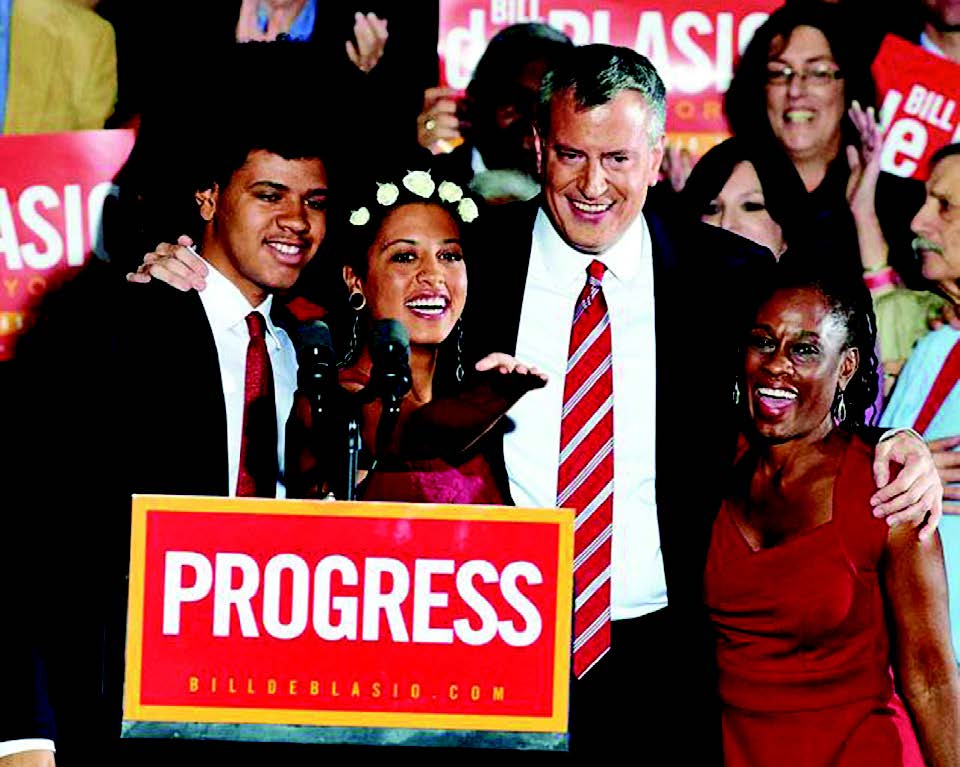
    NEW YORK, NY (TIP): Bill de Blasio crushed his opponent Joe Lhota by a wide margin of 40 % to be elected New York City’s first Democratic mayor in two decades. De Blasio, 52, will take office on Jan. 1 as the 109th mayor of the nation’s largest city. He ran as the anti-Bloomberg, railing against economic inequality and portraying New York as a “tale of two cities” – one rich, the other working class – under the probusiness, pro-development mayor, who made his fortune from the financial information company that bears his name. “Today you spoke loudly and clearly for a new direction for our city,” de Blasio told a crowd of supporters at the YMCA in his home neighborhood of Park Slope, Brooklyn. “We are united in the belief that our city should leave no New Yorker behind,” he said. “The people of this city have chosen a progressive path, and tonight we set forth on it together as one city.” He decried alleged abuses under the police department’s stop-and-frisk policy and enjoyed a surge when a federal judge ruled that police had unfairly singled out blacks and Hispanics.


    img6

    The candidate, a white man married to a black woman, also received a boost from a campaign ad featuring their son, a 15-year-old with a big Afro. “Inequality in New York is not something that only threatens those who are struggling,” de Blasio said Tuesday, November 5 night, flanked by his family. “We are all at our best when every child, every parent, every New Yorker has a shot. And we reach our greatest height when we all rise together.” President Barack Obama called de Blasio to congratulate him, according to reports emanating from the White House. Cuomo released a glowing statement, saluting his “true friend” on his victory. Lhota called de Blasio to concede about half an hour after polls closed at 9 p.m., according to a spokeswoman for the Democratic candidate. “It was a good fight and it was a fight worth having,” Lhota told a crowd of supporters in a Manhattan hotel before offering a word of caution to de Blasio. “Despite what you might have heard, we are all one city,” Lhota said. “We want our city to move forward and not backward, and I hope our mayor-elect understands that before Though polling shows New Yorkers largely approve of Bloomberg’s policies, those same surveys revealed the city was hungry for a change. While registered Democrats outnumber Republicans in the city 6 to 1, the last time a Democrat was elected mayor was 1989, when David Dinkins, de Blasio’s former boss, was victorious. Democrats also captured the other two citywide races: Letitia James, a Brooklyn city councilwoman, was elected public advocate, while Scott Stringer, the Manhattan Borough President, was chosen to be comptroller.

    “Today, you elected me the first,” she said, as the room erupted into wild cheers, “the first woman of color to win citywide office … I am so proud of what we accomplished together, and yes, I’m proud that we made history today”, said Letitia in her victory speech. Scot Stringer, with his wife by his side, promised in his victory speech to serve as controller “with honesty and integrity.” Voters in Boroughs, except for Staten Island, elected Democrats to govern them. . Gale Brewer, a Democrat from Manhattan’s upper West Side, will replace Scott Stringer as Manhattan Borough President. In Queens, voters chose former City Councilwoman Melinda Katz as their next borough president over Republican challenger Tony Arcabascio. And Bronx Borough President Ruben Diaz Jr., a Democrat who ran with no major opposition in the general election, is set to serve a second term. Eric Adams will succeed Marty Markowitz as Brooklyn borough president Only in Staten Island did voters choose a Republican for their borough president. James Oddo, the minority leader in the City Council, beat out Democrat Lou Liedy for the role Tuesday.

  • US aid needed to battle al-Qaida: IRAQI PM

    US aid needed to battle al-Qaida: IRAQI PM

    WASHINGTON (TIP): A bloody resurgence of al-Qaida in Iraq is prompting Baghdad to ask the US for more weapons, training and manpower, two years after pushing American troops out of the country.

    The request will be discussed during a White House meeting Friday between Iraqi Prime Minister Nouri al-Maliki and President Barack Obama in what Baghdad hopes will be a fresh start in a complicated relationship that has been marked both by victories and frustrations for each side. Al-Maliki will discuss Iraq’s plight in a public speech Thursday at the US Institute for Peace in Washington.

    “We know we have major challenges of our own capabilities being up to the standard. They currently are not,” said Lukman Faily, the Iraqi ambassador to the US, told The Associated Press in an interview Wednesday. “We need to gear up, to deal with that threat more seriously.We need support and we need help.” He added: “We have said to the Americans we’d be more than happy to discuss all the options short of boots on the ground.” “Boots on the ground” means military forces. The US withdrew all but a few hundred of its troops from Iraq in December 2011 after Baghdad refused to renew a security agreement to extend legal immunity for American forces that would have let more stay.

    At the time, the withdrawal was hailed as a victory for the Obama administration, which campaigned on ending the Iraq war and had little appetite for pushing Baghdad into a new security agreement. But within months, violence began creeping up in the capital and across the country as Sunni Muslim insurgents lashed out at Shiites, angered by a widespread belief that Sunnis have been sidelined by the Shiite-led government, and with no US troops to keep them in check.

    More than 5,000 Iraqis have been killed in attacks since April, and suicide bombers launched 38 strikes in the last month alone. Al-Maliki is expected to ask Obama for new assistance to bolster its military and fight al-Qaida. Faily said that could include everything from speeding up the delivery of US aircraft, missiles, interceptors and other weapons, to improving national intelligence systems. And when asked, he did not rule out the possibility of asking the US to send military special forces or additional CIA advisers to Iraq to help train and assist counterterror troops.

  • Only 248 signed up for Obamacare in first two days

    Only 248 signed up for Obamacare in first two days

    WASHINGTON (TIP: Enrollment in health insurance plans on the troubled Obamacare website was very small in the first couple of days of operation, with just 248 Americans signing up, according to documents released on October 31 by a US House of Representatives committee. The Obama administration has said it cannot provide enrollment figures from HealthCare.gov because it doesn’t have the numbers. The federal website, where residents of 36 states can buy new healthcare plans under President Barack Obama’s law, was launched on October 1. “We do not have any reliable data around enrollment, which is why we haven’t given it to date,” Health and Human Services Secretary Kathleen Sebelius told lawmakers on Wednesday. But the documents, which are labeled “war room” notes and appear to be summaries of issues with the problematic website beginning on October 2, indicate a mere six enrollments had occurred by that morning – the day after the website was launched and almost immediately crashed. “High capacity on the website, direct enrollment not working,” the October 2 notes said. By later that day, “approximately 100” enrollments had taken place. “As of yesterday, there were 248 enrollments,” said the notes from the morning of October 3.

    The documents were released by the House Oversight and Government Reform Committee, which has been demanding information from the administration about the website’s problems. The committee is chaired by Representative Darrell Issa, a Republican opponent of Obamacare. The notes were from meetings at the Centers for Medicare and Medicaid Services, the arm of the Health and Human Services Department that has been overseeing the website, an Issa spokeswoman said. The documents were first reported by CBS News. Health and Human Services spokeswoman Joanne Peters said the department will release Obamacare enrollment statistics on a monthly basis after coordinating information from different sources. This will including call centers, paper applications for insurance, and data from insurers and states. The first release of enrollment data will likely be mid-November, she said. “These appear to be notes, they do not include official enrollment statistics,” Peters said of the documents Issa’s panel released. “As the secretary (Sebelius) said before Congress, we are focused on providing reliable and accurate information and we do not have that at this time … We have always anticipated that the pace of enrollment will increase throughout the enrollment period.” HealthCare.gov has been plagued with technology problems since its rollout. It was back up on Thursday after not being fully functional for much of Wednesday. Both the federal exchange and the exchanges built by 14 other states and Washington D.C. were set up to let residents enroll in new plans created under the Affordable Care Act, Obama’s 2010 healthcare reform law commonly known as Obamacare. The government has said it expects about 7 million people to enroll for individual insurance in 2014, many of whom are expected to receive government subsidies.

  • Former Pakistan PM, officials deny US drone collusion

    Former Pakistan PM, officials deny US drone collusion

    ISLAMABAD (TIP): Pakistani officials and former prime minister Yousuf Raza Gilani on October 23 denied a report that they had approved US drone strikes on the country’s soil.Washington Post on october 21 quoted leaked secret documents as saying Pakistan had been regularly briefed on strikes up till late 2011 and in some cases had helped choose targets.The purported evidence of Islamabad’s involvement came as Prime Minister Nawaz Sharif met US President Barack Obama at the White House and urged him to end the attacks, which are widely unpopular with the Pakistani public.A Pakistani foreign ministry spokesman said the anti-drone stance of the Sharif government, elected in May, was clear and any past agreements no longer applied. Pakistani security officials claimed the story was a US attempt to undermine Sharif’s position and reduce criticism of the drone campaign, days after an Amnesty International report warned some of the strikes could constitute war crimes.Washington Post’s revelations concerned strikes in a four-year period from late 2007, when military ruler Pervez Musharraf was in power, to late 2011 when a civilian government had taken over. Gilani, prime minister from 2008 until June last year, vehemently denied giving any approval for drone strikes. “We have never allowed Americans to carry out drone attacks in the tribal areas,” Gilani told AFP. “From the very beginning we are against drone strikes and we have conveyed it to Americans at all forums,” he added. Islamabad routinely condemns the strikes targeting suspected Taliban and Al-Qaeda militants in its northwest tribal areas. But evidence of collusion or tacit approval has leaked out in recent years.

  • John Kerry warns that another budget gridlock will damage US leadership

    John Kerry warns that another budget gridlock will damage US leadership

    WASHINGTON (TIP): America’s top diplomat warned on October 23 that the United States could suffer more lasting damage to its influence abroad if the next round of budget talks in a few months lead to another breakdown. Secretary of State John Kerry said the recent 16-day shutdown had raised questions among key allies about whether Washington can be counted on to lead – whether it is in talks with Iran, Middle East peace negotiations or completing an Asia- Pacific trade deal. “What we do in Washington matters deeply to them, and that is why a selfinflicted wound like the shutdown that we just endured can never happen again,” Kerry told the Center of American Progress policy think tank. “The simple fact is that the shutdown created temporary but real consequences in our ability to work with our partners and pursue our interests abroad,” Kerry added. Kerry’s warning about future U.S. credibility was more forceful at home than abroad. In Asia recently where he stood in for President Barack Obama at summits in Indonesia, Brunei and Malaysia, Kerry dismissed the protracted budget negotiation in Washington as a “moment in politics” and assured countries it would not hurt U.S. commitments to the region.

    But back in Washington on Thursday after several weeks of non-stop travel in Asia and Europe, Kerry said the shutdown had affected confidence in the United States abroad. “This political moment was far more than just symbolism, far more than just a local fight. It matters deeply to our power and to our example,” he said. “While this chapter is temporarily over, we’ve got another date looming, and the experience has to serve as a stern warning to all.” “Make no mistake, the greatest danger to America doesn’t come from a rising rival,” Kerry said, “It comes from the damage that we’re capable of doing by our own dysfunction and the risks that will arise in a world that may see restrained or limited American leadership as a result.” U.S. lawmakers reached a last-minute deal earlier in October to break the fiscal impasse and avert a crippling debt default, but it promises another budget battle in a few months. Under the deal, a House-Senate negotiating committing will be formed to examine a broader budget agreement, with a deadline of Dec. 13. The deal funds the government until Jan. 15 and raises the debt ceiling to Feb. 7. Kerry said America’s allies were watching the budgets talks closely.

  • Automatic budget cuts could hit Pentagon harder this year

    Automatic budget cuts could hit Pentagon harder this year

    WASHINGTON (TIP): Months after the US military was hit with a $37 billion budget cut that threw it into turmoil and confusion, the Pentagon is headed into the new fiscal year facing a similar threat that could have even more devastating consequences, officials say. The budget deal that ended the government shutdown this month let the Pentagon continue spending at an annualized level of $496 billion in the 2014 fiscal year that began on October 1. That is about $31 billion below what President Barack Obama requested for 2014, but about $21 billion above the caps set by the Budget Control Act of 2011, meaning the Pentagon faces another acrossthe- board cut unless Congress reaches a new spending deal that changes the law by mid-January. And the situation could get worse. Under the 2011 budget act, defense spending is expected to begin growing again in 2015. But a top defense budget analyst said on Thursday that based on historical trends from previous military cutbacks, Pentagon spending could shrink to as low as $415 billion.

    Todd Harrison, an analyst at the Center for Strategic and Budgetary Assessments think tank, said a drop of that magnitude would force a huge cut in the size of the military, cause the cancellation of many weapons programs and lead many defense companies to go out of business. “This would be, you know, catastrophic, if you will, for a lot of procurement programs. There would be a lot of glass on the floor at the end of this. You’d break a lot of things,” he told reporters at a briefing on the 2014 defense budget. Harrison said he was not predicting that scenario would actually take place, but looking at what could happen if the current defense drawdown followed the pattern of cutbacks after the end of the Cold War, the Vietnam war and the Korean war. Defense officials paint a grim picture of the impact the budget uncertainty is having on their ability to ensure the military is prepared for action in the future.

    FEWER HELICOPTERS
    Army assistant secretary Heidi Shyu told a panel in the House of Representatives on Wednesday that more automatic budget cuts this year could force the Army to buy 12 fewer Apache helicopters and 11 fewer Chinooks helicopters and delay upgrades to the Abrams tank and Bradley Fighting Vehicle. William LaPlante, a principal deputy Air Force secretary, said the Air Force might have to drop plans to buy four or five of the 19 F-35 Joint Strike Fighters it was scheduled to purchase. Navy officials told the panel they would have to cancel much of their planned maintenance for ships and aircraft. “What we’ve been experiencing over the last one-and-a-half to two years, frankly, has been extraordinarily destabilizing,” said Sean Stackley, a Navy assistant secretary, noting that the uncertainty was unraveling efforts to cut contracting costs. Automatic budget cuts under a mechanism known as sequestration, which reduces spending across all accounts regardless of their strategic importance, is causing “a steady decline” in military preparedness and ultimately national security, he said.

    Harrison said the budget cuts that went into effect in March prompted the military to reduce spending for weapons programs and development. The Pentagon shifted some of that funding to current operations and training, essentially trading future preparedness to maintain the present force. But even with that shift in funding for present operations, only two Army brigades are fully trained for combat in the event of a crisis, General Ray Odierno, the top Army officer, said this week. Harrison urged the Pentagon to acknowledge that Congress, after two years of discord, is unlikely to reach a deal to lift the budget caps it set in 2011. He said by submitting budget plans that recognize the caps, the Pentagon could avoid the uncertainty of across-the-board cuts and plan more effectively.

  • Obama asks Sharif why trial of 26/11 accused has not started

    Obama asks Sharif why trial of 26/11 accused has not started

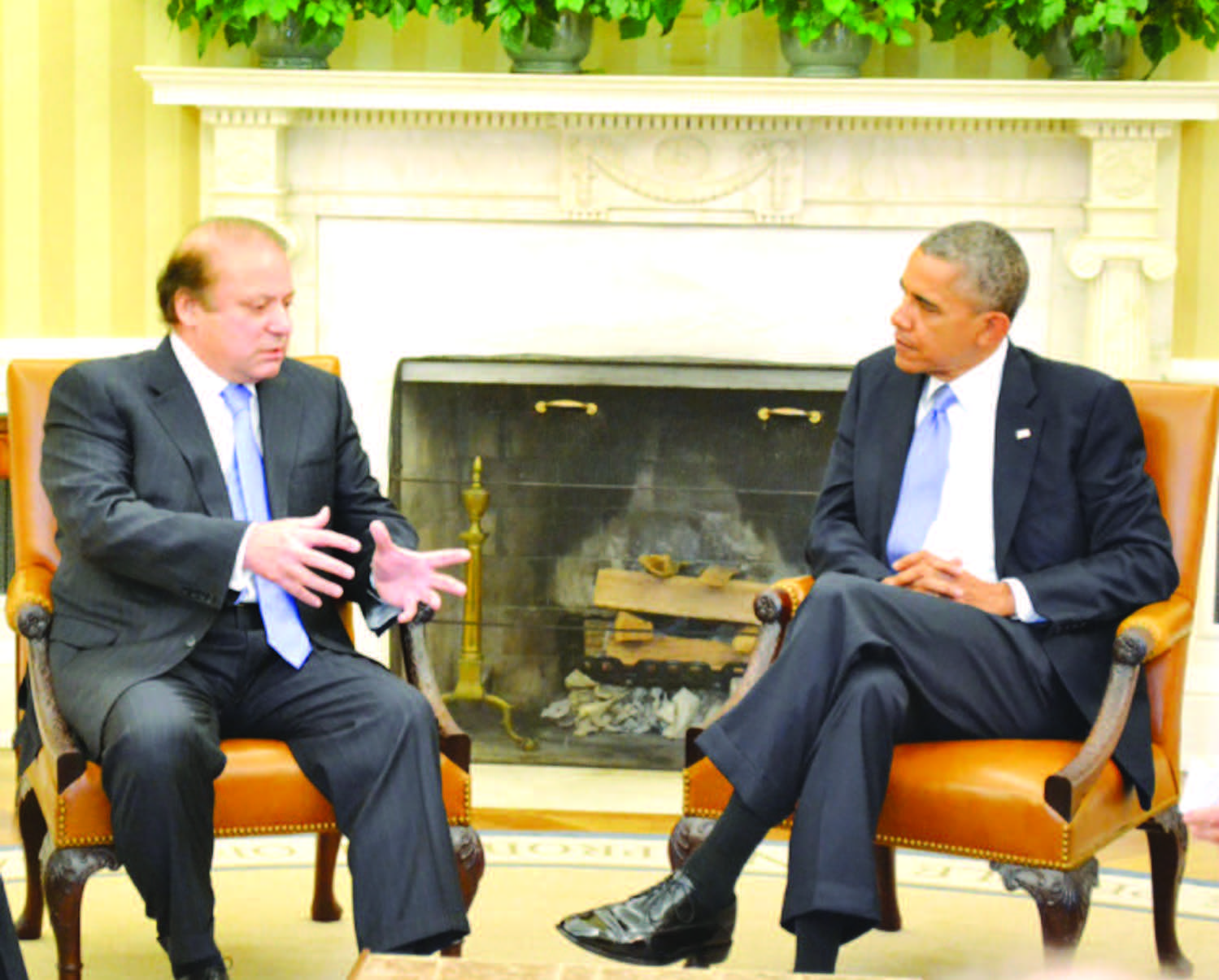
    WASHINGTON (TIP): Backing India’s concerns over the slow pace of progress in the 26/11 case in Pakistan, US President Barack Obama, October 24, asked the visiting Pakistan Prime Minister Nawaz Sharif why the trial of Mumbai attackers has not started. “He (Obama) asked, why the trial of the (Mumbai) terrorist attack in India has not started yet,” Sharif told reporters immediately after his over two-hour meeting with Obama at the Oval Office of the White House. During the meeting, the US President also raised the issue of Jamaat-ud-Dawa (JuD), cross border terrorism and Dr Shakil Afridi, the Pakistani doctor who helped the CIA track down al-Qaeda chief Osama bin Laden and has been imprisoned, Sharif said. “He (Obama) has raised the issue of (Dr Shakil) Afridi. He spoke about cross-border movement. He also talked about Jamaat-ud- Dawa,” the Pakistan Prime Minister said, without giving details. Speaking in chaste Urdu, Sharif told reporters that Pakistan’s relationship with India was discussed at length, including Kashmir, but did not give details of what aspect of Kashmir issue he raised; nor did he talk about the response from Obama on this issue.

    Obama, after the meeting with Sharif, said that the Pakistan Prime Minister was taking a “wise path” in exploring how decades of tension between India and Pakistan can be reduced. “I think he (Sharif) is taking a very wise path in exploring how decades of tension between India and Pakistan can be reduced, because, as he points out, billions of dollars have been spent on an arms race in response to these tensions and those resources could be much more profitably invested in education, social welfare programs on both sides of the border between India and Pakistan, and would be good for the entire subcontinent, and good for the world,” Obama told reporters in a joint media appearance with Sharif. In a joint statement issued after the meeting, Obama welcomed recent engagements between Sharif and Singh and expressed hope that this would mark the beginning of a sustained dialogue process between the two neighbors, aimed at building lasting peace in South Asia and resolving all outstanding territorial and other disputes through peaceful means. Obama said the two leaders had an opportunity to discuss India after the meeting of the Prime Ministers of India and Pakistan in New York on the sidelines of the UN General Assembly.

    Describing his meeting with Obama “a most cordial and comprehensive exchange of views” on matters of bilateral interest and issues of regional concern, Sharif said he told the US President about his sincere commitment to build a cordial and cooperative relationship with India. He also talked about “efforts to peacefully resolve all our outstanding issues, including Kashmir.” Sharif said that terrorism constitutes a common threat. “It is as much a concern to us as it is for India. We need to allay our respective concerns through serious and sincere efforts without indulging in any blame game. I also assured the President that as a responsible nuclear state, Pakistan will continue to act with maximum restraint and work toward strengthening strategic stability in South Asia,” Sharif said. In the joint statement, Obama and Sharif stressed that improvement in Pakistan- India bilateral relations would greatly enhance prospects for lasting regional peace, stability, and prosperity, as it would significantly benefit the lives of citizens on both sides of the border. “Obama welcomed steps taken by Pakistan and India to improve their economic relations, including by exploring electricity and gas supply agreements, developing a reciprocal visa regime, and expanding bilateral trade,” it said.

    Conceding that Pakistan is in the current situation today because of the action and deed of its own leaders in the past, Sharif said: “We need to keep our house in order. We have not taken care of our own house. As a result of which, the entire nation is suffering. We have to take Pakistan out of this situation.” He sought the support of the media, the civil society and people of Pakistan in this regard. “Both of us discussed strengthening and deepening of bilateral relationship. We had wide ranging discussions on issues including economy, Pakistan’s energy, education, extremism in Pakistan. We talked about Afghanistan; we talked about relationship with India. This included Kashmir. We talked on drones. We talked about Aafia Siddiqui,” Sharif said. Obama asked as to what the US can do for Pakistan, to which Sharif sought the policy of trade not aid. “When he (Obama) asked what we (US) can do for Pakistan, I said, I do not need any aid from you. We want to increase our economic relationship. Please open your market for Pakistani products. This is more than enough for us,” Sharif said. “He asked what we can do to address your energy issue. I said you should encourage your people, the private sector to come to Pakistan and invest in the energy sector. Pakistan is providing very good opportunities for them,” Sharif said. “We are trying to establish peace and stability in Pakistan. We hope that peace would be established in Karachi, a commercial hub. After lot of thought and determination, we have started operation there (in Karachi),” the Pakistan Prime Minister said. Sharif said he also appraised Obama on the peace talks with the Tehrik-e-Taliban Pakistan (TTP). Sharif left for Pakistan after the talks, concluding his four-day visit to the US, the first by a Pakistani head of State in more than five years.

  • US Senate confirms Nisha Desai Biswal as assistant secretary of state

    US Senate confirms Nisha Desai Biswal as assistant secretary of state

    WASHINGTON (TIP): The US Senate has confirmed Indian- American woman administrator Nisha Desai Biswal as the assistant secretary of state for South and Central Asia, making her the first person from the community to hold the top diplomatic position. Biswal, who is currently the assistant administrator for Asia at the US Agency for International Development ( USAID), will replace incumbent Robert Blake to head the key bureau in the state department. President Barack Obama had nominated her for this top position on July 18. The Senate foreign relations committee had held her confirmation hearing last month, during which she received bipartisan support and was praised by lawmakers from both the parties. “I consider you another compelling argument for comprehensive immigration reform,” said Senator John McCain of the Republican Party. “Despite your misguided political affiliation, I would like to say that you’re a great example to all of us of people who come to this country.

    I know you were very young … and the opportunities that this country provides,” McCain said in praise of Biswal, who is from the Democratic Party. McCain who lost out to Obama in the 2008 presidential elections rarely praises someone from the Democratic Party. From 2005 to 2010, she was the majority clerk for the state department and foreign operations subcommittee on the Committee on appropriations in the US House of Representatives. From 2002 to 2005, she served as the Policy and advocacy director at interaction. Previously, she served on the professional staff of the US House of Representatives international relations committee from 1999 to 2002. Daughter of first generation Indian Americans, Biswal draws her inspiration from her parents’ story of journey far from rural India to pursue the American Dream and a better life for their children, which she told lawmakers during the confirmation hearing of her current position on July 21, 2010.

  • Back from the Brink

    Back from the Brink

    The financial markets worldwide felt relieved after the US Congress reached an agreement shortly before the deadline was to expire on Wednesday. A debt default would have raised the cost of borrowings for the US. The 16-day government shutdown over a budget fight between the Democrats and the Republicans caused losses not just to the domestic economy but to all those countries dependent on US exports for growth. Many such countries were relying on a US demand pick-up to compensate for the sluggish economic conditions at home. There is one positive outcome that should cheer the emerging economies like India and China. There is hope that the US Federal Reserve will not rush to roll back its $85 billion a month bond-buying program, giving more time to the Asian countries to stabilize their economies and currencies, which had been shaken by dollar outflows in recent months.

    The Republicans had brought the US government to a halt, demanding that President Barack Obama’s favorite health care program should be either delayed or defunded and the existing taxes should be cut. Two years ago when there was a similar confrontation over raising the debt ceiling, President Obama had retreated, agreeing to a staggered slashing of domestic spending. This time Obama was firm and assertive, and called the Republicans’ bluff. The deal that was signed at the last minute indicated a complete Republican surrender. There was a minor concession on health care which required the administration to audit incomes of those seeking insurance subsidies. But the damage the Republicans have caused to the US reputation is incalculable. Americans dependent on government programs and Federal employees were the main sufferers. A fringe group in the Republican Party took the entire nation to ransom and ended up hurting its own leadership. The approval ratings of the Republicans are at the rock-bottom. But the relief is for a limited period. “Our drive to stop the train wreck that is the President’s health care law will continue”, said the Republican leader, Speaker John Boehner. Early next year the battle is expected to resume.

  • Indian-American Woman is Running for Seattle City Council

    Indian-American Woman is Running for Seattle City Council

    SEATTLE (TIP): Kshama Sawant, trained as a computer engineer in her native India and now a professor of economics, is running for a seat on the City Council of Seattle under an unambiguously far-left banner. Even in this liberal bastion of the Northwest, Sawant’s political views stand out. Having gained sufficient electoral support in the August primary (44,000 votes, or about 35 percent of the total, finishing second in a threeway race), Sawant is now challenging the entrenched 16-year Democratic incumbent Richard Conlin for a council seat in the November general election. A veteran of the Occupy Wall Street movement, Sawant espouses an explicitly anticapitalist creed that champions the rights of the poor, low-wage workers,women, immigrants, the homeless, the disabled, homosexuals and other marginalized segments of the population. Her current political campaign rests on three principal platforms: a $15-per-hour minimum wage; higher taxes on millionaires to fund mass transit and education; and rent control.

    “A majority of workers and young people face an increasingly unaffordable city,” she told local media. “Most are disgusted by the endless parade of politicians who play with progressive rhetoric at election time, then pander to big corporations and the super-rich while in office.” The Stranger, a Seattle area newspaper that has endorsed Sawant, along with six labor unions, said she is the only element of the campaign season that is providing any excitement or interest. After Sawant performed well in the August primary, John Halle wrote in the North Star, a Socialist newspaper, that her success should not have come as a surprise. “Recent polls have indicated a widespread sympathy to socialism, a sign that the many years of indoctrination equating ‘free markets and free people,’ capitalism and democracy, and of there being ‘no alternative’ to neo-liberal austerity are finally losing their power to convince,” Halle wrote. “Sawant’s candidacy is the first to give a concrete indication that these attitudes are beginning to find expression in terms of real political power.” The Socialist Alternative newspaper called Sawant’s showing in the run-off “stunning” and a “breakthrough.”

    A well-known political commentator in Seattle, Tom Barnard, wrote of Sawant’s campaign: “What happened conceptually was even more revolutionary.… For what Kshama did was to simply overturn the common wisdom of how to succeed in local elections in general and City Council races in particular. She took what were viewed as two immutable political laws [the need for big money and Democratic Party endorsements] and essentially threw them out the window… It’s nothing short of an earthquake… Kshama has shown a new path for independent candidates who directly advance working people’s interests and issues.” Sawant is trying to translate her activism into practical terms – for example, she has vowed that if she wins election, she will not accept the full $120,000 annual salary awarded to City Council members. Instead, she will take the average salary for city workers and hand over the rest to social movements. In an interview with International Business Times, Sawant laid out some of her vision and her disappointment with the administration of President Barack Obama. “I don’t support the Democrats because they are largely financed by corporate interests, [just] like the Republicans,” she said. “After the initial campaign of ‘Hope and Change’ in 2008, disillusion has set in among much of the electorate.

    The hopes of progressive people have been dashed after five years of Obama.” Sawant cited such issues as the government’s treatment of Wikileaks’ source Bradley Manning, the saber-rattling over Syria, the assault on public schools, drone missile attacks in Pakistan and the deportation of thousands of immigrants, among others, for the disillusionment with Obama. “I think in the current environment, the appeal of independent and alternative candidates has greatly increased,” she noted. “And I don’t think my embrace of socialism has much stigma as it might have had in the past.” Sawant is quick to point out that she embodies the principles of democratic socialism, not the repressive, bureaucratic nature of the former Soviet Union. She also suggests that after the devastation of the housing market collapse, the huge government bailouts of banks and large corporations, and the emergence of a whole new generation of debt-strapped college graduates with bleak job prospects, many members of the American public may simply be “sick of capitalism.” “I think many Americans, particularly the youth, feel demoralized, dejected and disenfranchised by corporate-driven politics,” she said. Indeed, with respect to Seattle, the economy is weakening. After driving the bulk (70 percent) of the state of Washington’s job growth since 2010, in August of this year, the Seattle area (which includes Bellevue and Everett) shed 4,300 jobs, including 1,600 manufacturing jobs, pushing up the local jobless rate to 5.2 percent. For the state as a whole, the jobless rate edged up to 7.0 percent.

    Still, these figures represent a much brighter picture than the rest of the country, particularly California (which is suffering under a nearly 9 percent jobless rate). Even if Seattle has a much healthier economy than other parts of the nation, the cost of living is rising and wages are stagnant. Sawant, a professional economist, contends that one of her fundamental campaign proposals – a $15/hour minimum wage – makes sense, citing that if consumers don’t have enough money to buys goods and services, small businesses will collapse. “Some corporate executives make more in one day than their lowest-paid employees make in a whole year,” she said. “Many companies could easily increase employee salaries. And even at $15/hour, that’s hardly an income that one can easily live on.” Sawant’s proposal even has the support of some local capitalists. Nick Hanauer, founder of Second Avenue Partners, a Seattle venture capital fund, wrote in Bloomberg that the widening wealth gap in the U.S. presents some difficult challenges for the economy. Hanauer noted that low-wage jobs are quickly replacing middle-class jobs in the U.S. economy. “Sixty percent of the jobs lost in the last recession were middle-income,while 59 percent of the new positions during the past two years of recovery were in low-wage industries that continue to expand such as retail, food services, cleaning and health care support,” he wrote. “By 2020, 48 percent of jobs will be in those service sectors.”

    Hanauer also indicated that if the federal minimum wage had simply tracked the rate of U.S. productivity gains since 1968, it would now be $21.72 an hour — three times the current wage. He also estimated that raising the minimum wage to $15 an hour would inject about $450 billion into the economy each year. “That would give more purchasing power to millions of poor and lower-middle-class Americans, and would stimulate buying, production and hiring,” he declared. Separately, as an Indian-American, Sawant presents a rather unusual alternative for most voters. Indeed, the two most famous and prominent Indian-American politicians – Govs. Nikki Haley of South Carolina and Bobby Jindal of Louisiana – are both right-wing Republicans, the polar opposite of Sawant’s decidedly leftist ideology. Sawant suggests that Jindal and Haley, as well as Florida Sen. Marco Rubio, represent attempts at window-dressing by the Republican Party in order to appeal to ethnic minorities.”These minority politicians are outliers,” she stated. “Most ethnic minority people in the U.S. do not support the Republican Party.” She also points out that in defiance of the “model minority” image of Indian-Americans earning high salaries, there are many in the Seattle area who receive low wages, including taxi drivers,who support her candidacy. Also, Sawant’s embrace of some social issues, namely abortion, gay rights and marriage equality,might strike observers as rather odd, given the deep conservatism and traditional values inherent in Indian culture. But Sawant counters that many Indians in U.S., particularly among the young, support such issues as gay rights. “It might be more of a problem if I was running for office in India itself,” she conceded. The Seattle election will be held on Nov. 5.

  • Bobby Jindal forms group to win ‘war of ideas’

    Bobby Jindal forms group to win ‘war of ideas’

    WASHINGTON (TIP): Louisiana’s Indian-American governor Bobby Jindal, a potential 2016 Republican presidential candidate, plans to create a policy-focused nonprofit group to help Republicans shed their image as “the party of no.” The group called “America Next” would produce detailed proposals for how conservatives would improve health care, education and energy policy if they were in charge again, Jindal told Politico, an influential politics focused Washington news site. Jindal, whose term as chairman of Republican Governors Association ends next month, complained that his party has focused excessively on criticising President Barack Obama without saying what it would do instead. Citing Mitt Romney’s failed effort to make the 2012 election a referendum on the president, Jindal, 42, said his group will bring together big thinkers to “play offense in the war of ideas.”

    “Saying ‘no’ is not enough,” he said. “We’ve got to get beyond the bumper-sticker slogans. We’ve got to get beyond the 30-second attack ads.” When asked about his plans for 2016, Jindal said: “I don’t know if I’m going to run for president or not.” He quoted former British Prime Minister Margaret Thatcher, who said that you need to win the war of ideas before you can win elections. Jindal, whose second term as governor ends at the start of 2016, said “America Next” will not be afraid to take controversial positions that run afoul of Republican orthodoxy. “Everything needs to be on the table,” he said. “This is not a time to be timid.” Jindal said there’s a helpful contrast between the paralysis in Washington and the reforms being pursued by 30 Republican governors in the states. “A rebellion is brewing outside the Washington Beltway,” Jindal was quoted as saying. “The American people know that the policies coming out of Washington are leading us to a dead end.

  • Obama meets Indian-American Miss America, Nina Davuluri

    Obama meets Indian-American Miss America, Nina Davuluri

    WASHINGTON (TIP): Despite tough ongoing negotiations to reopen the government and avoid a US debt default, President Barack Obama found time to meet Miss America, Nina Davuluri, the first Indian- American to win the coveted crown. “Had the pleasure of having a conversation with President @BarackObama in the Oval Office today! @NinaDavuluri #Celebration13,” Davuluri tweeted shortly after meeting the president at the White House Wednesday morning. “Miss America participated in a group photo with the president in honor of the Children’s Miracle Network Hospital Champions,” a White House official said. “Following the photo, she briefly visited the Oval Office,” the official said. Incidentally, Obama had referred to Davuluri’s achievement as he spoke about “incredible people-to-people ties that exist” between India and the US during his Sep 27 summit meeting with Prime Minister Manmohan Singh here. “You know, Indian-Americans make extraordinary contributions to the United States every single day — businessmen, scientists, academics. Now Miss America is of Indian-American descent. And I think it’s a signal of how close our countries are,” he then said. (Source: Arun Kumar. He can be contacted at arun.kumar@ians.in)

  • THE POLITICS OF THE GOVERNMENT SHUTDOWN

    THE POLITICS OF THE GOVERNMENT SHUTDOWN

    With the government having lurched into its first shutdown since the 1990s, many commentators are focusing on the potential ill effects that it might have for Republicans. Almost all of these analyses use the shutdowns of 1995- 1996 as their starting point. While I don’t think this development will be great for Republicans, many of the concerns are likely overwrought. Here are four points to ponder:
    1. While the GOP’s tactics are similar to those employed in the mid-’90s, the goals are different.
    The earlier budget debates were broad in nature and dealt with the scope of government. The 104th Congress, led by Newt Gingrich, believed that they were the culmination of the realignment supposedly begun by Ronald Reagan, that Bill Clinton’s election was a fluke caused by Ross Perot’s candidacy, and that they had been elected with a mandate to shrink the size and scope of government dramatically. They entered the shutdown believing that the public would rally to their side, that Clinton’s job approval would fall in the wake of the shutdown, and that he would ultimately cave on their demands. Despite the lore that has since sprung up, this wasn’t a completely harebrained view of the underlying politics: An earlier shutdown, in 1990, did play an important role in persuading George H.W. Bush to abandon his famous “no new taxes” pledge a few weeks later. Of course, that isn’t how it played out at all in 1995 and 1996; Bill Clinton was widely viewed as having held the line against the Republican onslaught, although he actually did give substantial ground on taxes and a number of other issues.

    The budget fight became the focal point of Democrats’ attempt to take back the House and Senate in the 1996 elections. But the Democrats didn’t actually use the shutdown itself as their main line of attack on Republicans. It was part of it, but the real attacks came over the Republicans’ motivation for the shutdown. Because of the expansive nature of the GOP’s cuts, the Democrats were able to focus on several unpopular portions of the GOP budget: the so-called M2E2 strategy. They commenced a mantra-like repetition of their opposition to Republican attempts to gut “Medicare, Medicaid, Education and the Environment” in favor of a “risky tax scheme” that benefited the rich. In other words, in evaluating 1996 as an illustration of what will happen to the GOP today, we probably have to separate the tactic of a shutdown from the substance of what motivates it. And today, the GOP is focused on defunding Obamacare, a law that isn’t particularly popular. For the analogy to 1995-96 to really stick, the GOP will probably have had to try something along the lines of shutting down government to implement the Paul Ryan balance-budget plan. While public opinion might be against the shutdown tactic, there probably won’t be the same level of outrage against the underlying policy motivation, which is what 1995-96 was mostly about. If Obamacare turns out to be the train wreck some conservatives predict (I have no clue whether it will or won’t), the tactic itself might be viewed as less of a negative.

    2. John Boehner is not Newt Gingrich, and Barack Obama is not Bill Clinton.
    This is a fairly minor point, but Gingrich’s public persona did play a part in bringing the shutdown to an unhappy end for the GOP. He was polarizing from the start, and the media didn’t bend over backwards to help him out. Case in point: The Daily News cover depicting him as a crybaby who shut down the government because he had to sit in the back of Air Force One. Boehner, on the other hand, has kept a much lower profile, and while he isn’t all that popular, he isn’t a lightening rod either (although Ted Cruz seems to be inching toward filling Gingrich’s shoes in that regard). At the same time, Obama is not really Clinton. The current president’s ability to present himself as a cautious centrist in political face-offs with Republicans to date have been mixed at best; his strength has always been energizing the liberal base for elections rather than tacking to the center. Clinton might be the most successful president of my lifetime when it comes to publicly framing a debate in a way favorable to his side (see, for example, the M2E2 strategy above). There are actually few examples, if any, of Obama rallying the public to his side in the various battles he’s fought; there are plenty of failures, with the fight over sequestration being the most recent case in point.

    3. The net effect of the shutdown was small in the 1990s.
    For all the talk of the sustained damage the Republicans suffered, the actual evidence for this is pretty weak. In 1994, Republicans won 230 seats in Congress. Five party switches and a special election victory later, they entered the 1996 elections with 236 seats. They emerged from those elections with 228 seats, for a loss of eight total (including the open seat of one of the Democratic Party switchers). So while Republicans lost seats, it ended up being something of an empty victory for Democrats: Americans elected a Republican Congress back-to-back for the first time since the 1920s. Republican candidates won the popular vote for the House, albeit very narrowly (Democrats won the vote only if you split up votes cast for candidates running on multiple party lines, e.g., a Republican also running on the Conservative Party line in New York). Republicans even gained a seat in a special election held in a Democraticleaning district in between government shutdowns, and only narrowly lost a Senate seat in Democratic-leaning Oregon immediately after the shutdown (Republicans proceeded to win another open Senate seat in the same state by four points in November). Those Republican House losses weren’t terribly surprising.

    Republicans were overexposed as a result of the 1994 “wave election” that swept a number of weak members into swing-to-Democratic-leaning districts. Losing representatives like Andrea Seastrand, Michael Flanagan and Fred Heineman was more a part of regression-to-the-mean than any wholesale rejection of Republicans. Of the 21 House seats that Democrats claimed from Republicans in 1996 (it was actually 22, but I don’t have presidential data for Louisiana’s 7th District), Clinton had carried 18 in 1992. The other four seats were all something of special cases: Bob Dornan in California, Gary Franks in Connecticut, David Funderburk in North Carolina, and Toby Roth’s open House seat in Wisconsin. This presents a problem for Democrats hoping to capitalize on the 2013 shutdown: The seats are much better sorted these days. Going into the 1996 elections, 79 Republicans occupied seats that had voted for Clinton in 1992. In other words, they lost 23 percent of their caucus from “Clinton seats.” Today, only 17 Republicans come from “Obama seats” to begin with. If Republicans suffered losses in unfriendly territory at the same rate as they did in 1996, they’d lose only four seats, before we start looking at the effect on Democrats from “Romney seats.” Perhaps Republicans would have fared better had they not attempted to shut down the government in the first place.

    Republicans picked up 10 open House seats and defeated three Democratic incumbents in 1996; absent the shutdown, perhaps they might have gained seats. In the Senate, Republicans narrowly lost open Democratic seats in Louisiana and Georgia, while missing good opportunities to defeat Tom Harkin in Iowa and Max Baucus in Montana. But as Harry Enten has ably demonstrated, Republicans did about as well in the House and in presidential elections as we would have expected given the performance of the economy, especially when you consider that exit polls showed Ross Perot pulling votes disproportionately from Republicans (unlike 1992, when he pulled evenly from both parties). Clinton’s comeback was likely due more to the flurry of good economic news in the run-up to the election than to anything else. Indeed, while Clinton’s job approval improved over the course of the shutdown, it had also improved in the months leading up to the shutdown at a similar rate. Senate losses in Louisiana and Georgia look bad today, but in 1996 both states were more Democratic; Clinton had carried both states in 1992 and only narrowly lost Georgia in 1996 while winning Louisiana by 12 points. Republicans had only won two narrow Senate elections in Georgia before 1996 (and hadn’t won the governorship since Reconstruction), while Republicans had never won a Senate election in Louisiana and were burdened by a controversial candidate in Woody Jenkins. Republicans were unable to defeat Harkin, Baucus or Mary Landrieu in the good GOP year of 2002.

    4. What happens to red state Senate Democrats?
    Of course, the real action for 2014 is not the House, where the GOP will continue to control the agenda except in the unlikely event that it loses 17 seats. The real fight is for control of the Senate, which in turn revolves around races in eight states: West Virginia, Arkansas, Kentucky, South Dakota, Louisiana, Alaska, Montana and North Carolina. Obama lost those states by, respectively, 27, 24, 23, 18, 17, 14, 14 and two points, respectively. The politics of a shutdown in these states are very different than in the nation as a whole. We can try to estimate the popularity of a shutdown by taking as a national baseline CNN’s recent finding that 46 percent of voters would blame Republicans for a shutdown vs. the 36 percent that would blame Obama. If we adjust these numbers according to the results of the presidential election in 2012, we would estimate that the president would shoulder the blame for a shutdown in each of those states save for North Carolina, and that outright majorities would blame the president in West Virginia, Arkansas and Kentucky. The last thing Democratic candidates in these states want is a public spat over a piece of legislation that is highly controversial, that might have a problematic rollout in the coming weeks and months, and that places them on the side of an unpopular president.

    If there’s an upside for the GOP, this is probably it. Even after the 1995-96 shutdowns, the GOP managed to gain Senate seats, largely by making gains in reddish states. Of course, none of this should be read as advocating the shutdown, or predicting that it could not possibly have any negative consequences for the GOP. For starters, a government shutdown is essentially lighting a fuse without knowing exactly where it will go. This is something that could easily get out of control if the shutdown stretches out for weeks and bleeds into the debt ceiling battle, which could be potentially catastrophic for the county. Moreover, it could give Democrats an issue to rally around. Unlike 1996, the economy is weak; the president’s job approval has suffered in recent months as a result of his perceived failure to move the Democratic agenda forward, and the aborted intervention in Syria. Many of these losses have come as a result of Democrats becoming dissatisfied with the president. If the election were held with the president’s job approval at its present level, Democrats would probably lose another 10 House seats or so, giving Republicans their largest House majority since 1946 (and possibly 1928). A dustup with congressional Republicans would probably help bring these Democrats back into the fold, especially if the president emerges victorious from the fight, helping to limit Democratic losses. Finally, we should also remember that the current weak recovery has been ongoing now for 52 months.

    It’s already longer than six of the 11 recoveries in the post-War era. By this time next year, it will be longer than seven of them. By 2016, only the booms of the mid-’60s, mid-’80s, and mid-’90s will have lasted longer. And, well, this recovery doesn’t much resemble those recoveries so far. In other words, there’s a decent chance that we’ll encounter a downturn in the economy in the next year, and a very good chance that we’ll encounter one in the next three years. Obama is probably reaching the end of the time period where his predecessor can be blamed for the state of the economy. But a lengthy shutdown could conceivably give Democrats ammunition to place the blame back on Republicans. The bottom line is this: The shutdown will probably not be a good thing for the GOP, and there’s a good chance Republicans won’t achieve their intended goal of limiting Obamacare’s reach. But at the same time, a lot of the prophecies of doom for Republicans are heavily overwrought. Unless things get too far out of control, the predictions of heavy GOP losses from a shutdown are likely overstated.

  • The Pivot under Pressure

    The Pivot under Pressure

    It’s not just the canceled trip. Other factors are limiting the ability of the U.S. to focus on the Asia-Pacific.

    Senior U.S. administration officials have been at pains in recent weeks to demonstrate how Washington’s strategic focus is shifting from the military quagmires of the greater Middle East to the dynamism of Asia. It’s a tough sell, and there is reason to doubt that America’s allies and friends in the region are buying it. Even before the cancellation of President Barack Obama’s Asia trip, which would have included the APEC and East Asia summits, doubts about U.S. focus were rising. Take Obama’s address before the UN General Assembly earlier this month. Its core takeaway is that the manifold problems of the Middle East have once more re-asserted their claim on Washington’s attention. Unveiled with much fanfare (here and here) two years ago, the so-called Asia pivot is all about shoring up the U.S. presence in a vital region that is increasingly under the sway of an ascendant China.

    Obama dubbed himself “America’s first Pacific president” and declared that Asia is where “the action’s going to be.” Vowing that the future would be “America’s Pacific Century,” his lieutenants rolled out two specific initiatives: 1.) A buildup of military forces that is plainly directed against China; and 2.) An ambitious set of trade and investment negotiations known as the “Trans-Pacific Partnership” (TPP) that would contest Beijing’s economic hegemony in East Asia. But the pivot – or the “strategic rebalance,” as administration officials now prefer to call it – was birthed with two congenital defects: It was unveiled just as the convulsions of the Arab Spring began tearing apart the decades-old political order in the Middle East, and just as an era of severe austerity in U.S. defense budgeting was taking shape. Until a few weeks ago, Obama gave every appearance of a man wishing the problems of the Middle East would just go away. But much like the Glenn Close character in Fatal Attraction, the region refuses to be ignored. For all the talk about turning the page on years of military and diplomatic activism in the region, Obama keeps having to take notice.

    Indeed, he was forcefully reminded of its combustibility when the outbreak of fighting in Gaza between Israel and Palestinian militants intruded on his last trip to Asia a year ago. And despite his stubborn determination to steer clear of it, he now finds himself sucked into Syria’s maelstrom. The president’s General Assembly address underscores the power of this gravitational pull. In it, Mr. Obama affirmed: “We will be engaged in the region for the long haul,” and outlined the security interests that he is prepared to use military action to protect. He reiterated his intention to see through the uncertain prospect of Syria’s chemical disarmament and then staked his prestige on two longshot projects: stopping Iran’s nuclear weapons program and brokering an Israeli-Palestinian peace accord. He also pledged renewed focus on sectarian conflicts and humanitarian tragedies like the Syrian civil war. This marks quite an evolution in Obama’s thinking from earlier in the year when he justified his Hamlet-like ambivalence on Syria by pondering: “And how do I weigh tens of thousands who’ve been killed in Syria versus the tens of thousands who are currently being killed in the Congo?” In all, Obama’s remarks last month mark a noticeable change in his foreign policy agenda.

    As the New York Times noted: “For a president who has sought to refocus American foreign policy on Asia, it was a significant concession that the Middle East is likely to remain a major preoccupation for the rest of his term, if not that of his successor. Mr. Obama mentioned Asia only once, as an exemplar of the kind of economic development that has eluded the Arab world.” This shift will only renew the multiplying doubts in the region about his commitment to the pivot. So too will the fiscal policy drama currently being played out in Washington, which regardless of its precise outcome, looks certain to end up codifying the sequestration’s deep budget cuts that have disproportionally affected defense spending. Already the drama in Washington has prompted him to cancel his Asia visit. Meanwhile, many in Asia are questioning whether the administration has the fiscal wherewithal to undertake its promised Asia pivot, including the military aspect. The budget squeeze is already cutting into military readiness. The U.S. Navy is slated to play a central part in the buildup, but two thirds of its non-deployed ships and aviation units reportedly don’t meet readiness goals, and the frequency of naval deployments has been noticeably pared back. The Air Force has grounded a third of its fighter squadrons and “Red Flag,” its premier combat training exercise, was canceled for the fiscal year that just ended. Deep reductions in Army and Marine Corps ground forces are in the offing, and joint exercises involving U.S. forces and their Asian counterparts have been scaled back.

    Moreover, a senior officer working on strategic planning for the Pentagon’s Joint Staff recently acknowledged the difficulty of militarily disengaging from the Middle East and re-directing forces to Asia. As Defense News reported: “‘We’ve been consumed by that arc of instability from Morocco to Pakistan for the last 10 years,’ Rear Adm. Robert Thomas said. And while the senior staffs at the Pentagon are dutifully discussing how they are rebalancing to the Pacific, ‘I suspect, though, for the next five years, just as the last 10 years, we will have this constant pull into the’ Middle East.” “Over the next several years, he continued, ‘I think that you’re going to continue to talk about a rebalance to Asia, and you’re going to do some preparatory work in the environment, but the lion’s share of the emphasis will still be in that arc of instability.’” Thomas also predicted a constant tug for resources between the U.S. military commands responsible for Asia and the Middle East. This strain may explain why the Pentagon has yet to develop a comprehensive game plan for the military buildup in Asia. Likewise in doubt is U.S. resolve on the TTP, which involves 12 Pacific Rim countries that together account for a third of the world’s trade.

    The Obama administration, having already missed the initial November 2011 deadline it set for completion, was hoping to have a basic agreement in place in time for the Asia Pacific Economic Cooperation (APEC) summit that convened in Indonesia on the weekend. But there has been slow progress in the negotiations (see here, here and here for background), and even the revised deadline looks likely to slip. Moreover, the White House has not even moved to formally request socalled “trade promotion authority,” a traditional indicator of serious intent because it puts trade deals on a quick path to Congressional approval. The administration announced more than a year ago that it would request this authority from Congress but Michael Froman, the new U.S. Trade Representative, recently stated there is “no particular deadline in mind.” Nor has the White House used its political capital to address rising domestic opposition (here and here) to the trade deal. Washington will continue to proclaim the Obama administration’s steadfastness to the Asia pivot. But U.S. allies and friends now have even more reason to think otherwise.

  • Pakistan’s new envoy to US was once expelled from India

    Pakistan’s new envoy to US was once expelled from India

    WASHINGTON (TIP): Pakistan has appointed as its ambassador to the United States an envoy who was once expelled from New Delhi for “indulging in activities incompatible with his official status.” Typically, that’s officialese for spying, but in that 2003 episode, Jalil Abbas Jilani was packed off from New Delhi for allegedly supplying cash to the Hurriyat leadership. Jilani, currently Pakistan’s foreign secretary, has been named by the Nawaz Sharif government as the country’s ambassador to Washington, filling a high-profile post that has remained vacant for several months after the resignation of Sherry Rehman, who was appointed by the Zardari-Bhutto’s PPP and who quit when the new Sharif’s PML came to power. Jilani’s appointment comes just ahead of Sharif’s visit to the White House on October 23 on an invitation from President Barack Obama as the two countries attempt to revive a relationship that has gone into steep decline in recent years.

    Pakistan is clearly out of favor in Washington DC because of its inability or unwillingness to act against terrorism that it has engendered as a state policy. Even its most ardent supporters and apologists in the administration, on the Hill, and in the think-tank circuit, seem to have a bleak view of the country and its future. A typical Pakistan-related event based on one of the many dismal, negative themes and books on the country will take place next week when Council of Foreign Relations’ Senior Fellow Daniel Markey will launch his new work “No Exit from Pakistan: America’s Tortured Relationship with Islamabad.” While a few well-wishers on both sides keep up the fiction of an alliance, Markey sees it as a dead-end relationship in which American and Pakistani policy makers have been condemned to agony in the same way as the sinners in John Paul Sartre’s play No Exit discover their hell is a room where they antagonize one another forever. “Like Sartre’s sinners, the United States and Pakistan have tormented each other for decades, if in very different ways,” Markey writes. “Both sides believe they have been sinned against. Even at high points in the relationship there were still underlying irritations and disagreements that got in the way of building any sort of strong, sustainable cooperation.”

    But like many other Washington pundits, he too believes the United States has important national security interests in Pakistan, and “both countries will have to cooperate even as the relationship evolves.” The Sharif-Jilani combine will have an uphill task of changing the discourse, which depends on how free they are from the stranglehold of the country’s military. For a change though, it will be the first time in nearly a decade that Pakistan has posted a career foreign service official as its ambassador to Washington. Jahangir Ashraf Qazi (2002-2004) was the last career diplomat who served as ambassador. He was succeeded by General Jehangir Karamat and Gen. Mahmud Ali Durrani, followed by Hussain Haqqani and Sherry Rehman, both PPP political appointees. Jilani meantime has kissed and made up with New Delhi, where he counts many friends despite the 2003 contretemps. He has visited India many times since then and has even met BJP leader, L KAdvani, who was the home minister when Jilani was expelled. In fact, it is a measure of New Delhi’s inconsistent approach to Pakistan that Jilani was even allowed to meet the Hurriyat leadership some years after he was expelled for bankrolling them.

  • Obama, Republicans continue talks after White House meeting

    Obama, Republicans continue talks after White House meeting

    WASHINGTON (TIP): Republicans offered a plan to President Barack Obama on Thursday that would postpone a possible US default in a sign the two sides may be moving to end the standoff that has shuttered large parts of the government and thrown America’s future creditworthiness into question. No deal emerged from a 90-minute meeting at the White House, but the two sides said they would continue to talk. It was the first sign of a thaw in a political crisis that has weighed on financial markets and knocked hundreds of thousands of federal employees out of work. “It was a very adult conversation,” said Republican Representative Hal Rogers, who attended the meeting. “Both sides said they were there in good faith.” The Republican offer would extend the government’s borrowing authority for several weeks, staving off a default that could come as soon as October 17.

    It would not necessarily reopen government operations that have been shuttered since October 1, but a Republican aide said that was part of the discussion as well. Significantly, Republicans seemed to be steering clear of the restrictions on Obama’s healthcare reforms and spending that prompted the crisis in the first place. The two sides instead are negotiating how far to extend the debt limit and how much funding they would provide the government when it opens, a Republican aide said. Both sides were expected to continue talks into the night. “The President looks forward to making continued progress with members on both sides of the aisle,” the White House said in a statement. Conflicting reports of the outcome of the meeting sent immediate ripples through financial markets. US equity index futures tracking the S&P 500 index dropped after a report that Obama had rejected the Republican offer, but rose when details of the meeting trickled out. Major US equity indexes closed 2 per cent higher earlier on Thursday on hopes of a deal.

    Shift by Republicans
    The proposal is a significant shift for Republicans, who had hoped to use the threat of a shutdown and a default to undermine Obama’s healthcare law and win further spending cuts. Those goals remain, but the Republican offer would at least push off the threat of default from October 17 until possibly the middle or end of November. That would give Republicans more time to seek spending cuts, a repeal of a medical-device tax, or other measures they say are needed to keep the national debt at a manageable level. The crisis began in late September when Republicans tied continued government funding to measures that would undercut the Affordable Care Act, Obama’s signature legislative accomplishment.

  • India, US Seal First Commercial Civil Nuclear Power Deal

    India, US Seal First Commercial Civil Nuclear Power Deal

    WASHINGTON (TIP): India and the US have reached the first commercial agreement on civilian nuclear power, five years after a landmark deal between the two countries was clinched. Addressing a joint media interaction after talks with Prime Minister Manmohan Singh, President Barack Obama disclosed that the two countries have sealed the agreement. “We’ve made enormous progress on the issue of civilian nuclear power, and in fact, have been able to achieve just in the last few days an agreement on the first commercial agreement between a US company and India on civilian nuclear power,” Obama said.

    India’s nuclear operator NPCIL (Nuclear Power Corporation of India Limited) and US firm Westinghouse have signed an agreement that will pave the way for setting up an atomic plant in India. However, there was no word on the tough nuclear liability clause in the Indian laws over which the US firms had strong objections. There was a major uproar in India last week over the agreement because of apprehensions that it entailed bypassing the Civil Nuclear Liability Law in place in the country by waiving the operator’s right to recourse with the supplier. Reiterating his commitment for strong ties, Obama said India is not just a regional, but also a global power. Prime Minister Singh reciprocated the feelings, saying US is as an indispensable partner for India. “India, as a significant not just regional power but world power, has worked closely with us on a whole range of issues from climate change to how we can help feed the world, alleviate poverty and deal with disease,” Obama told reporters in his Oval Office following their hourlong meeting. Praising the Prime Minister for his leadership in strengthening India-US ties, Obama said Singh has been a great friend and partner to the United States and to him personally.

    “Across the board, Prime Minister Singh has been an outstanding partner,” Obama said, adding that India continues to grow at an amazing rate, but obviously there are a lot of people in India that are still trapped in poverty. He said US is a strong partner to help India realize that vision because if there is a strong India, that is good for the world and it’s ultimately good for the US. In his remarks, Singh said Obama has imparted a powerful impetus to that process of the two countries being on the same page. “I’ve always believed that India and America are indispensable partners. During the time that I have been Prime Minister, and particularly during the time that President Obama and I have worked together, I think President Obama has made an outstanding contribution to strengthening, widening and deepening of our cooperation in diverse ways,” he said. Singh said India and America are working together to build on the cooperation and widening and deepening it in diverse directions. “We are cooperating in expanding the frontiers of trade investment in technology. Our bilateral trade today is USD 100 billion. Investments in India are USD 80 billion. And they are growing, despite the slowdown in the global economy,” Singh said, referring to the increasing trade between the two sides. “Outside the area of trade technology and investment, we are exploring avenues of cooperation in new areas like energy cooperation, clean coal technology, energy-efficient technology, cooperation in the field of environment, cooperation in the field of defense and securityrelated, cooperation with regard to the intelligence gathering and counterterrorism. In all these areas, India needs the United States to be standing by our side,” Singh said.

  • US COURT ISSUES SUMMONS TO MANMOHAN SINGH

    US COURT ISSUES SUMMONS TO MANMOHAN SINGH

    JALANDHAR (TIP): Weeks after securing a summons from a US court against Congress president Sonia Gandhi for protecting perpetrators of the 1984 anti-Sikh riots, rights group Sikhs For Justice has now obtained another summons from a federal court in Washington against Prime Minister Manmohan Singh for his alleged role in sanctioning cash rewards in the 90s for Punjab cops involved in fake encounters and protecting the architects of the riots. The case has been docketed and assigned to US district judge James E Boasberg. The plaintiffs have 120 days to serve summons on the PM, who will be in Washington this week to meet US president Barack Obama. However, SFJ legal advisor Gurpatwant Singh Pannu said that since it was an uphill task to serve summons to the PM through regular process during his meeting with Obama in White House, an emergency motion will be filed in the court seeking alternative means to deliver it to the White House staff and members of PM’s security personnel.

    Justifying the filing of rights violation lawsuit against the Prime Minister, SFJ said that he should be held accountable for funding crimes against humanity and protecting security force personnel involved in extrajudicial killings of Sikhs in Punjab. The human rights violation suit, filed under Alien Tort Claims Act (ATCA) and Torture Victim Protection Act (TVPA) for funding several counter-insurgency operations in Punjab resulting in killings of people, is seeking compensatory and punitive damages. Under ATCA and TVPA, US federal courts have jurisdiction over cases of human rights violations even though incidents occurred on foreign soil. The complaint filed on September 25 alleged that Manmohan’s culpability in the crimes started in 1991 when he took office of the finance minister. Manmohan approved and financed, as head of finance ministry, “cash rewards” for killing Sikhs through extra-judicial means. The 24-page complaint also claimed that during his tenure as PM, Manmohan has been actively shielding and protecting members of his political party who were involved in anti-Sikh riots. Sikh groups are also holding a “justice rally” on September 27 in front of the White House during Obama-Manmohan meeting.

  • End of Euphoria

    End of Euphoria

    “What prompts Obama to bracket Manmohan Singh with Hassanal Bolkiah is not difficult to fathom – simply put, both are potential buyers of American products” says the author.
    For a prime minister who got branded – unfairly, to my mind – as the most ‘pro- American’ in independent India, Manmohan Singh’s visit to the White House on Friday has an anti-climactic touch. There is near-total absence, on either side, of the sort of rhetoric that traditionally characterized such events. Meanwhile, next Monday also happens to be an important anniversary date. Five years ago the US Congress gave final approval on October 1, 2008 to the agreement facilitating nuclear cooperation between the US and India. Ironically, neither side is eager to celebrate the 5th anniversary. The nuclear deal was expected to bring India and the US together beneath the canopy of a strategic partnership based on an unprecedented convergence of interests. The leitmotif was the containment of China. The hyperbole raised very high expectations about a brave new world in which the US and India would fasten the “global commons”, exorcise terrorists, clean up environment and propagate democracy. But the unfulfilled expectations have come to haunt the relationship.

    There has been criticism that the US-India relations are in a state of drift and New Delhi should take the blame. Indeed, the nuclear deal brought about a sea change in the mutual perceptions regarding the relationship. In tangible terms, India is able to access uranium supplies from abroad, which in turn enables it to divert the scarce domestic reserves for the nuclear weapon program. As for the US, the new climate of relationship enabled it to make an entry into the massive Indian market and arms deals so far struck by it already exceed $10 billion in value. On the other hand, the US gradually lost the enthusiasm it claimed to have possessed in 2008 for getting India inducted into the technology control regimes, especially the Nuclear Suppliers Group. Nor is Washington fulfilling its 2008 commitments on transfer of reprocessing technology. Indeed, no one talks anymore about India’s permanent membership of the UN Security Council. On the contrary, the US behaves like the aggrieved party, complaining that India got ‘more’ out of the nuclear deal, since the expected dozens of billions of dollars worth nuclear commerce that Delhi had pledged may remain a distant dream unless the Indian government ‘tweaked’ its nuclear liability legislation. The blame game has put the Indian elites under pressure to ‘perform’ – that is, to ‘compensate’ the American side by at least buying more weapons from the US so that Washington is somehow kept in good humor. It also works as pressure to open up the Indian economy to boost US exports.

    Exceptional honor
    The American side knows how to play the game, especially the present administration whose top agenda is the recovery of the US economy. Thus, President Barack Obama is hosting a lunch in honor of Manmohan Singh and the US officials claim this to be an exceptional honor being bestowed on our prime minister because he would only be the second visiting dignitary that the US president is hosting to a lunch – other than the Sultan of Brunei. What prompts Obama to bracket Manmohan Singh with Hassanal Bolkiah is not difficult to fathom – simply put, both are potential buyers of American products. However, if the fizz has disappeared from the 2008 nuclear deal, the real reasons for it are to be found somewhere else. On the one hand, the US is a diminished world power today and is rebalancing its global strategies. On the other hand, India is acutely aware of the shift in the global balance of power that is happening and is making own adjustments to meet emergent realities. Thus, even as Manmohan Singh arrives in Washington, an Indian team landed in Beijing to prepare for a historic visit by the prime minister to China in October. Again, the impending visit of Manmohan Singh to Washington did not deter Delhi from talking loudly about stepping up its oil imports from Iran.

    Similarly, at the recent G20 summit in St Petersburg, President Vladimir Putin was pleasantly surprised at the forceful opposition to foreign military intervention in Syria by Manmohan Singh. The heart of the matter is that the euphoria of the nuclear deal was simply not sustainable. The latest revelations of the US National Security Agency whistleblower Edward Snowden come as a reality check. New Delhi covered up for the US so far by bravely defending the widespread snooping by American intelligence agencies as in the interests of preventing ‘terrorist attacks.’ The argument won’t wash anymore. The disclosures on Tuesday reveal that the NSA selected India’s Permanent Mission to the UN at New York and its embassy in Washington with great deliberation as “location targets” for infiltrating the hard disks of office computers and telephones with hi-tech bugs. Are we to believe that Indian diplomats posed threat to America’s homeland security? The disclosures say the Indian missions were specifically marked for various snooping techniques including one codenamed “Lifesaver,” which “facilitates imaging of the hard drive of computers.” It is fortuitous that Snowden’s disclosures have come on the eve of the fifth anniversary of the US-India nuclear deal. They serve to bring a sense of proportions to the India-US discourse. Hopefully, this will also be the end of the blame game that the US-India ties have lost their ‘sheen’ due to the Indian inertia. There never was any real sheen in the first instance – except in the rhetoric.

  • New president Hasan Rouhani: I have power to ensure Iran will never seek nuclear bomb

    New president Hasan Rouhani: I have power to ensure Iran will never seek nuclear bomb

    TV interview comes days before first appearance at the UN General Assembly

    TEHRAN (TIP): Iran’s recently installed President has said his country won’t seek a nuclear bomb, and claimed – contrary to Western perception – he has the authority to make such decisions. Hasan Rouhani spoke to the American TV station NBC in Tehran, ahead of his first appearance on the world stage when he attends the UN General Assembly in New York. Described widely as a moderate, the Glasgow-educated former nuclear envoy was elected on a promise to ease tensions with the West and free the country from painful trade sanctions. The sanctions have slashed Iran’s vital oil exports by more than half in the past two years, sent inflation soaring and severely undercut the value of its currency. According to an NBC translation of the interview, Mr Rouhani said: “We have never pursued or sought a nuclear bomb and we are not going to do so.

    “We have time and again said that under no circumstances would we seek any weapons of mass destruction, including nuclear weapons, nor will we ever.” That denial – along with the accompanying claim that Iran’s uranium enrichment programme is for energy production – has been made before, including by Rouhani’s predecessor, Mahmoud Ahmadinejad. It hasn’t yet convinced UK or US administrations. The US and its allies suspect Iran is trying to develop a nuclear weapon, a feat some experts say the country might be able to accomplish as early as next year. During past nuclear negotiations with the West, and despite the seemingly endless discord between the two sides, Rouhani became a respected and well-liked figure. But Iran’s Supreme Leader, Ayatollah Ali Khamenei, is known to control all important matters of state, with Rouhani not thought to have the clout to make decisions about nuclear policy. Rouhani denied this in the interview, saying: “In its nuclear programme, this government enters with full power and has complete authority. We have sufficient political latitude to solve this problem.”

    He also said he received a “positive and constructive” letter from US President Barack Obama upon his election in June. He said: “From my point of view, the tone of the letter was positive and constructive. It could be subtle and tiny steps for a very important future.” White House spokesman Jay Carney said there were no plans for Mr Obama to meet Mr Rouhani at the UN General Assembly. He said: “I think it’s fair to say that the President believes there is an opportunity for diplomacy when it comes to the issues that have presented challenges to the United States and our allies with regards to Iran. “And we hope that the Iranian government takes advantage of this opportunity.”