Tag: Barack Obama

  • As i see it: Despite Failures,  Obama is Heading For a Second Term

    As i see it: Despite Failures, Obama is Heading For a Second Term

    The majority of Indians living in America think that religion, region, caste, and color- factors playing a dominant role in elections in India- are irrelevant in American elections. But if one takes a close look at Presidential Elections in America, one can tell that all these factors do matter here too.

    Since Clinton ‘s time, Hispanic votes have remained a key factor for a Republican to win the White House. Romney, since he started campaigning, has alienated Hispanic voters by repeatedly declaring that he is not in favor of Amnesty to illegal immigrants, knowing that the majority is Hispanic. He is ignoring the fact that Bush owes both his terms to Hispanics for his promise of granting some kind of status to the illegal immigrants. The fact that Bush’s own party did not let him do so is besides the point. It looks like Romney is not practical at all for ignoring 13 million illegal immigrants as per official records, though the real number could well be in the vicinity of 20 million. Romney should know that all of them cannot be deported. They are human beings and we as Americans have to come up with some kind of amnesty scheme to honor humanity.

    If one looks at the simple mathematics, there are 16.5% Hispanics, 13.5% African Americans, and 6% Asian votes. In the last election Obama got 75% of the Hispanic vote, 96% of the African American vote and 95% of the Asian vote. Obama has done nothing wrong to this vote Bank other than annoying some African-Americans by granting Marriage Equality to gay and lesbian couples. At the same time, Obama has brought a scheme under which some of the illegal immigrants under the age of 30 can get an Employment Authorization Card and will not be deported for 2 years. The Hispanic votes will not drop; instead, they may go up slightly to keep the sum game for Obama to still lead by 32% over Romney.

    Obama’s Victory points to Immigration Reforms:

    Congress’ leading Hispanic lawmaker, Democratic Representative Luis Gutierrez, predicts that if President Barack Obama is re-elected, a weakened Republican Party will strike a deal with him on immigration reforms next year. The Illinois Democrat says he has received no promises from the Obama administration on immigration reform, but he tells The Hill he is “absolutely positive” that Obama will make immigration reform a priority during his second term.
    Now, let’s talk about 64% White votes of which Obama is sure to get 35-40% because of his support for gay marriage and some liberal views as well as support for illegal immigrants.

    Obama is also getting support for his foreign policy. This policy is of not starting new wars, rather gradually pulling American soldiers out from the countries that Republican President Bush put them in under a façade of War against Islamic Terrorism.

    The only thing Obama has to talk about with the voters is about his glaring failures on economic front. His opponent Romney is exploiting this to the maximum.

    Romney’s call for more military spending means more wars and trashing illegal immigrants is Economic recovery and jobs. Even this has become a center of a big controversy for him.

    The Tax Policy Center issued a report on August 1st, 2012 saying that Romney’s numbers don’t add up and his stated tax-reform goals can’t all be achieved simultaneously. The report cited five Romney objectives: cutting income-tax rates by 20 percent, being “revenue neutral” for the government, repealing the estate tax, repealing the Alternative Minimum Tax, and preserving and enhancing incentives for saving and investment.

    The Tax Policy Center calculated that even with all tax breaks they assume to be available under Romney’s criteria were wiped out for high-income earners; it wouldn’t be enough to keep Romney’s plan revenue neutral. Middle- or lower-income households would need to kick an extra $86 billion a year to meet the target.

    In effect, the report raised the prospect of higher taxes on the middle class. In stark language, it said achieving Romney’s goals is “not possible” without shifting a higher share of tax burden onto middle- or lower-income households. This is putting fears in the minds of the Middle class and dissuading them from voting for Romney. They would rather give Obama a second term despite his failures on economic recovery and jobs rather than take a hazardous chance with Romney.

    It is a universal fact that Israel /the Jewish lobby has a big influence on America; financially, politically, judicially, militarily, and culturally. Both Obama and Romney are financed by this lobby. A majority of Americans think Obama will not put America under the Bus for this lobby, but Romney can certainly put America under the Bus and can push America into more wars to serve the interest of Israeli and Defense lobby. The proof is Romney taking money from Sheldon Adelson who keeps Israel above America. Moreover, Romney made a public statement that he will outsource America ‘s Middle East Policy to Israel .

    A majority of Americans are disgusted and disturbed with Adelson ‘s machinations with a view to creating world history as a single person by pumping in hundreds of millions from his $28 billion empire to defeat Obama for his personal reasons.

    1 Adelson does not like Obama’s 2 state formula for Palestine & Israel.

    2. He does not like Obama’s proposal to tax foreign income of US companies because Adelson makes 90% of his money from foreign countries.

    3. He does not like the Obama administration investigating him for money laundering and violation of Foreign Trade Practices.

    Sheldon Adelson’s money bomb to defeat Obama will be another factor in Obama’s favor to get him re-elected for a second term as US President.

    Looking at the above factors it looks like there is no alternative “TINA” to Obama. Americans, and the rest of the world, must prepare for Obama’s second term despite his glaring failures on economic recovery and jobs in America. Potential voters are prepared to ignore Obama’s failure on economic front in the face of an economic forecast by eminent economists.

    Macroeconomic Advisors in April predicted a gain of 12.3 million jobs followed by Moody’s Analytics prediction in August which said 12 million jobs will be created by 2016, no matter who the president is.. It looks like slow moving recovery is also in favor of Obama if Moody’s and Macroeconomic Adisors are right; that will put Obama in the leaugue of only 2 presidents Reagan and Clinton who created more than 12 milion jobs in 4 years.
    Obama is likely to stay put in the White House for another 4 years.

  • The Exceptional Anand Kumar

    The Exceptional Anand Kumar

    Anand Kumar developed an indomitable affection and love for mathematics and possesses exceptional mathematical abilities. His role model is great Indian mathematician Ramanujan. During graduation, he submitted papers on Number Theory, which were published in Mathematical Spectrum and The Mathematical Gazette. He worked hard and dreamed of getting into one of the world’s best university, Cambridge. And one day he got admission to Cambridge.

    But very soon he realized that his father could not afford his education at Cambridge. He and his father searched helplessly for a sponsor all over India but nobody came up. And one day his family’s only breadwinner, his father died and his last hope of getting good education diminished. He gave up the dream of studying at Cambridge and came back to his home in Patna, Bihar.

    He would work on Mathematics during day time and sell papads in evenings, with his mother, who had started a small business from home, to support her family. He also tutored students in Mathematics to earn extra money. Since Patna University library did not have foreign journals, for his own study, he would travel every weekend on a six-hour train journey to Varanasi, where his younger brother, learning violin under N. Rajam, had a hostel room. Thus he would spend Saturday and Sunday at the Central Library, Benares Hindu University (BHU) and return to Patna on Monday morning.

    He rented a classroom for Rs.500 a month (around $10.00), and began his own institute-the Ramanujam School of Mathematics (RSM). Within the space of a year, his class grew from two students to thirty-six, and after three years there were almost 500 students enrolled. Then in early 2000, when a poor student who couldn’t afford the annual admission fee due to poverty, came to him seeking coaching for IIT-JEE, Kumar was motivated to start the Super 30 program in 2003, for which he is now well-known all over the world.

    Every year in August, since 2003, the Ramanujan School of Mathematics, now a trust, holds a competitive test to select 30 students for the ‘Super 30’ scheme. About 4,000 to 5,000 students appear at the test, and eventually he takes thirty intelligent students from economically backward sections which include beggars, hawkers, auto-driver’s children, tutors them, and provides study materials and lodging for a year. He prepares them for the Joint Entrance Examination for the Indian Institutes of Technology (IIT). His mother, Jayanti Devi, cooks for the students, and his brother Pranav Kumar takes care of the management.

    Out of 270 students he tutored from 2002-2011 236 students have made it to IITs. All of them came from poor parents who were Hawkers, Auto-drivers, laborer etc.

    In 2010, all the students of Super 30 cleared IIT JEE entrance making it a three in a row for the institution.
    Anand Kumar has no financial support for Super 30 from any government or from private agencies, and manages on the tuition fee he earns from the Ramanujam Institute. After the success of Super 30 and its growing popularity, he got many offers from the private – both national and international companies – as well as the government for financial help, but he always refused it. He wanted to sustain Super 30 through his own efforts. After three consecutive 30/30 results in 2008-2010, in 2011, 24 of the 30 students cleared IIT JEE.

    Anand’s work is now well received and recognized all over the world.

    US president Obama read about Anand in TIME magazine and sent a special envoy to check the work done by him and offered all the assistance. However, Anand never accepts help irrespective of helper.

    Discovery Channel broadcast a one-hour-long program on Super 30, and half a page has been devoted to Kumar in The New York Times.

    Actress and ex-Miss Japan Norika Fujiwara visited Patna to make a documentary on Anand’s initiatives.
    Kumar has been featured in programs by the BBC.

    He has spoken about his experiences at Indian Institute of Management Ahmedabad.

    Kumar is in the Limca Book of Records (2009) for his contribution in helping poor students crack IIT-JEE by providing them free coaching.

    Time Magazine has selected mathematician Anand Kumar’s school – Super 30 – in the list of Best of Asia 2010.
    Anand Kumar was awarded the S. Ramanujan Award for 2010 by the Institute for Research and Documentation in Social Sciences (IRDS) in July 2010.

    Super 30 received praise from United States President Barack Obama’s special envoy Rashad Hussain, who termed it the “best” institute in the country. Newsweek Magazine has taken note of the initiative of mathematician Anand Kumar’s Super 30 and included his school in the list of four most innovative schools in the world.

    Anand Kumar has been awarded the top award of Bihar government “Maulana Abdul Kalam Azad Shiksha Puraskar” in November 2010.

    He was awarded the Prof Yashwantrao Kelkar Yuva Puraskar 2010 by Akhil Bharatiya Vidyarthi Parishad (ABVP) in Bangalore.

    In April 2011, Anand Kumar was selected by Europe’s magazine Focus as “one of the global personalities who have the ability to shape exceptionally talented people”.

  • Reverse Outsourcing: Indian remedies to a fever-pitch outsourcing debate

    Reverse Outsourcing: Indian remedies to a fever-pitch outsourcing debate

    Presidential elections in the US follow a scripted narrative. As the candidates battle for the highest office, everything is fair game. In a weak economy, that means it is open season on that familiar bogey: outsourcing of jobs. US firms, driven less by altruism than by a desperation to cut costs, send jobs overseas: a well-known story. A deep recession that cost many Americans their jobs fuelled a backlash against outsourcing’s beneficiaries. And as the American economy has been making only a languid recovery, outsourcing has returned to being a political hot potato.
    In his speech accepting the Democratic Party’s presidential nomination, President Barack Obama threw in an allusion to outsourcing. His campaign has accused Republican rival Mitt Romney of investing in firms that moved jobs overseas when he was at the helm of private equity firm Bain Capital. Romney, whose campaign is run on the promise of creating American jobs, has distanced himself from that record and to show his critics where he stands on outsourcing, said earlier this year: “We will not let China continue to steal jobs from the United States of America.” India, of course, gets pride of place in that narrative.

    The truth is less simple. Actually, Indian-origin firms have over the years steadily established a foothold in the US, employing Americans, building the local economies and giving back to the communities in which they have put down roots. This trend is putting a dent in the tired argument that India, the most identifiable beneficiary of outsourcing, only “takes away” American jobs. While their US counterparts tend to be PR-savvy, the Indian companies have been reluctant to announce and promote their accomplishments. Largely due to a cultural difference, says Ameet Nivsarkar, vice-president of NASSCOM, the IT lobbying body

    A NASSCOM report in March found that Indian IT created over 2,80,000 jobs in the US in the past five years, of which about 2,18,000 are held by Americans or Green Card holders. “The US is the largest trading partner in the technology sector for the Indian industry and will continue to be so in the future. Over a period of time, more and more companies are getting closer to their customers. This kind of work can be outsourced, but it can’t be offshored,” says Nivsarkar.

    It isn’t just in the tech sector that desi firms have carved a niche for themselves. They are spread over a broad range of sectors, including education, energy, manufacturing, financial services, healthcare and hospitality. “Hundreds of Indian-origin companies currently operate in the US; these have put down roots, invested millions of dollars, and are today an integral part of the economic and social fabric,” reads a Confederation of Indian Industries report.

    “Rather than send American jobs to India, an Indian company is sending, safeguarding and even creating jobs overseas in the US.” Mani Iyer, President Mahindra US says.

    A list of firms that have established a presence in the US reads like a veritable who’s who of Indian industry. Mahindra USA was incorporated in 1994 in Houston, Texas. It has four assembly and distribution facilities: Houston; Red Bluff, California; Chattanooga, Tennessee; and Bloomsburg, Pennsylvania. Mani Iyer, Mahindra USA president, has a unique take on outsourcing: Mahindra & Mahindra Ltd outsources jobs to the US in the form of Mahindra USA and its partner-supplier relationships. “Rather than sending American jobs overseas to India, an Indian firm is sending, safeguarding and creating jobs overseas in the US,” he says.

    In 1999, Madhu Vuppuluri opened up shop for Essar in North America. Today, Essar Americas has close to 10,000 employees; 99 per cent are Americans. Essar Americas operates three main businesses in North America-iron ore in Minnesota, coal in West Virginia and Kentucky, and BPOs. It has acquired three call centers in the past decade, two of which are based in Texas and are run under the banner Aegis. Its employee base in this sector has grown from around 2,200 at the time of acquisition to 5,000 American employees and around 55,000 employees globally. “We have stabilized the operation, increased the employee base, increased the reach of this company and made it into a truly global BPO company, which has nearshore, onshore and offshore capabilities,” says Vuppuluri, who is president and CEO of Essar Americas.

    Some Indian-origin firms have actually gone out of their way to hire Americans. Akhil Jindal, head of finance and corporate strategy at Welspun, says the company, steel pipe and home textile producers in the US, resisted employing Indians at its facilities. “We actually brought 200 unskilled Americans who had no experience making a pipe to India for training,” says Jindal. “Indian companies probably have thought (in terms) of cost-saving, but at Welspun we have employed more than 600 people in Arkansas, one of the poorest states in America. When the US was going through a very difficult phase, we created more jobs and more opportunities, and that is also good for the company. It is not a social service,” he adds.

    And Welspun has also made greenfield investments, setting up operations from scratch. Similarly, Essar Americas is constructing a $1.7 billion iron ore palletizing project, one of the largest greenfield projects ever undertaken by an Indian corporation outside India, at the iron ore venture in northern Minnesota that it acquired in 2007. This undertaking is the first of its kind in the area in the past 35 years. “We are essentially engaged in manufacturing a revival, in some ways, in that part of the world,” says Vuppuluri.

    “We did not establish a call centre in India and move to the US. We acquired a US call centre and grew it. We were the first ones.” Madhu Vuppuluri, CEO Essar Americas

    Indian firms that have set up BPOs in the US may seem to go against the common wisdom that drives outsourcing. Essar followed a completely different model, Vuppuluri says. “We did not establish a call centre in India and move to the US. We acquired a call centre in the US, we grew that in the US and also grew outside the US. We were the first,” he says. “The driving factor is that instead of setting up shop in India and looking for customers here, we thought we would first try and understand the business as it is run within the US and then try and grow outside the US in a logical way in which to bring value to the customer. We proved we can manage operations onshore and still keep the competitiveness of the onshore operations intact, not by huge but by healthy margins,” Vuppuluri adds.

    The US is an obvious destination for Indian companies looking to grow a global presence. New Jersey-based Maneesh Agarwal, senior VP (finance) at Birlasoft, a global IT services provider, says the US is at an advantage since it has the “largest share of the biggest companies in the world and whatever global expansion they are doing, there are a lot of residual benefits that come to the US, as far as innovation and profits go”.

    Besides employing Americans, Indian-origin companies are making significant contributions to the wider communities in which they are based. In Nashwauk, Minnesota, Essar Americas (the biggest employer in north Minnesota) uses cutting-edge technology, reducing environmental emissions. And Mahindra USA has sponsored a scholarship program that recognizes and celebrates the important role women play in securing the future of the agricultural industry. This year, it has pledged to donate a portion of revenue from its tractor sales to Operation Finally Home, a non-profit body that provides custom-made, mortgage-free homes to wounded and disabled war veterans as also war widows. It has also contributed money and resources to disaster recovery programs, including after Hurricane Katrina. Welspun, meanwhile, has made healthcare for the needy its primary focus in Little Rock, Arkansas.

    For most India-based companies, their US experience has been rewarding, but not without challenges. “Doing business in America is not a bed of roses,” Vuppuluri points out. Yet, their Indian roots haven’t hindered, but appear rather to have helped, firms seeking innovative solutions to the constraints posed by a cautious, post-recession US banking system. “We got a financial tie-up of our entire financing before the crisis and suddenly realized that all the banks that had sanctioned us money for the project were not that forthcoming because of their own challenges,” Jindal says. His firm was forced to raise funds from the Indian banking sector. Essar Americas’s Minnesota iron ore project too is financed through a club of Indian banks.

    Yet such challenges have done little to deter their quests to grow their operations in the US. Jindal summed up the experience thus: “All in all, it’s been a good experience in a difficult time.” It’s an assessment many would agree with.

  • An Overview of the  67th UN General Assembly

    An Overview of the 67th UN General Assembly

    What did we learn from the 67th UNGA?

    Every year, United Nations General Assembly brings world leaders from across the world to New York under a single roof, to address the global issues that stare us in the face. The 67th United Nations General Assembly (UNGA) was no different, with more than 120 world leaders sharing a single podium to make statements.

    The General Assembly convened on 18th September 2012 with the theme “Bringing About Adjustment or Settlement of International Disputes or Situations by Peaceful Means.” The session officially ended on 1st October 2012.

    The UNGA is usually a dramatic affair where we see several debate boycotts and menacing threats that are openly made. And this year’s General Assembly did not fail to meet such standards. This year, the GA’s line up had an impressive transition. Mohammed Morsi, Egypt’s first democratically elected President addressed the world leaders for the first time while Iran’s Mahmoud Ahmadinejad spoke for the last time as Iranian President from the same podium.

    As the GA sessions started soon after the Benghazi attacks, the topic of Freedom of Speech was debated heavily. However, Syrian crisis remained the main issue at the UNGA. Almost all countries condemned the spiraling civil war in the region but they could not agree on a solution. Although there was no Muammar Gaddafi to tear up the UN charter this year, the debate was ‘action-packed’ nonetheless.

    Syrian crisis

    Once again, the world leaders who met at the UNGA failed to reach an amicable approach to solve the Syrian crisis. In his opening speech during the General Debate, UN Secretary-General Ban Ki-moon urged all the assembled nations to extend efforts to end the Syrian crisis and to immediately stop all arms flow into Syria. According to UN reports, approximately 28,000 have been killed in the crisis ridden Syria so far and thousands have been forced to take refuge in neighboring countries. Syrian civil war is slowly spilling across its borders, causing tensions in the region.

    Neither the nations supporting the opposition nor the nations supporting the Assad regime could eventually come to a unanimous decision on the appropriate steps that need to be taken in Syria. The Syrian Foreign Minister Walid Moellem accused several ‘well known countries’ of using the Syrian crisis as a pretence to pursuing their ‘colonial interests’ in the region. He also said that calling for Bashar Assad to step down is a ‘blatant interference in the domestic affairs of Syria.’

    Anti-Islam film

    US President Barack Obama delivered a speech that highlighted and honored the importance and preservation of freedom of speech. Violence erupted in the Islamic nations after a controversial movie made in the United States about the Islamic Prophet was televised in Egypt. The violence led to attacks on the US consulates and resulted in the murder of Christopher Stevens, US Ambassador to Libya. President Obama’s powerful speech contained the message meant for new Islamic leaders to “speak out forcefully against violence and extremism”. He also termed the video as ‘disgusting’ but maintained that no amount of controversies in video justifies the violence that surfaced in the Middle East. “There is no video that justifies an attack on an embassy. There is no slander that provides an excuse for people to burn a restaurant in Lebanon, or destroy a school in Tunis, or cause death and destruction in Pakistan. Like me, the majority of Americans are Christian, and yet we do not ban blasphemy against our most sacred beliefs,” he added.

    However, Islamic leaders assembled in the UN strongly disagreed with the President Obama’s opinion. Egyptian President Morsy said the contents of the film are ‘unacceptable’. Yemen’s President Abed Rabbo Mansour Hadi also agreed saying, “There are limits to the freedom of expression especially if such freedom blasphemes the beliefs of nations and defames their figures.”

    Iran and Israel

    Iranian President Ahmadinejad did not deter from his usual zealous attacks against Israel. He condemned “uncivilized Zionist military threats against Tehran”. He also accused the West for its “oppressive international order” and termed them as “handmaidens of the devil”. Tension has been mounting between Israel and Iran after Israel warned that Tehran is close to achieving nuclear weaponry and Iran maintaining that its nuclear program is peaceful. Israeli Prime Minister Netanyahu pushed President Obama to clearly set ‘red lines’ for Iran that would initiate military action against Iran’s nuclear developments. Obama took a clear stand against Iran at the UNGA by saying that US will “do what it must do” on Iran. He assured that the consequences of a nuclear armed Iran will be immense.

    Meanwhile Netanyahu literally drew the ‘red lines’ for the assembled world leaders to make Israel’s stand on Iran extremely clear. In his speech at the UNGA backed with a chart with a bomb drawn on it, Netanyahu suggested that threshold for a military strike should be set at the point Iran produces enough highly enriched uranium to produce a nuclear weapon. “Red lines don’t lead to a war, red lines prevent war”, said Netanyahu in his speech before the UNGA.
    Palestine

    Palestinian President Mahmoud Abbas stood before the General Assembly once again to bid for a full membership of Palestine in the UN. In his speech he condemned numerous attacks on Palestinians by Jewish settlers and claimed that the Israeli polices undermined the functioning of the Palestinian National authority and warned of a possible collapse of the nation. His speech was very well received by the UN leaders who gave him a standing ovation. Israel’s Netanyahu responded by saying that ‘libelous speeches’ at the UN could hardly further the cause of peace.
    India

    On the sidelines of the UN General Assembly, India participated in several meetings related to the international and regional stakeholders in Afghanistan after the proposed 2014 withdrawal of foreign forces is completed. Meanwhile, Kashmir once again made it to the General debate in the UN after a remark by Pakistani President Asif Ali Zardari triggered the issue. Zardari said in his speech that the ‘people of Kashmir have chosen their destinies’ and it was followed up by Pakistan’s Deputy Permanent representative at the UN, Raza Bashir Tarar’s remark that Jammu and Kashmir was never an integral part of India.

    India’s External Affairs Miniter S.M. Krishna spoke before the UN members and made it ‘abundantly clear’ that Jammu and Kashmir ‘has always been a part of India’. It must be noted that India always maintained that the issue of Kashmir should never be discussed on the UN podium and even President Obama conceded that Kashmir is an ‘internal issue’ for both India and Pakistan.

    Other issues

    Most of the UN member countries asked for strengthening of the nuclear Non-Proliferation Treaty (NPT). The nations asked for disarmament of nuclear weaponry and destruction of chemical weapons. Egyptian President Morsy accused Israel of disrupting peace in the Middle East region by saying, “Middle East no longer tolerates any country’s refusal to join the nuclear Non-Proliferation Treaty (NPT), especially if this is coupled with irresponsible policies or arbitrary threats”. Meanwhile most countries asked for Iran’s complete cooperation with UN’s nuclear wing, International Atomic Energy Agency.

    India took a strong stand at the UNGA and asked all the member states to ensure a “zero tolerance” approach towards terrorism. Countering Terrorism was also discussed extensively at the United Nations and many member states pledged support for India’s stance on terrorism.

    Cuban Foreign Minister Bruno Rodriguez denounced the embargo that was put in place in 1960 by the United States. He also added that the embargo has caused several downturns for its economy and that it has caused “invaluable human and economic damage.”

    North Korea’s Vice Foreign Minister Pak Kil-yon criticized the United States claiming that it wants to conquer the Korean Peninsula and use it as a stepping stone to achieving complete Asian domination.

    South Sudan’s President Riek Machar vowed to fight poverty in the region through diversifying its economy by utilizing its oil revenue.

    Middle East was the center of focus at this year’s General Assembly. This eventually led to many other global issues that were either almost sidelined or merely mentioned callously. The high-level meetings conducted on the Rule of Law at both International and National level only called for the reformation of the UN. Most of the member states called for a structural change in the working of the UN, including extending veto powers to members beyond the Permanent Council. However, issues such as the realization of the Millennium Development Goals found strong supporters among the participating countries. Yet, the session saw a mere reiteration of the importance of completing the goals before the deadline that seems to be closing in very soon. But discussion on efforts that are to be made and solutions to problems that surfaced were limited.

    Global warming and other environmental issues also found very few mentions, which could be attributed to the recent completion of the Rio-20 meetings. But considering the fact that the Rio meetings were less than successful, superficial discussion on global climate changes were rather surprising.

    Global health issues also found a backseat at the UN this year. At the event “New Alliance: Progress and the Way Forward”, USAID Administrator Rajiv Shah discussed U.S. efforts to address global hunger and food security through the Feed the Future Initiative and the New Alliance for Food Security and Nutrition. US Secretary of State Hilary Clinton also engaged in the meetings on health and water security pledging US support and efforts that are to be taken to achieve an AIDS free world and dispel wars for water.

    Education also did not receive complete focus this year at the UNGA and was only discussed with the Middle East crisis. Governments of several countries addressed the pressing concerns of lack of education in countries that are facing ongoing crisis. In a statement that was circulated on the sidelines of the UNGA, many member states ensured participation to eradicate lack of education in these regions. “Few Education Sector Plans and budgets address disaster risk reduction and emergency preparedness, response and recovery. This lack of plans, capacity and resources makes it harder for schools to keep children and youth safe and continue to hold classes when a crisis strikes, to inform communities of risks and actions to take, and for education systems to recover after a crisis,” the statement read.

    The 67th United Nations General Assembly focused heavily on the ongoing Middle East crisis. However, the participating nations remained ‘disunited’ on the appropriate solutions that need to be taken to resolve these issues. Such major differences led to an expected silence and complete inaction on other globally significant issues such as health, poverty, education, etc

  • Hafiz Saeed accuses Obama of starting religious war on Muslims

    Hafiz Saeed accuses Obama of starting religious war on Muslims

    ISLAMABAD (tip): One of Pakistan’s most feared Islamists accused President Barack Obama on Wednesday of starting a religious war against Muslims over his handling of a video that mocked the Prophet Mohammad.

    Hafiz Saeed, accused by India of masterminding the 2008 attack by Pakistani gunmen on Mumbai, said Obama should have ordered steps to remove the film from the internet instead of defending freedom of expression in America.

    “Obama’s statements have caused a religious war,” Saeed told Reuters in an interview. “This is a very sensitive issue. This is not going to be resolved soon. Obama’s statement has started a cultural war.”

    The Obama administration has condemned the film, which ignited Muslim protests around the world as “disgusting”.
    But Western countries remain determined to resist restrictions on freedom of speech and have already voiced disquiet about the repressive effect of blasphemy laws in Muslim countries such as Pakistan.

    “Obama has said he cannot block the film,” said Saeed. “What does that say?”

    He said the United States should take tough action against the makers of the film.

    “If not, then hand them to us,” he said, flanked by bodyguards.

    US, India want Pakistan to detain Saeed

    India has repeatedly called on Pakistan to bring Saeed to justice, an issue that has stood in the way of rebuilding relations between the nuclear-armed neighbors since the carnage in Mumbai, where gunmen killed 166 people over three days.

    India is furious that Pakistan has not detained Saeed since it handed over evidence against him to Islamabad. Washington has offered a reward of $10 million for information leading to Saeed’s capture.

    Saeed founded Lashkar-e-Taiba (LeT) in the 1990s, the militant group which India blames for the rampage in Mumbai, where six Americans were among the dead.

    He denies any wrongdoing and links to militants.

    The $10 million figure signifies major US interest in Saeed. Only three other militants, including Taliban leader Mullah Omar, fetch that high a bounty. There is a $25 million bounty on the head of al-Qaida leader Ayman al-Zawahri.
    After the reward was announced, Saeed taunted the United States by holding a press conference at a hotel 40 minutes’ drive away from the US embassy in Islamabad, calling the bounty laughable.

    On Wednesday, he again mocked the bounty, which has not led to Saeed’s capture even though he openly moves around strategic US ally Pakistan, fires up supporters at rallies and runs a huge charity.

    “I am wandering in my own country,” he said with a chuckle at a hotel where he and other Islamists gathered for a conference on the short film, called ‘Innocence of Muslims’.

    “So, what right does America have to put a bounty on my head? I have told America to start a case against me in court. So I can give my point of view. This is terrorism by putting a bounty on people’s heads.”

    A Pakistani minister offered $100,000 on Saturday to anyone who kills the maker of the online video. A spokesman for Pakistan’s prime minister said the government dissociated itself from his statement.

    While many Muslim countries saw mostly peaceful protests, 15 people were killed in Pakistan during demonstrations over the video.

  • Obama in new warning to Iran over nuclear ambitions

    Obama in new warning to Iran over nuclear ambitions

    NEW YORK (TIP): US President Barack Obama has told the United Nations General Assembly that America will do what it must to prevent Iran becoming a nuclear power.

    Obama stopped short of agreeing to an Israeli demand that Washington set a specific “red line” that Iran must not cross if it wants to avoid military action.

    “The Iranian government continues to prop up a dictator in Damascus and supports terrorist groups abroad. Time and again, it has failed to take the opportunity to demonstrate that its nuclear programme is peaceful and to meet its obligations to the United Nations,” said the US leader.

    Earlier, UN Secretary-General Ban ki-Moon warned states against threatening to attack one another.

    Obama’s speech follows two weeks of anti-American violence throughout the Muslim world following the the release of excerpts from a film which is said to mock the Prophet Mohammad.

    The president made clear his distaste for insults against any religion but denounced the killing of the US ambassador Christopher Stevens and three of his colleagues in Libya.

    “As president of our country and commander in chief of our military I accept that people are going to call me awful things every day. And I will always defend their right to do so. There are no words that excuse the killing of innocents. There is no video that justifies an attack on an embassy. There is no slander that provides an excuse for people to burn a restaurant in Lebanon or destroy a school in Tunis or cause death and destruction in Pakistan.”
    Obama called on world leaders to rally against extremism calling the violence an assault on the very ideals the UN was founded upon.

    While Syria is not formally on the General Assembly’s agenda, the US leader once again said that Syrian President Bashar al-Assad’s regime “must come to an end”.

  • Netanyahu draws ‘red line’ on Iran’s nuclear program

    Netanyahu draws ‘red line’ on Iran’s nuclear program

    UNITED NATIONS (TIP): Israeli Prime Minister Benjamin Netanyahu drew a “red line” for Iran’s nuclear program on Thursday despite a U.S. refusal to set an ultimatum, saying Tehran will be on the brink of developing a nuclear weapon in less than a year.

    By citing a time frame in an address to the U.N. General Assembly, Netanyahu – who has clashed with President Barack Obama over the urgency of military action against Iran – appeared to suggest no Israeli attack was imminent before the November 6 U.S. presidential election.

    Holding up a cartoon-like drawing of a bomb with a fuse, Netanyahu literally drew a red line just below a label reading “final stage” to a bomb, in which Iran was 90 percent along the path to having sufficient weapons-grade material.

    Experts put that at the point that Iran has amassed enough uranium, purified to a level of 20 percent, that could quickly be enriched further and be used to produce an atomic bomb.

    Netanyahu told the United Nations he believes that faced with a clear red line, Iran will back down in a crisis that has sent jitters across the region and through financial markets.

    “And this will give more time for sanctions and diplomacy to convince Iran to dismantle its nuclear weapons program altogether,” said the Israeli leader, who later met with U.S. Secretary of State Hillary Clinton for 75 minutes.
    Netanyahu’s remarks were the closest he or any top Israeli official has come to publicly laying out precisely which Iranian actions could trigger an Israeli military strike on Tehran’s nuclear infrastructure.

    But by referring to a spring or summer 2013 time frame for Iran to complete the next stage of uranium enrichment, the Israeli leader also seemed to dispel, at least for now, fears that Israel might strike Iran before the U.S. presidential election, 40 days away.

    Iran’s U.N. mission, responding to Netanyahu’s speech, accused him of making “baseless and absurd allegations” and said the Islamic Republic “reserves its full right to retaliate with full force against any attack.”
    Iran called Netanyahu’s visual tool “an unfounded and imaginary graph … used to justify a threat against a founding Member of the United Nations.”

    Netanyahu’s remarks also seemed to deliver a two-part message to the Obama White House – along with Iran’s leaders, his most important audience – signalling that the hawkish prime minister wanted an end to the all-too-public war of words with Washington over Iran’s suspected nuclear ambitions.

    But they also showed he was not backing down from his insistence that harsher warnings must be delivered to Tehran.
    A senior State Department official, making no mention of Netanyahu’s ultimatum, said the Israeli leader and Clinton reaffirmed “that the United States and Israel share the goal of preventing Iran from acquiring a nuclear weapon.”
    White House spokesman Jay Carney said he expected Obama to have a follow-up phone call with Netanyahu, probably on Friday.

    ‘NEXT SPRING OR SUMMER’

    In his speech, Netanyahu never explicitly said that if Iran crossed his red line, Israel would launch attacks against Iranian nuclear facilities, but he did seem to imply such a threat.

    “At this late hour, there is only one way to peacefully prevent Iran from getting atomic bombs. That’s by placing a clear red line on Iran’s nuclear program,” Netanyahu said.

    Iran, Netanyahu said, was well into what he defined as the second stage of enrichment – 20 percent purification – and predicted it would complete that stage by “next spring, at most by next summer, at current enrichment rates.”
    According to an August report by the U.N. International Atomic Energy Agency (IAEA), Iran has stockpiled 91.4 kg (201.5 pounds) of the 20 percent material.

    Some experts say Iran would need 200 to 250 kg (440 to 550 pounds) of such material for a weapon. Other experts suggest less might do it. Iran could potentially reach that threshold soon by producing roughly 15 kg (33 pounds) a month, a rate that could be speeded up if it activates new enrichment centrifuges.

    According to the U.N. nuclear watchdog, around 25 kg (55.1 pounds) of uranium enriched to a 90 percent purity level would be needed for a single nuclear weapon.

    In his own speech to the General Assembly on Tuesday, Obama said the United States will “do what we must” to prevent Iran from acquiring nuclear weapons and that time is not unlimited for diplomacy to resolve the issue.

    Britain, France, Germany, the United States, Russia and China have negotiated with Iran without success in one form or another for nearly 10 years to persuade it to halt its nuclear program in exchange for political and economic incentives.

    Addressing the General Assembly on Thursday, Chinese Foreign Minister Yang Jiechi said disagreement over Iran’s nuclear program had reached “a new, crucial stage,” and urged a diplomatic solution.

    The six nations, whose foreign ministers met at the United Nations on Thursday, have held three rounds of talks with Iran this year without visible progress. A U.S. official voiced hope for a fourth round “in the not-too-distant future.”

    As if to highlight Netanyahu’s concerns that tougher U.N. sanctions against Iran are unlikely due to Russian and Chinese resistance, the group failed to agree on any plan for further steps against Tehran, envoys said.
    Obama set no ultimatum or clear “red line” of his own, despite public urging from Netanyahu over the past several weeks that has aggravated strains between the two leaders.

    ‘CHART A PATH FORWARD’

    Seeking re-election, Obama has faced criticism from Republican challenger Mitt Romney that the president is being too tough with Israel and not tough enough with Iran.

    “I very much appreciate the president’s position, as does everyone in my country. We share the goal of stopping Iran’s nuclear weapons program,” Netanyahu said. “Israel is in discussions with the United States over this issue, and I am confident we can chart a path forward together,” he said.

    He spoke a day after Iranian President Mahmoud Ahmadinejad addressed the General Assembly. Ahmadinejad said on Monday he did not take seriously the threat that Israel could launch a military strike on Iran’s nuclear facilities.
    He also said Israel has no roots in the Middle East and would be “eliminated.”

    Obama has drawn criticism from Republicans for opting not to meet Netanyahu or other foreign leaders on the sidelines of the General Assembly and focus instead on his re-election campaign. Netanyahu has faced opposition within his cabinet and from former Israeli security chiefs to any go-it-alone attack on Iran. Opinion polls show Israelis are wary of any such strike by their military, whose capability of destroying underground Iranian facilities is limited.

    Israel, believed to have the Middle East’s only atomic arsenal, sees a nuclear-armed Iran as a threat to its existence and has expressed frustration over the failure of diplomacy and sanctions to rein in Tehran’s nuclear activity.

    Iran says it is enriching uranium only for peaceful energy and medical purposes, not for nuclear bombs.

  • US ignored Israel’s warnings of  radicalizing trends

    US ignored Israel’s warnings of radicalizing trends

    JERUSALEM (TIP): “In spite of Israel’s repeated warnings to the United States about “radicalizing trends” in post-revolution Arab states the US “preferred to find excuses” and did not pay heed to the problem, top Israeli diplomatic sources told a local daily.

    The United States was “burying its head in the sand” for months before the recent attacks on American embassies in North African states, one of the sources said.

    Senior Israeli Foreign Ministry officials told daily ‘Ha’aretz’ that during their conversations with their American counterparts they have focused on what Jerusalem terms “radicalizing trends against not only Israel but also against the United States and the West in general.”

    One of the most recent such meetings took place a week ago, during a visit to Jerusalem by the acting Assistant Secretary of State for Near East Affairs, A Elizabeth Jones, the daily reported.

    “The Americans were constantly trying to supply explanations and excuses for events in the post-revolution Arab states, and simply ignored the problems,” a senior Israeli official was quoted as saying.

    “In practice the administration’s ability to affect events in the Arab world has decreased immensely,” he added.
    The Barack Obama administration, which since the beginning of the Arab Spring has aided, directly or indirectly, the forces that brought down the dictatorial regimes in Egypt, Tunisia, Yemen and Lybia, now finds itself in a position of “helplessness”, the daily reported.

    The attack on the consulate in Benghazi, in which the US ambassador to Libya, Christopher Stevens, was killed, and the storming of the US embassies in Tunis, Sanaa and Cairo, proved the great hostility towards the United States and the unwillingness of these countries’ new leaders to challenge domestic public opinion, it stressed.

    The Foreign Ministry official presented the example of Tunisia, which was expected to be moderate despite the rise to power of the Muslim Brotherhood, to drive home his point.

    Several weeks ago Israel’s ambassador to Poland, Zvi Rav-Ner, reported that the Tunisian ambassador to Poland had been called back to Tunisia unexpectedly, ending her posting there.

    Rav-Ner in his report added that all five women serving as ambassadors of Tunisia in various countries had been recalled at around the same time.

    The Israel embassy in Washington was reportedly instructed to inform about the matter to the State Department and determine whether it was aware of the development.

    US officials reported several days later that the measure was a technical only, involving the replacement of all ambassadors from the previous regime, and had nothing to do with gender discrimination.

    The Israeli Foreign Ministry reportedly conducted its own examination and determined that many male ambassadors from the previous regime had not been recalled, he said.

    “We knew what was happening, but the Americans preferred to find excuses,” the senior official was quoted as saying.
    The unnamed official cited yet another example that yielded similar result when Israeli efforts to prevent a clause being added to the new Tunisian constitution outlawing normalization of contacts with Israel fell on deaf ears.
    The Foreign Ministry asked the United States to intervene, but was not satisfied by the response.

    “They told us, ‘Don’t worry, it’s going to be all right, the clause will be left out,’ but the clause is still in there,” the official said.

    Israel has also drawn American attention to the fact that for the past year Egypt has been dragging its feet over talks on reopening the Israeli embassy in Cairo.

    US appeals have failed to speed things up, the report noted.

    Senior Foreign Ministry officials said that the latest riots at the US embassy in Cairo, and the weak condemnation of President Mohammad Morsi, demonstrated that despite its massive military and economic aid to Egypt, the United States had failed to achieve any real influence over the Muslim Brotherhood.

    “Only now, after what happened to their embassies, the Americans are beginning to understand the situation,” the Israeli official emphasized.

    “To hear the President of the United States declare that Egypt isn’t an ally, but also isn’t the enemy – that’s a real earthquake,” he said.

    Meanwhile, Israel’s Prime Minister Benjamin Netanyahu has launched a new public relations offensive in the United States.

    (Input Agencies)

  • Egypt’s mufti urges Muslims to endure insults peacefully

    Egypt’s mufti urges Muslims to endure insults peacefully

    CAIRO (TIP) – Muslims angered by cartoons mocking the Prophet Mohammad should follow his example of enduring insults without retaliating, Egypt’s highest Islamic legal official said.

    Western embassies tightened security in Sanaa, fearing the cartoons published in a French magazine on September 19 could lead to more unrest in the Yemeni capital where crowds attacked the U.S. mission last week over an anti-Islam film made in America.

    In the latest of a wave of protests against that video in the Islamic world, several thousand Shi’ite Muslims demonstrated in the northern Nigerian town of Zaria, burning an effigy of U.S. President Barack Obama and crying “Death to America”.

    In the Pakistani capital, about 1,000 stone-throwing protesters clashed with police as they tried to force their way to the U.S. embassy on Thursday and the government shut down mobile phone services in more than a dozen cities as part of security arrangements ahead of protests expected on Friday.

    The U.S. embassy in Pakistan has been running television advertisements, one featuring Secretary of State Hillary Clinton, emphasising that the U.S. government had nothing to do with the film.

    The U.S. and French embassies were closed on Friday in Jakarta, capital of Indonesia, which has the world’s biggest Muslim population, and diplomatic missions in the Afghan capital, Kabul, were on lock-down.

    The cartoons in France’s Charlie Hebdo satirical weekly have provoked relatively little street anger, although about 100 Iranians demonstrated outside the French embassy in Tehran.

    In Tunisia, the birthplace of the Arab Spring revolts, the Islamist-led government decreed a ban on protests planned on Friday against the cartoons. Four people died and almost 30 were wounded last week when protesters incensed by the movie about the Prophet Mohammad stormed the U.S. embassy.

    An Islamist activist called for attacks in France to avenge the perceived insult to Islam by the “slaves of the cross”.

    Mu’awiyya al-Qahtani said on a website used by Islamist militants and monitored by the U.S.-based SITE intelligence group: “Is there someone who will roll up his sleeves and bring back to us the glory of the hero Mohammed Merah?”
    He was referring to an al Qaeda-inspired gunman who killed seven people, including three Jewish children, in the southern French city of Toulouse in March.

    Condemning the publication of the cartoons in France as an act verging on incitement, Egypt’s Grand Mufti Ali Gomaa said on Thursday it showed how polarised the West and the Muslim world had become.

    Gomaa said Mohammad and his companions had endured “the worst insults from the non-believers of his time. Not only was his message routinely rejected, but he was often chased out of town, cursed and physically assaulted on numerous occasions.

    “But his example was always to endure all personal insults and attacks without retaliation of any sort. There is no doubt that, since the Prophet is our greatest example in this life, this should also be the reaction of all Muslims.”
    His statement echoed one by Al Azhar, Egypt’s prestigious seat of Sunni learning, which condemned the caricatures showing the Prophet naked but said any protest should be peaceful.An official at the Coptic Orthodox Church in Egypt, whose population of 83 million people is 10 percent Christian, also condemned the cartoons as insults to Islam.

  • Indian-American Forum offersinternships in USCongress and WH

    Indian-American Forum offersinternships in USCongress and WH

    TAMPA, FL (TIP): An Indian-American forum has announced internship program for young members of the community in the US Congress and the White House with the aim of creating political awareness among them.

    Noting that while there are two Indian-American Governors – Nikki Haley and Bobby Jindal – there has not been much community representation in the Congress, the Indian-American Forum for Political Education (IAFPE) has said that it is time for more political awareness and participation among younger members of the community.

    “Internship program at the US Congress and the White House would help us achieve this goal,” IAFPE president Dr Sampat Shivangi said while announcing the internships. At its meeting in Tampa on September 8 to launch the Florida chapter of IAFPE, Dr Shivangi also announced programs to promote voter registration and encourage Indian- Americans to exercise their rights to vote and run for public offices. Inaugurated by the Deputy Indian Ambassador to the US, Arun Singh, IAFPE meeting also announced Student Ambassador Program for Indian-American students to visit India in association with Indian Embassy in US to maintain their Indian identity. Speaking on the occasion, Singh said that India-US relations have matured in last few years. The bi-lateral trade between to democracies has now touched USD 100 billion.

    India and US are natural allies as described US President Barack Obama and the Secretary of state Hillary Clinton, Singh said. Tulsi Gabbard, the Democratic Party Congressional candidate from Hawaii, was one of the guest speakers. Congressman Gus Bilirakis emphasized the contributions Indian-Americans have made in the US. The Congressman promised to join as a member of Indian Caucus in US Congress.

    Speaking on the occasion, the former Indian Ambassador at Large for Non-resident Indians, Bhishma Agnihotri, traced the history of Indian Immigrants and their contributions in the field of Medicine specifically by American Physicians of Indian Origin. (Agencies)

  • AS I SEE IT – China thrives in soft corner with two-track U.S. strategy

    AS I SEE IT – China thrives in soft corner with two-track U.S. strategy

    The U.S. strategy long has been geared against the rise of any hegemonic power in Asia and for a stable balance of power. Yet, as its 2006 national security strategy report acknowledges, the United States also remains committed to accommodate “the emergence of a China that is peaceful and prosperous and that cooperates with us to address common challenges and mutual interests.”

    Can U.S. policy reconcile these two seemingly conflicting objectives? The short answer is yes.

    The U.S., in fact, has played a key role in China’s rise. One example was the U.S. decision to turn away from trade sanctions against Beijing after the 1989 Tiananmen Square massacre and instead integrate that country with global institutions – a major decision that allowed China to rise. Yet, paradoxically, many in the world today see China as America’s potential peer rival.

    Often overlooked is the fact that U.S. policy has a long tradition of following a China-friendly approach.
    In 1905, for example, President Theodore Roosevelt – who hosted the Japan-Russia peace conference in Portsmouth, New Hampshire, after the war between the two countries – argued for the return of Manchuria to Manchu-ruled China and for a balance of power in East Asia. The Russo-Japanese War actually ended up making the U.S. an active participant in China’s affairs.

    After the Communists seized power in China in 1949, the U.S. openly viewed Chinese Communism as benign and thus distinct from Soviet Communism. In more recent decades, U.S. policy has aided the integration and then ascension of Communist China, which began as an international pariah state.

    It was the U.S. that helped turn China into the export juggernaut that it has become by outsourcing the production of cheap goods to it. Such manufacturing resulted in China accumulating massive trade surpluses and becoming the principal source of capital flows to the U.S.

    America’s China policy has traversed three stages. In the first phase, America courted the Mao Zedong regime, despite its 1950-51 annexation of Tibet and its domestic witch hunts, such as the “Let a Hundred Flowers Bloom” campaign. Disappointment with courtship led to estrangement, and U.S. policy then spent much of the 1960s seeking to isolate China.

    The third phase began immediately after the 1969 Sino-Soviet bloody military clashes, as the U.S. actively sought to take advantage of the open rift between the two communist states to rope in China as an ally in its anti-Soviet strategy.

    Even though the border clashes were clearly instigated by China, as the Pentagon later acknowledged, Washington sided with Beijing. That helped lay the groundwork for the China “opening” of 1970-71 engineered by Henry Kissinger, who had no knowledge of China until then.

    Since the 1970s, the U.S. has followed a conscious policy to aid China’s rise – a policy approach that remains intact today, even as Washington seeks to hedge against the risks of Chinese power sliding into arrogance. The Carter White House, in fact, sent a memo to various U.S. departments instructing them to help in China’s rise.

    In the second half of the Cold War, Washington and Beijing quietly forged close intelligence and other strategic cooperation, as belief grew in both capitals that the two countries were natural allies. Such cooperation survived the end of the Cold War. Even China’s 1996 firing of missiles into the Taiwan Strait did not change the U.S. policy of promoting China’s rise, despite the consternation in Washington over the Chinese action.

    If anything, the U.S. has been gradually withdrawing from its close links with Taiwan, with no U.S. Cabinet member visiting Taiwan since those missile maneuvers. Indeed, U.S. policy went on to acknowledge China’s “core interests” in Taiwan and Tibet in a 2009 joint communiqué with Beijing.

    In this light, China’s spectacular economic success – illustrated by its emergence with the world’s biggest trade surplus and largest foreign-currency reserves – owes a lot to the U.S. policy from the 1970s, including Washington’s post-Tiananmen decision not to sustain trade sanctions.

    Without the significant expansion in U.S.-Chinese trade and financial relations since the 1970s, China’s economic growth would have been much harder.

    From being allies of convenience in the second half of the Cold War, the U.S. and China have emerged as partners tied together by close interdependence. America depends on Chinese trade surpluses and savings to finance its supersized budget deficits, while Beijing relies on its huge exports to the U.S. both to sustain its economic growth and subsidize its military modernization.

    By plowing two-thirds of its mammoth foreign-currency reserves into U.S. dollar-denominated investments, Beijing has gained significant political leverage.

    China thus is very different from the adversaries the U.S. has had in the past, like the Soviet Union and Japan. U.S. interests now are so closely intertwined with China that they virtually preclude a policy that seeks to either isolate or confront Beijing. Even on the democracy issue, the U.S. prefers to lecture some other dictatorships rather than the world’s largest and oldest-surviving autocracy.

    Yet it is also true that the U.S. views with unease China’s not-too-hidden aim to dominate Asia – an objective that runs counter to U.S. security and commercial interests and to the larger U.S. goal for a balance in power in Asia.
    To help avert such dominance, the U.S. has already started building countervailing influences and partnerships, without making any attempt to contain China. Where its interests converge with Beijing, the U.S. will continue to work closely with it. American academic John Garver, writing in the current issue of the Orbis journal, sees a de facto bargain between Washington and Beijing in the vast South Asia-Indian Ocean Region (SA-IOR): “Beijing accepts continuing U.S. pre-eminence in the SA-IOR in exchange for U.S. acceptance of a gradual, incremental and peaceful expansion of Chinese presence and influence in that region.”

    For the U.S., China’s rising power helps to validate U.S. forward military deployments in the Asian theater, keep existing allies in Asia, and win new strategic partners. An increasingly assertive China indeed has proven a diplomatic boon for Washington in strengthening and expanding U.S. security arrangements in Asia.

    South Korea has tightened its military alliance with the United States, Japan has backed away from a move to get the U.S. to move a marine airbase out of Okinawa, Singapore has allowed the stationing of U.S. Navy ships, Australia is hosting U.S. Marine and other deployments, and India, Vietnam, Indonesia and the Philippines, among others, have drawn closer to the U.S.

    The lesson: The rise of a muscle-flexing power can help strengthen the relevance and role of a power in relative decline.

    Let us not forget that barely a decade ago, the U.S. was beginning to feel marginalized in Asia because of several developments, including China’s “charm offensive.” It was worried about being shunted aside in Asia.
    Today, America has returned firmly to the center-stage in Asia, prompting President Barack Obama to declare his much-ballyhooed “pivot” toward Asia. To lend strategic heft to the “pivot,” the U.S. is to redirect 60 percent of its battleships to the Pacific and 40 percent to the Atlantic by 2020, compared to the 50-50 split at present.

    Despite the “pivot,” the U.S. intends to stick to its two-track approach in Asia – seek to maintain a balance of power with the help of its strategic allies and partners, while continuing to accommodate a rising China, including by reaching unpublicized bargains with it on specific issues and Asian subregions.

    Brahma Chellaney is a prolific writer. He has authored “Asian Juggernaut” (HarperCollins) and “Water: Asia’s New Battleground” (Georgetown University Press).

  • US Healthcare  System Wastes  $750  Billion a Year: Report

    US Healthcare System Wastes $750 Billion a Year: Report

    WASHINGTON (TIP): The U.S. health care system squanders $750 billion a year – roughly 30 cents of every medical dollar – through unneeded care, byzantine paperwork, fraud and other waste, the influential Institute of Medicine said Thursday, September 6 in a report that ties directly into the presidential campaign.

    President Barack Obama and Republican Mitt Romney are accusing each other of trying to slash Medicare and put seniors at risk. But the counter-intuitive finding from the report is that deep cuts are possible without rationing, and a leaner system may even produce better quality

    “Health care in America presents a fundamental paradox,” said the report from an 18-member panel of prominent experts, including doctors, business people, and public officials. “The past 50 years have seen an explosion in biomedical knowledge, dramatic innovation in therapies and surgical procedures, and management of conditions that previously were fatal …

    “Yet, American health care is falling short on basic dimensions of quality, outcomes, costs and equity,” the report concluded.

    If banking worked like health care, ATM transactions would take days, the report said. If home building were like health care, carpenters, electricians and plumbers would work from different blueprints and hardly talk to each other. If shopping were like health care, prices would not be posted and could vary widely within the same store, depending on who was paying.

    If airline travel were like health care, individual pilots would be free to design their own preflight safety checks – or not perform one at all.

    How much is $750 billion? The one-year estimate of health care waste is equal to more than ten years of Medicare cuts in Obama’s health care law. It’s more than the Pentagon budget. It’s more than enough to care for the uninsured.
    Getting health care costs better controlled is one of the keys to reducing the deficit, the biggest domestic challenge facing the next president. The report did not lay out a policy prescription for Medicare and Medicaid but suggested there’s plenty of room for lawmakers to find a path.

    Both Obama and Romney agree there has to be a limit to Medicare spending, but they differ on how to get that done. Obama would rely on a powerful board to cut payments to service providers, while gradually changing how hospitals and doctors are paid to reward results instead of volume. Romney would limit the amount of money future retirees can get from the government for medical insurance, relying on the private market to find an efficient solution. Each accuses of the other of jeopardizing the well-being of seniors.

    But panel members urged a frank discussion with the public about the value Americans are getting for their health care dollars. As a model, they cited “Choosing Wisely,” a campaign launched earlier this year by nine medical societies to challenge the widespread perception that more care is better.

    “Rationing to me is when we are denying medical care that is helpful to patients, on the basis of costs,” said cardiologist Dr. Rita Redberg, a medical school professor at the University of California, San Francisco. “We have a lot of medical care that is not helpful to patients, and some of it is harmful. The problem is when you talk about getting rid of any type of health care, someone yells, ‘Rationing.’ ”

    More than 18 months in the making, the report identified six major areas of waste: unnecessary services ($210 billion annually); inefficient delivery of care ($130 billion); excess administrative costs ($190 billion); inflated prices ($105 billion); prevention failures ($55 billion), and fraud ($75 billion). Adjusting for some overlap among the categories, the panel settled on an estimate of $750 billion.

    Examples of wasteful care include most repeat colonoscopies within 10 years of a first such test, early imaging for most back pain, and brain scans for patients who fainted but didn’t have seizures.
    The report makes ten recommendations, including payment reforms to reward quality results instead of reimbursing for each procedure, improving coordination among different kinds of service providers, leveraging technology to reinforce sound clinical decisions and educating patients to become more savvy consumers.

    The report’s main message for government is to accelerate payment reforms, said panel chair Dr. Mark Smith, president of the California HealthCare Foundation, a research group. For employers, it’s to move beyond cost shifts to workers and start demanding accountability from hospitals and major medical groups. For doctors, it means getting beyond the bubble of solo practice and collaborating with peers and other clinicians.

    “It’s a huge hill to climb, and we’re not going to get out of this overnight,” said Smith. “The good news is that the very common notion that quality will suffer if less money is spent is simply not true. That should reassure people that the conversation about controlling costs is not necessarily about reducing quality.”
    The Institute of Medicine, an arm of the National Academy of Sciences, is an independent organization that advises the government.

  • U.S. Stocks Rally

    U.S. Stocks Rally

    NEW YORK (TIP): U.S. stocks surged Thursday, September 6 with all three major indexes closing at the highest levels in years, as optimistic investors went on a buying spree.

    A combination of stronger-than-expected data on the job market and the European Central Bank’s bond-buying program provided the momentum. The Dow Jones industrial average closed more than 240 points higher.

    The rally comes a day ahead of Friday’s monthly jobs report and hours before President Barack Obama makes his case for re-election in a convention speech accepting the Democratic presidential nomination.

  • Obama accepts Democratic Party’s nomination: Says ‘Our problems can be solved’

    Obama accepts Democratic Party’s nomination: Says ‘Our problems can be solved’

    President Obama assured Americans at the Convention of a better tomorrow. “Our challenges can be met. The path we offer may be harder, but it leads to a better place. And I’m asking you to choose that future.”

    CHARLOTTE, NC (TIP): President Obama took the stage shortly before 10:30 p.m. Thursday, September 6 and accepted his party’s nomination. A week after his Republican challenger, Mitt Romney, accepted his party’s nomination, Obama promised Americans, wary of giving him another term, that “our problems can be solved” if only voters will grant him four more years.

    “Know this, America: Our problems can be solved,” he told thousands of delegates to the Democratic National Convention in Charlotte, N.C. “Our challenges can be met. The path we offer may be harder, but it leads to a better place. And I’m asking you to choose that future.

    ” His appeal aimed to build on a rousing speech from Michelle Obama and former president Bill Clinton. The first lady assured disenchanted voters who backed her husband in 2008 but are wary or wavering today that four years of political knife fights and hard compromises had not stripped her husband of his moral core. And Clinton cast the current president as the heir to the policies that charged the economy of the 1990s and yielded government surpluses. “I won’t pretend the path I’m offering is quick or easy. I never have,” Obama told the cheering crowd in the Time Warner Cable Arena and a television audience expected to number in the tens of millions. “You didn’t elect me to tell you what you wanted to hear. You elected me to tell you the truth. And the truth is, it will take more than a few years for us to solve challenges that have built up over a decade.

    ” Obama’s main vulnerability is the stills puttering economy with a stubbornly high unemployment rate at 8.3 percent nearly four years after he took office vowing to restore it to health. In Charlotte, he ridiculed the Republican approach championed by Mitt Romney. “All they have to offer is the same prescriptions they’ve had for the last thirty years: Have a surplus? Try a tax cut. Deficit too high? Try another. Feel a cold coming on? Take two tax cuts, roll back some regulations, and call us in the morning!” he said, to laughter and cheers from the crowd.

    And it was with ridicule, too, that he portrayed Romney and vice presidential candidate Paul Ryan as heirs to George W. Bush’s foreign policy, and unfit to manage America’s relations with the world. “My opponent and his running mate are new to foreign policy, but from all that we’ve seen and heard, they want to take us back to an era of blustering and blundering that cost America so dearly,” he said. “After all, you don’t call Russia our number one enemy-not al Qaeda, Russia unless you’re still stuck in a Cold War mind warp, he said. “You might not be ready for diplomacy with Beijing if you can’t visit the Olympics without insulting our closest ally. My opponent said it was “tragic” to end the war in Iraq, and he won’t tell us how he’ll end the war in Afghanistan. I have, and I will.” (In fact, Romney has supported an Obama endorsed, NATO-approved timetable to withdraw the alliance’s combat troops by the end of 2014.) The speech reflected Obama’s drive to convince voters to see the election as a choice, and not as a referendum on an embattled incumbent whose job approval ratings are below the 50-percent mark, a traditional danger zone.

    “On every issue, the choice you face won’t be just between two candidates or two parties. It will be a choice between two different paths for America. A choice between two fundamentally different visions for the future,” he said. At the same time, he did not spell out in detail his plans for a second term should he get one–even as he acknowledged that he is not the candidate he was when he pursued his history-making 2008 drive for the White House. “You know, I recognize that times have changed since I first spoke to this convention. Times have changed-and so have I,” he said. “If you turn away now-if you buy into the cynicism that the change we fought for isn’t possible, well, change will not happen.” Obama’s speech came after an evening studded with stars, from Hollywood’s Scarlett Johansson, who pressed young voters to register and cast ballots in November, to James Taylor, who quipped: “I’m an old white guy and I love Barack Obama” in between renditions of his folksy classics. And he was preceded onstage by Vice President Joe Biden, who gave a long-form version of this memorable reelection slogan: “Osama Bin Laden is dead, and General Motors is alive.”

    In addition to the economy, the president highlighted his support for access to abortion, and offered his longest remarks on the fight against climate change in recent memory. “Yes, my plan will continue to reduce the carbon pollution that is heating our planet because climate change is not a hoax. More droughts and floods and wildfires are not a joke. They’re a threat to our children’s future. And in this election, you can do something about it.” Obama had moved his speech from nearby Bank of America Stadium into the Time Warner Cable Arena citing concerns about the weather. Republicans charged he merely feared not being able to fill the 74,000-seat space. Democrats countered that they had more than 65,000 ticket holders.

  • Democrats reinstate ‘God-given’ and Jerusalem as Israel’s capital to party platform

    Democrats reinstate ‘God-given’ and Jerusalem as Israel’s capital to party platform

    CHARLOTTE, N.C. (TIP): Democrats gathered Wednesday, September 5 at their presidential nominating convention made 11th-hour changes to the party platform to reinstate a reference to God and a declaration that “undivided” Jerusalem is Israel’s capital to pacify pro-Israel groups amid a Republican led outcry.

    There was widespread booing on the floor of the Time Warner Cable Arena in Charlotte as Los Angeles Mayor Antonio Villaraigosa led delegates in three voice votes that sounded, at best, equally divided on whether to restore language from the party’s 2008 document. Observers said the boos were directed at Villaraigosa’s decision to skip a formal ballot and declare the platform amended.

    “Jerusalem is and will remain the capital of Israel. The parties have agreed that Jerusalem is a matter for final status negotiations. It should remain an undivided city accessible to people of all faiths,” the amended document read.

    The vote also returned this language to the platform: “We need a government that stands up for the hopes, values, and interests of working people, and gives everyone willing to work hard the chance to make the most of their God-given potential.”

    President Barack Obama’s position—which echoes that of President George W. Bush—is that the status of Jerusalem is among the so-called “final status” issues that must be resolved by Israel and the Palestinians. The Palestinians want East Jerusalem to be the capital of their future state.

    An American law declares that Jerusalem is Israel’s capital and calls for the United States Embassy there to leave Tel Aviv, where it is now. But it includes a presidential waiver authority, and Bill Clinton, George W. Bush and Barack Obama have all used that to forestall the change.

    “Mitt Romney has consistently stated his belief that Jerusalem is the capital of Israel,” said Romney campaign spokeswoman Andrea Saul. “Now is the time for President Obama to state in unequivocal terms whether or not he believes Jerusalem is Israel’s capital.”

    White House spokesman Jay Carney, speaking to reporters aboard Air Force One, said that “the position on Jerusalem held by this administration, this president, is exactly the same position that presidents and administrations have held since 1967—presidents of both parties, administrations of both parties.”

    “You certainly didn’t hear leaders of the Republican Party during the George W. Bush administration saying that his position of his government that Jerusalem needed to be resolved in final status negotiations between the two parties—Israelis and Palestinians—was ‘shameful,’” Carney said. “I didn’t hear Mitt Romney say that. I certainly didn’t hear Paul Ryan say that.”

    Right. Americans heard Barack Obama make that argument in 2008. And then back off when the Palestinians objected and finally end up where Bush had been throughout his eight years in office.

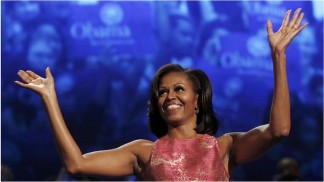
  • First Lady Michelle Obama Makes a Spirited Plea for Obama Re-election

    First Lady Michelle Obama Makes a Spirited Plea for Obama Re-election

    CHARLOTTE, NC (TIP): Closing the first night of the Democratic convention, Mrs. Obama spoke of the vision and values that guided Barack Obama as president.

    She said it was an “extraordinary privilege” to serve as first lady.

    Michelle Obama spoke of the shared values she said guided Barack Obama as president

    President Obama will formally accept the nomination on Thursday, and face Republican Mitt Romney in November.
    A recent opinion poll suggests Mr. Obama maintains a thin lead over Mr. Romney.

    But an ABC News/Washington Post poll released as the convention got under way in Charlotte, North Carolina, showed Mr. Obama with the lowest pre-convention favorability for an incumbent president since the 1980s.

    The president is aiming to recapture the political spotlight over the next few days, after last week’s Republican convention.

    ‘Kindred spirit’

    Mrs. Obama said that four years ago she “believed deeply” in her husband’s “vision for this country”, but worried about how a run for president would change their life and the life of their daughters.

    In a speech that energized a hyped-up crowd, she shared memories from their 23-year relationship, and noted that she had found a “kindred spirit” in a man whose values were similar to hers.

    “Barack and I were both raised by families who didn’t have much in the way of money or material possessions but who had given us something far more valuable – their unconditional love, their unflinching sacrifice, and the chance to go places they had never imagined for themselves.”

    She added: “Barack knows what it means when a family struggles. He knows what it means to want something more for your kids and grandkids.

    “Barack knows the American Dream because he’s lived it… and he wants everyone in this country to have that same opportunity, no matter who we are, or where we’re from, or what we look like, or who we love.”

    The first lady’s speech connected their shared background to the values she said guided Mr. Obama as president.

    “As president, you can get all kinds of advice from all kinds of people,” she said, “but at the end of the day, when it comes time to make that decision, as president, all you have to guide you are your values and your vision and the life experiences that make you who you are.”

    She said Mr. Obama was inspired by his own background when advocating for laws involving fair pay for women, healthcare and student debt.

    He had not been changed by the White House, she said, and was “still the same man I fell in love with all those years ago”.

    “He’s the same man who started his career by turning down high-paying jobs and instead working in struggling neighborhoods where a steel plant had shut down, fighting to rebuild those communities.”

    In the toughest moments, she added, “he just keeps getting up and moving forward… with patience and wisdom, and courage and grace.”

  • Democratic convention calls for Obama re-election

    Democratic convention calls for Obama re-election

    CHARLOTTE, NC (TIP): The US Democratic Party launched its National Convention September 4 as it seeks to convince voters that President Barack Obama deserves a second term.
    The chair of the Democratic National Committee, Debbie Wasserman Schultz, brought the gala into session with a strike of the gavel at 5 P.M. ET.

    Schultz, who is also the chairwoman of the Democratic National Committee, said that throughout the next three days, “we will demonstrate we need to keep President Barack Obama and Vice President Joe Biden four more years.”
    We will keep tabs on the convention all night. I’ll be joined by NPR’s Liz Halloran, and photographer Becky Lettenberger will bring us some of the sights.

    If Ted Strickland delivered the strongest attack on Mitt Romney, Gov. Deval Patrick delivered the best defense of Barack Obama.

    “If we want to win elections in November and keep our country moving forward, if we want to earn the privilege to lead, it’s time for Democrats to stiffen our backbone and stand up for what we believe,” he said.

    He added:”This is the president who delivered the security of affordable health care to every single American after 90 years of trying. This is the president who brought Osama bin Laden to justice, who ended the war in Iraq and is ending the war in Afghanistan. This is the president who ended “don’t ask, don’t tell” so that love of country, not love of another, determines fitness for military service. Who made equal pay for equal work the law of the land. This is the president who saved the American auto industry from extinction, the American financial industry from self-destruction, and the American economy from depression. Who added over 4.5 million private sector jobs in the last two-plus years, more jobs than George W. Bush added in eight.

    “The list of accomplishments is long, impressive and barely told—even more so when you consider that congressional Republicans have made obstruction itself the centerpiece of their governing strategy. With a record and a vision like that, I will not stand by and let him be bullied out of office—and neither should you, and neither should you and neither should you.”

    First Lady Michelle Obama and former President Bill Clinton are among those who will address the three-day jamboree in Time Warner Cable Arena, Charlotte, North Carolina.
    A recent opinion poll shows Mr. Obama maintains a thin lead over the Republican nominee Mr. Mitt Romney.

    With November’s election looming, the president will aim to recapture the political spotlight over the next few days, after last week’s Republican convention. Throughout this campaign, there’s been a lot of talk about whether President Obama would be able to rekindle the kind of fervor he sparked in 2008.

    Mr. Obama is expected to answer Republican attacks that his economic policies have failed, and present himself to voters as an experienced and caring alternative to Mr. Romney.Shortly after the convention opened, delegates cheered their backing for the party’s new platform in an open voice vote.

    Among the changes found in the text of the party’s 2012 platform was the removal of language from the Middle East section referring to Jerusalem as the capital of Israel. That message was replaced with a passage referring to the party’s “unshakeable commitment to Israel’s security” and Mr. Obama’s “steadfast opposition to any attempt to delegitimize Israel”.

    The change prompted criticism from Republicans and Mitt Romney, who accuse Mr. Obama of “selling out” a key US ally.
    Tuesday’s first session saw a series of Democratic governors, members of Congress, mayors and electoral candidates speak in support of Mr. Obama and his policies, most notably his much-criticized healthcare reform law.

    A video tribute to the late Senator Edward Kennedy included clips from his 1994 Senate debate with Mr. Romney, and independent Rhode Island Governor Lincoln Chafee argued that his former party – the Republicans – had lost their way and had forfeited the label of conservative.

    Former White House Chief of Staff Rahm Emanuel said the next president would set the tone for the next 40 years.
    “It will be the president’s leadership that determines how we as a nation meet the challenges that face the middle class. It is the president’s values that shape a future in which the middle class has hope,” he said.
    Mrs. Obama’s address at the end of Tuesday’s session will highlight the president’s character and praise his attributes as a father and husband.

    Her remarks will inevitably be compared and contrasted with those by would-be first lady Ann Romney, who gave a glowing tribute to her husband last week to the Republican convention in Tampa, Florida.
    The Democratic convention is likely to highlight the party’s diversity, with young black and Hispanic party members set to deliver speeches.Julian Castro, the Latino Mayor of San Antonio, Texas, will give the keynote address immediately before Mrs. Obama. But a number of the country’s top Democratic figures will not attend.
    Secretary of State Hillary Clinton is missing a Democratic convention for the first time in more than 40 years on account of ethical guidelines preventing cabinet heads from participating in political activities.
    Nor will California Governor Jerry Brown and former Vice-President Al Gore be present, both citing personal commitments.

    A number of Democratic congressional candidates and incumbents have also declined to attend, as they are engaged in tough battles for election in November.

    The Democratic gathering will see Mr. Obama and Vice-President Joe Biden formally re-nominated as the party’s presidential and vice-presidential candidates on Wednesday.

    Later that evening, there will be speeches from Elizabeth Warren, who is fighting Republican incumbent Scott Brown in a high-profile race for a Massachusetts Senate seat, and former President Clinton.The convention culminates on Thursday with speeches from Mr. Obama and Mr. Biden.The gala also offers the Democrats the chance to make a high-profile pitch to voters in North Carolina, a state that narrowly voted for Mr. Obama in 2008, but is now firmly up for grabs.

    As they did four years ago, the Democrats will take the event outside the convention centre for the president’s prime-time speech, taking over a 74,000-seater stadium in Charlotte for the final night of speeches.

    Organizers are working to ensure a full house for Mr. Obama’s speech. But organizers are concerned that thunderstorms forecast to hit Charlotte during the convention could keep people away.

    Meanwhile, Republicans were quick to seize on a remark Mr. Obama made on Monday, in which he told a local Colorado news station that he would give himself an “incomplete” grade on the economy.

    Vice-presidential candidate Paul Ryan told CBS News that the US should be “bouncing out of” the recent recession. “We’re not creating jobs at near the pace we could,” he said.

    A Gallup opinion poll on Monday suggested the convention had given the Republicans only the slightest of boosts, with 40% saying they were now more likely to vote for Mr. Romney but 38% of respondents describing themselves as less likely to.Mr. Obama maintained a lead over Mr. Romney of one percentage point – as he had done before the event

  • Paul Ryan Republican speech ‘contained errors’

    Paul Ryan Republican speech ‘contained errors’

    AMPA, FL (TIP):
    Republican vice-presidential nominee Paul Ryan has come under fire for alleged inaccuracies during his convention debut in Tampa, Florida.

    Mr. Ryan attacked the president for making cuts to the Medicare healthcare program, but did not say that his own budget plan includes the same savings.

    He complained that proposals by a budget commission were not adopted, but did not mention he opposed its report.
    Mr. Romney’s speech to the convention is the challenger’s biggest opportunity yet to make his case to the nation and is one of the set-piece events of the US election calendar.

    He and Mr. Ryan will challenge President Barack Obama and his Vice-President Joe Biden on Election Day, 6 November.
    In a barnstorming speech to a rapt audience, Mr. Ryan promised a “turnaround” for America and said Mr. Obama’s administration was tired and out of ideas.

    The Wisconsin congressman said he and Mitt Romney would not duck the tough issues.
    Mr. Ryan, who serves as chairman of the House of Representatives Budget Committee, is known as a leading Washington policy “wonk”, responsible for the budget plans backed by Mr. Romney and Republicans in Congress.
    But fact-checkers listening to his speech on Wednesday night quickly alleged that he had been slack with his facts.
    On a key area of debate, the future of Medicare, the government-run health program for over-65s, Mr. Ryan accused the White House of slashing $716bn (£450bn) from the much-loved scheme.

    But FactCheck.org, amongst others, said Mr. Obama’s 2010 healthcare reform law does not cut money from Medicare, but simply reduces the growth in spending on the scheme in an effort to keep it solvent.
    In addition, Mr. Ryan – who described the Obama plan as “the biggest, coldest, power play of all” – failed to note that he proposed virtually the same cuts in his own budget plans.

    He accused the president of “political patronage” via his $800bn stimulus plan, passed in 2008. However, he neglected in his speech to mention that he sought to procure stimulus dollars for energy firms in his home state of Wisconsin, the Associated Press notes.

    The vice-presidential hopeful was also accused of misleading his audience over the timing of the closure of a GM plant in his home town of Janesville, Wisconsin.
    That statement earned Mr. Ryan a “false” rating from PolitiFact.com, having failed to note that the plant closed under the previous administration of President George W Bush.
    The Obama campaign released a web video on Thursday highlighting Mr. Ryan’s contentious statements, and dubbing him the “wrong choice for the middle class”.