Tag: Omar Abdullah

  • Omar Abdullah sworn in as Jammu & Kashmir Chief Minister

    Omar Abdullah sworn in as Jammu & Kashmir Chief Minister

    Says “I fulfilled the promise of giving representation to all the regions equally; our endeavor will be to walk together.”

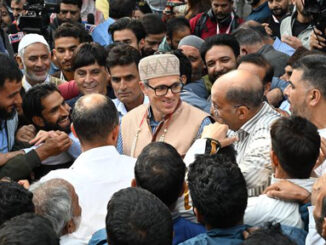
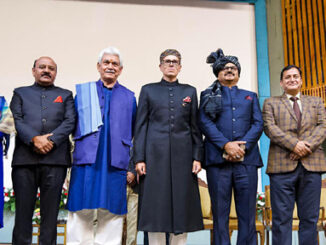
    SRINAGAR (TIP): National Conference leader Omar Abdullah took over as the first Chief Minister of the five-year-old Union Territory of Jammu and Kashmir on Wednesday, October 16, 2024, against the backdrop of the monumental changes the region has witnessed since 2019. Dropping his previous belligerence on the abrogation of Article 370, Mr. Abdullah has sought to tread the path of reconciliation, evident from the fact the new government’s starting point has been to address the regional and religious divide in J&K.

    The composition of the J&K Council of Ministers reflects a rare bid by the National Conference (NC) leadership to build a healthy relationship with the plains of Jammu, whose voters overwhelmingly opted for the BJP, helping the party to win 29 out of Jammu’s 43 seats. The Council has 10 ministerial berths including the Chief Minister. Of the six legislators who took oath on Wednesday (October 16, 2024), including Mr. Abdullah, three were from the Jammu region and three from the Kashmir region. The Chief Minister picked two non-Muslim members and one prominent Muslim face from the Jammu region.

    Surinder Kumar Choudhary, an NC MLA from Nowshera in Jammu, was offered the post of Deputy Chief Minister. Another Hindu face is Satish Sharma, the son of former MP Madal Lal Sharma. Mr. Sharma was inducted into the Council of Ministers even though he did not win the election on the ticket of the NC or its ally, the Congress. Mr. Sharma, a former Congress leader, won from Jammu’s Chhamb constituency. The third Minister from Jammu is Javed Ahmad Rana who was elected from the Pir Panjal valley, which witnessed polarization on the basis of caste between Gujjars and Paharis.

    The J&K election verdict fell along regional and religious lines, except for islands like Inderwal, where a Hindu Independent candidate Payare Lal Sharma defeated a Muslim candidate Gulam Mohammad Saroori, who had quit the Congress in 2022 and joined Ghulam Nabi Azad’s Democratic Azad Party. However, Mr. Saroori, who has represented the constituency thrice, contested as an Independent.

    On the one hand, voters from the three valleys of J&K — the Kashmir valley, the Pir Panjal valley and the Chenab valley — elected candidates from the NC, Peoples Democratic Party, Congress, Awami Ittehad Party, and J&K Peoples Conference, as well as Independents. On the other hand, the plains of Jammu, especially the Samba, Kathua and Jammu districts, only voted for the BJP.

    The BJP may not have the numbers in the Assembly, but its vote share of 25.5% posed a challenge to the NC to make the first move of reconciliation. The NC only had a 23.4% vote share and its ally Congress had a 11.9% vote share, though the alliance’s combined vote share exceeded the BJP’s. The Congress, which contested many seats in the Jammu region, failed to consolidate secular votes there. The party only won one seat from 10 districts in the Jammu region.

    J&K Assembly poll result reiterates NC’s status as guardian of Kashmiri nationalism

    Mr. Abdullah may have laid the foundation of a government based on secular values, but there is a long way to go to bridge the gap between regions with divergent aspirations. The relationship needs more repair and the annual shifting of the capital between Srinagar and Jammu, locally called the Darbar Move, could be the second step towards mending the relationship between the two regions. The Darbar Move was ended by the previous Lieutenant Governor’s administration, though it had for decades facilitated a rare cultural exchange and boost to business between different parts of J&K.

  • Democracy back on rails in J&K: Omar Abdullah to be the Chief Minister

    Democracy back on rails in J&K: Omar Abdullah to be the Chief Minister

    SRINAGAR (TIP): Paving the way for National Conference (NC) vice-president Omar Abdullah to take charge as the Chief Minister of Jammu and Kashmir, his party’s legislators on Thursday, October 10, unanimously approved his name for the top post. NC president Farooq Abdullah announced that his son had been unanimously chosen as the chairman of the legislature party. This clears the way for the younger Abdullah to stake his claim, with the Congress’s support, to form the government in J&K after a gap of 10 years. The new government’s formation is likely to be finalized in the next two days. “Talks are ongoing with the Congress party. Once the Congress provides its letter of support, the NC will approach the Raj Bhavan to formally stake its claim to form the government,” Mr. Abdullah said. Representatives of the Congress, which managed to win only six of the 32 seats it contested, are likely to meet NC leaders in Srinagar on Friday, October 11. Party sources said the two parties were discussing the modalities and composition of the government “for a smooth transition”. The NC received a shot in the arm as four Independent legislators, all from the Jammu region, announced their support: Pyare Lal Sharma (Inderwal), Satish Sharma (Chhamb), Choudhary Mohammed Akram (Surankote), and Rameshwar Singh (Bani). These four will add to the NC’s own tally of 42 seats in the 90-member Assembly. The new government will also have the support of the Communist Party of India (Marxist)’s lone MLA Mohamad Yousaf Tarigami and the six Congress legislators.

    Top NC leaders have been promising to include leaders from Jammu in the government to ensure representation from the region. The BJP swept most of the seats in the plains of Jammu, in the Samba, Kathua, and Reasi districts, winning 29 seats. In the Valley, the INDIA bloc was chosen decisively over rivals who included independents fielded by the banned Jamaat-e-Islami. A CSDS-Lokniti survey report showed that in Jammu and Kashmir, it was a vote for strengthening the democratic process, but that while statehood seems to be the main ground of convergence, party choices sharply bring to the fore the divergences between the Jammu region and Kashmir Valley.
    The Hindu, in an editorial pointed out that the Chief Minister-designate’s work is cut out as he embarks upon the tough path of fulfilling promises made to the electorate in the Union Territory. “The NC must now live up to this mandate but the task is not easy.” But it pointed out that with the electorate ensuring that the INDIA bloc got the reins to power, it would be best if the Centre respected the mandate, accelerated the process of restoring statehood and allowed the newly elected government to fulfil its promises.
    (With input from The Hindu)