Tag: Operation Blue Star

  • Operation Blue Star – A festering wound

    Operation Blue Star – A festering wound

    38 years after it took place, the infamous Operation Blue Star is a festering wound for the Sikh community the world over whose psyche was terribly hurt to find their Holiest Shrine desecrated, the Holy Akal Takht — sign of the Sikh dignity-raged to the ground, and thousands of innocent pilgrims killed , all in the name of neutralizing “Sikh extremists/ militants” led by Sant Jarnail Singh Bhindranwale. Hundreds of books and thousands of articles have been published on the issue, and the authors have analyzed the causes and the effects, and, of course, their views on the issue diverged, but almost all have questioned the need and wisdom to have a military operation to “neutralize the Sikh extremists / militants”. Just as the Jews have not forgotten the Holocaust, the Operation Blue Star will continue to be a festering wound for the Sikh community.

    It happened 38 years ago but it feels as if it was yesterday – the heart, body and mind still feel the tremors of the emotional earthquake it caused. The force of those tremors intensifies every year when June 6 approaches. Operation Bluestar (saka neela tara), a fancy-sounding name given to a dreadful military action at the Sikhs’ holiest shrine, the Golden Temple in Amritsar, was launched on June 2, 1984, with a ‘national broadcast to the nation’ by then prime minister Indira Gandhi. It was claimed to have been completed successfully on June 6 with the ending of the last resistance by Sikh combatants to the army’s entry at the Temple. State media (TV and radio) and other non-state media outlets praised the operation for saving India’s ‘unity and integrity’ from ‘anti-national’ Sikh secessionism.
    The most reliable estimates of the total number of deaths during Operation Bluestar range from 5,000 to 7,000. It was a tragedy that could have been avoided if – and it is a big if – Indira Gandhi had had the vision to reach a political settlement with the moderate Akali leadership. Most Akali Dal demands – regarding federal decentralisation, river water rights, territorial readjustment and the transfer of Chandigarh to Punjab as its capital – could have been negotiated. Rajiv Gandhi did agree to each of these demands, and many more besides, in the 1985 Rajiv-Longowal Accord. He implemented none.
    Indira Gandhi’s political decision to use the ‘Hindu card’ to gain electoral victories led her to choose a dangerous path of confrontation, first with the Akalis and eventually with the entire Sikh community. This miscalculation cost Mrs Gandhi her life, and left the communities of Punjab and of India in general scarred and polarised. This polarisation peaked with the genocidal violence against the Sikh minority in Delhi and many other North Indian Hindu majority towns in November 1984 after the assassination of Indira Gandhi by two of her Sikh security guards. Sikh nationalists in Punjab were eventually defeated, at least militarily, by the 1990s, but Hindu nationalism was promoted so powerfully that the Hindu nationalists succeeded within a few decades in capturing the Indian state.
    In the Sikhs’ collective memory of 1984, the deaths by army action in June and those by genocidal mob violence in November constitute two ends of the same arc of killings. The two cannot be separated and, therefore, remain indelibly linked to the memory of Operation Bluestar, which is seen as the trigger both for the killings and for later disappearances, killings in custody and deaths by ‘encounters’ during the military operations against the armed Sikh opposition movement after the events of 1984.
    Operation Bluestar is gradually finding a place in the Sikh practice of ardaas (prayer). This practice is unique in the history of world religions because it gives collective memory a central place. On all important occasions – birth, marriage, death, new job, promotion, passing an examination, new house, Gurpurab celebrations (in honour of the gurus’ birthdays), or even the daily rituals in a gurdwara – the ardaas recounts in capsule form the history of the Sikh faith.
    The ardaas narrative starts with the founding of the faith by Guru Nanak, its continuation by his nine successors and the sacrifices made by the tenth guru Guru Gobind Singh’s four sons (sahibzade), the five Beloved Ones (panj piare), the 40 Liberated Ones (chali mukte) and numerous other martyrs right up to the present time. Sikhs have a long memory. Udham Singh waited for 21 years to avenge the Jallianwala Bagh massacre of 1919 by assassinating Michael O’Dwyer in 1940. The Naxalite Sikhs punished a Sikh landlord Ajaib Singh Kokri, a witness against the revolutionary Bhagat Singh, by assassinating him in 1974, 43 years after Bhagat Singh was hanged in 1931. The socialisation from early childhood of anyone growing up in a Sikh household (irrespective of the political affiliation of the household) involves such a focused exercise in historical remembrance that most adult Sikhs remember the ardaas by heart, whether they are illiterate farmers or university academics. The ardaas contributes to the making of an active historical being who remembers the past, relates that past to the present and imagines the shaping of the future.
    Blue Star bloodbath
    Shortly after 10.30 p.m. on June 5, 1984, 20 men in black dungarees stealthily entered the Golden Temple. They wore night-vision goggles, M-1 steel helmets, bulletproof vests and carried a mix of MP-5 submachine guns and AK-47 assault rifles. The men of sg’s 56th Commando Company were then the only force in India trained for room intervention, the specialised art of fighting in confined spaces. Each commando was a sharpshooter, diver and parachutist and could do 40-km speed marches. Some of them wore gas masks and carried stubby gas guns meant to launch CX gas canisters, a more potent tear gas. Three months before this night, the commandos had stayed around the temple and rehearsed for Operation Sundown. Some of them still sported the beards they had grown for their undercover work as volunteers in the Golden Temple’s langar. When the plan was called off, they returned to their base in Sarsawa. They had flown into Amritsar the previous day at the request of Lt-Gen Sundarji.
    The three battalions that Lt-Gen Brar’s 9th Infantry Division sent into the Golden Temple that night were trained to fight a conventional combat on the plains of Punjab and in the deserts of Rajasthan. They would overwhelm the enemy by sheer force of numbers. The commandos, who spearheaded the assault, made use of stealth, speed and surprise to achieve results. Soon after arriving, one of the sg officers had briefed Lt-Gen Ranjit Singh Dayal, Sundarji’s chief of staff, on a plan to capture the Akal Takht by blowing off its rear wall. General Dayal, a paratrooper who had captured the Haji Pir pass in an unconventional operation in the 1965 war, immediately overruled it. “There must be no damage to the Akal Takht,” he said. The commandos were to capture the sacred building by using gas to flush out the militants, he said.
    The Army had clearly underestimated the defences. As soon as they entered the temple, a sniper shot the unit’s radio operator clean through his helmet. The rest took cover in the long gallery of pillars that led to the Akal Takht. Light machine guns and carbines crackled from behind impregnable walls of the temple, their multiple gun flashes blinding the commandos’ night-vision devices, forcing them to take them off. The commandos and infantry soldiers cautiously advanced, sheltering behind rows of pillars. Those who tried to advance towards the Akal Takht were cut down on the marble parikrama. An armoured personnel carrier bringing in troops was immobilised by a rocket-propelled grenade. “Shabeg knew the Army’s Achilles heel,” says an SG colonel. “He knew we couldn’t fight in built-up areas.”
    Post-midnight, remnants of the sg unit and the Army’s 1 Para huddled near a fountain at the base of the Akal Takht. The area between the Akal Takht and the Darshani Deori that led to the Golden Temple had turned into a killing zone, covered by Shabeg’s light machine guns. Attempts by the para-commandos to storm the defences were repeatedly beaten back. They lost at least 17 men, their black dungaree-clad bodies lying prone on white marble. Commandos who tried to fire the CX gas canisters discovered that the Akal Takht’s windows had been bricked up. The only openings were horizontal slots out of which machine guns poured deadly fire. The commandos neutralised two of the machine gun nests by dropping grenades into them but the Akal Takht was impregnable. Then, around 7.30 a.m. on June 5, three Vickers-Vijayanta tanks were deployed. They fired 105 mm shells and knocked down the walls of the Akal Takht. Commandos and infantrymen then moved in to mop up the defenders, tossing gas and lobbing grenades inside the building.
    The temple premises resembled a medieval battlefield, one sg trooper recalls. Bloodied and blackened bodies lay scattered around the white temple parikrama. In the basement of the blackened, still-smoking ruin of the Akal Takht, the commandos found the body of Shabeg. The Army recovered 51 light machine guns, 31 of which had been concentrated around the Akal Takht. “Normally, an army unit (of around 800 soldiers) would deploy this quantum of firepower to cover an area of about eight km,” Lt-Gen Brar recounted in his book Operation Blue Star: The True Story. Shabeg, he believed, wanted to hold out until daylight in the hope that there would be a popular uprising among the people when they get to know of the army action. The former war hero had extracted a bloody price on an army he felt had wronged him.
    Operation Blue Star has come to be remembered as the teeja Ghallughara (the third holocaust). Many gurdwaras outside India and perhaps some even in India have incorporated the remembrance of the teeja Ghallughara in the ardaas. In Sikh historical memory, there have been two Ghallugharas before Operation Bluestar – the chhota Ghallughara (the small holocaust) and the wadda Ghallughara (the big holocaust). The chhota Ghallughara took place in May 1746 when, according to estimates made by the celebrated Sikh historian Professor Ganda Singh, about 10,000 Sikh men and women were killed. The wadda Ghallughara took place in February 1762 when about 30,000 Sikh men, women and children were slaughtered. According to one as yet unconfirmed estimate, about half of the total Sikh population was liquidated during the wadda Ghallughara.
    These were the darkest times in the history of the Sikhs. These massacres could have demoralised them to the point of extinction, but, inspired by the memories of their gurus and martyrs, they regrouped and within a few decades of the wadda Ghallughara, emerged literally from the ashes to become the de facto rulers of Punjab in the last quarter of the 18th century. By 1799, one of them (Ranjit Singh) formalised that de facto rule to become the Maharaja of Punjab. The force of memory weighed upon him too and he ruled, therefore, in the name of the gurus. Some features of feudal degeneration which emerged during his rule were the result of his dissociation from the memory of the path of the gurus.
    During the dark times the Sikh community faced from 1716, when the Sikh warrior Banda Singh Bahadur was martyred, to 1799 when Ranjit Singh came to power, Harmandar Sahib (later known more popularly as the Golden Temple) became the nerve centre for the moral, political, military, spiritual and even economic empowerment of the community. While living the life of guerrilla combatants against the Moghul powers, the leading members of the community would meet twice a year on Vaisakhi and Diwali for deliberations and collective decision-making for the future survival of the community. Once in the precincts of the Harmandar Sahib, they considered themselves protected by the Guru and had no fear of any earthly powers such as the Moghul rulers they had to confront. The mystique of the Harmandar grew and this mystique has continued and strengthened over the centuries. The Golden Temple has literally become the heart of the community.
    The death, destruction and sacrilege caused during Operation Bluestar pierced the heart not only of the Sikhs but also of many Punjabi Hindus. The devastation it caused in the personal lives of so many millions has still not been fully recorded and acknowledged because the political divide over the attitudes towards Operation Bluestar has overshadowed the human stories.
    A whole generation has grown up after the Operation and many in this new generation have become parents. They hear and read about the Operation and try to understand the meaning of it to reconnect to the history of their parents, their grandparents and before. Many of them are devising new tools and media to relate to that history. Of many doctoral dissertations I have evaluated as an external examiner, one by Shruti Devgun of Rutgers University, USA on ‘Re-Presenting Pasts: Sikh Diasporic and Digital Memories of 1984’ stands out for its subject and methodology. Her thesis focuses on the work of an intergenerational cohort of Sikhs in the diaspora (in the US and Canada) who are trying to piece together the fragments of painful pasts ‘to give cultural meaning and shape to broken traumatic experiences’.
    Through their work, they are puncturing, and perhaps demolishing, the Indian State’s narratives of Operation Bluestar. This painful ‘memory work’ is creating new spaces for them to understand and connect with the pain of the victims of many other genocides e.g., the Jews, the Palestinians, the Armenians and the Rwandan Tutsis.
    The wounds may never heal but by connecting your pain to the pain of others, the meaning and experience of pain is transformed.
    Source: The Wire and India Today.
    Writers: Pritam Singh and Sandeep Unnithan

  • “Operation Blue Star – Counterbalancing Terror –  results in boomeranging horrible pain”

    By Ravi Batra

    The 1984 Operation Blue Star was the biggest internal security mission ever undertaken by the Indian Army. Operation Blue Star was Indira Gandhi’s solution to the haywire going law and order situation in Punjab.

    Operation Blue Star was carried out between June 1 and June 10, 1984, in Amritsar.-EDITOR

    Leadership requires making choices – picking between not “good” and “bad,” but “bad” and “worse.” This Op-Ed is aimed at policymakers – to abandon counterbalance as a pillar of statecraft, and it’s noisy and genie-out-of-the-bottle progeny: state-sponsored Terrorism. It doesn’t work, and is very painful at the bitter end. Being “right,” and winning by “right means” permits an end – as a civil “trial by jury” does daily in our courts even for losers. Nations, however, continue to exercise “might is right,” when it really never was – given its lingering “tail”.

    My takeaway: don’t use counterbalance; it’s sexy upfront, and painful as a nightmare divorce in the end. Recently, Kurds in Syria bear witness – as some of them became Terrorists against Turkey.

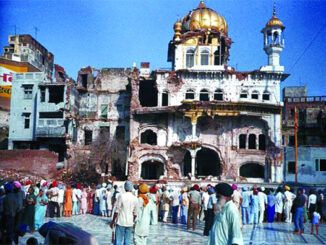
    The Akal Takht- the symbol of the supreme temporal power of the Sikhs, was destroyed in the Operation Bluestar. (Photo : CourtesyCentralSikhMuseum.com)

    The enemy of my enemy is my friend; or so goes the saying, lovingly followed by policymakers seeking a shortcut to victory for several millennia. Indeed, counterbalancing continues as a steady pillar of statecraft the world over. It matters not that ultimately it doesn’t work, and backfires with a painful boomerang.

    Recall President Ronald Reagan’s “Freedom Fighters” in Afghanistan who we trained and equipped to fight the then-USSR’s excursion in Afghanistan to an unhappy exit. Then, after 9/11, when we were in hot pursuit of its mastermind OBL and ended up in Afghanistan – our Freedom Fighters became the Taliban we were fighting against. 40 years and lots of blood and treasure we have spent, only to make a recent Jello gelatin flexible peace-deal with the Taliban, and then cause the local government’s twin executives to sign on after the fact to make it operational, all so we may extricate ourselves from a war we cannot lose, nor win by civilized standards in a place where our values are alien to the local ecosystem. My takeaway: don’t use counterbalance; it’s sexy upfront, and painful as a nightmare divorce in the end. Recently, Kurds in Syria bear witness – as some of them became Terrorists against Turkey.

    Well, let’s go back to 1971 – when the Blood Telegram sent from Dhaka was ignored in China-loving Richard Nixon’s Washington DC – and Indira Gandhi, Prime Minister of India, moved to save the remaining Hindus in now-Bangladesh from genocidal demise. India secured a striking victory in short order that exceeded expectations and was decisive to boot. Pakistan was unhappy, to state the obvious. Nations have found that sponsoring Terror is attractive – because it is what I call – war on the cheap. Pakistan enjoyed such sponsorship as a rejoinder. India’s Punjab and Kashmir border Pakistan, and cross-border Terror-support in Sikh-rich Punjab was easier, as Sikhism’s founder, Guru Nanak’s immortal roots remain in Pakistan – a matter of great importance even now while celebrating His 550th Birthday in Nankana Sahib, Lahore Pakistan via opening the visa-free Kartarpur Corridor – thanks to P. M. Imran Khan and P. M  Narendra Modi – which nations and people of goodwill celebrate.

    So after 1971, Pakistan’s cross-border sponsorship was for Khalistan to be born – perhaps, as a nation for a nation – with three Sikh leaders Shabeg Singh, Balbir Singh, and Amrik Singh turned separatists, who were allegedly taught tactics more familiar to Terror in Pakistan. As a result, India suffered a porous border and a porous state in Punjab and Kashmir, such that India’s sovereignty would be an afterthought if not stopped.  Mrs. Gandhi decided to fight fire with fire, and allegedly “sponsored” a genuine Sikh leader Jarnail Singh Bhindranwale. Ultimately, he and his armed supporters came under threat of arrest, being un-controllable by Delhi, and took refuge in the Golden Temple – the holiest Harmandir Sahib – and Operation Blue Star was born in June 1984 to turn back the hands of time and Statecraft’s expediently sexy counterbalance pillar. When first trying to peacefully end the stalemate and get the innocent pilgrims released failed over two days, as the separatists were armed with even Chinese-made grenade-launchers, on June 5th military force was initiated to forcibly evict Terrorists from the house of worship. That goal would be tough enough without religion being implicated; but attacking the holiest Sikh Gurdwara – a sanctuary – with 10,000 booted soldiers was successful in a military sense, but a failure by all other metrics. Harmandir Sahib was severely damaged, ancient scripts and artifacts forever lost in the “firefighting fire.” Thereafter, while the Indian Government rebuilt it, the Sikh community tore it down and rebuilt it afresh – perhaps, as we recently tore down our newly built embassy in Moscow and rebuilt it anew.

    The historic Ramgarhia Bunga damaged in the Operation Bluestar
    (Photo : Courtesy Central Sikh Museum.com)

    The price of counterbalancing Pakistan’s punishment – trying to create Khalistan for loss of her East Pakistan – was that Mrs. Gandhi was assassinated on October 31, 1984 by her favorite bodyguard, Beant Singh, and Satwant, both Sikhs – whom she insisted upon keeping. What followed was nothing short of a bloodbath – known as the Anti-Sikh Riots or worse – where even innocent Sikhs were hurt, injured and even killed and some members of the Indian Congress party were allegedly directing the Sikh-killings in an opportunistic manner – a stain that India has dealt with (and still has to remedy) as we did for interning loyal Japanese-Americans after Pearl Harbor some 40 years later.

    Recall in 1988, President Reagan signed the Civil Liberties Act to compensate more than 100,000 Japanese-Americans who were incarcerated in internment camps during World War II. The Law offered a formal apology and paid $20,000 in compensation to each surviving victim.

    Leadership requires making choices – picking between not “good” and “bad,” but “bad” and “worse.” This Op-Ed is aimed at policymakers – to abandon counterbalance as a pillar of statecraft, and it’s noisy and genie-out-of-the-bottle progeny: state-sponsored Terrorism. It doesn’t work, and is very painful at the bitter end. Being “right,” and winning by “right means” permits an end – as a civil “trial by jury” does daily in our courts even for losers. Nations, however, continue to exercise “might is right,” when it really never was – given its lingering “tail.” A lesson China will learn from its current collective and sequential miscalculations: Tibet, Uighurs, OBOR with AIIB, exporting Wuhan Virus (lab-engineered as it has the Spike Glycoprotein (S) spliced off the 2003 SARS Bat viruses and transplanted onto the surface of the AIDS virus in 2019 – see, my April 14, 2020 “Open Letter to POTUS et al” in public domain – recently re-confirmed by former head of MI6) as a global Pearl Harbor, with it’s cover-up, followed not by an apology and compensation, but added belligerence in South China Sea and Hong King, and inter alia, converting diplomacy, a channel most useful during disputes and war, and instead burning it by making diplomats act as a “Wolf Warrior” commando doing battle. That our Hollywood celebrates Chinese-Americans and China is starkly in contrast to the steady anti-American diet fed by Chinese Communist Party leadership to her people. That is both strategic, as it is tactical – something President Trump, Secretary Esper, Speaker Pelosi and Leader McConnell ought digest, as we too have our nation to defend in present time from folks we saw as friends, since Nixon, but who played us.

    Disclosure: I legally represented Indian National Congress and Mrs. Sonia Gandhi, merely a loving wife, mother and daughter-in-law in 1984, when they were sued by a so-called entity, Sikhs for Justice, under the Alien Tort Claims Act in United States Federal Courts in New York – SDNY and EDNY. I successfully argued that India, where all events occurred and all actors reside, was ineligible for US courts to exercise extra-territoriality and it was for India to remedy this stain. The lofty U. S. Second Circuit Court of Appeals issued two orders in 2014 and 2015, respectively, agreeing to dismiss the cases pursuant to US law. Thereafter, Rahul Gandhi, adopting my legal filings, gave an interview to Arnab Goswami confirming for the first time that “some” Congressmen were complicit in misconduct. SFJ’s subsequent cases against then-PM Manmohan Singh and PM Narendra Modi were dismissed, based upon the precedents I secured, along with application of the Foreign Sovereign Immunities Act, as Prime Ministers, as head of government, are so entitled – which neither INC or INC President Sonia Gandhi was so entitled.  Now, SFJ is out of the media-rich harassing litigation, but, allegedly, based upon reports, may be subject to Foreign Agent Registration Act given its foreign supporters.”

    (The author is a senior attorney and Chair, National Advisory Council South Asian Affairs. He can be reached at ravi@ravibatralaw.com)
