Tag: Operation Bluestar

  • Operation Bluestar and its deep impact on the Sikh psyche: The third ghallughara

    Operation Bluestar and its deep impact on the Sikh psyche: The third ghallughara

    Operation Bluestar, executed by the Indian Army in June 1984 at the Golden Temple in Amritsar, was not merely a military offensive—it became a watershed moment in the history of Sikhism. For the Sikh community, it was not a battle against terrorism but an unforgivable desecration of their holiest shrine, an assault on their collective identity, and the beginning of a long era of emotional, political, and spiritual rupture.In Sikh history, the term Ghallughara, meaning “holocaust” or “massacre,” has been used to describe periods of mass violence inflicted upon the Sikh people. Operation Bluestar is remembered as the Teeja Ghallughara (Third Holocaust)—a modern-day catastrophe that left a deep scar on the Sikh psyche.
    Historical Context: Sikh Ghallugharas
    The Sikh community has endured repeated episodes of persecution and massacres known as Ghallugharas:
    – Chhota Ghallughara (1746): A brutal massacre by Mughal forces in which thousands of Sikhs were killed.
    – Wadda Ghallughara (1762): The Great Massacre where Afghan invader Ahmad Shah Abdali killed tens of thousands of Sikhs in one day.
    – Teeja Ghallughara (1984): The storming of the Golden Temple by the Indian Army, followed by the anti-Sikh riots post-Indira Gandhi’s assassination.
    These historical traumas are etched deeply into the Sikh collective consciousness as moments of suffering and sacrifice, but also resilience.
    Devastation of the Golden Temple Complex
    The Indian Army’s use of tanks, heavy artillery, and infantry inside the sacred Golden Temple complex caused massive physical destruction:
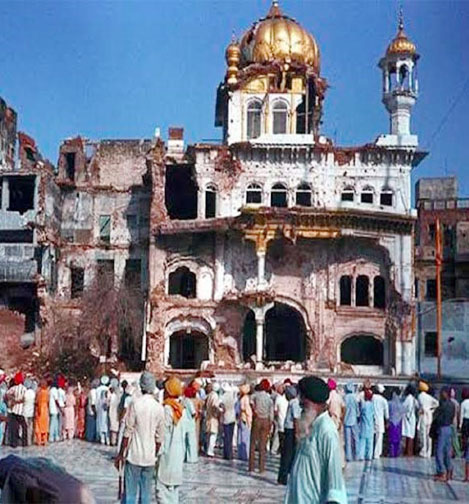
    – Damage to the Akal Takht: The Akal Takht, the supreme temporal authority of Sikhism, was heavily damaged. It was reduced to rubble, which was an unimaginable blow to Sikh spiritual sovereignty.
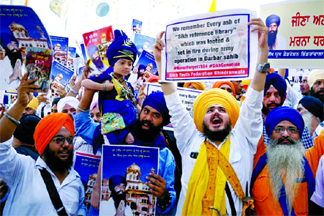
    – Destruction of the Sikh Reference Library: The library housed centuries-old scriptures, historical documents, handwritten manuscripts, and relics of the Gurus. Its burning was perceived as a deliberate attempt to erase Sikh history.
    – Widespread Casualties: Estimates of deaths vary, but it is widely accepted that hundreds, possibly thousands, of militants, civilians, and pilgrims died during the assault. The presence of unarmed pilgrims and non-combatants inside the complex intensified the trauma.
    Desecration and Violation
    The Golden Temple is not only a place of worship but a sanctuary, a symbol of Sikh identity and spiritual refuge. The operation violated this sanctity, leaving many Sikhs feeling profoundly betrayed and humiliated. The act of soldiers entering the shrine with weapons and destroying sacred sites was seen as sacrilege.
    Impact on the Sikh Psyche
    Collective Trauma and Spiritual Wound: Operation Bluestar was not experienced as a simple military action but as an assault on Sikh identity and spirituality.
    – The sense of violation was akin to a profound spiritual wound. The Guru Granth Sahib, the eternal Sikh scripture, and the sanctity of the Harmandir Sahib were perceived to be attacked.
    – Many Sikhs described feelings of shock, disbelief, and grief, similar to collective mourning for a devastating loss.
    – This trauma entered the cultural memory as a form of existential crisis, shaking the foundations of Sikh confidence in the Indian nation-state.
    A Crisis of Faith and Identity
    For many, Bluestar triggered a deep crisis of faith – not in Sikhism itself, but in the protection that the Indian state was supposed to offer its minorities. The event forced Sikhs to re-examine their place in India.
    – Feelings of alienation and vulnerability intensified.
    – The Sikh community felt targeted, marginalized, and feared further erosion of their political and cultural rights.
    – Many Sikh youth turned towards assertive identities, including militancy, as a way of reclaiming dignity and protecting their heritage.
    The Aftermath
    The trauma of Bluestar was compounded by the horrific anti-Sikh riots that erupted in November 1984, after the assassination of Prime Minister Indira Gandhi by her Sikh bodyguards.
    – Over 3,000 Sikhs were massacred in Delhi alone, with thousands more killed in other parts of India.
    – The widespread nature of the violence, often with alleged complicity or passive support of political actors, deepened feelings of betrayal.
    – This event reinforced the perception of systemic persecution, making the Sikh community feel under siege.
    The combined effect of Operation Bluestar and the 1984 pogroms is often described as a modern Ghallughara, reshaping Sikh political and social consciousness.
    Sociopolitical and Cultural Ramifications
    Rise in Sikh Militancy and Calls for Khalistan
    – Operation Bluestar galvanized militant groups advocating for a separate Sikh homeland, Khalistan.
    – The event became a rallying cry for those who saw armed struggle as the only means to protect Sikh interests.
    – While the majority of Sikhs did not support violence, the trauma legitimized radical political voices in many communities.
    Diaspora Mobilization
    – Sikh diaspora communities in Canada, the UK, and the US responded with protests, fundraisers, and political lobbying.
    – Bluestar strengthened Sikh identity abroad and heightened advocacy for human rights and justice.
    – The diaspora became crucial in keeping the memory alive and pushing for international awareness.
    Memory, Mourning, and
    Identity Preservation
    Commemoration as a Collective Process
    – Every year, Sikhs commemorate the anniversary of Operation Bluestar with memorial prayers (Ardas), candlelight vigils, and seminars.
    – The event is remembered in literature, music, and art, serving both as a mourning and a form of resistance.
    Passing Trauma Across Generations
    – The trauma has been passed down through oral histories, storytelling, and family narratives.
    – New generations understand Bluestar as part of their identity, often with strong feelings of justice, remembrance, and resilience.
    Psychological Effects: Trauma and Healing
    – Many Sikhs suffered from post-traumatic stress, depression, and a sense of helplessness.
    – Counseling and support structures were limited, especially in the 1980s and 1990s.
    – Over time, Sikh organizations and mental health professionals have worked to address this trauma through community healing initiatives.
    An Unhealed Wound
    Operation Bluestar was more than a military event-it was a collective trauma that profoundly altered Sikh consciousness. It was a moment when the sanctity of faith, the integrity of identity, and the sense of security for millions of Sikhs were violently shattered.The memory of the Teeja Ghallughara continues to influence Sikh politics, culture, and spiritual life. Until the wounds of 1984 are acknowledged and healed with justice and reconciliation, the pain and mistrust remain a defining feature of Sikh relations with the Indian state.

  • Operation Bluestar: The siege of Golden Temple and the tragedy that followed

    Operation Bluestar: The siege of Golden Temple and the tragedy that followed

    Operation Bluestar, executed in June 1984, was one of the most traumatic episodes in independent India’s history. Conceived by the Indian government to flush out Sikh militants from the Golden Temple complex in Amritsar, Punjab, it became a military operation of immense scale — unprecedented in its political, religious, and human costs. It left a deep scar on the Sikh psyche, led to significant loss of life and heritage, and forever altered the course of Indian politics and Sikh-Centre relations.
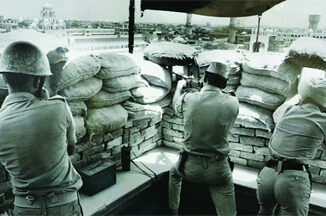
    Operation Bluestar, conducted between June 1 and June 10, 1984, was a military operation ordered by then-Prime Minister Indira Gandhi to remove Sikh militants, including the heavily armed followers of Jarnail Singh Bhindranwale, from the Harmandir Sahib (Golden Temple) complex in Amritsar, Punjab. The assault, carried out by the Indian Army, not only resulted in significant casualties and damage but also triggered a tragic chain of events including the assassination of Indira Gandhi and the genocidal violence against Sikhs in November 1984.
    The Build-Up to the Operation
    By the early 1980s, Punjab was in the grip of rising militancy, with radical Sikh groups demanding Khalistan-a separate Sikh homeland. The central figure of this movement was Sant Jarnail Singh Bhindranwale, a fiery preacher who positioned himself as a defender of Sikh rights and identity. He had taken up residence in the Akal Takht, one of the holiest Sikh sites within the Golden Temple complex, along with hundreds of armed followers.
    Tensions escalated as violence spread across Punjab. Political deadlock between the Indian government and the Akali Dal deepened, and bombings, assassinations, and communal killings increased. By early 1984, the Golden Temple complex had become a fortress, and the government considered the situation untenable.
    Operation Bluestar Begins
    On June 1, 1984, the Indian Army began preliminary operations by surrounding the temple complex. Officially, the army claimed it was responding to provocation from inside the temple. On June 3, a full curfew was imposed in Punjab, communication lines were cut, and news media was barred-effectively sealing the region.
    The main assault began on the night of June 5 and continued until June 6, involving elite army units including the Para Commandos and Sikh Regiment soldiers. Tanks and artillery were brought into the sacred complex, and the Akal Takht was fired upon with heavy ordnance.
    Destruction of the Akal Takht
    One of the most painful outcomes for the Sikh community was the near-total destruction of the Akal Takht, the highest seat of earthly authority for Sikhs, which had been converted by militants into a fortified bunker. The Indian Army used tank fire and shelling to neutralize resistance, reducing the historic building to rubble. Ancient manuscripts, relics, and scriptures were lost or destroyed.
    Damage to the Golden Temple Complex
    – Bullet marks pockmarked the marble walls of the Harmandir Sahib.
    – Sacred pools turned red with blood.
    – Libraries and the Sikh Reference Library were set ablaze; priceless historical texts were lost forever.
    – More than 100 gurdwaras across Punjab were raided as part of related operations (Operations Woodrose and Trident).
    Death Toll and Casualties
    There is no consensus on the number of people killed during Operation Bluestar.
    – Official government figures put the number of deaths at about 492 militants and civilians and 83 soldiers, with 249 injured.
    – Independent sources and Sikh groups estimate 3,000-7,000 deaths, many of them civilians and innocent pilgrims caught in the crossfire during a sacred time (Guru Arjan Dev’s martyrdom anniversary), when the complex was crowded.
    – Women, children, and elderly pilgrims were among those killed.
    – Eyewitnesses and survivors spoke of wounded being denied medical help, and unarmed men being shot or dragged away.
    The operation caused deep psychological trauma to survivors and thousands of families, many of whom never recovered the remains of their loved ones.
    Aftermath & Wider Repercussions
    Assassination of Indira Gandhi
    On October 31, 1984, Indira Gandhi was assassinated by her two Sikh bodyguards in retaliation for Operation Bluestar. This led to anti-Sikh pogroms, especially in Delhi, where over 3,000 Sikhs were killed, women were raped, properties were destroyed, and entire neighborhoods burned down with police and political complicity.
    Rise in Militancy
    Operation Bluestar radicalized many Sikh youth. The sense of betrayal and desecration pushed many into the armed separatist movement. From 1984 to the early 1990s, Punjab saw intense insurgency, enforced disappearances, extrajudicial killings, and heavy militarization.
    Army Mutinies
    Several Sikh soldiers across regiments mutinied in response to the assault on the Golden Temple. Around 5,000 were arrested or dismissed. The army, one of the most respected institutions, faced internal rupture along communal lines.
    4. Social and Political Fallout
    The trust between the Indian state and the Sikh community was shattered. Many Sikhs felt alienated, fearful, and unsafe. Even moderate voices in the Sikh community were pushed to the margins, as polarizing forces gained ground. Politically, it laid the groundwork for the rise of Hindu nationalism in the 1990s and deepened communal cleavages.
    Cultural and Religious Trauma
    For Sikhs, Operation Bluestar was not just a political or military event-it was a spiritual wound. The Golden Temple is not merely a place of worship; it is the soul of the Sikh faith. To see tanks roll in, the Akal Takht bombed, pilgrims gunned down, and sacred texts destroyed was a trauma akin to sacrilege.
    The operation is now remembered by Sikhs as the Teeja Ghallughara (Third Holocaust), following:
    – The Chhota Ghallughara of 1746 (approx. 10,000 Sikhs killed),
    – The Wadda Ghallughara of 1762 (approx. 30,000 Sikhs massacred).
    Ardaas (Sikh prayers) in many gurdwaras now incorporate remembrance of this event, embedding it into Sikh collective memory.
    Operation Bluestar left behind more than just rubble and blood-it tore through the fabric of India’s secular promise, fractured national unity, and deeply wounded the Sikh community’s psyche. The scars of June 1984 continue to shape Sikh identity, Indian politics, and public memory.
    No official apology has ever been issued. No full reckoning of the deaths, disappearances, and destruction has occurred. And until the state addresses its moral responsibility-through truth, justice, and reconciliation-the ghosts of Operation Bluestar will not be laid to rest.

  • Operation Bluestar And Punjab

    Operation Bluestar And Punjab

    Thoughts on the 39th anniversary of Operation Blue star: The game is for power not for Punjab

    By Prabhjot Singh

    Thirty-nine years after the traumatic Operation Blue Star, Punjabis in general and Sikhs in particular, continue to ponder what makes all ruling parties at the Centre to betray

    them. All agitations in this border State have ended in trading of power without anything being said about its long-standing demands, be it territorial rights, dams and water works, prime

    institutions and its people. Sikhs have been in the habit of hawking newspaper headlines for reasons that extend beyond the geographic boundaries of their motherland for whose independence they made nearly 80 per cent of the total sacrifices. Of late some of the world leaders while eulogizing the contributions this minute minority community has made in the Corona pandemic went to the extent of saying that there should be a gurdwara – Sikh temple –everywhere to look after the suffering humanity.

    It is that institution of gurdwara that has been making the Sikh community seek answers from the Central Government in India in general and the national political parties in particular.

    Questions about the attack on their sancta sanctorum have either been ignored or they remained mired in controversies. The Sikhs, a global community, have every reason to nurse a grouse both against the Congress – for engineering attack on their sancta sanctorum besides depriving the State of its rightful territorial and rivers water rights – and the Bharatiya Janata Party (BJP) for not assuaging their hurt psyche without taking any action to mitigate it.

    Wreaked by two politics-engineered partitions, this once affluent State continues to struggle to get its long-standing demands, including territorial sovereignty and rightful claim over its rivers waters, met. While the first partition in 1947 played havoc with the life and property of this border province, the second partition took away whatever little progress or gains it had made since independence. All major projects, including its capital, dams and water works and institutions, were taken away and brought under control of the Centre.

    It is all the more agonizing for the Sikhs when they look back at the history. Before the 1947 partition, says historian Research Professor Rajmohan Gandhi, the then British rulers tried to appease all major communities of northern India – the majority Hindu community and the minorities Muslims and the Sikhs. Though he did not say in many words that while the Hindus got India and the Muslims Pakistan, the Sikhs had to swallow false promises.

    After partition, their agitation for a Sikh Homeland ended in a truncated State they got which was without a capital, most of its dams and water works and many Punjabi speaking areas.

    While they were still trying to come out of the trauma of the two partitions, came the Operation Blue star. Whatever are the causes or reasons behind the “Dharam Yudh” morcha that made the Sikhs launch a struggle to get autonomy for States after adopting the Sri Anandpur Sahib resolution of August 1977.

    Agreed, violence has no place in any civilized society in general and liberal democracies in particular, Punjab has never been at peace with itself for a continuous period of 30 or more years. To be precise, Sikhs have always been at war, if not with the powers at the Centre then among themselves. And even in their struggle, political, religious or social, they have always pioneered a number of initiatives, both in and outside India. It is here where the role of journalists, as members of the fourth estate, becomes crucial in highlighting injustices done to the State or its people, Journalists are eyes and ears of a society as they play a critical role in preserving democracy. They are mandated to act as watchdogs in liberal democracies as while weaving their stories, they not only understand the importance or significance of Rule of Law but also keep the public good above everything else. While judging a journalist or his or her work, especially in the context of Punjab, it is important to understand the trying circumstances in which they worked. The State had the longest spell of President’s rule besides promulgation of draconian laws to contain militancy. A State that was once acknowledged as the sword arm or sports arm of the country besides serving as the food bowl of the country is now tottering at the brink.

    Some experienced journalists, both from within and outside the country, would invariably use objectivity and verification combined with storytelling skills to make a subject both credible and newsworthy. But journalists from Punjab remain suspects in the eyes of the Centre. Punjab has had more spells of curfew than any other State in the country. It is not to suggest that what a journalist writes has general acceptance.

    Objectivity itself is subjective. Like everything else, criticism of journalistic works often has political dividends. Increasing attacks by politicians on the credibility of a journalist or a media house have often been part of a conscious strategy to weaken both the accountability and credibility of journalism in general and a journalist in particular.

    Of late, we all have been a witness to a collapse of the notion that politically relevant facts can be discerned by news professionals, reiterating the general belief that journalists are no more apolitical leaving their readers uncertain about ingesting the messages communicated to them as credible. These changing perceptions and thoughts apart, there are old timers who are continuing to discharge their role as torchbearers. They religiously follow professional ethics and discharge their duties as ears and eyes of the society they represent. A couple of years ago, I reviewed a book by one of my friends, Jagtar Singh, for The Tribune, an institution with which remained associated for 37 years.

    As a veteran journalist and columnist, Jagtar Singh, remained an eyewitness from the very beginning of the fight for Sikh Homeland, to the present. His latest book “The Khalistan Struggle: Rivers on Fire” is the story of militant struggle in the border state of Punjab. It tells students of history as to what sparked this struggle, which were the people in the beginning and how this discourse shaped up as a fight for a separate Sikh state.

    Not only this, several other books about the Sikh religio-political discourse in synergy of both the peaceful and militant struggle from the earlier days, have taken up only selective militant actions, as these were the incidents as these shaped the discourse at crucial moments.

    For Sikhs, it is not only their emotive bondage with the institution of gurdwara in general and the sanctum sanctorum in particular but has acted as a catalyst to prove to the world that the Sikh gurdwara which the Indian defense forces attacked with mortar, grenades and guns in 1984, are the shelter homes for those in distress.

    And these spiritual centers-cum-shelter homes do not discriminate with beneficiaries on the grounds of their ethnicity, color, creed, religion or language. No Sikh would ever take or accept any attack on its place of worship.

    Most of those who have done work or written essays on developments in Punjab since 1947 have documented their works well. However, a few important revelations made in the book, including one about the assassination of the then Prime Minister Indira Gandhi, need corroboration. The author says that the names of all those who gunned down Indira Gandhi and those who were part of the design to kill her were in public domain. At least three more people besides all those known names were part of the plan to avenge Operation Bluster.

    This revelation has not been substantiated as he mentions that one of the three names – Manbir Singh Chaheru – purchased a plot in Mohali for Bimal Kaur Khalsa, wife of Delhi Police Sub Inspector Beant Singh, one of the two assassins of Indira Gandhi. It appears to be a post-action (assassination) association that brought Bimal Khalsa in contact with Manbir Chaheru and Damdami Taksal. All said and done, it was the religious hurt that made Beant and Satwant kill Indira Gandhi. The revelation cannot be dismissed, as corroboratory evidence may have remained unexplored.

    Incidentally, I covered most of the militant actions, including assassinations of Indira Gandhi and Beant Singh, besides Operation Bluestar, Kapuri Morcha and the Dharam Yudh morcha.

    Coming to the emotive issue of rivers waters, it has been proved that the State Assembly never ratified none of these awards. The assembly took up the issue twice, first during the Akali Government of Surjit Singh Barnala that annulled the 1981 award, and the second by the Congress Government of Capt Amarinder Singh that set aside all water agreements. It may sound strange that none of these Legislative pronouncements could become effective. The issue has been once again thrown open by the Apex Court necessitating the Centre to get back to the rigmarole of holding meetings with the Chief Ministers of Punjab and Haryana. When the Barnala government annulled the 1981 award (Indira-Darbara award), the State Assembly simultaneously endorsed the Rajiv-Longowal accord that mandated the setting up of a Tribunal to resolve the water sharing problem. And the Tribunal so set up – Eradi Tribunal – after submitting its interim report in 1987, failed to give its final report even after

    24 years costing the state exchequer several crores. When we talk of Punjab Rivers’ waters issue, reference to Riparian principle or law becomes imminent. Going by Encyclopaedia Britannica, “In property right doctrine pertaining to properties adjacent to a waterway that

    (a) governs the use of surface water and

    (b) gives all owners of land contiguous to streams, lakes, and ponds equal rights to the water, whether the right is exercised or not.

    The riparian right is un-usufructuary, meaning that the landowner does not own the water itself but instead enjoys a right to use the water and its surface”.

    Going by the basic philosophy of the Riparian Law or principle, the actual rights rest with the people who live adjacent to waterways. Intriguingly, in the case of Punjab, the actual beneficiaries were uprooted and the State or the center claimed ownership rights over the waters. And select powerful people, holding high positions both in the state and the center, forget about the water awards without ever getting to the beneficiaries, the people, for their endorsement.

    Now coming back to the Operation Blue star, after 39 years, there is no credible or authentic version of the whole unfortunate episode that reveals actual drills of the operation, exact total casualties, the fate of the archives, artifacts, books and documents that were there in the SGPC museum damaged during the attack on Golden Temple as a part of Operation Blue star.

    Complicity of other powers, including the British government, in the events leading to the Operation Blue star, is still to be told. The only conclusion that can be safely drawn is that the people of Punjab have suffered immensely. And their agony continues unabated.

    (Prabhjot Singh is a veteran journalist with over three decades of experience of 14 years with Reuters News and 30 years with The Tribune Group, covering a wide spectrum of subjects and stories. He has covered Punjab and Sikh affairs for more than three decades besides covering seven Olympics and several major sporting events and hosting TV shows.)