
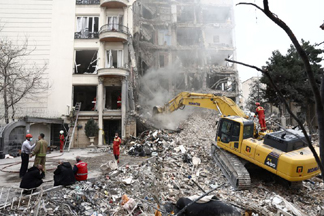

Israel is quite possibly the leading actor. Israeli’s military narrative runs dramatically differently from that of the US.
“Most analyses of the American defeat correctly attributed it to political and military failures in the US. American presidents were accused of entering the war without a political objective and reinforcing failure as the Vietnamese escalated the war. US Defense Secretary Robert McNamara, who otherwise reformed the Pentagon, was accused of using statistics to assess the war’s progress, like casualties inflicted and the weight of bombs dropped, without understanding the political objective.”

The world media is full of events that led to the attack on Iran by the US-Israeli alliance. The ensuing conflict has shaken the economies of all countries, except that of Russia. The story, however, begins much earlier — in April 1975, when the world was shocked by a photograph in the media that showed a US helicopter taking off from the roof of the US embassy in Saigon, evacuating the last Americans from South Vietnam, before Saigon fell to the North Vietnamese army, marking the end of the disastrous 20-year US war in Vietnam.
It was shocking because it marked the first defeat of the world’s superpower by a poor undeveloped Asian country. Not so shocking, because 20 years earlier, at a little-known town in Vietnam called Dien Bien Phu, the same North Vietnamese army had recorded the first defeat of a former European army, the French, by its South East Asian colony.
The media then lacked the power it wields today. People soon forgot about the event after ascribing the victory to the patience and tenacity of the charismatic Vietnamese leader, Ho Chi Minh.
Most analyses of the American defeat correctly attributed it to political and military failures in the US. American presidents were accused of entering the war without a political objective and reinforcing failure as the Vietnamese escalated the war. US Defense Secretary Robert McNamara, who otherwise reformed the Pentagon, was accused of using statistics to assess the war’s progress, like casualties inflicted and the weight of bombs dropped, without understanding the political objective.
The military was also accused of the same error, particularly by General William Westmoreland, commander of the US forces, during the Vietnam war. He presented an optimistic assessment of the air campaign by the same statistical methods, stating that more bombs were dropped on Vietnam than were dropped during the Second World War.
The US military, to give it its due, analyzed the causes of the defeat much more deeply. It was startled to realize that the North Vietnamese General who had defeated the French in 1954 at Dien Bein Phu and the General who took Saigon in 1975 was the same person — General Vo Nguyen Giap. A study of General Giap’s strategy revealed that he relied entirely on the writings of the Chinese strategist, Sun Tzu of the 5th century BC.
A significant conversation is alleged to have occurred between Westmoreland and Giap after the war. It went like this: Westmoreland said, “You know, General, that in every battle, we have defeated you.” Giap is alleged to have replied, “But how is that relevant?” Meaning thereby: what was the political outcome?
But Sun Tzu began to be deeply studied in US war colleges, second only to German strategist Carl von Clausewitz, revered by many other military colleges. His most famous quote is: “War is politics by other means.”
Coming to today’s Iran war, the other protagonist apart from the US is Israel and it is quite possibly the leading actor. Israeli’s military narrative runs dramatically differently from that of the US. Influenced overwhelmingly by its small population and geography, it regards none of the classical strategists canonically.
Instead, it is reliant on the war doctrine of David Ben-Gurion, primary founder and first Prime Minister of Israel, and, if at all, by American military strategist John Boyd, who said that victory goes to him who has the faster decision-making cycle. The Israelis took Boyd’s writing much farther, perhaps intended to mean: eliminate the political and military leadership to break the enemy’s decision-making cycle.
Israel’s own experiences in the wars of 1967, 1973 and the eventual fall of Syria’s Assad reinforced its conviction that its own politico-military strategy should be continued in any conflict with Iran. Perhaps one of the principal contributing causes to the, so far, successful Israeli strategy has been the spectacular achievements of Mossad, its external intelligence agency, in penetrating the techno-political military societies of West Asia.
It would appear from the conduct of the Israeli bombing campaign that Iran is perhaps a step ahead. Foreseeing the elimination of its leadership in Israeli attacks, Iran has put in place, under Mohammad Ali Jafari, a decentralized command structure that can prolong the war, but makes the termination of the war or the final negotiations problematic.
The other significant influence on early Israeli military figures like Moshe Dayan was the British strategist Liddel Hart. He made the seminal observation that it was difficult, if not impossible, to achieve a political victory against an autocratic or fundamentalist regime because the regime would not baulk at any level of destruction or casualties as long as the regime survived.
To get back to the success or failure of the US theory of war, Donald Trump enters the scene with two strong cases of when the American political class pulled political defeat out of military victory. The military reorganization after Vietnam created the spectacular US military success in the first Gulf war.
So spectacular that even the Chinese PLA took note and wrote the path-breaking Military Strategic Guidelines (MSG) of 1993, which dumped Mao’s People’s war doctrine in favor of an ‘informational Sed war under local conditions’.
However, in the second Gulf war, US political figures struck again. Then US Secretary of Defense Donald Rumsfeld emphasized a “light” military footprint after Iraq’s President Saddam Hussein was toppled in 2003. It conflicted with US diplomat Paul Bremer’s governance methods in Iraq — which involved the dissolution of the Iraqi army and de-Baathification, and devolved into disastrous state-building.
Similarly, George Bush figures strongly in the Afghan disaster, which after a brilliant military campaign devolved into a catastrophic Afghan state-building, in which countries have floundered in the past.
As in Vietnam, former US President Barack Obama faced the dilemma of ‘evacuating’ or ‘reinforcing’. He chose the latter, eventually leaving it to Joe Biden to pull out altogether, in defeat in 2021.
So, the American institutions come to the Iran war with a mixed record: A competent military, which pointed out to Trump the danger to the Strait of Hormuz, and a political class neutered with MAGA appointees by Trump. The outcome is, therefore, predictable.
(Raja Menon is a retired Rear Admiral of Indian Navy)



Be the first to comment