

How Energy Markets—Not the Battlefield—Could Decide a U.S.–Israel Confrontation with Iran

The most dangerous battlefield in a war between the United States, Israel, and Iran may not be in the Middle East at all.
It may be the global economy.
What began as a military confrontation is rapidly evolving into an economic war with worldwide consequences. While Iran is unlikely to defeat the United States or Israel in a conventional military conflict, it possesses a different and potentially more disruptive form of leverage: the ability to destabilize global energy markets.
Recent developments in March 2026 have brought this reality into sharp focus.
Following coordinated U.S.–Israel strikes on Iranian military and strategic targets, the conflict escalated dramatically with direct attacks on critical energy infrastructure, including Iran’s South Pars gas field—the largest in the world. These strikes triggered immediate disruptions in global energy markets, pushing oil prices sharply higher and injecting volatility into already fragile supply chains.
Iran’s response has extended far beyond Israel. By targeting energy infrastructure and signaling potential disruption to shipping routes across the Persian Gulf, Tehran has transformed the conflict into a broader regional economic confrontation.
The war is no longer just about territory or military capability. It is increasingly about control over energy flows, market stability, and global economic pressure.
The Strait of Hormuz: The World’s Energy Chokepoint
At the center of this strategy lies the Strait of Hormuz—the most critical energy chokepoint in the world.
Nearly one-fifth of global oil consumption and a significant portion of liquefied natural gas shipments pass through this narrow corridor. Roughly 20–22 million barrels of oil move through the strait each day, supplying major economies across Asia, including India, China, Japan, and South Korea.
Geographically, the strait is highly vulnerable. At its narrowest, it spans just 21 miles, with shipping lanes only about 2 miles wide in each direction. This creates a structural weakness: even limited disruption—through mines, missile strikes, drones, or damaged tankers—could severely restrict maritime traffic.
In such a scenario, the impact would not remain regional. It would ripple instantly across global markets.
From Military Conflict to Economic Warfare
The events of March 2026 suggest a clear strategic shift.
By targeting energy infrastructure—both directly and indirectly—the conflict has entered a new phase where economic disruption is no longer a secondary effect but a central objective.
Iran’s strategic calculus appears rooted in asymmetry. Unable to match U.S. or Israeli military power, it can instead impose costs by:
- Disrupting energy production
- Threatening critical shipping lanes
- Increasing geopolitical risk premiums
- Triggering volatility in global commodity markets
This approach transforms the battlefield from a physical domain into a systemic one.
Oil Shock and Global Consequences
The immediate market response underscores the stakes.
Energy prices have surged amid fears of supply disruption, with traders pricing in risks related to infrastructure damage and potential restrictions in the Strait of Hormuz. Even the perception of instability has proven sufficient to drive significant price movements.
A sustained disruption could lead to:
- Sharp increases in oil and gas prices
- Rising inflation across major economies
- Supply chain disruptions
- Financial market volatility
- Slower global growth or recessionary pressure
For energy-importing nations, particularly in Asia, including India, China, Japan, and South Korea, the consequences could be severe. For advanced economies already managing inflation and monetary tightening, an energy shock of this scale could destabilize recovery trajectories.
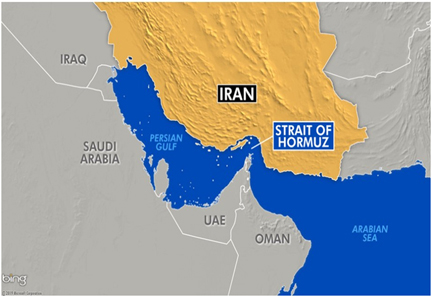
Strait of Hormuz
The Strait of Hormuz is a narrow waterway linking the Persian Gulf with the Gulf of Oman and the Arabian Sea. It is one of the world’s most strategically significant chokepoints for global oil and gas shipments, serving as a critical artery in international energy trade and maritime security.
Key facts
- Location: Between Iran and Oman (Musandam Peninsula)
- Width: Approximately 21 nautical miles (39 km) at its narrowest
- Depth: Averages 60 meters
- Major users: Oil exporters such as Saudi Arabia, Iraq, UAE, and Kuwait
- Transit volume: Roughly one-fifth of global petroleum passes through
“About 22 million barrels of oil per day—roughly one-quarter of global seaborne oil trade—passes through the Strait of Hormuz.”
———————————————————————————————-
Regional Escalation and Systemic Risk
What makes the current situation particularly dangerous is the widening scope of the conflict.
Strikes on energy infrastructure and threats to Gulf shipping routes indicate that the confrontation is no longer confined to bilateral hostilities. Instead, it is evolving into a broader regional crisis with global implications.
The risk is not merely of higher oil prices, but of systemic disruption:
- Multi-country involvement in energy infrastructure attacks
- Spillover into key maritime trade routes
- Increased military presence in critical shipping corridors
- Escalation cycles driven by retaliation and deterrence
In this environment, even limited incidents can produce outsized global effects.
A Wider Geopolitical Dimension
Another important dimension of the conflict involves intelligence and surveillance.
China’s tracking vessel Liaowang‑1 has reportedly been operating in international waters near Oman. Ships of this type can monitor radar emissions, aircraft activity, and missile launches across vast distances.
In modern warfare, information can be as valuable as weapons. Even without direct military involvement, outside powers can influence conflicts through intelligence, satellite imagery, and electronic surveillance.
Lessons From History
History shows how powerful energy disruptions can be. During the 1973 Oil Crisis, supply cuts from the Middle East caused oil prices to surge, triggering inflation and economic stagnation across many Western economies.
A major disruption today could have even faster consequences because the global economy is far more interconnected than it was in the 1970s.
Conclusion: Where War May Be Decided
Most wars are judged by territorial gains or military outcomes.
This one may be different.
The decisive arena may not be the battlefield, but the global energy system. The side that can most effectively influence oil flows, market stability, and economic pressure may ultimately shape the outcome.
The developments of March 2026 have made one thing clear: the risk is no longer hypothetical.
The conflict is already testing the resilience of global energy markets and exposing the vulnerability of an interconnected world economy.
If escalation continues, the consequences will not be confined to the Middle East. They will be felt in fuel prices, inflation rates, and economic growth across the globe.
In this war, the most powerful weapon may not be military force.
It may be disruption.
It would be interesting to make a guess about probable winners and losers, though of course, such assessments may not always prove correct even though they are based on an assessment of the existing situations .
The biggest loser in this war is America. It may end up with 1 trillion dollars being added to their already unsustainable deficit of 39 trillion dollars. If you break it down, it is $113,617 per citizen and $357,068 per taxpayer. Americans will face the unbearable pain of double-digit inflation, unemployment and affordability crisis even for basic food items for their families.
Bloomberg reports that Goldman Sachs projects if the war stretches on five or six more weeks it will lead to a 14% contraction of the GDP of Qatar and some of the other GCC countries. Thatwould have a domino effect on the global economy, adding that the only available impact comparison is the state of the global economy during the COVID-19 pandemic.
The biggest winner of this war will be Isael. Besides occupying West Bank and Gaza turned rubble by displacing 3.5 million Palestinians, in the current war Israel may end up occupying the entire south Lebanon by turning into rubble like Gaza and displacing 1.5 million Lebanese. Israel has invaded Lebanon six times in the past 50 years and has encroached its land with impunity from the civilized world. Israel will also be able to decimate Iran by turning its more than 40% territory into rubble with no industry and infrastructure and 5-8 million displaced residents.
Israel is famous since its bloody inception, “kill the leadership that wants to discuss peace and solution to the conflict over territory; prime example is Palestine than Iran, Syria and Lebanon. It is the Israelis that are never interested in any diplomatic solution for a simple reason; they have a vision for a Greater Isreal with a bigger territory than what they have now. They want to be the superpower of Middle East also having control on USA, Europe and India. They are the only country in the world that can bring a Superpower USA to fight their wars of expansion.
Another winner of this war economically is Russia with oil prices over $100 dollars and all those sanctions the Europeans and US put on countries to stop them from buying Russian oil are being discarded by USA itself that countries can buy Russian oil. Prominent among are India, Pakistan, South Korea, Japan etc. Europeans are in a moral quandary whether to restart buying oil from Russia because they are the one that decided not to buy Russian oil when Russia attacked Ukraine. At present they are supporting Ukraine in their war against Russia since 2022.
(Dave Makkar is a New Jersey based social activist and contributes regularly to The Indian Panorama. He can be reached at davemakkar@yahoo.com)
(with inputs from various sources)


Backbiome is a naturally crafted, research-backed daily supplement formulated to gently relieve back tension and soothe sciatic discomfort.