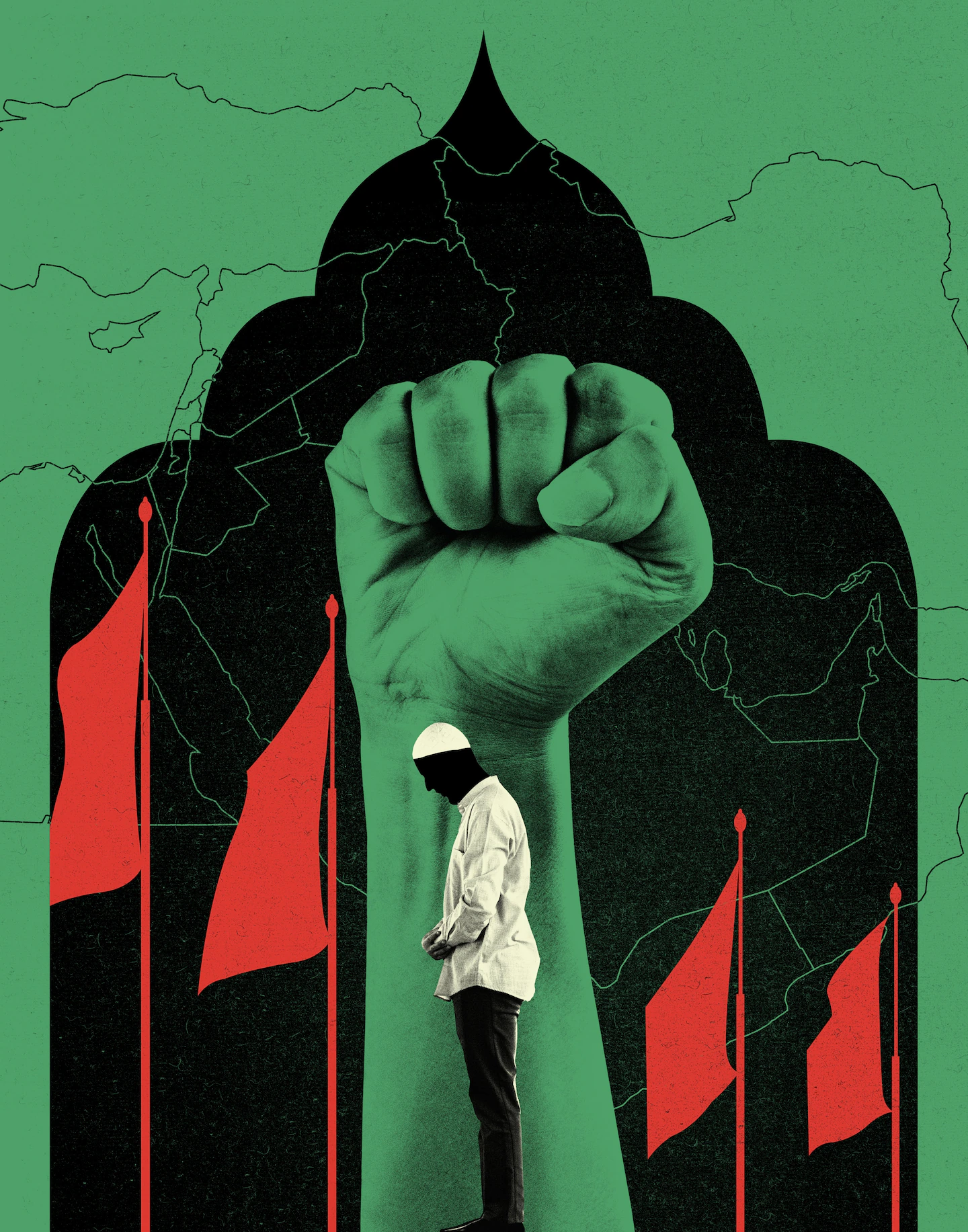
From Nasser to Khomeini, the region’s revolutionary ideologies have delivered only ruin
“The outgrowth of these dramatic events was an explosion of terrorism rooted in three different flavors of extremist Islamism: Iranian-sponsored groups such as Hezbollah in Lebanon; Brotherhood-rooted groups such as Hamas in Gaza, which also enjoyed Iranian support; and Salafi Saudi-backed groups like al-Qaeda, which ultimately turned on Riyadh. These trend lines were not distinct. While al-Qaeda and Hezbollah and Hamas prioritized different goals, their Islamist credos — both Sunni and Shiite — were similar: Down with the West and its local puppets, death to Israel and a return to the tenets of the Quran.”

Should the Islamic Republic of Iran collapse against the backdrop of the U.S.-Israel military campaign, it could mean much more than the demise of a single dictatorship. The regime’s fall could mark the exhaustion of Islamism as a political force — the latest in a line of Middle Eastern ideologies that overpromised and catastrophically underdelivered.
The Middle East has now tried nationalism, socialism and Islamism. All of them have failed, but Islamism, the last of the three to take hold, continues to block the path to stability and prosperity for the people of the region.
This tragic history has unfolded in three overlapping and interconnected waves. First was pan-Arab nationalism, which in the postcolonial era overthrew traditional monarchies in Egypt, Iraq and Libya. Egypt’s Gamal Abdel Nasser, the most important leader of the movement, articulated a vision that centralized power ostensibly in the pursuit of national dignity. But his pseudo-socialist, Soviet-style diktats — “ism” No. 2 — led inevitably to economic disaster. Baath Party regimes in Syria and Iraq embraced similar ideals and achieved similar results.
Still, Arab nationalism and socialism had a decades-long run, motivating masses and fueling wars in the 1960s and 1970s. The cynical embrace of the Palestinian cause offered a form of life support for these regimes, intended to distract attention from their other manifest failures. Ultimately, however, the ventilator gave out.
Inability to uphold lofty promises opened space for yet another “ism” — Islamism — to gain strength in the region. Iran’s Ayatollah Ruhollah Khomeini, al-Qaeda leader Osama bin Laden and Islamic State “caliph” Abu Bakr al-Baghdadi all promised utopias but delivered disappointment and worse.
The religious appeal of purist Islamism — a construct that rejects any divide between government, religion and culture — is powerful. In its idealized version, neither politics nor profit corrupt life under the dictates of the Quran. Nor does such a system tolerate the subjugation of Muslims under Christians or Jews.
The arrival of Islamism was long in the making. Hassan al-Banna, the founder of the Muslim Brotherhood, warned in the 1930s against what he called “blind imitation” of the ideologies that predated his recommended Islamism. Islam, he wrote, is the superior alternative and the “road to salvation from Western colonialism.”
But the violence that lies at its core also appeared early. Egypt outlawed the Brotherhood in 1948 after it launched a wave of terrorism directed at the monarchy and its constitutional system. Al-Banna, assassinated the following year, never saw his vision come to life.
Throughout the Arab socialist heyday, the Muslim Brotherhood and related Islamist movements — both Sunni and Shiite — grew in strength behind the scenes. In parallel, the Kingdom of Saudi Arabia invested heavily in the export of its own Wahhabi brand of Salafism, or originalist Sunni Islam.
The hinge point came in 1979. Egypt’s Anwar Sadat repudiated both Nasser’s Soviet alliance and the losing effort to rid the region of the state of Israel. Iranians overthrew their U.S.-aligned shah and embraced Khomeini’s Islamic Revolution. Soon after, the Soviet Union invaded Afghanistan.
The outgrowth of these dramatic events was an explosion of terrorism rooted in three different flavors of extremist Islamism: Iranian-sponsored groups such as Hezbollah in Lebanon; Brotherhood-rooted groups such as Hamas in Gaza, which also enjoyed Iranian support; and Salafi Saudi-backed groups like al-Qaeda, which ultimately turned on Riyadh. These trend lines were not distinct. While al-Qaeda and Hezbollah and Hamas prioritized different goals, their Islamist credos — both Sunni and Shiite — were similar: Down with the West and its local puppets, death to Israel and a return to the tenets of the Quran.
What has this radical Islamism delivered, whether to the Iranian people, the Palestinians or the Muslim Middle East? Just like the “isms” that preceded it, the short answer is nothing good.
Now another hinge point is here, and this one offers a liberalizing pathway that can respect Islam (and Judaism and Christianity) while delivering a better life to the hundreds of millions of people who live in the Middle East.
Such a movement would repudiate the ideologies, from pan-Arab nationalism to socialism to radical Islamism, that overpromised and underdelivered and instead tread the path of slow opening that is now seen in Saudi Arabia, the United Arab Emirates, and even Syria and Lebanon.
These nations have not rejected Islam; they have rejected the lies that socialism, pan-Arabism and Islamism peddled. They recognize the corrupting mix of Islamism and politics, and even more important, they have begun to acknowledge that the practice of religion can be an individual choice. Better still, they acknowledge that more open societies, the free market and religious faith need not be mutually exclusive but rather can coexist and deliver prosperity and stability.
As Islamist tyranny teeters in Iran today, the hope must be that the Iranian people can join ranks with their Arab neighbors, hammer home the nail in the coffin of the last of these 20th century isms and usher in a new era of tolerance and pluralism in the Middle East.
(Danielle Pletka is a senior fellow at the American Enterprise Institute.)

Be the first to comment