
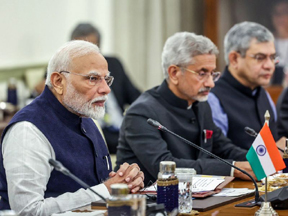

India has abandoned its posture in favor of US & Israel, but not joined the coalition. It has chosen the worst of both worlds
“India’s absence is manifest in other ways. Last week Donald Trump said he had asked “about seven” countries to join America in keeping the Straits of Hormuz open. He named five: China, South Korea, Japan, France, Britain. India was not on the list. This is all the more curious because India is proximate to Hormuz, has a strong navy, and is dependent on the Strait for a significant share of its hydrocarbons. More important, at the outbreak of the war, India had abandoned its customary balanced approach and made clear which side it was on. In his first call to the UAE, Modi condemned the Iranian retaliatory attack without mentioning Iran. Immediately thereafter he called Netanyahu and conveyed India’s “concerns,” urging an early cessation of hostilities. He not only sidestepped the fact that it was Israel and the US that had attacked Iran and killed its Supreme Leader, Ayatollah Khamenei — he did not offer even token condolences to Tehran.”

The changing patterns of the American-Israeli war against Iran are as bewildering as a kaleidoscope. On Monday morning, Trump pulled back from the brink — postponing threatened strikes on Iranian power plants for five days after what he described as “productive conversations” with Tehran. Whether this marks a genuine diplomatic opening or a tactical pause remains unclear.
What is clear is that India was not part of the back-channel diplomacy that produced it. Oman is reportedly mediating. Whether the US envoys remain Steve Witkoff and Jared Kushner is not clear. India — proximate, oil-dependent, a self-described balancer — remains on the sidelines.
Prime Minister Modi has been talking, recently again to Iran’s President Masoud Pezeshkian. He has also spoken to leaders of all the Gulf monarchies, and to Prime Minister Benjamin Netanyahu. The theme has been a standard condemnation of the attacks on the region, alarm at the destruction of critical infrastructure, and the need to keep international shipping lanes open. If you parse his remarks, they are so finely balanced that they end up saying nothing of note. India has become a spectator in a region where it had played the role of a balancer, with significant ties to all the major actors.
Most tellingly, Modi has still not spoken to the country that started the war and has the power to end it immediately — the United States of America.
India’s absence is manifest in other ways. Last week Donald Trump said he had asked “about seven” countries to join America in keeping the Straits of Hormuz open. He named five: China, South Korea, Japan, France, Britain. India was not on the list. This is all the more curious because India is proximate to Hormuz, has a strong navy, and is dependent on the Strait for a significant share of its hydrocarbons. More important, at the outbreak of the war, India had abandoned its customary balanced approach and made clear which side it was on. In his first call to the UAE, Modi condemned the Iranian retaliatory attack without mentioning Iran. Immediately thereafter he called Netanyahu and conveyed India’s “concerns,” urging an early cessation of hostilities. He not only sidestepped the fact that it was Israel and the US that had attacked Iran and killed its Supreme Leader, Ayatollah Khamenei — he did not offer even token condolences to Tehran.
In a structural sense, India is already part of the region’s US-led security architecture. It is a member of the 47-nation Combined Maritime Forces headquartered with the US Fifth Fleet in Bahrain, and two weeks before the Israeli-American attack on Iran, it assumed command of Combined Task Force 154, which deals with training. So, India is present in the region but not a participant — friendly to the US but not allied, warm but not quite trusted, occupying a geopolitical halfway house.
Just what role Trump envisaged for India is not easy to discern. He has referred to Modi as a “great friend,” a “great gentleman,” a “tough as hell leader.” Modi’s references are more modest, usually terming Trump a “dear friend.” But the two have not physically met for the past year — a situation attributed to the fallout over Operation Sindoor — and neither have they spoken since the war began in West Asia.
There was another curious development. Despite rising tensions and a visible military build-up in mid-February, Modi chose to visit Israel 48 hours before the war began. According to well-informed journalist Barak Ravid, the attack had originally been planned a week earlier, and it was important for the Israelis to signal that no imminent threat existed — so that Ayatollah Khamenei and others would feel safe and not take to their underground shelters. They had also kept up the ruse of the Geneva talks to sustain the impression that diplomacy was still the main path being pursued. Was the unwitting Modi also used as cover for Israeli war plans? Asaduddin Owaisi has alleged so; Israeli Foreign Minister Gideon Sa’ar has denied it. It would be useful to know what Modi knew, and when, and whether he had sought advice from the foreign ministry and the intelligence community on the visit’s timing.
Modi’s subsequent behavior has compounded the surprise. He extended no public condolences for the killing of Ayatollah Khamenei, and offered no condemnation of the Israeli-US attack on Iran — formally a friendly country and a fellow member of both BRICS and the SCO. India currently chairs BRICS.
While India did sign a formal condolence book at the Iranian embassy a week later, Modi had already taken a different track. In a 48-hour period between March 1 and 3, he spoke to leaders of eight West Asian countries — Israel, Jordan, the UAE, Saudi Arabia, Bahrain, Qatar, Kuwait and Oman — condemning the attacks on them without naming Iran, and calling for an early cessation of hostilities. The clearest indicator that New Delhi remains a bystander in a conflict wracking its neighborhood came on March 4, when the IRIS Derna was sunk while returning from a friendly visit to an Indian Navy Fleet Review at Visakhapatnam. There was no protest, let alone any expression of regret, from New Delhi.
Modi is ultimately the one who shapes Indian policy, and he may have decided that given the new balance of forces in the region and India’s national interests, it was prudent to cut Iran loose. But this could still have been done with some subtlety.
Through all of this, Modi did not speak to President Trump — and Trump did not call him, signaling a deeper dissonance. Trump’s framework is transactional and coalitional: you are useful or you are not. India’s simultaneous commitments to Iran (oil, Chabahar, BRICS), the Gulf states, Israel and the US make it valuable as a balancer in normal times. But Trump is not operating in normal times. He is assembling a wartime coalition, and a country that will not call him during a war he has started is not in it.
The tragedy is that India decisively abandoned its balanced posture in West Asia in favor of the US and Israel — but has still not joined the American coalition. In doing so, it has probably chosen the worst of both worlds.
(Manoj Joshi is a Distinguished Fellow, Observer Research Foundation, New Delhi)

Be the first to comment