


Even pre-independence India, with 450 million people and 12.6 million square miles, had around 600 princely states.
Modern New Jersey, with 9.3 million people and 8,722 square miles, has 564 princely fiefdoms — each with its own local monarch.
Call it home rule or over-rule, but New Jersey remains a bureaucratic circus running on taxpayers money.
At a Glance
New Jersey by Numbers (2025)
Population: ~9.26 million (2024 estimate)
Land Area: 8,722 sq. miles
Municipalities: 564
FY 2025 State Budget: ≈ $56.6 billion
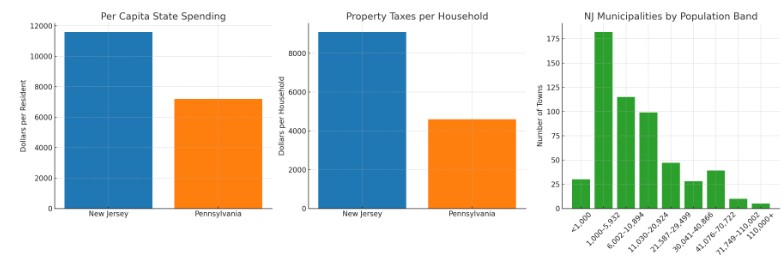
Average Property Tax (2024): Over $10,000 — highest in the U.S.
Licensed Attorneys: 39,311 (≈ 4.23 per 1,000 residents)
Dual-Office Holding: Banned for new officials since 2007 (loopholes remain)
A Tiny State with Too Many Governments
New Jersey is a small state — just 8,722 square miles, smaller than many American counties — yet it manages to support one of the most bureaucratically dense systems on Earth.
With 564 municipalities under 21counties, serving 9.3 million people, every town insists on having its own mayor, council, police department, court, and school district.
The beloved “home rule” system, once a symbol of grassroot democracy, has in practice become a monument to duplication, inefficiency and waste.
💬 New York City serves roughly the same population with one mayor, one police commissioner, and one school system. New Jersey does it with 564.
The result? Sky-high costs. Sky-high taxes. And bottom-shelf results.
A Budget That Outpaces Its Neighbors
For FY 2025, New Jersey enacted a $56.6 billion budget — larger than Pennsylvania’s, even though Pennsylvania has 43% more people and four times the land area.
Average Property Tax (2024): $10,000+
A Decade Ago: ~$7,200
Increase: Nearly 40% in ten years
We pay more, yet get less. Taxes in the Garden State have risen faster than almost anywhere in America.
Education: Spending More, Achieving Less
New Jersey ranks among the top spenders on public education — often over $20,000 per student, compared to the U.S. average of $14,000.
It has 695 Local Educational Agencies (LEAs) managing 2,506 public schools.
Despite this, outcomes remain uneven:
New Jersey ranks among the top spenders with over $20,000 per student, compared to the U.S. average of $14,000.
It maintains 695 Local Educational Agencies (LEAs) to manage 2,506 public schools — a bureaucratic forest of superintendents, consultants, and boards.
Despite this lavish spending, outcomes remain uneven and disappointing.
Many students graduate lacking basic literacy and numeracy.
Newark spent $26,280 per student (FY 2023); Camden, $25,449 (FY 2022) — yet academic gains remain negligible.
Our education system mirrors our governance — expensive, layered, and unaccountable.
Lawyers Everywhere, Justice Nowhere
According to the American Bar Association, New Jersey had 39,311 active lawyers in 2024 — about 4.23 per 1,000 residents. That rivals California’ 4.3, a state with four times our population.
For a state this small, the legal saturation is staggering. Litigation seeps into every corner of life — from zoning and education to local governance. We’ve built a culture where bureaucracy thrives on endless lawyering.
For a state this small, the legal saturation is staggering. Litigation seeps into every corner of civic life — from zoning to schools to town hall politics.
We’ve built a state where government thrives not on efficiency, but on endless lawyering and procedural paralysis.
The Double-Dipping Tradition That Refuses to Die
New Jersey outlawed dual-office holding in 2007 — but grandfathered in incumbents who already held multiple posts. The result?
The same old abuse continues under new legal cover.
Example: Nicholas Sacco, North Bergen power broker —
Mayor since 1991
State Senator since 1994
Township Commissioner since 1985
Assistant Superintendent of Schools on top of it all
Few states would allow this concentration of power. In New Jersey, it’s just another Tuesday.
In any other state, this would raise eyebrows and legal challenges.
In New Jersey, it raises pensions.
Why New Jersey Costs So Much
Let’s connect the dots:
564 municipalities
21 counties
Hundreds of overlapping school boards
39,000 lawyers
619,000 government employees
Property taxes exceeding $10,000 per household
Add it up, and you have America’s most expensive and over-governed state.
Let’s have a comparison between New Jersey and Pennsylvania.
Unlike Pennsylvania, where large areas remain unincorporated, every inch of New Jersey is incorporated. Every town has its own mini-bureaucracy — its police, public works, clerk’s office, attorney, and school board.
Some towns have fewer than 1,000 residents — yet still operate as full-fledged municipal governments.
The Township Patchwork
Here’s the municipal breakdown:
30 towns under 1,000 residents
182 towns with 1,000–6,000 residents
115 towns with 6,000–11,000
99 towns with 11,000–21,000
47 towns with 21,000–30,000
39 towns with 40,000–70,000
10 towns between 71,000–110,000
Top Five Cities: Newark, Jersey City, Paterson, Lakewood, Elizabeth
That’s 564 “mini-kingdoms,” each with its own royal court of mayors, clerks, attorneys, and chiefs — funded by the taxpayer.
The Home Rule Illusion
Supporters of “home rule” say it brings government closer to the people. In reality, it brings bureaucracy closer to your wallet.
Each town guards its turf and budget like a feudal estate. What we have is not participatory democracy, but a collection of fiefdoms for politicians and bureaucrats.
Every inch of New Jersey is incorporated. Every square mile is ruled by a mini-bureaucracy — with its own police, attorney, and clerk. Some towns have fewer than 1,000 residents yet operate like full-fledged governments.
This isn’t home rule. It’s job security for politicians and bureaucrats.
As I often say in Hindi:
“Netaji aur Sarkar Chalane Walon ke Liye Rozgar Yojana.”
(A government employment scheme for politicians and bureaucrats.)
Even pre-independence India, with 450 million people and 12.6 million square miles, had around 600 princely states.
Modern New Jersey, with 9.3 million people and 8,722 square miles, has 564 princely fiefdoms — each with its own local monarch.
Call it home rule or over-rule, but New Jersey remains a bureaucratic circus running on taxpayer money.
New Jersey vs. Pennsylvania: A Tale of Two States
Metric (2025) New Jersey Pennsylvania
Land Area 8,722 sq mi ~46,055 sq mi
Population 9.26 million 13.25 million
Municipalities 564 Far fewer
State Budget $56.6B ~$47.6B (General Fund)
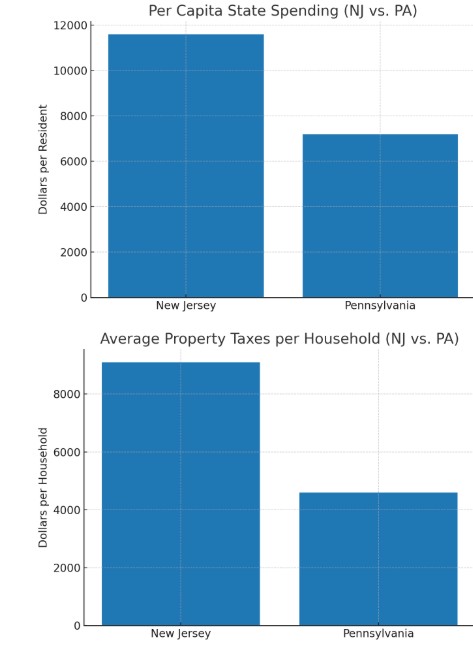
Avg. Property Tax ~$10,000 ~$4,600
Per Capita Spending ~$11,600 ~$7,200
Dual Office Holding Banned (with loopholes) Rare
Despite being one-fifth the size, New Jersey spends like an empire. Trenton operates a larger budget than its bigger neighbor while delivering no better services — just more layers of officials.
Counties Within Chaos
New Jersey’s 21 counties add yet another layer: each has its own commissioners, sheriff, clerk, and surrogate.
Salem County (population 56,874) — 15 municipalities in 338 sq miles.
Bergen County (population 978,641) — 70 municipalities in just 234 square miles!
That’s bureaucracy on steroids.
The Cost of Keeping 585 Governments Running
According to the Bureau of Labor Statistics (2024):
Government Employees (NJ Total): ~619,000
State Employees: ~152,500
Average Compensation: $63.94/hour (wages + benefits)
That’s roughly $76.7 billion in annual payroll — more than the entire state budget.
Add in 13,000+ elected and appointed officials, whose salaries and benefits push the total cost near $500 million annually.
Add 13,000+ elected and appointed officials, and taxpayers are on the hook for roughly $500 million annually in salaries and benefits just for the rulers.
No wonder residents feel like they’re paying for the privilege of being governed.
New Jerseyans aren’t citizens — they’re the paying customers of a political monopoly.
Democracy or Legalized Extortion?
What we have in New Jersey isn’t functional democracy — it’s a political protection racket.
Residents are treated as the ATM for a bloated, self-replicating system.
This isn’t democracy in action. It’s a legalized extortion — a political protection racket disguised as government.
Pennsylvania shows that larger, more complex states can spend less and deliver more. New Jersey proves that corruption and inefficiency are bipartisan traditions.
Trenton remains the heart of this cartel — where outdated laws protect political dynasties, and public money fuels private ambition. Until someone cuts through this structural fat, we’ll keep paying Cadillac taxes for Chevy-level governance.
……Chevy-level governance — by dishonest, unethical, and immoral politicians hiding behind century-old laws.
A State That Serves Itself
New Jersey is rich, urbanized, and strategically located. Yet, it’s governed by a system that exists to serve itself.
Let’s recap:
$56.6 billion State budget
$76.7 billion in government payroll
$500 million in elected & appointed payroll
564 municipalities
$10,000 average property tax
619,000 total government workers
39,000 lawyers
Rampant legalism and inefficiency
I’ve lived here since 1996 — long enough to conclude that the Garden State’s most reliable crop isn’t tomatoes — it’s bureaucrats and politicians.
Perhaps psychiatrists, not voters, can best explain why New Jerseyans keep tolerating it.
(This article was first published in The Indian Panorama on September 5, 2011, and updated for 2025 with new data and analysis.)
Sadly, political and bureaucratic corruption in New Jersey has only grown more refined — and more shameless.
Compiled and updated by:
Dave Makkar An inmate of the world’s most corrupt state since December 1996
(The author can be reached at davemakkar@yahoo.com / phone: 973-416-1600)



Be the first to comment