
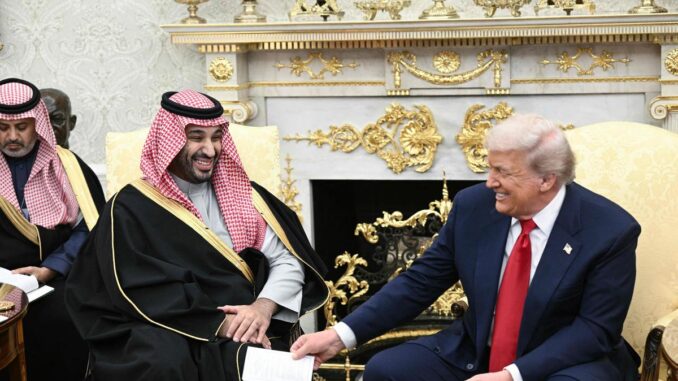

The exceptional amity heralds new domains of strategic cooperation, with the potential to anchor bilateral, regional and global developments in a more consequential manner

As adrenaline-high at the Saudi-American Summit last week demonstrated, the 80-year-old bilateral alliance remains perhaps the oldest transactional deal still going strong. It predates the establishment of post-Second World War global architectures such as the United Nations, the North Atlantic Treaty Organization (NATO) and the Bretton Woods Institutions. It was conceived as a secret “oil-for-security” strategic partnership signed on Valentine’s Day 1945 between U.S. President Franklin D. Roosevelt and King Abdul Aziz bin Abdul Rehman al-Saud on the USS Quincy in the Suez Canal Area. Originally intended to last 60 years, it was renewed in 2005.
Thanks to the exceptional amity between U.S. President Donald Trump and Saudi Crown Prince Mohammed bin Salman (MbS), this arrangement is currently being reset to the new domains of strategic cooperation, with the potential to anchor bilateral, regional and global developments in a more consequential manner.
The trajectory of ties
During the past 80 years, U.S.-Saudi ties have not always had smooth sailing. First, thanks to shale technology, the U.S. has become the world’s largest producer of crude and a significant exporter. While this has reduced the commercial content of the relationship, the U.S.’s exports have remained steady, leading to a decline in the bilateral merchandise trade and a balance swinging in America’s favor. As Saudi Arabia’s trading partner, the U.S. now ranks below China and India.
Historically, the ties came under strain during the Ramadan War of 1973, when Saudi Arabia joined an Arab oil embargo. In the mid-1980s, the Saudis surprised the Americans by buying intermediate-range ballistic missiles from China, a country they did not even recognize then. There have been tensions as the American military supplies were staunched during the Yemen war, affecting Saudi offensive and defensive capabilities against the Houthis.
The assassination of Jamal Khashoggi, a prominent Saudi commentator working with The Washington Post, in the Saudi consulate in Istanbul in October 2018 jolted ties, and the Biden presidency initially decided to keep MbS at arm’s-length. The friction pushed the Saudis into diversifying their ties with China and Russia.
In December 2022, China’s President Xi Jinping visited Riyadh and held three separate summits with the leaders of Saudi Arabia, Arab and Muslim countries, respectively. Later, Beijing also facilitated the resumption of diplomatic ties between Saudi Arabia and Iran. Since late 2023, the U.S. support for Israel’s brutal military campaign in Gaza has also made it difficult for Riyadh to turn a new page in bilateral ties.
The Saudis have resisted U.S. pressure to formally recognize Israel, pre-conditioning it on the creation of a pathway to Palestinian statehood, which Israel has ruled out.
New contours under the Trump presidency
There has been a positive sea change in bilateral ties since Mr. Trump took over the U.S. presidency this year. His first visit of his second term abroad was to Saudi Arabia in May 2025, where an agreement to supply $142 billion worth of military equipment was secured. The new contours of this new relationship were in evidence at the no-holds-barred state visit. It included a moving guard of honor, a fly-past, a private lunch and a 300-guest banquet, both hosted by Mr. Trump, who also attended the investment forum at which deals worth $270 billion were signed.
On his part, MbS readily agreed to raise the promised Saudi investments in the U.S. economy from $600 billion to $1 trillion without a fixed time frame. The amount is nearly as big as the country’s GDP and the entire corpus of the Kingdom’s Public Investment Fund (PIF), which already has 40% of its foreign investments in the U.S. economy. The groundbreaking Strategic Defense Agreement was signed, formally designating Saudi Arabia as a “major non-NATO ally” and committing the U.S. to actively assist Saudi Arabia if it came under an attack.
The two sides also made tangible progress towards collaboration in civil nuclear energy and the supply of state-of-the-art Artificial Intelligence (AI) chips. Given the Trumpian propensity for “truthful hyperbole” and Saudi economic stringency, observers are skeptical about all key promises made during the visit being fully realized.
Moreover, the bilateral differences on basic issues such as the global oil glut, Riyadh-Tel Aviv reconciliation, Iran, and the Kingdom’s drive towards strategic autonomy were papered over during the Summit, which was conspicuous by the absence of any final communiqué. The visit can, nevertheless, be considered as a qualified bilateral success, particularly as it managed to bury the past ghost issues.
The robust revival of the U.S.-Saudi ties in Trump 2.0 is bound to have a regional impact. Under MbS, Saudi Arabia, the Arab world’s largest economy, has abandoned its low-key diplomatic profile, adopting a more assertive and visible pursuit of national interests. This process has accelerated after the two-year-long Israeli military campaign that has subdued Iran, the Kingdom’s long-standing rival in the region and the Islamic world.
MbS has already persuaded Mr. Trump to drop sanctions against Syria’s new regime and has asked for stronger American intervention to end the Sudanese civil war. Even the Iranian President has sought the MbS facilitation of the resumption of nuclear talks with Washington. The robust endorsement by the White House during the recent visit would further empower MbS, who at 40 years could be around for decades, making him an indispensable, long-term U.S. interlocutor as the region’s geopolitical architecture gets reconfigured.
While the visit was silent on global issues, there are signs of subterranean bilateral coordination. Although oil has largely disappeared as the driver for bilateral economic synergy, the Saudi economy continues to be highly dependent on oil export revenues. Moreover, as recent U.S. sanctions against the two Russian oil majors demonstrated, Washington intends to continue its dominance of the global oil market. Both Saudis and Americans want the oil price to be at a moderate, sustainable level. The concerted American actions on sanctions against Iran, Venezuela and two Russian oil majors can only help stem the emerging supply-side oil glut, shore up the price and create market space for higher exports by both Saudi Arabia and the U.S. For the U.S., reinforced ties with Saudi Arabia would also stave off the recent encroachments by China and Russia on its turf, and complement its regional Pax Americana.
Impact on India
The Washington Summit does have several implications for India. First, it may provide advanced U.S. military equipment access to Pakistan, with which Riyadh concluded a strategic mutual defense agreement in September 2025, apparently with the U.S. nod-and-wink.
Second, although India, as the world’s third-largest oil importer, would prefer oil prices to be low, moderation and stability in the oil market may still be preferable as it navigates for alternative sources to Russian supplies.
Third, soaring Saudi ambitions for its post-oil Vision-2030, such as AI data centers, may create economic opportunities for India.
Fourth, curbing China’s foray into Saudi Arabia may open the door wider for India. India also needs to prioritize entering into a Comprehensive Economic Partnership Agreement with Saudi Arabia.
Lastly, the emerging modus vivendi with Israel may also facilitate the work on the India-Middle East-Europe Economic Corridor, which transits through Saudi Arabia. At a different level, White House’s differential treatment of MbS shows that its single-minded pursuit of economic transactions continues to trump all previous qualms, such as human rights and proliferation concerns, may light India’s pathway to an economic peace with the Americans.
The evident MbS-Trump bonhomie during the White House Summit signals the U.S. reclaiming primacy in Riyadh. The locus of the relationship has, nevertheless, shifted from the past “oil-for-security” paradigm. As the new, more nebulous drivers congeal and Saudi Arabia asserts its sovereign autonomy, the alliance enters an uncharted territory. While much may remain unaltered, it would, nevertheless, be fascinating to watch its progression.
(Mahesh Sachdev is a retired Indian Ambassador, specializing in the Arab world and oil issues)


Be the first to comment