
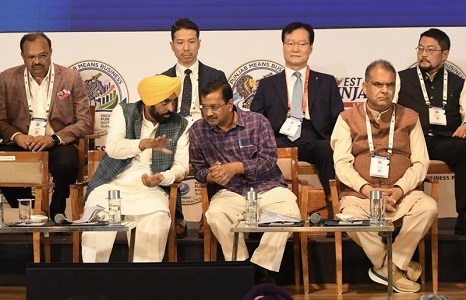

“The problem is that Punjab is broke. An investment summit in Mohali this weekend may have come a bit late in the day, even if it’s to make good-natured promises. Unfortunately, AAP has not called upon the experiences of Punjab’s hugely successful entrepreneurial class elsewhere in the country or abroad — remember, Canada’s 4-crore population can become Punjab’s 24th district — to reinvent itself. The previous Congress government’s Punjab Innovation Mission had some good ideas. Unfortunately, it’s a cipher of its former self, because Bhagwant Mann’s bureaucracy is so busy reinventing the wheel that there’s no time to ponder over the ideas that came in the previous cycle.”

The Modi government’s foreign policy failures resonated in the Punjab Assembly earlier this week, with MLAs cutting across party lines passing a resolution against the Indo-US trade deal. This is certainly a first. It’s certainly not the business of legislatures to pontificate on foreign policy, leave alone pass resolutions. But so much bitterness is these days defining the business of politics, that not even the spectacular Le Corbusier-designed building that is the Punjab Assembly was able to insulate itself from the noise of the street.
No wonder the state is bracing itself for a huge rally by Home Minister Amit Shah today in Punjab. The BJP is blowing the bugle, make no mistake, announcing its ambition to stake a claim in the politics of this hugely important border state. Less than a year from now there will be a new government and the BJP is asking itself — and Punjab — why it cannot do the unthinkable, which is to paint Punjab kesariya, saffron, the color of sacrifice, both intimate and familiar, especially to Sikhs.
So far, though, the party has been a bit at sixes and sevens. Even if Amit Shah takes a leaf out of Lenin’s book, who famously said he found power lying on the streets of St. Petersburg, picked it up and that’s why he mounted the Revolution, the BJP, at least for the moment, is discovering that the people of the Land of Five Rivers — or three, today — are a slightly different kettle of fish.
It’s not that Punjab is in the pink of health — quite the opposite. The drug crisis is dragging down the state into a vortex, from which there’s no seeming return — read my colleague, Aparna Banerji’s depressing stories about the third drug death in a fortnight, of a 19-year-old boy from Mehatpur, in the Doaba region. Everyday stories of foreign-based gangsters gunning down rivals in Punjab’s broad light of day are rife. The ruling AAP has thrown caution to the winds by announcing impossible spends in a Budget that promises a little of everything to everyone — including Rs 1,000 a month policy benefit for women (Rs 1,500 for women belonging to Scheduled Castes, a third of the 3-crore population), which is being seen as a Brahmastra. Only, the problem is no one knows where the money’s coming from. Punjab’s debt is an astounding Rs 4.17 lakh crore, interest payments alone totaling Rs 1.16 lakh crore, its state GDP the second lowest in the country after Arunachal Pradesh.
Cunningly, the women-only card is straight out of PM Modi’s quiver — AAP’s national convenor Arvind Kejriwal has learnt well.
The problem is that Punjab is broke. An investment summit in Mohali this weekend may have come a bit late in the day, even if it’s to make good-natured promises. Unfortunately, AAP has not called upon the experiences of Punjab’s hugely successful entrepreneurial class elsewhere in the country or abroad — remember, Canada’s 4-crore population can become Punjab’s 24th district — to reinvent itself. The previous Congress government’s Punjab Innovation Mission had some good ideas. Unfortunately, it’s a cipher of its former self, because Bhagwant Mann’s bureaucracy is so busy reinventing the wheel that there’s no time to ponder over the ideas that came in the previous cycle.
And then there’s Bhagwant Mann. The chief minister has been rightfully castigated for his loose comments on women in a speech in Ludhiana some days ago; he was supposedly remembering the escapades of his callow youth, but really, there have to be less colorful ways. (As for the Congress party’s Sukhpal Khaira, his outrageous comments linking “dancing women” with the benefits of AAP’s Rs 1,000 payout should encourage the party to immediately banish him to Kalapani, where he should repent deeply and seek forgiveness — well, he definitely should beware the rage of Punjab’s women.)
As for dancing women, all of Punjab’s men, including Khaira, should know that these “naachnewaalis” are doing an honest day’s work, and not dependent on anyone for handouts or freebies. As for who’s dancing on which master puppeteer’s tune — well, the jury is out and the people will decide, not just in Punjab next year, but in West Bengal, Assam and Kerala this year.
But back to Bhagwant Mann. His occasional visits to the hospital to check his hemoglobin provoke a huge yawn — Punjab’s hemoglobin levels have been high for a while. The promise to make the state corruption-free shimmers in the unseasonal heat, an echo from another “na khaoonga, na khaane doonga” era. As for the influence from Delhi — Punjab is a worthwhile prize, has never liked to submit to the Dilli Durbar, which is why the return journey, across the political class, is in such high demand.
Arvind Kejriwal and Manish Sisodia and AAP’s Delhi politicians understand that basic truth. Punjab is not a consolation for the loss of Delhi or the pivot to relaunch the party across the rest of the country. The state’s significant sense of self has been scarred by Partition, damaged by terrorism and depleted by the continuing lack of investment into itself, both political and economic. If AAP wants to win Punjab again, it has to do much more than just tokenism — and that includes the Rs 1,000-a-month benefit for women.
AAP — like the BJP elsewhere in the country, where largesse for women has been doled out in amounts that could help wipe out Punjab’s debt, in the attempt to create a “women constituency” that will supersede caste — must remember that women are not beneficiaries, or recipients of handouts or “wombs” from which “brave men are born” — some of those phrases that resonated in the Punjab Assembly earlier this week were not just jarring, they were revealing of a deeply patriarchal mindset that doesn’t even realize it is patriarchal.
Punjab is special because it isn’t interested in tokenism. To rephrase John F Kennedy, as the state goes to the polls in a few months, ask not what Punjab can do for you, but what you can do for Punjab. That’s also why Amit Shah’s rally will be keenly watched today.
Montek Singh Ahluwalia, former Finance Secretary and right-hand man to former PM Manmohan Singh in the early 1990s — two Punjabis who led the economic reforms in the country and changed the course of the nation — sent me this phrase, quoting a ballad by Bhai Gurdas, much admired by Guru Arjan Dev himself. “Satguru Nanak pargatya/miti dhund/jag chaanan hoya.” Guru Nanak manifested himself, the fog of ignorance lifted and the world was bathed in light!
If Punjab has to be bathed in light again, the way forward is clear.
(Jyoti Malhotra is Editor in Chief of The Tribune Group)


Be the first to comment