Tag: P.V. Narasimha Rao.

  • From 1947 Poverty to 2014 Prosperity, and the Myths of Sudden Greatness

    By 2014, before the Modi government came to power, India’s GDP had reached nearly $2 trillion, the 10th largest in the world, with foreign reserves of $300 billion. Telecom penetration had exploded, highways expanded, and privatized airports transformed city skylines. A once destitute land now stood as a rising economic power.

    “To claim that India was stagnant for seventy years before 2014 is to rewrite history. The Green Revolution, the IT revolution, liberalization, space exploration, and nuclear power were achievements of earlier eras. Poverty reduction, literacy gains, and rising life expectancy were the result of decades of collective effort.”

    “The myths of sudden greatness may serve short-term politics, but the truth is more powerful: India’s destiny has been shaped not by one decade or one leader, but by the collective endurance of its people.”

    By Prof. Indrajit S Saluja
    By Prof. Indrajit S Saluja

    In May 2014, the Bharatiya Janata Party (BJP) under Narendra Modi stormed to power on the promise of a “New India.” The campaign narrative was dramatic: the nation had supposedly wasted seventy years under Congress and other governments in corruption, drift, and poverty, and only under Modi would India rise to greatness. For millions of frustrated voters, weary of scams and inflation, that story was compelling. But it was also misleading. To accept it uncritically is to erase the extraordinary journey that India has traveled since 1947.

    India’s rise is not the miracle of one leader or one party. It is the long, uneven, but unmistakable climb of a nation that began life among the world’s poorest states and, through seven decades of collective struggle, emerged as a major global player.

    1947: Freedom in Ruins

    When the Union Jack came down on August 15, 1947, India was free but fractured. Partition had displaced nearly 14 million people and killed over a million in horrific communal violence. Refugees poured into makeshift camps; trains carrying corpses crossed the new borders.

    The economic picture was equally bleak. Per capita income was about ₹250 a year (roughly $50). Life expectancy was 35 years. Literacy stood below 20%. Agriculture was primitive and unable to feed the population. Famines had claimed millions of lives, most recently in Bengal in 1943.

    Infrastructure, too, was skeletal. Fewer than 1,500 villages had electricity. India inherited 53,000 kilometers of railways, but they had been designed for extraction, not integration. Industry contributed barely 10% of GDP. Globally, India’s share of output had collapsed from 23% in the 18th century to around 3% at independence.

    The world doubted India’s survival. Winston Churchill predicted disintegration, and American journalists dismissed it as a “basket case.” The challenge of building a secular, democratic, and united country out of such poverty and diversity seemed nearly impossible.

    Laying the Foundations

    Jawaharlal Nehru and the Constituent Assembly chose democracy over dictatorship and pluralism over sectarianism. The Constitution of 1950 was one of the most ambitious in the world, guaranteeing universal suffrage, federalism, and fundamental rights.

    In the 1950s and 60s, India invested heavily in institutions: the Election Commission, the Supreme Court, the Planning Commission, and the Indian Administrative Service. Nehru’s vision emphasized science and industry: steel plants at Bhilai, Rourkela, and Durgapur; the Bhakra Nangal Dam; IITs, AIIMS, and national laboratories.

    Growth was slow — the infamous “Hindu rate” of around 3%. Licensing and bureaucratic controls bred inefficiency. Food shortages were chronic, forcing dependence on American PL-480 wheat imports. Yet, India survived as a democracy, while many post-colonial states slid into coups and dictatorships. That survival alone was no small achievement.

    Green Revolution and Wars

    The 1960s and 70s tested India repeatedly. The humiliating defeat to China in 1962 exposed military weakness, but wars with Pakistan in 1965 and 1971 showcased determination. The 1971 victory reshaped South Asia, leading to the creation of Bangladesh.

    At home, the Green Revolution transformed agriculture. With high-yield seeds, irrigation, and fertilizer, wheat production surged, ending chronic shortages. By the 1980s, India was largely self-sufficient in food.

    There were darker chapters too. The Emergency (1975–77) suspended democratic rights and censored the press. But India’s voters proved resilient, ousting Indira Gandhi in 1977 and restoring democracy. Few developing nations bounced back from authoritarianism so quickly.

    1991: Liberalization and Takeoff

    By the late 1980s, India was again in economic distress. Growth lagged, deficits ballooned, and a foreign exchange crisis loomed. In 1991, Prime Minister P. V. Narasimha Rao and Finance Minister Manmohan Singh launched sweeping reforms: dismantling licenses, cutting tariffs, and opening markets.

    This liberalization was a turning point. Growth accelerated to 6–8% annually over the next two decades. The IT services revolution, led by Infosys, TCS, and Wipro, turned Bangalore into a global hub. Foreign investment surged, exports expanded, and a confident middle class of 300 million emerged.

    The transformation was visible in human development. Literacy rose from 12% in 1947 to 74% by 2011. Life expectancy doubled. Poverty, once above 70%, fell to around 22%. Diseases like polio were eradicated. India joined the club of spacefaring nations and, in 2013, placed a probe into orbit around Mars on its first attempt, stunning the world with cost efficiency.

    India on the World Stage

    India’s diplomacy evolved with its growth. A leader of the Non-Aligned Movement during the Cold War, it later became a member of G20, BRICS, and a sought-after strategic partner. Nuclear tests in 1998 established India as a de facto nuclear power, and the 2008 Indo-U.S. Civil Nuclear Agreement recognized its status.

    By 2014, before the Modi government came to power, India’s GDP had reached nearly $2 trillion, the 10th largest in the world, with foreign reserves of $300 billion. Telecom penetration had exploded, highways expanded, and privatized airports transformed city skylines. A once destitute land now stood as a rising economic power.

    India’s Historic Journey: Key Milestones

    2014 and Beyond: Continuity, Not Creation

    This was the India the BJP inherited in 2014 — dynamic but troubled, with corruption scandals and slowing growth under the UPA years. Modi’s government accelerated infrastructure building, digitization, and foreign policy assertiveness. Schemes like Ayushman Bharat (health insurance) and Ujjwala Yojana (LPG connections) reached millions. ISRO achieved new milestones with Chandrayaan-3 and Aditya-L1.

    But the record is mixed. Demonetization in 2016 disrupted livelihoods without eliminating black money. The GST rollout was chaotic. The pandemic exposed fragile health systems. Youth unemployment has remained stubborn, and inequality has widened.

    Politically, India has faced growing concerns about democratic backsliding — shrinking press freedom, partisan use of investigative agencies, and majoritarian rhetoric. International indices like Freedom House and V-Dem have downgraded India’s democratic rankings.

    Myths and Realities

    To claim that India was stagnant for seventy years before 2014 is to rewrite history. The Green Revolution, the IT revolution, liberalization, space exploration, and nuclear power were achievements of earlier eras. Poverty reduction, literacy gains, and rising life expectancy were the result of decades of collective effort.

    The BJP has added its imprint, but it did not create prosperity out of a vacuum. It stands on foundations built by generations of Indians — farmers, scientists, entrepreneurs, teachers, and ordinary citizens — who struggled through scarcity to build capacity.

    The Road Ahead

    India today is the world’s fourth largest economy, with unmatched potential. But challenges remain: ensuring equitable growth, strengthening education and health, protecting democratic pluralism, and addressing inequality. Propaganda cannot substitute for policy, nor can political myth-making erase the sacrifices of earlier decades.

    The real story of India’s rise is not a Modi miracle, nor a Nehru legacy alone. It is the cumulative triumph of a people who refused to accept despair. From the shattered land of 1947 to the confident republic of today, India’s journey has been long, uneven, and unfinished.

    The myths of sudden greatness may serve short-term politics, but the truth is more powerful: India’s destiny has been shaped not by one decade or one leader, but by the collective endurance of its people.

    (The author welcomes comments)

  • A Tribute to Dr. Manmohan Singh: A Visionary Economist and Statesman

    A Tribute to Dr. Manmohan Singh: A Visionary Economist and Statesman

    The passing away of Dr. Manmohan Singh, India’s former Prime Minister,  marks the end of an era in Indian politics and economic thought. Known for his quiet demeanor, profound intellect, and relentless commitment to public service, Dr. Singh leaves behind an indelible legacy that will continue to shape India and inspire the world for generations to come. This tribute seeks to capture the essence of his life, his achievements, and his contributions to both national and international spheres.

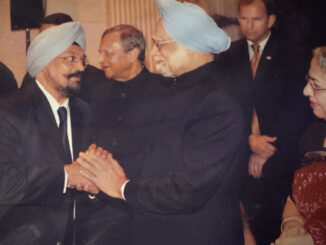
    To me, it is a personal loss. I had the opportunity to know and meet him, and interact with him. I studied his economic thought, and it is there for the world to see how transformative were his economic ideas. He was the man who built a solid economic structure of India. The simple  and unostentatious man will be remembered as a builder of a colossal India.

    I am tempted to trace the life of this gem of a person for the younger generation  of Indians, particularly, the ones here in America, who have been fed for too long with all kinds of lies about this great man. It will be worthwhile to know him.

    Dr. Singh’s early life and education 

    Dr. Manmohan Singh was born on September 26, 1932  in Gah, a small village in the Punjab region of British India (now in Pakistan). His early years were marked by the tumultuous partition of India in 1947, during which his family migrated to India. Despite the hardships, Dr. Singh’s academic brilliance shone brightly.

    He pursued his undergraduate degree in Economics from Panjab University and went on to earn a master’s degree from the same institution. His quest for knowledge took him to the University of Cambridge, where he completed another degree in Economics. Dr. Singh then pursued his DPhil in Economics from the University of Oxford, specifically Nuffield College, writing his doctoral thesis on “India’s Export Trends and Prospects for Self-Sustained Growth.”

    Professional Career and Early Contributions

    Dr. Singh began his illustrious career in academia as a professor of Economics at Panjab University and later at the prestigious Delhi School of Economics. However, his transition to policymaking and governance marked a turning point in his journey. In 1971, he was appointed as an Economic Advisor in the Ministry of Commerce and Industry, followed by a series of prominent roles:

    Chief Economic Advisor (1972-1976): Dr. Singh’s insights played a key role in shaping India’s economic policies during a challenging period.

    Governor of the Reserve Bank of India (1982-1985): His tenure as RBI Governor was marked by efforts to stabilize India’s financial system.

    Deputy Chairman of the Planning Commission (1985-1987): Dr. Singh contributed significantly to the nation’s long-term economic planning.

    Architect of Economic Reforms

    Dr. Singh’s most defining role came in 1991 when he was appointed as India’s Finance Minister in the government led by Prime Minister P.V. Narasimha Rao. India was facing a severe economic crisis, with depleting foreign exchange reserves and soaring inflation. Against this backdrop, Dr. Singh unveiled a series of groundbreaking economic reforms, including:

    Liberalization: Opening up India’s economy to global markets by reducing import tariffs and encouraging foreign investment.

    Privatization: Reducing government control over key industries.

    Globalization: Integrating India’s economy with the global market.

    His visionary approach transformed India into one of the fastest-growing economies in the world. His iconic statement during the 1991 budget speech, “No power on Earth can stop an idea whose time has come,” became emblematic of India’s newfound confidence.

    Tenure as Prime Minister

    Dr. Manmohan Singh served as the 13th Prime Minister of India from 2004 to 2014, heading the United Progressive Alliance (UPA) government. As Prime Minister, his tenure was marked by remarkable achievements:

    Economic Growth

    Under his leadership, India achieved unprecedented economic growth rates, often exceeding 8% annually. Key initiatives included:

    National Rural Employment Guarantee Act (NREGA): Providing a safety net for rural households.

    Right to Information Act: Promoting transparency and accountability in governance.

    Accelerated Infrastructure Development: Expanding roads, ports, and power projects to sustain economic growth.

    Nuclear Deal with the United States

    Dr. Singh’s efforts to secure the historic India-U.S. Civil Nuclear Agreement in 2008 underscored his diplomatic acumen. This agreement not only ended India’s nuclear isolation but also paved the way for strategic partnerships in science, technology, and defense.

    Social Welfare

    Dr. Singh’s administration introduced landmark programs in education and healthcare, such as the National Health Mission and the Right to Education Act, aiming to uplift millions from poverty and illiteracy.

    Contributions to International Relations

    Dr. Singh’s tenure saw India emerge as a key player on the global stage. He was instrumental in forging strong ties with major powers, including the United States, Russia, China, and Japan. His advocacy for South-South cooperation and his emphasis on combating climate change earned him international acclaim.

    Under his leadership, India gained greater prominence in multilateral forums such as the G20, BRICS, and the United Nations. Dr. Singh’s measured and thoughtful diplomacy earned him respect among world leaders, many of whom sought his counsel on global economic and geopolitical issues.

    Personality and Legacy

    Dr. Manmohan Singh was a leader of few words but immense wisdom. Known for his integrity, humility, and steadfast dedication to the nation, he inspired admiration across party lines. Despite facing criticism during his second term as Prime Minister, particularly regarding corruption scandals, his personal reputation remained untarnished.

    His ability to navigate complex economic challenges, coupled with his unwavering commitment to the welfare of India’s citizens, cemented his status as a statesman of rare caliber. His academic rigor and pragmatic approach to policymaking set him apart as a leader who prioritized the nation’s interests above all else.

    Tributes from World Leaders

    Dr. Singh’s demise has elicited heartfelt tributes from leaders worldwide:

    Joe Biden, President of the United States: “Dr. Manmohan Singh’s vision and leadership were pivotal in strengthening U.S.-India relations. His wisdom and kindness will be deeply missed.”

    Narendra Modi, Prime Minister of India: “India has lost a great leader and scholar. Dr. Singh’s contributions to our nation’s development will always be remembered.”

    Rishi Sunak, former Prime Minister of the United Kingdom: “Dr. Manmohan Singh’s economic reforms and global vision elevated India on the world stage. His legacy is one of hope and progress.”

    Christine Lagarde, President of the European Central Bank: “Dr. Singh was a towering figure in global economics. His insights and humility left an indelible mark on international policymaking.”

    Dr. Manmohan Singh’s life was a testament to the power of knowledge, integrity, and perseverance. From his humble beginnings to becoming one of the most respected leaders in the world, he exemplified the values of hard work and selfless service.

    As India mourns the loss of one of its greatest leaders, the world remembers Dr. Singh as a visionary economist, a transformative Prime Minister, and a statesman who believed in building bridges rather than walls. His legacy will continue to guide India and inspire future generations to dream big and act with courage.

    Rest in peace, Dr. Manmohan Singh—a true architect of modern India.