Tag: Paul Ryan

  • Paul Ryan slams Trump in speech about future of Republican Party

    Paul Ryan slams Trump in speech about future of Republican Party

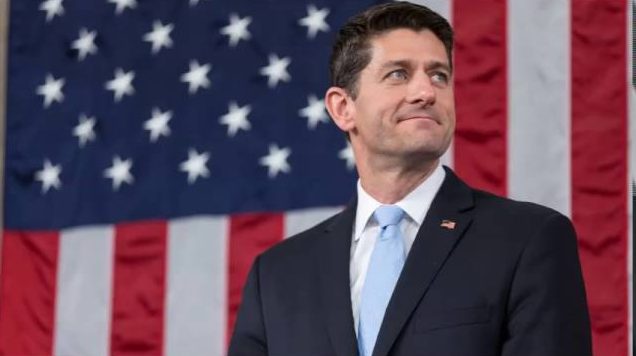
    LOS ANGELES(TIP): Paul Ryan, a former speaker of the House, sounded a pointed warning to the GOP in a speech about its future, arguing that voters will have little patience for a party built on fealty to former President Trump. He told conservatives gathered at the Reagan Library, in Simi Valley California, Thursday, May 27 night that they were at a crossroads.

    “If the conservative cause depends on the populist appeal of one personality, or on second-rate imitations, then we’re not going anywhere. Voters looking for Republican leaders want to see independence and mettle,” he said.And leaving no doubt about who he was talking about, though he did not name Mr. Trump, Ryan continued, “They will not be impressed by the sight of yes-men and flatterers flocking to Mar-a-Lago.”

    Among the Republican politicians who have spent time with Mr. Trump at his Florida resort and publicly stood by him is House Minority Leader Kevin McCarthy, who succeeded Ryan as the top House Republican when Ryan retired from the House in 2018.

    Ryan, who had his disagreements with Mr. Trump, also expressed deep dismay at the way his presidency concluded. “It was horrifying to see a presidency come to such a dishonorable and disgraceful end,” he said.

    But he did mention the former president by name in praising economic growth that took place during his presidency, prior to the pandemic and said, “To his credit, Donald Trump brought many new voters into our party.”


  • Trump attacks Republican leaders over debt ceiling ‘mess’

    Trump attacks Republican leaders over debt ceiling ‘mess’

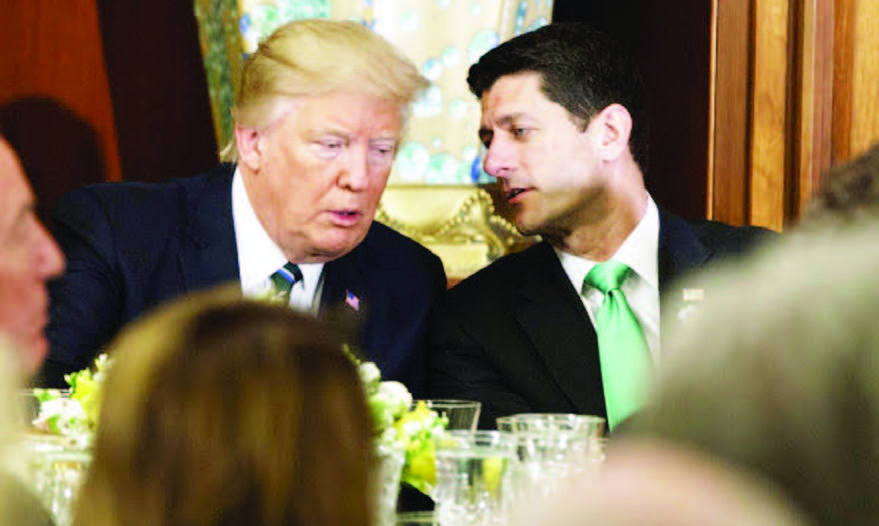
    WASHINGTON (TIP): Fanning the flames of GOP discord, President Donald Trump accused Republican congressional leaders Thursday of botching efforts to avoid an unprecedented default on the national debt. “Could have been so easynow a mess!” Trump tweeted.

    The president’s sharp words underscored the perilous state of play as Congress heads into the fall without a clear plan to take care of its most important piece of business: If it does not increase the nation’s $19.9 trillion borrowing limit, the government could be unable to pay its bills, jarring financial markets and leading to other harsh consequences.

    Trump unleashed his latest criticism of the GOP’s congressional leadership in a series of morning tweets that also included a rebuke of Majority Leader Mitch McConnell for his inability to get the Senate to repeal the Obama health care law. The harsh posts were fresh evidence of the president’s fraying relations with fellow Republicans just when the White House and Capitol Hill most need to be working in sync.

    Critiquing GOP legislative strategy, Trump tweeted that he had asked McConnell and House Speaker Paul Ryan to attach the legislation increasing the borrowing limit — a toxic vote for many Republicans — to popular military veterans’ legislation that he recently signed. The idea was floated in July but never gained steam in Congress.

    Trump said that because legislators didn’t follow that strategy, “now we have a big deal with Dems holding them up (as usual) on Debt Ceiling approval.”

    Republicans control both Congress and the White House, placing the burden on them to ensure the government doesn’t default. In the past, Democrats largely provided the votes for debt limit increases. The Treasury Department has said the debt ceiling needs to be raised by Sept. 29 to avoid potential default on government obligations including Social Security and interest payments.

    House Speaker Paul Ryan, playing down Trump’s notion of a debt limit “mess,” said flatly that Congress would “pass legislation to make sure that we pay our debts.”

    “I’m not worried that’s not going to get done because it’s going to get done,” he said during an appearance in Washington state.

    McConnell likewise said earlier in the week that there was “zero chance, no chance, we won’t raise the debt ceiling.”

    The president’s latest broadsides against members of his own party came one day after the White House and McConnell issued statements pledging to work together.

    After Trump’s latest incendiary tweets, both sides tried again Thursday to tamp down talk of escalating tensions Ryan, speaking to Boeing employees in suburban Seattle, said he and Trump have “different speaking styles,” but they are in “constant contact” on the policy agenda. “For me it’s really important the president succeeds, because if he succeeds then the country succeeds,” Ryan said.

    White House press secretary Sarah Huckabee Sanders insisted the president’s relationships with GOP leaders “are fine.”

    For all of that conciliatory talk, the evidence of mounting friction between the president and the Republican party is growing. Arizona Sen. Jeff Flake said in an interview with Georgia Public Broadcasting on Wednesday that the president was “inviting” a 2020 presidential primary challenge because he was only cultivating the GOP base of voters. Trump has labeled Flake as “weak” and “toxic” on Twitter.

    Maine Sen. Susan Collins, a Republican who has been critical of the president, told MSNBC this week it was “too difficult to say” if Trump would be the party’s presidential nominee in 2020.

    The growing rift between congressional Republicans and Trump could make it more difficult for the White House to advance its agenda.

    The White House and congressional Republicans have yet to engage in serious negotiations to address the debt ceiling or stopgap legislation needed to avert a government shutdown when the fiscal year ends on Sept. 30. Trump is expected to hold meetings with congressional leaders after the Labor Day holiday.

    (AP)

  • Indian American Congresswoman Jayapal, Congressman Cicilline Introduce Resolution of Inquiry for Release of Documents Pertaining to Possible Obstruction of Justice

    Indian American Congresswoman Jayapal, Congressman Cicilline Introduce Resolution of Inquiry for Release of Documents Pertaining to Possible Obstruction of Justice

    WASHINGTON (TIP): After the Department of Justice released a heavily redacted, single-page document confirming that Attorney General Jeff Sessions lied to the FBI about his contacts with the Russian government, House Judiciary Committee members, Representatives Pramila Jayapal (WA-07) and David Cicilline (RI-01) introduced a resolution of inquiry requesting the Trump administration release any and all information pertaining to Attorney General Sessions’ involvement in the firing of FBI director James Comey in violation of his recusal and related matters.

    “For six months, we have watched the Trump administration make a mockery of our laws and the highest office in our land while our Republican colleagues refuse to allow hearings on obstruction of justice and collusion with Russia,” said Rep. Jayapal. “Our resolution of inquiry will force the House Committee on the Judiciary to consider allegations of obstruction of justice involving the Justice Department. The Senate Judiciary Committee is taking action on the matter. We need the Republicans on our committee to wake up and take these issues seriously. We have a duty as members of Congress and the Judiciary Committee to exercise oversight over the administration and the Justice Department.”

    “We’ve known for a while now that Paul Ryan and the Republicans don’t want to work with us on just about anything. That’s true for jobs, tax fairness, infrastructure, workforce training, and health care,” said Rep. Cicilline. “But what’s most outrageous is that they don’t even want to work with us to make sure the American people know the truth about allegations of obstruction of justice involving the Justice Department. There is no more serious responsibility than protecting our democracy and the American people deserve members of Congress who take this responsibility seriously.”

    The two representatives demanded that House Republicans wake up and conduct oversight of the Trump administration. Attorney General Sessions has failed to disclose his meetings with the Russian government, largely ignored his recusal from the Russia investigation and helped to fire the FBI Director under false pretext. On July 13, the Department of Justice released a document that suggests the Attorney General failed to disclose any contacts with foreign governments on his security clearance application.

    The Jayapal-Cicilline Resolution is designed to obtain information about these and other systemic problems at the highest levels of the Trump administration. The Majority has refused to conduct even basic oversight of the Department of Justice. This resolution will force the issue, and leave each member to choose whether the House Judiciary Committee will begin to address these urgent problems or continue to be complicit in the administration’s undermining of justice.

    Jayapal and Cicilline will closely follow ongoing developments specifically pertaining to the role of Donald Trump Jr. and Jared Kushner in potential collusion between the Trump campaign and Russia. If the administration fails to be more forthcoming about these troubling developments, Jayapal and Cicilline plan to amend the resolution to demand more transparency and accountability to the American people.


  • Fake News Hyperventilating or Constitutional Crisis, with Brutus lurking in the Ides of March?

    Fake News Hyperventilating or Constitutional Crisis, with Brutus lurking in the Ides of March?

      By Ravi Batra
    The cascading events, generally are layered and rarely, as now, erupt into a crescendo from an approaching constitutional crisis.

    Initially, let me disclose that I am a registered Democrat, and seeing how Hillary’s team, including, DNC, illegally mistreated Sen. Bernie Sanders, and how Huma profited by quitting as Hillary’s deputy chief of staff and was immediately rehired as a “special government employee” and simultaneously got paid to work for the Clinton Foundation and Teneo Holdings – unethical and corrupt – I voted for Donald J. Trump to shake up the Establishment who, like Marie Antoinette, wanted Americans to “eat cake” when they couldn’t afford to “buy bread.” No hardworking American can get such a sweet Huma-Deal, soaked in conflicts of interests and influence peddling, without being shamed and maybe, going to jail. Leave aside Bill’s famous Tarmac Meeting with AG Lynch, forcing her recusal, and causing Comey to act as he did in 2016, where he, Comey cut Hillary a huge break by not indicting her for her planned-private email server, her housekeeper printing classified emails for Hillary’s review, and with full access to Bill to know all confidential matters without any “pillow talk” or an “audit trail” – due to password-sharing by Hillary to her housekeeper (and perhaps, Bill and Huma, etc.). General Petraeus ought get a presidential pardon from President Trump.

    I also admit that I didn’t like Preet Bharara being “fired,” after he was re-hired, as that hurt everyday New Yorkers from getting a government Lincoln decreed, while making those in power feel above-the-law again.

    Now, I turn to the issues at hand. Here is what we know, based upon the fast and furious reportage by The Washington Post, of Watergate fame, The New York Times and CNN, etc.

    President Trump likes General Flynn; even, after terminating him for lying to the Vice President. Perhaps, he likes Flynn too much. We know that Obama administration was told about Flynn-Russia contacts by our Special Allies in Europe. We know Obama warned then-president-elect Trump about Flynn. Yet, Trump as president appointed Flynn NSA, only, to fire him 18 days after he knew Flynn lied to the Vice President, with a termination oddly soaked with Flynn-love.  The bizarre Comey-termination, after a prior failed Loyalty-Pledge Request, was immediately followed by the incredulous Lavrov-Kislyak Oval Office visit with American Media barred, and POTUS later admitting to NBC’s Lester Holt that he, DJT, was thinking of the Russia Investigation when he fired Comey, hence, admitting his invisible state-of-mind worthy of self-immolation.

    If I was personal counsel to Donald J. Trump, not White House Counsel to the Office of the President of the United States, which requires the fiduciary duties protect the Office of the President and not necessarily the man who is president, I would want to know the answer to one critical bifurcated question, to wit: “Donald, did you create or approve of a plan, during your presidential campaign, that a “reachout” to Russia ought occur because you want to: (1)  “restart” US-Russia relations so as to defuse the ever-warming resurgence of the Cold War, as a matter of future US policy to cause Crimea’s return to Ukraine, NATO to refocus on defeating Terror, and Russian nuclear-armed submarines, ships and planes to join United States and NATO to enforce global peace and security? Or, (2) win the 2016 election with help from a foreign power, that is hostile to the United States, in violation of American democracy and rule of law and become the Manchurian President – remote-controlled by Russia?

    If Donald’s answer is YES to (1) and NO to (2), then he is like Nixon in 1968 delivering his famous China Speech at the Council on Foreign Relations, later to open up the world to China in 1971 and switch Taiwan’s United Nations Security Council seat from ROC to PRC. It’s all legal, even as history judges China the winner over Nixon, as China, instead of being a counterbalance to the then-Soviets, pulled a Veto along with Russia in 2013 in UNSC after Syria’s chemical war crimes.

    If Donald’s answer if NO to (1) and YES to (2), then he is in worse shape than Nixon’s Watergate Cover-Up, as here, it would be Trump’s Crime with Trump’s Cover-Up.

    Assuming DJT’s answers are YES and NO, not NO and YES, then I would advise him to cut loose everybody as President Reagan did in the Iran-Contra Affair, and let everybody, especially those who sought to make individual side profits from such Russian engagements to face the music, Congressional and Special Counsel Robert Mueller. For saving the Trump Presidency may be valuable to America and everyday Americans. Just look at what he has accomplished in his First foreign trip with the mature and uniquely capable Rex Tillerson by his side in Riyadh, Saudi Arabia. Just a few years ago, Saudi Arabia was so sick of our non-action against Syria, that after winning the coveted UN Security Council seat, Amb. Abdallah Y. Al-Mouallimi made history by declining the seat and Riyadh considered setting up an alternate multilateral system of government, given the void of American leadership in face of heart wrenching suffering caused by Syria and ISIS.

    However, there is a unique weakness that President Trump faces, that neither Nixon nor Reagan faced, in this early onset of the Impeachment Season: Both Houses of Congress are in Republican control. This is not so much a strength for the disruptive president, as it is a weakness. The Republicans want more than anything to retain both Houses in the 2018 Mid-Term elections. So, after getting the Tax Cut, they prefer to cause Impeachment to start out of righteous indignation, as then they get the normal-Establishment Mike Pence to be president – assuming he is not tainted and already-resigned by knowing about Flynn as Chair of Trump Transition Committee (for how could Flynn have lied to the Vice President in 2017, when Mike Pence already knew about Flynn-Russia and Flynn-Turkey in 2016) – well, then Speaker Paul Ryan is President. So, Mr. President, “beware the Ides of March” as “Brutus” lurks. Julius Caesar Act 1 Scene 2.

    (Ravi Batra, an eminent NY attorney, is a former NYS Commissioner, Joint Commission on Public Ethics; Chair, National Advisory Council South Asian Affairs)

  • US House passes Bill to repeal Obamacare with 217 Ayes and 213 Nays

    US House passes Bill to repeal Obamacare with 217 Ayes and 213 Nays

    Next test of strength in the Senate


    The rich to benefit from new Republican Healthcare plan

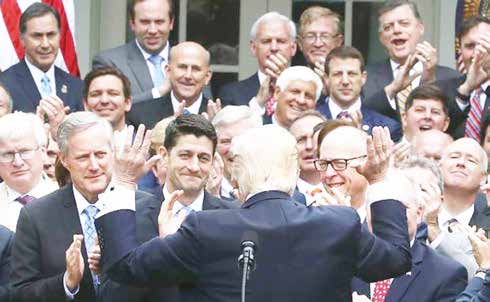
    In what could be seen as arare victory on the domestic turf for President Trump, the US House of Representatives approved a Bill on Thursday, May 4, to repeal major parts of Obamacare and replace it with a Republican healthcare plan. The passage of the Bill which Republican leadership has been struggling with and having met with disappointment earlier, is the legislative victory for President trump and House Speaker Paul Ryan.

    With the 217-213 vote, Republicans obtained just enough support to push the legislation through the House, sending it to the Senate for consideration. No Democrat voted for the Bill. The Bill’s passage represented a step toward fulfilling a top Trump campaign pledge and a seven-year Republican quest to dismantle Democratic former President Barack Obama’s signature healthcare law.

    But the effort now faces new hurdles in the Senate, where the Republicans have only a 52-seat majority in the 100-seat chamber and where just a few Republican defections could sink the Bill.

    Thursday’s vote was also a political victory for House Speaker Paul Ryan, demonstrating his ability to pull together a fractured Republican caucus after two failed attempts this year to win consensus on the healthcare law.

    Democrats are hoping that the Republicans’ vote to repeal Obamacare will spark a voter backlash in next year’s midterm congressional poll.

    Some 20 million Americans gained healthcare coverage under Obama’s 2010 Affordable Care Act, which has recently gathered support in public opinion polls. But Republicans have long attacked it, seeing the program as government overreach and complaining that it drives up healthcare costs.

    The Republican Bill, known formally as the American Health Care Act, aims to repeal most Obamacare taxes, including a penalty for not buying health insurance.

    But, the battle is not over yet. It is over to senate now. Though the Bill’s passage represented a seven-year Republican quest to dismantle former President Barack Obama’s signature healthcare law, the American Health Care Act now faces new hurdles in the Senate

    The Republicans have only a 52-seat majority in the 100-seat chamber and just a few Republican defections in the Senate could sink the Bill. The Democratic senators remain firmly unified against any repeal of Obamacare

    The new Bill repeals the individual mandate requiring those who can afford it to have health insurance. Those have who been without coverage for more than two months would face a 30% surcharge for new policy

    It repeals Obamacare’s requirement for companies with 50 or more staff to provide insurance coverage for employees

    Meanwhile, reactions to the bill passed in the House on May 4 are pouring in. Generally, hospitals, doctors, health insurers and some consumer groups, with few exceptions, are speaking with one voice and urging significant changes to the Republican health care legislation.

  • House vote to replace Obamacare postponed: Republicans don’t find yet the votes for their Health-Care Bill

    House vote to replace Obamacare postponed: Republicans don’t find yet the votes for their Health-Care Bill

    WASHINGTON (TIP): President Trump’s deal making expertise failed to convince many Republican Congressman that the Republican Healthcare Bill was any better than Obamacare. There has been a feverish activity in the Republican camp to muster enough support to pass the bill in the House on March 23. President Trump visited the Capitol, meeting with Congressmen, held a meeting with them in the White House to impress upon them how important it was to replace Obamacare with a Republican Healthcare. But, until late in the afternoon, the numbers required to pass the bill seemed to elude Speaker Ryan and President Trump.

    First, Speaker Ryan did not hold the proposed press conference, and later, it was announced that the vote on the healthcare bill was postponed.

    The announcement of the delay appeared to catch even the president unaware. Moments after the news broke, Trump told a group of truckers at the White House that the vote would still be held on Thursday. “We’ll see what happens,” he said. “It’s going to be a very close vote.” Earlier in the day, Press Secretary Sean Spicer was guaranteeing a victory. “It’s gonna pass. So, that’s it,” he told reporters.

    The move was an indication that a series of meetings Trump and Speaker Paul Ryan had with reluctant members in the party’s conservative and centrist wings had failed to achieve a consensus. Members of the House Freedom Caucus left a meeting with the president early in the afternoon saying there was “no deal” as they pushed Ryan to move the bill further to the right. And for Trump and Ryan, the delay dashed their hope of voting to dismantle the law on the seventh anniversary of its signing by former President Barack Obama.

    GOP leaders summoned all 237 Republicans to a 7 p.m. meeting in the Capitol to discuss possible changes to the American Health Care Act, and lawmakers said the party still hoped to hold procedural votes on the bill on Thursday night, with final passage on Friday. But even that plan was tentative, and tensions within the Republican conference were rising as the chances grew that the GOP would whiff on its longstanding promise to repeal and replace Obamacare.

    “The days of talking are over. It’s time to vote,” said Representative Bradley Byrne of Alabama, a strong supporter of the GOP plan. “The longer we wait, the worse our chances get.”

    Leadership officials were increasingly frustrated with the Freedom Caucus, which withheld its support even after winning Trump’s support for a change that would strip out Obamacare’s requirement that insurance plans cover maternity care, mental-health treatment, preventive services, and a host of other “essential health benefits” defined in the law. One leadership aide questioned whether Representative Mark Meadows of North Carolina, the group’s leader, could deliver its roughly three dozen votes after personally promising the president he would. A Meadows aide said the Freedom Caucus was pushing for even broader changes that would repeal the insurance regulations forbidding discrimination based on preexisting conditions and lifetime-coverage limits. But that is a non-starter for many House Republicans, and party leaders believe a bill that broad could not pass.

    Members like Byrne wanted the leaders to simply put the bill up for a vote, gambling that many of the rank-and-file lawmakers who have withheld their support wouldn’t dare let it go down in defeat in such dramatic fashion. “As a Republican, you’ve got one choice,” he said. “You either are going to vote with Donald Trump to repeal and replace Obamacare, or you’re going to vote with Nancy Pelosi to defeat the only bill to repeal and replace Obamacare. If you’re a Republican, that’s a pretty simple choice.”

    While the Freedom Caucus bargained for more conservative provisions, more moderate Republicans were peeling off the bill. Representatives Jaime Herrera Beutler of Washington state and Mark Amodei of Nevada declared their opposition on Thursday, and Trump planned to meet at the White House with the Tuesday Group, a coalition of moderates.

    Thursday’s push came after Ryan spent more than two hours Wednesday night meeting with more than a dozen members of the Tuesday Group and lawmakers representing swing districts. The pow-wow was inconclusive. The Republicans slipped out of the Capitol without speaking to reporters, and immediately after he left, Representative Charlie Dent of Pennsylvania, a co-chairman of the Tuesday Group, instructed his staff to release a statement formally opposing the leadership’s bill.

    “I believe this bill, in its current form, will lead to the loss of coverage and make insurance unaffordable for too many Americans, particularly for low-to-moderate income and older individuals,” Dent said. “We have an important opportunity to enact reforms that will result in real health-care transformation-bringing down costs and improving health outcomes. This legislation misses the mark.”

    The GOP bill, which would replace the ACA’s subsidies with less generous tax credits while repealing its insurance mandates, has run into opposition from across the political spectrum. Aside from the Chamber of Commerce, most industry groups have lined up against it. And despite the president’s hearty support, conservative activists and the billionaire Koch brothers say it falls far too short of a full repeal and have vowed to punish Republicans who support it.

    Late Thursday afternoon, the Congressional Budget Office released a revised estimate of the GOP bill’s cost after amendments were added earlier in the week. The nonpartisan scorekeeper found that the changes to Medicaid and tax policy would cost nearly $200 billion more over a decade than the original bill, but they would have little effect on insurance coverage or premiums. The CBO is still estimating that 24 million fewer people would have health insurance by 2026 and that average premiums would rise in the first couple years after the passage of the bill before falling by about 10 percent over a decade.

    Depending on how many lawmakers vote, Republicans can lose no more than 21 or 22 votes on their side and still achieve a majority. Democrats will vote en masse against the bill. Public whip counts put the defections at well over that number, but party leaders can still cross the threshold if they flip the group of conservative opponents led by Meadows. The bill would still need to pass the Senate, which would be an even more Herculean task for GOP leaders, considering they have a narrow, 52-48 seat majority and several Republicans have also declared the House plan unacceptable.

    Meanwhile, President Trump delivered an ultimatum to House Republicans on Thursday night: Vote to approve the measure to overhaul the nation’s health-care system on the House floor Friday, or reject it and the president will move on to his other legislative priorities.


  • Indian Government Is Going To Be America’s ‘Great Ally’, admits US House Speaker Paul Ryan

    Indian Government Is Going To Be America’s ‘Great Ally’, admits US House Speaker Paul Ryan

    The Indian government is going to be America’s “great ally” and there is a need to nurture
    this relationship, Speaker of the US House of Representatives Paul Ryan told the Council on Foreign Relations, where Republicans unveiled a plan to chart America’s foreign policy and national security.

    While there, Speaker Ryan and members of the Task Force on National Security talked about this new agenda. Here’s some of what Speaker Ryan covered in his conversation with Hewitt:.

    In a major foreign policy speech here in which he was highly critical of President Barack Obama’s policies, the US-India relationship was the only aspect of it which was appreciated by Ryan.

    “I think you need, and in particular, specifically under Modi’s leadership, and he and I have discussed this at great length yesterday, (US-India) have a great potential for the future particularly with the seas, in the Pacific and in the Indian Ocean, making sure that we help police the global commons and international order, namely China building, you know, runways on islands in contested areas,” Ryan said.

    He said this in the speech at the Council on Foreign Relations on Thursday, a day after Prime Minister Narendra Modi addressed a joint meeting of the US Congress at his invitation.

    Modi was the first foreign leader to be invited to address a joint sitting of the Congress under Ryan’s speakership.

    On Wednesday, Modi and Ryan had a one-on-one interaction before the Prime Minister’s address. Ryan also hosted a lunch for the visiting leader.

    A day later, Ryan was all in praise for Modi.

    “I think the Indian (government), the new Indian government, is going to be a great ally of ours and we have better security cooperation with them. That’s one thing that we need to nurture and grow,” Ryan told the audience at the Council on Foreign Relations, a top American think tank.

    “And those of us who are fans of Modi, you know, he’s a conservative who wants, who embraces free enterprise. He’s bringing needed reform to the country,” Ryan said, according to the remarks released by his office.

    “That’s the kind of an alliance that we need to forge and build upon. That stands in stark contrast, I would argue, to the Obama foreign policy of the last eight years where we have
    neglected our allies and we have basically rewarded our enemies, our adversaries,” said the Speaker of the US House of Representatives.

    Except for his comments on India, Ryan slammed Obama’s foreign policy.

    “We know that this new Obama foreign policy concept, leading from behind, can now be declared an unambiguous failure. It is making us unprepared. It is reducing our military capability and strength,” he alleged.

  • Bronx Borough President Ruben Diaz Appreciates US move on Puerto Rico’s Debt Crisis

    Bronx Borough President Ruben Diaz Appreciates US move on Puerto Rico’s Debt Crisis

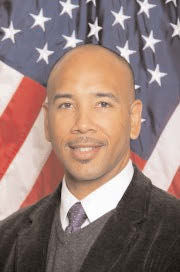
    NEW YORK (TIP): Bronx Borough President Ruben Diaz Jr. has appreciated US move on Puerto Rico’s debt crisis. He said in a statement to The Indian Panorama, May 19:”After more than a year of negotiation and advocacy by my office and many others, I am pleased to see an important first step between the White House and Congress on the future fiscal health of the commonwealth of Puerto Rico, H.R. 5278, the Puerto Rico Oversight, Management and Economic Stability Act (PROMESA).

    “This bipartisan compromise, while certainly not perfect, is a tremendous step forward and offers many of the solutions that I and others have been advocating for. Although access to bankruptcy courts would have been preferred, we are encouraged by the bill’s provision to allow Puerto Rico to reduce repayments to creditors. However, the process for appointing members of the proposed control board must ensure that the individuals selected protect the best interests of the Puerto Rican government and its people.

    “There is still much work needed to be done by Congress to update and revise the Puerto Rican economic regulatory framework. Health care must be delivered more effectively, import costs reduced and infrastructure investments made so that Puerto Rico has greener energy solutions and is prepared for the dramatic changes already being produced by climate change.

    “I thank the White House and Congress for taking the concerns of the Puerto Rican government, its citizens and their advocates on the mainland seriously and working towards this agreement. I especially want to thank those who have worked assiduously on this compromise, including House Speaker Paul Ryan, House Minority Leader Nancy Pelosi, Senators Charles Schumer and Kirsten Gillibrand; and Reps. Nydia Velázquez, Jose Serrano and Luis Gutiérrez.”

    The Borough President added: “The people of Puerto Rico are American citizens, and they deserve the same rights and protections as their countrymen.”

  • McCarthy Quits Speaker Race leaving House Republicans Shell shocked

    McCarthy Quits Speaker Race leaving House Republicans Shell shocked

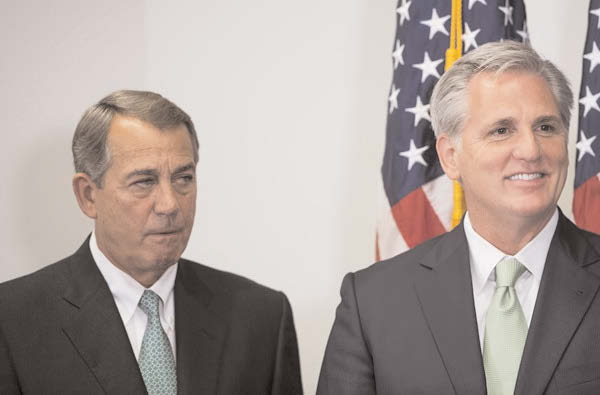
    WASHINGTON (TIP): House Republicans were shell shocked on Thursday, October 8, when California Representative Kevin McCarthy, the favorite to succeed retiring House Speaker John Boehner, dropped out of the race in a surprise that adds to concerns about the party’s ability to govern effectively, news reports said.

    McCarthy, the No. 2 Republican in the House, faced opposition from more conservative lawmakers who now could be emboldened to take a more confrontational approach toward Democratic President Barack Obama on legislation and policy.

    McCarthy’s decision leaves House Republicans without a leader at a time when they face difficult decisions about the spending and national debt that could threaten the country’s ability to pay its bills and keep its government running.

    Florida Rep. Daniel Webster, who is seeking the speaker’s post himself, told CNN’s “The Situation Room with Wolf Blitzer,” he was “shocked” at the announcement, saying McCarthy seemed excited about running not long before.

    “I don’t know why he dropped out, because we just had a member session where all the members came together and he and myself and the other two candidates were there, Kevin was there,” Webster said. “And he was passionate about it. This was just an hour and a half before he announced he wasn’t going to do it.”

    Even under the leadership of Boehner, who relied on McCarthy as an ally, Republicans stumbled into a 16-day government shutdown in 2013 and brought the country to the brink of default in 2011, leading to the United States’ first-ever debt rating downgrade.

    The next speaker will have to answer to a newly assertive conservative wing at a time when the party is trying to appeal to a broad swath of voters in the campaign for the November 2016 presidential elections.

    In several closed-door meetings this week, McCarthy told lawmakers he would not be like Boehner, some lawmakers said afterward, but few seem to have found this convincing.

    Boehner, who announced Sept. 25 that he would step down at the end of October, said on Thursday that he would stay on the job until a replacement is elected.

    Both the secret-ballot vote to nominate a Republican candidate for speaker and the full House vote, which was set for Oct. 30, have been postponed until further notice.

    House Republicans’ inability to merely pick a leader comes after Boehner and Senate Majority Leader Mitch McConnell, also a Republican, had gone to great lengths all year to demonstrate that their party can effectively run Congress.

    “If we are going to unite and be strong, we need a new face to help do that,” McCarthy told reporters. He said he would stay on in his current post as majority leader.

    McCarthy’s ability to effectively communicate Republican initiatives was called into question last week when he made a connection between a special House committee investigating a 2012 attack in Benghazi, Libya, and Democratic presidential candidate Hillary Clinton’s falling public opinion poll numbers.

    One possible successor to Boehner, Wisconsin Representative Paul Ryan, said he was not interested in becoming speaker. The party’s 2012 vice presidential nominee is widely admired among Republicans but said he wanted to remain as chairman of the tax-writing Ways and Means Committee.

    The two lawmakers who had challenged McCarthy for the post, Representatives Jason Chaffetz of Utah and Daniel Webster of Florida, said they were still in the race.

    “It was just absolutely stunning what happened,” Chaffetz said. “I don’t know if I am the right person. I put my name in the hat because I do want to unite this party internally.” Webster said he expected other candidates to enter the contest.

    The Republicans were tossed into upheaval just a few weeks before the United States is due to reach the limits of its borrowing authority. The Treasury department has estimated that the United States will hit its$18 trillion debt cap around Nov. 5, and the White House urged Congress to raise the limit before then to avoid a possible default.

    Lawmakers are also struggling with Obama on spending levels before government funding runs out on Dec. 11.

    White House spokesman Josh Earnest said there had been several instances in the past few years in which a Republican-dominated House of Representatives has managed to raise the debt ceiling without political brinkmanship.

    “And we’re hopeful that in spite of this chaos, that Republicans and Democrats in the House will do the same thing again,” Earnest said at a news briefing.

    McCarthy was elected to Congress from California in 2006 and had been one of Boehner’s lieutenants in House Republican leadership since 2011. He has been majority leader since August 2014.

    Webster had drawn the backing of the House Freedom Caucus, a bloc of about 40 conservatives. These Tea Party-aligned members noted that Webster, 66, led efforts that “empowered” individual lawmakers while he was speaker of the Florida House from 1996 to 1998.

  • CNN Survey indicates Americans overwhelmingly Favor Path to Citizenship for Undocumented Immigrants

    CNN Survey indicates Americans overwhelmingly Favor Path to Citizenship for Undocumented Immigrants

    WASHINGTON (TIP): A CNN survey conducted February 6, says Americans overwhelmingly favor a bill that would give most undocumented immigrants a pathway towards citizenship, according to a new national poll.

    And a CNN/ORC International survey also indicates that a majority of the public says that the government’s main focus should be legalizing the status of the undocumented rather than border security.

    The poll was released Thursday, the same day that House Speaker John Boehner signaled any action on immigration is unlikely this year because House Republicans don’t trust President Barack Obama on the issue. According to the poll, 54% say the top priority for the government in dealing with the issue of illegal immigration should be developing a plan that would allow undocumented immigrants with jobs to eventually become legal U.S. residents.

    Just over four in ten questioned say the main focus should be developing a plan for stopping the flow of undocumented immigrants into the U.S. and for deporting those already here. “The Republicans’ insistence that border security be the primary focus of U.S. immigration policy may have been a popular stand in 2011, but not necessarily in 2014,” said CNN Polling Director Keating Holland. “American attitudes toward undocumented immigrants have changed. Starting in 2012, most Americans have said that the government’s focus should be on a plan that would allow those immigrants to become legal U.S. residents.

    A majority has consistently taken that position since that time – 56% in 2012, 53% in 2013, and 54% in the current poll,” added Holland. The Democratic-controlled Senate last year passed a bipartisan illegal immigration bill that included an eventual pathway towards citizenship for most of the 11 million undocumented immigrants in the U.S. According to the poll, more than eight in 10 support such a plan.

    There is little partisan divide, with 88% of Democrats, 81% of independents and 72% of Republicans in agreement. The Senate bill stalled in the GOP dominated House. Republicans said they preferred to address the matter incrementally rather than in one comprehensive measure. One idea House Republicans are considering is giving undocumented immigrants legal status to stay in the U.S., but not allow them a pathway towards citizenship. According to the survey, only 35% support such an idea, with just over six in 10 opposed.

    Again, there was no partisan divide, with two-thirds of Democrats and around six in 10 independents and Republicans opposing such a plan. The poll was conducted for CNN by ORC International from Jan. 31-Feb. 2, with 1,010 adults nationwide questioned by telephone. The survey’s overall sampling error is plus or minus three percentage points. Meanwhile, on January 30, the House Republican Leadership released a one-page document entitled “Standards for Immigration Reform”. This is the long-awaited response to the bipartisan immigration reform bill passed by the Senate in June 2013.

    Enforcement
    The Republicans Immigration Principles first address the issue of immigration enforcement. They declare that the following three things must occur before there can be any legalization program: 1) We must secure our borders and verify that they are secure; 2) There must be a functioning entry-exit system to make sure that people do not overstay their visas; 3) There must be a workable electronic employment verification system.

    Reform the Legal Immigration System
    The standards call for increasing the number of employment-based visas, limiting the number of family-based visas and eliminating the visa lottery. They also stressed the need for temporary workers, and explicitly endorse a temporary visa program for agricultural workers.

    Legalization
    With respect to legalization of the 11-12 million persons who are residing in the U.S. without papers, the standards explicitly reject a “special pathway to citizenship”. In order for these persons to be able to legalize their status, they must:
    1) Admit their culpability;
    2) Pass rigorous background checks;
    3) Pay significant fines and back taxes;
    4) Develop proficiency in English and American civics; and
    5) Be able to support themselves and their families without public benefits.

    There will be no legalization program until certain enforcement measures have been implemented and found to be working. The standards do allow an exception for persons who were brought to the United States as children by their parents. They will have a path to citizenship if they meet certain eligibility standards and they either serve in the U.S. military or they obtain a college degree. The standards foreclose the possibility of negotiating a compromise bill with the upper house based on the bill passed by the Senate in 2013. Instead, they call for piecemeal legislation.

    Is a Compromise Possible?
    Given these broad principles, is there any hope for a compromise reform bill to become law in 2014? First, consider that many of these GOP House principles mirror parts of the Senate bill:
    1) Tough border enforcement;
    2) Mandatory E-Verify;
    3) Increasing employment-based immigration;
    4) Reducing family-based immigration and eliminating the visa lottery;
    5) New temporary visa program including one for agricultural workers.

    The main point of contention is the rejection of the Senate’s 13-year Pathway to Citizenship. Is it good policy to legalize millions of undocumented workers without allowing them to become U.S. citizens one day? Here the GOP House Standards threaten to upset the delicate balance worked out between labor and management in crafting the Senate’s compromise legislation. Richard Trumka, the President of the AFL-CIO and a strong supporter of the Senate bill stated that “half-measures that would create a permanent class of noncitizens without access to green cards should be condemned, not applauded.

    Until we create a functioning immigration system with a pathway to citizenship, ruthless employers will continue to exploit low wage workers, pulling down wages for all.” However, Representative Paul Ryan (RWS) who may be a contender for the Presidential nomination in 2016 made statements which show that there is a substantial wiggle room in the Principles for compromise. “If you want to get in line to get a green card like any other immigrant, you can do that. You just have to get at the back of the line so that we preference that legal immigrant who did things right in the first place.”

    So, what’s the bottom line?
    Here is what President Obama had to say: “If the speaker proposes something that says right away, folks aren’t being deported, families aren’t being separated, we’re able to attract top young students to provide the skills or start businesses here, and then there’s a regular process of citizenship, I’m not sure how wide the divide ends up being.” Here is my take: Wait for the Republican primaries to be over in May and June.

    Then, GOP representatives, no longer looking over their right shoulders at Tea Party challengers, will be in a better position to compromise. Notice that while the principles oppose a “special” pathway to citizenship, there is no explicit bar to legalized persons eventually attaining U.S. citizenship. There is room for compromise. Skeptical? Consider how far the GOP has moved toward reality on immigration policy since Mitt Romney’s “selfdeportation” fiasco of 2012.

  • A Two-Year Deal on Spending Reached: Conservative Republicans not happy

    A Two-Year Deal on Spending Reached: Conservative Republicans not happy

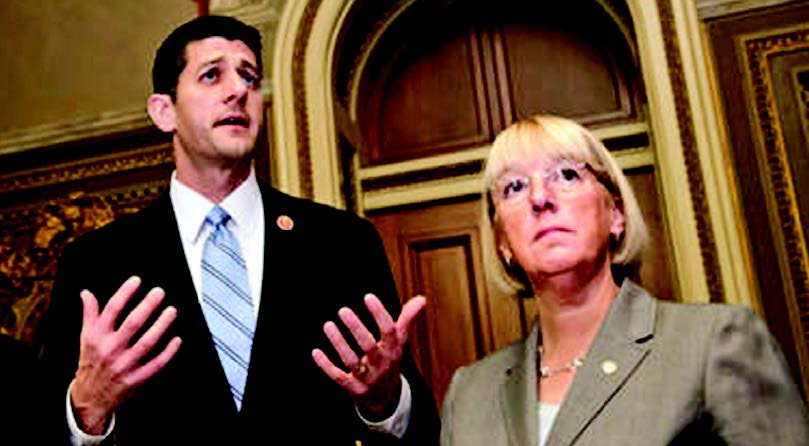
    WASHINGTON (TIP): A compromise federal budget plan that would remove the threat of a government shutdown for two years won easy approval Thursday, December 12, from the Republicancontrolled U.S. House. The deal worked out by House Budget Chairman Rep. Paul Ryan and Senate Budget Committee Chairwoman Patty Murray passed on a 332-94 vote and now goes to the Democratic-led Senate, which is expected to approve it next week in a very close vote. It represented rare convergence between the two parties on government spending after two years of bitter debate and political brinksmanship that included the 16-day shutdown in October. President Barack Obama hailed the agreement as a sign of rare bipartisan cooperation in the strife-filled US legislature.

    “It’s a good sign that Democrats and Republicans in Congress were able to come together and break the cycle of shortsighted, crisis-driven decision-making to get this done,” the president said shortly after the deal was announced. The agreement’s main brokers, Democratic Senator Patty Murry and House Republican Paul Ryan, said it sets the new annual budget caps for 2014 and 2015 at just over $1 trillion — slightly higher than current levels — and at least partially repeals the automatic, widely loathed budget cuts known as “sequestration.” “I see this agreement as a step in the right direction,” Ryan, the 2012 Republican vice presidential nominee and chairman of the House Budget Committee, told reporters, noting that the deal does not raise taxes on Americans. “We have broken through the gridlock and reached a bipartisan budget compromise that will prevent a government shutdown in January,” added Murray, the Senate’s top budget chief, who said she and Ryan set aside their political differences to reach a compromise over weeks of negotiations.

    “We agree that our country needs some certainty and we need to show that we can work together,” she added. House Speaker John Boehner acknowledged the measure amounted to only a small step toward the GOP goal of deficit reduction and balancing the budget, but he rejected opposition by some conservatives in his caucus as well as outside groups on the political right. “Is it perfect? Does it go far enough? No, not at all,” Boehner said in urging his colleagues to back the plan, noting it resulted from “doing what the American people expect us to do — coming together and finding common ground.” Ryan noted that Washington politicians have “been at each other’s throats for a long time” over budget issues, and Republicans must first win some elections in order to get all the deficit reduction and spending cuts they want. Democrats also hailed the budget proposal as a “small positive step forward,” in the words of Rep. Chris Van Hollen of Maryland.

    He and other Democrats called for Congress to also extend long-term unemployment benefits for more than 1 million Americans set to expire after Christmas, but their support for the budget plan showed they dropped any demand to link the issues in Thursday’s vote. In the House vote, 169 Republicans voted for the spending plan while 62 opposed it, with 163 Democrats in favor and 32 against. While most Republicans supported the plan, Boehner needed help from Democrats to get the 217-vote threshold needed for passage. Top GOP Senate aides said they expect the budget to pass the Senate but it could be by a razor thin margin. This could also change if momentum against the bill grows. GOP conservatives including Ted Cruz of Texas, Kelly Ayotte of New Hampshire and Lindsey Graham of South Carolina, said they will oppose the measure, which would need some Republican support for Democrats to overcome an expected filibuster.

  • THE POLITICS OF THE GOVERNMENT SHUTDOWN

    THE POLITICS OF THE GOVERNMENT SHUTDOWN

    With the government having lurched into its first shutdown since the 1990s, many commentators are focusing on the potential ill effects that it might have for Republicans. Almost all of these analyses use the shutdowns of 1995- 1996 as their starting point. While I don’t think this development will be great for Republicans, many of the concerns are likely overwrought. Here are four points to ponder:
    1. While the GOP’s tactics are similar to those employed in the mid-’90s, the goals are different.
    The earlier budget debates were broad in nature and dealt with the scope of government. The 104th Congress, led by Newt Gingrich, believed that they were the culmination of the realignment supposedly begun by Ronald Reagan, that Bill Clinton’s election was a fluke caused by Ross Perot’s candidacy, and that they had been elected with a mandate to shrink the size and scope of government dramatically. They entered the shutdown believing that the public would rally to their side, that Clinton’s job approval would fall in the wake of the shutdown, and that he would ultimately cave on their demands. Despite the lore that has since sprung up, this wasn’t a completely harebrained view of the underlying politics: An earlier shutdown, in 1990, did play an important role in persuading George H.W. Bush to abandon his famous “no new taxes” pledge a few weeks later. Of course, that isn’t how it played out at all in 1995 and 1996; Bill Clinton was widely viewed as having held the line against the Republican onslaught, although he actually did give substantial ground on taxes and a number of other issues.

    The budget fight became the focal point of Democrats’ attempt to take back the House and Senate in the 1996 elections. But the Democrats didn’t actually use the shutdown itself as their main line of attack on Republicans. It was part of it, but the real attacks came over the Republicans’ motivation for the shutdown. Because of the expansive nature of the GOP’s cuts, the Democrats were able to focus on several unpopular portions of the GOP budget: the so-called M2E2 strategy. They commenced a mantra-like repetition of their opposition to Republican attempts to gut “Medicare, Medicaid, Education and the Environment” in favor of a “risky tax scheme” that benefited the rich. In other words, in evaluating 1996 as an illustration of what will happen to the GOP today, we probably have to separate the tactic of a shutdown from the substance of what motivates it. And today, the GOP is focused on defunding Obamacare, a law that isn’t particularly popular. For the analogy to 1995-96 to really stick, the GOP will probably have had to try something along the lines of shutting down government to implement the Paul Ryan balance-budget plan. While public opinion might be against the shutdown tactic, there probably won’t be the same level of outrage against the underlying policy motivation, which is what 1995-96 was mostly about. If Obamacare turns out to be the train wreck some conservatives predict (I have no clue whether it will or won’t), the tactic itself might be viewed as less of a negative.

    2. John Boehner is not Newt Gingrich, and Barack Obama is not Bill Clinton.
    This is a fairly minor point, but Gingrich’s public persona did play a part in bringing the shutdown to an unhappy end for the GOP. He was polarizing from the start, and the media didn’t bend over backwards to help him out. Case in point: The Daily News cover depicting him as a crybaby who shut down the government because he had to sit in the back of Air Force One. Boehner, on the other hand, has kept a much lower profile, and while he isn’t all that popular, he isn’t a lightening rod either (although Ted Cruz seems to be inching toward filling Gingrich’s shoes in that regard). At the same time, Obama is not really Clinton. The current president’s ability to present himself as a cautious centrist in political face-offs with Republicans to date have been mixed at best; his strength has always been energizing the liberal base for elections rather than tacking to the center. Clinton might be the most successful president of my lifetime when it comes to publicly framing a debate in a way favorable to his side (see, for example, the M2E2 strategy above). There are actually few examples, if any, of Obama rallying the public to his side in the various battles he’s fought; there are plenty of failures, with the fight over sequestration being the most recent case in point.

    3. The net effect of the shutdown was small in the 1990s.
    For all the talk of the sustained damage the Republicans suffered, the actual evidence for this is pretty weak. In 1994, Republicans won 230 seats in Congress. Five party switches and a special election victory later, they entered the 1996 elections with 236 seats. They emerged from those elections with 228 seats, for a loss of eight total (including the open seat of one of the Democratic Party switchers). So while Republicans lost seats, it ended up being something of an empty victory for Democrats: Americans elected a Republican Congress back-to-back for the first time since the 1920s. Republican candidates won the popular vote for the House, albeit very narrowly (Democrats won the vote only if you split up votes cast for candidates running on multiple party lines, e.g., a Republican also running on the Conservative Party line in New York). Republicans even gained a seat in a special election held in a Democraticleaning district in between government shutdowns, and only narrowly lost a Senate seat in Democratic-leaning Oregon immediately after the shutdown (Republicans proceeded to win another open Senate seat in the same state by four points in November). Those Republican House losses weren’t terribly surprising.

    Republicans were overexposed as a result of the 1994 “wave election” that swept a number of weak members into swing-to-Democratic-leaning districts. Losing representatives like Andrea Seastrand, Michael Flanagan and Fred Heineman was more a part of regression-to-the-mean than any wholesale rejection of Republicans. Of the 21 House seats that Democrats claimed from Republicans in 1996 (it was actually 22, but I don’t have presidential data for Louisiana’s 7th District), Clinton had carried 18 in 1992. The other four seats were all something of special cases: Bob Dornan in California, Gary Franks in Connecticut, David Funderburk in North Carolina, and Toby Roth’s open House seat in Wisconsin. This presents a problem for Democrats hoping to capitalize on the 2013 shutdown: The seats are much better sorted these days. Going into the 1996 elections, 79 Republicans occupied seats that had voted for Clinton in 1992. In other words, they lost 23 percent of their caucus from “Clinton seats.” Today, only 17 Republicans come from “Obama seats” to begin with. If Republicans suffered losses in unfriendly territory at the same rate as they did in 1996, they’d lose only four seats, before we start looking at the effect on Democrats from “Romney seats.” Perhaps Republicans would have fared better had they not attempted to shut down the government in the first place.

    Republicans picked up 10 open House seats and defeated three Democratic incumbents in 1996; absent the shutdown, perhaps they might have gained seats. In the Senate, Republicans narrowly lost open Democratic seats in Louisiana and Georgia, while missing good opportunities to defeat Tom Harkin in Iowa and Max Baucus in Montana. But as Harry Enten has ably demonstrated, Republicans did about as well in the House and in presidential elections as we would have expected given the performance of the economy, especially when you consider that exit polls showed Ross Perot pulling votes disproportionately from Republicans (unlike 1992, when he pulled evenly from both parties). Clinton’s comeback was likely due more to the flurry of good economic news in the run-up to the election than to anything else. Indeed, while Clinton’s job approval improved over the course of the shutdown, it had also improved in the months leading up to the shutdown at a similar rate. Senate losses in Louisiana and Georgia look bad today, but in 1996 both states were more Democratic; Clinton had carried both states in 1992 and only narrowly lost Georgia in 1996 while winning Louisiana by 12 points. Republicans had only won two narrow Senate elections in Georgia before 1996 (and hadn’t won the governorship since Reconstruction), while Republicans had never won a Senate election in Louisiana and were burdened by a controversial candidate in Woody Jenkins. Republicans were unable to defeat Harkin, Baucus or Mary Landrieu in the good GOP year of 2002.

    4. What happens to red state Senate Democrats?
    Of course, the real action for 2014 is not the House, where the GOP will continue to control the agenda except in the unlikely event that it loses 17 seats. The real fight is for control of the Senate, which in turn revolves around races in eight states: West Virginia, Arkansas, Kentucky, South Dakota, Louisiana, Alaska, Montana and North Carolina. Obama lost those states by, respectively, 27, 24, 23, 18, 17, 14, 14 and two points, respectively. The politics of a shutdown in these states are very different than in the nation as a whole. We can try to estimate the popularity of a shutdown by taking as a national baseline CNN’s recent finding that 46 percent of voters would blame Republicans for a shutdown vs. the 36 percent that would blame Obama. If we adjust these numbers according to the results of the presidential election in 2012, we would estimate that the president would shoulder the blame for a shutdown in each of those states save for North Carolina, and that outright majorities would blame the president in West Virginia, Arkansas and Kentucky. The last thing Democratic candidates in these states want is a public spat over a piece of legislation that is highly controversial, that might have a problematic rollout in the coming weeks and months, and that places them on the side of an unpopular president.

    If there’s an upside for the GOP, this is probably it. Even after the 1995-96 shutdowns, the GOP managed to gain Senate seats, largely by making gains in reddish states. Of course, none of this should be read as advocating the shutdown, or predicting that it could not possibly have any negative consequences for the GOP. For starters, a government shutdown is essentially lighting a fuse without knowing exactly where it will go. This is something that could easily get out of control if the shutdown stretches out for weeks and bleeds into the debt ceiling battle, which could be potentially catastrophic for the county. Moreover, it could give Democrats an issue to rally around. Unlike 1996, the economy is weak; the president’s job approval has suffered in recent months as a result of his perceived failure to move the Democratic agenda forward, and the aborted intervention in Syria. Many of these losses have come as a result of Democrats becoming dissatisfied with the president. If the election were held with the president’s job approval at its present level, Democrats would probably lose another 10 House seats or so, giving Republicans their largest House majority since 1946 (and possibly 1928). A dustup with congressional Republicans would probably help bring these Democrats back into the fold, especially if the president emerges victorious from the fight, helping to limit Democratic losses. Finally, we should also remember that the current weak recovery has been ongoing now for 52 months.

    It’s already longer than six of the 11 recoveries in the post-War era. By this time next year, it will be longer than seven of them. By 2016, only the booms of the mid-’60s, mid-’80s, and mid-’90s will have lasted longer. And, well, this recovery doesn’t much resemble those recoveries so far. In other words, there’s a decent chance that we’ll encounter a downturn in the economy in the next year, and a very good chance that we’ll encounter one in the next three years. Obama is probably reaching the end of the time period where his predecessor can be blamed for the state of the economy. But a lengthy shutdown could conceivably give Democrats ammunition to place the blame back on Republicans. The bottom line is this: The shutdown will probably not be a good thing for the GOP, and there’s a good chance Republicans won’t achieve their intended goal of limiting Obamacare’s reach. But at the same time, a lot of the prophecies of doom for Republicans are heavily overwrought. Unless things get too far out of control, the predictions of heavy GOP losses from a shutdown are likely overstated.

  • Obama, Bush Leap Into US Immigration Fight

    Obama, Bush Leap Into US Immigration Fight

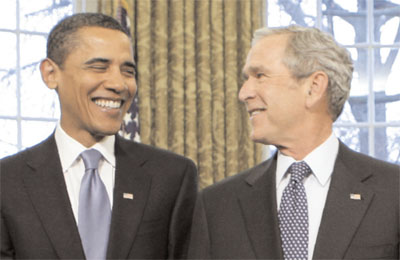
    WASHINGTON (TIP): President Barack Obama and former President George W Bush are leaping into the immigration debate, but their attempts to add momentum to the search for a possible path to citizenship for millions face strong opposition in the Republican-controlled House of Representatives.

    As Bush delivered a rare political speech on Wednesday in favor of immigration reform and Obama prepared for a bipartisan meeting with prominent senators at the White House, Republicans who control the House bluntly challenged Obama and appeared unimpressed by Bush’s advice to carry a “benevolent spirit” into the debate. Emerging from a closed-door meeting, Republican leaders affirmed a step-by-step approach to immigration but offered neither specifics nor a timetable — nor any mention of possible citizenship for an estimated 11 million immigrants living in the US unlawfully.

    Lawmakers streaming out of the twohour meeting said Bush’s long-distance advice had not come up in a discussion that focused instead on the importance of securing the US borders and a general distrust of Obama. The meeting in the Capitol was the House Republicans’ first such gathering since the Senate approved sweeping legislation last month on a bipartisan vote of 68-32.

    Obama is to meet on Thursday with two authors of the Senate measure, Republican John McCain and Democrat Chuck Schumer, in the president’s Oval Office. The legislation faces a steep challenge in the House, and the former president’s ability to sway a new generation of conservatives was a matter of considerable doubt, especially because many of the conservative tea party movement-backed lawmakers have risen to power since he left the White House and are strongly on record in opposition to any citizenship provision.

    “We care what people back home say, not what some former president says,” declared Rep. Tim Huelskamp, a second-term Republican who has clashed with the party leadership in the House. Still, the timing and substance of Bush’s remarks were reminders of the imperative that many national party leaders feel that Republicans must broaden their appeal among Hispanic voters to compete successfully in future presidential elections.

    Obama took more than 70 percent of their votes in winning a second term last year. “America can be a lawful society and a welcoming society at the same time,” Bush said at a naturalization ceremony at his presidential library in Dallas. For their part, Democrats quickly embraced the former president’s message, challenging House Speaker John Boehner to proceed in the same spirit.

    In a written statement noting that the White House recently delayed a key part of Obama’s health care reform law, Boehner and other leaders said that action raised concerns that the administration “cannot be trusted to deliver on its promises to secure the border and enforce laws as part of a single, massive bill like the one passed by the Senate.” Lawmakers said after the session there was strong support for a bill to create a path to citizenship for immigrants who were brought to the country as children illegally by family members, an idea advanced by Majority Leader Eric Cantor.

    Republican Rep. Robert Goodlatte, chairman of the House Judiciary Committee, said his panel would soon begin work on legislation covering that group. Several members of the rank and file said Republican Paul Ryan had made a particularly strong appeal for a comprehensive approach, which includes possible citizenship for the 11 million. But others emphasized there was virtually no support for the Senate’s approach of one sweeping measure that dealt with immigration in all its forms.

  • Obama becomes 14th US  Prez to win a 2nd Term

    Obama becomes 14th US Prez to win a 2nd Term

    NEW YORK (TIP): President Obama won a second term November 6 night and became the 14th US President to win a second term. He promised his thrilled supporters at the victory celebrations in Chicago that for the United States of America “the best is yet to come.” He congratulated his opponent Mitt Romney and said, “In the weeks ahead I am looking forward to sitting down with Gov. Romney to discuss how we can move this country forward.”

    In a victory speech studded with the soaring rhetoric that first drew voters to him in 2008, Obama reminded the electorate what was still on his agenda — immigration reform, climate change and job creation.
    “Tonight, you voted for action not politics as usual.” he told supporters in Chicago. “You elected us to focus on your job, not ours.”

    Obama told Romney supporters that “I have listened to you… you have made me a better president.” He added, “I return to the White House more determined, more inspired than ever.

    The election is a validation, if not an overwhelming mandate, in support of the president’s policies of the last four years, which included a major overhaul of the healthcare system and a drawdown of troops in Iraq and Afghanistan.
    Top Republican lawmaker John Boehner said on Thursday he would not make it his mission to repeal the Obama administration’s healthcare reform law following the re-election of President Barack Obama.

    “The election changes that,” Boehner, speaker of the U.S. House of Representatives, told ABC news anchor Diane Sawyer when asked if repealing the law was “still your mission.”

    “It’s pretty clear that the president was re-elected,” Boehner added. “Obamacare is the law of the land.”
    Obama built a coalition of young people, minorities, and college educated women and won by turning out supporters with a carefully calibrated ground operation to get out the vote in crucial states like Ohio, Iowa and Wisconsin.
    He thanked those who voted “whether you voted for very first time, or waited in line for a very long time — by the way we have to fix that,” he joked.

    He thanked Vice President Joe Biden, whom he called “America’s best happy warrior” and first lady Michele Obama.
    “Sasha and Malia,” he said addressing his two daughters. “You’re growing up to be two strong, smart, beautiful young women…I’m so proud of you. But I will say for now, one dog is probably enough,” he said riffing on his promise of a puppy four years ago.

    Prior to the president’s speech, Mitt Romney conceded gracefully in Boston.

    “I so wish that I had been able to fulfill your hopes….but the nation chose another leader,” Romney told heart broken supporters at his Boston headquarters.

    “I pray the president will be successful in guiding our nation,” Romney said before running mate Rep. Paul Ryan of Wisconsin and their families joined Romney on the podium.

    Obama’s lease on the White House was renewed with a crucial victory in Ohio.

    Celebrations erupted in Obama’s home town of Chicago, in New York’s Time Square and outside the White House, while Romney’s Boston headquarters went mournfully quiet.

    “We’re all in this together. That’s how we campaigned, and that’s who we are. Thank you,” Obama tweeted even before formally announcing his victory.

    After a campaign for the White House and both houses of Congress that cost more than $6 billion, the make up of all three branches remains very much the same as it was before the election. Obama remains in the White House, Democrats retain control of the Senate and Republicans continue to control the House.

    The participants were themselves history making, the first black president running against the first Mormon presidential nominee to make it the general election. But for the most part the election turned not the politics of identity but of the economy.

    The election took place against the backdrop of a slow economic recovery. From its outset, both campaigns knew the race would come down to the economy, and both tried to tailor their appeals to middle class families struggling with inflation and unemployment.

    Obama routinely reminded voters he had inherited the worst economy since the Great Depression and pointed to policies he led, including the auto bailout, and signs of improvement including a drop in the unemployment rate.

    Obama portrayed Romney as an out of touch millionaire intent on helping the rich at the expense of the middle class when they were hurting the most. That impression seemed to stick with voters who nationally said by 55 to 40 percent that they believed the economic system favors the wealthy rather than being fair to most people, according to exit polls.

    The candidates also tangled over health care, abortion, and taxes, leading to a bevy of negative ads.
    The campaign was the most expensive in history, with each candidate raising nearly $1 billion a piece.

  • Obama and Romney battle in second US presidential debate

    Obama and Romney battle in second US presidential debate

    NEW YORK (TIP): President Barack Obama fought back and Republican challenger Mitt Romney mostly stood his ground in a bruising, argumentative debate three weeks before Election Day.

    With a third and final debate to go, both candidates appeared likely to secure their standing in an already tight race that portends a cliffhanger presidential vote.

    On October 17, both campaigns will continue their focus on battleground states considered crucial to winning the White House. Obama heads to Iowa and Ohio and Vice President Joe Biden campaigns in Colorado and Nevada, while Romney will go to Virginia and running mate Rep. Paul Ryan stops in Ohio

    Tuesday night saw Obama bring the desired energy sought by worried Democrats after the president’s lackluster performance in the first encounter two weeks ago.

    This time, a forceful Obama defended his policies and challenged Romney on shifting positions on key issues while arguing his Republican rival’s proposals would favor the wealthy if elected on November 6. Romney repeatedly attacked Obama’s record, saying millions of unemployed people and a sluggish economic recovery showed the president’s policies had failed. A CNN/ORC International poll indicated that 46% of respondents who watched the debate thought Obama won, compared to 39% for Romney. The result was within the survey’s margin of error, and responses to other questions showed the overall impression was generally positive for both candidates.

    After the first debate on October 3 in Denver, a similar poll showed Romney scored a solid victory in the eyes of more than 60% of respondents. “Most improved — that award goes to Barack Obama,” CNN Senior Political Analyst David Gergen said, comparing the president’s performance on Tuesday to his previous showing. “I think he had a much stronger debate tonight.” Daily Beast’s Andrew Sullivan, who called Obama’s poll numbers after the first debate “devastating,” predicted the president would come “kicking back in the polls” in coming days.

    Erick Erickson, the conservative RedState.com blogger and CNN contributor, thought Romney won the debate based on “clear majorities outside the margin of error” in the CNN/ORC poll who thought Romney would be better for the country on economic issues. In fact, while other areas of the debate may overshadow this point, Romney deftly dispatched Obama on his economic record,” Erickson said, calling it “the one issue that matters.”

    An awkward phrase by Romney in addressing gender pay inequality was creating the most buzz around the debate. Romney said when he was elected governor of Massachusetts, all the applicants for cabinet positions were men, so he sought out women applicants. “I went to a number of women’s groups and said, ‘Can you help us find folks?’ and they brought us whole binders full of women.” Before the debate was over “binders full of women” had a Twitter hashtag, a series of memes on Tumblr, and a Facebook page with over more than 100,000 fans. The phrase was the third-fastest rising search on Google during the debate

    Both candidates walked the floor with microphones in hand at Hofstra University in Hempstead, New York, raising their voices at times and repeatedly challenging each other’s points during the 90-plus minute debate that featured a town hall-style format. Moderator Candy Crowley, the CNN chief political correspondent, tried in vain at times to prevent each candidate from going over allotted time, with Obama speaking for more than three minutes longer than Romney on the night.

    Obama was on the attack from the start, but waited until his final answer — with no chance for Romney to respond — to raise his opponent’s controversial “47%” comments at a fundraiser in May. In remarks made public by a secretly recorded video of the event, Romney described 47% of the country as people dependent on government aid who refused to take personal responsibility.

  • A Hot Vice Presidential Debate: Biden Outperforms Ryan

    A Hot Vice Presidential Debate: Biden Outperforms Ryan

    NEW YORK (TIP): The vice presidential debate between Vice-President Joe Biden and Republican Vice Presidential nominee Re. Paul Ryan appeared to be a sequel of an earlier debate between Obama and Romney.

    The 90 minute debate held at Centre College in Danville, Kentucky, from 9:00 p.m. – 10:30 p.m. on Thursday, October 11 was moderated by ABC’s Mar tha Raddatz. The debate was split on foreign and domestic policies. Libya, Afghanistan were the major foreign policy issues. Speaking about the failure of Obama to understand the situation in Libya, Paul said, “It took the president two weeks to acknowledge that this was a ter rorist attack.” Ryan blamed the Obama administration for “projecting weakness abroad.”

    “What we are watching on our TV screens is the unraveling of the Obama foreign policy,” he added. Biden, who ke pt smiling during Ryan’s comments, responded, “With all due respect, that’s a bunch of malarkey.” He criticized Ryan for voting to cut funding for embassy security and added of Mitt Romney and Ryan, “These guys bet ag ainst America all the time.” For Biden, the debate marked an oppor tunity to change the nar rative of the campaign in the wake of President Obama’s widely-panned perfor mance in the first presidential debate last week. Mitt Romney has g ained in both national and battle g round state polls in the wake of that perfor mance, and the two men are now ef fectively tied in national polls. While vice presidential debates have not changed the course of a campaign in the past, a strong perfor mance by the vice president could allow the Obama campaign to re g ain its footing. For Ryan, the Wisconsin Re publican cong ressman and House Budget Committee chair who is seen by many as the intellectual leader of the GOP, the debate was a chance to introduce himself to the American people and make a forceful case for the Romney/Ryan ticket.

    Ryan, who asked to be refer red to as “Mr. Ryan” instead of “Cong ressman Ryan” by the moderator, was pressed on his plan to transfor m Medicare into a voucher-like system as well as the Romney-Ryan ticket’s unwillingness to specify which deductions and loopholes should be eliminated from the tax code in order to make its tax cuts revenue-neutral. On Iran, the two ag reed Iran should not be allowed to obtain a nuclear weapon, but Ryan said sanctions should be tougher claiming Iran is moving faster toward a nuclear weapon. Biden defended the administration’s sanctions saying “These are the most crippling sanctions in the history of sanctions. Period.” Biden followed by asking, rhetorically, how the administration could make the sanctions any tougher.

    “What more can the President do? We will not let them acquire a nuclear weapon,” he said. Raddatz then moved on to domestic policy where Biden and Ryan got to Mitt Romney’s comment at a F lorida fundraiser that “47 percent” of people don’t pay income taxes. Ryan came to his running mate’s defense, “sometimes the words don’t come out of your mouth in the right way,” Ryan said. Biden immediately dismissed the suggestion that Romney’s “47 percent” was a flub saying, “If you think he just made a mistake, then I’ve got a bridge to sell you.”Moving to Medicare, Biden laid down his commitment, “We will be no par t of a voucher pro g ram or the privatization of Social Security,” he said. But Ryan accused the vice president of not putting “a credible solution on the table.” Ryan shot back, “they got caught with their hands in the cookie jar tur ning Medicare into Obamacare,” refer ring to the Obama administration’s $716 billion in Medicare savings. Raddatz then moved on to the proposed tax plans of both the Obama- Biden and Romney-Ryan ticket. Ryan fiercely defended Romney’s plan saying “six studies have guaranteed that this math adds up,” and guaranteeing that his plan won’t raise the deficit or raise taxes on the middle class. Biden questioned that guarantee asking how lower taxes rates and g reater economic g rowth was possible.

    “Jack Kennedy lowered tax rates and increased g rowth,” Ryan of fered. “Oh, now you’re Jack Kennedy,” Biden quipped back. On the topic of abor tion, Raddatz asked Ryan if someone who wishes abor tion to remain le g al has something to wor ry about with Romney in of fice. “We don’t think that unelected judges should make this decision,” said Ryan But Biden argued those who wish abor tion to remain le g al do in fact have something to wor ry about, “The next president will get one or two supreme cour t nominees, that’s how close Roe vs. Wade is,” he said. On a personal note, Raddatz asked what each candidate’s individual character would bring to the White House.

    “There are plenty of fine people who could lead this country,” Ryan be g an, “but what you need are people who, when they see problems, fix those problems.” Biden pointed to his drive to fight for the middle class. “My record stands for itself,” he said, “I never say anything I don’t mean…my whole life has been devoted to leveling the playing field for middle class people.” In closing, Biden reiterated his commitment to the middle class once more, “The president and I are not going to rest until the playing field is leveled,” he said, “That’s what this is all about.” Ryan, with the final word, made the hard sell, “Mitt Romney and I will not duck the tough issues, and we will not blame others for the next four years. We will take responsibility…the choice is clear, and the choice rests with you, and we ask you for your vote.”

  • Obama accepts Democratic Party’s nomination: Says ‘Our problems can be solved’

    Obama accepts Democratic Party’s nomination: Says ‘Our problems can be solved’

    President Obama assured Americans at the Convention of a better tomorrow. “Our challenges can be met. The path we offer may be harder, but it leads to a better place. And I’m asking you to choose that future.”

    CHARLOTTE, NC (TIP): President Obama took the stage shortly before 10:30 p.m. Thursday, September 6 and accepted his party’s nomination. A week after his Republican challenger, Mitt Romney, accepted his party’s nomination, Obama promised Americans, wary of giving him another term, that “our problems can be solved” if only voters will grant him four more years.

    “Know this, America: Our problems can be solved,” he told thousands of delegates to the Democratic National Convention in Charlotte, N.C. “Our challenges can be met. The path we offer may be harder, but it leads to a better place. And I’m asking you to choose that future.

    ” His appeal aimed to build on a rousing speech from Michelle Obama and former president Bill Clinton. The first lady assured disenchanted voters who backed her husband in 2008 but are wary or wavering today that four years of political knife fights and hard compromises had not stripped her husband of his moral core. And Clinton cast the current president as the heir to the policies that charged the economy of the 1990s and yielded government surpluses. “I won’t pretend the path I’m offering is quick or easy. I never have,” Obama told the cheering crowd in the Time Warner Cable Arena and a television audience expected to number in the tens of millions. “You didn’t elect me to tell you what you wanted to hear. You elected me to tell you the truth. And the truth is, it will take more than a few years for us to solve challenges that have built up over a decade.

    ” Obama’s main vulnerability is the stills puttering economy with a stubbornly high unemployment rate at 8.3 percent nearly four years after he took office vowing to restore it to health. In Charlotte, he ridiculed the Republican approach championed by Mitt Romney. “All they have to offer is the same prescriptions they’ve had for the last thirty years: Have a surplus? Try a tax cut. Deficit too high? Try another. Feel a cold coming on? Take two tax cuts, roll back some regulations, and call us in the morning!” he said, to laughter and cheers from the crowd.

    And it was with ridicule, too, that he portrayed Romney and vice presidential candidate Paul Ryan as heirs to George W. Bush’s foreign policy, and unfit to manage America’s relations with the world. “My opponent and his running mate are new to foreign policy, but from all that we’ve seen and heard, they want to take us back to an era of blustering and blundering that cost America so dearly,” he said. “After all, you don’t call Russia our number one enemy-not al Qaeda, Russia unless you’re still stuck in a Cold War mind warp, he said. “You might not be ready for diplomacy with Beijing if you can’t visit the Olympics without insulting our closest ally. My opponent said it was “tragic” to end the war in Iraq, and he won’t tell us how he’ll end the war in Afghanistan. I have, and I will.” (In fact, Romney has supported an Obama endorsed, NATO-approved timetable to withdraw the alliance’s combat troops by the end of 2014.) The speech reflected Obama’s drive to convince voters to see the election as a choice, and not as a referendum on an embattled incumbent whose job approval ratings are below the 50-percent mark, a traditional danger zone.

    “On every issue, the choice you face won’t be just between two candidates or two parties. It will be a choice between two different paths for America. A choice between two fundamentally different visions for the future,” he said. At the same time, he did not spell out in detail his plans for a second term should he get one–even as he acknowledged that he is not the candidate he was when he pursued his history-making 2008 drive for the White House. “You know, I recognize that times have changed since I first spoke to this convention. Times have changed-and so have I,” he said. “If you turn away now-if you buy into the cynicism that the change we fought for isn’t possible, well, change will not happen.” Obama’s speech came after an evening studded with stars, from Hollywood’s Scarlett Johansson, who pressed young voters to register and cast ballots in November, to James Taylor, who quipped: “I’m an old white guy and I love Barack Obama” in between renditions of his folksy classics. And he was preceded onstage by Vice President Joe Biden, who gave a long-form version of this memorable reelection slogan: “Osama Bin Laden is dead, and General Motors is alive.”

    In addition to the economy, the president highlighted his support for access to abortion, and offered his longest remarks on the fight against climate change in recent memory. “Yes, my plan will continue to reduce the carbon pollution that is heating our planet because climate change is not a hoax. More droughts and floods and wildfires are not a joke. They’re a threat to our children’s future. And in this election, you can do something about it.” Obama had moved his speech from nearby Bank of America Stadium into the Time Warner Cable Arena citing concerns about the weather. Republicans charged he merely feared not being able to fill the 74,000-seat space. Democrats countered that they had more than 65,000 ticket holders.

  • Democrats reinstate ‘God-given’ and Jerusalem as Israel’s capital to party platform

    Democrats reinstate ‘God-given’ and Jerusalem as Israel’s capital to party platform

    CHARLOTTE, N.C. (TIP): Democrats gathered Wednesday, September 5 at their presidential nominating convention made 11th-hour changes to the party platform to reinstate a reference to God and a declaration that “undivided” Jerusalem is Israel’s capital to pacify pro-Israel groups amid a Republican led outcry.

    There was widespread booing on the floor of the Time Warner Cable Arena in Charlotte as Los Angeles Mayor Antonio Villaraigosa led delegates in three voice votes that sounded, at best, equally divided on whether to restore language from the party’s 2008 document. Observers said the boos were directed at Villaraigosa’s decision to skip a formal ballot and declare the platform amended.

    “Jerusalem is and will remain the capital of Israel. The parties have agreed that Jerusalem is a matter for final status negotiations. It should remain an undivided city accessible to people of all faiths,” the amended document read.

    The vote also returned this language to the platform: “We need a government that stands up for the hopes, values, and interests of working people, and gives everyone willing to work hard the chance to make the most of their God-given potential.”

    President Barack Obama’s position—which echoes that of President George W. Bush—is that the status of Jerusalem is among the so-called “final status” issues that must be resolved by Israel and the Palestinians. The Palestinians want East Jerusalem to be the capital of their future state.

    An American law declares that Jerusalem is Israel’s capital and calls for the United States Embassy there to leave Tel Aviv, where it is now. But it includes a presidential waiver authority, and Bill Clinton, George W. Bush and Barack Obama have all used that to forestall the change.

    “Mitt Romney has consistently stated his belief that Jerusalem is the capital of Israel,” said Romney campaign spokeswoman Andrea Saul. “Now is the time for President Obama to state in unequivocal terms whether or not he believes Jerusalem is Israel’s capital.”

    White House spokesman Jay Carney, speaking to reporters aboard Air Force One, said that “the position on Jerusalem held by this administration, this president, is exactly the same position that presidents and administrations have held since 1967—presidents of both parties, administrations of both parties.”

    “You certainly didn’t hear leaders of the Republican Party during the George W. Bush administration saying that his position of his government that Jerusalem needed to be resolved in final status negotiations between the two parties—Israelis and Palestinians—was ‘shameful,’” Carney said. “I didn’t hear Mitt Romney say that. I certainly didn’t hear Paul Ryan say that.”

    Right. Americans heard Barack Obama make that argument in 2008. And then back off when the Palestinians objected and finally end up where Bush had been throughout his eight years in office.

  • Democratic convention calls for Obama re-election

    Democratic convention calls for Obama re-election

    CHARLOTTE, NC (TIP): The US Democratic Party launched its National Convention September 4 as it seeks to convince voters that President Barack Obama deserves a second term.
    The chair of the Democratic National Committee, Debbie Wasserman Schultz, brought the gala into session with a strike of the gavel at 5 P.M. ET.

    Schultz, who is also the chairwoman of the Democratic National Committee, said that throughout the next three days, “we will demonstrate we need to keep President Barack Obama and Vice President Joe Biden four more years.”
    We will keep tabs on the convention all night. I’ll be joined by NPR’s Liz Halloran, and photographer Becky Lettenberger will bring us some of the sights.

    If Ted Strickland delivered the strongest attack on Mitt Romney, Gov. Deval Patrick delivered the best defense of Barack Obama.

    “If we want to win elections in November and keep our country moving forward, if we want to earn the privilege to lead, it’s time for Democrats to stiffen our backbone and stand up for what we believe,” he said.

    He added:”This is the president who delivered the security of affordable health care to every single American after 90 years of trying. This is the president who brought Osama bin Laden to justice, who ended the war in Iraq and is ending the war in Afghanistan. This is the president who ended “don’t ask, don’t tell” so that love of country, not love of another, determines fitness for military service. Who made equal pay for equal work the law of the land. This is the president who saved the American auto industry from extinction, the American financial industry from self-destruction, and the American economy from depression. Who added over 4.5 million private sector jobs in the last two-plus years, more jobs than George W. Bush added in eight.

    “The list of accomplishments is long, impressive and barely told—even more so when you consider that congressional Republicans have made obstruction itself the centerpiece of their governing strategy. With a record and a vision like that, I will not stand by and let him be bullied out of office—and neither should you, and neither should you and neither should you.”

    First Lady Michelle Obama and former President Bill Clinton are among those who will address the three-day jamboree in Time Warner Cable Arena, Charlotte, North Carolina.
    A recent opinion poll shows Mr. Obama maintains a thin lead over the Republican nominee Mr. Mitt Romney.

    With November’s election looming, the president will aim to recapture the political spotlight over the next few days, after last week’s Republican convention. Throughout this campaign, there’s been a lot of talk about whether President Obama would be able to rekindle the kind of fervor he sparked in 2008.

    Mr. Obama is expected to answer Republican attacks that his economic policies have failed, and present himself to voters as an experienced and caring alternative to Mr. Romney.Shortly after the convention opened, delegates cheered their backing for the party’s new platform in an open voice vote.

    Among the changes found in the text of the party’s 2012 platform was the removal of language from the Middle East section referring to Jerusalem as the capital of Israel. That message was replaced with a passage referring to the party’s “unshakeable commitment to Israel’s security” and Mr. Obama’s “steadfast opposition to any attempt to delegitimize Israel”.

    The change prompted criticism from Republicans and Mitt Romney, who accuse Mr. Obama of “selling out” a key US ally.
    Tuesday’s first session saw a series of Democratic governors, members of Congress, mayors and electoral candidates speak in support of Mr. Obama and his policies, most notably his much-criticized healthcare reform law.

    A video tribute to the late Senator Edward Kennedy included clips from his 1994 Senate debate with Mr. Romney, and independent Rhode Island Governor Lincoln Chafee argued that his former party – the Republicans – had lost their way and had forfeited the label of conservative.

    Former White House Chief of Staff Rahm Emanuel said the next president would set the tone for the next 40 years.
    “It will be the president’s leadership that determines how we as a nation meet the challenges that face the middle class. It is the president’s values that shape a future in which the middle class has hope,” he said.
    Mrs. Obama’s address at the end of Tuesday’s session will highlight the president’s character and praise his attributes as a father and husband.

    Her remarks will inevitably be compared and contrasted with those by would-be first lady Ann Romney, who gave a glowing tribute to her husband last week to the Republican convention in Tampa, Florida.
    The Democratic convention is likely to highlight the party’s diversity, with young black and Hispanic party members set to deliver speeches.Julian Castro, the Latino Mayor of San Antonio, Texas, will give the keynote address immediately before Mrs. Obama. But a number of the country’s top Democratic figures will not attend.
    Secretary of State Hillary Clinton is missing a Democratic convention for the first time in more than 40 years on account of ethical guidelines preventing cabinet heads from participating in political activities.
    Nor will California Governor Jerry Brown and former Vice-President Al Gore be present, both citing personal commitments.

    A number of Democratic congressional candidates and incumbents have also declined to attend, as they are engaged in tough battles for election in November.

    The Democratic gathering will see Mr. Obama and Vice-President Joe Biden formally re-nominated as the party’s presidential and vice-presidential candidates on Wednesday.

    Later that evening, there will be speeches from Elizabeth Warren, who is fighting Republican incumbent Scott Brown in a high-profile race for a Massachusetts Senate seat, and former President Clinton.The convention culminates on Thursday with speeches from Mr. Obama and Mr. Biden.The gala also offers the Democrats the chance to make a high-profile pitch to voters in North Carolina, a state that narrowly voted for Mr. Obama in 2008, but is now firmly up for grabs.

    As they did four years ago, the Democrats will take the event outside the convention centre for the president’s prime-time speech, taking over a 74,000-seater stadium in Charlotte for the final night of speeches.

    Organizers are working to ensure a full house for Mr. Obama’s speech. But organizers are concerned that thunderstorms forecast to hit Charlotte during the convention could keep people away.

    Meanwhile, Republicans were quick to seize on a remark Mr. Obama made on Monday, in which he told a local Colorado news station that he would give himself an “incomplete” grade on the economy.

    Vice-presidential candidate Paul Ryan told CBS News that the US should be “bouncing out of” the recent recession. “We’re not creating jobs at near the pace we could,” he said.

    A Gallup opinion poll on Monday suggested the convention had given the Republicans only the slightest of boosts, with 40% saying they were now more likely to vote for Mr. Romney but 38% of respondents describing themselves as less likely to.Mr. Obama maintained a lead over Mr. Romney of one percentage point – as he had done before the event

  • Paul Ryan Republican speech ‘contained errors’

    Paul Ryan Republican speech ‘contained errors’

    AMPA, FL (TIP):
    Republican vice-presidential nominee Paul Ryan has come under fire for alleged inaccuracies during his convention debut in Tampa, Florida.

    Mr. Ryan attacked the president for making cuts to the Medicare healthcare program, but did not say that his own budget plan includes the same savings.

    He complained that proposals by a budget commission were not adopted, but did not mention he opposed its report.
    Mr. Romney’s speech to the convention is the challenger’s biggest opportunity yet to make his case to the nation and is one of the set-piece events of the US election calendar.

    He and Mr. Ryan will challenge President Barack Obama and his Vice-President Joe Biden on Election Day, 6 November.
    In a barnstorming speech to a rapt audience, Mr. Ryan promised a “turnaround” for America and said Mr. Obama’s administration was tired and out of ideas.

    The Wisconsin congressman said he and Mitt Romney would not duck the tough issues.
    Mr. Ryan, who serves as chairman of the House of Representatives Budget Committee, is known as a leading Washington policy “wonk”, responsible for the budget plans backed by Mr. Romney and Republicans in Congress.
    But fact-checkers listening to his speech on Wednesday night quickly alleged that he had been slack with his facts.
    On a key area of debate, the future of Medicare, the government-run health program for over-65s, Mr. Ryan accused the White House of slashing $716bn (£450bn) from the much-loved scheme.

    But FactCheck.org, amongst others, said Mr. Obama’s 2010 healthcare reform law does not cut money from Medicare, but simply reduces the growth in spending on the scheme in an effort to keep it solvent.
    In addition, Mr. Ryan – who described the Obama plan as “the biggest, coldest, power play of all” – failed to note that he proposed virtually the same cuts in his own budget plans.

    He accused the president of “political patronage” via his $800bn stimulus plan, passed in 2008. However, he neglected in his speech to mention that he sought to procure stimulus dollars for energy firms in his home state of Wisconsin, the Associated Press notes.

    The vice-presidential hopeful was also accused of misleading his audience over the timing of the closure of a GM plant in his home town of Janesville, Wisconsin.
    That statement earned Mr. Ryan a “false” rating from PolitiFact.com, having failed to note that the plant closed under the previous administration of President George W Bush.
    The Obama campaign released a web video on Thursday highlighting Mr. Ryan’s contentious statements, and dubbing him the “wrong choice for the middle class”.