Tag: Personal Journal

  • “Sweet and Sour”- When bureaucrats turn writers

    “Sweet and Sour”- When bureaucrats turn writers

    • By Prabhjot Singh
    The Legacy Tree signed by alumni

    “Just overwhelmed”. Thank you all for your welcoming and warm messages, phone calls and kind wishes conveyed in person to the first episode of my new monthly blog. I sincerely hope you will continue to back this offbeat venture as it is about you and me and our common friends.  On my side, I shall make every endeavor to sustain your interest by recalling events or talking about developments that are of mutual interest.

    Incidentally, February turned out to be an eventful month. A  lot was happening around. A visit to my alma mater – Department of Languages, Culture and Journalism in the College of Basic Sciences and Humanities at Punjab Agricultural University – was most fulfilling.

    It was more than a reunion. Returning to the Department on the first floor of the infamous Pal Auditorium revived memories of the  Functional English classes we used to attend in the Department.

    Dr Satbir Singh Gosal addressing the audience

    We were three students – Bhagwan Dass, AP Singh, and me – when the M.Sc. in Agricultural Journalism degree programme was revived after a gap of a couple of years. At that time, Dr Hazara Singh was the Head of the Department of Languages, Culture and Journalism.

    From the earlier batches, senior journalists like Surinder Sud and PPS Gill, besides  Rantej Singh and Shiv Jagday, were among the successful passouts. The Masters in Agricultural Journalism was introduced when Dr M.S. Randhawa was the Vice-Chancellor and Promila Kalhan of the Hindustan Times was roped in as  Guest Faculty and Head.

    The Department’s claim to fame is based on a rich crop of journalists it has produced over the years. The successful alumni include Ramesh Vinayak, Aditi Tandon, late Sarabjit Pandher, Amardeep Bhattal, Varinder Walia, Umesh Dewan, Ramaninder Bhatia, Dr Balwinder Singh, Kamlesh Singh Duggal, Anupam Bhagria, Jai Raj Kajla, Bandeep Singh, Amarpal Singh and Kanwal Preet Kaur, and several others.

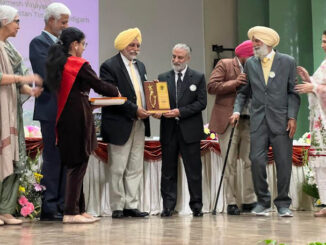
    A view of the dais (from left to right) Dr Balwinder Singh Dhaliwal, Mr Ramesh Vinayak, Dr Satbir Singh Gosal and Dr Amarjit Singh Hayer

    Professor Hazara Singh, a perfectionist, would keep us amused by narrating his encounters with some of the freedom fighters. An ardent and committed follower of Shaheed-e-Azam Bhagat Singh, Professor Hazara Singh was a teacher of an altogether different genre. He would get his lectures typed – there were no computers those days – and give us copies.

    Ms Ramaninder Kaur Bhatia

    He was not only an excellent teacher but also a great motivator. He inculcated in his students the qualities of inquisitiveness and scientific temperament. He also religiously followed the progress of each of his students and would volunteer to help in case any one of us needed extra classes or help as two of us – myself and Mr Bhagwan Dass – came from a different system of education while PAU followed the American 4.0 grading system with weekly and monthly tests. We both had done our Bachelor of Journalism from Punjabi University, Patiala, while our other class fellow, AP Singh, an excellent photo artist, was a PAU graduate.

    Meeting my batchmate AP Singh was gratifying. Dr Amarjit Singh Hayer, who also taught English to students of the subsequent batches, has been the spirit behind organizing the reunion. Dr Amarjit Singh Hayer, now settled in Mohali, misses no opportunity to stay in touch with all passouts from the Department.

    Dr Amajit Singh Hayer

    The Vice-Chancellor of PAU, Dr  Satbir Singh Gosal, must have cancelled all his appointments to spend the entire day with the alumni. He not only participated in all events but also interacted freely with all old students, applauding the role media has been playing in the dissemination of information, thus bridging the gap between the research institutions and farmers, the ultimate beneficiaries, and the agrarian societies.

    Also in attendance were the Dean of College of Basic Sciences, Dr Kiran Bains, Acting Director of Communications Centre, Dr T.S. Riar, Prof (retd) Dr Amarjit Singh Hayer, Dr Sheetal Thapar, Head of Department of Journalism. Dr Hina Goyal played master of ceremonies while students of the Department volunteered to make the day memorable for all of us.

    Three of the outstanding alumni – Ramesh Vinayak, Executive Editor, Hindustan Times; Ms Ramaninder Bhatia, a former senior Assistant Editor of Times of India; and Dr Balwinder Singh, who had a stint as a teacher in the Department, before moving to Canada, where he runs Radio Sargam – made excellent presentations on the theme of the reunion “Reaping Stories: Sowing Ideas.”

    Among the alumni were senior journalists, including senior Tribune staffer  Umesh Dewan, Jai Raj Kajla (ex-Commissioner, Income Tax),  Kanwal Preet Kaur,  Bandeep Singh, Brampton-based Satbir Singh, Amarpal Singh (Ludhiana Head of  Daily Savera), Anupam Bhagria, and an accomplished teacher of journalism Kamlesh Singh Duggal, besides others.

    Dr Kiran Bains, Dean, College of Basic Sciences

    To make the event memorable, all guests signed a “Heritage tree” while students regaled the audience with some popular Punjabi folk numbers to give a musical finish to the day-long event.

    Other than the “Reaping Stories: Sowing Ideas” event, I had a chance to meet several old timers and friends in sports like Gurmangal Dass, who, after his degree in Engineering, returned to his village Rurka in the Doab. In the last 30 years, he has not only taken his native village to the world soccer map through his football club – YFC  – but also got it on a select list of five cities that run the Generation Amazing programme to empower youth. Rurka is the only center in India.

    Meeting Gurmangal Dass after a long gap was both illuminating and rewarding.  He is perhaps the first person in the subcontinent to talk about the “Right to Sports” and believes education through sports is the best way to take a nation forward.

    Starting with a modest budget of Rs one lakh, YFC Rurka Kalan now spends Rs 18 crore a year in its endeavor to produce world leaders of tomorrow.

    Gurmanagl Dass with Nassar Ali Khori

    “We are thrilled to deepen our partnership with YFC Rurka Kalan, building on the strong foundation, we established in 2017, remarked Nasser Ali Khori, Executive Director of Generation Amazing, who was present at the inauguration of the GA Multi Sports Facility at Rurka Kalan that includes football pitch, synthetic courts for basketball, tennis, volleyball and picket ball as well as a multi-activity hall and a modern 50-station gym. Additionally, the facility features a 200-seat auditorium for community events and training sessions. It has on-site accommodation and dining facilities where, at present, 60-odd athletes, including soccer players and wrestlers, are training under the watchful eyes of qualified trainers.

    Developed with the support of the Generation Amazing Foundation, the Supreme Committee for Delivery and Legacy of the FIFA World Cup 2022, and the contributions from non-resident Indians, the US$ 1 million project will provide free access to children and youth in the community.

    The backbone of this project has been the support it has been getting from the overseas Indian community. Gurmangal Dass recalls how his first trip to England helped him to collect £30,000 for his Youth Football Club (YFC) Rurka Kalan, the forerunner to the newly launched Generation Amazing programme.

    Talking about the new facility,  Gurmangal Dass says that the “inauguration of this facility is a proud moment for the YFC Rurka Kalan and the entire community. I can say that this facility is more than just a sports complex – it is a beacon of hope and opportunity for thousands of young people in Punjab.

    Yes, weaning youth away from the menace of drugs, sports is the best way.

    Among others, he is supported in his endeavor by his college classmate, Amandeep Singh Marwaha,  and his elder brother Rajeev Rattan, also known as Tony Sandhu.

    Those who have been lending all support from overseas include Balbir Singh Sandhu, ex-Deputy Mayor of Derby, and Ravinder Singh Sandhu, past District Governor, Coventry.

    It is time to stand by people like Gurmangal Dass in their endeavor to put disenchanted Punjabi youth back on track to progress and prosperity. 

    (Prabhjot Singh is a Toronto-based award-winning independent journalist. He was celebrated by AIPS, the international body of sports journalists, for covering ten Olympics, at its centennial celebrations held at UNESCO Centre in Paris during the 2024 Olympic Games. Besides, he has written extensively about business and the financial markets, the health industry, the public and private sectors, and aviation. He has worked as a political reporter besides covering Sikh and Punjab politics. He is particularly interested in Indian Diaspora and Sikh Diaspora in particular. His work has also appeared in various international and national newspapers, magazines, and journals. He can be reached at prabhjot416@gmail.com)

  • Doing Iftar hopping I learned about growing communal amity

    Doing Iftar hopping I learned about growing communal amity

    By Parveen Chopra

    To mingle with the Muslims today, you don’t have to wear a skull cap and sport Solzhenitsyn type of facial hair. Just get invited to an Iftar, the fast-breaking evening meal during the month of Ramadan! I did precisely that and attended four Iftar parties on Long Island in New York. As a bonus, I can tell a happy story of increasing communal amity.

    My last Iftar on April 18 was hosted by the Town of Hempstead, presided by Supervisor Don Clavin. According to Zahid Syed, the Town’s Community Affairs Executive Director, as many as 800 people showed up. They included non-Muslims like me, a Hindu, and fellow editor Prof Indrajit Singh Saluja, a Sikh, all mainly hailing from the Indian subcontinent. Zahid claims that the first Iftar in New York held 25 years ago in City Hall was at his behest. This year, he has noticed quite a few first Iftars, including at the Town of North Hempstead, and the District Attorney’s office in Suffolk County.

    Zahid Syed, who is organizing a Vaisakhi event next, is heartened to see people celebrating other communities’ festivals, signifying interfaith harmony. “The participation by politicians of all stripes is a recognition of the demographic changes,” he states

    Before the Iftar meal, Imam Kashif Aziz, associated with the mosques in Valley Stream and Elmont, explained the significance of Ramadan, the holiest month in the Islamic calendar when the Quran began revealing to Prophet Muhammed (PBUH). Believers are told to do charity work and feed the hungry this month. Fasting is to practice self-control and earn taqwa (piety/God consciousness). My Iftar hopping started because having founded ALotusInTheMud.com a few months ago, I noticed that my Rolodex – even Facebook friends list – was not diverse enough. To make amends, I approached Arvind Vora who has been active in the interfaith movement for over 30 years. He took me along to many events and got me invited to Iftars.

    My first Iftar was at the Amityville mosque of Ahmadiyyas, a sect of Islam. Rizwan Ahmad Alladin, its President, graciously invited me to introduce my Lotus magazine to the assembled men (women were in the partitioned section of the hall). The buffet was typical for South Asian gatherings (except for the alcohol, the prohibition of which is followed strictly by an overwhelming majority of Muslims till today). There was chicken biryani, goat meat, and even matter paneer, especially added to the menu for Mr Vora, a Jain.

    The Iftar I enjoyed the most was hosted by Yavuz Girdap at his home in Saint James, NY. He is from Turkey and a franchisee of Moda Foods, importer of Turkish delicacies like baklava, which is going mainstream. The meal planned by his wife, Hafza, followed to the T what a doctor would have ordered. Lentil soup and salad, followed by brown rice, pasta, lean meat, and baklavas for dessert. All at a leisurely pace as conversation flowed and we had our laughter therapy thanks mainly to guest Nora Saleem’s cascade of cat stories.

    A diverse group of guests at the Iftar hosted by Sadri Altinok (second from right), President of the Turkish Cultural Center Long Island. (Photo by Parveen Chopra)

    One guest at Yavuz’s was Sadri Altinok, President of the Turkish Cultural Center in Ronkonkoma. So, I promptly got invited to their upcoming Iftar. No segregation of the sexes there. Sadri Altinok honored some of those who donated to Turkey earthquake relief and Suffolk County officers for their service. Mr Vora told me later that for decades the Turkish community in the US has been at the forefront of soft diplomacy of outreach to other communities and lawmakers.

    A guest I met at the Turkish Cultural Center was Azra Dhar, President of Pacoli (Pakistani American Community of Long Island). She said that earlier when the Muslim community was smaller, people hosted Iftar parties at home with friends and family or went to the mosque. Now with a growing community and acceptance of diversity, you see Iftar gatherings at the official seats of government. “After years of tightness, I am happy to see this acceptance,” she commented.

    While Azra Dhar attended over a dozen Iftars this Ramadan, Tahira Sharif, a fellow Pacolian who started Ali Hasnain Foundation for philanthropic work in Pakistan, has also attended as many. Feeding a fasting person brings Sadaqa from God, she says, and that is how arose the tradition of people, organizations, mosques, and the community holding Iftars. While Prophet Muhammed (PBUH) is said to break his fast only with a few dates and water, Tahira says it is difficult to resist good food after the rozas from dawn to dusk without even a drop of water.

    My neighbor, Rehana Siddiqui, who recently went to do her first Umra pilgrimage in Mecca, has followed prayers more devoutly this Ramadan and watched what she was eating to break the fast. She reports losing six pounds – and looks it.

    Religious fasting, however good for your spiritual well-being, should not turn into feasting in these times of sedentary lifestyles when we all have to watch our diet. Done right, Ramadan can detox your body as well, not just the mind and soul. Dr Irfan Ahmad Alladin, a pain management expert, quotes Prophet Muhammed (Peace Be Upon Him) no less: “We should consume only to the point that one-third of the stomach is occupied with solid, one-third is occupied with liquid, and one-third is left empty.” Link to his article: https://alotusinthemud.com/moderation-the-right-way-to-ramadan-fasting/

    (Parveen Chopra is the founder and editor of ALotusInTheMud.com, a wellness and spirituality web magazine based in New York)